
Report Feature
Open Source Intelligence Market Trends and Forecast
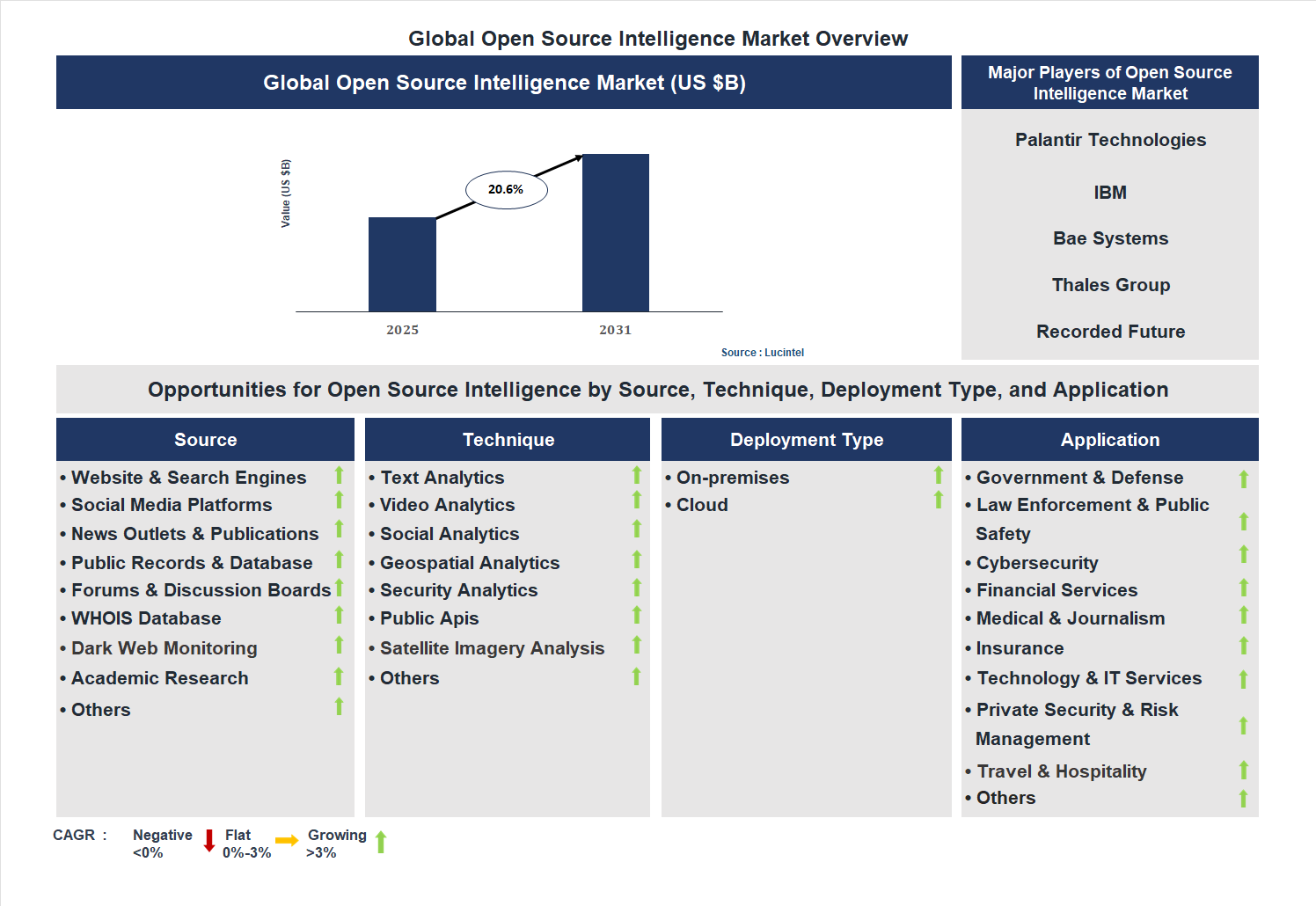
The future of the global open source intelligence market looks promising with opportunities in the government & defense, law enforcement & public safety, cybersecurity, financial service, medical & journalism, insurance, technology & it service, private security & risk management, and travel & hospitality markets. The global open source intelligence market is expected to grow with a CAGR of 20.6% from 2025 to 2031. The major drivers for this market are the increasing demand for real time threat intelligence, the rising adoption of data driven security analytics, and the growing use of public digital information sources.• Lucintel forecasts that, within the source category, website & search engine is expected to witness the highest growth over the forecast period.
• Within the application category, government & defense is expected to witness the highest growth.
• In terms of region, APAC is expected to witness the highest growth over the forecast period. Gain valuable insights for your business decisions with our comprehensive 150+ page report. Sample figures with some insights are shown below.
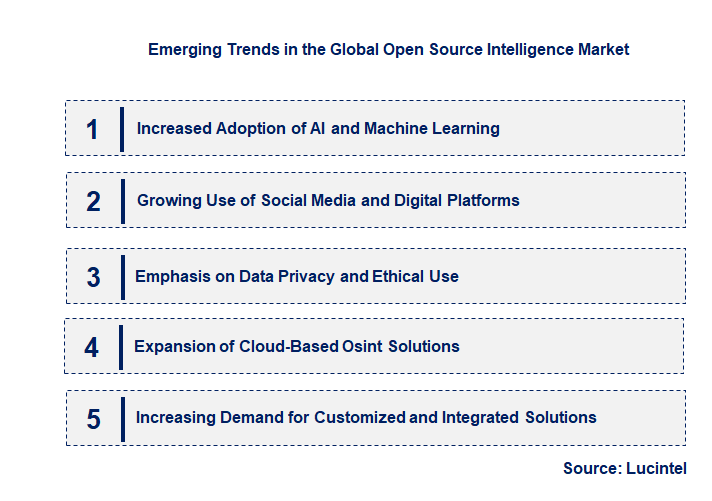
Emerging Trends in the Open Source Intelligence Market
The open source intelligence market is experiencing rapid growth driven by technological advancements, increasing security concerns, and the need for cost-effective intelligence solutions. Organizations across government, corporate, and private sectors are leveraging open source data to enhance decision-making, threat detection, and competitive intelligence. As digital footprints expand and data sources multiply, the market is evolving to meet the demands for faster, more accurate, and ethically sourced intelligence. These developments are transforming how organizations gather, analyze, and utilize open source information, leading to more proactive and informed strategies in various sectors.• Increased Adoption of AI and Machine Learning: The integration of AI and ML algorithms in OSINT tools enhances data processing capabilities, enabling faster and more accurate analysis of vast open source data. These technologies facilitate pattern recognition, sentiment analysis, and predictive insights, which are crucial for threat detection and strategic planning. As AI becomes more sophisticated, OSINT solutions are becoming more automated, reducing manual effort and increasing efficiency. This trend is expanding the scope of OSINT applications and improving the quality of intelligence gathered, making it indispensable for modern security and business operations.
• Growing Use of Social Media and Digital Platforms: Social media platforms and online forums are becoming primary sources of real-time information. Organizations are increasingly monitoring these platforms to gather insights on public sentiment, emerging threats, and market trends. Advanced social media analytics tools enable users to filter relevant data, identify influencers, and track misinformation. This trend enhances situational awareness and allows for rapid response to crises or opportunities. The proliferation of digital platforms has made social media a vital component of OSINT strategies, significantly expanding the volume and diversity of accessible data.
• Emphasis on Data Privacy and Ethical Use: As OSINT relies heavily on publicly available data, there is a growing focus on ethical considerations and privacy regulations. Organizations are adopting best practices to ensure compliance with laws such as GDPR and CCPA, avoiding intrusive or illegal data collection methods. Ethical guidelines are being integrated into OSINT workflows to balance intelligence needs with respect for individual privacy rights. This trend fosters trust and legitimacy in OSINT activities, encouraging responsible data use while maintaining effectiveness in intelligence gathering.
• Expansion of Cloud-Based OSINT Solutions: Cloud technology is transforming OSINT by providing scalable, flexible, and cost-effective platforms for data collection and analysis. Cloud-based solutions enable real-time data access, collaboration across teams, and easier integration with other cybersecurity and intelligence tools. This trend reduces infrastructure costs and enhances agility, allowing organizations to adapt quickly to emerging threats or opportunities. The shift to cloud-based OSINT is also facilitating remote work and global collaboration, broadening the reach and capabilities of intelligence operations.
• Increasing Demand for Customized and Integrated Solutions: Organizations are seeking tailored OSINT tools that address specific industry needs and integrate seamlessly with existing systems. Customization allows for targeted data collection, specialized analytics, and user-friendly interfaces. Integration with other cybersecurity, CRM, or analytics platforms enhances overall operational efficiency. This trend reflects a move away from generic solutions towards more strategic, industry-specific offerings that deliver actionable insights. It is driving innovation in product development and fostering a competitive market landscape focused on personalized intelligence solutions. In summary, these trends are reshaping the OSINT market by making intelligence gathering more automated, real-time, ethical, scalable, and tailored. They are enabling organizations to respond more swiftly to threats and opportunities, improve decision-making accuracy, and operate within legal and ethical boundaries. As these developments continue, the OSINT market is poised for further innovation, expanding its role as a critical component of modern security and business strategies.
Recent Development in the Open Source Intelligence Market
The open source intelligence market has experienced significant growth driven by increasing demand for intelligence gathering across government, corporate, and security sectors. Advances in technology, rising cyber threats, and the need for cost-effective intelligence solutions have propelled this market forward. Recent developments reflect a shift towards more sophisticated, automated, and integrated OSINT tools that enhance data collection, analysis, and threat detection capabilities. These innovations are transforming how organizations monitor, analyze, and respond to global security challenges. The following key developments highlight the current trajectory and future potential of the OSINT Market.• Integration of Artificial Intelligence (AI): AI-powered OSINT tools now enable faster and more accurate data analysis, reducing manual effort and increasing threat detection efficiency. This development enhances real-time intelligence capabilities, allowing organizations to respond swiftly to emerging threats and trends.
• Expansion of Data Sources: The market has seen a surge in the integration of diverse data sources, including social media, dark web, and IoT devices. This broadens the scope of intelligence gathering, providing more comprehensive insights and improving situational awareness.
• Cloud-Based OSINT Solutions: Cloud technology adoption has made OSINT tools more accessible and scalable. Cloud-based platforms facilitate remote access, collaboration, and real-time updates, which are crucial for global operations and rapid decision-making.
• Enhanced Data Privacy and Security Measures: As OSINT involves extensive data collection, recent developments focus on strengthening privacy and security protocols. These measures ensure compliance with regulations and protect sensitive information from cyber threats.
• Increased Adoption of Automation and Machine Learning: Automation in data collection and analysis has accelerated, reducing human error and increasing efficiency. Machine learning algorithms now identify patterns and anomalies more effectively, improving predictive capabilities. In summary, these developments are significantly transforming the OSINT Market by making intelligence gathering more efficient, comprehensive, and secure. The integration of AI, expanded data sources, cloud solutions, privacy enhancements, and automation are collectively driving market growth and enabling organizations to better anticipate and respond to global security challenges.
Strategic Growth Opportunities in the Open Source Intelligence Market
The open source intelligence market is experiencing rapid growth driven by increasing demand for actionable intelligence across various sectors. As organizations seek cost-effective and efficient ways to gather information, OSINT tools and techniques are becoming essential. Key applications such as cybersecurity, law enforcement, corporate security, competitive intelligence, and disaster response are expanding their use of OSINT solutions. These developments are shaping the future landscape of intelligence gathering, offering new opportunities for innovation and market expansion. Understanding these growth opportunities helps stakeholders capitalize on emerging trends and enhance their strategic positioning in this dynamic market.• Cybersecurity: The rise in cyber threats has heightened the need for OSINT in cybersecurity. Organizations utilize OSINT tools to identify vulnerabilities, monitor threat actors, and gather intelligence on cyberattacks. This application enhances proactive defense strategies, reduces response times, and improves overall security posture, making OSINT indispensable in safeguarding digital assets.
• Law Enforcement: Law enforcement agencies leverage OSINT for criminal investigations, surveillance, and threat assessment. By analyzing publicly available data, agencies can track criminal activities, identify suspects, and prevent crimes more effectively. This application improves investigative efficiency and supports national security efforts, leading to safer communities.
• Corporate Security: Companies use OSINT to monitor brand reputation, detect insider threats, and conduct due diligence. OSINT helps organizations identify potential risks from competitors or malicious actors, enabling proactive measures. This application strengthens corporate resilience and supports strategic decision-making.
• Competitive Intelligence: Businesses employ OSINT to analyze market trends, monitor competitors, and identify new opportunities. Gathering open-source data allows companies to make informed strategic moves, adapt to market changes, and gain a competitive edge. This application drives innovation and growth in highly competitive industries.
• Disaster Response: OSINT plays a crucial role in disaster management by providing real-time information on affected areas, infrastructure status, and resource needs. Emergency responders utilize open-source data to coordinate efforts, allocate resources efficiently, and save lives. This application enhances response effectiveness and resilience in crisis situations. In summary, these key growth opportunities in the OSINT market are significantly impacting the industry by enabling more efficient, cost-effective, and timely intelligence gathering across diverse applications. As these sectors continue to evolve, the demand for advanced OSINT solutions is expected to accelerate, fostering innovation and expanding market reach.
Open Source Intelligence Market Driver and Challenges
The open source intelligence market is influenced by a variety of technological, economic, and regulatory factors. Rapid advancements in data collection and analysis tools, increasing cyber threats, and the need for cost-effective intelligence solutions are key drivers. Additionally, evolving privacy laws and data protection regulations pose significant challenges. The markets growth is also shaped by the rising adoption of AI and machine learning to enhance intelligence gathering. However, issues such as data privacy concerns, regulatory compliance, and technological complexities present hurdles. Understanding these drivers and challenges is essential for stakeholders aiming to capitalize on opportunities and mitigate risks within the OSINT landscape. The factors responsible for driving the open source intelligence market include:• Technological Advancements: The integration of AI, machine learning, and big data analytics has revolutionized OSINT capabilities. These technologies enable faster, more accurate data processing from diverse sources, including social media, forums, and public records. As organizations seek real-time insights for cybersecurity, national security, and competitive intelligence, the demand for advanced tools increases. Continuous innovation in data mining and visualization techniques further enhances the efficiency and scope of OSINT solutions, making them indispensable for modern intelligence operations.
• Growing Cybersecurity Threats: The surge in cyberattacks, data breaches, and digital espionage has heightened the need for robust intelligence gathering. Organizations and governments are investing heavily in OSINT to identify vulnerabilities, monitor malicious activities, and respond proactively. The increasing sophistication of cyber threats necessitates comprehensive open-source data analysis, which drives market growth. As cyber risks evolve, so does the reliance on OSINT to provide timely, actionable insights, making it a critical component of cybersecurity strategies worldwide.
• Increasing Adoption Across Sectors: Various industries, including defense, law enforcement, corporate security, and financial services, are adopting OSINT solutions to enhance decision-making. Governments utilize OSINT for national security and counter-terrorism, while private firms leverage it for market intelligence and risk management. The versatility and cost-effectiveness of open-source data make it attractive across sectors. As organizations recognize the value of open-source insights, market penetration expands, fueling growth and innovation in OSINT technologies.
• Regulatory and Privacy Concerns: Evolving data privacy laws, such as GDPR and CCPA, influence how OSINT data is collected, stored, and used. Organizations must navigate complex legal frameworks to ensure compliance, which can limit data access and increase operational costs. These regulations also raise ethical questions about data usage, impacting market development. Companies investing in OSINT solutions need to adapt their practices to balance intelligence needs with legal obligations, influencing the pace and nature of market expansion.
• Rising Demand for Cost-Effective Intelligence Solutions: Budget constraints across public and private sectors drive the demand for affordable yet effective OSINT tools. Open-source data offers a cost-efficient alternative to traditional intelligence methods, enabling organizations to gather valuable insights without significant expenditure. The proliferation of cloud-based platforms and open-source software further reduces costs and enhances accessibility. This trend encourages widespread adoption, especially among small and medium-sized enterprises, thereby expanding the market and fostering innovation in affordable OSINT solutions. The challenges facing this Market include:
• Data Privacy and Ethical Issues: The collection and analysis of open-source data often raise privacy concerns and ethical dilemmas. Unauthorized data scraping or monitoring can infringe on individual privacy rights, leading to legal repercussions and reputational damage. Organizations must implement strict compliance measures and ethical guidelines, which can complicate operations and limit data sources. Balancing the need for comprehensive intelligence with respect for privacy remains a significant challenge, potentially hindering market growth and innovation.
• Regulatory Compliance and Legal Barriers: The dynamic landscape of data protection laws creates uncertainties for OSINT providers. Variations in regulations across regions complicate data collection and sharing practices, increasing compliance costs. Non-compliance can result in hefty fines and legal actions, discouraging investment and innovation. Navigating these legal complexities requires substantial resources and expertise, which can be a barrier for smaller firms and limit market expansion.
• Technological Complexity and Data Overload: The vast volume of open-source data presents challenges in filtering relevant information from noise. Advanced analytical tools are required to process and interpret data effectively, demanding significant technical expertise and infrastructure. Additionally, rapid technological changes necessitate continuous updates and investments, which can be resource-intensive. Managing data overload while maintaining accuracy and timeliness remains a critical challenge for OSINT providers, impacting their ability to deliver actionable insights efficiently. In summary, the open source intelligence market is driven by technological innovations, increasing cyber threats, sectoral adoption, regulatory developments, and cost considerations. However, it faces challenges related to privacy concerns, legal compliance, and technological complexities. These factors collectively shape the markets trajectory, requiring stakeholders to innovate responsibly and adapt to evolving legal and technological landscapes. The interplay of drivers and challenges will determine the pace of growth and the nature of future opportunities within the OSINT domain.
List of Open Source Intelligence Companies
Companies in the market compete on the basis of product quality offered. Major players in this market focus on expanding their manufacturing facilities, R&D investments, infrastructural development, and leverage integration opportunities across the value chain. With these strategies open source intelligence companies cater increasing demand, ensure competitive effectiveness, develop innovative products & technologies, reduce production costs, and expand their customer base. Some of the open source intelligence companies profiled in this report include-• Palantir Technologies
• IBM
• Bae Systems
• Thales Group
• Recorded Future
• Verint Systems
• Cybint
Open Source Intelligence Market by Segment
The study includes a forecast for the global open source intelligence market by source, technique, deployment type, application, and region.Open Source Intelligence Market by Source [Value from 2019 to 2031]:
• Website & Search Engines
• Social Media Platforms
• News Outlets & Publications
• Public Records & Database
• Forums & Discussion Boards
• WHOIS Database
• Dark Web Monitoring
• Academic Research
• Others
Open Source Intelligence Market by Technique [Value from 2019 to 2031]:
• Text Analytics
• Video Analytics
• Social Analytics
• Geospatial Analytics
• Security Analytics
• Public Apis
• Satellite Imagery Analysis
• Others
Open Source Intelligence Market by Deployment Type [Value from 2019 to 2031]:
• On-premises
• Cloud
Open Source Intelligence Market by Application [Value from 2019 to 2031]:
• Government & Defense
• Law Enforcement & Public Safety
• Cybersecurity
• Financial Services
• Medical & Journalism
• Insurance
• Technology & IT Services
• Private Security & Risk Management
• Travel & Hospitality
• Others
Open Source Intelligence Market by Region [Value from 2019 to 2031]:
• North America
• Europe
• Asia Pacific
• The Rest of the World
Country Wise Outlook for the Open Source Intelligence Market
The open source intelligence market has experienced significant growth driven by increasing demand for cybersecurity, national security, and corporate intelligence. Advances in technology, such as artificial intelligence and machine learning, have enhanced data collection and analysis capabilities. Governments and private sectors are investing heavily to improve their OSINT tools to better detect threats, monitor activities, and gather actionable insights. The markets evolution reflects a shift towards more sophisticated, automated, and real-time intelligence solutions, with emerging trends focusing on data privacy, ethical considerations, and cross-border collaboration. These developments are shaping the future landscape of OSINT across major economies.• United States: The US market has seen substantial investments in AI-powered OSINT tools, with increased adoption by federal agencies for national security and cybersecurity. Private firms are also expanding their capabilities, integrating advanced analytics and automation to enhance threat detection and intelligence gathering. Regulatory frameworks are evolving to address data privacy concerns while maintaining operational efficiency.
• China: China is rapidly advancing its OSINT capabilities, focusing on integrating big data analytics and AI to strengthen surveillance and monitoring systems. The government emphasizes domestic security and social stability, investing heavily in developing indigenous OSINT solutions. Cross-sector collaborations are increasing to enhance data collection and processing efficiency.
• Germany: Germanys OSINT market is characterized by a focus on data privacy and ethical use of intelligence. The country is investing in secure, privacy-compliant tools for law enforcement and intelligence agencies. There is also a growing emphasis on integrating OSINT with traditional intelligence methods to improve national security without compromising privacy standards.
• India: India is witnessing rapid growth in OSINT adoption, driven by increasing cyber threats and the need for border security. The government is investing in AI and machine learning-based solutions to enhance real-time data analysis. Public-private partnerships are emerging to develop cost-effective and scalable OSINT tools tailored to regional security needs.
• Japan: Japan is focusing on advanced technological integration in OSINT, including AI, robotics, and big data analytics. The country aims to strengthen its cybersecurity infrastructure and counter regional threats. Collaboration between government agencies and private tech firms is increasing to develop innovative, secure, and efficient intelligence solutions.

Features of the Global Open Source Intelligence Market
Market Size Estimates: Open source intelligence market size estimation in terms of value ($B). Trend and Forecast Analysis: Market trends (2019 to 2024) and forecast (2025 to 2031) by various segments and regions. Segmentation Analysis: Open source intelligence market size by various segments, such as by source, technique, deployment type, application, and region in terms of value ($B). Regional Analysis: Open source intelligence market breakdown by North America, Europe, Asia Pacific, and Rest of the World. Growth Opportunities: Analysis of growth opportunities in different sources, techniques, deployment types, applications, and regions for the open source intelligence market. Strategic Analysis: This includes M&A, new product development, and competitive landscape of the open source intelligence market. Analysis of competitive intensity of the industry based on Porter’s Five Forces model.
FAQ
Q1. What is the growth forecast for open source intelligence market? Answer: The global open source intelligence market is expected to grow with a CAGR of 20.6% from 2025 to 2031. Q2. What are the major drivers influencing the growth of the open source intelligence market? Answer: The major drivers for this market are the increasing demand for real time threat intelligence, the rising adoption of data driven security analytics, and the growing use of public digital information sources. Q3. What are the major segments for open source intelligence market? Answer: The future of the open source intelligence market looks promising with opportunities in the government & defense, law enforcement & public safety, cybersecurity, financial service, medical & journalism, insurance, technology & it service, private security & risk management, and travel & hospitality markets. Q4. Who are the key open source intelligence market companies? Answer: Some of the key open source intelligence companies are as follows:• Palantir Technologies
• IBM
• Bae Systems
• Thales Group
• Recorded Future
• Verint Systems
• Cybint Q5. Which open source intelligence market segment will be the largest in future? Answer: Lucintel forecasts that, within the source category, website & search engine is expected to witness the highest growth over the forecast period. Q6. In open source intelligence market, which region is expected to be the largest in next 5 years? Answer: In terms of region, APAC is expected to witness the highest growth over the forecast period. Q7. Do we receive customization in this report? Answer: Yes, Lucintel provides 10% customization without any additional cost.
List of Figures
List of Tables
Methodology
- In-depth interviews of the major players in this market
- Detailed secondary research from competitors’ financial statements and published data
- Extensive searches of published works, market, and database information pertaining to industry news, company press releases, and customer intentions
- A compilation of the experiences, judgments, and insights of Lucintel’s professionals, who have analyzed and tracked this market over the years.


Buy Now
Choose a license that fits your team. Instant PDF delivery.
Prices exclude taxes. Instant delivery. Custom licensing available on request.
Key Questions
- • What are some of the most promising, high-growth opportunities for the open source intelligence market by source (website & search engines, social media platforms, news outlets & publications, public records & database, forums & discussion boards, WHOIS database, dark web monitoring, academic research, and others), technique (text analytics, video analytics, social analytics, geospatial analytics, security analytics, public APIs, satellite imagery analysis, and others), deployment type (on-premises and cloud), application (government & defense, law enforcement & public safety, cybersecurity, financial services, medical & journalism, insurance, technology & IT services, private security & risk management, travel & hospitality, and others), and region (North America, Europe, Asia Pacific, and the Rest of the World)?
- • Which segments will grow at a faster pace and why?
- • Which region will grow at a faster pace and why?
- • What are the key factors affecting market dynamics? What are the key challenges and business risks in this market?
- • What are the business risks and competitive threats in this market?
- • What are the emerging trends in this market and the reasons behind them?
- • What are some of the changing demands of customers in the market?
- • What are the new developments in the market? Which companies are leading these developments?
- • Who are the major players in this market? What strategic initiatives are key players pursuing for business growth?
- • What are some of the competing products in this market and how big of a threat do they pose for loss of market share by material or product substitution?
- • What M&A activity has occurred in the last 5 years and what has its impact been on the industry? For any questions related to Open Source Intelligence Market, Open Source Intelligence Market Size, Open Source Intelligence Market Growth, Open Source Intelligence Market Analysis, Open Source Intelligence Market Report, Open Source Intelligence Market Share, Open Source Intelligence Market Trends, Open Source Intelligence Market Forecast, Open Source Intelligence Companies, write Lucintel analyst at email: helpdesk@lucintel.com. We will be glad to get back to you soon.


