
Report Feature
In-Store Drones Market Trends and Forecast
The technologies behind in-store drones technology have evolved significantly over the past few years. Wherein, the evolution shifted from manual drone navigation to the AI-driven autonomous operation. From the changes, the utilization of machine learning algorithms in ensuring accurate inventory management and analysis of real-time data would be included. The capability of drones in performing just imaging has been shifted towards sensor fusion for advanced obstacle detection and smoother indoor navigation in stores, thereby enabling companies to optimize store operations, boost efficiency, and raise the customer experience.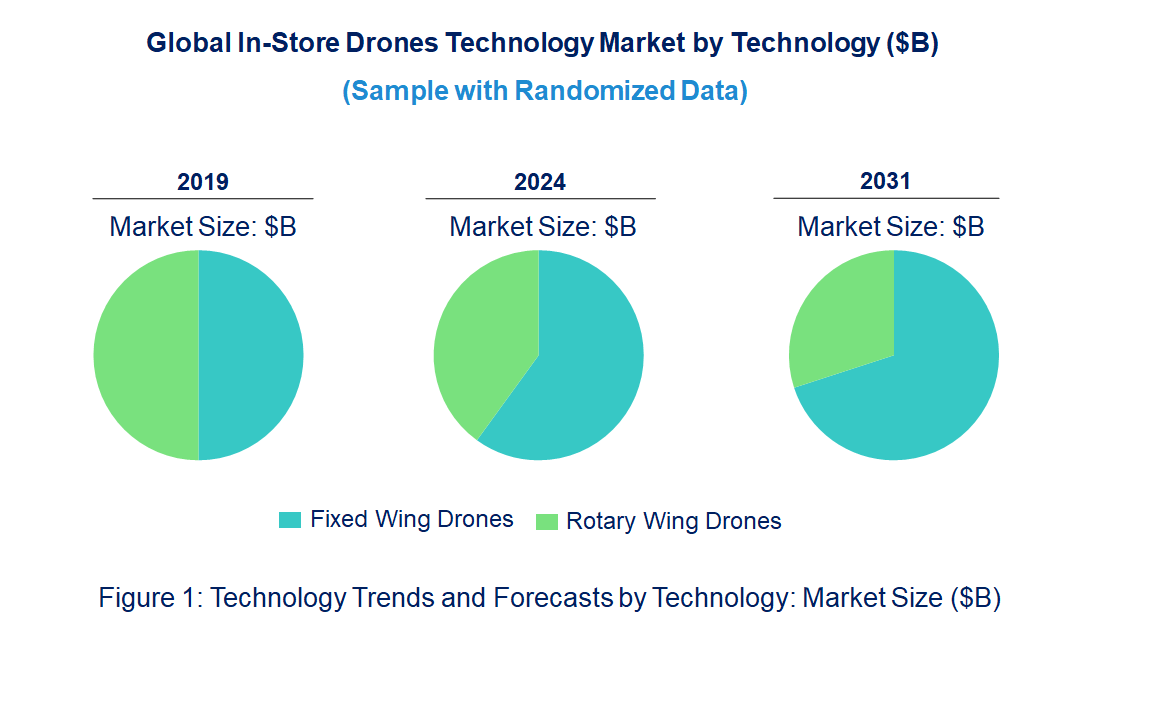
Emerging Trends in the In-Store Drones Market
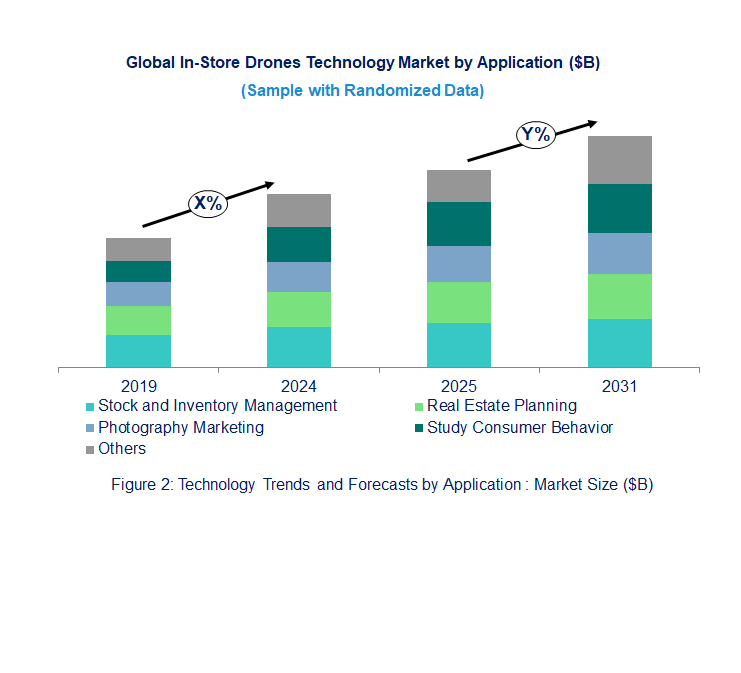
The rapid development of in-store drone technology has opened up transformative possibilities for retail operations. They are becoming an integral element for the efficient management of stock, improved customer service, and reduction of operational costs. Here are the trends shaping this industry:• AI-Driven Inventory Management: Advanced artificial intelligence algorithms are now being embedded into drones for the automatic tracking of inventories with accuracy. It reduces human error and accelerates stock audits to enable real-time updates on inventory.
• Better Indoor Navigation: LiDAR and computer vision are emerging technologies that can better navigate drones in complex indoor environments. The result is that the operations are collision-free and smooth in a crowded store layout.
• Multi-Functionality: Drones are becoming multifunctional, scanning barcodes, capturing video surveillance, and delivering products within stores, which increases operational efficiency and flexibility.
• Better Data Analysis: In-store drones can collect data in real time and report on customer behavior, shelf performance, and store layouts. This enables retailers to make data-driven decisions.
• Sustainability Integration: Focus areas in this aspect include eco-friendly drones powered by renewable sources of energy, as a result, reflecting the industry's focus on sustainability and reduction in carbon footprint through retail operations. The above trends together reflect a new paradigm shift in retail where in-store drones can become inevitable tools in smarter, more sustainable, and customer-centric store operations.
In-Store Drones Market : Industry Potential, Technological Development, and Compliance Considerations
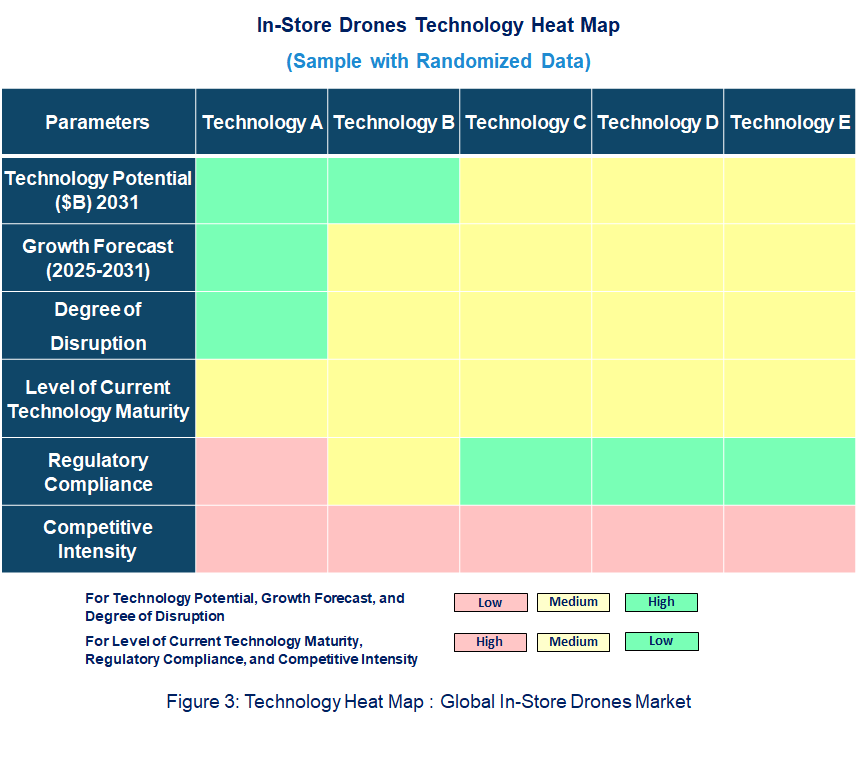
• Technological Potential: In-store drones are very capable of increasing operational efficiency by automating tasks such as scanning inventories, replenishing the shelves, and positioning products. Retailers can thus track inventories in real-time and have better stock control, reduced wastage, and minimal human interference. Such drones also allow for analytics-driven decision-making, with insights into sales trends and customer preferences.
• Degree of Disruption: This is huge in terms of disruption because the drones replaced such a huge manual inventory checking and shelf management process, which was tedious and error-prone. Cost savings, operational efficiency, and faster workflow all come through automation brought by drones, which cut directly into labor requirements and reduce operational expenses.
• Current Technology Maturity Level: In-store drone technology has matured fast and reached a new level with its mature elements, including computer vision and LiDAR. On the other hand, fully integrating these drones into the large retail environment remains under development.
• Regulatory Compliance: In-store drones revolutionize retail operations, providing much-needed efficient solutions concerning inventory management, logistics, and customer service. The combined integration of robotics, AI, and computer vision unlocks this vast potential in making faster and more streamlined workflows as intelligent as possible.
Recent Technological development in In-Store Drones Market by Key Players
In-store drone technology is revolutionizing retail operations through the streamlining of inventory management, logistics, and operational efficiency. Some of the leading companies that are spearheading this area include Amazon, FedEx, Microsoft, Apple, IBM, General Electric, and SZ DJI Technology. These companies are combining robotics, AI, and computer vision to create smarter, faster, and more cost-effective retail environments. Such developments are changing the in-store operations, reducing labor costs, and ensuring real-time inventory accuracy.• Amazon: Amazon has invested heavily in in-store drones to optimize warehouse and retail operations. Their drones are equipped with advanced computer vision and AI for real-time inventory tracking and shelf replenishment, ensuring quick and accurate stock management.
• FedEx Corporation: FedEx is using in-store drones to enhance delivery logistics and in-store operations. Their technology focuses on parcel sorting and distribution automation, significantly reducing operational time and enhancing efficiency within large retail and warehouse spaces.
• Microsoft Corporation: Microsoft is combining with retail partners to deliver in-store drone technologies. The company works on actual data analytics with computer vision that improves stock tracking and delivers enhanced customer experiences in retail environments.
• Apple: In-store drone technologies are currently being explored for better retail product placement and more precise in-store analytics through Apple. This integration includes the use of augmented reality and computer vision technologies to make its retail experience far more dynamic and interactive.
• IBM: IBM integrates store drones with advanced analytics and AI, optimizing shelf space and in-store inventory. Their product ensures accurate product placement with predictive insights that eliminate out-of-stock scenarios.
• General Electric Company: GE integrates in-store drone technology with sensor capability and IoT, optimizing energy efficiency and ensuring environmental controls of large retail spaces for seamless operations.
• SZ DJI Technology: DJI has developed agile, compact drones designed for warehouse and retail environments. Its drones provide high-precision inventory scanning and monitoring with real-time updates and operational efficiency. These companies are pushing the boundaries of in-store drone technology, driving automation, enhancing operational intelligence, and ensuring cost-efficiency, ultimately reshaping the landscape of retail logistics and inventory management.
In-Store Drones Market Driver and Challenges
In-store drones are transforming retail operations, making processes more efficient, and redesigning logistics and inventory management. Companies are embracing drone technology to make their business operations more streamlined, save on costs, and better the satisfaction of customers. Challenges persist, though - complexity in technology, constraints of regulations, and problems in integration. The factors responsible for driving the in-store drones market include:• Real-time Inventory Management: In-store drones, equipped with advanced sensors and computer vision, can accurately track inventory in real-time, thereby reducing stock discrepancies and ensuring that products are available. This will result in more efficient operations and a lower risk of out-of-stock items.
• Improved Delivery and Logistics Efficiency: Drones may enable rapid delivery within a store and distribute parcels within the shortest delivery time. Their access to narrow spaces makes them more suitable for rapid and effective movement of goods.
• Cost Reduction through Automation: Automation of repetitive tasks like inventory scanning and shelf replenishment through drones reduces labor costs and operational costs since companies will be able to use their human resources effectively and efficiently.
• AI and Predictive Analytics Integration: Through the use of AI, in-store drones are able to analyze data, predict stock requirements, and optimize shelf space. It, therefore, enhances operational planning and reduces wastage and inefficiency.
• Scalability and Flexibility: Drones offer scalable solutions that fit different sizes of stores and retail environments. Companies can easily deploy drones in huge warehouses or small retail spaces, thus ensuring operational flexibility. Challenges
• Seamless Integration with In-Store Systems: In-store drones must integrate with existing inventory management systems, point-of-sale (POS) systems, and security infrastructures. Robotic middleware must bridge communication between the drone and these various systems, ensuring accurate data exchange and real-time updates. Ensuring compatibility and minimizing the complexity of integration across different platforms can be a significant hurdle for retailers.
• Navigation and Collision Avoidance in Dynamic Environments: In-store environments are dynamic, with constantly changing obstacles such as customers, employees, and store displays. Robotic middleware must enable drones to process sensor data, navigate the store efficiently, and avoid collisions in real-time. Ensuring smooth and reliable navigation in such complex environments while maintaining safety standards poses significant challenges for middleware solutions. These growth opportunities highlight how in-store drones are transforming retail operations by optimizing inventory management, logistics, and delivery systems. While there are still technological, logistical, and regulatory challenges, advancements in AI, sensor integration, and predictive analytics are driving efficiency and scalability, ultimately reshaping the future of retail technology.
List of In-Store Drones Companies
Companies in the market compete based on product quality offered. Major players in this market focus on expanding their manufacturing facilities, R&D investments, infrastructural development, and leverage integration opportunities across the value chain. With these strategies in-store drones companies cater to increasing demand, ensure competitive effectiveness, develop innovative products & technologies, reduce production costs, and expand their customer base. Some of the in-store drones companies profiled in this report include.• Amazon
• Fedex Corporation
• Microsoft Corporation
• Apple
• International Business Machines
• General Electric Company
In-Store Drones Market by Technology
• Technology Readiness and Key Applications: Fixed-wing drones are well-developed for long-range surveillance, agricultural monitoring, and large-scale environmental research, offering robust endurance and speed. Rotary-wing drones are highly adaptable, suitable for inventory scanning, warehouse operations, search-and-rescue missions, and urban deliveries. Fixed-wing drones rely on aerodynamic designs and efficient propulsion systems, while rotary drones prioritize maneuverability and stability. Fixed-wing technology has reached maturity for outdoor large-area mapping, while rotary drones are increasingly used in the indoor and urban space. Both technologies are integrated with GPS, AI, advanced sensors, and machine learning and can be applied across logistics, defense, agriculture, retail, and mapping industries.
• Competitive Intensity and Regulatory Compliance: The competition in-store drones market is intense, with fixed-wing and rotary-wing drones each having distinct areas of dominance. Fixed-wing drones are often employed in industries requiring large-scale operations, such as agriculture, surveillance, and mapping. Rotary-wing drones dominate areas requiring flexibility and precision, like indoor retail environments or emergency response. Both types of drones are required to be used with full regulatory compliance with the aviation laws, safety standards, and operational guidelines as followed in different regions. Fixed-wing drones are usually restricted regarding altitude and coverage area, and rotary drones require strict adherence to proximity and spatial operation regulations.
• Disruption potential of different technologies: Fixed-wing drones and rotary-wing drones bring their unique disruption potential to the respective industries. Fixed-wing drones can provide long-endurance flight, high speed, and large coverage areas, which make them ideal for mapping and surveillance on a large scale. Rotary-wing drones provide excellent maneuverability, stability, and flexibility in indoor and tight-space operations. These two types of drones can replace the traditional methods of delivery, increase warehouse automation, and facilitate data collection in remote areas. Their integration with AI, machine learning, and advanced sensors enables smarter decision-making and predictive analytics. Moreover, their ability to operate autonomously significantly reduces the need for human intervention, lowering operational risks and costs.
In-Store Drones Market Trend and Forecast by Technology [Value from 2019 to 2031]:
• Fixed Wing Drones
• Rotary Wing Drones
In-Store Drones Market Trend and Forecast by Application [Value from 2019 to 2031]:
• Stock and Inventory Management
• Real Estate Planning
• Photography Marketing
• Study Consumer Behavior
• Others
In-Store Drones Market by Region [Value from 2019 to 2031]:
• North America
• Europe
• Asia Pacific
• The Rest of the World
• Latest Developments and Innovations in the In-Store Drones Technologies
• Companies / Ecosystems
• Strategic Opportunities by Technology Type
Features of the Global In-Store Drones Market
Market Size Estimates: In-store drones market size estimation in terms of ($B).Trend and Forecast Analysis: Market trends (2019 to 2024) and forecast (2025 to 2031) by various segments and regions.Segmentation Analysis: Technology trends in the global in-store drones market size by various segments, such as application and technology in terms of value and volume shipments.Regional Analysis: Technology trends in the global in-store drones market breakdown by North America, Europe, Asia Pacific, and the Rest of the World.Growth Opportunities: Analysis of growth opportunities in different application, technologies, and regions for technology trends in the global in-store drones market.Strategic Analysis: This includes M&A, new product development, and competitive landscape for technology trends in the global in-store drones market.Analysis of competitive intensity of the industry based on Porter’s Five Forces model.Table of Contents
Methodology
- In-depth interviews of the major players in this market
- Detailed secondary research from competitors’ financial statements and published data
- Extensive searches of published works, market, and database information pertaining to industry news, company press releases, and customer intentions
- A compilation of the experiences, judgments, and insights of Lucintel’s professionals, who have analyzed and tracked this market over the years.


Buy Now
Choose a license that fits your team. Instant PDF delivery.
Prices exclude taxes. Instant delivery. Custom licensing available on request.
Key Questions
- • What are some of the most promising potential, high-growth opportunities for the technology trends in the global in-store drones market by technology (fixed wing drones and rotary wing drones), application (stock and inventory management, real estate planning, photography marketing, study consumer behavior, and others), and region (North America, Europe, Asia Pacific, and the Rest of the World)?
- • Which technology segments will grow at a faster pace and why?
- • Which regions will grow at a faster pace and why?
- • What are the key factors affecting dynamics of different technology? What are the drivers and challenges of these technologies in the global in-store drones market?
- • What are the business risks and threats to the technology trends in the global in-store drones market?
- • What are the emerging trends in these technologies in the global in-store drones market and the reasons behind them?
- • Which technologies have potential of disruption in this market?
- • What are the new developments in the technology trends in the global in-store drones market? Which companies are leading these developments?
- • Who are the major players in technology trends in the global in-store drones market? What strategic initiatives are being implemented by key players for business growth?
- • What are strategic growth opportunities in this in-store drones technology space?
- • What M & A activities did take place in the last five years in technology trends in the global in-store drones market?


