Hair Care Product Market Report: Trends, Forecast and Competitive Analysis to 2035

Key data points: The market size in 2035 = $129 billion, growth forecast = 3.5% annually for the next 8 years. Scroll below to get more insights. This market report covers trends, opportunities and forecasts in hair care product market to 2035 by product type (shampoo, conditioner, hair colorants, hair styling products, and others), category (premium products and mass products), ingredient type (natural & organic and conventional / synthetic), end use (supermarkets/hypermarket, specialty stores, online retail stores, and others), and region (North America, Europe, Asia Pacific, and the Rest of the World)

Publisher: Lucintel Last Updated: July 2026
See Pricing

Download Sample Report

| ✨ New Download Sample report — Get instant insights! | ✨ New Download Sample report — Get instant insights!

Hair Care Product Market Report: Trends, Forecast and Competitive Analysis to 2035

Hair Care Product Market

The future of the global hair care product market looks promising with opportunities in the natural & organic and conventional / synthetic markets. The global hair care product market is expected to reach an estimated $129 billion by 2035 with a CAGR of 3.5% from 2026 to 2035. The major drivers for this market are the increasing demand for natural ingredients, the rising preference for personalized hair solutions, and the growing interest in hair health awareness.

  • Lucintel forecasts that, within the product type category, shampoo is expected to witness the highest growth over the forecast period due to the increasing demand for daily personal care hygiene products.
  • Within the ingredient type category, conventional / synthetic is expected to witness higher growth due to the cost effectiveness and wide availability of synthetic ingredients.
  • In terms of regions, APAC is expected to witness the highest growth over the forecast period due to the rising disposable income and expanding personal care market.

Gain valuable insights for your business decisions with our comprehensive 150+ page report. Sample figures with some insights are shown below.
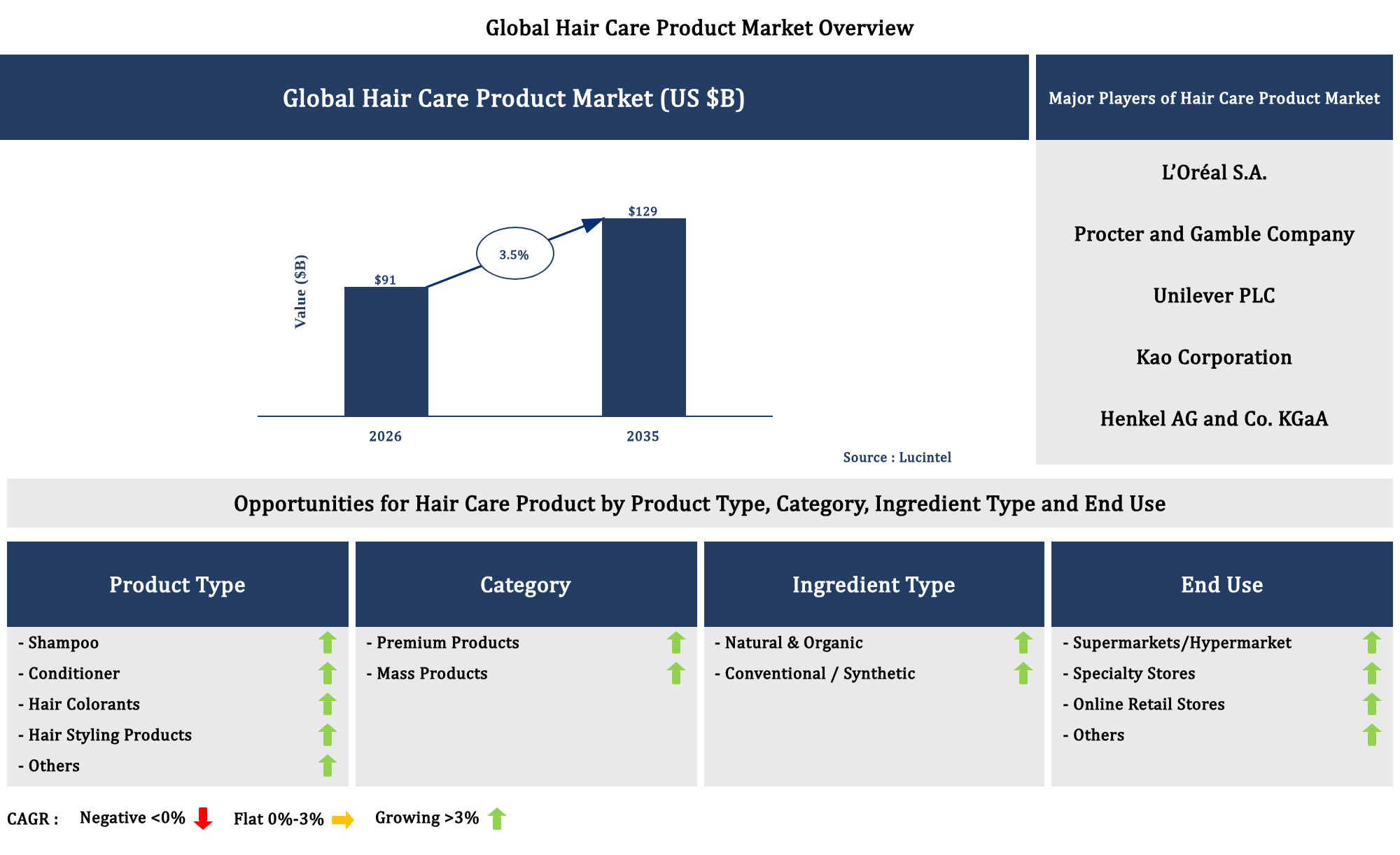
Hair Care Product Market

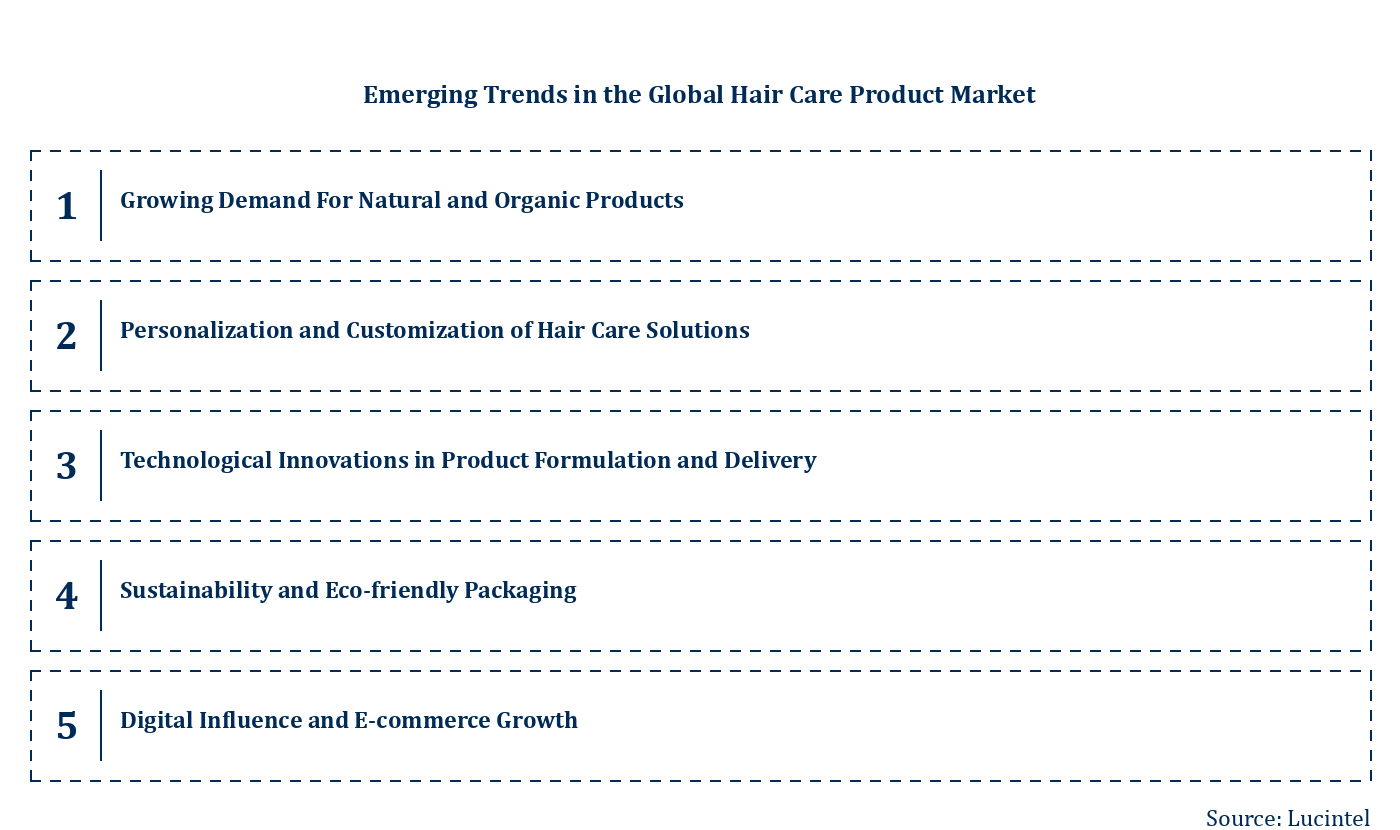
Emerging Trends in the Hair Care Product Market

The hair care product market is experiencing rapid evolution driven by consumer preferences, technological advancements, and sustainability concerns. As consumers become more informed and selective, brands are innovating to meet these changing demands. The market is shifting towards personalized solutions, natural ingredients, and eco-friendly practices. Digital platforms and social media influence purchasing behaviors, while new formulations and delivery systems enhance product efficacy. These developments are not only expanding market size but also redefining brand strategies and consumer engagement. Understanding these emerging trends is crucial for stakeholders aiming to stay competitive and meet the future demands of the hair care industry.

  • Growing Demand for Natural and Organic Products: Increased consumer awareness about health and environmental issues is driving demand for natural, organic, and chemical-free hair care products. Consumers prefer products with plant-based ingredients, free from sulfates, parabens, and silicones, believing they are safer and more sustainable. This trend encourages brands to reformulate existing products and develop new lines that emphasize natural ingredients, transparency, and eco-friendly packaging. The shift towards natural products is also supported by certifications and labels that assure quality and authenticity, ultimately influencing purchasing decisions and market growth.
  • Personalization and Customization of Hair Care Solutions: Consumers seek tailored hair care routines that address their specific hair types, concerns, and preferences. Advances in technology enable brands to offer personalized products through online quizzes, DNA testing, or AI-driven recommendations. Custom formulations allow consumers to select ingredients suited to their scalp health, hair texture, and styling needs. This trend enhances customer engagement and loyalty, as personalized products tend to deliver better results and satisfaction. It also opens new revenue streams for brands willing to invest in innovative customization platforms.
  • Technological Innovations in Product Formulation and Delivery: The market is witnessing the integration of cutting-edge technology such as nanotechnology, encapsulation, and advanced delivery systems to improve product efficacy. These innovations enable active ingredients to penetrate deeper into hair shafts or scalp, providing longer-lasting benefits. Additionally, new formats like foam, sprays, and serums enhance ease of use and convenience. Such technological advancements not only improve performance but also differentiate brands in a competitive landscape, attracting tech-savvy consumers eager for effective and innovative solutions.
  • Sustainability and Eco-Friendly Packaging: Environmental concerns are prompting brands to adopt sustainable practices, including biodegradable packaging, refillable containers, and reduced plastic use. Consumers increasingly prefer brands that demonstrate environmental responsibility, influencing purchasing decisions. Companies are investing in eco-friendly materials and transparent supply chains to meet these expectations. This trend aligns with broader societal shifts towards sustainability, encouraging innovation in packaging design and waste reduction. As a result, eco-conscious branding is becoming a key differentiator and a significant factor in market expansion.
  • Digital Influence and E-Commerce Growth: The rise of social media platforms, influencer marketing, and online shopping has transformed how consumers discover and purchase hair care products. Digital channels provide brands with direct access to target audiences, enabling personalized marketing and real-time engagement. E-commerce platforms facilitate convenient purchasing, subscription models, and global reach. Virtual try-ons, reviews, and tutorials influence buying decisions, making digital presence crucial. This trend accelerates market growth, encourages innovation in digital marketing strategies, and allows brands to gather valuable consumer data for product development and targeted campaigns.

These emerging trends are reshaping the hair care product market by fostering innovation, emphasizing sustainability, and enhancing consumer engagement. The focus on natural ingredients, personalization, technological advancements, eco-friendly practices, and digital influence is creating a more dynamic, competitive, and consumer-centric industry. Companies that adapt to these trends are better positioned to capitalize on new opportunities and sustain long-term growth in this evolving market.
Hair Care Product Market by country

Recent Developments in the Hair Care Product Market

The hair care product market is experiencing rapid innovation driven by consumer demand for natural ingredients, personalized solutions, and sustainable practices. Technological advancements and shifting preferences are shaping new product lines and marketing strategies. Companies are investing heavily in research and development to meet these evolving needs. The market's growth is also fueled by increasing awareness of hair health and beauty standards worldwide. These developments are creating new opportunities for brands to expand their reach and enhance consumer engagement.

  • Growth in Natural and Organic Products: The demand for natural, organic, and chemical-free hair care products is surging as consumers seek healthier, eco-friendly options. This trend encourages brands to innovate with plant-based ingredients and sustainable packaging, leading to increased market share for organic lines. The shift also influences marketing strategies, emphasizing transparency and ingredient sourcing. As consumers become more conscious of product safety and environmental impact, this growth opportunity is expected to continue expanding, driving overall market growth and encouraging industry-wide sustainability initiatives.
  • Personalization and Custom Solutions: Advances in technology enable brands to offer personalized hair care solutions tailored to individual hair types, concerns, and preferences. Custom formulations and digital consultations are becoming popular, enhancing customer satisfaction and loyalty. This trend allows companies to differentiate themselves in a competitive market by providing targeted benefits, such as scalp health, color protection, or anti-aging properties. The rise of personalized products is transforming the industry, fostering innovation, and creating new revenue streams, ultimately boosting market growth through enhanced consumer engagement.
  • Sustainability and Eco-Friendly Initiatives: Sustainability is increasingly influencing product development, packaging, and corporate practices within the hair care industry. Brands adopting eco-friendly ingredients, biodegradable packaging, and ethical sourcing are gaining consumer trust and loyalty. This shift aligns with global environmental goals and consumer values, encouraging industry-wide adoption of green practices. The focus on sustainability not only enhances brand reputation but also opens new market segments, driving growth as consumers prioritize environmentally responsible products and companies.
  • Digital Marketing and E-Commerce Expansion: The rise of digital platforms and e-commerce channels is transforming how hair care products are marketed and sold. Brands leverage social media, influencer collaborations, and online advertising to reach wider audiences and engage consumers directly. E-commerce provides convenience and access to a broader product range, boosting sales and market penetration. This digital shift enables personalized marketing, data-driven insights, and rapid product launches, significantly impacting market dynamics by increasing accessibility and consumer choice, and fostering global growth.
  • Innovation in Hair Care Technologies: Cutting-edge technologies such as nanotechnology, biotechnological ingredients, and advanced delivery systems are revolutionizing product efficacy. These innovations improve ingredient penetration, longevity, and overall performance, meeting consumer demands for effective solutions. Companies investing in R&D are developing breakthrough products that address specific hair concerns more efficiently. This technological progress enhances product differentiation, boosts consumer confidence, and accelerates market expansion, positioning the industry at the forefront of scientific advancement and consumer satisfaction.

The overall impact of these developments is a dynamic, innovative, and sustainable hair care market. Consumer preferences for natural, personalized, and eco-friendly products are driving brands to adapt quickly. Digital channels are expanding reach and engagement, while technological innovations are elevating product efficacy. These trends collectively foster market growth, increase competition, and create opportunities for new entrants, ultimately shaping a resilient and forward-looking industry landscape.

Strategic Growth Opportunities in the Hair Care Product Market

The hair care product market is experiencing rapid expansion driven by increasing consumer awareness, evolving beauty standards, and a rising focus on personal grooming. Innovations in formulations, natural ingredients, and sustainable packaging are shaping consumer preferences. Market players are exploring new distribution channels and targeting diverse demographics to capture growth. The convergence of technology and beauty, along with a focus on scalp health, presents significant opportunities for brands to differentiate and expand their market share in this competitive landscape.

  • Expansion Into Emerging Markets: The growing middle class and increasing disposable incomes in developing regions present substantial opportunities for hair care brands. Localized product offerings tailored to regional hair types and preferences can drive market penetration. Additionally, rising urbanization and changing beauty standards are fueling demand for premium and innovative products. Companies investing in distribution networks and marketing strategies in these areas can capitalize on untapped growth potential, establishing brand loyalty early and gaining competitive advantage.
  • Development of Natural and Organic Hair Care Products: Consumers are increasingly seeking products with natural, organic, and chemical-free ingredients due to health and environmental concerns. This shift encourages brands to innovate with plant-based formulations, sustainable sourcing, and eco-friendly packaging. The demand for clean-label products is particularly strong among Millennials and Gen Z consumers. Companies that effectively communicate their commitment to sustainability and transparency can differentiate themselves, capture market share, and build trust with environmentally conscious customers.
  • Integration of Technology for Personalized Hair Care Solutions: Advances in AI, data analytics, and digital platforms enable brands to offer personalized hair care regimens tailored to individual hair types, scalp conditions, and preferences. Smart devices and apps can provide customized recommendations, enhancing customer engagement and satisfaction. This technological integration fosters brand loyalty and opens new revenue streams. As consumers seek more effective and tailored solutions, companies adopting these innovations can gain a competitive edge and expand their market presence.
  • Focus on Scalp Health and Hair Wellness: Growing awareness of scalp health’s role in overall hair quality is driving demand for specialized products like scalp treatments, serums, and wellness-focused formulations. Brands are emphasizing ingredients that promote scalp hydration, reduce dandruff, and improve hair strength. The trend aligns with the broader wellness movement, encouraging consumers to view hair care as part of overall health. Investing in research and product development in this area can position brands as leaders in holistic hair wellness, attracting health-conscious consumers.
  • Expansion of E-Commerce and Direct-to-Consumer Channels: The shift towards online shopping has accelerated, especially post-pandemic, providing brands with direct access to consumers. E-commerce platforms enable personalized marketing, subscription models, and wider product availability. Digital marketing strategies, influencer collaborations, and virtual consultations enhance customer engagement. This channel expansion reduces reliance on traditional retail and allows brands to gather valuable consumer data. Strengthening online presence and DTC strategies can boost sales, improve margins, and foster stronger customer relationships in a competitive market.

The overall landscape of the hair care product market is poised for significant growth as brands leverage these opportunities to innovate, expand geographically, and meet evolving consumer demands, ensuring sustained market vitality and competitive advantage.

Hair Care Product Market Drivers and Challenges

The hair care product market is influenced by a complex interplay of technological advancements, economic shifts, and regulatory changes. Innovations in formulation and packaging drive consumer interest, while economic factors such as disposable income levels and global economic stability impact purchasing power. Regulatory frameworks concerning safety standards and ingredient disclosures shape product development and marketing strategies. Additionally, evolving consumer preferences towards natural and organic products, along with digital marketing trends, further influence market dynamics. Understanding these drivers and challenges is essential for stakeholders aiming to capitalize on growth opportunities and navigate potential risks within this competitive landscape.

The factors responsible for driving the hair care product market include:-

  • Technological Innovations: The development of advanced formulations, such as sulfate-free, paraben-free, and organic products, has significantly enhanced product efficacy and safety. Innovations in packaging, like eco-friendly and convenient designs, attract environmentally conscious consumers. These technological advancements enable brands to differentiate themselves, meet evolving consumer demands, and expand their product portfolios, thereby fueling market growth.
  • Rising Consumer Awareness and Preference for Natural Products: Increasing awareness about the harmful effects of chemicals in hair care products has led consumers to seek natural, organic, and chemical-free alternatives. This shift is driven by health consciousness, environmental concerns, and social media influence. As a result, brands investing in natural ingredient sourcing and transparent labeling are gaining market share, boosting overall industry growth.
  • E-commerce Expansion and Digital Marketing: The proliferation of online retail channels and social media platforms has transformed how consumers discover and purchase hair care products. E-commerce offers convenience, wider product availability, and personalized marketing, which enhances consumer engagement. Digital marketing strategies, including influencer collaborations and targeted advertising, further accelerate sales and brand loyalty, contributing to market expansion.
  • Economic Growth and Rising Disposable Income: Increased disposable income levels, especially in emerging markets, enable consumers to spend more on premium and specialized hair care products. Economic stability and growth in regions like Asia-Pacific and Latin America have expanded the customer base for high-end and innovative products, thereby driving market revenue and diversification.

The challenges in the hair care product market are:

  • Stringent Regulatory Frameworks: Governments and regulatory bodies impose strict standards concerning ingredient safety, labeling, and environmental impact. Compliance requires significant investment in research, testing, and certification processes, which can delay product launches and increase costs. Navigating these regulations is complex, especially for international brands, and may hinder rapid innovation and market entry.
  • Intense Competition and Market Saturation: The market is highly competitive with numerous established brands and new entrants vying for consumer attention. Saturation in key segments makes differentiation difficult, leading to price wars and reduced profit margins. Companies must continuously innovate and invest in marketing to maintain market share, which can strain resources.
  • Fluctuating Raw Material Prices and Supply Chain Disruptions: The availability and cost of raw materials, such as natural extracts and specialty chemicals, are subject to volatility due to geopolitical issues, climate change, and supply chain disruptions. These fluctuations increase production costs and can lead to delays, affecting product availability and profitability.

The hair care product market is driven by technological innovations, consumer preferences for natural products, digital marketing, and economic growth, which collectively foster expansion and diversification. However, regulatory challenges, intense competition, and supply chain issues pose significant hurdles. Navigating these drivers and challenges requires strategic agility, innovation, and compliance to sustain growth and capitalize on emerging opportunities. Overall, the market's future hinges on balancing innovation with regulatory adherence and supply chain resilience.

List of Hair Care Product Market Companies

Companies in the market compete on the basis of product quality offered. Major players in this market focus on expanding their manufacturing facilities, R&D investments, infrastructural development, and leverage integration opportunities across the value chain. Through these strategies hair care product market companies cater increasing demand, ensure competitive effectiveness, develop innovative products & technologies, reduce production costs, and expand their customer base. Some of the hair care product market companies profiled in this report include-

  • L’Oréal S.A.
  • Procter and Gamble Company
  • Unilever PLC
  • Kao Corporation
  • Henkel AG and Co. KGaA
  • Johnson and Johnson Services inc.
  • Shiseido Company Ltd.
  • Coty Inc.
  • Amorepacific Corp.
  • Estée Lauder Companies

Hair Care Product Market by Segment

The study includes a forecast for the global hair care product market by product type, category, ingredient type, end use, and region.

  • Hair Care Product Market by Product Type [Value from 2019 to 2035]:
    • Shampoo
    • Conditioner
    • Hair Colorants
    • Hair Styling Products
    • Others
  • Hair Care Product Market by Category [Value from 2019 to 2035]:
    • Premium Products
    • Mass Products
  • Hair Care Product Market by Ingredient Type [Value from 2019 to 2035]:
    • Natural & Organic
    • Conventional / Synthetic
  • Hair Care Product Market by End Use [Value from 2019 to 2035]:
    • Supermarkets/Hypermarket
    • Specialty Stores
    • Online Retail Stores
    • Others
  • Hair Care Product Market by Region [Value from 2019 to 2035]:
    • North America
    • Europe
    • Asia Pacific
    • The Rest of the World

Country Wise Outlook for the Hair Care Product Market

The hair care product market has experienced significant growth driven by increasing consumer awareness, innovation in product formulations, and shifting beauty standards. Technological advancements and sustainability trends are shaping product development and marketing strategies across major markets. Countries are adopting new regulations, expanding product lines, and embracing digital platforms to reach consumers. The evolving preferences for natural and organic products are also influencing market dynamics. As the industry adapts to these changes, each country exhibits unique trends reflecting local consumer behaviors, regulatory environments, and economic conditions, contributing to the overall growth and diversification of the global hair care market.

  • United States: The US market has seen a surge in organic and natural hair care products, driven by health-conscious consumers. Innovation in sulfate-free shampoos and leave-in conditioners is prominent, with brands emphasizing sustainability and cruelty-free practices. E-commerce sales continue to grow rapidly, supported by social media marketing and influencer collaborations. The focus on men's grooming products has expanded, reflecting broader grooming trends. Regulatory standards are tightening around ingredient disclosures, encouraging transparency. Additionally, personalized hair care solutions using AI and data analytics are gaining popularity, enhancing consumer engagement and product efficacy.
  • China: China's hair care market is expanding rapidly, fueled by rising disposable incomes and urbanization. Local brands are gaining ground by offering affordable, innovative products tailored to Asian hair types. There is a strong demand for anti-dandruff, scalp care, and hair growth solutions. E-commerce platforms like Alibaba and JD.com dominate sales channels, with live-streaming marketing boosting product visibility. Consumers are increasingly interested in natural ingredients and herbal formulations rooted in traditional Chinese medicine. International brands are entering the market, adapting products to local preferences. Sustainability and eco-friendly packaging are gradually gaining importance among younger consumers.
  • Germany: The German hair care market emphasizes high-quality, eco-friendly, and dermatologically tested products. There is a growing trend toward organic and vegan formulations, driven by environmentally conscious consumers. Innovation in hair repair and color protection products is prominent, with a focus on reducing chemical exposure. The market is also witnessing increased demand for products catering to specific hair types and conditions, such as sensitive scalps. Digitalization plays a key role, with brands investing in online consultations and personalized recommendations. Regulatory compliance with EU standards remains a priority, ensuring product safety and transparency.
  • India: The Indian hair care market is characterized by a strong preference for herbal and Ayurvedic products, reflecting cultural traditions. The segment is witnessing rapid growth, especially in natural and organic categories, as consumers seek chemical-free options. Hair oils, shampoos, and hair growth serums are popular, with local brands expanding their reach through e-commerce. The rise of men's grooming products is notable, with an increasing focus on scalp health and hair fall solutions. Rural markets are becoming more accessible via digital platforms, broadening consumer base. Sustainability and eco-friendly packaging are gradually gaining importance among urban consumers.
  • Japan: Japan's hair care market is marked by innovation in anti-aging and scalp health products. Consumers favor gentle, hypoallergenic formulations with advanced technology, such as scalp revitalization and damage repair. The demand for premium and luxury hair care products remains strong, emphasizing quality and efficacy. Natural ingredients and minimalistic packaging are trending, aligning with Japanese aesthetic values. Digital marketing and online shopping are integral to distribution strategies. The market also shows a growing interest in sustainable practices, including biodegradable packaging and cruelty-free testing. Regulatory standards ensure high safety and transparency, maintaining consumer trust.

Features of the Hair Care Product Market

  • Market Size Estimates: Hair care product market size estimation in terms of value ($B).
  • Trend and Forecast Analysis: Market trends (2019 to 2025) and forecast (2026 to 2035) by various segments and regions.
  • Segmentation Analysis: Hair care product market size by various segments, such as by product type, category, ingredient type, end use, and region in terms of value ($B).
  • Regional Analysis: Hair care product market breakdown by North America, Europe, Asia Pacific, and Rest of the World.
  • Growth Opportunities: Analysis of growth opportunities in different product type, category, ingredient type, end use, and regions for the hair care product market.
  • Strategic Analysis: This includes M&A, new product development, and competitive landscape of the hair care product market.
  • Analysis of competitive intensity of the industry based on Porter’s Five Forces model.

Top 5 Companies

  • L’Oréal S.A.
  • Procter and Gamble Company
  • Unilever PLC
  • Kao Corporation
  • Henkel AG and Co. KGaA

Table of Contents

1. Executive Summary
15.1 Competitive Analysis Overview

List of Figures

List of Tables

Methodology

Lucintel has been in the business of market research and management consulting since 2000 and has published over 1000 market intelligence reports in various markets / applications and served over 1,000 clients worldwide. This study is a culmination of four months of full-time effort performed by Lucintel's analyst team. The analysts used the following sources for the creation and completion of this valuable report:

  • In-depth interviews of the major players in this market
  • Detailed secondary research from competitors' financial statements and published data
  • Extensive searches of published works, market, and database information pertaining to industry news, company press releases, and customer intentions
  • A compilation of the experiences, judgments, and insights of Lucintel's professionals, who have analyzed and tracked this market over the years.

Extensive research and interviews are conducted across the supply chain of this market to estimate market share, market size, trends, drivers, challenges, and forecasts. Below is a brief summary of the primary interviews that were conducted by job function for this report.

Lucintel's methodology for market research

Thus, Lucintel compiles vast amounts of data from numerous sources, validates the integrity of that data, and performs a comprehensive analysis. Lucintel then organizes the data, its findings, and insights into a concise report designed to support the strategic decision-making process. The figure below is a graphical representation of Lucintel's research process.

Primary interviews by job function

Buy Now

Choose a license that fits your team. Instant PDF delivery.

Market Report

1 User PDF

$4,850
Buy Now

Market Report

2-5 Users PDF

$6,700
Buy Now

Market Report

Corporate PDF

$8,850
Buy Now

Market Report

Global PDF

$10,000
Buy Now

Prices exclude taxes. Instant delivery. Custom licensing available on request.

Frequently Asked Questions

What is the hair care product market size?
The global hair care product market is expected to reach an estimated $129 billion by 2035.
What is the growth forecast for hair care product market?
The global hair care product market is expected to grow with a CAGR of 3.5% from 2026 to 2035.
What are the major drivers influencing the growth of the hair care product market?
The major drivers for this market are the increasing demand for natural ingredients, the rising preference for personalized hair solutions, and the growing interest in hair health awareness.
What are the major segments for hair care product market?
The future of the hair care product market looks promising with opportunities in the natural & organic and conventional / synthetic markets.
Who are the key hair care product market companies?

Some of the key hair care product companies are as follows:

  • L’Oréal S.A.
  • Procter and Gamble Company
  • Unilever PLC
  • Kao Corporation
  • Henkel AG and Co. KGaA
  • Johnson and Johnson Services inc.
  • Shiseido Company Ltd.
  • Coty Inc.
  • Amorepacific Corp.
  • Estée Lauder Companies
Which hair care product market segment will be the largest in future?
Lucintel forecasts that, within the product type category, shampoo is expected to witness the highest growth over the forecast period.
In hair care product market, which region is expected to be the largest in next 8 years?
In terms of region, APAC is expected to witness the highest growth over the forecast period.
Do we receive customization in this report?
Yes, Lucintel provides 10% customization without any additional cost.

Key Questions

  • What are some of the most promising, high-growth opportunities for the hair care product market by product type (shampoo, conditioner, hair colorants, hair styling products, and others), category (premium products and mass products), ingredient type (natural & organic and conventional / synthetic), end use (supermarkets/hypermarket, specialty stores, online retail stores, and others), and region (North America, Europe, Asia Pacific, and the Rest of the World)?
  • Which segments will grow at a faster pace and why?
  • Which region will grow at a faster pace and why?
  • What are the key factors affecting market dynamics? What are the key challenges and business risks in this market?
  • What are the business risks and competitive threats in this market?
  • What are the emerging trends in this market and the reasons behind them?
  • What are some of the changing demands of customers in the market?
  • What are the new developments in the market? Which companies are leading these developments?
  • Who are the major players in this market? What strategic initiatives are key players pursuing for business growth?
  • What are some of the competing products in this market and how big of a threat do they pose for loss of market share by material or product substitution?
  • What M&A activity has occurred in the last 5 years and what has its impact been on the industry?
Why Choose Us

The Lucintel Advantage

Trusted partner for strategic intelligence and business growth

25+ Years Excellence

25+ Years Excellence

Quarter century of proven expertise in management consulting and market research across global markets.
Game-Changer Ideas

Game-Changer Ideas

Innovative strategies and actionable insights that help clients become the smartest in their industry.
Global Reach

Global Reach

Extensive coverage across 50+ industries and markets worldwide with localized expertise.
Start Your Growth Journey

Get Your Free
Market Intelligence
Briefing

Receive a complimentary market analysis tailored to your industry. Our analysts will identify key growth opportunities and competitive dynamics specific to your business.

Custom Market Snapshot

Market size, growth rate, and key trend analysis for your specific sector.

Competitive Landscape Overview

Top competitor positioning and market share analysis.

Growth Opportunity Identification

Strategic recommendations backed by data-driven insights.

Subscribe

Subscribe to our Newsletter

Get curated market intelligence and competitive moves straight to your inbox.

By subscribing, you agree to receive our monthly insights. Unsubscribe anytime.

Industry Trends Market Signals Opportunities Competitor Moves