
Report Feature
General Aviation Engine Market Trends and Forecast
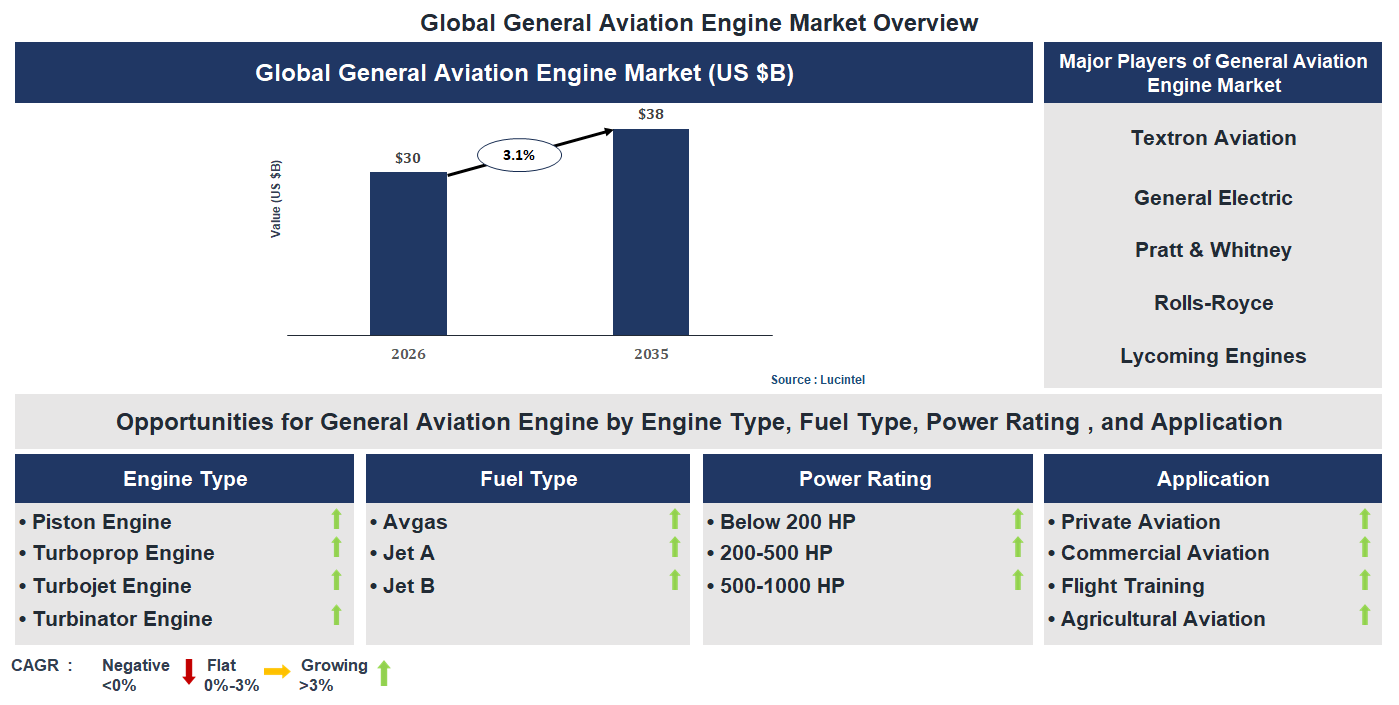
The future of the global general aviation engine market looks promising with opportunities in the private aviation, commercial aviation, flight training, and agricultural aviation markets. The global general aviation engine market is expected to reach an estimated $38 billion by 2035 with a CAGR of 3.1% from 2026 to 2035. The major drivers for this market are the increasing demand for private air travel, the rising need for fuel-efficient engines, and the growing focus on aviation safety standards.• Lucintel forecasts that, within the engine type category, piston engine is expected to witness the highest growth over the forecast period.
• Within the application category, private aviation is expected to witness the highest growth.
• In terms of region, North America is expected to witness the highest growth over the forecast period. Gain valuable insights for your business decisions with our comprehensive 150+ page report. Sample figures with some insights are shown below.
Emerging Trends in the General Aviation Engine Market
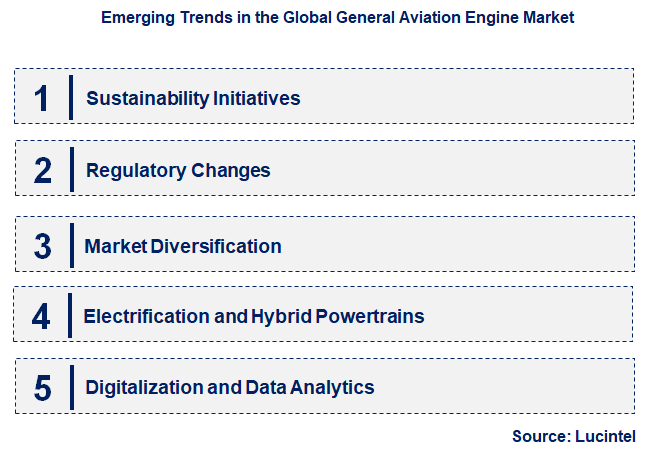
The general aviation engine market is experiencing rapid transformation driven by technological innovations, shifting consumer preferences, and evolving regulatory landscapes. These developments are shaping the future of the industry, making aircraft more efficient, sustainable, and accessible. As the market adapts to these changes, stakeholders must stay informed about emerging trends that could influence investment, manufacturing, and operational strategies. The following five key trends highlight the most significant shifts currently impacting the market, offering insights into how the industry is evolving to meet new demands and challenges.• Sustainability Initiatives: Growing emphasis on eco-friendly engines and alternative fuels is transforming the market. Manufacturers are investing in developing engines that produce fewer emissions and consume less fuel, driven by stricter environmental regulations and increasing consumer demand for sustainable aviation. This shift is encouraging innovation in hybrid and electric propulsion systems, which promise to reduce the carbon footprint of general aviation. As a result, the industry is moving toward greener solutions, potentially lowering operating costs and aligning with global sustainability goals.
• Regulatory Changes: Evolving safety and environmental regulations are significantly impacting engine design and certification processes. Governments and aviation authorities are implementing stricter standards to ensure safety and reduce environmental impact, which in turn influences engine development timelines and costs. Manufacturers must adapt quickly to these regulatory requirements, often leading to increased R&D investments and longer certification periods. These changes are fostering a more rigorous and safety-focused industry, ultimately enhancing trust and reliability in general aviation engines.
• Market Diversification: The market is witnessing increased diversification with new entrants and regional players expanding their presence. Emerging markets in Asia, Africa, and Latin America are experiencing growth due to rising demand for private and business aviation. This diversification is broadening the customer base and creating opportunities for tailored engine solutions suited to different regional needs. It also encourages competition, driving innovation and price competitiveness, which benefits consumers and stimulates overall market growth.
• Electrification and Hybrid Powertrains: The adoption of electric and hybrid propulsion systems is gaining momentum in general aviation. These systems offer benefits such as reduced noise, lower emissions, and decreased operational costs. While still in developmental stages, advancements in battery technology and electric motors are making these options more viable for small aircraft. The shift toward electrification is poised to revolutionize aircraft design and operation, opening new markets and enabling more sustainable and cost-effective flying options for general aviation.
• Digitalization and Data Analytics: Increasing integration of digital technologies is transforming engine maintenance, performance monitoring, and design optimization. Advanced sensors and data analytics enable predictive maintenance, reducing downtime and operational costs. Digital twin technology allows manufacturers to simulate and improve engine performance virtually, accelerating innovation cycles. This trend enhances safety, reliability, and efficiency, providing operators with real-time insights and enabling more informed decision-making. As digitalization deepens, it will continue to reshape how engines are developed, maintained, and operated in the general aviation sector. These emerging trends are collectively reshaping the general aviation engine market by fostering sustainability, regulatory compliance, diversification, technological innovation, and operational efficiency. They are driving a more competitive, environmentally conscious, and technologically advanced industry, positioning it for sustainable growth and increased adoption worldwide.
Recent Developments in the General Aviation Engine Market
The general aviation engine market is experiencing rapid advancements driven by technological innovation, increased demand for private and business aircraft, and a focus on sustainability. These developments are reshaping industry dynamics, creating new opportunities for manufacturers, and influencing market growth trajectories. Stakeholders are closely monitoring these changes to capitalize on emerging trends and maintain competitive advantage in a rapidly evolving landscape.• Electric and Hybrid Engines: Electric and hybrid engines are gaining traction as sustainable alternatives, reducing emissions and operational costs. These innovations are attracting environmentally conscious consumers and regulatory support, leading to increased adoption in general aviation. The shift towards cleaner propulsion systems is expected to accelerate market growth, foster technological advancements, and open new avenues for startups and established players alike.
• Advanced Materials and Manufacturing: The integration of lightweight, durable materials like composites and advanced manufacturing techniques such as 3D printing is revolutionizing engine design. These innovations improve fuel efficiency, reduce weight, and lower production costs. As a result, manufacturers can produce more efficient engines, meet stricter regulations, and offer competitive pricing, thereby expanding market share and enabling the development of more versatile aircraft.
• Digitalization and IoT Integration: Incorporating digital technologies and IoT into engine systems enhances performance monitoring, predictive maintenance, and operational efficiency. This digital transformation reduces downtime and maintenance costs, increasing reliability and safety. The data-driven approach also enables manufacturers to optimize engine performance and develop tailored solutions, fostering customer loyalty and opening new revenue streams in the evolving market landscape.
• Regulatory Support and Certification Advances: Evolving regulations favoring emissions reduction and safety standards are prompting engine manufacturers to innovate. Streamlined certification processes and supportive policies facilitate quicker market entry for new engine technologies. This regulatory environment encourages investment in R&D, accelerates the adoption of advanced engines, and ensures compliance, ultimately driving market expansion and fostering innovation within the general aviation sector.
• Growing Demand for Business and Personal Aircraft: Rising disposable incomes and a preference for private travel are boosting demand for business jets and personal aircraft. This surge directly impacts engine sales, prompting manufacturers to develop more reliable, efficient, and versatile engines. The increasing market size offers significant growth opportunities, encourages technological innovation, and attracts investments, shaping a competitive landscape focused on delivering high-performance propulsion solutions. These developments are significantly transforming the general aviation engine market by fostering innovation, enhancing efficiency, and supporting sustainability. The integration of new technologies, materials, and regulatory frameworks is driving growth, expanding market opportunities, and encouraging industry players to adapt swiftly. As a result, the market is poised for robust expansion, with increased competitiveness and a focus on environmentally friendly, technologically advanced engine solutions.
Strategic Growth Opportunities in the General Aviation Engine Market
The general aviation engine market is experiencing significant growth driven by technological advancements, increasing demand for private and business aircraft, and a rising focus on fuel efficiency and sustainability. Emerging markets and the modernization of existing fleets present substantial opportunities for manufacturers and service providers. Strategic investments in innovation, maintenance, and regional expansion are crucial for capturing market share and meeting evolving customer needs. This dynamic environment offers numerous avenues for growth, innovation, and competitive advantage in the coming years.• Expansion into Emerging Markets: Growing middle-class populations and increased air travel in regions like Asia-Pacific and Latin America create new demand for general aviation engines. Local infrastructure development and favorable government policies further support market entry. Companies investing in regional manufacturing, distribution, and after-sales services can capitalize on these expanding markets, boosting sales and brand presence.
• Development of Fuel-Efficient and Eco-Friendly Engines: Rising environmental concerns and fuel costs drive the need for more efficient engines. Innovations in lightweight materials, hybrid systems, and alternative fuels are key to reducing emissions and operational costs. Manufacturers focusing on sustainable engine technologies can differentiate themselves, meet regulatory standards, and appeal to environmentally conscious customers, thereby gaining a competitive edge.
• Integration of Digital Technologies for Maintenance and Performance Optimization: The adoption of IoT, AI, and data analytics enhances engine monitoring, predictive maintenance, and performance management. These technologies reduce downtime, improve safety, and lower maintenance costs. Companies investing in digital solutions can offer value-added services, improve customer satisfaction, and create new revenue streams through data-driven insights and remote diagnostics.
• Modernization of Existing Fleet with Upgrades and Retrofitting: Many operators seek to extend the lifespan of their aircraft through engine upgrades and retrofitting. This presents opportunities for aftermarket services, spare parts, and upgrade kits. Providing cost-effective, reliable solutions helps operators meet regulatory requirements and improve performance, fostering long-term customer relationships and recurring revenue streams for manufacturers and service providers.
• Strategic Collaborations and Partnerships for Innovation: Collaborations between engine manufacturers, aircraft OEMs, and technology firms accelerate innovation and product development. Joint ventures and strategic alliances facilitate access to new markets, shared R&D costs, and faster deployment of advanced engine solutions. These partnerships enable companies to stay competitive, leverage complementary expertise, and respond swiftly to evolving market demands. These growth opportunities are poised to significantly influence the general aviation engine market by fostering innovation, expanding regional reach, and enhancing operational efficiency. Companies that strategically leverage these avenues can strengthen their market position, meet customer expectations, and drive sustainable growth in a competitive landscape.
General Aviation Engine Market Driver and Challenges
The general aviation engine market is influenced by a variety of technological, economic, and regulatory factors that shape its growth and development. Advances in engine technology, such as increased fuel efficiency and reduced emissions, are driving innovation and market expansion. Economic conditions, including rising disposable incomes and increased demand for private and business travel, contribute to market growth. Regulatory frameworks aimed at safety, environmental standards, and certification processes also significantly impact market dynamics. Additionally, geopolitical factors and global supply chain stability influence manufacturing and distribution. Understanding these drivers and challenges is essential for stakeholders to navigate the evolving landscape of the general aviation engine industry effectively. The factors responsible for driving the general aviation engine market include:• Technological Advancements: The continuous development of more efficient, lightweight, and environmentally friendly engines is a major driver. Innovations such as composite materials, digital engine controls, and improved fuel efficiency reduce operational costs and meet stricter emission standards. These technological improvements attract more customers and enable manufacturers to offer competitive products, thereby expanding market share. Moreover, advancements in maintenance and diagnostics through digitalization enhance reliability and reduce downtime, further boosting market growth.
• Increasing Demand for Private and Business Aviation: Rising disposable incomes and a growing preference for private travel are fueling demand for general aviation aircraft. This trend is driven by the need for flexible, time-saving, and personalized travel options, especially in regions with congested commercial airports. The expansion of business aviation, in particular, is a significant growth driver, as companies seek to optimize operational efficiency and employee productivity. This increased demand directly correlates with higher sales of engines suitable for a variety of general aviation aircraft.
• Regulatory Support and Certification Standards: Governments and aviation authorities worldwide are implementing supportive policies and stringent certification standards to ensure safety and environmental compliance. These regulations encourage manufacturers to develop engines that meet or exceed standards, fostering innovation and market confidence. Certification processes, although challenging, serve as quality assurance, attracting customers who prioritize safety and reliability. Regulatory support also facilitates market entry in emerging regions, expanding the global footprint of the industry.
• Growing Focus on Sustainability and Emission Reduction: Environmental concerns and climate change initiatives are prompting the industry to develop greener engines. The push for lower emissions and higher fuel efficiency is a key driver, leading to investments in alternative fuels, hybrid-electric propulsion, and advanced engine designs. Governments are offering incentives and subsidies for sustainable aviation solutions, further accelerating adoption. This focus on sustainability not only aligns with global environmental goals but also opens new market opportunities for innovative engine technologies.
• Expansion of Regional Markets: Emerging markets in Asia-Pacific, Latin America, and Africa are experiencing rapid growth in general aviation activities. Increasing urbanization, economic development, and infrastructure investments are expanding the customer base. Local manufacturers are entering the market, and international players are establishing regional facilities, which reduces costs and improves supply chain efficiency. This regional expansion broadens market reach and creates new opportunities for engine manufacturers to cater to diverse customer needs. The challenges facing the general aviation engine market include:
• High Development and Certification Costs: Developing advanced engines that meet stringent safety and environmental standards requires significant investment in research, testing, and certification processes. These costs can be prohibitive for smaller manufacturers and may delay product launches, impacting competitiveness. The lengthy certification timelines also increase financial risks and can hinder rapid innovation, limiting market agility and responsiveness to changing customer demands.
• Supply Chain Disruptions: The global supply chain for aerospace components, including engine parts, is vulnerable to disruptions caused by geopolitical tensions, pandemics, and logistical issues. Shortages of critical materials and delays in component delivery can hamper production schedules and increase costs. These disruptions threaten to slow down market growth, reduce profit margins, and impact customer satisfaction due to delayed aircraft deliveries and maintenance.
• Intense Competition and Price Pressures: The market is highly competitive, with established players and new entrants vying for market share. Price competition often leads to reduced profit margins and pressures manufacturers to innovate cost-effectively. Differentiating products through technological superiority becomes essential but challenging, especially for smaller companies. This competitive landscape necessitates strategic investments and can lead to market consolidation, impacting overall industry dynamics. The general aviation engine market is shaped by technological innovations, rising demand, supportive regulations, sustainability initiatives, and regional growth. However, high development costs, supply chain vulnerabilities, and intense competition pose significant challenges. These drivers and challenges collectively influence market growth, requiring stakeholders to adapt strategically. Embracing technological advancements and sustainability while managing costs and supply chain risks will be crucial for sustained success in this evolving industry landscape.
List of General Aviation Engine Companies
Companies in the market compete on the basis of product quality offered. Major players in this market focus on expanding their manufacturing facilities, R&D investments, infrastructural development, and leverage integration opportunities across the value chain. With these strategies general aviation engine companies cater increasing demand, ensure competitive effectiveness, develop innovative products & technologies, reduce production costs, and expand their customer base. Some of the general aviation engine companies profiled in this report include-• Textron Aviation
• General Electric
• Pratt & Whitney
• Rolls-Royce
• Lycoming Engines
• Continental Motors
• Wright Aeronautical
• Mtu Aero Engines
• Hartzell Propeller
• CFM International
General Aviation Engine Market by Segment
The study includes a forecast for the global general aviation engine market by engine type, fuel type, power rating , application, and region.General Aviation Engine Market by Engine Type [Value from 2019 to 2035]:
• Piston Engine
• Turboprop Engine
• Turbojet Engine
• Turbinator Engine
General Aviation Engine Market by Fuel Type [Value from 2019 to 2035]:
• Avgas
• Jet A
• Jet B
General Aviation Engine Market by Power Rating [Value from 2019 to 2035]:
• Below 200 HP
• 200-500 HP
• 500-1000 HP
General Aviation Engine Market by Application [Value from 2019 to 2035]:
• Private Aviation
• Commercial Aviation
• Flight Training
• Agricultural Aviation
General Aviation Engine Market by Region [Value from 2019 to 2035]:
• North America
• Europe
• Asia Pacific
• The Rest of the World
Country Wise Outlook for the General Aviation Engine Market
The general aviation engine market has experienced significant shifts driven by technological innovation, regulatory changes, and evolving demand patterns across major economies. As private and commercial aviation sectors expand, countries are investing in more efficient, sustainable, and advanced engine technologies. These developments reflect broader trends toward greener aviation solutions, increased safety standards, and digital integration. Each country’s unique economic, regulatory, and technological landscape influences its market trajectory, shaping the global outlook for general aviation engines in the coming years.• United States: The US market has seen substantial growth driven by technological advancements in fuel efficiency and emissions reduction. Major manufacturers like Textron and GE Aviation are developing next-generation engines with hybrid and electric capabilities. Regulatory agencies are promoting sustainability initiatives, encouraging innovation. The rise of private jet ownership and corporate aviation has increased demand for reliable, high-performance engines. Additionally, the US government’s investments in aerospace R&D are fostering innovation in engine design and manufacturing processes.
• China: China’s general aviation engine market is rapidly expanding, supported by government policies aimed at boosting domestic aerospace capabilities. Local companies such as AVIC are investing heavily in research and development to produce more efficient engines. The country’s focus on regional connectivity and infrastructure development has increased demand for smaller, versatile engines suitable for regional aircraft. China is also exploring electric and hybrid propulsion systems to meet its environmental goals, positioning itself as a key player in sustainable aviation technology.
• Germany: Germany remains a leader in aerospace engineering, with a focus on high-precision, lightweight engine components. The market benefits from strong collaborations between industry and research institutions, fostering innovation in turbojet and turboprop engines. Emphasis on environmental sustainability has led to the development of more efficient engines with lower emissions. Germany’s aerospace sector is also investing in digitalization and automation to enhance manufacturing processes. The country’s strategic position within the European Union facilitates access to a broad market and regulatory support for advanced engine technologies.
• India: India’s general aviation engine market is experiencing rapid growth due to increasing demand for regional connectivity and private aviation. Domestic companies like Hindustan Aeronautics Limited are working on developing indigenous engines to reduce reliance on imports. The government’s push for Make in India and infrastructure development is creating a conducive environment for market expansion. There is also a growing interest in electric propulsion systems, driven by environmental concerns and technological advancements. The market is expected to see increased foreign investment and collaborations to accelerate innovation.
• Japan: Japan’s market is characterized by a focus on innovation and sustainability, with significant investments in hybrid and electric engine technologies. Companies such as Kawasaki and Mitsubishi are developing advanced propulsion systems aimed at reducing carbon footprints. Japan’s aerospace industry benefits from strong government support and collaborations with global aerospace firms. The country is also emphasizing the integration of digital technologies for engine monitoring and maintenance, improving safety and efficiency. The push toward eco-friendly solutions aligns with Japan’s broader environmental policies, positioning it as a key player in sustainable aviation engine development.

Features of the Global General Aviation Engine Market
Market Size Estimates: General aviation engine market size estimation in terms of value ($B). Trend and Forecast Analysis: Market trends (2019 to 2025) and forecast (2026 to 2035) by various segments and regions. Segmentation Analysis: General aviation engine market size by various segments, such as by engine type, fuel type, power rating , application, and region in terms of value ($B). Regional Analysis: General aviation engine market breakdown by North America, Europe, Asia Pacific, and Rest of the World. Growth Opportunities: Analysis of growth opportunities in different engine types, fuel types, power rating , applications, and regions for the general aviation engine market. Strategic Analysis: This includes M&A, new product development, and competitive landscape of the general aviation engine market. Analysis of competitive intensity of the industry based on Porter’s Five Forces model.
FAQ
Q1. What is the general aviation engine market size? Answer: The global general aviation engine market is expected to reach an estimated $38 billion by 2035. Q2. What is the growth forecast for general aviation engine market? Answer: The global general aviation engine market is expected to grow with a CAGR of 3.1% from 2026 to 2035. Q3. What are the major drivers influencing the growth of the general aviation engine market? Answer: The major drivers for this market are the increasing demand for private air travel, the rising need for fuel-efficient engines, and the growing focus on aviation safety standards. Q4. What are the major segments for general aviation engine market? Answer: The future of the general aviation engine market looks promising with opportunities in the private aviation, commercial aviation, flight training, and agricultural aviation markets. Q5. Who are the key general aviation engine market companies? Answer: Some of the key general aviation engine companies are as follows:• Textron Aviation
• General Electric
• Pratt & Whitney
• Rolls-Royce
• Lycoming Engines
• Continental Motors
• Wright Aeronautical
• Mtu Aero Engines
• Hartzell Propeller
• CFM International Q6. Which general aviation engine market segment will be the largest in future? Answer: Lucintel forecasts that, within the engine type category, piston engine is expected to witness the highest growth over the forecast period. Q7. In general aviation engine market, which region is expected to be the largest in next 8 years? Answer: In terms of region, North America is expected to witness the highest growth over the forecast period. Q8. Do we receive customization in this report? Answer: Yes, Lucintel provides 10% customization without any additional cost.
Table of Contents
List of Figures
List of Tables
Methodology
- In-depth interviews of the major players in this market
- Detailed secondary research from competitors’ financial statements and published data
- Extensive searches of published works, market, and database information pertaining to industry news, company press releases, and customer intentions
- A compilation of the experiences, judgments, and insights of Lucintel’s professionals, who have analyzed and tracked this market over the years.


Buy Now
Choose a license that fits your team. Instant PDF delivery.
Prices exclude taxes. Instant delivery. Custom licensing available on request.
Key Questions
- • What are some of the most promising, high-growth opportunities for the general aviation engine market by engine type (piston engine, turboprop engine, turbojet engine, and turbinator engine), fuel type (avgas, jet A, and jet B), power rating (below 200 HP, 200-500 HP, and 500-1000 HP), application (private aviation, commercial aviation, flight training, and agricultural aviation), and region (North America, Europe, Asia Pacific, and the Rest of the World)?
- • Which segments will grow at a faster pace and why?
- • Which region will grow at a faster pace and why?
- • What are the key factors affecting market dynamics? What are the key challenges and business risks in this market?
- • What are the business risks and competitive threats in this market?
- • What are the emerging trends in this market and the reasons behind them?
- • What are some of the changing demands of customers in the market?
- • What are the new developments in the market? Which companies are leading these developments?
- • Who are the major players in this market? What strategic initiatives are key players pursuing for business growth?
- • What are some of the competing products in this market and how big of a threat do they pose for loss of market share by material or product substitution?
- • What M&A activity has occurred in the last 5 years and what has its impact been on the industry? For any questions related to General Aviation Engine Market, General Aviation Engine Market Size, General Aviation Engine Market Growth, General Aviation Engine Market Analysis, General Aviation Engine Market Report, General Aviation Engine Market Share, General Aviation Engine Market Trends, General Aviation Engine Market Forecast, General Aviation Engine Companies, write Lucintel analyst at email: helpdesk@lucintel.com. We will be glad to get back to you soon.


