
Report Feature
Gaming Console Market Trends and Forecast
The future of the global gaming console market looks promising with opportunities in the residential and commercial markets. The global gaming console market is expected to reach an estimated $97 billion by 2035 with a CAGR of 6.1% from 2026 to 2035. The major drivers for this market are the increasing demand for high-quality gaming experiences, the rising popularity of online multiplayer games, and the growing spending on digital entertainment.• Lucintel forecasts that, within the type category, home console is expected to witness the highest growth over the forecast period.
• Within the end use category, residential is expected to witness higher growth.
• In terms of region, APAC is expected to witness the highest growth over the forecast period.
Gain valuable insights for your business decisions with our comprehensive 150+ page report. Sample figures with some insights are shown below.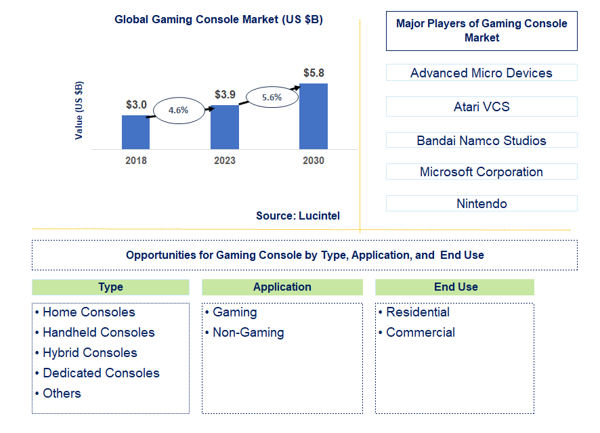
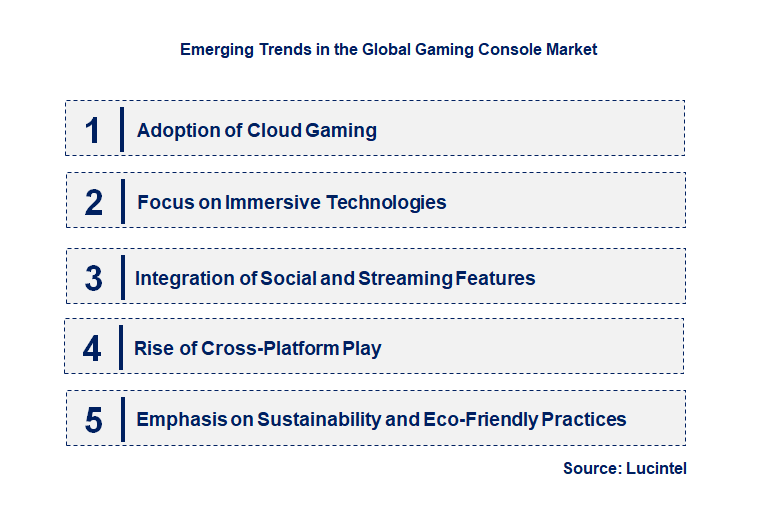
Emerging Trends in the Gaming Console Market
The gaming console market is experiencing rapid transformation driven by technological advancements, changing consumer preferences, and innovative business models. As digital entertainment becomes more integrated into daily life, manufacturers are exploring new features, platforms, and services to attract diverse audiences. The rise of cloud gaming, increased focus on immersive experiences, and the integration of social and streaming functionalities are shaping the future landscape. These developments are not only expanding market reach but also redefining how consumers engage with gaming content. Understanding these emerging trends is crucial for stakeholders aiming to stay competitive and capitalize on new opportunities in this dynamic industry.• Adoption of Cloud Gaming: Expanding accessibility and reducing hardware dependency. Cloud gaming allows players to stream high-quality games directly to devices without needing expensive consoles. This trend broadens market reach, especially in regions with limited hardware affordability, and enables instant access to a vast library of titles. It also encourages subscription-based models, fostering continuous revenue streams for providers. As internet infrastructure improves globally, cloud gaming is poised to become a dominant force, transforming traditional console ownership and gameplay experiences.
• Focus on Immersive Technologies: Enhancing realism through VR and AR. Virtual Reality (VR) and Augmented Reality (AR) are increasingly integrated into gaming consoles, offering more immersive experiences. These technologies enable players to interact with virtual environments in a more natural and engaging way, elevating gameplay and storytelling. The adoption of VR/AR is driving hardware innovation and creating new market segments. As costs decrease and content libraries grow, immersive tech is expected to become a standard feature, significantly impacting user engagement and the overall gaming ecosystem.
• Integration of Social and Streaming Features: Creating connected gaming communities. Modern consoles are emphasizing social connectivity by integrating streaming platforms, social media sharing, and multiplayer functionalities. This trend fosters community building and enhances user engagement by allowing players to share gameplay, participate in live streams, and collaborate in real-time. It also opens new monetization avenues through advertising and sponsored content. As social features become more sophisticated, they are transforming gaming from a solitary activity into a shared, interactive experience, thereby expanding the market’s appeal to broader demographics.
• Rise of Cross-Platform Play: Breaking down device barriers. Cross-platform compatibility enables gamers to play together regardless of the device or console they own. This trend promotes inclusivity and extends the lifespan of games by maintaining active player bases across different platforms. It also encourages developers to create more versatile titles, increasing market competitiveness. The growth of cross-platform play is fostering a more unified gaming community, reducing fragmentation, and boosting overall engagement, which in turn drives sales and subscription growth across the industry.
• Emphasis on Sustainability and Eco-Friendly Practices: Responding to environmental concerns. As consumers become more environmentally conscious, gaming companies are adopting sustainable practices such as eco-friendly manufacturing, energy-efficient hardware, and recycling initiatives. This trend not only aligns with global sustainability goals but also enhances brand reputation and appeals to eco-aware consumers. Additionally, energy-efficient consoles and digital distribution reduce carbon footprints, contributing to a greener industry. The focus on sustainability is reshaping product development and corporate strategies, influencing consumer choices and fostering long-term market resilience.
These emerging trends are fundamentally reshaping the gaming console market by making gaming more accessible, immersive, social, inclusive, and environmentally responsible. They are driving innovation, expanding consumer engagement, and creating new revenue streams, ensuring the industry remains vibrant and competitive in the evolving digital entertainment landscape.
Recent Developments in the Gaming Console Market
The gaming console market has experienced rapid evolution driven by technological advancements, changing consumer preferences, and increased digital engagement. Recent developments are shaping the future landscape, offering new opportunities for manufacturers and investors. These innovations are enhancing user experiences, expanding market reach, and fostering competitive advantages. As the industry adapts to these changes, understanding key growth opportunities is essential for stakeholders aiming to capitalize on emerging trends and sustain long-term growth.• Advancements in Cloud Gaming: Expanding accessibility and reducing hardware dependency
• Cloud gaming technology is revolutionizing the gaming experience by enabling players to stream high-quality games on various devices without expensive consoles. This development broadens market reach, attracts casual gamers, and reduces entry barriers. As infrastructure improves, cloud gaming is expected to increase subscription models and generate new revenue streams, making gaming more accessible globally and fostering a more inclusive gaming community.
• Integration of Virtual Reality (VR) and Augmented Reality (AR): Enhancing immersive gameplay
• The incorporation of VR and AR into gaming consoles is creating highly immersive experiences that attract tech-savvy consumers. These technologies offer realistic environments and interactive gameplay, boosting user engagement and satisfaction. As hardware becomes more affordable and content libraries expand, VR and AR are poised to significantly increase market share, influence game development, and open new avenues for monetization within the gaming industry.
• Focus on Sustainability and Eco-Friendly Designs: Meeting consumer demand for responsible products
• Manufacturers are adopting sustainable practices by using eco-friendly materials and energy-efficient components in console production. This shift aligns with consumer preferences for environmentally responsible products and enhances brand reputation. Sustainable development reduces environmental impact, appeals to eco-conscious buyers, and complies with regulatory standards, ultimately driving sales and fostering long-term industry growth while promoting corporate social responsibility.
• Expansion of Subscription and Digital Services: Creating new revenue models
• Subscription services like Xbox Game Pass and PlayStation Plus are transforming how consumers access games, offering vast libraries for a monthly fee. This model encourages ongoing engagement, reduces piracy, and provides predictable revenue streams for companies. The growth of digital services also facilitates content updates, cloud saves, and multiplayer features, making gaming more convenient and personalized, which sustains market growth and enhances customer loyalty.
• Development of Cross-Platform Gaming: Increasing connectivity and user engagement
• Cross-platform gaming allows players on different devices to compete and cooperate seamlessly, broadening the multiplayer experience. This development fosters community building, increases game longevity, and attracts diverse audiences. As developers prioritize compatibility, the market benefits from higher user retention, expanded user bases, and increased revenue opportunities. Cross-platform capabilities are becoming a key differentiator, driving innovation and competitiveness in the gaming console industry.
These recent developments are significantly transforming the gaming console market by enhancing accessibility, immersion, sustainability, and connectivity. Cloud gaming, VR/AR, eco-friendly designs, subscription models, and cross-platform play are creating new revenue streams, expanding consumer bases, and fostering innovation. Collectively, these opportunities are driving growth, increasing market competitiveness, and shaping a more inclusive, sustainable, and engaging gaming ecosystem for the future.
Strategic Growth Opportunities in the Gaming Console Market
The gaming console market is experiencing rapid expansion driven by technological advancements, increasing consumer demand, and the integration of innovative features. As gamers seek more immersive experiences, manufacturers are exploring new avenues for growth. Strategic investments in hardware, software, and ecosystem development are essential to capture market share. Emerging markets and evolving consumer preferences present significant opportunities for industry players to diversify offerings and enhance profitability. This dynamic landscape requires a focus on innovation, partnerships, and customer engagement to sustain long-term growth.• Expansion into Cloud Gaming and Streaming Services: The rise of cloud gaming platforms offers a significant growth avenue by enabling players to access high-quality games without expensive hardware. This shift reduces barriers to entry, broadens the consumer base, and encourages subscription models. Companies investing in cloud infrastructure and partnerships with content providers can capitalize on this trend, providing seamless gaming experiences across devices. As internet connectivity improves globally, cloud gaming is poised to become a core component of the gaming console ecosystem.
• Development of Next-Generation Hardware with Enhanced Features: Advancements in processing power, graphics, and immersive technologies like VR/AR are driving demand for next-gen consoles. Incorporating faster processors, higher resolution displays, and innovative controllers can attract tech-savvy consumers seeking premium experiences. Hardware innovation also includes integrating AI for smarter gameplay and personalization. Companies that prioritize R&D to deliver cutting-edge features will differentiate themselves, increase sales, and establish a competitive edge in a rapidly evolving market.
• Growth of Subscription and Digital Content Ecosystems: Subscription services and digital storefronts are transforming how consumers access games and related content. Offering extensive libraries, exclusive titles, and regular updates encourages customer loyalty and recurring revenue. Developing robust digital ecosystems with seamless user interfaces and cross-platform compatibility enhances user engagement. Strategic partnerships with developers and publishers can expand content offerings, making consoles more attractive and fostering long-term customer retention in a competitive environment.
• Penetration into Emerging Markets with Affordable Consoles: Expanding into regions with growing internet penetration and rising disposable incomes presents substantial growth opportunities. Offering affordable, localized consoles tailored to regional preferences can capture new customer segments. Building distribution channels, providing localized content, and establishing regional partnerships are crucial for success. This approach not only increases market share but also diversifies revenue streams, helping companies mitigate risks associated with mature markets and capitalize on global growth trends.
• Integration of Advanced Technologies for Enhanced User Experience: Incorporating AI, machine learning, and biometric sensors can significantly improve user interaction and personalization. Features like adaptive difficulty, voice recognition, and health monitoring create more engaging and accessible gaming experiences. These technological enhancements can attract a broader demographic, including casual and health-conscious gamers. Companies investing in innovative tech integration will differentiate their products, foster brand loyalty, and meet evolving consumer expectations for smarter, more intuitive gaming environments.
These strategic growth opportunities are set to reshape the gaming console market by expanding consumer reach, enhancing product offerings, and fostering innovation. Embracing cloud gaming, next-gen hardware, digital ecosystems, emerging market penetration, and advanced technologies will enable industry players to sustain competitive advantage. As the market evolves, leveraging these opportunities will be crucial for long-term success, profitability, and leadership in a highly dynamic and competitive landscape.
Gaming Console Market Driver and Challenges
The gaming console market is influenced by a variety of technological, economic, and regulatory factors that shape its growth and development. Rapid advancements in hardware and software technologies drive innovation, while economic conditions affect consumer spending and market demand. Regulatory policies, including content restrictions and import/export laws, also impact market dynamics. Additionally, shifts in consumer preferences and the emergence of new entertainment platforms further influence the competitive landscape. Understanding these drivers and challenges is essential for stakeholders aiming to capitalize on opportunities and navigate potential obstacles within this evolving industry.The factors responsible for driving the gaming console market include:-
• Technological Innovation: The continuous development of advanced hardware, such as high-resolution graphics, faster processors, and immersive virtual reality capabilities, enhances user experience and attracts new customers. These innovations enable console manufacturers to differentiate their products, increase sales, and expand market share. Moreover, integration with cloud gaming and streaming services offers consumers more flexible and accessible gaming options, further fueling market growth. As technology evolves rapidly, staying ahead of competitors becomes crucial for sustained success in this dynamic environment.
• Increasing Consumer Demand: The rising popularity of gaming across diverse demographics, including younger audiences and older adults, significantly boosts market growth. The proliferation of online multiplayer games, eSports, and social gaming platforms encourages higher engagement levels. Additionally, the growing adoption of gaming consoles in emerging markets presents vast opportunities for expansion. Consumers are willing to invest in high-quality gaming experiences, driven by the desire for entertainment, social interaction, and competitive play, which collectively sustain demand and stimulate industry innovation.
• Strategic Partnerships and Collaborations: Collaborations between console manufacturers, game developers, and technology providers foster innovation and expand content offerings. These partnerships enable the development of exclusive titles, enhanced gaming experiences, and integrated services, which attract and retain customers. Licensing agreements and joint ventures also facilitate entry into new markets and segments, boosting overall market penetration. Such strategic alliances are vital for maintaining competitive advantage and responding effectively to evolving consumer preferences.
• Market Expansion and New Demographics: The entry into emerging markets and targeting new demographic groups are key drivers for growth. As internet penetration and disposable incomes increase globally, more consumers gain access to gaming consoles. Efforts to diversify game content and marketing strategies help reach broader audiences, including women and older adults. This expansion not only increases sales volume but also encourages innovation tailored to diverse user needs, ensuring sustained market vitality and long-term profitability.
The challenges in the gaming console market are:
• Regulatory and Content Restrictions: Governments worldwide impose regulations related to content, age restrictions, and data privacy, which can limit market growth. Compliance costs increase as companies navigate different legal frameworks, potentially delaying product launches or restricting certain features. Content restrictions may also impact the development and distribution of games, affecting revenue streams. Moreover, data privacy laws require significant investments in security infrastructure, adding to operational costs and complexity.
• High Development and Manufacturing Costs: Developing cutting-edge gaming consoles involves substantial investment in research, development, and manufacturing. These costs can be prohibitive, especially for smaller players, limiting market entry and innovation. Additionally, fluctuations in component prices, supply chain disruptions, and tariffs can increase production expenses, squeezing profit margins. The need for continuous innovation to stay competitive further amplifies financial risks and challenges for manufacturers.
• Intense Competition and Market Saturation: The gaming console industry faces fierce competition from established players like Sony, Microsoft, and Nintendo, as well as from alternative gaming platforms such as PCs and mobile devices. Market saturation in developed regions limits growth opportunities, forcing companies to seek new markets or innovate aggressively. Price wars, exclusive game titles, and marketing battles intensify competition, which can erode profit margins and hinder sustainable growth for some players.
The gaming console market is driven by rapid technological advancements, increasing consumer demand, strategic collaborations, and market expansion efforts. However, regulatory challenges, high development costs, and intense competition pose significant hurdles. These factors collectively influence the market‘s trajectory, requiring industry players to innovate continuously, adapt to legal frameworks, and explore new opportunities to sustain growth. Navigating these drivers and challenges effectively will determine the future landscape and profitability of the gaming console industry.
List of Gaming Console Companies
Companies in the market compete on the basis of product quality offered. Major players in this market focus on expanding their manufacturing facilities, R&D investments, infrastructural development, and leverage integration opportunities across the value chain. With these strategies gaming console companies cater increasing demand, ensure competitive effectiveness, develop innovative products & technologies, reduce production costs, and expand their customer base. Some of the gaming console companies profiled in this report include-• Advanced Micro Devices
• Atari VCS
• Bandai Namco Studios
• Microsoft Corporation
• Nintendo
• NVIDIA Corporation
• Sony Group Corporation
Gaming Console Market by Segment
The study includes a forecast for the global gaming console market by type, application, end use, and region.Gaming Console Market by Type [Value from 2019 to 2035]:
• Home Consoles
• Handheld Consoles
• Hybrid Consoles
• Dedicated Consoles
• Others
Gaming Console Market by Application [Value from 2019 to 2035]:
• Gaming
• Non-Gaming
Gaming Console Market by End Use [Value from 2019 to 2035]:
• Residential
• Commercial
Gaming Console Market by Region [Value from 2019 to 2035]:
• North America
• Europe
• Asia Pacific
• The Rest of the World
Country Wise Outlook for the Gaming Console Market
The gaming console market has experienced rapid growth and significant technological advancements over recent years, driven by increasing consumer demand, innovative features, and expanding digital ecosystems. The COVID-19 pandemic accelerated adoption rates, prompting companies to enhance hardware capabilities and expand online services. As the market evolves, countries are adopting new strategies to capture consumer interest, including integrating virtual reality, cloud gaming, and subscription models. Each region‘s unique economic and technological landscape influences these developments, shaping the future of gaming consoles globally. Here is a country-specific overview of recent trends and innovations in this dynamic market.• United States: The US gaming console market has seen a surge in demand for next-generation devices like PlayStation 5 and Xbox Series X, driven by high consumer interest in immersive gaming experiences. Major companies are expanding their digital ecosystems with cloud gaming services such as Xbox Cloud Gaming and PlayStation Now, offering more flexible access. The rise of esports and streaming platforms has also contributed to increased engagement. Additionally, there is a growing focus on exclusive titles and hardware innovations, including faster load times and enhanced graphics, to attract a broader audience and maintain market dominance.
• China: In China, the gaming console market is expanding amid regulatory relaxations and increased consumer spending. Local companies like Tencent are investing heavily in console development and partnerships with international brands. Cloud gaming is gaining traction, supported by robust internet infrastructure, enabling more players to access high-quality games without high-end hardware. The government’s easing of restrictions has also led to a rise in console imports and sales. Furthermore, Chinese consumers show strong interest in hybrid gaming devices and mobile integration, reflecting a shift towards more versatile gaming options.
• Germany: Germany‘s gaming console market is characterized by a mature consumer base and high digital penetration. Recent developments include the adoption of 4K and HDR technologies in new consoles, enhancing visual experiences. There is a notable increase in the popularity of virtual reality accessories and multiplayer online gaming. German consumers are also embracing subscription services like Xbox Game Pass and PlayStation Plus, which offer extensive game libraries. The market is driven by a mix of AAA titles and indie games, with a focus on sustainability and energy-efficient hardware. Local developers are increasingly collaborating with international brands to diversify offerings.
• India: The Indian gaming console market is witnessing rapid growth, fueled by rising disposable incomes and internet penetration. Entry-level consoles and affordable gaming devices are gaining popularity among younger audiences. Companies are launching region-specific content and localized marketing strategies to capture the market. Cloud gaming services are expanding, providing access to high-quality games on low-cost devices. The government’s initiatives to promote digital infrastructure and e-sports are also contributing to market expansion. Additionally, mobile gaming remains dominant, but console gaming is gradually gaining traction as consumers seek more immersive experiences.
• Japan: Japan remains a key player in the gaming console industry, with a strong base of dedicated gamers. Recent developments include the launch of new hardware with improved performance and backward compatibility features. The integration of augmented reality and virtual reality is gaining momentum, offering innovative gameplay options. Japanese companies are focusing on exclusive titles and collaborations to boost console sales. The market also sees a rise in digital downloads and subscription services, reducing reliance on physical media. Furthermore, there is a growing interest in cloud gaming and cross-platform play, reflecting a shift towards more flexible gaming environments.

Features of the Global Gaming Console Market
Market Size Estimates: Gaming console market size estimation in terms of value ($B).Trend and Forecast Analysis: Market trends (2019 to 2025) and forecast (2026 to 2035) by various segments and regions.
Segmentation Analysis: Gaming console market size by type, application, end use, and region in terms of value ($B).
Regional Analysis: Gaming console market breakdown by North America, Europe, Asia Pacific, and Rest of the World.
Growth Opportunities: Analysis of growth opportunities in different type, application, end use, and regions for the gaming console market.
Strategic Analysis: This includes M&A, new product development, and competitive landscape of the gaming console market.
Analysis of competitive intensity of the industry based on Porter’s Five Forces model.

FAQ
Q1. What is the gaming console market size?Answer: The global gaming console market is expected to reach an estimated $97 billion by 2035.
Q2. What is the growth forecast for gaming console market?
Answer: The global gaming console market is expected to grow with a CAGR of 6.1% from 2026 to 2035.
Q3. What are the major drivers influencing the growth of the gaming console market?
Answer: The major drivers for this market are the increasing demand for high-quality gaming experiences, the rising popularity of online multiplayer games, and the growing spending on digital entertainment.
Q4. What are the major segments for gaming console market?
Answer: The future of the gaming console market looks promising with opportunities in the residential and commercial markets.
Q5. Who are the key gaming console market companies?
Answer: Some of the key gaming console companies are as follows:
• Advanced Micro Devices
• Atari VCS
• Bandai Namco Studios
• Microsoft Corporation
• Nintendo
• NVIDIA Corporation
• Sony Group Corporation
Q6. Which gaming console market segment will be the largest in future?Answer: Lucintel forecasts that, within the type category, home console is expected to witness the highest growth over the forecast period.
Q7. In gaming console market, which region is expected to be the largest in next 8 years?
Answer: In terms of region, APAC is expected to witness the highest growth over the forecast period.
Q8. Do we receive customization in this report?
Answer: Yes, Lucintel provides 10% customization without any additional cost.
Table of Contents
List of Figures
List of Tables
Methodology
- In-depth interviews of the major players in this market
- Detailed secondary research from competitors’ financial statements and published data
- Extensive searches of published works, market, and database information pertaining to industry news, company press releases, and customer intentions
- A compilation of the experiences, judgments, and insights of Lucintel’s professionals, who have analyzed and tracked this market over the years.


Buy Now
Choose a license that fits your team. Instant PDF delivery.
Prices exclude taxes. Instant delivery. Custom licensing available on request.
Key Questions
- • What are some of the most promising, high-growth opportunities for the gaming console market by type (home consoles, handheld consoles, hybrid consoles, dedicated consoles, and others), application (gaming and non-gaming), end use (residential and commercial), and region (North America, Europe, Asia Pacific, and the Rest of the World)?
- • Which segments will grow at a faster pace and why?
- • Which region will grow at a faster pace and why?
- • What are the key factors affecting market dynamics? What are the key challenges and business risks in this market?
- • What are the business risks and competitive threats in this market?
- • What are the emerging trends in this market and the reasons behind them?
- • What are some of the changing demands of customers in the market?
- • What are the new developments in the market? Which companies are leading these developments?
- • Who are the major players in this market? What strategic initiatives are key players pursuing for business growth?
- • What are some of the competing products in this market and how big of a threat do they pose for loss of market share by material or product substitution?
- • What M&A activity has occurred in the last 5 years and what has its impact been on the industry? For any questions related to Gaming Console Market, Gaming Console Market Size, Gaming Console Market Growth, Gaming Console Market Analysis, Gaming Console Market Report, Gaming Console Market Share, Gaming Console Market Trends, Gaming Console Market Forecast, Gaming Console Companies, write Lucintel analyst at email: helpdesk@lucintel.com. We will be glad to get back to you soon.


