
Report Feature
Full Body Scanner Market Trends and Forecast
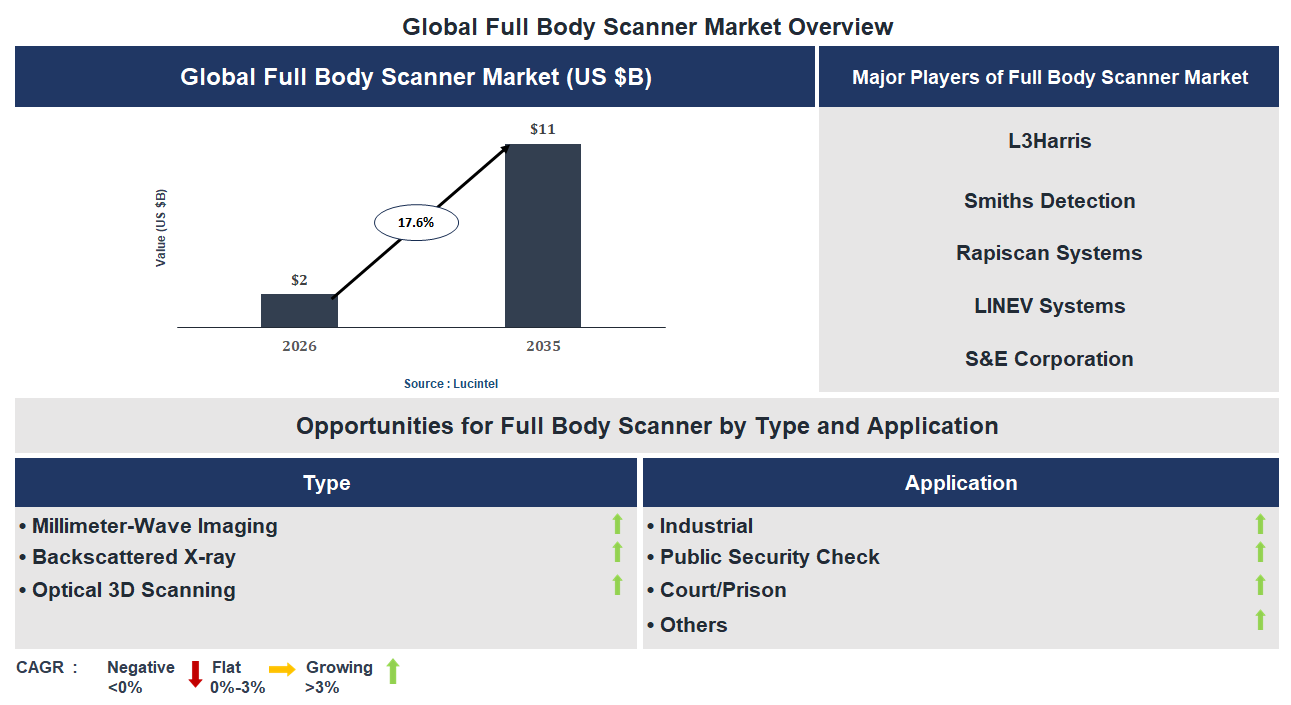
The future of the global full body scanner market looks promising with opportunities in the industrial, public security check, and court/prison markets. The global full body scanner market is expected to reach an estimated $15 billion by 2035 with a CAGR of 18.7% from 2026 to 2035. The major drivers for this market are the increasing demand for enhanced security screening systems, the rising adoption of advanced imaging technologies, and the growing need for efficient threat detection solutions.• Lucintel forecasts that, within the type category, millimeter-wave imaging is expected to witness the highest growth over the forecast period.
• Within the application category, public security check is expected to witness the highest growth.
• In terms of region, APAC is expected to witness the highest growth over the forecast period. Gain valuable insights for your business decisions with our comprehensive 150+ page report. Sample figures with some insights are shown below.
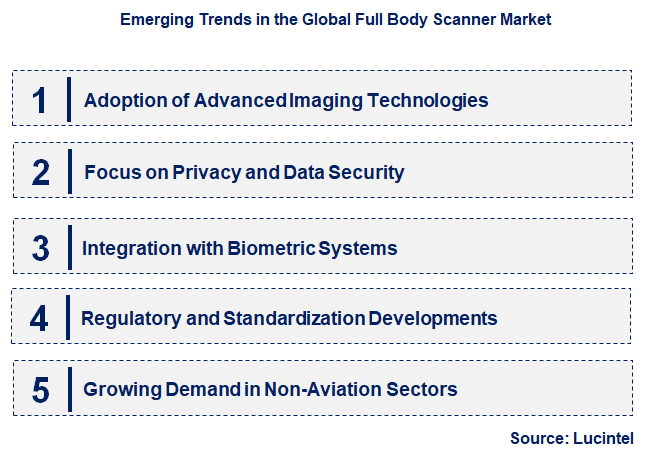
Emerging Trends in the Full Body Scanner Market
The full body scanner market is experiencing rapid evolution driven by technological advancements, increasing security concerns, and changing regulatory landscapes. As airports, government agencies, and private sectors seek more efficient and effective screening solutions, new trends are emerging that are shaping the future of this industry. These developments are not only enhancing security measures but also improving user experience and operational efficiency. The markets growth is also influenced by innovations in imaging technology, integration with other security systems, and rising demand for non-intrusive screening methods. Understanding these key trends is essential for stakeholders aiming to stay competitive and meet evolving security needs.• Integration of AI and 3D Imaging: The incorporation of artificial intelligence and 3D imaging technologies is revolutionizing full body scanners. AI enhances image analysis, enabling faster and more accurate threat detection while reducing false positives. 3D imaging provides detailed visualizations, improving the identification of concealed objects. These innovations lead to more efficient screening processes, minimizing delays and enhancing security. As technology continues to evolve, scanners become smarter, more reliable, and capable of handling complex security scenarios, thereby increasing their adoption across various sectors.
• Increased Focus on Privacy and Non-Intrusiveness: With growing concerns over privacy, manufacturers are developing non-intrusive full body scanners that protect individual privacy rights. These scanners utilize advanced imaging techniques that obscure personal details while still detecting threats effectively. The market is witnessing a shift towards privacy-preserving solutions, which are more acceptable to the public and regulatory bodies. This trend is crucial for expanding scanner deployment in sensitive environments like airports and public venues, ensuring security without compromising personal privacy, and fostering greater user acceptance.
• Rising Adoption in Non-Aviation Sectors: Beyond airports, full body scanners are increasingly adopted in sectors such as government buildings, event venues, and corporate security. This diversification is driven by the need for comprehensive security solutions in high-risk environments. The deployment in these sectors helps prevent unauthorized access, contraband smuggling, and other security threats. As organizations recognize the benefits of non-intrusive screening, the market is expanding rapidly, creating new revenue streams and encouraging technological innovation tailored to diverse security needs.
• Integration with Other Security Systems: The trend towards integrating full body scanners with other security infrastructure, such as biometric systems and CCTV networks, is gaining momentum. This integration enhances overall security by providing a multi-layered approach to threat detection and access control. It allows for seamless data sharing and real-time threat assessment, improving operational efficiency. Such integrated systems are becoming standard in modern security setups, enabling authorities to respond swiftly to threats and streamline security workflows, ultimately creating a more robust and cohesive security environment.
• Growing Emphasis on Portability and Ease of Use: Manufacturers are focusing on developing portable and user-friendly full body scanners to facilitate quick deployment and operation in various settings. Compact designs and simplified interfaces make these scanners suitable for temporary or mobile security checkpoints. This trend is particularly relevant for emergency response, military operations, and large-scale events. The emphasis on portability and ease of use ensures broader adoption, reduces installation costs, and allows security personnel to adapt quickly to changing threat landscapes, thereby enhancing overall security readiness. These emerging trends are transforming the full body scanner market by making security screening more intelligent, privacy-conscious, versatile, integrated, and accessible. These developments are not only improving threat detection capabilities but also enhancing user experience and operational efficiency, ultimately reshaping how security is managed across multiple sectors.
Recent Development in the Full Body Scanner Market
The full body scanner market is experiencing rapid growth driven by advancements in security technology, increasing demand for safety measures, and expanding applications across airports, government facilities, and event venues. Innovations in imaging technology and integration with AI are enhancing detection capabilities. Governments and private sectors are investing heavily to upgrade security infrastructure, creating significant opportunities for manufacturers and service providers. This evolving landscape demands continuous adaptation to emerging threats and technological trends, shaping the future of security screening worldwide.• Growing Security Concerns Drive Market Expansion: Increasing global security threats and terrorism concerns are prompting airports, government agencies, and private organizations to adopt advanced full body scanners. These devices offer non-intrusive, quick, and reliable screening solutions, boosting passenger safety and operational efficiency. As security protocols tighten, demand for high-quality scanners rises, fueling market growth and encouraging technological innovation to meet evolving safety standards.
• Technological Advancements Enhance Detection Capabilities: Innovations such as 3D imaging, AI integration, and improved resolution are transforming full body scanners. These advancements enable more accurate threat detection, reduce false positives, and improve user experience. Enhanced imaging and automation streamline security processes, making screenings faster and more reliable. As technology progresses, the market benefits from increased adoption, with manufacturers investing in R&D to stay competitive and meet stringent security requirements.
• Expansion into New Applications Broadens Market Reach: Beyond airports, full body scanners are increasingly used in government buildings, correctional facilities, and large event venues. This diversification opens new revenue streams and market segments. The ability to adapt scanners for different environments and security needs enhances market penetration. Growing awareness of security risks in various sectors accelerates adoption, driving demand for versatile, portable, and specialized scanning solutions.
• Rising Investment in Security Infrastructure Fuels Growth: Governments and private entities are allocating substantial budgets to upgrade security infrastructure, including full body scanners. Public-private partnerships and international security initiatives contribute to increased procurement. Investment in training, maintenance, and technological upgrades sustains market momentum. This financial commitment ensures continuous innovation and expansion, positioning the full body scanner market as a critical component of global security strategies.
• Regulatory Standards and Privacy Concerns Shape Market Dynamics: Evolving regulations regarding privacy and data protection influence scanner design and deployment. Manufacturers are developing privacy-preserving features, such as automated threat detection without detailed imaging. Compliance with international standards ensures market access and acceptance. Balancing security effectiveness with privacy rights remains a key challenge, prompting ongoing innovation and adaptation to regulatory changes, which ultimately impact market growth and acceptance. The recent developments in the full body scanner market, driven by technological innovation, expanding applications, increased investments, and regulatory adaptations, are significantly shaping the security landscape. These advancements enhance detection accuracy, operational efficiency, and user privacy, fostering broader adoption across various sectors. As security concerns persist and technology evolves, the market is poised for sustained growth, with opportunities for innovation and expansion that will influence global security infrastructure for years to come.
Strategic Growth Opportunities in the Full Body Scanner Market
The full body scanner market is experiencing rapid growth driven by increasing security concerns, technological advancements, and expanding applications across airports, public venues, and healthcare. As safety standards evolve, demand for efficient, non-invasive screening solutions rises. Market players are innovating to meet diverse needs, creating significant opportunities for expansion. Strategic investments and technological integration are key to capturing market share and enhancing operational efficiency, positioning the industry for sustained growth in the coming years.• Growing Adoption in Airport Security: The increasing need for enhanced security measures at airports worldwide is driving the adoption of full body scanners. These systems provide quick, non-invasive screening, improving passenger throughput and safety. Governments and private operators are investing heavily to upgrade existing infrastructure, ensuring compliance with international security standards. The demand for advanced imaging technology that can detect concealed threats without physical contact is a major growth driver, expanding the market’s reach across global aviation hubs.
• Expansion into Public Venues and Events: Full body scanners are increasingly being deployed in public venues such as stadiums, concert halls, and government buildings to prevent threats and ensure safety. The rising frequency of large-scale events and heightened security concerns have prompted authorities to adopt these systems for crowd screening. Portable and scalable scanner solutions are gaining popularity, enabling quick deployment and high throughput. This expansion into diverse venues offers new revenue streams and broadens the market’s application scope.
• Integration with Advanced Threat Detection Technologies: The integration of full body scanners with AI, machine learning, and biometric systems enhances threat detection accuracy and operational efficiency. These technological advancements enable real-time analysis, reducing false positives and improving passenger experience. Vendors are investing in R&D to develop smarter, more reliable systems that can identify a wider range of threats. This convergence of technologies is creating a competitive edge, fostering innovation, and opening new market segments.
• Growing Healthcare and Medical Security Applications: The healthcare sector is adopting full body scanners for patient safety, infection control, and medical security. These systems assist in non-invasive diagnostics, patient monitoring, and secure access to sensitive areas. The increasing need for contactless procedures, especially post-pandemic, is boosting demand. Additionally, hospitals and clinics are investing in advanced imaging solutions for better diagnostics, which broadens the market beyond traditional security applications and into medical fields.
• Rising Focus on Privacy and Data Security: As full body scanners handle sensitive biometric and imaging data, privacy concerns are prompting the development of secure, compliant systems. Market players are focusing on data encryption, anonymization, and user privacy features to meet regulatory standards. This focus on security enhances user trust and acceptance, facilitating broader deployment. Addressing privacy issues is crucial for market growth, especially in regions with strict data protection laws, ensuring sustainable expansion and customer confidence. These growth opportunities collectively position the full body scanner market for substantial expansion, driven by technological innovation, diverse application areas, and increasing security demands. Strategic focus on integration, privacy, and new markets will enable vendors to capitalize on emerging trends. As safety concerns continue to rise globally, the market’s evolution will be shaped by advancements that improve efficiency, accuracy, and user trust, ensuring long-term growth and resilience.
Full Body Scanner Market Driver and Challenges
The full body scanner market is influenced by a variety of technological, economic, and regulatory factors that shape its growth and development. Advances in imaging technology and increased security concerns drive demand, while regulatory standards and privacy issues pose challenges. Economic conditions, such as government spending and airline industry health, also impact market expansion. Additionally, evolving security threats and the need for enhanced screening solutions further influence market dynamics. Understanding these drivers and challenges is essential for stakeholders to navigate the complex landscape and capitalize on emerging opportunities while addressing potential obstacles. The factors responsible for driving the full body scanner market include:• Technological Innovation: The development of advanced imaging technologies, such as millimeter-wave and backscatter X-ray scanners, has significantly improved detection capabilities. These innovations enable faster, more accurate screening processes, which are crucial for high-traffic security environments like airports and government facilities. As technology continues to evolve, manufacturers can offer more compact, efficient, and less invasive scanners, boosting adoption rates. The integration of artificial intelligence and machine learning further enhances threat detection accuracy, making these systems indispensable for modern security infrastructure.
• Increasing Security Concerns: Rising global security threats, including terrorism and smuggling, have heightened the need for effective screening solutions. Governments and private organizations are investing heavily in full body scanners to prevent security breaches and ensure public safety. The growing emphasis on border security and airport safety standards has led to widespread deployment of these scanners. This increased focus on security measures directly correlates with market growth, as organizations seek reliable, non-intrusive screening methods to mitigate risks and maintain safety protocols.
• Regulatory and Policy Frameworks: Stringent government regulations and standards regarding security screening procedures have propelled the adoption of full body scanners. Many countries mandate the use of advanced imaging systems at airports, border crossings, and high-security zones. These policies often include guidelines on privacy and data protection, influencing scanner design and deployment strategies. Compliance with such regulations ensures legal operation and enhances public trust, thereby expanding market opportunities. Regulatory support also encourages technological upgrades and the adoption of newer, more effective systems.
• Growing Air Travel and Transportation Sector: The expansion of the global airline industry and increased passenger traffic have driven demand for efficient security screening solutions. Full body scanners enable quick, non-invasive checks, reducing wait times and improving passenger experience. As air travel continues to grow, airports require scalable security solutions that can handle high throughput without compromising safety. This sectors growth directly impacts the market, prompting manufacturers to innovate and supply advanced scanners tailored for busy transportation hubs.
• Rising Investment in Security Infrastructure: Governments and private entities are increasing investments in security infrastructure to combat evolving threats. Funding for airport modernization, border security, and public event security has surged, facilitating the deployment of full body scanners. These investments often include upgrading existing systems and integrating new technologies to enhance overall security effectiveness. The focus on comprehensive security solutions creates a favorable environment for market growth, encouraging manufacturers to develop innovative products that meet stringent security and privacy standards. The challenges facing the full body scanner market include:
• Privacy and Ethical Concerns: The use of full body scanners raises significant privacy issues, as they often produce detailed images of individuals bodies. Public apprehension about invasion of privacy and data security can hinder acceptance and deployment. Regulatory bodies and advocacy groups demand strict privacy protections, which can increase compliance costs and limit certain technological features. Balancing security needs with privacy rights remains a critical challenge, potentially slowing market growth and affecting public trust in these systems.
• High Implementation and Maintenance Costs: The initial purchase, installation, and ongoing maintenance of full body scanners involve substantial financial investment. Many organizations, especially in developing regions, may find these costs prohibitive. Additionally, technological upgrades and regular maintenance are necessary to ensure optimal performance and compliance with evolving standards, further increasing expenses. These financial barriers can restrict market penetration, particularly among smaller entities or regions with limited budgets, thereby impacting overall market expansion.
• Regulatory and Legal Barriers: Despite supportive policies, complex regulatory environments and legal restrictions can impede market growth. Variations in privacy laws, security standards, and approval processes across countries create barriers to widespread adoption. Lengthy certification procedures and compliance requirements can delay deployment and increase costs. Navigating these legal complexities requires significant resources and expertise, which may deter some organizations from investing in full body scanning solutions, thus constraining market development. The full body scanner market is driven by technological advancements, increasing security concerns, supportive regulations, sector growth, and investments in security infrastructure. However, privacy issues, high costs, and regulatory barriers pose significant challenges. These factors collectively influence market dynamics, requiring stakeholders to innovate and adapt strategies to maximize opportunities while addressing obstacles. The overall impact suggests a promising yet cautious growth trajectory, emphasizing the need for balanced solutions that prioritize security, privacy, and cost-effectiveness.
List of Full Body Scanner Companies
Companies in the market compete on the basis of product quality offered. Major players in this market focus on expanding their manufacturing facilities, R&D investments, infrastructural development, and leverage integration opportunities across the value chain. With these strategies full body scanner companies cater increasing demand, ensure competitive effectiveness, develop innovative products & technologies, reduce production costs, and expand their customer base. Some of the full body scanner companies profiled in this report include-• L3Harris
• Smiths Detection
• Rapiscan Systems
• LINEV Systems
• S&E Corporation
• Westminster Group
• ODSecurity
• Xscann Technologies
• Vitronic
• Artec 3D
Full Body Scanner Market by Segment
The study includes a forecast for the global full body scanner market by type, application, and region.Full Body Scanner Market by Type [Value from 2019 to 2035]:
• Millimeter-Wave Imaging
• Backscattered X-ray
• Optical 3D Scanning
Full Body Scanner Market by Application [Value from 2019 to 2035]:
• Industrial
• Public Security Check
• Court/Prison
• Others
Full Body Scanner Market by Region [Value from 2019 to 2035]:
• North America
• Europe
• Asia Pacific
• The Rest of the World
Country Wise Outlook for the Full Body Scanner Market
The full body scanner market has experienced significant growth driven by increasing security concerns, technological advancements, and regulatory requirements worldwide. Countries are investing in innovative scanning solutions to enhance safety in airports, public venues, and border controls. The markets evolution is marked by the integration of advanced imaging technologies, improved detection capabilities, and the adoption of AI-driven systems. As security threats become more sophisticated, nations are prioritizing the deployment of these scanners to ensure safety while balancing privacy concerns. The following summarizes recent developments in the United States, China, Germany, India, and Japan.• United States: The US market has seen rapid adoption of advanced full body scanners, especially in airports and government facilities. Innovations include AI-powered threat detection systems and improved privacy features. Regulatory agencies are updating standards to incorporate these technologies, leading to increased deployment. The focus is on enhancing detection accuracy and reducing false positives, with significant investments from both government and private sectors. The US also emphasizes integrating biometric identification with scanning systems for seamless security checks.
• China: China is rapidly expanding its full body scanner infrastructure, particularly in major airports and border crossings. The country is investing heavily in AI and machine learning to improve threat detection and streamline security processes. Chinese manufacturers are developing cost-effective, high-performance scanners tailored for large-scale deployment. The government prioritizes security modernization, with a focus on integrating these systems into broader surveillance networks. Recent developments include the deployment of 3D imaging scanners and facial recognition-enabled systems to enhance security and efficiency.
• Germany: Germanys market is characterized by a focus on privacy and data protection alongside technological advancements. The country is adopting scanners with enhanced privacy features, such as automatic image blurring and encrypted data transmission. Germany emphasizes compliance with strict EU data protection regulations while upgrading security infrastructure. Recent developments include the integration of AI to improve threat detection accuracy and the deployment of scanners in high-traffic public areas, including airports and train stations, to balance security with individual privacy rights.
• India: India is witnessing rapid growth in the deployment of full body scanners, driven by increased security needs at airports, government buildings, and public events. The country is focusing on affordable, portable, and easy-to-operate systems to cover a wide range of locations. Recent advancements include the adoption of AI-enabled scanners that can detect concealed threats more effectively. The government is also promoting indigenous manufacturing to reduce reliance on imports and enhance security infrastructure across the country. The emphasis remains on scalability and cost-efficiency to meet expanding security demands.
• Japan: Japan is integrating advanced full body scanning technology primarily in airports and border control points. The country is investing in systems that combine high-resolution imaging with biometric verification to improve security and passenger flow. Recent developments include the deployment of contactless, AI-enhanced scanners that facilitate quick and accurate screening. Japan also emphasizes privacy-preserving features and seamless integration with existing security systems. The focus is on maintaining high safety standards while ensuring minimal disruption to travelers, especially in the context of international events and increased security measures.

Features of the Global Full Body Scanner Market
Market Size Estimates: Full body scanner market size estimation in terms of value ($B). Trend and Forecast Analysis: Market trends (2019 to 2025) and forecast (2026 to 2035) by various segments and regions. Segmentation Analysis: Full body scanner market size by type, application, and region in terms of value ($B). Regional Analysis: Full body scanner market breakdown by North America, Europe, Asia Pacific, and Rest of the World. Growth Opportunities: Analysis of growth opportunities in different types, applications, and regions for the full body scanner market. Strategic Analysis: This includes M&A, new product development, and competitive landscape of the full body scanner market. Analysis of competitive intensity of the industry based on Porter’s Five Forces model.
FAQ
Q1. What is the full body scanner market size? Answer: The global full body scanner market is expected to reach an estimated $15 billion by 2035. Q2. What is the growth forecast for full body scanner market? Answer: The global full body scanner market is expected to grow with a CAGR of 18.7% from 2026 to 2035. Q3. What are the major drivers influencing the growth of the full body scanner market? Answer: The major drivers for this market are the increasing demand for enhanced security screening systems, the rising adoption of advanced imaging technologies, and the growing need for efficient threat detection solutions. Q4. What are the major segments for full body scanner market? Answer: The future of the full body scanner market looks promising with opportunities in the industrial, public security check, and court/prison markets. Q5. Who are the key full body scanner market companies? Answer: Some of the key full body scanner companies are as follows:• L3Harris
• Smiths Detection
• Rapiscan Systems
• LINEV Systems
• S&E Corporation
• Westminster Group
• ODSecurity
• Xscann Technologies
• Vitronic
• Artec 3D Q6. Which full body scanner market segment will be the largest in future? Answer: Lucintel forecasts that, within the type category, millimeter-wave imaging is expected to witness the highest growth over the forecast period. Q7. In full body scanner market, which region is expected to be the largest in next 8 years? Answer: In terms of region, APAC is expected to witness the highest growth over the forecast period. Q8. Do we receive customization in this report? Answer: Yes, Lucintel provides 10% customization without any additional cost.
Table of Contents
List of Figures
List of Tables
Methodology
- In-depth interviews of the major players in this market
- Detailed secondary research from competitors’ financial statements and published data
- Extensive searches of published works, market, and database information pertaining to industry news, company press releases, and customer intentions
- A compilation of the experiences, judgments, and insights of Lucintel’s professionals, who have analyzed and tracked this market over the years.


Buy Now
Choose a license that fits your team. Instant PDF delivery.
Prices exclude taxes. Instant delivery. Custom licensing available on request.
Key Questions
- • What are some of the most promising, high-growth opportunities for the full body scanner market by type (millimeter-wave imaging, backscattered X-ray, and optical 3D scanning), application (industrial, public security check, court/prison, and others), and region (North America, Europe, Asia Pacific, and the Rest of the World)?
- • Which segments will grow at a faster pace and why?
- • Which region will grow at a faster pace and why?
- • What are the key factors affecting market dynamics? What are the key challenges and business risks in this market?
- • What are the business risks and competitive threats in this market?
- • What are the emerging trends in this market and the reasons behind them?
- • What are some of the changing demands of customers in the market?
- • What are the new developments in the market? Which companies are leading these developments?
- • Who are the major players in this market? What strategic initiatives are key players pursuing for business growth?
- • What are some of the competing products in this market and how big of a threat do they pose for loss of market share by material or product substitution?
- • What M&A activity has occurred in the last 5 years and what has its impact been on the industry? For any questions related to Full Body Scanner Market, Full Body Scanner Market Size, Full Body Scanner Market Growth, Full Body Scanner Market Analysis, Full Body Scanner Market Report, Full Body Scanner Market Share, Full Body Scanner Market Trends, Full Body Scanner Market Forecast, Full Body Scanner Companies, write Lucintel analyst at email: helpdesk@lucintel.com. We will be glad to get back to you soon.


