
Report Feature
Conversational AI Market Trends and Forecast
The technologies in the conversational AI market have undergone significant changes in recent years, shifting from rule-based chatbots to AI-driven conversational agents. This transition has led to more natural, context-aware interactions, leveraging advanced natural language processing (NLP) and machine learning (ML) to enhance customer engagement and improve service efficiency across industries.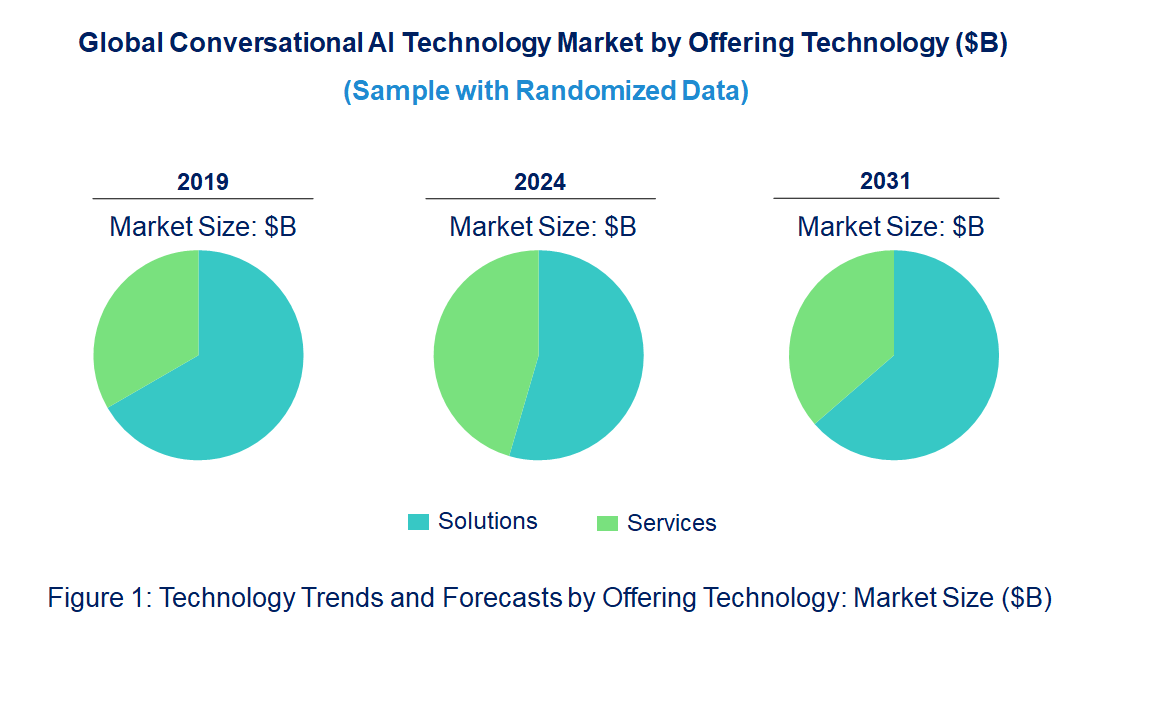
Emerging Trends in the Conversational AI Market
The conversational AI market is evolving rapidly as AI-driven solutions are increasingly integrated into businesses to enhance customer experience, automate tasks, and reduce operational costs. The following five trends are shaping the future of Conversational AI:• AI-powered personalization: Conversational AI solutions are becoming increasingly personalized, utilizing machine learning to tailor interactions based on past conversations, customer preferences, and behaviors. This leads to more engaging and relevant experiences, driving customer satisfaction and loyalty.
• Multi-channel and omnichannel integration: Businesses are deploying Conversational AI solutions across multiple channels, such as websites, mobile apps, social media, and voice assistants. This trend allows companies to provide seamless, consistent experiences for customers regardless of the platform, improving accessibility and convenience.
• Sentiment analysis and emotional intelligence: Modern Conversational AI systems are incorporating sentiment analysis and emotional intelligence capabilities, enabling them to better understand user emotions and respond in a more empathetic and effective manner. This improves customer interactions, especially in industries like healthcare, finance, and customer service.
• Voice assistants and voice commerce: With the rise of voice-enabled devices like Amazon Alexa, Google Assistant, and Siri, Conversational AI is making significant strides in voice-based applications. Voice assistants are now being used for various business functions, including customer service, transactions, and product discovery, driving the growth of voice commerce.
• Automated customer service and virtual assistants: Many businesses are automating customer service tasks using AI-driven virtual assistants that can handle inquiries, troubleshoot issues, and provide information. This reduces the need for human intervention, increases operational efficiency, and provides quicker, more accurate responses to customers. These emerging trends are transforming the conversational AI market by enhancing personalization, improving customer experiences, and driving efficiency in operations. As businesses increasingly leverage AI-powered solutions, they are able to deliver more intelligent, adaptive, and seamless customer interactions.
Conversational AI Market : Industry Potential, Technological Development, and Compliance Considerations
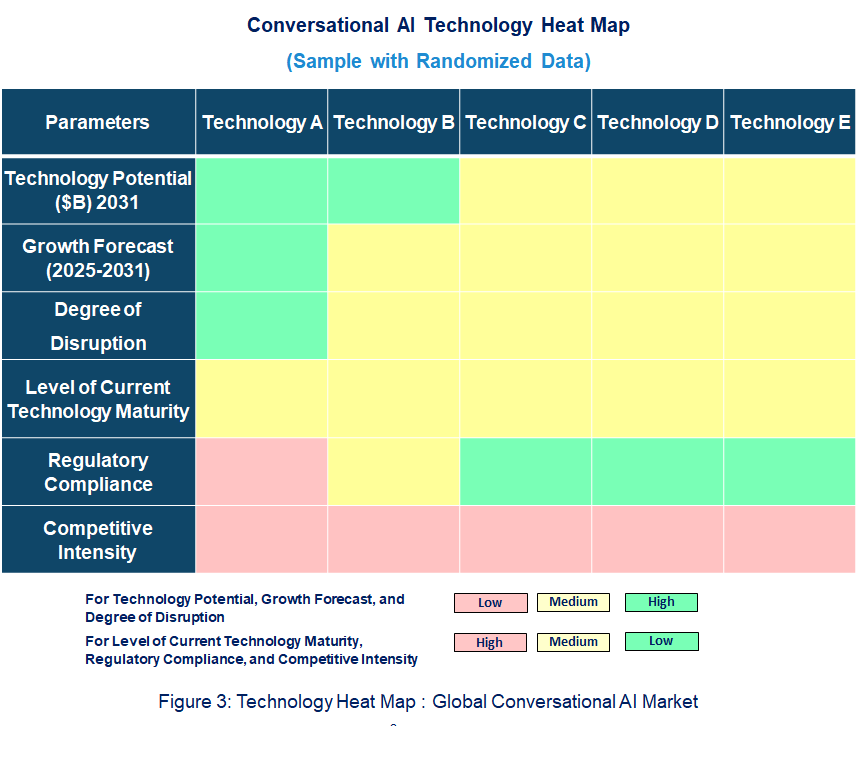
Conversational AI is revolutionizing how humans interact with machines, enabling natural, intuitive communication through text and voice. With advancements in natural language processing (NLP) and machine learning, conversational AI is increasingly being deployed across industries to enhance customer experiences and automate tasks.• Technology potential: The potential for conversational AI is immense, with applications spanning customer service, virtual assistants, healthcare, e-commerce, and more. By leveraging NLP, machine learning, and sentiment analysis, conversational AI can provide highly personalized and context-aware interactions, improving efficiency and user satisfaction. It also enables businesses to scale customer engagement and automate routine processes, reducing operational costs.
• Degree of disruption: Conversational AI is highly disruptive, transforming customer support, marketing, and even decision-making processes. It is replacing traditional customer service models, where human agents are limited, with 24/7 virtual assistants that can handle a wide range of inquiries. This shift is creating new business models and opportunities, particularly in industries like retail, banking, and telecom.
• Technology maturity: While basic conversational AI technologies, such as chatbots, are well-established, more advanced applications—like voice-enabled assistants and multilingual support—are still maturing. Despite rapid advancements, challenges remain in achieving truly conversational, context-aware AI that can handle complex, nuanced dialogues.
• Regulatory compliance: Conversational AI technologies must comply with privacy and data protection regulations like GDPR and CCPA. They also need to address industry-specific compliance, such as HIPAA for healthcare, ensuring that customer data is handled securely and ethically.
Recent Technological development in Conversational AI Market by Key Players
As conversational AI technologies continue to evolve, major players in the industry are driving innovations that improve customer service, streamline operations, and offer more sophisticated AI capabilities. Here are the recent developments from key players:• IBM integrates AI into its Watson Assistant to deliver more sophisticated conversational capabilities. Watson now includes advanced NLP, machine learning, and integration with enterprise systems, enabling businesses to create more personalized and context-aware customer interactions.
• Microsoft has made significant advancements in Conversational AI with its Azure Cognitive Services. By combining natural language understanding, speech recognition, and translation technologies, Microsoft has enabled businesses to create intelligent chatbots and virtual assistants that can function across multiple languages and channels.
• Google has strengthened its conversational capabilities with the introduction of Google Dialogflow, which leverages Google's AI and NLP capabilities to help businesses develop powerful voice and text-based conversational interfaces. The integration with Google Cloud enhances scalability and supports a wide range of industry applications.
• AWS has continued to enhance its Conversational AI offerings with Amazon Lex, enabling businesses to build sophisticated conversational agents with automatic speech recognition (ASR) and natural language understanding (NLU). AWS's robust cloud infrastructure allows for scalable deployment across industries like retail, healthcare, and finance.
• Artificial Solutions offers advanced conversational AI solutions through its Teneo platform, which is capable of creating highly intelligent, multilingual virtual assistants. Teneo uses AI and NLP to enable businesses to automate complex tasks and deliver intelligent conversational experiences in real time.
• Baidu has launched several AI-driven conversational products, including its DuerOS platform, which powers voice assistants for smart devices. Baidu's focus is on deep learning and NLP to improve conversational accuracy and enable intelligent virtual assistants for a wide range of industries.
• SAP integrates Conversational AI into its enterprise software suite with SAP Conversational AI. This platform is designed to help businesses automate customer service, HR processes, and other functions, improving overall productivity and user engagement.
• Oracle offers conversational AI solutions through Oracle Digital Assistant, which provides a platform for building virtual assistants across various enterprise applications. It allows businesses to automate workflows and integrate AI-driven interactions into their enterprise systems.
• OpenAI has made notable strides in Conversational AI with the launch of GPT (Generative Pre-trained Transformer) models. GPT-3, in particular, has revolutionized the capabilities of chatbots by offering more nuanced, human-like conversations, setting a new benchmark for natural language generation.
• LivePerson provides Conversational AI solutions that empower businesses to engage with customers across multiple messaging platforms. Their AI-powered chatbots are designed to enhance customer service, reduce operational costs, and improve the customer journey with intelligent, automated responses. These developments reflect the ongoing evolution of conversational AI, with a strong focus on enhancing natural language processing, integration with enterprise systems, and multi-channel capabilities. The continued innovation by these key players is propelling the market forward and transforming customer interactions across industries.
Conversational AI Market Driver and Challenges
The conversational AI market is experiencing rapid growth, driven by the increasing demand for automation, personalization, and customer engagement solutions. However, challenges such as data privacy concerns and technological limitations persist. Below are the key drivers and challenges impacting the market: The factors responsible for driving the conversational AI market include:• Growing demand for automated customer support: Companies are increasingly adopting Conversational AI to automate customer service functions. This reduces operational costs, increases efficiency, and provides 24/7 support, making businesses more accessible and responsive to customer needs.
• Rising adoption of AI and NLP technologies: Advances in AI and natural language processing (NLP) are making Conversational AI solutions more accurate and capable. These technologies are helping businesses create smarter, more human-like virtual assistants, enhancing the overall customer experience.
• Need for personalized customer experiences: Consumers expect more personalized interactions with brands. Conversational AI allows businesses to deliver tailored content, recommendations, and services based on individual preferences and behaviors, leading to increased customer satisfaction and loyalty.
• Expansion of voice-activated devices: The proliferation of voice-activated devices like Amazon Alexa, Google Assistant, and Apple Siri is driving the growth of voice-based Conversational AI applications. Businesses are leveraging these platforms to engage customers and provide hands-free, intuitive experiences. Challenges in the conversational AI market are:
• Data privacy and security concerns: With the increasing use of AI-driven chatbots and virtual assistants, data privacy and security are major concerns. Businesses must ensure that customer data is handled responsibly and that AI systems comply with data protection regulations like GDPR.
• Integration with existing systems: Many businesses face challenges in integrating Conversational AI solutions with their existing IT infrastructure and enterprise systems. This requires significant time, effort, and resources to ensure seamless functionality and data flow across platforms.
• Limited understanding of context and emotions: While Conversational AI has made great strides, it still struggles with understanding nuanced emotions, cultural contexts, and complex human interactions. This limitation can affect the quality of customer service and engagement, especially in sensitive areas like healthcare and finance. While these drivers present significant opportunities for the Conversational AI Market, addressing the challenges of data privacy, system integration, and emotional intelligence will be essential for maximizing the effectiveness and adoption of Conversational AI solutions. Conversational AI is revolutionizing how humans interact with machines, enabling natural, intuitive communication through text and voice. With advancements in natural language processing (NLP) and machine learning, conversational AI is increasingly being deployed across industries to enhance customer experiences and automate tasks.
List of Conversational AI Companies
Companies in the market compete based on product quality offered. Major players in this market focus on expanding their manufacturing facilities, R&D investments, infrastructural development, and leverage integration opportunities across the value chain. With these strategies conversational AI companies cater to increasing demand, ensure competitive effectiveness, develop innovative products & technologies, reduce production costs, and expand their customer base. Some of the conversational AI companies profiled in this report include.• IBM
• Microsoft
• AWS
• Artificial Solutions
• Baidu
Conversational AI Market by Technology
• Technology readiness by type for Conversational AI Market: Conversational AI solutions like chatbots and virtual assistants are mature but still face challenges in achieving perfect human-like interaction. AI services, such as integration and consulting, are growing, with varied maturity based on implementation complexity. Competitive intensity is high, with established players and startups offering advanced solutions. Regulatory compliance is critical in sectors like finance and healthcare, where data security is essential. Both solutions and services must meet privacy regulations such as GDPR. Key applications include customer service, sales, and healthcare support, with growing integration into voice devices and enterprise software. Solutions are evolving with a focus on natural language understanding and user experience. The market is dynamic, with continuous innovation in personalization, scalability, and automation.
• Competitive intensity and regulatory compliance of different technologies for the Conversational AI Market: The conversational AI market is highly competitive, with global players and startups offering diverse solutions and services. AI solution providers compete on natural language processing, integration, and customization. Services like AI consulting and integration are also competitive, with businesses seeking specialized expertise. Regulatory compliance is a significant challenge, especially in industries like healthcare, finance, and retail, which handle sensitive data. Companies must comply with data protection laws such as GDPR and CCPA. Ethical concerns regarding AI biases and transparency also impact market dynamics. Solutions and services must align with legal frameworks and ensure data privacy to maintain trust. Regulatory requirements are increasing, driving innovation in secure and ethical AI applications. Meeting compliance and ethical standards is essential to gaining market acceptance.
• Disruption potential of different technologies for the Conversational AI Market: Solutions and services in the conversational AI market have transformative potential. AI solutions, like chatbots and voice assistants, automate customer interactions, improving efficiency and reducing costs. Services such as AI integration and consulting help businesses scale AI technologies. The combination of machine learning, NLP, and cloud computing enhances conversational capabilities, enabling real-time, personalized communication. These solutions are adopted across sectors like retail, healthcare, finance, and telecom, disrupting traditional service models. Conversational AI offers significant benefits in customer experience, streamlining operations and creating new business models. As AI continues to evolve, it becomes central to improving customer engagement and driving automation. The ability to automate tasks and provide human-like interaction gives businesses a competitive advantage. This technology is reshaping industries by optimizing communication and business processes.
Conversational AI Market Trend and Forecast by Offering Technology [Value from 2019 to 2031]:
• Solutions
• Services
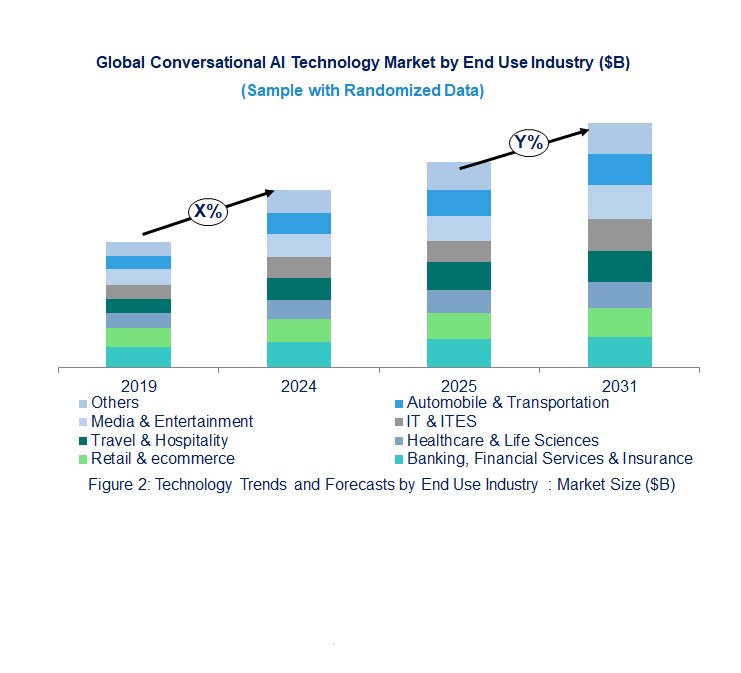
Conversational AI Market Trend and Forecast by End Use Industry [Value from 2019 to 2031]:
• Banking, Financial Services & Insurance
• Retail & ecommerce
• Healthcare & Life Sciences
• Travel & Hospitality
• IT & ITES
• Media & Entertainment
• Automobile & Transportation
• Others
Conversational AI Market by Region [Value from 2019 to 2031]:
• North America
• Europe
• Asia Pacific
• The Rest of the World
• Latest Developments and Innovations in the Conversational AI Technologies
• Companies / Ecosystems
• Strategic Opportunities by Technology Type
Features of the Global Conversational AI Market
Market Size Estimates: Conversational AI market size estimation in terms of ($B). Trend and Forecast Analysis: Market trends (2019 to 2024) and forecast (2025 to 2031) by various segments and regions. Segmentation Analysis: Technology trends in the global conversational AI market size by various segments, such as end use industry and offering technology in terms of value and volume shipments. Regional Analysis: Technology trends in the global conversational AI market breakdown by North America, Europe, Asia Pacific, and the Rest of the World. Growth Opportunities: Analysis of growth opportunities in different end use industries, offering technologies, and regions for technology trends in the global conversational AI market. Strategic Analysis: This includes M&A, new product development, and competitive landscape for technology trends in the global conversational AI market. Analysis of competitive intensity of the industry based on Porter’s Five Forces model.Table of Contents
Methodology
- In-depth interviews of the major players in this market
- Detailed secondary research from competitors’ financial statements and published data
- Extensive searches of published works, market, and database information pertaining to industry news, company press releases, and customer intentions
- A compilation of the experiences, judgments, and insights of Lucintel’s professionals, who have analyzed and tracked this market over the years.


Buy Now
Choose a license that fits your team. Instant PDF delivery.
Prices exclude taxes. Instant delivery. Custom licensing available on request.
Key Questions
- • What are some of the most promising potential, high-growth opportunities for the technology trends in the global conversational ai market by offering technology (solutions and services), end use industry (banking, financial services & insurance, retail & ecommerce, healthcare & life sciences, travel & hospitality, it & ites, media & entertainment, automobile & transportation, and others), and region (North America, Europe, Asia Pacific, and the Rest of the World)?
- • Which technology segments will grow at a faster pace and why?
- • Which regions will grow at a faster pace and why?
- • What are the key factors affecting dynamics of different offering technology? What are the drivers and challenges of these offering technologies in the global conversational AI market?
- • What are the business risks and threats to the technology trends in the global conversational AI market?
- • What are the emerging trends in these offering technologies in the global conversational AI market and the reasons behind them?
- • Which technologies have potential of disruption in this market?
- • What are the new developments in the technology trends in the global conversational AI market? Which companies are leading these developments?
- • Who are the major players in technology trends in the global conversational AI market? What strategic initiatives are being implemented by key players for business growth?
- • What are strategic growth opportunities in this conversational AI technology space?
- • What M & A activities did take place in the last five years in technology trends in the global conversational AI market?


