
Report Feature
Cable Joints Market Trends and Forecast
The technologies under cable joints technology have changed significantly in the past few years, from rubber and compression-based cable joints to advanced epoxy and cold-shrink technologies. They emphasize durability, environmental resistance, and electrical performance. New materials and manufacturing techniques have improved the lifespan and reliability of cable joints, ensuring better performance in harsh environments. It includes innovations in increasing flexibility, ease of installation, and compatibility with high-voltage and low-temperature applications meeting all modern industrial requirements.

Emerging Trends in the Cable Joints Market
The cable joint technology market is developing at a very rapid pace because of the increasing need for more robust, reliable, and environmentally resilient solutions across different industries such as energy, telecommunications, and infrastructure. Innovations focus on improving electrical conductivity, longevity, and resistance to environmental factors like temperature fluctuations and moisture. Here are five key trends shaping this market:• Adoption of Cold-Shrink Technology: Cold-shrink cable joints are increasingly becoming popular because they have a faster installation process and superior environmental protection. These joints have excellent resistance to moisture and contaminants, thus providing long-term performance under adverse conditions.
• Incorporation of Advanced Epoxy Materials: The use of high-performance epoxy materials in cable joints enhances the mechanical strength and electrical insulation. This trend improves the durability and reliability of connections, even under extreme temperatures and environmental conditions.
• Sustainable and Eco-Friendly Materials: Eco-friendly materials, like recyclable compounds, are becoming the new focus for manufacturers to decrease their ecological footprint. The demand for sustainable and green technologies is on the rise in the industrial and utility sectors.
• High Voltage and Temperature Tolerance Solutions: New cable joint technologies are designed with high voltage and extreme temperature variations, which guarantee safety and efficiency in critical power transmission and industrial applications.
• Increased Ease of Installation and Maintenance: Technologies have also been focused on designing systems that make the installation and maintenance aspects easier. Quick connect and modularity ensure minimum downtime in installation, and reduced labor inputs during maintenance stages help make the cabling joints more cost and efficient for integration. The market is getting reshaped as these new cable joint technologies emerge based on the principles of durability, environmental sustainability, and cost efficiency. Advanced materials and an eco-friendly design ensure more performance with sustainability, satisfying the demands across energy, telecommunications, and infrastructure.
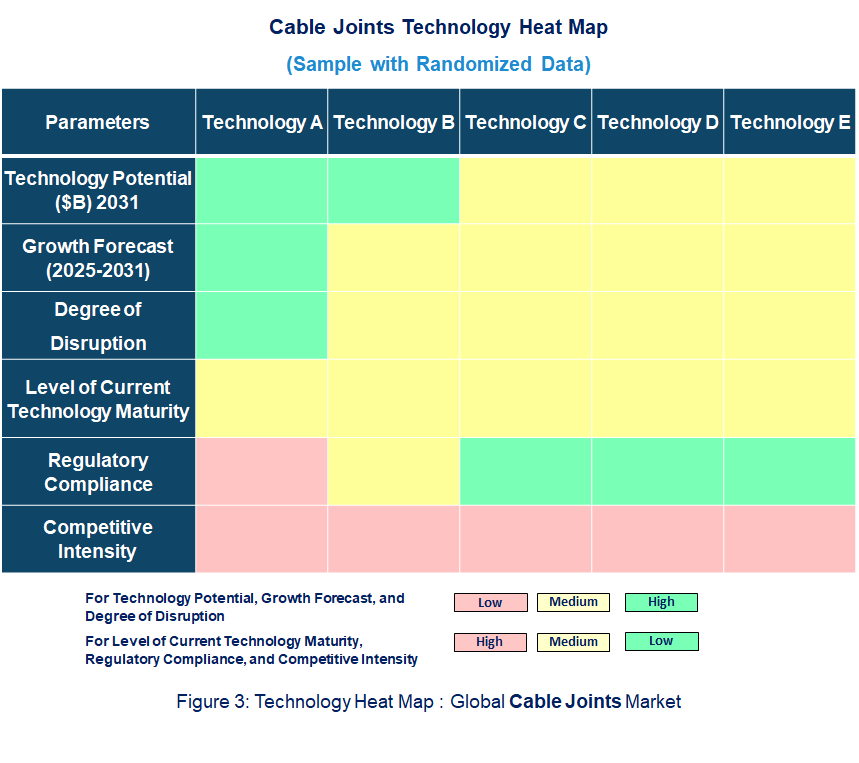
Cable Joints Market : Industry Potential, Technological Development, and Compliance Considerations
The evolving nature of the cable joints technology market is a product of growing demand for increased efficiency, durability, and resilience of connections in a diverse set of industries involving energy, telecommunication, construction, and many others. Advancements in electrical performance and environmental factors, and materials, which are supposed to be sustainable, play an essential role in forming modern infrastructure and utility project applications with the aid of cable joints.• Technology Potential: Cable joints have tremendous opportunities for innovation, concerning materials such as cold-shrink compounds and high-performance epoxies. These innovations improve electrical conductivity, mechanical strength, and resistance to environmental wear. Integration of smart technologies and self-healing materials is on the horizon.
• Degree of Disruption: The adoption of cold-shrink technology, modular designs, and eco-friendly materials is disrupting traditional installation and maintenance practices. These technologies reduce installation time, costs, and environmental impact, transforming the operational workflow in utilities and infrastructure projects.
• Current Technology Maturity Level: Most cable joint technologies, such as cold-shrink and epoxy-based solutions, are mature and widely deployed across critical sectors. Continuous development ensures improved efficiency and reliability, even in demanding environments.
• Regulatory Compliance: Manufacturers adhere to strict industry standards and regulations concerning electrical safety, material durability, and environmental impact, such as IEC and ANSI guidelines. Compliance ensures the reliability and sustainability of cable joints across global markets and infrastructure projects.
Recent Technological development in Cable Joints Market by Key Players
The cable joint technology market has witnessed substantial advancements in recent years, driven by the demand for greater durability, performance efficiency, and sustainability. Leading companies like TE Connectivity, 3M, Fujikura, ABB, and others are focusing on enhancing the reliability, environmental resilience, and cost-effectiveness of their products. Innovations in materials, modular designs, and eco-friendly solutions are setting new benchmarks in performance, safety, and installation efficiency across industries such as energy, telecommunications, and infrastructure.• TE Connectivity: TE Connectivity continues to innovate with high-performance cable joint solutions designed for harsh environments. Their cold-shrink technology and modular designs provide improved durability, resistance to moisture, and quick installation capabilities.
• 3M :3M has advanced its cable joint solutions with environmentally resilient compounds and sustainable materials. Its offerings include cold-shrink and adhesive-based joints, which ensure long-lasting connections while prioritizing ease of installation and environmental compliance.
• Fujikura: Fujikura specializes in high-performance cable joints, using state-of-the-art materials to achieve the best electrical conductivity and mechanical integrity, thus enabling optimum performance in the energy and telecommunications sectors.
• ABB: ABB has developed modular cable joint systems that cut installation complexity and time. Their technology is focused on energy efficiency and long-term reliability, making installations faster and cheaper.
• Connect Cable Accessories: This company offers robust cable joint solutions that focus on safety and resistance to environmental factors, ensuring operational continuity across critical infrastructure projects.
• NKT: NKT has developed advanced jointing technologies that focus on eco-friendly materials, enhancing environmental sustainability without compromising performance.
• Cable Jointing Solutions: They provide client-specific jointing technologies whose deployment is fast, cost-efficient, safe, and able to meet the industry requirements in terms of safety, performance, and environment.
• Nexans: Nexans considers performance and environmental sustainability at its core, providing high-resistance and cold-shrink joints for demanding industries and energy applications.
• Prysmian: Their focus is on highly resilient cable jointing solutions that are applicable for offshore and underground installations, and resistant to harsh environments.
• Yamuna Power & Infrastructure: Yamuna Power & Infrastructure remains focused on cost-effective jointing solutions with high operational reliability for critical energy and infrastructure sectors while adhering to global safety standards. These companies' relentless innovation towards eco-friendly, efficient technologies is driving advancements in the cable joint market and further enhancing reliability, sustainability, and cost efficiency across various industries.
Cable Joints Market Driver and Challenges
The cable joint technology market is witnessing tremendous growth through its increasing demand for connections, which are reliable, durable, and environmentally durable. The performance requirements of different industries, including energy, telecommunication, and infrastructure, are compelling companies to become more innovative to reduce time to install and lower overall costs. The factors responsible for driving the Cable Joints market include:• High-Performing Materials for High Permeability: The need for superior electrical conductivity coupled with higher mechanical strength is increased in industrial applications where better connections are highly demanded. Sustainable and environment-friendly solutions - The increase in demand for environmentally benign cable joint technologies is prevalent. Companies have been developing solutions making use of sustainable materials and eco-aware manufacturing processes, as per global environmental regulations are concerned.
• Modular and Quick-Install Designs: Modular cable joint systems are on the rise because they save time and reduce labor costs in installation. This innovation allows for fast deployment and continued operation in projects for critical infrastructure.
• Advancements in Cold-Shrink Technology: Cold-shrink technology is widely used because of its waterproof and quick-install capabilities, which ensure that installations are efficient in both underground and harsh outdoor environments. Challenges
• Technological Integration of Renewable Energy Projects: The integration of advanced cable joints in renewable energy infrastructure that includes solar farms and installations of wind is expanding toward having efficient energy transmission and sustainability. These growth opportunities are reshaping the cable joint technology market by driving the development of more reliable, cost-efficient, and environmentally sustainable solutions. The emphasis on high-performance materials, quick installation designs, and modular solutions ensures operational efficiency and compliance with global environmental and safety standards across industries.
List of Cable Joints Companies
Companies in the market compete based on product quality offered. Major players in this market focus on expanding their manufacturing facilities, R&D investments, infrastructural development, and leverage integration opportunities across the value chain. With these strategies cable joints companies cater to increasing demand, ensure competitive effectiveness, develop innovative products & technologies, reduce production costs, and expand their customer base. Some of the cable joints companies profiled in this report include.• TE Connectivity
• 3M
• Fujikura
• ABB
• Connect Cable Accessories
• NKT
Cable Joints Market by Technology
• Technology Readiness by Technology Type: High-voltage cable joint technology is mature, with robust solutions that ensure efficient power transmission over long distances, which is crucial for grid infrastructure and utility projects. Low-voltage cable joint technology is accessible, focusing on cost efficiency and wide integration in consumer electronics and small appliances. Medium-voltage technologies are well-established in commercial and industrial use, balancing performance with safety and scalability. Cold-shrink and modular technologies are being increasingly applied across all voltage levels because of the ease of installation and resilience to the environment. There is constant research into developing the materials involved in these technologies, for instance, using green compounds for all voltage technologies. Electrical conductivity and mechanical strength are being enhanced for joint performance. Real-time diagnostics and preventive maintenance through smart monitoring and IoT integration are also becoming increasingly implemented. Developable as compatible with different voltage technologies of modular connectors and pre-fabricated solutions, industry leaders seek quick-connect and environmentally friendly solutions to make products cost-effective while causing minimal damage to nature. Applications of these products encompass several other arenas in the form of large-scale projects related to infrastructure, renewable source installation, consumer electronics products, and industries.
• Competitive Intensity and Regulatory Compliance: The competitive intensity in the cable joint technology market is driven by companies striving to meet the performance and safety standards required across high, low, and medium voltage applications. High-voltage technologies face stringent regulatory compliance due to safety and efficiency mandates, ensuring minimal transmission losses. Low-voltage solutions cater to consumer electronics, where design flexibility and cost control are crucial. Medium voltage technologies are widely used in commercial and industrial sectors, and thus require robust safety and compliance measures. Regulations around environmental sustainability are influencing the use of eco-friendly materials across all voltage categories. Companies invest heavily in research and development to meet international electrical safety and environmental standards. Continuous improvements in cold-shrink and modular designs further differentiate product offerings. Quick-connect solutions aim at reducing installation times and operational costs for competitive manufacturers. Cross-sector partnerships are developing to address interoperability and compatibility issues. Quality certifications and adherence to ISO and IEC standards serve as key differentiators. These ensure that companies maintain a competitive edge in delivering cost-effective, reliable, and sustainable cable joint solutions across all voltage levels.
• Disruption Potential of Different Technologies: The disruption potential of high voltage, low voltage, and medium voltage cable joint technologies is considerable since all of them bring forth specific benefits as well as problems. High-voltage solutions advance power transmission efficiency and grid scalability. Low-voltage designs are also enhanced to be more flexible and accessible for consumer electronics. Medium voltage technologies are in the middle of transmission capacity and safety, with applications in industry and infrastructure. Innovations like cold-shrink and modular joints are uprooting the traditional installation methods. Advanced materials enhance electrical conductivity and longevity at all voltage levels. AI-driven monitoring technologies are integrating real-time diagnostics to prevent failures. The demand for eco-friendly materials is pushing sustainable solutions across all voltage technologies. Compact designs and quick-install connectors enable faster deployment and cost efficiency. The technologies are also adapting to smart grid integration and renewable energy solutions. With industries scaling up their operations and requiring more robust connections, these voltage levels continue to drive technological progress. Finally, these innovations improve efficiency, reliability, and sustainability across applications that range from infrastructure projects to consumer electronics and renewable energy integration.
Cable Joints Market Trend and Forecast by Voltage Technology [Value from 2019 to 2031]:
• High Voltage
• Low Voltage
• Medium Voltage
Cable Joints Market Trend and Forecast by End Use Industry [Value from 2019 to 2031]:
• Industrial
• Aerospace and defense
• Oil and gas
• Energy and Power
• IT and Telecommunication
• Others
Cable Joints Market by Region [Value from 2019 to 2031]:
• North America
• Europe
• Asia Pacific
• The Rest of the World
• Latest Developments and Innovations in the Cable Joints Technologies
• Companies / Ecosystems
• Strategic Opportunities by Technology Type
Features of the Global Cable Joints Market
Market Size Estimates: Cable joints market size estimation in terms of ($B). Trend and Forecast Analysis: Market trends (2019 to 2024) and forecast (2025 to 2031) by various segments and regions. Segmentation Analysis: Technology trends in the global cable joints market size by various segments, such as end use industry and voltage technology in terms of value and volume shipments. Regional Analysis: Technology trends in the global cable joints market breakdown by North America, Europe, Asia Pacific, and the Rest of the World. Growth Opportunities: Analysis of growth opportunities in different end use industries, voltage technologies, and regions for technology trends in the global cable joints market. Strategic Analysis: This includes M&A, new product development, and competitive landscape for technology trends in the global cable joints market. Analysis of competitive intensity of the industry based on Porter’s Five Forces model.Table of Contents
Methodology
- In-depth interviews of the major players in this market
- Detailed secondary research from competitors’ financial statements and published data
- Extensive searches of published works, market, and database information pertaining to industry news, company press releases, and customer intentions
- A compilation of the experiences, judgments, and insights of Lucintel’s professionals, who have analyzed and tracked this market over the years.


Buy Now
Choose a license that fits your team. Instant PDF delivery.
Prices exclude taxes. Instant delivery. Custom licensing available on request.
Key Questions
- • What are some of the most promising potential, high-growth opportunities for the technology trends in the global cable joints market by voltage technology (high voltage, low voltage, and medium voltage), end use industry (industrial, aerospace and defense, oil and gas, energy and power, it and telecommunication, and others), and region (North America, Europe, Asia Pacific, and the Rest of the World)?
- • Which technology segments will grow at a faster pace and why?
- • Which regions will grow at a faster pace and why?
- • What are the key factors affecting dynamics of different voltage technology? What are the drivers and challenges of these voltage technologies in the global cable joints market?
- • What are the business risks and threats to the technology trends in the global cable joints market?
- • What are the emerging trends in these technologies in the global cable joints market and the reasons behind them?
- • Which technologies have potential of disruption in this market?
- • What are the new developments in the technology trends in the global cable joints market? Which companies are leading these developments?
- • Who are the major players in technology trends in the global cable joints market? What strategic initiatives are being implemented by key players for business growth?
- • What are strategic growth opportunities in this cable joints technology space?
- • What M & A activities did take place in the last five years in technology trends in the global cable joints market?


