
Report Feature
Blockchain Finance Market Trends and Forecast
The technologies in the blockchain finance market have experienced a dramatic shift in recent years from public blockchains to private blockchains for better privacy and scalability, thereby making financial transactions more secure. Furthermore, there has been a shift from proof-of-work (PoW) to proof-of-stake (PoS) consensus mechanisms, which provide energy-efficient alternatives for transaction validation. Increased adoption of smart contracts has also led to more automation of financial processes such as asset management and trade finance with reduced intermediaries. Additionally, interoperability solutions have been enhanced to allow the seamless integration of different blockchain networks that improve cross-border payment and settlement systems. The market is also seeing improvement in identity verification technologies, which will include biometric authentication and DIDs for better security and friendliness to the identification processes. These changes in technology have streamlined operations, reduced costs, and increased the security and efficiency of blockchain-based financial services.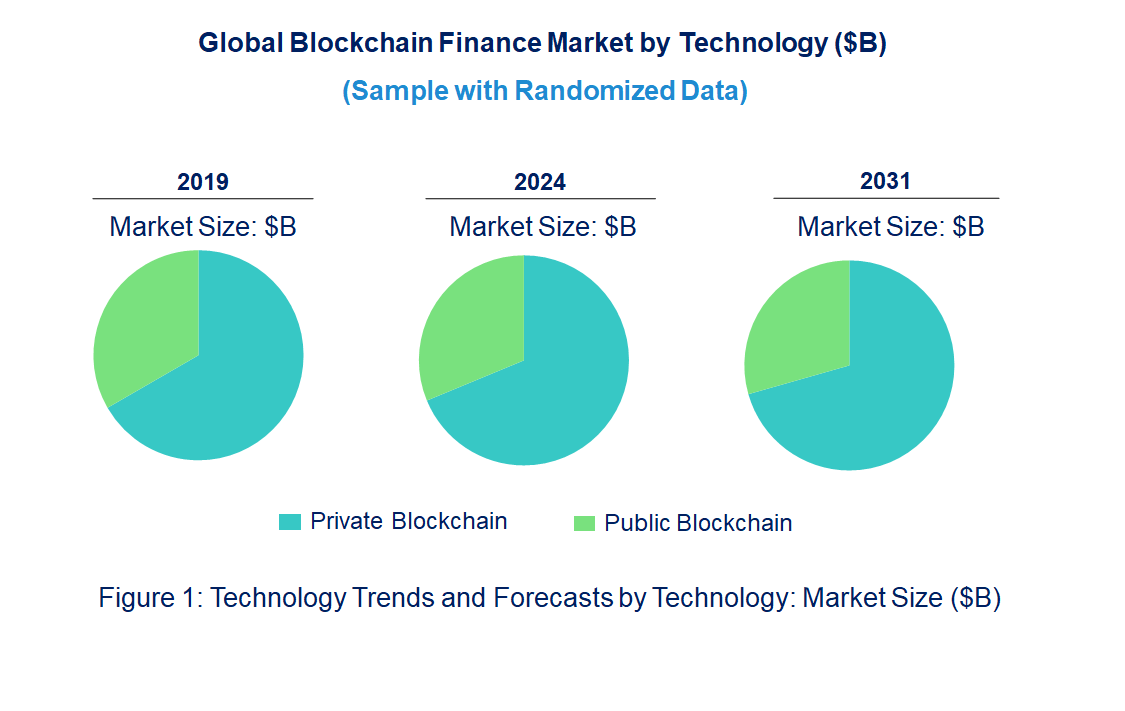
Emerging Trends in the Blockchain Finance Market
The blockchain finance market is fast-evolving, with financial institutions and companies increasingly looking at the benefits of blockchain technology to enhance security, transparency, and efficiency. Digital currencies, decentralized finance (DeFi), and regulatory developments have been leading to new trends in shaping the future of financial services. Five key emerging trends that are driving change in the market are listed below:• Integration of Central Bank Digital Currencies (CBDCs): Many governments are now looking into the development and adoption of CBDCs, which utilize blockchain for secure, transparent, and efficient currency issuance. These digital currencies will transform cross-border payments and settlements by providing faster and cheaper alternatives to traditional banking systems. CBDCs may also lead to financial inclusion by offering accessible banking solutions to unbanked populations.
• Growth in Decentralized Finance (DeFi): The adoption of DeFi platforms, which allow for lending, borrowing, and trading without intermediaries, is gaining significant momentum. DeFi uses the transparency, security, and capabilities of smart contracts in blockchain to create decentralized financial ecosystems. The rapidly increasing use of DeFi applications is democratizing access to financial services, especially for people in underbanked regions, and also opening up new avenues for investment and asset management.
• More Interest in Blockchain Interoperability: With the increasing emergence of blockchain networks, interoperability has been the latest trend in the finance sector. Solutions that allow seamless interaction between different blockchain platforms provide more fluid cross-chain transactions and data sharing. This trend supports the development of a more connected and integrated blockchain finance ecosystem, ensuring that different networks, such as private and public blockchains, can work together efficiently.
• Tokenization of Assets: Tokenization, or the process of converting real-world assets (such as real estate, stocks, and commodities) into digital tokens on a blockchain, is gaining momentum. This trend is making assets more accessible, as fractional ownership becomes possible, enabling smaller investors to participate in markets that were previously out of reach. Tokenization is also improving liquidity by allowing assets to be traded 24/7 on blockchain-based platforms.
• Enhanced Security and Privacy Solutions: As blockchain adoption grows in finance, so does the need for stronger security and privacy mechanisms. Innovations like zero-knowledge proofs (ZKPs) and advanced encryption techniques are being implemented to enhance transaction confidentiality and protect user data. This is particularly important for applications like identity verification and cross-border payments. This rising trend in the blockchain finance market, such as improving security, accessibility, and efficiency of financial services, is reshaping the marketplace. CBDCs, growth of DeFi, interoperability, tokenization of assets, and security innovation are driving the next generation to innovation, offering new doors of financial inclusion, investment opportunities, and global transactions.
Blockchain Finance Market : Industry Potential, Technological Development, and Compliance Considerations
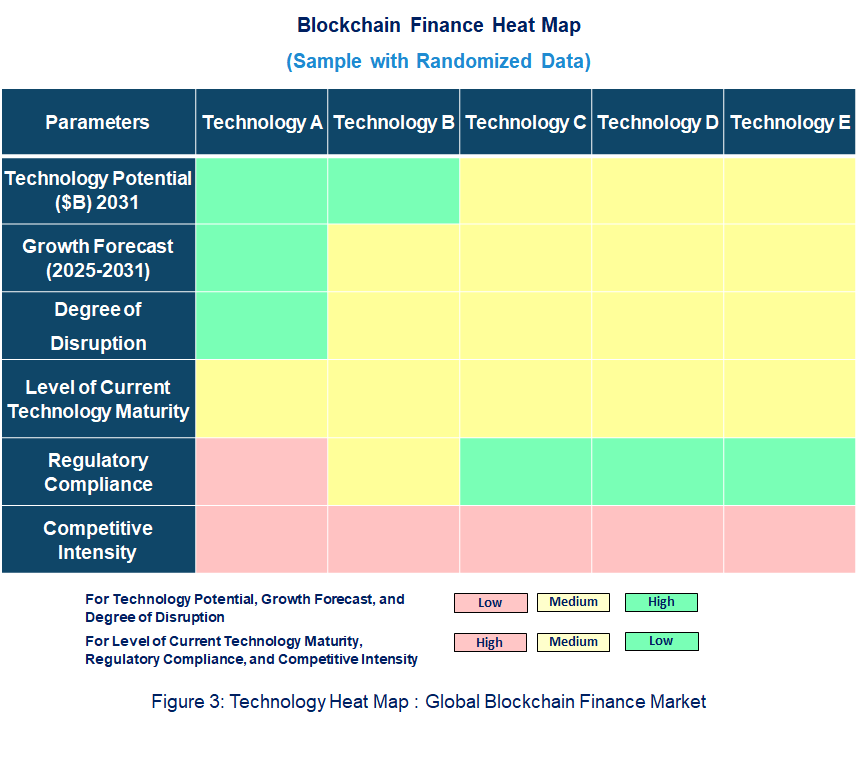
A few variables define blockchain finance technology’s potential, disruption, maturity, and regulatory compliance.• Technology Potential: Blockchain in finance holds vast potential for revolutionizing all sectors, including payments, cross-border transactions, lending, and asset management. The decentralized nature enhances transparency, security, and efficiency. Blockchain can streamline the clearing and settlement process and minimize fraud and operational costs. It also introduces innovations like decentralized finance (DeFi), which enables peer-to-peer financial services without any intermediary.
• Degree of Disruption: Blockchain has the highest disruption potential for the traditional financial industry. This is because it challenges the central authorities like banks and clearinghouses with decentralized, transparent, and tamper-proof solutions. It might reduce dependency on intermediaries, disrupt the payment systems, and even alter the asset ownership structures.
• Level of Current Technology Maturity: Blockchain technology is still in its development stage, though promising. Most of the blockchain platforms, especially those in finance, are still in the experimental or early adoption phase. The challenges include scalability, transaction speed, energy consumption, and interoperability. Though blockchain has been successful in areas such as cryptocurrency, broader financial services adoption would require further development.
• Regulatory Compliance: Blockchain finance faces a huge regulatory barrier. Governments and financial regulators are working to create frameworks that ensure consumer protection, prevent money laundering, and manage risks. There is uncertainty in the absence of global regulatory standards, though some regions are developing more blockchain-friendly regulations.
Recent Technological development in Blockchain Finance Market by Key Players
The blockchain finance market has experienced tremendous growth as traditional financial institutions and technology companies increasingly explore decentralized technologies for streamlining financial services. With blockchain’s ability to offer transparent, secure, and cost-effective solutions, major players like JP Morgan Chase, Alphabet, Inc., IBM, Circle Internet Financial, Microsoft, Accenture, Deloitte, R3, Goldman Sachs, and Global Arena Holding have accelerated their investments and innovation in this space. These developments manifest the emerging alignment of finance, technology, and regulatory frameworks, harbinger of a new era in financial systems.• JP Morgan Chase: JP Morgan made tremendous advancements in blockchain technology as it launched JPM Coin, an in-house digital currency to simplify the means of making payments between institutional customers. The bank also inaugurated Onyx, a blockchain-based division for digital assets and blockchain innovation. For this reason, JP Morgan positions itself as a central banking system for interbank payments using blockchain technology for proper financial services.
• Alphabet, Inc.: Alphabet, the parent of Google, has ventured into blockchain technology through its cloud services, providing a base for blockchain applications on its architecture. It has been focused primarily on providing blockchain-as-a-service (BaaS) to corporations in developing decentralized apps, enabling secure data sharing in their system. They aim for scalability in solutions for developers who build blockchain applications within financial and other high-performance computing industries.
• International Business Machines Corporation (IBM): IBM has been a leading player in blockchain finance through its IBM Blockchain platform. Through collaboration with large financial institutions, IBM has been promoting the use of permissioned blockchains for secure, transparent, and efficient trading and supply chain management. Its collaboration with the We.trade consortium is an example of how IBM is enriching financial ecosystems with blockchain technology.
• Circle Internet Financial Limited: Circle is one of the leaders in cryptocurrencies and digital payment solutions. It has made its name with its stablecoin called USD Coin (USDC). The company has been concentrating on making a more stable, transparent, and secure alternative to traditional financial systems, thus enabling businesses and individuals to carry out transactions with cryptocurrencies in a regulatory-compliant manner.
• Microsoft Corporation: Microsoft has embraced blockchain in its offerings through Azure Blockchain Services, which provides tools and frameworks for building, deploying, and managing blockchain applications. Through collaboration with financial institutions, Microsoft has helped optimize payments, improve transparency, and introduce blockchain-based smart contracts, furthering adoption within the financial sector.
• Accenture: Accenture has been a strong consultant in blockchain development, supporting their clients in the finance sector to implement blockchain into existing systems. Accenture supports institutions in adopting blockchain for cross-border payments, trade finance, and asset tracking among other purposes through partnerships with companies like R3 and Enterprise Ethereum Alliance.
• Deloitte Touche Tohmatsu Limited: Deloitte has been using blockchain to improve financial processes for its clients. Deloitte Blockchain Lab assists businesses in designing and implementing blockchain-based solutions for financial services, including payments, identity management, and digital assets. It also provides advisory services to navigate blockchain adoption in regulated financial markets.
• R3: R3 is a forerunner in developing Corda, which is an enterprise-grade blockchain platform designed for financial services. It has concentrated its efforts on building a permissioned blockchain platform that resulted in solutions for industries like banking, insurance, and trade finance. Its strategic partnerships with leading financial institutions reveal the increased reliance on its technology to transform settlement systems and compliance.
• Goldman Sachs: Goldman Sachs has made notable advances in blockchain finance by launching GS Digital Finance and exploring the use of blockchain for asset management and digital securities. The investment bank’s focus is on integrating blockchain to enhance trading, improve transparency, and increase the liquidity of financial assets, particularly through tokenized assets.
• Global Arena Holding Inc.: Global Arena Holding utilizes blockchain to provide secure and transparent voting systems, especially for financial market regulations. It aims to have more accessible and efficient mechanisms for governance in financial markets, with the potential to disrupt the traditional voting and compliance practices within financial and legal proceedings.
Blockchain Finance Market Driver and Challenges
The blockchain finance market is growing rapidly, with financial institutions and technological companies integrating decentralized technologies to operate in this marketplace. Its appeal is found because of the efficiency, cost reduction, and increased transparency that it ensures in its processes. Many factors, though, act to promote the growth of this industry as well as the adoption of innovation by the financial sector. Diver• Increased Efficiency and Cost Reduction: Blockchain’s ability to remove intermediaries and automate processes leads to significant cost savings and operational efficiencies. It enables faster transaction processing, reduces settlement times, and minimizes the risk of errors, making it an attractive solution for financial services, particularly in payments and remittances.
• Demand for Transparency and Security: Blockchain provides unparalleled security and transparency, a factor that is greatly needed in finance. The decentralized nature of the technology ensures that transactions are tamper-proof, hence the need for users and regulators to have more secure financial ecosystems, thus fuelling the adoption of blockchain.
• Rise of DeFi: The DeFi movement disrupts the traditional financial systems by providing decentralized alternatives to banking services such as lending, borrowing, and trading. Blockchain allows peer-to-peer financial services without the intermediaries’ involvement, thus leading to its acceptance and widening the scope of its application in the financial market.
• Regulatory Clarity and Standardization: Increased regulatory clarity and the setting of standards for blockchain in finance are opening it up to more adoption. Governments and financial regulators are actively working on providing guidelines that ensure consumer protection, anti-money laundering (AML) practices, and risk management, which are creating a more favorable environment for blockchain-based financial services. Main Challenges
• Scalability Issues: Blockchain networks, especially those built on proof-of-work algorithms, suffer from scalability issues that limit their transaction processing speed. This challenge hinders the wide-scale adoption of blockchain, especially in high-volume financial applications where quick and efficient processing is crucial.
• Regulatory Uncertainty: Despite regulatory clarity, many regions still have not developed comprehensive frameworks for blockchain-based financial products. The uncertainty of data privacy, cryptocurrency regulations, and cross-border transactions remains a big hurdle to the adoption of blockchain technology in the financial industry.
• Integration with Legacy Systems: The integration of blockchain with legacy systems of banks is a challenging process. It often requires great costs and takes plenty of time because the firm has to rebuild its processes and implement new tools to launch blockchain.
• Security Issues and Cyber Threats: Since blockchain is inherently secure, however, new threats such as 51% attacks, vulnerabilities within smart contracts, and hacking can reduce the trust in blockchain technology. Financial institutions need to continue to find ways to improve security protocols to protect digital assets and customers’ data. The blockchain finance market is being shaped by various drivers and challenges. While the demand for increased efficiency, transparency, and decentralized finance solutions accelerates adoption, scalability issues, regulatory uncertainty, and integration challenges remain significant obstacles. Overcoming these challenges while seizing growth opportunities will be key to blockchain’s widespread impact in the financial sector.
List of Blockchain Finance Companies
Companies in the market compete based on product quality offered. Major players in this market focus on expanding their manufacturing facilities, R&D investments, infrastructural development, and leverage integration opportunities across the value chain. With these strategies blockchain finance companies cater to increasing demand, ensure competitive effectiveness, develop innovative products & technologies, reduce production costs, and expand their customer base. Some of the blockchain finance companies profiled in this report include.• JP Morgan Chase
• Alphabet, Inc.
• International Business Machines Corporation
• Circle Internet Financial Limited
• Microsoft Corporation
• Accenture
Blockchain Finance Market by Technology
• Technology Readiness by Technology Type: Private blockchains are relatively mature and ready for implementation in the finance market. It has well-established use within institutions; it provides the following: high security, scale, and controls over access. Such technologies are quite ideal for application in areas like cross-border payments, digital asset management, as well as supply chain finance. Public blockchains are highly innovative but still in development in terms of scalability, security, and regulatory compliance, especially in high-volume finance applications. Competitive intensity is higher for public blockchains, with many emerging platforms in the decentralized finance space, but they struggle with adoption due to regulatory uncertainty. Both technologies have different use cases, with private blockchains focusing on institutional needs and public blockchains leading decentralized finance innovation.
• Competitive Intensity and Regulatory Compliance: Private blockchains are not so competitive in intensity since most of them are taken by financial institutions that require safe and compliant environments with lesser openness. Centralized control makes private blockchains easier to enforce regulatory compliance, which is ideal for sectors that require strict oversight. Public blockchains have higher competitive intensity, with numerous startups and projects driving innovation. They face complex regulatory challenges, especially in cryptocurrency and cross-border transactions, as their decentralized nature complicates enforcement. Regulatory frameworks are still developing; this is creating uncertainties for public blockchain platforms but allows more innovation with fewer restrictions.
• Different Blockchain Technologies: Disruption Potential: Private blockchain technologies offer permissioned access with a large disruption potential in the financial sector because they support secure, transparent, and efficient systems for banks, payment processors, and institutional investors. They support faster transactions and enhanced privacy. The public blockchains are decentralized and transparent; thus, they are more widely disruptive because they support the creation of DeFi platforms, tokenized assets, and peer-to-peer transactions. Their openness creates innovation in global payment systems and financial services. This disrupts the traditional banking infrastructure. Private blockchains focus on controlled environments, whereas public blockchains break the financial markets due to their democratized approach that minimizes the involvement of intermediaries.
Blockchain Finance Market Trend and Forecast by Technology [Value from 2019 to 2031]:
• Private Blockchain
• Public Blockchain
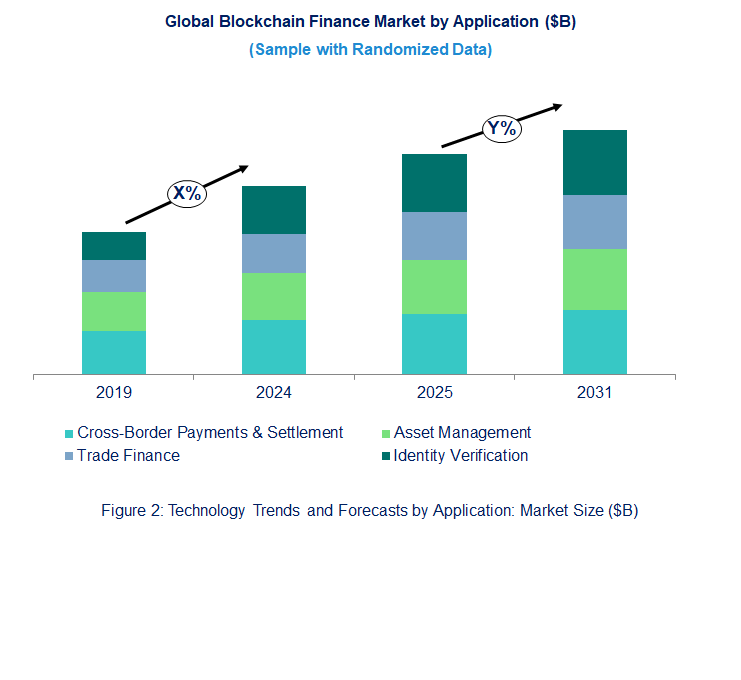
Blockchain Finance Market Trend and Forecast by Application [Value from 2019 to 2031]:
• Cross-Border Payments & Settlement
• Asset Management
• Trade Finance
• Identity Verification
Blockchain Finance Market by Region [Value from 2019 to 2031]:
• North America
• Europe
• Asia Pacific
• The Rest of the World
• Latest Developments and Innovations in the Blockchain Finance Technologies
• Companies / Ecosystems
• Strategic Opportunities by Technology Type
Features of the Global Blockchain Finance Market
Market Size Estimates: Blockchain finance market size estimation in terms of ($B). Trend and Forecast Analysis: Market trends (2019 to 2024) and forecast (2025 to 2031) by various segments and regions. Segmentation Analysis: Technology trends in the global blockchain finance market size by various segments, such as application and technology in terms of value and volume shipments. Regional Analysis: Technology trends in the global blockchain finance market breakdown by North America, Europe, Asia Pacific, and the Rest of the World. Growth Opportunities: Analysis of growth opportunities in different applications, technologies, and regions for technology trends in the global blockchain finance market. Strategic Analysis: This includes M&A, new product development, and competitive landscape for technology trends in the global blockchain finance market. Analysis of competitive intensity of the industry based on Porter’s Five Forces model.Table of Contents
Methodology
- In-depth interviews of the major players in this market
- Detailed secondary research from competitors’ financial statements and published data
- Extensive searches of published works, market, and database information pertaining to industry news, company press releases, and customer intentions
- A compilation of the experiences, judgments, and insights of Lucintel’s professionals, who have analyzed and tracked this market over the years.


Buy Now
Choose a license that fits your team. Instant PDF delivery.
Prices exclude taxes. Instant delivery. Custom licensing available on request.
Key Questions
- • What are some of the most promising potential, high-growth opportunities for the technology trends in the global blockchain finance market by technology (private blockchain and public blockchain), application (cross-border payments & settlement, asset management, trade finance, and identity verification), and region (North America, Europe, Asia Pacific, and the Rest of the World)?
- • Which technology segments will grow at a faster pace and why?
- • Which regions will grow at a faster pace and why?
- • What are the key factors affecting dynamics of different technology? What are the drivers and challenges of these technologies in the global blockchain finance market?
- • What are the business risks and threats to the technology trends in the global blockchain finance market?
- • What are the emerging trends in these technologies in the global blockchain finance market and the reasons behind them?
- • Which technologies have potential of disruption in this market?
- • What are the new developments in the technology trends in the global blockchain finance market? Which companies are leading these developments?
- • Who are the major players in technology trends in the global blockchain finance market? What strategic initiatives are being implemented by key players for business growth?
- • What are strategic growth opportunities in this blockchain finance technology space?
- • What M & A activities did take place in the last five years in technology trends in the global blockchain finance market?


