
Automotive Sensor Market
The future of the global automotive sensor market looks promising with opportunities in the engine and transmission, safety and security, body applications, chassis applications and driver support markets. The global automotive sensor market is expected to reach an estimated $74 billion by 2035 with a CAGR of 6.4% from 2026 to 2035. The major drivers for this market are the increasing vehicle production boosting sensor demand, the rising automotive safety technology adoption and the growing electric vehicle sensor integration.
• Lucintel forecasts that, within the vehicle types category, passenger car will remain the largest segment over the forecast period as the rising adoption of advanced driver assistance technologies.
• Within the application category, safety and security will remain the largest segment due to the the increasing vehicle safety regulations driving sensor integration.
• In terms of regions, APAC will remain the largest region over the forecast period due to the the growing automotive manufacturing investments.
Gain valuable insights for your business decisions with our comprehensive 150+ page report.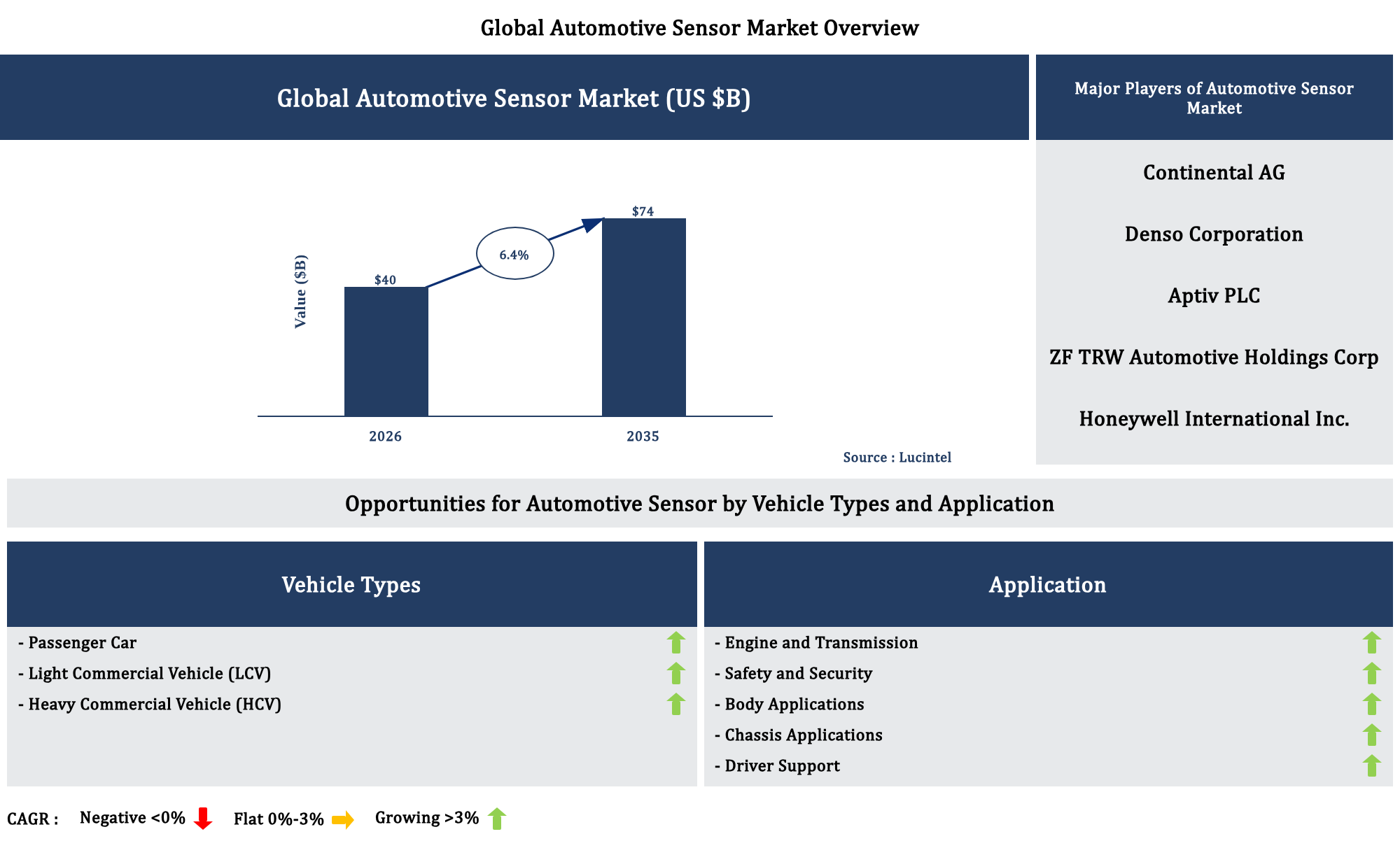
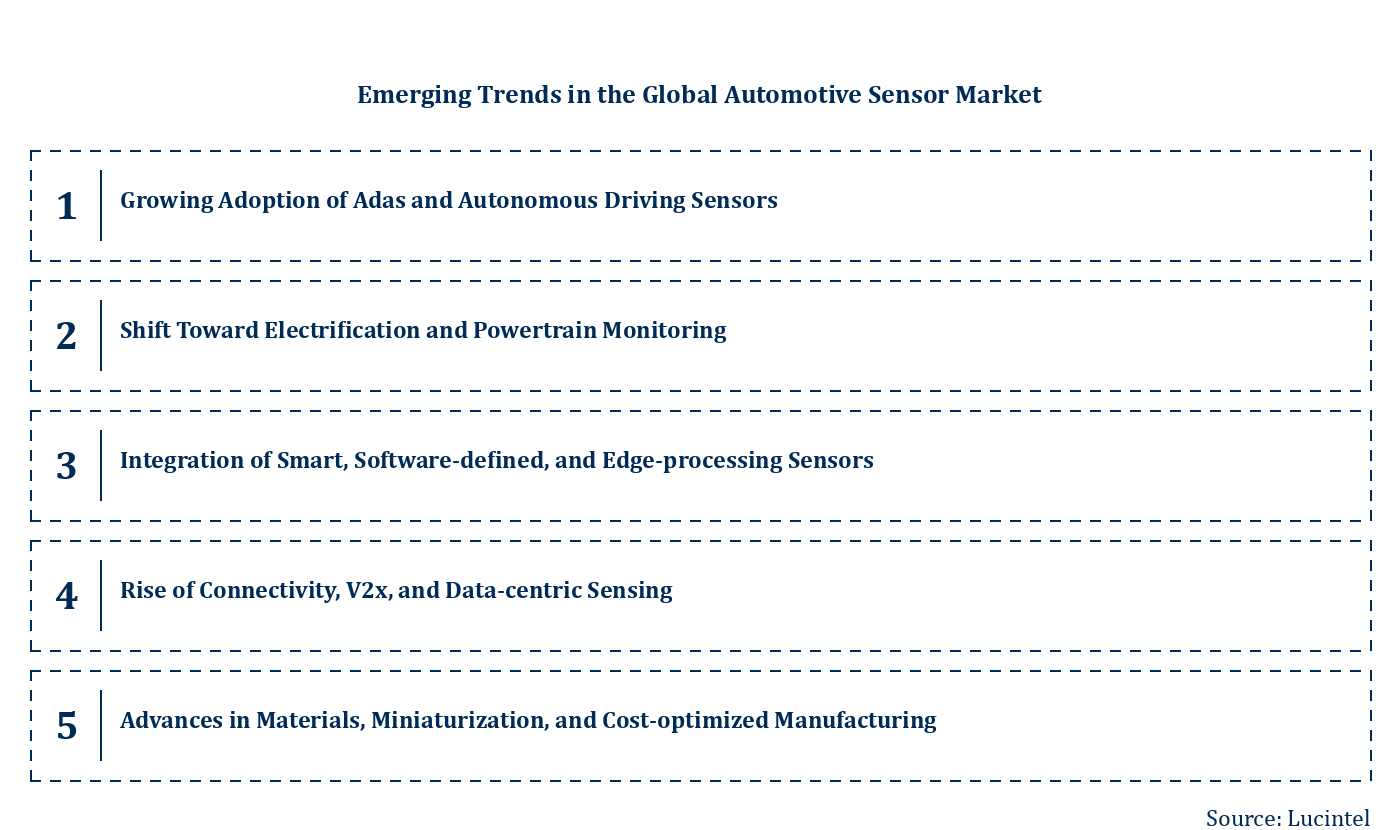
Emerging Trends in the Automotive Sensor Market
The automotive sensor market is evolving rapidly as vehicles become increasingly connected, automated, and electrified. Automakers and technology providers are integrating more sophisticated sensing technologies to enhance safety, efficiency, and driving experience. Growing adoption of advanced driver-assistance systems, autonomous driving features, and stringent emissions and safety regulations is pushing demand for high-performance, reliable, and cost-effective sensors. At the same time, advances in materials, miniaturization, and on-sensor intelligence are transforming sensor design and integration. These emerging trends are reshaping supply chains, competitive dynamics, and innovation priorities across the global automotive ecosystem.
Recent Developments in the Automotive Sensor Market
The automotive sensor market is undergoing rapid transformation as vehicle manufacturers accelerate electrification, autonomy, and connectivity strategies. Demand for advanced driver assistance systems, stringent safety and emission regulations, and consumer expectations for smarter in-vehicle experiences are reshaping sensor portfolios and performance requirements. Recent developments span innovations in perception technologies, integration with software-defined vehicle architectures, and rising collaboration between semiconductor companies and automakers. At the same time, cost, reliability, and cybersecurity have become central design criteria. These dynamics are redefining competitive positioning and supply chains, while setting the stage for the next generation of intelligent, data-rich vehicles worldwide.
Strategic Growth Opportunities in the Automotive Sensor Market
The automotive sensor market is entering a new growth phase as vehicles become more electrified, connected, and automated. Sensors now underpin critical functions from powertrain control and emissions management to advanced driver assistance, occupant safety, and in-vehicle comfort. As regulations tighten, software content rises, and consumers demand safer, smarter cars, sensor volumes and value per vehicle are increasing. At the same time, new architectures such as zonal electronics and software-defined vehicles are reshaping sensor requirements. These shifts are creating distinct, high-value opportunities for innovators that can deliver more accurate, durable, and integrated sensing solutions across key automotive applications.
Automotive Sensor Market Drivers and Challenges
The global automotive sensor market is shaped by a dynamic mix of technological innovation, evolving mobility trends, cost pressures, and shifting regulatory landscapes. Rapid progress in electronics, software, and connectivity is driving the integration of sophisticated sensors that enable advanced driver assistance, powertrain optimization, and in‑vehicle comfort features. At the same time, automakers and suppliers must navigate challenges related to safety compliance, supply chain resilience, and escalating development complexity. Understanding the principal drivers and obstacles is critical for stakeholders seeking to prioritize investments, align product portfolios with future vehicle architectures, and sustain profitable growth across both established and emerging automotive markets.
The factors responsible for driving the automotive sensor market include:
The challenges facing this Market include:
The automotive sensor market is being reshaped by powerful growth drivers including ADAS expansion, electrification, regulatory mandates, enhanced in‑vehicle experiences, and rapid advances in semiconductor and MEMS technologies. These forces are increasing sensor content per vehicle and pushing the industry toward more integrated, intelligent, and reliable sensing solutions. At the same time, cost pressures, safety and integration complexity, and supply chain vulnerabilities constrain suppliers and slow the transition to next‑generation platforms. Stakeholders that can manage these risks, invest in robust engineering and manufacturing capabilities, and align sensor roadmaps with evolving vehicle architectures are best positioned to capture long‑term value in this market.
List of Automotive Sensor Market Companies
Companies in the market compete on the basis of product quality offered. Major players in this market focus on expanding their manufacturing facilities, R&D investments, infrastructural development, and leverage integration opportunities across the value chain. Through these strategies automotive sensor market companies cater increasing demand, ensure competitive effectiveness, develop innovative products & technologies, reduce production costs, and expand their customer base. Some of the automotive sensor market companies profiled in this report include-
Automotive Sensor Market by Segment
The study includes a forecast for the global automotive sensor market by vehicle types, application, and region.
Country Wise Outlook for the Automotive Sensor Market
The global automotive sensor market is undergoing rapid transformation as vehicles become increasingly connected, electrified, and automated. Sensors are central to advanced driver assistance systems, battery management, emissions control, and in-cabin experience, driving strong demand across all major automotive regions. Technological progress in micro-electromechanical systems, radar, lidar, cameras, and pressure and thermal sensors is enabling higher safety standards and more efficient powertrains. At the same time, sustainability regulations and supply-chain realignment are reshaping where and how sensors are designed and manufactured. The summaries below outline recent developments in the United States, China, Germany, India, and Japan.
Features of the Automotive Sensor Market
Article
Automotive Sensor Market: Which Strategic Shifts Are Redefining the Next Decade?
Dallas, July 20, 2026 – The automotive sensor market is entering a decisive phase as vehicle architectures, safety regulations, and software-defined platforms converge around data-rich, sensor-heavy designs. From advanced driver assistance systems to fully connected, electrified vehicles, sensors have moved from supporting components to strategic control points that determine performance, safety, and user experience. This article examines the major trends reshaping the automotive sensor market, identifies where the most significant impact will be felt, and outlines the challenges, opportunities, and technology industry use cases emerging from this fast-evolving landscape.
How Are ADAS and Autonomous Driving Requirements Changing Sensor Strategies?
Advanced driver assistance systems (ADAS) and the gradual march toward higher levels of vehicle automation are transforming how automakers approach sensing. What started as isolated features like parking sensors and basic radar has evolved into dense sensor suites that must deliver 360-degree perception and precise situational awareness.
These shifts are particularly disruptive in the premium passenger vehicle segment, where safety and comfort features drive pricing power, and in commercial fleets, where autonomous and semi-autonomous capabilities directly influence total cost of ownership and uptime.
Why Are Electrification and Thermal Management Creating a New Sensor Demand Curve?
The accelerated adoption of battery electric vehicles and plug-in hybrids is driving fresh demand for sensors that can ensure safe, efficient energy management. Electric powertrains require precise monitoring of battery health, motor performance, and thermal conditions, placing new emphasis on sensing technologies throughout the vehicle.
These innovations create strong growth momentum in the EV segment of passenger cars, buses, and light commercial vehicles, disrupting traditional sensor portfolios and forcing suppliers to pivot toward high-voltage, high-reliability components tailored to electrified platforms.
How Is the Software-Defined Vehicle Model Reshaping Sensor Architecture?
As vehicles transition into software-defined platforms, sensors are no longer treated as static hardware but as upgradeable, reconfigurable endpoints in a broader digital ecosystem. This shift is introducing new levels of complexity but also new revenue and service models.
The disruption is most pronounced for Tier 1 suppliers and technology firms that can combine hardware, software, and cloud services into integrated platforms. Markets such as connected fleet management, mobility-as-a-service, and insurance technology stand to benefit significantly from rich, real-time sensor data streams.
Where Are the Strongest Market Impacts and Which Segments Are Poised for Outperformance?
Not all areas of the automotive ecosystem will benefit equally from these advances, and decision-makers are increasingly selective about where to allocate capital and partnership resources.
These shifts will disrupt incumbents that rely heavily on legacy mechanical or low-intelligence sensing components, while opening opportunities for firms that can deliver scalable, software-centric sensor platforms and services.
What Key Challenges Could Slow the Momentum of the automotive sensor market?
Despite robust tailwinds, the market faces nontrivial obstacles that could delay deployment timelines or compress margins for suppliers and automakers.
How these challenges are managed will strongly influence which suppliers consolidate share and which players lose ground as vehicles become more reliant on robust, interconnected sensor networks.
Which Strategic Opportunities Are Emerging for Innovators and Investors?
Alongside the challenges, opportunities are expanding for companies that can align sensor portfolios with long-term shifts in vehicle design, regulation, and digital business models.
For investors and corporate strategists, the most attractive opportunities lie at the intersection of sensing, software, and services where value creation continues well beyond the point of vehicle sale.
What Are the Technology Industry Use Cases Emerging from Automotive Sensor Innovation?
Automotive sensors are increasingly intertwined with broader technology industry trends, creating cross-sector use cases and collaborative business models.
These intersections expand the addressable market for automotive sensor innovation far beyond the automotive sector, reinforcing the role of sensors as foundational data sources in the broader technology landscape.
Which Recent Developments Are Signaling the Next Phase of Market Evolution?
Recent moves across the value chain highlight how rapidly the automotive sensor market is evolving and where competitive dynamics are shifting.
As these developments accelerate, the automotive sensor market is set to become one of the most strategically important segments in the broader mobility ecosystem. Companies that can combine technical excellence with robust supply chains, software integration capabilities, and ecosystem partnerships will be best positioned to capture value as vehicles evolve into highly sensed, always-connected platforms.
Top 5 Companies
1. Continental AG
Continental AG is a leading German technology company with a strong position in the global automotive sensor market, serving major original equipment manufacturers and tier-one suppliers across Europe, North America, Asia-Pacific, and emerging markets. Founded in 1871 and headquartered in Hanover, the company employs well over 190,000 people worldwide across multiple business areas, including Automotive, Tires, and ContiTech. Its automotive sensor portfolio spans powertrain, chassis, safety, and interior applications, with products such as pressure sensors, wheel-speed sensors, radar and lidar sensors for advanced driver-assistance systems, inertial and acceleration sensors, temperature and gas sensors, and position and angle sensors used in internal combustion, hybrid, and battery-electric vehicles. Continental has been investing heavily in smart and connected sensor solutions that support automated driving, vehicle electrification, and over-the-air diagnostics. The company has expanded its geographic manufacturing and engineering footprint for sensors in Eastern Europe, China, India, and Mexico to be closer to key automotive hubs and to support global platform sourcing by major automakers. In the automotive sensor domain, Continental has entered several joint development agreements and partnerships with semiconductor and software companies to strengthen its capabilities in radar, lidar, and environmental sensing stacks for advanced driver assistance and autonomous driving. Although Continental’s largest inorganic transactions focus on broader automotive technologies, the integration of electronics and safety businesses over time has solidified its role as a full-system supplier that can combine sensors, control units, and software into complete safety and automated driving solutions.
2. Denso Corporation
Denso Corporation is a major Japanese automotive technology supplier and a dominant participant in the global automotive sensor market, with a comprehensive range of sensors for powertrain, safety, body, and electrification systems. Headquartered in Kariya and established in 1949, Denso employs more than 160,000 people and operates a wide network of production plants, technical centers, and sales offices across Japan, North America, Europe, China, and other Asian and emerging markets. Its sensor portfolio includes pressure, temperature, oxygen and air–fuel ratio sensors, knock and crank sensors, wheel-speed and acceleration sensors, radar and vision sensors for advanced driver-assistance systems, battery-monitoring and current sensors for hybrids and electric vehicles, and various occupant and environment sensors used in climate and body systems. Denso continues to expand sensor manufacturing and R&D in regions such as North America, India, and Southeast Asia to support localized vehicle platforms and to serve global customers like Toyota and other major automakers. The company has invested in new facilities and lines for advanced sensing used in autonomous driving and electrified powertrains, including high-precision radar and camera sensing modules. In terms of transactions and strategic alliances related to automotive sensors, Denso has pursued equity investments and technology collaborations with semiconductor, lidar, and AI software companies to enhance perception, sensor fusion, and edge-computing capabilities in next-generation vehicles. These moves position Denso as a key end-to-end supplier combining sensors, electronic control units, and software for safety, electrification, and connected car applications.
3. Aptiv PLC
Aptiv PLC, headquartered in Dublin, is a global technology company focused on advanced mobility solutions and plays a significant role in the automotive sensor market through its smart vehicle architecture, active safety, and autonomous driving platforms. Formed in its current structure in 2011, with heritage tracing back to Delphi Automotive, Aptiv employs tens of thousands of people across engineering, manufacturing, and software centers in North America, Europe, China, and other Asian and Latin American markets. While Aptiv is widely known for electrical and electronic architectures and software, it is also deeply involved in sensing solutions such as radar, camera systems, ultrasonic sensors, and integrated perception modules that support advanced driver-assistance systems, automated driving, and safety functions including automatic emergency braking, lane keeping, and adaptive cruise control. Aptiv’s sensor-related portfolio is tightly integrated with its centralized compute platforms, high-speed connectivity, and data-management solutions, enabling sensor fusion and over-the-air updates. The company has expanded its geographic presence in sensor and ADAS development through engineering centers in Europe, the United States, and China, and through collaborations with global automakers and mobility providers. A pivotal transaction reinforcing Aptiv’s position in automotive sensing and autonomy was its acquisition of nuTonomy and elements of Ottomatika to enhance its autonomous driving software stack, which directly relies on rich sensor suites. Aptiv also formed Motional, a joint venture with Hyundai Motor Group focused on Level 4 autonomous vehicles, further anchoring its long-term commitment to advanced sensing technologies integrated with AI, perception, and safety-critical software.
4. ZF TRW Automotive Holdings Corp
ZF TRW Automotive Holdings Corp represents the safety and electronics operations that became part of ZF Friedrichshafen AG, creating a major global supplier of active and passive safety systems and automotive sensors. The business, historically rooted in TRW Automotive, has deep expertise in braking, steering, occupant restraint, and safety electronics, and it is now integrated into ZF’s global structure with engineering and manufacturing footprints across North America, Europe, Asia-Pacific, and emerging markets. With corporate activities in the United States for the former TRW units and the broader ZF group headquartered in Friedrichshafen, Germany, the combined entity employs well over 150,000 people worldwide. In the automotive sensor market, ZF TRW offers radar sensors, camera systems, lidar collaborations, wheel-speed sensors, steering-angle sensors, accelerometers, and various chassis and safety sensors used for electronic stability control, airbag deployment, advanced driver assistance, and automated driving functions. The company has expanded sensor production and development capabilities in China, Eastern Europe, and North America to support global automakers and to align with regional safety regulations and New Car Assessment Program requirements. A defining M&A event in this space was the acquisition of TRW Automotive by ZF Friedrichshafen, which significantly enhanced ZF’s portfolio in safety electronics and sensing technologies by adding radar, camera, and brake-control sensors to its expertise in driveline and chassis systems. Since then, ZF has continued to invest in perception and sensor fusion platforms under its safety and electronics division, aiming to deliver integrated systems that merge sensing hardware with control units and software for advanced safety and automated driving.
5. Honeywell International Inc.
Honeywell International Inc. is a diversified industrial and technology company with activities spanning aerospace, building technologies, performance materials, and safety and productivity solutions, and it participates in the automotive sensor market primarily through its sensing and IoT-focused businesses. Headquartered in Charlotte and established in 1906, Honeywell employs more than 90,000 people globally, with a strong presence across North America, Europe, Asia-Pacific, and Latin America. Honeywell’s sensor-related portfolio relevant to automotive applications includes pressure transducers, position sensors, speed and torque sensors, temperature and humidity sensors, inertial measurement units, and gas and chemical sensors that can be integrated into powertrain, braking, thermal management, emissions control, and cabin environment systems. Many of these products, originally developed for industrial and aerospace sectors, are adapted and qualified for automotive environments, particularly in commercial vehicles, off-highway equipment, and specialized automotive segments. Honeywell has been expanding its presence in connected and intelligent sensing, leveraging wireless communication, edge analytics, and cybersecurity to enable sensor-rich systems that support predictive maintenance, asset tracking, and safety monitoring, which can intersect with broader automotive and mobility ecosystems. The company has augmented its sensing capabilities through selective acquisitions in sensing, industrial IoT, and software platforms that enhance data handling and analytics for sensor networks, although these deals typically span multiple end markets rather than being solely automotive-focused. Through its global manufacturing and engineering network, Honeywell continues to localize sensor production and offer application engineering support close to customers in automotive and transportation, addressing regional standards and requirements for harsh-environment and safety-critical sensor solutions.
Table of Contents
List of Figures
List of Tables
Methodology
Lucintel has been in the business of market research and management consulting since 2000 and has published over 1000 market intelligence reports in various markets / applications and served over 1,000 clients worldwide. This study is a culmination of four months of full-time effort performed by Lucintel's analyst team. The analysts used the following sources for the creation and completion of this valuable report:
- In-depth interviews of the major players in this market
- Detailed secondary research from competitors' financial statements and published data
- Extensive searches of published works, market, and database information pertaining to industry news, company press releases, and customer intentions
- A compilation of the experiences, judgments, and insights of Lucintel's professionals, who have analyzed and tracked this market over the years.
Extensive research and interviews are conducted across the supply chain of this market to estimate market share, market size, trends, drivers, challenges, and forecasts. Below is a brief summary of the primary interviews that were conducted by job function for this report.

Thus, Lucintel compiles vast amounts of data from numerous sources, validates the integrity of that data, and performs a comprehensive analysis. Lucintel then organizes the data, its findings, and insights into a concise report designed to support the strategic decision-making process. The figure below is a graphical representation of Lucintel's research process.

Buy Now
Choose a license that fits your team. Instant PDF delivery.
Prices exclude taxes. Instant delivery. Custom licensing available on request.
Frequently Asked Questions
What is the Automotive Sensor Market size?
What is the growth forecast for Automotive Sensor Market?
What are the major drivers influencing the growth of the Automotive Sensor Market?
What are the major segments for Automotive Sensor Market?
Who are the key Automotive Sensor Market companies?
Which Automotive Sensor Market segment will be the largest in future?
In Automotive Sensor Market, which region is expected to be the largest in next 9 years?
Do we receive customization in this report?
Key Questions
- • What are some of the most promising, high-growth opportunities for the Automotive Sensor Market by Vehicle Types (Passenger Car, Light Commercial Vehicle (LCV), and Heavy Commercial Vehicle (HCV)), Application (Engine and Transmission, Safety and Security, Body Applications, Chassis Applications, and Driver Support), and region (North America, Europe, Asia Pacific, and the Rest of the World)?
- • Which segments will grow at a faster pace and why?
- • Which region will grow at a faster pace and why?
- • What are the key factors affecting market dynamics? What are the key challenges and business risks in this market?
- • What are the business risks and competitive threats in this market?
- • What are the emerging trends in this market and the reasons behind them?
- • What are some of the changing demands of customers in the market?
- • What are the new developments in the market? Which companies are leading these developments?
- • Who are the major players in this market? What strategic initiatives are key players pursuing for business growth?
- • What are some of the competing products in this market and how big of a threat do they pose for loss of market share by material or product substitution?
- • What M&A activity has occurred in the last 9 years, and what has its impact been on the industry?


