
Report Feature
Agriculture Technology as-a-Service Market Trends and Forecast
Recently, significant change occurred in technologies associated with agriculture technology as-a-service, switching the paradigm from traditional farming and agriculture to data-driven solution implementation of leading-edge technologies such as artificial intelligence and machine learning. Thus, the market has advanced from merely basic sensing technologies to intelligent, highly evolved platforms of data analytics. The main strengths of these platforms are that they are built using real-time data collection and AI-driven insights for optimized farm operations, improved yield prediction, and precision agriculture. Integration of cloud computing with variable rate application technologies has enhanced the scalability and accessibility of agricultural services by providing farmers with more actionable insights and better resource management.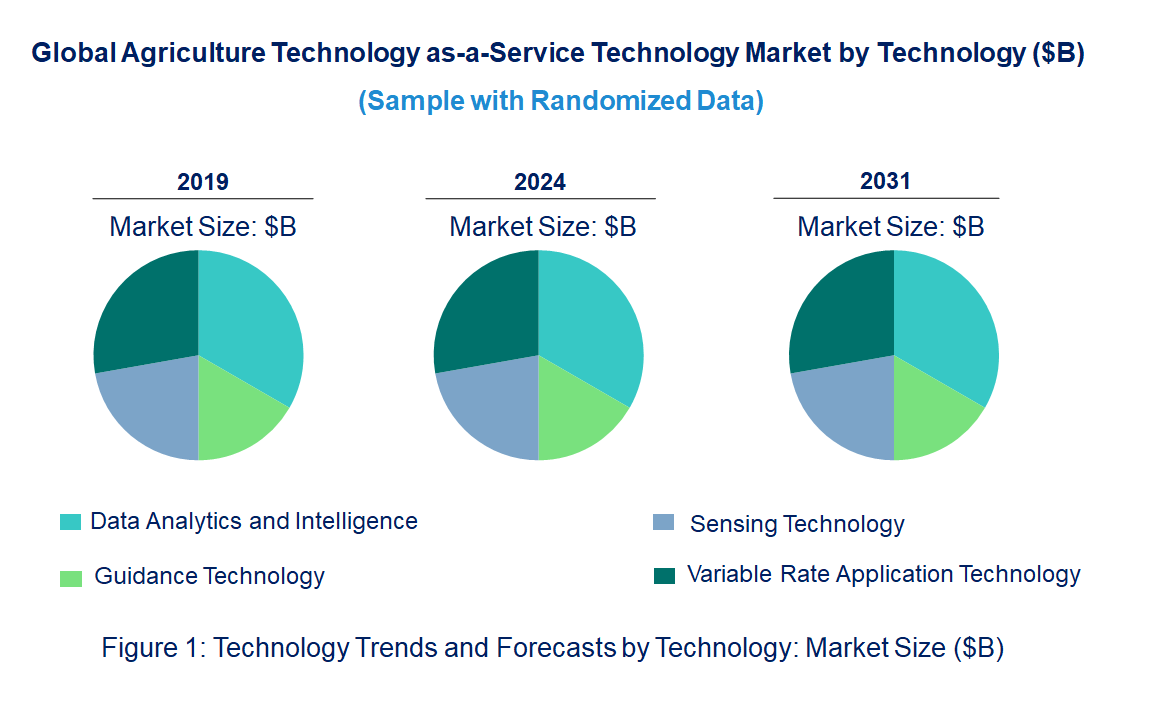
Emerging Trends in the Agriculture Technology as-a-Service Market
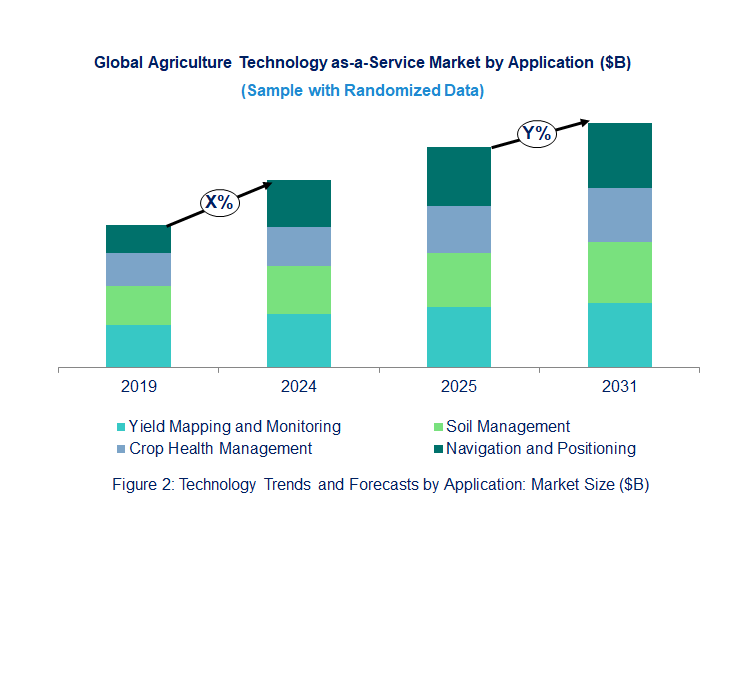
Agriculture technology as a service market is changing rapidly due to a need for more efficiency, sustainability, and profitability in farming operations. There are key trends repositioning the industry towards better agricultural practices through integration with more advanced technologies and data analytics.• Data Analytics and AI: The integration of AI and machine learning in agriculture technology is transforming the market. These technologies enable predictive analytics, precise forecasting, and decision-making support so that farmers can optimize crop yields, monitor crop health, and enhance overall farm management.
• Precision Agriculture: Precision farming techniques, such as variable rate application technology, are gaining momentum. Farmers can apply fertilizers, water, and pesticides more efficiently with the help of sensors, GPS, and data analytics, thereby reducing costs and environmental impact while improving yields.
• Expansion of IoT and Connected Devices: The internet of things has become an integral component in the agricultural process. Connected sensors, drones, and devices provide real-time data on soil conditions, weather, and crop health, thereby allowing farmers to make decisions on appropriate intervention.
• Sustainability Focus and Resource Efficiency: Growing environmental concerns have brought greater attention to sustainability in agriculture. Technologies such as soil management and variable rate application have enabled farmers to save resources, reduce waste, and lower their carbon footprints. All this contributes to sustainable agricultural practices in the long term.
• Cloud-Based Farm Management Platforms: Cloud technology is helping agriculture undergo digital transformation. Cloud-based platforms enable farmers to access real-time data, integrate multiple tools for farm management, and streamline operations. These platforms also offer scalability, allowing farmers to scale their operations with ease. These trends are driving the digitalization of agriculture, allowing for better resource management, efficiency, and sustainability. Technologies such as AI, IoT, and cloud-based platforms are evolving, thereby reshaping the agriculture technology as-a-service market.
Agriculture Technology as-a-Service Market : Industry Potential, Technological Development, and Compliance Considerations
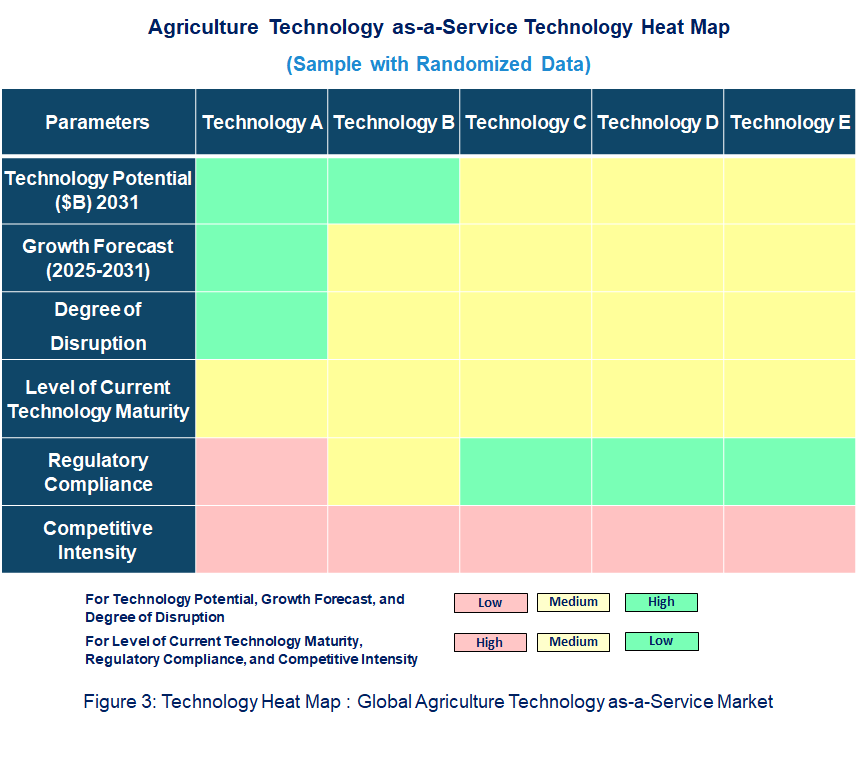
The AgTech-as-a-Service market refers to the delivery of agricultural technologies through subscription-based or pay-per-use models, allowing farmers to access advanced tools without large upfront investments. This model includes services like precision farming, data analytics, drone technology, and IoT-based monitoring systems, which help optimize crop yield, reduce costs, and improve sustainability.• Technology Potential: With an increasingly needed trend of sustainable farming practices, food security, and resourceful usage, AgTech-as-a-Service is a wide-open playing field. Technologies like AI-driven data analytics, remote sensing, and automated machinery are transforming farming, making the whole process more intelligent with real-time insights and automating labor-intensive tasks. With pressure building in global agriculture to produce for a population that keeps on growing, these technologies are there to make farmers both productive and less environmentally intrusive.
• Degree of Disruption: The degree of disruption is high. AgTech-as-a-Service transforms traditional farming with data-driven, precision agriculture methods that significantly improve efficiency. This business model democratizes access to cutting-edge technologies, especially for small and medium-sized farms that could not afford such innovations previously.
• Current Technology Maturity: The technology is at the intermediate maturity stage. Whereas most solutions, such as IoT sensors and GPS-guided machinery, are fully proven, innovations about AI, machine learning, and drone technology are still being established.
• Regulatory Compliance: AgTech-as-a-Service providers have to conform to agricultural safety standards and data privacy regulations in places such as the GDPR to have safe, ethical, and sustainable operations.
Recent Technological development in Agriculture Technology as-a-Service Market by Key Players
Several key players in the agriculture technology as-a-service market are leading innovation through the development and deployment of cutting-edge solutions aimed at enhancing farm management, sustainability, and operational efficiency.• 365FarmNet GmbH: 365FarmNet has introduced a comprehensive farm management platform that integrates data analytics, weather forecasting, and machine learning to optimize operations across various farming activities. Their solutions enable farmers to improve productivity and sustainability through data-driven insights.
• Accenture: Accenture has been focusing on leveraging AI and machine learning in developing smart farming solutions. Through partnerships with agribusinesses, Accenture is helping transform agricultural processes, offering tools for real-time data analytics and operational efficiency to support precision farming.
• AGCO Corporation: Through its Fuse ^{®} Smart Farming platform, AGCO has adopted precision agriculture technologies. Fuse integrates guidance, sensing, and variable rate technologies to better help farmers manage their operations for optimal yields with less environmental impact.
• Agrivi: Agrivi has designed a farm management software that offers end-to-end solutions on crop health management, soil management, and yield monitoring. The software relies on data analytics to help farmers in making the right decision through actionable insights, enabling them to optimize their operations and make better decisions.
• Airbus SE: This company recently launched an agriculture-focused satellite imaging service that delivers high-resolution, real-time data on crop health and soil conditions. Airbus makes use of satellite technology to help farmers observe crops at a large scale, thereby simplifying crop monitoring and managing farm operations.
• AT&T Inc.: AT&T has collaborated with agriculture companies to bring IoT and connectivity solutions to the farming sector. Through their IoT services, farmers can monitor the health of their soil and their irrigation systems and equipment in real-time, thus making the operations more efficient and allowing proactive decision-making.
• Ceres Imaging: Ceres Imaging is the source of high-resolution aerial imagery for precision agriculture. This company’s technology assists farmers in monitoring crop health, detecting nutrient deficiencies, and tracking water usage, making targeted interventions to improve crop yield while preventing the wastage of resources.
• CLAAS KGaA mbH: CLAAS has established high-grade steering and automation systems for agricultural machinery, which provide precision in planting, fertilization, and harvesting. Their systems rely on real-time information and sensor technologies to improve operational efficiency and reduce input costs for farmers.
• CNH Industrial N.V.: CNH Industrial precision farming solutions leverage data analytics and sensor technologies to make each customer’s operation better. Its products, such as automated tractors and planting systems, can help farmers save money, be more productive, and reduce their environmental impact.
• CropIn Technology Solutions Pvt. Ltd.: CropIn offers an AI-powered farm management platform that provides real-time data analytics for crop health, weather forecasting, and yield prediction. Their platform helps farmers make better decisions and improve agricultural productivity through smart data-driven insights. These recent developments show how the best players in the agriculture technology as-a-service market are looking to use advanced technologies such as AI, IoT, and data analytics to enhance farm management, sustainability, and productivity.
Agriculture Technology as-a-Service Market Driver and Challenges
The agriculture technology as-a-service market is growing very fast due to the rising need for more efficient, sustainable, and profitable farming. However, factors such as high implementation costs and access to technology in rural areas have to be addressed before it can reach its full potential. The factors responsible for driving the agriculture technology as-a-service market include:• Demand for High Agricultural Productivity: With the population increasing globally, there is increasing demand to produce more through agriculture. Tech innovations such as data analytics and precision farming are efficient variables in assisting farmers in maximizing yields while optimizing resource usage to address the issue of food security.
• Move toward sustainable agriculture : Rising environmental awareness is compelling the agriculture sector to shift toward sustainable practices. Technologies like soil management, precision irrigation, and crop health monitoring have empowered farmers to use resources more efficiently, minimize waste, and reduce their environmental footprint.
• IoT and Connectivity Advancements: With the increased use of IoT devices, sensors, and connected machinery in agriculture, it is possible to monitor and make decisions more accurately in real time. The technologies improve operational efficiency, manage inputs, and optimize farm management practices, thereby leading to better resource utilization.
• Government Support and Funding for AgTech Innovation: Many governments are offering subsidies and grants to encourage the uptake of advanced agricultural technologies. This support is allowing farmers to move toward a more efficient and sustainable way while encouraging the development of the new technologies required for modern agriculture. Challenges in the agriculture technology as-a-service market include:
• High Initial Investment Costs: The upfront costs of implementing advanced agricultural technologies can be prohibitive for small-scale farmers, thereby hindering their adoption. Although the long-term benefits are clear, the initial capital investment required for hardware, software, and training remains a barrier to its widespread implementation.
• Inadequate rural infrastructure connectivity. Many parts of the world, especially developing countries, lack reliable internet connectivity and digital infrastructure. This puts a significant constraint on farmers’ access to cloud-based platforms, real-time data, and IoT-based solutions, thereby rendering the adoption of modern agricultural technologies inordinately slow.
• Data Privacy and Security: The greater dependency on cloud computing and IoT devices for farm management also raises concerns over data privacy and security. Farmers may be concerned over data misuse or theft in relation to crop yields, soil conditions, and the operational practices associated with such data. the agriculture technology as-a-service market is experiencing huge growth due to increased demand for higher agricultural productivity, sustainability, and technological advancements. However, the challenge of high implementation costs, infrastructure gaps, and data security concerns must be addressed in order to fully unlock the potential of these technologies and drive widespread adoption in the agricultural sector.
List of Agriculture Technology as-a-Service Companies
Companies in the market compete based on product quality offered. Major players in this market focus on expanding their manufacturing facilities, R&D investments, and infrastructural development, as well as leveraging integration opportunities across the value chain. With these strategies agriculture technology as-a-service companies cater to increasing demand, ensure competitive effectiveness, develop innovative products & technologies, reduce production costs, and expand their customer base. Some of the agriculture technology-as-a-service companies profiled in this report include.• 365FarmNet GmbH
• Accenture
• AGCO Corporation
• Agrivi
• Airbus SE
• AT&T Inc.
Agriculture Technology as-a-Service Market by Technology
• Technology Readiness by Technology Type of Data Analytics, Guidance, Sensing, and Variable Rate Application Technology for Agriculture Technology as-a-Service Market: Data analytics and intelligence are highly mature, with AI and predictive models used in precision farming. Guidance technology, such as GPS and autonomous vehicles, is well-established, improving operational efficiency. Sensing technology is also advanced, offering real-time monitoring for soil health and crop conditions. Variable rate application technology is highly adopted, which allows for accurate resource management. All the technologies have regulatory compliance, which deals with data privacy, environmental impact, and safety standards for autonomous systems. The competitive intensity is high in data analytics, guidance, and sensing. However, variable-rate applications have lower competitive intensity.
• Competitive Intensity and Regulatory Compliance of Data Analytics, Guidance, Sensing, and Variable Rate Application Technology for Agriculture Technology as-a-Service Market: Competitive intensity is high, especially in data analytics, where most companies provide optimization and decision-making solutions. Guidance technology and autonomous machinery are also competitive, with multiple players developing GPS and automation solutions. Sensing technology is competitive, focusing on accuracy and real-time monitoring. Variable rate application technology faces less competition but is essential for efficiency. Regulatory compliance is critical, with data privacy, environmental laws for pesticide use, and autonomous vehicle safety standards being key concerns for all technologies.
• Major Disruption Potential of Data Analytics, Guidance, Sensing, and Variable Rate Application Technology for Agriculture Technology as-a-Service Market. Data analytics and intelligence are highly disruptive in agriculture by enabling precision farming through data-driven insights and optimization. Guidance technology, including GPS and autonomous machinery, automates operations with efficiency gains and labor cost reductions. Application technology herein refers to sensing, including devices such as soil and crop health sensors, that give real-time data for better yield prediction and efficient use of resources. Variable rate application technology allows precise input application, saving costs and promoting sustainability. Along with these, the overall technologies are driving agriculture towards more efficient, eco-friendly ways of performing.
Agriculture Technology as-a-Service Market Trend and Forecast by Technology [Value from 2019 to 2031]:
• Data Analytics and Intelligence
• Guidance Technology
• Sensing Technology
• Variable Rate Application Technology
Agriculture Technology as-a-Service Market Trend and Forecast by Application [Value from 2019 to 2031]:
• Yield Mapping and Monitoring
• Soil Management
• Crop Health Management
• Navigation and Positioning
Agriculture Technology as-a-Service Market by Region [Value from 2019 to 2031]:
• North America
• Europe
• Asia Pacific
• The Rest of the World
• Latest Developments and Innovations in the Agriculture Technology as-a-Service Technologies
• Companies / Ecosystems
• Strategic Opportunities by Technology Type
Features of the Global Agriculture Technology as-a-Service Market
Market Size Estimates: Agriculture technology as-a-service market size estimation in terms of ($B). Trend and Forecast Analysis: Market trends (2019 to 2024) and forecast (2025 to 2031) by various segments and regions. Segmentation Analysis: Technology trends in the global agriculture technology as-a-service market size by various segments, such as application and technology in terms of value and volume shipments. Regional Analysis: Technology trends in the global agriculture technology as-a-service market breakdown by North America, Europe, Asia Pacific, and the Rest of the World. Growth Opportunities: Analysis of growth opportunities in different applications, technologies, and regions for technology trends in the global agriculture technology as-a-service market. Strategic Analysis: This includes M&A, new product development, and competitive landscape for technology trends in the global agriculture technology as-a-service market. Analysis of competitive intensity of the industry based on Porter’s Five Forces model.Table of Contents
Methodology
- In-depth interviews of the major players in this market
- Detailed secondary research from competitors’ financial statements and published data
- Extensive searches of published works, market, and database information pertaining to industry news, company press releases, and customer intentions
- A compilation of the experiences, judgments, and insights of Lucintel’s professionals, who have analyzed and tracked this market over the years.


Buy Now
Choose a license that fits your team. Instant PDF delivery.
Prices exclude taxes. Instant delivery. Custom licensing available on request.
Key Questions
- • What are some of the most promising potential, high-growth opportunities for the technology trends in the global agriculture technology as-a-service market by technology (data analytics and intelligence, guidance technology, sensing technology, and variable rate application technology), application (yield mapping and monitoring, soil management, crop health management, and navigation and positioning), and region (North America, Europe, Asia Pacific, and the Rest of the World)?
- • Which technology segments will grow at a faster pace and why?
- • Which regions will grow at a faster pace and why?
- • What are the key factors affecting dynamics of different technology? What are the drivers and challenges of these technologies in the global agriculture technology as-a-service market?
- • What are the business risks and threats to the technology trends in the global agriculture technology as-a-service market?
- • What are the emerging trends in these technologies in the global agriculture technology as-a-service market and the reasons behind them?
- • Which technologies have potential of disruption in this market?
- • What are the new developments in the technology trends in the global agriculture technology as-a-service market? Which companies are leading these developments?
- • Who are the major players in technology trends in the global agriculture technology as-a-service market? What strategic initiatives are being implemented by key players for business growth?
- • What are strategic growth opportunities in this agriculture technology as-a-service technology space?
- • What M & A activities did take place in the last five years in technology trends in the global agriculture technology as-a-service market?


