
Report Feature
Engine Sound Simulation Chip Market Trends and Forecast
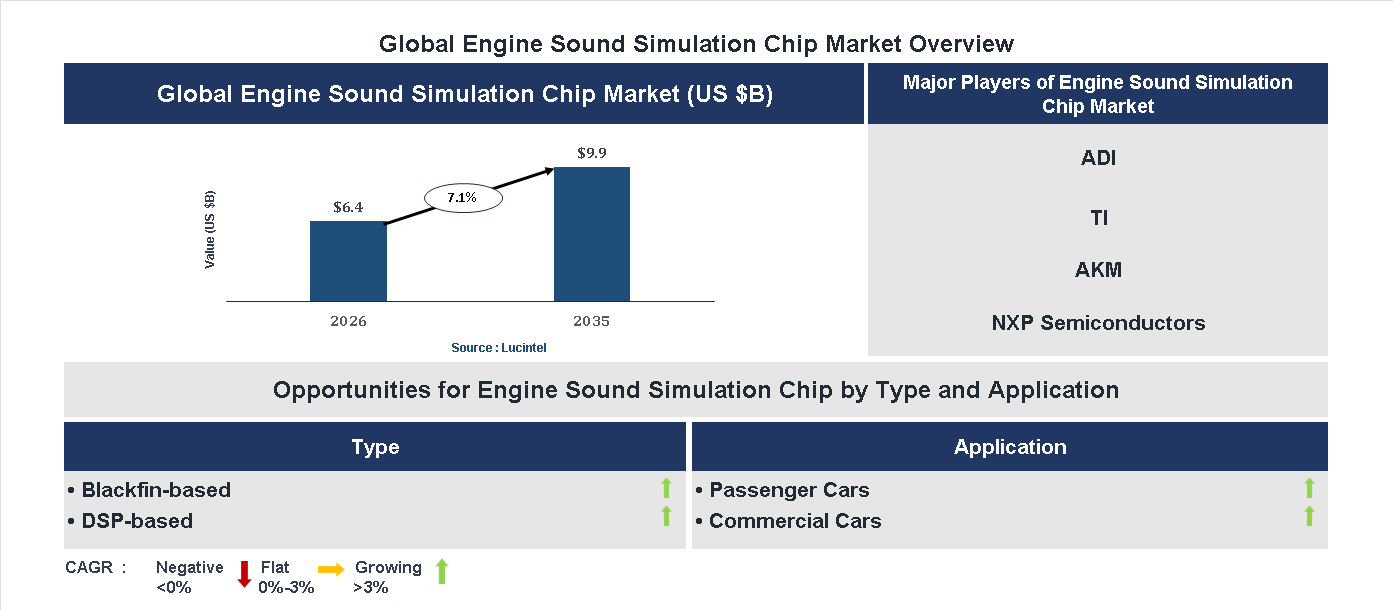
The future of the global engine sound simulation chip market looks promising with opportunities in the passenger car and commercial car markets. The global engine sound simulation chip market is expected to reach an estimated $9.9 billion by 2035 with a CAGR of 7.1% from 2026 to 2035. The major drivers for this market are the increasing adoption of electric & hybrid vehicles, the rising demand for realistic engine sound simulation, and the growing integration of advanced automotive audio systems.• Lucintel forecasts that, within the type category, DSP-based is expected to witness higher growth over the forecast period.
• Within the application category, passenger car is expected to witness higher growth.
• In terms of region, APAC is expected to witness the highest growth over the forecast period. Gain valuable insights for your business decisions with our comprehensive 150+ page report. Sample figures with some insights are shown below.
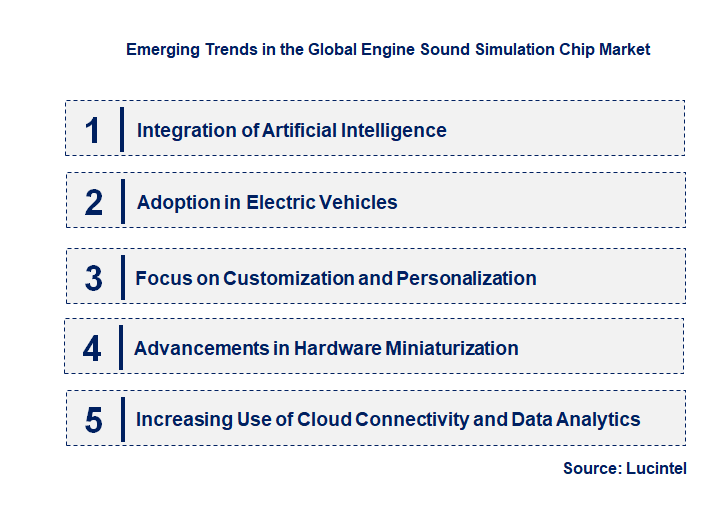
Emerging Trends in the Engine Sound Simulation Chip Market
The engine sound simulation chip market is experiencing rapid growth driven by advancements in automotive technology, increasing demand for realistic engine sounds in electric vehicles, and the need for enhanced driving experiences. As automakers seek innovative ways to improve vehicle appeal and meet regulatory standards, the market is evolving with new technological integrations and consumer preferences. These developments are not only transforming how engine sounds are produced and experienced but also influencing vehicle design and user engagement. The following key trends highlight the major shifts shaping this dynamic market landscape.• Integration of Artificial Intelligence: AI is increasingly being incorporated into engine sound simulation chips to create more realistic and adaptive engine sounds. This technology allows for real-time sound customization based on driving conditions, vehicle speed, and driver preferences. AI-driven systems can learn and improve over time, providing a personalized auditory experience that enhances driver satisfaction and safety. This trend is making engine sound simulation more sophisticated, enabling automakers to deliver immersive and dynamic soundscapes that closely mimic traditional engines or create unique auditory identities for electric vehicles.
• Adoption in Electric Vehicles: As electric vehicles (EVs) become more prevalent, the need for artificial engine sounds has grown to ensure pedestrian safety and driver awareness. Engine sound simulation chips are being integrated into EVs to produce synthetic engine noises that mimic traditional combustion engines or create entirely new sound profiles. This trend helps bridge the sensory gap for drivers accustomed to engine sounds and addresses regulatory requirements for EV sound emissions. The adoption of simulation chips in EVs is expanding the market scope and driving innovation in sound design.
• Focus on Customization and Personalization: Consumers increasingly seek personalized driving experiences, prompting automakers to offer customizable engine sounds through simulation chips. These chips enable drivers to select or modify engine sounds according to their preferences, enhancing emotional connection and vehicle appeal. Customization options include choosing different engine tones, volume levels, and sound effects, which can be adjusted via vehicle infotainment systems. This trend is fostering a more engaging and tailored driving environment, influencing vehicle branding and customer satisfaction.
• Advancements in Hardware Miniaturization: The trend toward smaller, more efficient hardware components is enabling the integration of engine sound simulation chips into a wider range of vehicles, including compact and lightweight models. Miniaturization reduces costs and allows for seamless incorporation into existing vehicle architectures without compromising space or performance. This technological progress broadens the market reach, making advanced sound simulation accessible to a broader customer base and supporting the development of innovative vehicle designs.
• Increasing Use of Cloud Connectivity and Data Analytics: Cloud-based platforms and data analytics are being utilized to enhance engine sound simulation systems. Connected chips can collect data on driving patterns, environmental conditions, and user preferences to optimize sound profiles dynamically. This connectivity enables continuous updates, remote diagnostics, and improved system performance. The integration of cloud technology is transforming engine sound simulation from static to adaptive, providing smarter, more responsive auditory experiences that evolve with user behavior and technological advancements. These trends are significantly reshaping the engine sound simulation chip market by making sound systems more realistic, customizable, and integrated with emerging vehicle technologies. They are driving innovation, expanding market applications, and enhancing the overall driving experience, ultimately influencing vehicle design, safety, and consumer engagement in this evolving industry.
Recent Development in the Engine Sound Simulation Chip Market
The engine sound simulation chip market is experiencing rapid growth driven by advancements in automotive technology, increasing demand for realistic engine sounds in electric vehicles, and the integration of sound simulation in entertainment and gaming industries. Innovations in chip design and sound processing are enhancing user experiences and safety features. Market players are investing heavily in R&D to develop more efficient, compact, and cost-effective solutions. These developments are shaping the future landscape of the automotive and entertainment sectors, creating new opportunities and competitive dynamics.• Growing Demand for Realistic Engine Sounds: The shift towards electric vehicles has increased the need for authentic engine sound simulation to enhance driving experience and safety, prompting manufacturers to develop advanced chips that deliver high-fidelity sound reproduction. This trend is expanding the market as automakers seek to replicate traditional engine noises, improving user satisfaction and vehicle appeal. The integration of these chips also supports regulatory requirements for sound emissions, making them essential in modern vehicle design.
• Advancements in Chip Technology and Processing Power: Innovations in semiconductor technology have led to more powerful, energy-efficient engine sound simulation chips. These improvements enable real-time sound processing with minimal latency, enhancing realism and user immersion. The increased processing capabilities allow for complex sound modeling, supporting diverse vehicle types and customization options. As a result, manufacturers can deliver more sophisticated sound experiences, boosting market competitiveness and opening new avenues for application in various automotive segments.
• Integration of Sound Simulation in Electric Vehicles: Electric vehicles (EVs) lack traditional engine noise, creating safety concerns and driving the need for sound simulation solutions. Recent developments focus on embedding advanced chips that generate authentic engine sounds, improving pedestrian awareness, and driver experience. This integration is crucial for regulatory compliance and consumer acceptance. The market is witnessing a surge in demand as automakers adopt these chips to provide a more familiar and safer driving environment, thereby expanding the application scope of sound simulation technology.
• Expansion into Entertainment and Gaming Industries: The entertainment sector is increasingly adopting engine sound simulation chips to create immersive experiences in gaming, virtual reality, and theme park attractions. These chips enable realistic sound effects that enhance storytelling and user engagement. The growing demand for high-quality audio in entertainment is driving innovation in chip design, making them more compact and capable of delivering complex soundscapes. This cross-industry application broadens the market, fostering new revenue streams and technological collaborations.
• Rising Investment in R&D and Strategic Collaborations: Market players are investing heavily in research and development to improve chip performance, reduce costs, and expand application areas. Strategic partnerships between automotive manufacturers, tech companies, and entertainment firms are accelerating innovation and commercialization. These collaborations facilitate knowledge sharing and resource pooling, leading to faster development cycles and market entry. Increased R&D efforts are also addressing challenges related to power consumption and miniaturization, ensuring the chips meet evolving industry standards and consumer expectations. The overall impact of these developments is significantly transforming the engine sound simulation chip market by enhancing product capabilities, expanding application areas, and fostering innovation. These advancements are driving market growth, increasing adoption across automotive and entertainment sectors, and creating competitive advantages for industry players. As a result, the market is poised for sustained expansion, offering new opportunities for technological progress and strategic collaborations.
Strategic Growth Opportunities in the Engine Sound Simulation Chip Market
The engine sound simulation chip market is experiencing rapid growth driven by advancements in automotive technology, increasing demand for realistic engine sounds in electric vehicles, and the need for enhanced driving experiences. Innovations in chip design and integration are expanding applications across automotive entertainment, virtual reality, and simulation training. Market players are focusing on developing compact, energy-efficient solutions to meet diverse industry requirements, creating significant opportunities for expansion and technological breakthroughs in the coming years.• Integration of Engine Sound Simulation Chips in Electric Vehicles: As electric vehicles lack traditional engine sounds, simulation chips are increasingly used to replicate authentic engine noises, enhancing driver experience and safety. Automakers aim to provide immersive soundscapes that mimic internal combustion engines, improving customer satisfaction. The demand for realistic sound profiles is rising, prompting the development of advanced chips capable of delivering high-fidelity audio while maintaining energy efficiency and compact design for seamless integration into EV platforms.
• Expansion of Virtual Reality and Gaming Applications: The gaming and virtual reality sectors are adopting engine sound simulation chips to create immersive environments with realistic engine noises. These chips enable developers to generate authentic sound effects that enhance user engagement and realism. As VR and gaming markets grow, the need for high-quality audio simulation solutions increases, encouraging innovation in chip technology to support complex sound modeling, real-time processing, and compatibility with various hardware platforms.
• Adoption in Automotive Entertainment and Infotainment Systems: Automotive manufacturers are integrating engine sound simulation chips into infotainment systems to provide drivers with customizable engine sounds, enhancing the driving experience. These chips enable real-time sound modulation based on vehicle speed and engine performance, offering a personalized touch. The trend is driven by consumer demand for premium in-car entertainment, prompting investments in advanced sound simulation solutions that are compact, reliable, and capable of seamless integration with existing vehicle electronics.
• Development of Compact and Energy-Efficient Chips for Aftermarket Use: The aftermarket segment is witnessing increased demand for portable, energy-efficient engine sound simulation chips that can be retrofitted into existing vehicles or used in simulation setups. These chips cater to automotive enthusiasts, driving schools, and entertainment venues seeking realistic engine sounds without extensive modifications. Focusing on miniaturization and power efficiency is critical to expanding market reach, enabling widespread adoption across various applications with minimal space and energy constraints.
• Growth of Simulation and Training Platforms for the Automotive Industry: Engine sound simulation chips are vital components in driving simulators and training platforms, providing realistic auditory feedback for driver training and vehicle testing. These chips help replicate diverse engine types and conditions, improving training effectiveness and safety. As the automotive industry emphasizes simulation-based testing and skill development, the demand for sophisticated sound simulation solutions increases, fostering innovation in chip design to support high-fidelity, scalable, and adaptable training environments. The overall market is poised for substantial growth as these opportunities converge, fostering innovation and expanding applications across automotive, entertainment, and simulation sectors, ultimately enhancing user experience and industry capabilities.
Engine Sound Simulation Chip Market Driver and Challenges
The engine sound simulation chip market is influenced by a variety of technological, economic, and regulatory factors. Advances in automotive technology, consumer demand for enhanced driving experiences, and stricter environmental regulations are shaping the market landscape. Additionally, the integration of sound simulation chips with electric and hybrid vehicles presents new opportunities and challenges. Market growth is also driven by the increasing adoption of advanced driver-assistance systems (ADAS) and the need for realistic engine sounds to improve vehicle appeal. However, rapid technological changes, regulatory compliance issues, and high development costs pose significant challenges. Understanding these drivers and challenges is essential for stakeholders to navigate the evolving market effectively. The factors responsible for driving the engine sound simulation chip market include:• Technological Advancements: The continuous development of sophisticated sound synthesis and digital signal processing technologies enables more realistic and customizable engine sounds. These innovations allow automakers to enhance vehicle appeal, especially in electric vehicles where engine noise is absent. The integration of AI and machine learning further refines sound quality, creating immersive driving experiences. As technology progresses, the cost of chips decreases, making them more accessible for mass-market vehicles. This technological evolution is crucial for meeting consumer expectations and differentiating products in a competitive automotive industry.
• Rising Demand for Electric Vehicles (EVs): As the automotive industry shifts toward electric mobility, the absence of engine noise in EVs has become a concern for safety and driving experience. Engine sound simulation chips address this gap by generating artificial engine sounds, making EVs more familiar and reassuring for drivers and pedestrians. This demand is driven by stricter emission regulations and consumer preferences for eco-friendly vehicles. Automakers are increasingly incorporating sound simulation technology to comply with safety standards and enhance user experience, thereby expanding the market for these chips.
• Consumer Preference for Enhanced Driving Experience: Modern consumers seek vehicles that offer more than just transportation—they desire immersive and customizable experiences. Engine sound simulation chips enable automakers to tailor engine sounds to match vehicle performance, brand identity, and driver preferences. This personalization enhances emotional connection and satisfaction. Additionally, sound simulation contributes to perceived vehicle quality and performance, influencing purchasing decisions. As consumers become more discerning, the demand for sophisticated sound systems, including engine sound simulation, continues to grow, driving market expansion.
• Regulatory and Safety Standards: Governments worldwide are implementing stringent safety and environmental regulations that influence vehicle design and features. Regulations requiring realistic engine sounds for electric and hybrid vehicles to ensure pedestrian safety are particularly impactful. Compliance with these standards necessitates advanced sound simulation technology, fueling demand for specialized chips. Moreover, regulations aimed at reducing noise pollution push automakers to develop sound profiles that balance safety and comfort. Navigating these regulatory frameworks is vital for market players to avoid penalties and ensure product acceptance.
• Integration with Advanced Driver-Assistance Systems (ADAS): The increasing adoption of ADAS features such as autonomous driving, parking assistance, and collision avoidance relies heavily on accurate sensory feedback, including sound cues. Engine sound simulation chips are integrated with these systems to provide realistic auditory signals that enhance safety and driver awareness. This integration allows for synchronized sound outputs that adapt to driving conditions, improving overall vehicle intelligence. As ADAS technology becomes more prevalent, the demand for compatible sound simulation solutions is expected to rise, further propelling market growth. The challenges facing the engine sound simulation chip market include:
• High Development and Implementation Costs: Developing advanced engine sound simulation chips involves significant investment in research, design, and testing. Automakers and suppliers face high costs associated with integrating these chips into vehicles, which can hinder adoption, especially in cost-sensitive segments. Additionally, ongoing updates and customization require substantial resources. These financial barriers may limit market penetration and slow down innovation, particularly among smaller manufacturers or in emerging markets where cost constraints are more pronounced.
• Rapid Technological Changes and Obsolescence: The fast-paced evolution of automotive electronics and sound technology creates a risk of rapid obsolescence. Companies investing heavily in current solutions may find their products outdated quickly, necessitating continuous innovation and upgrades. This dynamic environment complicates product development cycles and increases R&D expenses. Moreover, compatibility issues may arise as new standards and technologies emerge, challenging manufacturers to keep their offerings relevant and competitive in a constantly shifting landscape.
• Regulatory Uncertainty and Compliance Challenges: While regulations drive demand for sound simulation technology, evolving standards can also pose compliance challenges. Variations across regions and frequent updates to safety and noise regulations require companies to adapt quickly, increasing complexity and costs. Non-compliance can lead to legal penalties, product recalls, or market restrictions. Navigating these regulatory uncertainties demands significant legal and technical expertise, which can be resource-intensive and may delay product launches or limit market access. The engine sound simulation chip market is shaped by technological innovations, rising EV adoption, consumer preferences, and regulatory requirements. While these drivers foster growth and market expansion, challenges such as high costs, rapid technological change, and regulatory complexities pose hurdles. Overall, the market's future depends on how effectively stakeholders can leverage technological advancements while managing regulatory and financial risks. Strategic investments and adaptive innovation will be key to sustaining growth and maintaining competitive advantage in this evolving landscape.
List of Engine Sound Simulation Chip Companies
Companies in the market compete on the basis of product quality offered. Major players in this market focus on expanding their manufacturing facilities, R&D investments, infrastructural development, and leverage integration opportunities across the value chain. With these strategies engine sound simulation chip companies cater increasing demand, ensure competitive effectiveness, develop innovative products & technologies, reduce production costs, and expand their customer base. Some of the engine sound simulation chip companies profiled in this report include-• ADI
• TI
• AKM
• NXP Semiconductors
Engine Sound Simulation Chip Market by Segment
The study includes a forecast for the global engine sound simulation chip market by type, application, and region.Engine Sound Simulation Chip Market by Type [Value from 2019 to 2035]:
• Blackfin-based
• DSP-based
Engine Sound Simulation Chip Market by Application [Value from 2019 to 2035]:
• Passenger Cars
• Commercial Cars
Engine Sound Simulation Chip Market by Region [Value from 2019 to 2035]:
• North America
• Europe
• Asia Pacific
• The Rest of the World
Country Wise Outlook for the Engine Sound Simulation Chip Market
The engine sound simulation chip market has experienced significant growth driven by advancements in automotive technology, increasing demand for realistic engine sounds in electric vehicles, and the integration of sound simulation in autonomous driving systems. As automakers seek to enhance driving experiences and meet regulatory standards, innovations in chip design and sound modeling are accelerating. The market's evolution reflects broader trends in vehicle electrification, smart technology adoption, and consumer preferences for immersive driving environments. Countries with strong automotive industries are investing heavily in R&D to develop sophisticated sound simulation solutions, positioning themselves as leaders in this emerging sector.• United States: The US market has seen rapid adoption of engine sound simulation chips, driven by major automakers and tech companies investing in electric vehicle sound enhancement. Innovations in AI-driven sound modeling and integration with vehicle infotainment systems are prominent. Regulatory pressures for safety and noise standards are also fueling development. Startups and established firms are collaborating to create more realistic and customizable engine sounds, boosting consumer appeal. The US government’s focus on EV infrastructure and smart vehicle technology further supports market growth, making it a key hub for innovation in engine sound simulation.
• China: China's market is expanding swiftly due to its massive EV adoption and government incentives promoting smart vehicle technologies. Local companies are developing cost-effective sound simulation chips tailored for mass-market electric vehicles. There is a focus on integrating sound systems with vehicle connectivity features, enhancing user experience. Chinese firms are also investing in R&D to improve sound realism and reduce manufacturing costs. The rapid growth of autonomous vehicles and smart transportation initiatives in China is creating new opportunities for engine sound simulation solutions, positioning the country as a major player in this sector.
• Germany: Germany's automotive industry is emphasizing high-quality sound simulation to enhance luxury and performance vehicles. Leading automakers are incorporating advanced chips to produce authentic engine sounds that complement their premium offerings. The focus is on integrating sound simulation with vehicle acoustics and driver assistance systems. Germany's strong emphasis on engineering excellence and innovation is driving the development of sophisticated sound modeling technologies. Additionally, regulatory standards for noise pollution are influencing the market, encouraging the adoption of sound simulation to meet safety and comfort requirements in both traditional and electric vehicles.
• India: The Indian market is witnessing growing interest in engine sound simulation chips, primarily driven by the expanding EV segment and increasing consumer demand for enhanced driving experiences. Local manufacturers are developing affordable solutions suitable for the price-sensitive Indian market. The government’s push for electric mobility and infrastructure development is accelerating adoption. Indian automakers are exploring sound simulation to compensate for the quieter nature of EVs, aiming to improve safety and driver engagement. Collaborations with international tech firms are also helping to introduce advanced sound modeling technologies, positioning India as a promising emerging market in this domain.
• Japan: Japan's automotive sector is focusing on integrating engine sound simulation chips to improve the driving experience in electric and hybrid vehicles. Leading companies are investing in R&D to develop highly realistic sound models that can be customized for different vehicle types. The emphasis is on enhancing safety, comfort, and brand differentiation through innovative sound solutions. Japan’s strong tradition of automotive innovation and strict regulatory standards are driving the adoption of advanced sound simulation technologies. Additionally, collaborations between automakers and tech firms are fostering the development of next-generation sound systems, reinforcing Japan’s position as a leader in automotive sound technology.

Features of the Global Engine Sound Simulation Chip Market
Market Size Estimates: Engine sound simulation chip market size estimation in terms of value ($B). Trend and Forecast Analysis: Market trends (2019 to 2025) and forecast (2026 to 2035) by various segments and regions. Segmentation Analysis: Engine sound simulation chip market size by type, application, and region in terms of value ($B). Regional Analysis: Engine sound simulation chip market breakdown by North America, Europe, Asia Pacific, and Rest of the World. Growth Opportunities: Analysis of growth opportunities in different types, applications, and regions for the engine sound simulation chip market. Strategic Analysis: This includes M&A, new product development, and competitive landscape of the engine sound simulation chip market. Analysis of competitive intensity of the industry based on Porter’s Five Forces model.
FAQ
Q1. What is the engine sound simulation chip market size? Answer: The global engine sound simulation chip market is expected to reach an estimated $9.9 billion by 2035. Q2. What is the growth forecast for engine sound simulation chip market? Answer: The global engine sound simulation chip market is expected to grow with a CAGR of 7.1% from 2026 to 2035. Q3. What are the major drivers influencing the growth of the engine sound simulation chip market? Answer: The major drivers for this market are the increasing adoption of electric & hybrid vehicles, the rising demand for realistic engine sound simulation, and the growing integration of advanced automotive audio systems. Q4. What are the major segments for engine sound simulation chip market? Answer: The future of the engine sound simulation chip market looks promising with opportunities in the passenger car and commercial car markets. Q5. Who are the key engine sound simulation chip market companies? Answer: Some of the key engine sound simulation chip companies are as follows:• ADI
• TI
• AKM
• NXP Semiconductors Q6. Which engine sound simulation chip market segment will be the largest in future? Answer: Lucintel forecasts that, within the type category, DSP-based is expected to witness higher growth over the forecast period. Q7. In engine sound simulation chip market, which region is expected to be the largest in next 5 years? Answer: In terms of region, APAC is expected to witness the highest growth over the forecast period. Q8. Do we receive customization in this report? Answer: Yes, Lucintel provides 10% customization without any additional cost.
Table of Contents
List of Figures
List of Tables
Methodology
- In-depth interviews of the major players in this market
- Detailed secondary research from competitors’ financial statements and published data
- Extensive searches of published works, market, and database information pertaining to industry news, company press releases, and customer intentions
- A compilation of the experiences, judgments, and insights of Lucintel’s professionals, who have analyzed and tracked this market over the years.


Buy Now
Choose a license that fits your team. Instant PDF delivery.
Prices exclude taxes. Instant delivery. Custom licensing available on request.
Key Questions
- • What are some of the most promising, high-growth opportunities for the engine sound simulation chip market by type (blackfin-based and DSP-based), application (passenger cars and commercial cars), and region (North America, Europe, Asia Pacific, and the Rest of the World)?
- • Which segments will grow at a faster pace and why?
- • Which region will grow at a faster pace and why?
- • What are the key factors affecting market dynamics? What are the key challenges and business risks in this market?
- • What are the business risks and competitive threats in this market?
- • What are the emerging trends in this market and the reasons behind them?
- • What are some of the changing demands of customers in the market?
- • What are the new developments in the market? Which companies are leading these developments?
- • Who are the major players in this market? What strategic initiatives are key players pursuing for business growth?
- • What are some of the competing products in this market and how big of a threat do they pose for loss of market share by material or product substitution?
- • What M&A activity has occurred in the last 7 years and what has its impact been on the industry? For any questions related to Engine Sound Simulation Chip Market, Engine Sound Simulation Chip Market Size, Engine Sound Simulation Chip Market Growth, Engine Sound Simulation Chip Market Analysis, Engine Sound Simulation Chip Market Report, Engine Sound Simulation Chip Market Share, Engine Sound Simulation Chip Market Trends, Engine Sound Simulation Chip Market Forecast, Engine Sound Simulation Chip Companies, write Lucintel analyst at email: helpdesk@lucintel.com. We will be glad to get back to you soon.


