
Report Feature
Encoder Market Trends and Forecast
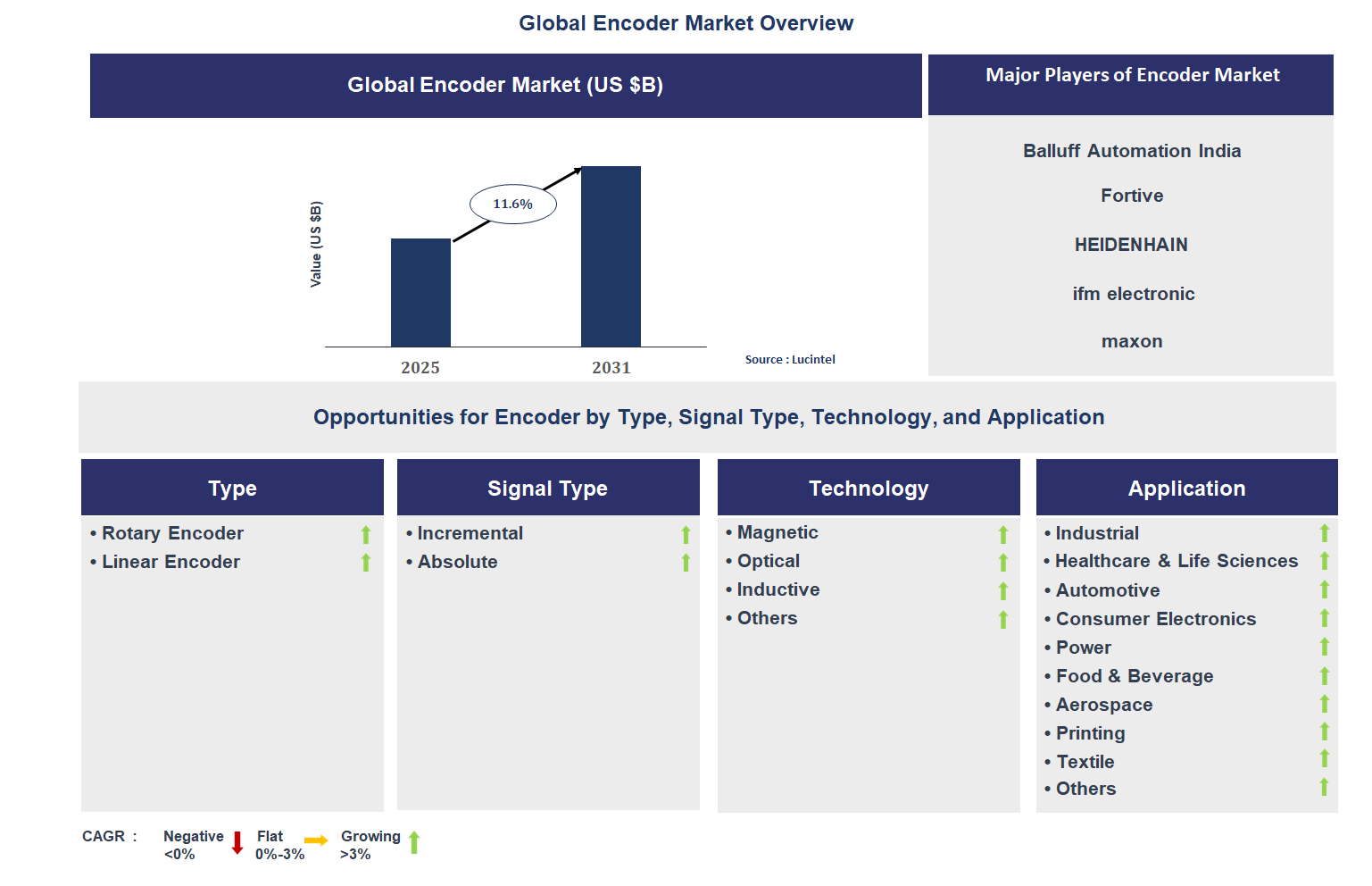
The future of the global encoder market looks promising with opportunities in the industrial, healthcare & life science, automotive, consumer electronics, power, food & beverage, aerospace, printing, and textile markets. The global encoder market is expected to grow with a CAGR of 11.6% from 2025 to 2031. The major drivers for this market are the increasing demand for automation in industries, the rising adoption of robotics across sectors, and the growing use of encoders in machinery.• Lucintel forecasts that, within the type category, rotary encoder is expected to witness higher growth over the forecast period.
• Within the application category, automotive is expected to witness the highest growth.
• In terms of region, APAC is expected to witness the highest growth over the forecast period. Gain valuable insights for your business decisions with our comprehensive 150+ page report. Sample figures with some insights are shown below.
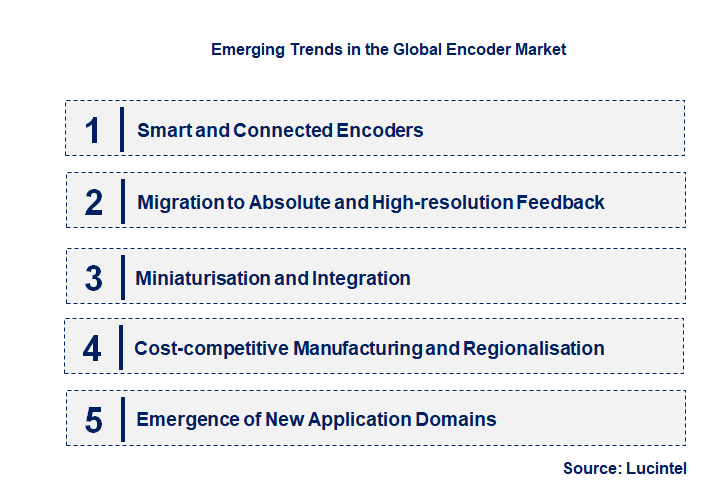
Emerging Trends in the Encoder Market
In the evolving encoder market, five major trends are emerging that are reshaping how manufacturers design, deploy and use encoders across industries. These trends reflect shifts in technology, connectivity, integration and market structure.• Smart and Connected Encoders: Encoders are increasingly embedded with digital diagnostics, wireless connectivity and data interfaces for real-time monitoring and maintenance. This trend enables predictive maintenance, reduces downtime and supports Industry 4.0 systems that integrate feedback sensors into IoT platforms.
• Migration to Absolute and High-resolution Feedback: As applications demand higher precision and fault-tolerance (e.g., robotics, EVs, aerospace), the shift from incremental to absolute encoders is accelerating. Higher resolution encoders reduce errors, improve positioning accuracy and enable safer, more reliable motion control systems.
• Miniaturization and Integration: Encoders are becoming smaller, more compact and integrated directly into motors or modules. This reduces footprint, simplifies assembly, lowers cost and supports applications in electronics manufacturing, compact robotics and medical devices where space and weight are at premium.
• Cost-competitive Manufacturing and Regionalization: Manufacturers in Asia-Pacific (especially China and India) are scaling production of encoders domestically, reducing reliance on imports, lowering unit cost and improving localisation. This makes encoders more accessible for OEMs in high-volume automation and supports regional supply-chain resilience.
• Emergence of New Application Domains: Beyond traditional industrial automation, encoders are being adopted in healthcare, renewable energy, logistics, consumer electronics and EV powertrains. This broadening of applications opens growth for encoder suppliers and reinforces the need for diversified, application-tailored solutions. These emerging trends — connectivity, precision, miniaturization, localisation and application diversification — are transforming the encoder market. Suppliers and OEMs who adapt technology, manufacturing and go-to-market strategies accordingly are well-positioned for the next wave of growth in industrial automation and smart motion-control systems.
Recent Development in the Encoder Market
Recent years have witnessed several notable developments in the encoder market, driven by technological innovation, evolving applications, supply-chain changes and automation investments. Highlighting five key developments illustrates how the market is being reshaped.• Launch of next-generation encoder models with diagnostics and networking: Leading suppliers are introducing encoders with self-detection of faults, programmable resolution, real-time diagnostics and Ethernet/IO-Link connectivity. These models reduce downtime and enable easier integration into automated systems.
• Expansion of encoder production in Asia-Pacific to meet rising automation demand: Asian markets, particularly China and India, are investing in local encoder manufacturing capacity to support regional robotics and smart factory growth. Lower cost production helps meet high-volume demand and supports export opportunities.
• Increasing use of encoders in EVs and advanced driver-assistance systems (ADAS): As electric and autonomous vehicles proliferate, encoders are required for motor feedback, steering systems and sensor actuation. This automotive trend is creating new demand and premium requirements for durability and precision.
• Integration of encoders into smart factory ecosystems (Industry 4.0): Encoders are no longer isolated sensors—they are part of networked motion-control, IoT and digital-twin systems. Their role in real-time feedback, machine learning and predictive maintenance has become a development focal point.
• Shift towards non-contact and magnetic sensing technologies: To address harsh environments, maintenance-free operation and cost constraints, magnetic and inductive encoder technologies are gaining ground relative to optical types. These technologies improve robustness, especially in industrial and outdoor settings. Together, these developments are pushing the encoder market toward smarter, more integrated, higher-precision and regionally diversified solutions. Suppliers who innovate and align with evolving application demands and global supply-chain shifts will drive the next phase of market growth.
Strategic Growth Opportunities in the Encoder Market
To capitalise on evolving market dynamics, encoder manufacturers and suppliers can target high-growth application areas. Here are five key growth opportunities, each offering strategic value in the encoder market.• Automotive & EV drive systems: As electric vehicles and ADAS deployments accelerate, encoders have a critical role in motor control, braking systems and autonomous actuators. Focusing on high-accuracy, rugged automotive-grade encoders offers long-term growth potential.
• Industrial automation & robotics: Ongoing factory automation, robot deployment and retrofitting in manufacturing facilities continue to drive demand. Encoders tailored for collaborative robots, CNC machines and smart conveyors present major growth levers.
• Medical devices & healthcare equipment: Encoders in medical robotics, imaging systems, diagnostics equipment and lab automation represent a less-crowded growth niche. High-reliability, compact encoders customised for healthcare applications offer premium opportunities.
• Consumer electronics & semiconductor manufacturing: Smaller form-factor encoders for positioning in consumer-electronics assembly, semiconductor tool motion control and precision packaging can tap into high-volume markets and support miniaturization trends.
• Renewable energy & infrastructure automation: Wind turbines, solar tracking systems, smart grid actuators and infrastructure automation rely on accurate position/speed feedback. Encoders designed for outdoor, harsh-environment operation can capture this emerging market. By aligning product development, manufacturing and channel strategies to these high-growth applications, encoder market participants can leverage expanding demand across automotive, industrial, medical, electronic and infrastructure sectors — thereby reinforcing long-term growth and diversification.
Encoder Market Driver and Challenges
The encoder market is shaped by a combination of technological, economic and regulatory forces. Key drivers and challenges influence growth, innovation and competitive dynamics in the market. The factors responsible for driving the encoder market include: 1. Automation and Industry 4.0 investment: Market growth is propelled by increasing factory automation, robotics deployment and digital-manufacturing initiatives globally. Encoders are fundamental to motion control and feedback systems. 2. Electric vehicles and ADAS adoption: The automotive transition toward EVs and autonomous systems creates new demand for high-precision sensors and encoders in motors, steering and actuator systems. 3. Rising demand for precision and miniaturization: Industries such as electronics, medical and aerospace require compact, high-resolution encoders to deliver accurate motion feedback in constrained spaces. 4. Regional manufacturing growth and localisation: Countries like China and India are increasing domestic encoder production to support local automation and reduce import dependency — driving regional demand and manufacturing scale. 5. Expansion into new application domains: Encoders are finding usage beyond traditional manufacturing — in healthcare, semiconductors, renewable energy and infrastructure — broadening market scope. Challenges in the encoder market are: 1. High cost and integration complexity: Advanced encoders with high resolution, connectivity and diagnostics often carry premium pricing and require complex integration into existing systems, limiting adoption in cost-sensitive segments. 2. Technological standardisation and interoperability: Variation in communication protocols, feedback formats and sensor standards creates hurdles for global deployment and increases development complexity for suppliers. 3. Supply-chain disruptions and competitiveness: Dependence on raw materials, geopolitical issues, localisation pressures and increasing price competition from low-cost manufacturers challenge margin sustainability and quality control. The encoder market is being catalyzed by automation, automotive transformation, precision demands, regional manufacturing expansion and diversified applications. At the same time, cost pressures, integration complexity and supply-chain risks present strategic challenges. Successful players will navigate these dynamics to capture growth and sustain differentiation.List of Encoder Companies
Companies in the market compete on the basis of product quality offered. Major players in this market focus on expanding their manufacturing facilities, R&D investments, infrastructural development, and leverage integration opportunities across the value chain. With these strategies encoder companies cater increasing demand, ensure competitive effectiveness, develop innovative products & technologies, reduce production costs, and expand their customer base. Some of the encoder companies profiled in this report include-• Balluff Automation India
• Fortive
• HEIDENHAIN
• ifm electronic
• maxon
• Mitutoyo Corporation
• Pepperl+Fuchs
• Pilz
• Renishaw
• Sensata Technologies
Encoder Market by Segment
The study includes a forecast for the global encoder market by type, signal type, technology, application, and region.Encoder Market by Type [Value from 2019 to 2031]:
• Rotary Encoder
• Linear Encoder
Encoder Market by Signal Type [Value from 2019 to 2031]:
• Incremental
• Absolute
Encoder Market by Technology [Value from 2019 to 2031]:
• Magnetic
• Optical
• Inductive
• Others
Encoder Market by Application [Value from 2019 to 2031]:
• Industrial
• Healthcare & Life Sciences
• Automotive
• Consumer Electronics
• Power
• Food & Beverage
• Aerospace
• Printing
• Textile
• Others
Encoder Market by Region [Value from 2019 to 2031]:
• North America
• Europe
• Asia Pacific
• The Rest of the World
Country Wise Outlook for the Encoder Market
Global demand for encoders continues to accelerate as industries push towards automation, precision control and Industry 4.0-enabled manufacturing. With rising investments in robotics, electric vehicles, smart factories and motion control systems, regional encoder markets are evolving rapidly — reflecting shifts in production, localisation, technology upgrade and regulatory influence.• United States: The U.S. encoder market is being driven by advanced manufacturing and automation in automotive, aerospace and semiconductor sectors. U.S. players focus on high-precision optical encoders and integration with IoT systems for predictive maintenance.
• China: China is rapidly scaling its encoder production, especially for incremental and absolute feedback devices, supported by automation push and domestic manufacturing excellence. The country is also exporting encoders and evolving into a hub for cost-competitive solutions.
• Germany: In Germany the encoder market benefits from the country’s strong industrial automation base and auto manufacturing heritage. Demand for high-durability, precision feedback sensors in robotics, additive manufacturing and smart factory settings is increasing.
• India: India’s encoder market is gaining momentum via its Make-in-India initiative and growing CNC/machine-tool manufacturing. Localisation of production and rising demand in industrial automation are shaping the market.
• Japan: Japan remains a key market for high-end encoders integrated into robotics, medical equipment and precision electronics. With labour shortages and a shift to smart manufacturing, Japanese firms are adopting advanced absolute encoders and IoT-enabled feedback systems.

Features of the Global Encoder Market
Market Size Estimates: Encoder market size estimation in terms of value ($B). Trend and Forecast Analysis: Market trends (2019 to 2024) and forecast (2025 to 2031) by various segments and regions. Segmentation Analysis: Encoder market size by various segments, such as by type, signal type, technology, application, and region in terms of value ($B). Regional Analysis: Encoder market breakdown by North America, Europe, Asia Pacific, and Rest of the World. Growth Opportunities: Analysis of growth opportunities in different types, signal types, technologies, applicationS, and regions for the encoder market. Strategic Analysis: This includes M&A, new product development, and competitive landscape of the encoder market. Analysis of competitive intensity of the industry based on Porter’s Five Forces model.
FAQ
Q1. What is the growth forecast for encoder market? Answer: The global encoder market is expected to grow with a CAGR of 11.6% from 2025 to 2031. Q2. What are the major drivers influencing the growth of the encoder market? Answer: The major drivers for this market are the increasing demand for automation in industries, the rising adoption of robotics across sectors, and the growing use of encoders in machinery. Q3. What are the major segments for encoder market? Answer: The future of the encoder market looks promising with opportunities in the industrial, healthcare & life science, automotive, consumer electronics, power, food & beverage, aerospace, printing, and textile markets. Q4. Who are the key encoder market companies? Answer: Some of the key encoder companies are as follows:• Balluff Automation India
• Fortive
• HEIDENHAIN
• ifm electronic
• maxon
• Mitutoyo Corporation
• Pepperl+Fuchs
• Pilz
• Renishaw
• Sensata Technologies Q5. Which encoder market segment will be the largest in future? Answer: Lucintel forecasts that, within the type category, rotary encoder is expected to witness higher growth over the forecast period. Q6. In encoder market, which region is expected to be the largest in next 5 years? Answer: In terms of region, APAC is expected to witness the highest growth over the forecast period. Q7. Do we receive customization in this report? Answer: Yes, Lucintel provides 10% customization without any additional cost.
Table of Contents
List of Figures
List of Tables
Methodology
- In-depth interviews of the major players in this market
- Detailed secondary research from competitors’ financial statements and published data
- Extensive searches of published works, market, and database information pertaining to industry news, company press releases, and customer intentions
- A compilation of the experiences, judgments, and insights of Lucintel’s professionals, who have analyzed and tracked this market over the years.


Buy Now
Choose a license that fits your team. Instant PDF delivery.
Prices exclude taxes. Instant delivery. Custom licensing available on request.
Key Questions
- • What are some of the most promising, high-growth opportunities for the encoder market by type (rotary encoder and linear encoder), signal type (incremental and absolute), technology (magnetic, optical, inductive, and others), application (industrial, healthcare & life sciences, automotive, consumer electronics, power, food & beverage, aerospace, printing, textile, and others), and region (North America, Europe, Asia Pacific, and the Rest of the World)?
- • Which segments will grow at a faster pace and why?
- • Which region will grow at a faster pace and why?
- • What are the key factors affecting market dynamics? What are the key challenges and business risks in this market?
- • What are the business risks and competitive threats in this market?
- • What are the emerging trends in this market and the reasons behind them?
- • What are some of the changing demands of customers in the market?
- • What are the new developments in the market? Which companies are leading these developments?
- • Who are the major players in this market? What strategic initiatives are key players pursuing for business growth?
- • What are some of the competing products in this market and how big of a threat do they pose for loss of market share by material or product substitution?
- • What M&A activity has occurred in the last 5 years and what has its impact been on the industry? For any questions related to Encoder Market, Encoder Market Size, Encoder Market Growth, Encoder Market Analysis, Encoder Market Report, Encoder Market Share, Encoder Market Trends, Encoder Market Forecast, Encoder Companies, write Lucintel analyst at email: helpdesk@lucintel.com. We will be glad to get back to you soon.


