
'
...

The Impact of COVID-19 is included in Emergency and Disaster Response Market Report. Buy it today to get an advantage.

Request the impact of COVID-19 on your product or industry


Emergency and Disaster Response Market Trends and Forecast

The future of the global emergency and disaster response market looks promising with opportunities in the government agency, non-governmental organization, private sector, and military markets. The global emergency and disaster response market is expected to reach an estimated $198 billion by 2035 with a CAGR of 4.9% from 2026 to 2035. The major drivers for this market are the increasing frequency of natural disaster events, the rising demand for rapid emergency response systems, and the growing investment in disaster management technologies.

• Lucintel forecasts that, within the type of emergency category, health emergency is expected to witness the highest growth over the forecast period.
• Within the end use category, government agency is expected to witness the highest growth.
• In terms of region, APAC is expected to witness the highest growth over the forecast period.
Gain valuable insights for your business decisions with our comprehensive 150+ page report. Sample figures with some insights are shown below.
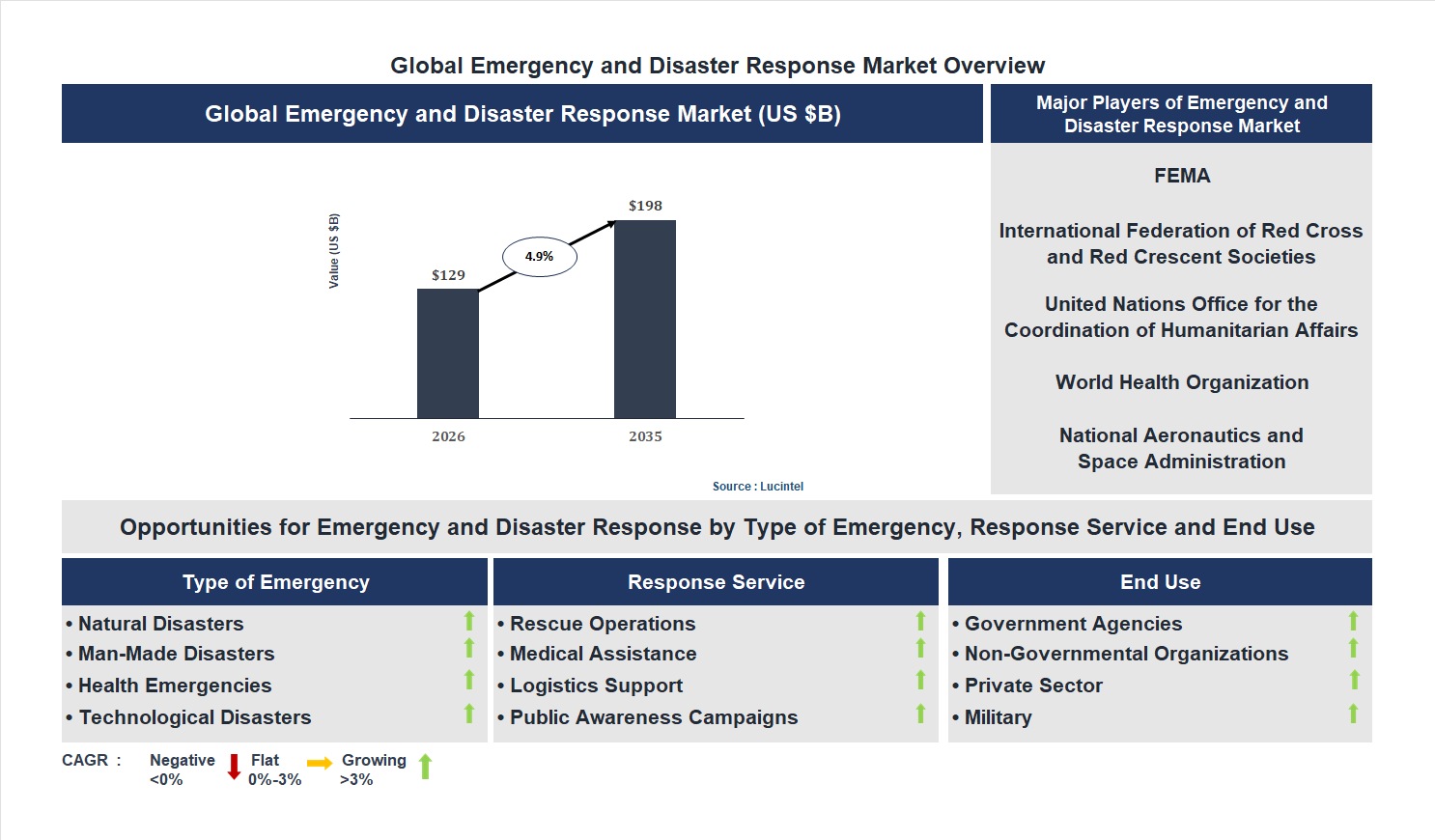
Emergency and Disaster Response Market Trends and Forecast

Emerging Trends in the Emergency and Disaster Response Market

The emergency and disaster response market is experiencing rapid evolution driven by technological advancements, increasing global risks, and the need for more efficient response mechanisms. As natural and man-made disasters become more frequent and severe, stakeholders are investing in innovative solutions to enhance preparedness, response, and recovery efforts. These developments are reshaping the landscape, emphasizing agility, data integration, and sustainability. The following key trends highlight the transformative changes occurring within this vital sector, reflecting a shift towards smarter, more coordinated, and resilient emergency response systems.

• Adoption of Advanced Technologies: The integration of AI, IoT, and drone technology is revolutionizing disaster response. AI algorithms enable predictive analytics for early warning systems, while IoT sensors provide real-time data on environmental conditions. Drones facilitate rapid assessment of affected areas, especially in inaccessible zones. These technologies improve decision-making speed, accuracy, and resource allocation, ultimately saving lives and reducing damage. The trend toward automation and data-driven responses is expected to grow, fostering smarter emergency management systems.
• Increased Focus on Data Integration and Interoperability: Modern emergency response relies heavily on seamless data sharing across agencies and platforms. Efforts are underway to develop unified command centers and interoperable communication systems that enable real-time information exchange. This integration enhances coordination among first responders, government agencies, and NGOs, reducing response times and avoiding duplication of efforts. The trend toward comprehensive data ecosystems supports more effective disaster management, especially during large-scale emergencies involving multiple stakeholders.
• Emphasis on Resilient Infrastructure and Sustainable Solutions: Building resilient infrastructure capable of withstanding disasters is gaining prominence. This includes the development of flood-resistant buildings, earthquake-proof structures, and sustainable energy sources for emergency operations. Incorporating green technologies and eco-friendly materials reduces environmental impact and ensures long-term sustainability. This trend aligns with global efforts to create disaster-resilient communities, minimizing economic losses and safeguarding ecosystems while maintaining operational continuity during crises.
• Growth of Public-Private Partnerships (PPPs): Collaboration between government agencies, private companies, and non-profit organizations is expanding to enhance disaster response capabilities. PPPs facilitate resource sharing, innovation, and funding for advanced response systems. Private sector expertise in logistics, technology, and infrastructure complements public efforts, leading to more comprehensive and efficient disaster management strategies. This trend fosters a more resilient response network, leveraging diverse resources and expertise to address complex emergencies effectively.
• Development of Specialized Training and Simulation Programs: To prepare responders for diverse disaster scenarios, there is a rising focus on advanced training and simulation exercises. Virtual reality (VR) and augmented reality (AR) technologies create realistic training environments, improving responders skills and decision-making under pressure. These programs enhance readiness for natural calamities, industrial accidents, and terrorist attacks. The trend toward specialized, scenario-based training ensures a more competent and confident response workforce, ultimately reducing response times and improving outcomes during actual emergencies.

These trends are fundamentally transforming the emergency and disaster response market by fostering smarter, more integrated, and resilient systems. The adoption of cutting-edge technologies, emphasis on interoperability, sustainable infrastructure, strategic partnerships, and advanced training are collectively enhancing global disaster preparedness and response capabilities. As these developments continue, the market is poised for increased efficiency, reduced impact of disasters, and improved safety for communities worldwide.
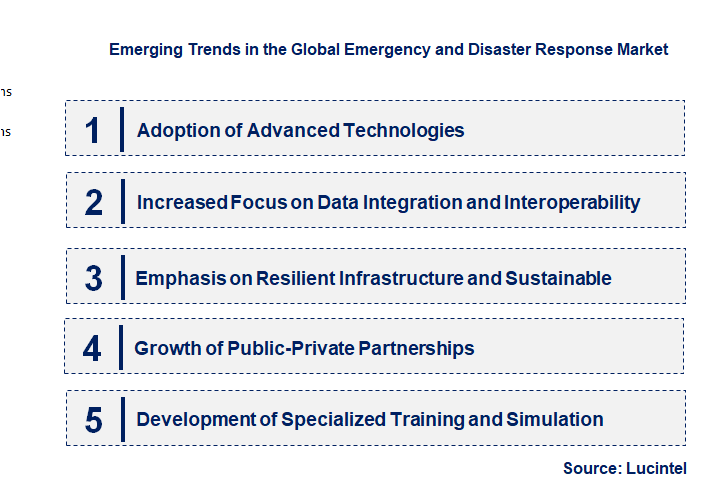
Emerging Trends in the Emergency and Disaster Response Market

Recent Development in the Emergency and Disaster Response Market

The emergency and disaster response market is experiencing rapid growth driven by increasing natural calamities, technological advancements, and global preparedness initiatives. Governments, organizations, and private sectors are investing heavily to enhance response capabilities, improve coordination, and develop innovative solutions. These developments are shaping a more resilient infrastructure, fostering international cooperation, and expanding market opportunities. As the frequency and severity of disasters rise, the markets evolution is crucial for saving lives, minimizing damage, and ensuring swift recovery worldwide.

• Technological Innovations in Disaster Management: Adoption of AI, IoT, and Big Data is transforming response strategies. These technologies enable real-time data collection, predictive analytics, and efficient resource allocation, significantly improving response times and accuracy. Enhanced communication systems and drone technology facilitate rapid assessment and delivery of aid. This integration leads to smarter, more coordinated responses, reducing casualties and economic losses, and fostering a more resilient disaster management infrastructure globally.
• Increased Government and Private Sector Investments: Governments are allocating substantial budgets for disaster preparedness and response infrastructure. Private companies are partnering with public agencies to develop advanced equipment, training programs, and emergency services. These investments enhance capacity, foster innovation, and ensure readiness for large-scale emergencies. The growth in funding also promotes research and development, leading to new solutions that improve response efficiency and community resilience, ultimately strengthening the overall market landscape.
• Expansion of Emergency Response Equipment and Supplies: The market for emergency response gear, medical supplies, and rescue equipment is expanding rapidly. Innovations include portable medical devices, advanced firefighting gear, and durable rescue tools. Increased demand stems from rising disaster incidents and preparedness initiatives. This growth supports local and international response efforts, improves safety standards, and ensures rapid deployment of essential supplies, thereby boosting the market and enabling more effective disaster management operations worldwide.
• Development of Integrated Response Platforms: Unified command systems and digital platforms are being developed to streamline coordination among agencies. These platforms facilitate information sharing, resource management, and strategic planning during crises. They improve interoperability between different responders, reduce response times, and enhance situational awareness. The deployment of such integrated systems is critical for managing complex emergencies, leading to more organized and effective disaster response efforts, and expanding the market for these technological solutions.
• Focus on Community Resilience and Preparedness Programs: Increasing emphasis on training, awareness campaigns, and community-based initiatives is strengthening local disaster response capabilities. These programs empower communities to act swiftly and effectively during emergencies, reducing dependency on external aid. Enhanced resilience reduces overall impact and recovery time, encouraging investments in local infrastructure and education. This focus broadens market opportunities for training providers, educational tools, and local response solutions, fostering a more prepared and resilient global population.

The overall impact of these developments is a more efficient, technologically advanced, and resilient emergency response market. Increased investments, innovation, and community engagement are driving growth, improving response times, and reducing disaster-related damages. These advancements are creating a safer, more prepared global environment, ultimately saving lives and minimizing economic losses during emergencies.

Strategic Growth Opportunities in the Emergency and Disaster Response Market

The emergency and disaster response market is experiencing rapid growth driven by increasing natural calamities, technological advancements, and global preparedness initiatives. Governments, organizations, and private sectors are investing heavily in innovative solutions to enhance response efficiency and reduce impact. Expanding applications across various sectors such as healthcare, infrastructure, and communication are creating new opportunities. Strategic investments and collaborations are vital for market players to capitalize on emerging trends and improve overall disaster management capabilities worldwide.

• Technological Integration in Emergency Response Systems: The adoption of advanced technologies like AI, IoT, and drones is transforming disaster response. These innovations enable real-time data collection, faster decision-making, and efficient resource deployment. Sub-segments such as predictive analytics and remote sensing are improving preparedness and response accuracy, reducing casualties and damage. As technology becomes more affordable and accessible, its integration into existing emergency frameworks will significantly enhance overall response effectiveness.
• Increasing Investment in Disaster Preparedness Infrastructure: Governments and private entities are prioritizing infrastructure development to withstand natural disasters. This includes resilient buildings, early warning systems, and dedicated emergency response centers. Such investments aim to minimize damage and facilitate rapid recovery. The focus on resilient infrastructure in regions prone to earthquakes, floods, and hurricanes is expected to drive market growth, creating opportunities for construction firms, technology providers, and service providers specializing in disaster-resistant solutions.
• Expansion of Emergency Medical Services and Healthcare Solutions: The rising frequency of disasters necessitates robust medical response systems. Innovations in portable medical devices, telemedicine, and mobile clinics are expanding healthcare access during emergencies. Sub-segments like trauma care, disease outbreak management, and mental health support are gaining prominence. The integration of these solutions into disaster response plans enhances survival rates and reduces long-term health impacts, fostering growth in healthcare markets dedicated to emergency medical services.
• Growth of Communication and Coordination Platforms: Effective communication is critical during disasters. The development of integrated communication platforms, including satellite communication, emergency alert systems, and mobile apps, is improving coordination among responders. These platforms facilitate swift information sharing, resource allocation, and public alerts. As communication technology advances, the ability to manage complex disaster scenarios improves, creating opportunities for telecom providers, software developers, and government agencies to enhance disaster response efficiency.
• Rising Focus on Training, Simulation, and Capacity Building: Preparedness training and simulation exercises are vital for effective disaster response. Investment in virtual reality, scenario-based training, and capacity-building programs is increasing globally. These initiatives improve responder skills, coordination, and decision-making under pressure. The development of specialized training modules for different disaster types, such as floods or industrial accidents, supports a more resilient response workforce, ultimately reducing response times and improving outcomes across the emergency response ecosystem.

These growth opportunities are collectively shaping a more resilient and technologically advanced emergency and disaster response market. Strategic investments in innovation, infrastructure, healthcare, communication, and training will enhance global preparedness and response capabilities. As these opportunities mature, they will drive market expansion, improve response efficiency, and ultimately save lives and reduce economic losses during disasters worldwide.

Emergency and Disaster Response Market Driver and Challenges

The emergency and disaster response market is influenced by a complex interplay of technological advancements, economic conditions, and regulatory frameworks. Rapid technological innovations such as AI, IoT, and advanced communication systems enhance response efficiency and coordination. Economic factors, including government funding and global disaster preparedness budgets, significantly impact market growth. Additionally, evolving regulations and standards shape operational protocols and safety measures. These drivers and challenges collectively determine the markets trajectory, influencing the development, deployment, and effectiveness of emergency response solutions worldwide. Understanding these factors is crucial for stakeholders aiming to optimize disaster management strategies and improve resilience.

The factors responsible for driving the emergency and disaster response market include:-
• Technological Innovation: The integration of advanced technologies like artificial intelligence, IoT, and drone surveillance enhances real-time data collection, situational awareness, and decision-making during emergencies. These innovations enable faster, more accurate responses, reducing casualties and damage. As technology continues to evolve, the market benefits from increased efficiency, automation, and predictive analytics, which are vital in managing complex disaster scenarios. The adoption of such technologies is driven by the need for more effective response mechanisms, making this a key growth driver.
• Government Initiatives and Funding: Governments worldwide are prioritizing disaster preparedness and response through increased funding, policy support, and strategic initiatives. Public sector investments in emergency management infrastructure, training, and technology deployment significantly boost market growth. These initiatives often include establishing national disaster response frameworks and international collaborations, which facilitate resource sharing and capacity building. The availability of funding and supportive policies directly influence the expansion and modernization of emergency response systems.
• Increasing Frequency and Severity of Disasters: The rising occurrence of natural calamities such as hurricanes, floods, wildfires, and earthquakes, driven by climate change, necessitates robust response mechanisms. This trend compels governments and organizations to invest in advanced response solutions to mitigate impacts. The growing scale and complexity of disasters demand innovative, scalable, and rapid-response systems, fueling market demand for specialized equipment, software, and trained personnel.
• Rising Awareness and Preparedness: Enhanced awareness about disaster risks and the importance of preparedness campaigns encourages governments, organizations, and communities to adopt comprehensive response strategies. Educational initiatives and public safety programs promote early warning systems and emergency planning, which in turn drive demand for related technologies and services. This increased focus on preparedness reduces response times and improves overall resilience, positively impacting market growth.
• Technological Collaboration and Partnerships: Strategic alliances between technology providers, government agencies, and private organizations foster innovation and resource sharing. Collaborative efforts lead to the development of integrated response platforms, data sharing protocols, and joint training programs. These partnerships accelerate the deployment of advanced solutions and expand market reach, creating a more resilient and responsive disaster management ecosystem.

The challenges facing the emergency and disaster response market include:-
• Regulatory and Compliance Barriers: The emergency response sector faces complex regulatory environments that vary across regions, often leading to delays in technology adoption and deployment. Strict safety standards, data privacy laws, and certification requirements can hinder innovation and increase operational costs. Navigating these regulations requires significant effort and resources, which may slow down market growth and limit the rapid implementation of new solutions.
• High Cost of Advanced Technologies: Implementing cutting-edge technologies such as AI, drones, and IoT devices involves substantial capital investment. Many organizations, especially in developing regions, struggle with budget constraints, limiting their ability to adopt these innovations. The high costs can restrict market penetration and delay the modernization of existing emergency response systems, impacting overall effectiveness.
• Fragmented Market and Lack of Standardization: The emergency response market is highly fragmented, with numerous players offering diverse solutions that often lack interoperability. The absence of standardized protocols and systems hampers seamless coordination during multi-agency responses. This fragmentation complicates procurement, training, and integration efforts, reducing overall efficiency and creating barriers to large-scale adoption of comprehensive response solutions.

The emergency and disaster response market is driven by technological advancements, government support, increasing disaster incidents, awareness, and strategic collaborations. However, regulatory hurdles, high technology costs, and market fragmentation pose significant challenges. These factors collectively influence the pace and scope of market development, requiring stakeholders to navigate complexities carefully. Overall, the markets growth hinges on balancing innovation with regulatory compliance and cost management, aiming to enhance global disaster resilience and response capabilities.

List of Emergency and Disaster Response Companies

Companies in the market compete on the basis of product quality offered. Major players in this market focus on expanding their manufacturing facilities, R&D investments, infrastructural development, and leverage integration opportunities across the value chain. With these strategies emergency and disaster response companies cater increasing demand, ensure competitive effectiveness, develop innovative products & technologies, reduce production costs, and expand their customer base. Some of the emergency and disaster response companies profiled in this report include-
• FEMA
• International Federation of Red Cross and Red Crescent Societies
• United Nations Office for the Coordination of Humanitarian Affairs
• World Health Organization
• National Aeronautics and Space Administration
• DHL Supply Chain
• Boeing

Emergency and Disaster Response Market by Segment

The study includes a forecast for the global emergency and disaster response market by type of emergency, response service, end use, and region.

Emergency and Disaster Response Market by Type of Emergency [Value from 2019 to 2035]:


• Natural Disasters
• Man-Made Disasters
• Health Emergencies
• Technological Disasters

Emergency and Disaster Response Market by Response Service [Value from 2019 to 2035]:


• Rescue Operations
• Medical Assistance
• Logistics Support
• Public Awareness Campaigns

Emergency and Disaster Response Market by End Use [Value from 2019 to 2035]:


• Government Agencies
• Non-Governmental Organizations
• Private Sector
• Military

Emergency and Disaster Response Market by Region [Value from 2019 to 2035]:


• North America
• Europe
• Asia Pacific
• The Rest of the World

Country Wise Outlook for the Emergency and Disaster Response Market

The emergency and disaster response market has experienced significant growth driven by increasing natural disasters, technological advancements, and heightened global awareness of crisis management. Governments and private sectors are investing heavily in innovative solutions to improve response times, coordination, and resource allocation. The market is characterized by the integration of advanced communication systems, AI-driven analytics, and portable medical devices. As climate change accelerates, the demand for robust emergency response systems is expected to rise across the globe, with particular focus on the United States, China, Germany, India, and Japan, each demonstrating unique developments tailored to their specific needs and challenges.

• United States: The US has seen substantial investments in AI-powered disaster management systems and drone technology for search and rescue operations. Federal agencies are enhancing interoperability of communication networks and deploying advanced simulation tools for preparedness. The development of smart emergency response centers and increased funding for community resilience programs are notable trends. The focus remains on integrating technology to reduce response times and improve coordination during large-scale disasters.
• China: China has rapidly expanded its emergency response infrastructure, emphasizing the use of big data analytics and IoT devices for real-time disaster monitoring. The government has launched nationwide initiatives to improve urban resilience, including the deployment of smart sensors and early warning systems. Investments in mobile medical units and rescue robots are also increasing, aiming to enhance on-ground response capabilities. The country’s focus is on integrating traditional methods with cutting-edge technology to manage both natural and industrial disasters effectively.
• Germany: Germany is advancing its disaster response through the adoption of digital twin technology and enhanced crisis communication platforms. The country emphasizes sustainable and eco-friendly response solutions, including renewable energy-powered emergency units. Germany’s focus on research and development is evident in its deployment of advanced firefighting drones and integrated command systems. The government is also strengthening cross-border cooperation within the EU to improve regional disaster preparedness and response.
• India: India is witnessing rapid growth in emergency response infrastructure, driven by frequent natural calamities like floods and cyclones. The country is investing in mobile health units, early warning systems, and community-based disaster preparedness programs. The adoption of satellite-based communication and GIS technology is improving situational awareness. Efforts are also underway to train local responders and integrate traditional knowledge with modern technology to enhance resilience, especially in rural and vulnerable areas.
• Japan: Japan continues to lead in earthquake and tsunami preparedness, with significant advancements in early warning systems and seismic monitoring. The country is developing autonomous rescue robots and enhancing its disaster simulation exercises. Investments in resilient infrastructure, such as flood barriers and earthquake-resistant buildings, are prominent. Japan’s focus remains on integrating technology with community-based approaches to ensure rapid and effective disaster response, reflecting its experience with frequent natural disasters.

Lucintel Analytics Dashboard

Features of the Global Emergency and Disaster Response Market

Market Size Estimates: Emergency and disaster response market size estimation in terms of value ($B).
Trend and Forecast Analysis: Market trends (2019 to 2025) and forecast (2026 to 2035) by various segments and regions.
Segmentation Analysis: Emergency and disaster response market size by type of emergency, response service, end use, and region in terms of value ($B).
Regional Analysis: Emergency and disaster response market breakdown by North America, Europe, Asia Pacific, and Rest of the World.
Growth Opportunities: Analysis of growth opportunities in different types of emergency, response services, end uses, and regions for the emergency and disaster response market.
Strategic Analysis: This includes M&A, new product development, and competitive landscape of the emergency and disaster response market.
Analysis of competitive intensity of the industry based on Porter’s Five Forces model.

Lucintel Consulting Services

FAQ

Q1. What is the emergency and disaster response market size?
Answer: The global emergency and disaster response market is expected to reach an estimated $198 billion by 2035.
Q2. What is the growth forecast for emergency and disaster response market?
Answer: The global emergency and disaster response market is expected to grow with a CAGR of 4.9% from 2026 to 2035.
Q3. What are the major drivers influencing the growth of the emergency and disaster response market?
Answer: The major drivers for this market are the increasing frequency of natural disaster events, the rising demand for rapid emergency response systems, and the growing investment in disaster management technologies.
Q4. What are the major segments for emergency and disaster response market?
Answer: The future of the emergency and disaster response market looks promising with opportunities in the government agency, non-governmental organization, private sector, and military markets.
Q5. Who are the key emergency and disaster response market companies?
Answer: Some of the key emergency and disaster response companies are as follows:
• FEMA
• International Federation of Red Cross and Red Crescent Societies
• United Nations Office for the Coordination of Humanitarian Affairs
• World Health Organization
• National Aeronautics and Space Administration
• DHL Supply Chain
• Boeing
Q6. Which emergency and disaster response market segment will be the largest in future?
Answer: Lucintel forecasts that, within the type of emergency category, health emergency is expected to witness the highest growth over the forecast period.
Q7. In emergency and disaster response market, which region is expected to be the largest in next 8 years?
Answer: In terms of region, APAC is expected to witness the highest growth over the forecast period.
Q8. Do we receive customization in this report?
Answer: Yes, Lucintel provides 10% customization without any additional cost.

This report answers following 11 key questions:

Q.1. What are some of the most promising, high-growth opportunities for the emergency and disaster response market by type of emergency (natural disasters, man-made disasters, health emergencies, and technological disasters), response service (rescue operations, medical assistance, logistics support, and public awareness campaigns), end use (government agencies, non-governmental organizations, private sector, and military), and region (North America, Europe, Asia Pacific, and the Rest of the World)?
Q.2. Which segments will grow at a faster pace and why?
Q.3. Which region will grow at a faster pace and why?
Q.4. What are the key factors affecting market dynamics? What are the key challenges and business risks in this market?
Q.5. What are the business risks and competitive threats in this market?
Q.6. What are the emerging trends in this market and the reasons behind them?
Q.7. What are some of the changing demands of customers in the market?
Q.8. What are the new developments in the market? Which companies are leading these developments?
Q.9. Who are the major players in this market? What strategic initiatives are key players pursuing for business growth?
Q.10. What are some of the competing products in this market and how big of a threat do they pose for loss of market share by material or product substitution?
Q.11. What M&A activity has occurred in the last 5 years and what has its impact been on the industry?

For any questions related to Emergency and Disaster Response Market, Emergency and Disaster Response Market Size, Emergency and Disaster Response Market Growth, Emergency and Disaster Response Market Analysis, Emergency and Disaster Response Market Report, Emergency and Disaster Response Market Share, Emergency and Disaster Response Market Trends, Emergency and Disaster Response Market Forecast, Emergency and Disaster Response Companies, write Lucintel analyst at email: helpdesk@lucintel.com. We will be glad to get back to you soon.
                                           Table of Contents

            1. Executive Summary

            2. Market Overview

                        2.1 Background and Classifications
                        2.2 Supply Chain

            3. Market Trends & Forecast Analysis

                        3.1 Macroeconomic Trends and Forecasts
                        3.2 Industry Drivers and Challenges
                        3.3 PESTLE Analysis
                        3.4 Patent Analysis
                        3.5 Regulatory Environment
                        3.6 Global Emergency and Disaster Response Market Trends and Forecast

            4. Global Emergency and Disaster Response Market by Type of Emergency

                        4.1 Overview
                        4.2 Attractiveness Analysis by Type of Emergency
                        4.3 Natural Disasters : Trends and Forecast (2019 to 2035)
                        4.4 Man-Made Disasters : Trends and Forecast (2019 to 2035)
                        4.5 Health Emergencies : Trends and Forecast (2019 to 2035)
                        4.6 Technological Disasters : Trends and Forecast (2019 to 2035)

            5. Global Emergency and Disaster Response Market by Response Service

                        5.1 Overview
                        5.2 Attractiveness Analysis by Response Service
                        5.3 Rescue Operations : Trends and Forecast (2019 to 2035)
                        5.4 Medical Assistance : Trends and Forecast (2019 to 2035)
                        5.5 Logistics Support : Trends and Forecast (2019 to 2035)
                        5.6 Public Awareness Campaigns : Trends and Forecast (2019 to 2035)

            6. Global Emergency and Disaster Response Market by End Use

                        6.1 Overview
                        6.2 Attractiveness Analysis by End Use
                        6.3 Government Agencies : Trends and Forecast (2019 to 2035)
                        6.4 Non-Governmental Organizations : Trends and Forecast (2019 to 2035)
                        6.5 Private Sector : Trends and Forecast (2019 to 2035)
                        6.6 Military : Trends and Forecast (2019 to 2035)

            7. Regional Analysis

                        7.1 Overview
                        7.2 Global Emergency and Disaster Response Market by Region

            8. North American Emergency and Disaster Response Market

                        8.1 Overview
                        8.2 North American Emergency and Disaster Response Market by Type of Emergency
                        8.3 North American Emergency and Disaster Response Market by End Use
                        8.4 The United States Emergency and Disaster Response Market
                        8.5 Canadian Emergency and Disaster Response Market
                        8.6 Mexican Emergency and Disaster Response Market

            9. European Emergency and Disaster Response Market

                        9.1 Overview
                        9.2 European Emergency and Disaster Response Market by Type of Emergency
                        9.3 European Emergency and Disaster Response Market by End Use
                        9.4 German Emergency and Disaster Response Market
                        9.5 French Emergency and Disaster Response Market
                        9.6 Italian Emergency and Disaster Response Market
                        9.7 Spanish Emergency and Disaster Response Market
                        9.8 The United Kingdom Emergency and Disaster Response Market

            10. APAC Emergency and Disaster Response Market

                        10.1 Overview
                        10.2 APAC Emergency and Disaster Response Market by Type of Emergency
                        10.3 APAC Emergency and Disaster Response Market by End Use
                        10.4 Chinese Emergency and Disaster Response Market
                        10.5 Indian Emergency and Disaster Response Market
                        10.6 Japanese Emergency and Disaster Response Market
                        10.7 South Korean Emergency and Disaster Response Market
                        10.8 Indonesian Emergency and Disaster Response Market

            11. ROW Emergency and Disaster Response Market

                        11.1 Overview
                        11.2 ROW Emergency and Disaster Response Market by Type of Emergency
                        11.3 ROW Emergency and Disaster Response Market by End Use
                        11.4 Middle Eastern Emergency and Disaster Response Market
                        11.5 South American Emergency and Disaster Response Market
                        11.6 African Emergency and Disaster Response Market

            12. Competitor Analysis

                        12.1 Product Portfolio Analysis
                        12.2 Operational Integration
                        12.3 Porter’s Five Forces Analysis
                                    • Competitive Rivalry
                                    • Bargaining Power of Buyers
                                    • Bargaining Power of Suppliers
                                    • Threat of Substitutes
                                    • Threat of New Entrants
                        12.4 Market Share Analysis

            13. Opportunities & Strategic Analysis

                        13.1 Value Chain Analysis
                        13.2 Growth Opportunity Analysis
                                    13.2.1 Growth Opportunity by Type of Emergency
                                    13.2.2 Growth Opportunity by Response Service
                                    13.2.3 Growth Opportunity by End Use
                                    13.2.4 Growth Opportunity by Region
                        13.3 Emerging Trends in the Global Emergency and Disaster Response Market
                        13.4 Strategic Analysis
                                    13.4.1 New Product Development
                                    13.4.2 Certification and Licensing
                                    13.4.3 Mergers, Acquisitions, Agreements, Collaborations, and Joint Ventures

            14. Company Profiles of the Leading Players Across the Value Chain

                        14.1 Competitive Analysis Overview
                        14.2 FEMA
                                    • Company Overview
                                    • Emergency and Disaster Response Market Business Overview
                                    • New Product Development
                                    • Merger, Acquisition, and Collaboration
                                    • Certification and Licensing
                        14.3 International Federation of Red Cross and Red Crescent Societies
                                    • Company Overview
                                    • Emergency and Disaster Response Market Business Overview
                                    • New Product Development
                                    • Merger, Acquisition, and Collaboration
                                    • Certification and Licensing
                        14.4 United Nations Office for the Coordination of Humanitarian Affairs
                                    • Company Overview
                                    • Emergency and Disaster Response Market Business Overview
                                    • New Product Development
                                    • Merger, Acquisition, and Collaboration
                                    • Certification and Licensing
                        14.5 World Health Organization
                                    • Company Overview
                                    • Emergency and Disaster Response Market Business Overview
                                    • New Product Development
                                    • Merger, Acquisition, and Collaboration
                                    • Certification and Licensing
                        14.6 National Aeronautics and Space Administration
                                    • Company Overview
                                    • Emergency and Disaster Response Market Business Overview
                                    • New Product Development
                                    • Merger, Acquisition, and Collaboration
                                    • Certification and Licensing
                        14.7 DHL Supply Chain
                                    • Company Overview
                                    • Emergency and Disaster Response Market Business Overview
                                    • New Product Development
                                    • Merger, Acquisition, and Collaboration
                                    • Certification and Licensing
                        14.8 Boeing
                                    • Company Overview
                                    • Emergency and Disaster Response Market Business Overview
                                    • New Product Development
                                    • Merger, Acquisition, and Collaboration
                                    • Certification and Licensing

            15. Appendix

                        15.1 List of Figures
                        15.2 List of Tables
                        15.3 Research Methodology
                        15.4 Disclaimer
                        15.5 Copyright
                        15.6 Abbreviations and Technical Units
                        15.7 About Us
                        15.8 Contact Us

                                               List of Figures


            Chapter 1

                        Figure 1.1: Trends and Forecast for the Global Emergency and Disaster Response Market

            Chapter 2

                        Figure 2.1: Usage of Emergency and Disaster Response Market
                        Figure 2.2: Classification of the Global Emergency and Disaster Response Market
                        Figure 2.3: Supply Chain of the Global Emergency and Disaster Response Market

            Chapter 3

                        Figure 3.1: Trends of the Global GDP Growth Rate
                        Figure 3.2: Trends of the Global Population Growth Rate
                        Figure 3.3: Trends of the Global Inflation Rate
                        Figure 3.4: Trends of the Global Unemployment Rate
                        Figure 3.5: Trends of the Regional GDP Growth Rate
                        Figure 3.6: Trends of the Regional Population Growth Rate
                        Figure 3.7: Trends of the Regional Inflation Rate
                        Figure 3.8: Trends of the Regional Unemployment Rate
                        Figure 3.9: Trends of Regional Per Capita Income
                        Figure 3.10: Forecast for the Global GDP Growth Rate
                        Figure 3.11: Forecast for the Global Population Growth Rate
                        Figure 3.12: Forecast for the Global Inflation Rate
                        Figure 3.13: Forecast for the Global Unemployment Rate
                        Figure 3.14: Forecast for the Regional GDP Growth Rate
                        Figure 3.15: Forecast for the Regional Population Growth Rate
                        Figure 3.16: Forecast for the Regional Inflation Rate
                        Figure 3.17: Forecast for the Regional Unemployment Rate
                        Figure 3.18: Forecast for Regional Per Capita Income
                        Figure 3.19: Driver and Challenges of the Emergency and Disaster Response Market

            Chapter 4

                        Figure 4.1: Global Emergency and Disaster Response Market by Type of Emergency in 2019, 2025, and 2035
                        Figure 4.2: Trends of the Global Emergency and Disaster Response Market ($B) by Type of Emergency
                        Figure 4.3: Forecast for the Global Emergency and Disaster Response Market ($B) by Type of Emergency
                        Figure 4.4: Trends and Forecast for Natural Disasters in the Global Emergency and Disaster Response Market (2019-2035)
                        Figure 4.5: Trends and Forecast for Man-Made Disasters in the Global Emergency and Disaster Response Market (2019-2035)
                        Figure 4.6: Trends and Forecast for Health Emergencies in the Global Emergency and Disaster Response Market (2019-2035)
                        Figure 4.7: Trends and Forecast for Technological Disasters in the Global Emergency and Disaster Response Market (2019-2035)

            Chapter 5

                        Figure 5.1: Global Emergency and Disaster Response Market by Response Service in 2019, 2025, and 2035
                        Figure 5.2: Trends of the Global Emergency and Disaster Response Market ($B) by Response Service
                        Figure 5.3: Forecast for the Global Emergency and Disaster Response Market ($B) by Response Service
                        Figure 5.4: Trends and Forecast for Rescue Operations in the Global Emergency and Disaster Response Market (2019-2035)
                        Figure 5.5: Trends and Forecast for Medical Assistance in the Global Emergency and Disaster Response Market (2019-2035)
                        Figure 5.6: Trends and Forecast for Logistics Support in the Global Emergency and Disaster Response Market (2019-2035)
                        Figure 5.7: Trends and Forecast for Public Awareness Campaigns in the Global Emergency and Disaster Response Market (2019-2035)

            Chapter 6

                        Figure 6.1: Global Emergency and Disaster Response Market by End Use in 2019, 2025, and 2035
                        Figure 6.2: Trends of the Global Emergency and Disaster Response Market ($B) by End Use
                        Figure 6.3: Forecast for the Global Emergency and Disaster Response Market ($B) by End Use
                        Figure 6.4: Trends and Forecast for Government Agencies in the Global Emergency and Disaster Response Market (2019-2035)
                        Figure 6.5: Trends and Forecast for Non-Governmental Organizations in the Global Emergency and Disaster Response Market (2019-2035)
                        Figure 6.6: Trends and Forecast for Private Sector in the Global Emergency and Disaster Response Market (2019-2035)
                        Figure 6.7: Trends and Forecast for Military in the Global Emergency and Disaster Response Market (2019-2035)

            Chapter 7

                        Figure 7.1: Trends of the Global Emergency and Disaster Response Market ($B) by Region (2019-2025)
                        Figure 7.2: Forecast for the Global Emergency and Disaster Response Market ($B) by Region (2026-2035)

            Chapter 8

                        Figure 8.1: Trends and Forecast for the North American Emergency and Disaster Response Market (2019-2035)
                        Figure 8.2: North American Emergency and Disaster Response Market by Type of Emergency in 2019, 2025, and 2035
                        Figure 8.3: Trends of the North American Emergency and Disaster Response Market ($B) by Type of Emergency (2019-2025)
                        Figure 8.4: Forecast for the North American Emergency and Disaster Response Market ($B) by Type of Emergency (2026-2035)
                        Figure 8.5: North American Emergency and Disaster Response Market by Response Service in 2019, 2025, and 2035
                        Figure 8.6: Trends of the North American Emergency and Disaster Response Market ($B) by Response Service (2019-2025)
                        Figure 8.7: Forecast for the North American Emergency and Disaster Response Market ($B) by Response Service (2026-2035)
                        Figure 8.8: Trends and Forecast for the United States Emergency and Disaster Response Market ($B) (2019-2035)
                        Figure 8.9: Trends and Forecast for the Mexican Emergency and Disaster Response Market ($B) (2019-2035)
                        Figure 8.10: Trends and Forecast for the Canadian Emergency and Disaster Response Market ($B) (2019-2035)

            Chapter 9

                        Figure 9.1: Trends and Forecast for the European Emergency and Disaster Response Market (2019-2035)
                        Figure 9.2: European Emergency and Disaster Response Market by Type of Emergency in 2019, 2025, and 2035
                        Figure 9.3: Trends of the European Emergency and Disaster Response Market ($B) by Type of Emergency (2019-2025)
                        Figure 9.4: Forecast for the European Emergency and Disaster Response Market ($B) by Type of Emergency (2026-2035)
                        Figure 9.5: European Emergency and Disaster Response Market by Response Service in 2019, 2025, and 2035
                        Figure 9.6: Trends of the European Emergency and Disaster Response Market ($B) by Response Service (2019-2025)
                        Figure 9.7: Forecast for the European Emergency and Disaster Response Market ($B) by Response Service (2026-2035)
                        Figure 9.8: Trends and Forecast for the German Emergency and Disaster Response Market ($B) (2019-2035)
                        Figure 9.9: Trends and Forecast for the French Emergency and Disaster Response Market ($B) (2019-2035)
                        Figure 9.10: Trends and Forecast for the Spanish Emergency and Disaster Response Market ($B) (2019-2035)
                        Figure 9.11: Trends and Forecast for the Italian Emergency and Disaster Response Market ($B) (2019-2035)
                        Figure 9.12: Trends and Forecast for the United Kingdom Emergency and Disaster Response Market ($B) (2019-2035)

            Chapter 10

                        Figure 10.1: Trends and Forecast for the APAC Emergency and Disaster Response Market (2019-2035)
                        Figure 10.2: APAC Emergency and Disaster Response Market by Type of Emergency in 2019, 2025, and 2035
                        Figure 10.3: Trends of the APAC Emergency and Disaster Response Market ($B) by Type of Emergency (2019-2025)
                        Figure 10.4: Forecast for the APAC Emergency and Disaster Response Market ($B) by Type of Emergency (2026-2035)
                        Figure 10.5: APAC Emergency and Disaster Response Market by Response Service in 2019, 2025, and 2035
                        Figure 10.6: Trends of the APAC Emergency and Disaster Response Market ($B) by Response Service (2019-2025)
                        Figure 10.7: Forecast for the APAC Emergency and Disaster Response Market ($B) by Response Service (2026-2035)
                        Figure 10.8: Trends and Forecast for the Japanese Emergency and Disaster Response Market ($B) (2019-2035)
                        Figure 10.9: Trends and Forecast for the Indian Emergency and Disaster Response Market ($B) (2019-2035)
                        Figure 10.10: Trends and Forecast for the Chinese Emergency and Disaster Response Market ($B) (2019-2035)
                        Figure 10.11: Trends and Forecast for the South Korean Emergency and Disaster Response Market ($B) (2019-2035)
                        Figure 10.12: Trends and Forecast for the Indonesian Emergency and Disaster Response Market ($B) (2019-2035)

            Chapter 11

                        Figure 11.1: Trends and Forecast for the ROW Emergency and Disaster Response Market (2019-2035)
                        Figure 11.2: ROW Emergency and Disaster Response Market by Type of Emergency in 2019, 2025, and 2035
                        Figure 11.3: Trends of the ROW Emergency and Disaster Response Market ($B) by Type of Emergency (2019-2025)
                        Figure 11.4: Forecast for the ROW Emergency and Disaster Response Market ($B) by Type of Emergency (2026-2035)
                        Figure 11.5: ROW Emergency and Disaster Response Market by Response Service in 2019, 2025, and 2035
                        Figure 11.6: Trends of the ROW Emergency and Disaster Response Market ($B) by Response Service (2019-2025)
                        Figure 11.7: Forecast for the ROW Emergency and Disaster Response Market ($B) by Response Service (2026-2035)
                        Figure 11.8: Trends and Forecast for the Middle Eastern Emergency and Disaster Response Market ($B) (2019-2035)
                        Figure 11.9: Trends and Forecast for the South American Emergency and Disaster Response Market ($B) (2019-2035)
                        Figure 11.10: Trends and Forecast for the African Emergency and Disaster Response Market ($B) (2019-2035)

            Chapter 12

                        Figure 12.1: Porter’s Five Forces Analysis of the Global Emergency and Disaster Response Market
                        Figure 12.2: Market Share (%) of Top Players in the Global Emergency and Disaster Response Market (2025)

            Chapter 13

                        Figure 13.1: Growth Opportunities for the Global Emergency and Disaster Response Market by Type of Emergency
                        Figure 13.2: Growth Opportunities for the Global Emergency and Disaster Response Market by Response Service
                        Figure 13.3: Growth Opportunities for the Global Emergency and Disaster Response Market by End Use
                        Figure 13.4: Growth Opportunities for the Global Emergency and Disaster Response Market by Region
                        Figure 13.5: Emerging Trends in the Global Emergency and Disaster Response Market

                                               List of Tables


            Chapter 1

                        Table 1.1: Growth Rate (%, 2024-2025) and CAGR (%, 2026-2035) of the Emergency and Disaster Response Market by Type of Emergency, Response Service, and End Use
                        Table 1.2: Attractiveness Analysis for the Emergency and Disaster Response Market by Region
                        Table 1.3: Global Emergency and Disaster Response Market Parameters and Attributes

            Chapter 3

                        Table 3.1: Trends of the Global Emergency and Disaster Response Market (2019-2025)
                        Table 3.2: Forecast for the Global Emergency and Disaster Response Market (2026-2035)

            Chapter 4

                        Table 4.1: Attractiveness Analysis for the Global Emergency and Disaster Response Market by Type of Emergency
                        Table 4.2: Market Size and CAGR of Various Type of Emergency in the Global Emergency and Disaster Response Market (2019-2025)
                        Table 4.3: Market Size and CAGR of Various Type of Emergency in the Global Emergency and Disaster Response Market (2026-2035)
                        Table 4.4: Trends of Natural Disasters in the Global Emergency and Disaster Response Market (2019-2025)
                        Table 4.5: Forecast for Natural Disasters in the Global Emergency and Disaster Response Market (2026-2035)
                        Table 4.6: Trends of Man-Made Disasters in the Global Emergency and Disaster Response Market (2019-2025)
                        Table 4.7: Forecast for Man-Made Disasters in the Global Emergency and Disaster Response Market (2026-2035)
                        Table 4.8: Trends of Health Emergencies in the Global Emergency and Disaster Response Market (2019-2025)
                        Table 4.9: Forecast for Health Emergencies in the Global Emergency and Disaster Response Market (2026-2035)
                        Table 4.10: Trends of Technological Disasters in the Global Emergency and Disaster Response Market (2019-2025)
                        Table 4.11: Forecast for Technological Disasters in the Global Emergency and Disaster Response Market (2026-2035)

            Chapter 5

                        Table 5.1: Attractiveness Analysis for the Global Emergency and Disaster Response Market by Response Service
                        Table 5.2: Market Size and CAGR of Various Response Service in the Global Emergency and Disaster Response Market (2019-2025)
                        Table 5.3: Market Size and CAGR of Various Response Service in the Global Emergency and Disaster Response Market (2026-2035)
                        Table 5.4: Trends of Rescue Operations in the Global Emergency and Disaster Response Market (2019-2025)
                        Table 5.5: Forecast for Rescue Operations in the Global Emergency and Disaster Response Market (2026-2035)
                        Table 5.6: Trends of Medical Assistance in the Global Emergency and Disaster Response Market (2019-2025)
                        Table 5.7: Forecast for Medical Assistance in the Global Emergency and Disaster Response Market (2026-2035)
                        Table 5.8: Trends of Logistics Support in the Global Emergency and Disaster Response Market (2019-2025)
                        Table 5.9: Forecast for Logistics Support in the Global Emergency and Disaster Response Market (2026-2035)
                        Table 5.10: Trends of Public Awareness Campaigns in the Global Emergency and Disaster Response Market (2019-2025)
                        Table 5.11: Forecast for Public Awareness Campaigns in the Global Emergency and Disaster Response Market (2026-2035)

            Chapter 6

                        Table 6.1: Attractiveness Analysis for the Global Emergency and Disaster Response Market by End Use
                        Table 6.2: Market Size and CAGR of Various End Use in the Global Emergency and Disaster Response Market (2019-2025)
                        Table 6.3: Market Size and CAGR of Various End Use in the Global Emergency and Disaster Response Market (2026-2035)
                        Table 6.4: Trends of Government Agencies in the Global Emergency and Disaster Response Market (2019-2025)
                        Table 6.5: Forecast for Government Agencies in the Global Emergency and Disaster Response Market (2026-2035)
                        Table 6.6: Trends of Non-Governmental Organizations in the Global Emergency and Disaster Response Market (2019-2025)
                        Table 6.7: Forecast for Non-Governmental Organizations in the Global Emergency and Disaster Response Market (2026-2035)
                        Table 6.8: Trends of Private Sector in the Global Emergency and Disaster Response Market (2019-2025)
                        Table 6.9: Forecast for Private Sector in the Global Emergency and Disaster Response Market (2026-2035)
                        Table 6.10: Trends of Military in the Global Emergency and Disaster Response Market (2019-2025)
                        Table 6.11: Forecast for Military in the Global Emergency and Disaster Response Market (2026-2035)

            Chapter 7

                        Table 7.1: Market Size and CAGR of Various Regions in the Global Emergency and Disaster Response Market (2019-2025)
                        Table 7.2: Market Size and CAGR of Various Regions in the Global Emergency and Disaster Response Market (2026-2035)

            Chapter 8

                        Table 8.1: Trends of the North American Emergency and Disaster Response Market (2019-2025)
                        Table 8.2: Forecast for the North American Emergency and Disaster Response Market (2026-2035)
                        Table 8.3: Market Size and CAGR of Various Type of Emergency in the North American Emergency and Disaster Response Market (2019-2025)
                        Table 8.4: Market Size and CAGR of Various Type of Emergency in the North American Emergency and Disaster Response Market (2026-2035)
                        Table 8.5: Market Size and CAGR of Various Response Service in the North American Emergency and Disaster Response Market (2019-2025)
                        Table 8.6: Market Size and CAGR of Various Response Service in the North American Emergency and Disaster Response Market (2026-2035)
                        Table 8.7: Trends and Forecast for the United States Emergency and Disaster Response Market (2019-2035)
                        Table 8.8: Trends and Forecast for the Mexican Emergency and Disaster Response Market (2019-2035)
                        Table 8.9: Trends and Forecast for the Canadian Emergency and Disaster Response Market (2019-2035)

            Chapter 9

                        Table 9.1: Trends of the European Emergency and Disaster Response Market (2019-2025)
                        Table 9.2: Forecast for the European Emergency and Disaster Response Market (2026-2035)
                        Table 9.3: Market Size and CAGR of Various Type of Emergency in the European Emergency and Disaster Response Market (2019-2025)
                        Table 9.4: Market Size and CAGR of Various Type of Emergency in the European Emergency and Disaster Response Market (2026-2035)
                        Table 9.5: Market Size and CAGR of Various Response Service in the European Emergency and Disaster Response Market (2019-2025)
                        Table 9.6: Market Size and CAGR of Various Response Service in the European Emergency and Disaster Response Market (2026-2035)
                        Table 9.7: Trends and Forecast for the German Emergency and Disaster Response Market (2019-2035)
                        Table 9.8: Trends and Forecast for the French Emergency and Disaster Response Market (2019-2035)
                        Table 9.9: Trends and Forecast for the Spanish Emergency and Disaster Response Market (2019-2035)
                        Table 9.10: Trends and Forecast for the Italian Emergency and Disaster Response Market (2019-2035)
                        Table 9.11: Trends and Forecast for the United Kingdom Emergency and Disaster Response Market (2019-2035)

            Chapter 10

                        Table 10.1: Trends of the APAC Emergency and Disaster Response Market (2019-2025)
                        Table 10.2: Forecast for the APAC Emergency and Disaster Response Market (2026-2035)
                        Table 10.3: Market Size and CAGR of Various Type of Emergency in the APAC Emergency and Disaster Response Market (2019-2025)
                        Table 10.4: Market Size and CAGR of Various Type of Emergency in the APAC Emergency and Disaster Response Market (2026-2035)
                        Table 10.5: Market Size and CAGR of Various Response Service in the APAC Emergency and Disaster Response Market (2019-2025)
                        Table 10.6: Market Size and CAGR of Various Response Service in the APAC Emergency and Disaster Response Market (2026-2035)
                        Table 10.7: Trends and Forecast for the Japanese Emergency and Disaster Response Market (2019-2035)
                        Table 10.8: Trends and Forecast for the Indian Emergency and Disaster Response Market (2019-2035)
                        Table 10.9: Trends and Forecast for the Chinese Emergency and Disaster Response Market (2019-2035)
                        Table 10.10: Trends and Forecast for the South Korean Emergency and Disaster Response Market (2019-2035)
                        Table 10.11: Trends and Forecast for the Indonesian Emergency and Disaster Response Market (2019-2035)

            Chapter 11

                        Table 11.1: Trends of the ROW Emergency and Disaster Response Market (2019-2025)
                        Table 11.2: Forecast for the ROW Emergency and Disaster Response Market (2026-2035)
                        Table 11.3: Market Size and CAGR of Various Type of Emergency in the ROW Emergency and Disaster Response Market (2019-2025)
                        Table 11.4: Market Size and CAGR of Various Type of Emergency in the ROW Emergency and Disaster Response Market (2026-2035)
                        Table 11.5: Market Size and CAGR of Various Response Service in the ROW Emergency and Disaster Response Market (2019-2025)
                        Table 11.6: Market Size and CAGR of Various Response Service in the ROW Emergency and Disaster Response Market (2026-2035)
                        Table 11.7: Trends and Forecast for the Middle Eastern Emergency and Disaster Response Market (2019-2035)
                        Table 11.8: Trends and Forecast for the South American Emergency and Disaster Response Market (2019-2035)
                        Table 11.9: Trends and Forecast for the African Emergency and Disaster Response Market (2019-2035)

            Chapter 12

                        Table 12.1: Product Mapping of Emergency and Disaster Response Suppliers Based on Segments
                        Table 12.2: Operational Integration of Emergency and Disaster Response Manufacturers
                        Table 12.3: Rankings of Suppliers Based on Emergency and Disaster Response Revenue

            Chapter 13

                        Table 13.1: New Product Launches by Major Emergency and Disaster Response Producers (2019-2025)
                        Table 13.2: Certification Acquired by Major Competitor in the Global Emergency and Disaster Response Market

.

Buy full report or by chapter as follows

Price by License Type:
[-] Hide Chapter Details
[Chapter Number] [Chapter Name] [Chapter Number Of Pages] [Chapter Price]
Title/Chapter Name Pages Price
Full Report: Emergency and Disaster Response Market Report: Trends, Forecast and Competitive Analysis to 2035 Full Report $ 4,850
A 150 Page Report
Lucintel has been in the business of market research and management consulting since 2000 and has published over 1000 market intelligence reports in various markets / applications and served over 1,000 clients worldwide. This study is a culmination of four months of full-time effort performed by Lucintel's analyst team. The analysts used the following sources for the creation and completion of this valuable report:
  • In-depth interviews of the major players in this market
  • Detailed secondary research from competitors’ financial statements and published data 
  • Extensive searches of published works, market, and database information pertaining to industry news, company press releases, and customer intentions
  • A compilation of the experiences, judgments, and insights of Lucintel’s professionals, who have analyzed and tracked this market over the years.
Extensive research and interviews are conducted across the supply chain of this market to estimate market share, market size, trends, drivers, challenges, and forecasts. Below is a brief summary of the primary interviews that were conducted by job function for this report.
 
Thus, Lucintel compiles vast amounts of data from numerous sources, validates the integrity of that data, and performs a comprehensive analysis. Lucintel then organizes the data, its findings, and insights into a concise report designed to support the strategic decision-making process. The figure below is a graphical representation of Lucintel’s research process. 
 

Please sign in below to get report brochure - Emergency and Disaster Response Market Report.

At Lucintel, we respect your privacy and maintain the confidentiality of information / data provided by you
(Please enter your corporate email. * These fields are mandatory )

Follow us on