
Market Report · July 22, 2026

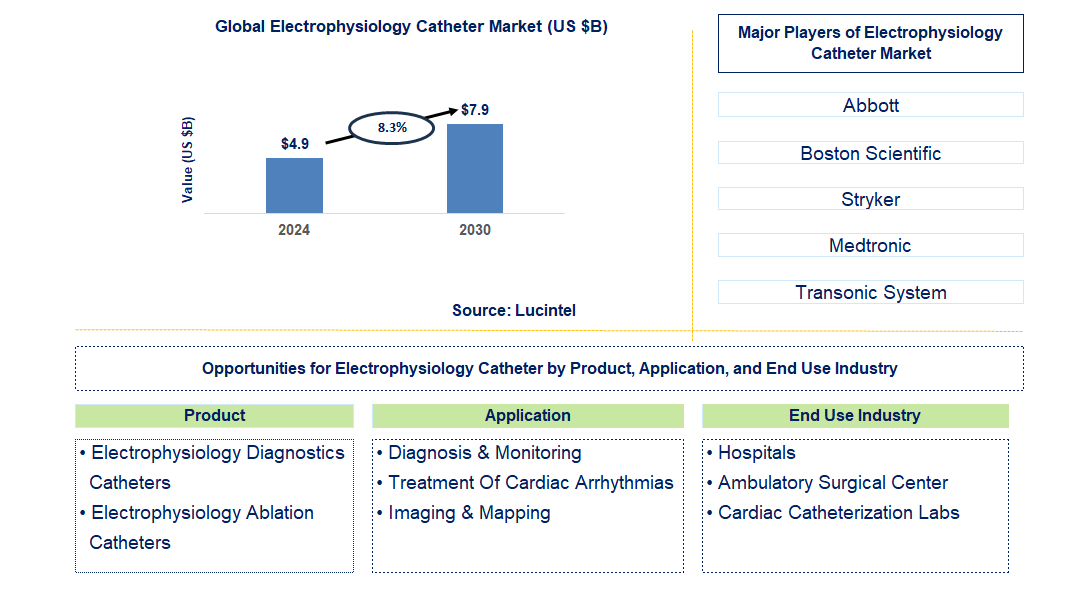
Key data points: The market size in 2030 = $7.9 billion, growth forecast = 8.3% annually for the next 6 years. Scroll below to get more insights. This market report covers trends, opportunities, and forecasts in the global electrophysiology catheter market to 2030 by product (electrophysiology diagnostics catheters and electrophysiology ablation catheters), application (diagnosis & monitoring, treatment of cardiac arrhythmias, and imaging & mapping), end use industry (hospitals, ambulatory surgical center, and cardiac catheterization labs), and region (North America, Europe, Asia Pacific, and the Rest of the World)
We'll send your sample report shortly.
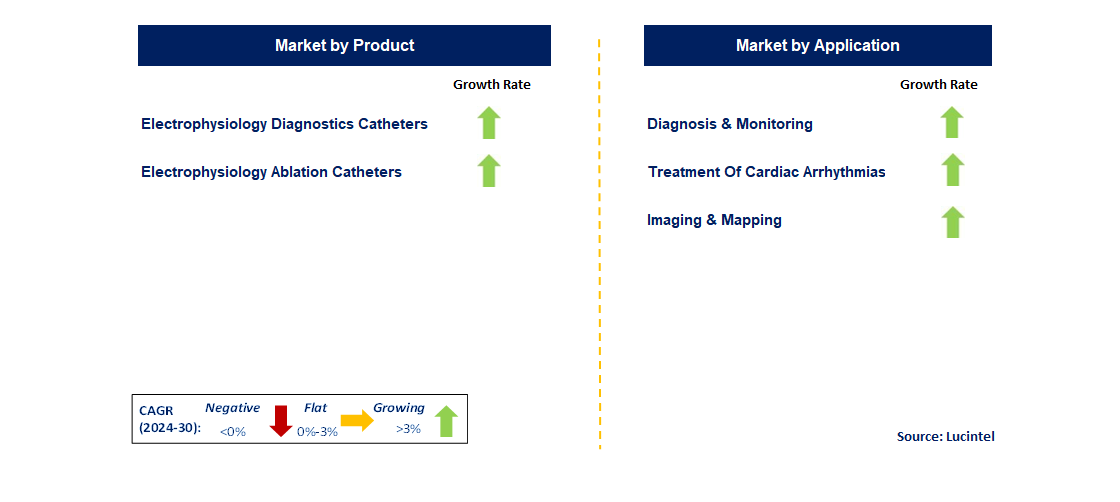
• Lucintel forecasts that, within the product category electrophysiology diagnostics catheters is expected to witness higher growth over the forecast period.
• Within the application category, diagnosis and monitoring will remain the largest segment.
• In terms of regions, North America will remain the largest region over the forecast period due to the growing prevalence of cardiovascular disorders and rising number of product launches by key players in the region. Gain Valuable insights for your business decisions with our comprehensive 150+ page report.
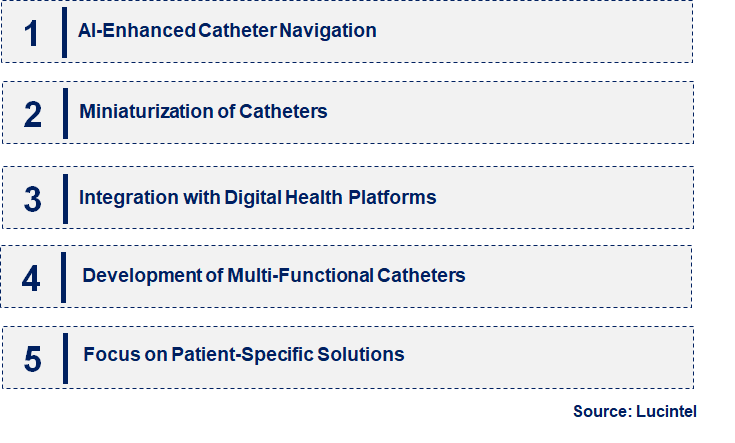
• AI-Enhanced Catheter Navigation: One of the most appealing advancements is the use of AI technology in the electrophysiology catheters which assists in the navigation and mapping aspects. AI-based algorithms act on real time data to enhance the instructional value and placement of the catheters. This trend enhances the accuracy of the procedures, lessening the chances of complications thus improving the patients’ recovery and overall health.
• Miniaturization of Catheters: The progressive of catheters as to size and weight is attributable to the need to conduct fewer invasive surgeries. Reduced size of catheters makes it possible to maximize on movement and minimize the aches felt by patients during and after the procedures. There is great progress in the materials and engineering that has made catheter making smaller in size but very flexible to improve procedural efficiency as well as patient safety.
• Integration with Digital Health Platforms: Storage of electrophysiology catheters on cloud technologies and electronic record systems is becoming the new norm, alongside stealing the processes. This to allows for collection and exchange of data as well as monitoring as the patients receive care, thereby enhancing the management in treatment and making treatment outcome planning and carrying more effective.
• Development of Multi-Functional Catheters: In the present day, new electrophysiologic catheters are being developed which are more multicompartmental while performing several functions of one device including mapping, ablation, and imaging among others. This aids in reducing the number of devices used in the procedures thus increasing the overall efficiency and accuracy of electrophysiology interventions.
• Focus on Patient-Specific Solutions: The trend is however changing as there is more focus on creating custom-made electrophysiology catheters that fit a patient’s form or disease. Such provisions of interchangeable catheters that are previously unused are suited to the peculiarities of individual patients, and so several cases of invasive treatments can turn out to be less risky and be more effective. New trends in the development of electrophysiology catheters, ranging from the implementation of AI platforms for navigation and connecting to digital devices to miniaturization, multi-functionality, and individual-oriented approaches, are making another twist. With these trends, catheter ablations become more targeted and effective, as well as less painful and shorter, enabling the evolution of such techniques as electrophysiology to become more effective.
• AI-Enhanced Navigation Systems: The infusion of artificial intelligence into electrophysiology catheters helps in navigation and mapping techniques in a tremendous manner. Therefore, algorithms are applied in the analysis of information in real time and also for guidance of the catheter, hence improving the accuracy of procedures and limiting the risk of complications. This makes it possible to achieve higher success rates while performing arrhythmia procedures and consequently improving the overall success rates.
• Advanced Ablation Technologies: As this new technology is advanced, it is added to the electrophysiology catheters to assist in the accuracy of delivery of energy. Newer energy sources for the ablation devices and better control systems to direct the ablation effectively lessens tissue damage and enhances the treatment of arrhythmias through ablation procedures.
• Miniaturization and Flexibility: The improvements done recently have also made it possible to come up with smaller, more and flexible electrophysiology catheters. These new small instruments provide better access during the procedures as a result of a smaller size device and are user-friendly, making procedures more comfortable to patients and improving the effectiveness of electrophysiology procedures.
• Integration with Imaging Systems: There has been an increase in the number of systems where electrophysiology catheters are hybridized with various image systems including the 3D mapping and fluoroscopy systems. This combination offers geometrical images and improves the accuracy of catheter placement thereby enabling efficient management of challenging complex arrhythmias.
• Safety and Precision Enhancements: The use of electrophysiology catheters now includes embedded sensors and other advanced feedback mechanisms as part of new safety features. Such improvements make it possible to avoid procedural errors and enhance patient safety by correlating data as well as generating alarms during interventions. The recent progress in the development of the electrophysiology catheter features – artificial intelligence-enhanced tracking of the catheter, sophisticated techniques of ablation, the strive for miniaturization, imaging, and safety – are helping progress in this field substantially. Improving the precision, efficacy, and safety of the prescription of antiarrhythmic therapy in patients with cardiac arrhythmias.
• Expansion of Minimally Invasive Procedures: There is a growing opportunity for electrophysiology catheters that support a growing field of increasing gradualness of procedure. As healthcare system becomes less intrusive catheters that support such procedures are gaining demand. This growth opportunity coincides with the increasing demand of comfort for the patients and quicker healing times.
• Integration with Advanced Imaging Technologies: Good growth prospects especially ovulation are presented by electrophysiology catheters combined with the 3D mapping and real English imaging methods. Additional possibilities appeared due to interaction of advanced catheter placement and treatment and fulfilling requirements for procedural detailed anatomical visualization.
• Development of Patient-Specific Solutions: There is a robust electrophysiology catheter electronics that is specific to the patient exploiting their electro-mapping. It is necessary to customize the catheters as this would demand on the improvement in the effectiveness and accuracy of treatment.
• Emergence of Remote Monitoring Capabilities: Expansion of the electrophysiology catheters incorporating the features of remote monitoring apparatus is demand. Collection and analyses of data will be possible because of remote monitoring ensuring early interventions as well as better management of the patients. Such a capability follows the increasing moves into digital health as per telemedicine and expansive digital networks. There are several modern possibilities for growth in electrophysiology catheters with a future growth outlook. These include AI-enabled systems, minimally invasive surgeries, combination with advanced understanding capabilities, individual patient treatment, and use of remote monitoring. Such opportunities fuel the development of novel approaches and further improve the efficiency of electrophysiology interventions, where patients and medicine are beneficiaries.
• Technological Advancements: Fast technological advancement is a prominent factor for the market of electrophysiology catheter. Such advancements include the incorporation of the AI, the advancement of imaging, as well as miniaturization which improve the capabilities of catheters and the accuracy of procedures. This growth in market is due to the growing demand for advanced solutions for cardiac care that these developments are able to fulfill.
• Rising Incidence of Cardiac Arrhythmias: The global rising incidence of cardiac arrhythmias is one of the compelling market drivers. Along with an increase in the number of patients eligible for electrophysiology procedures, there is an increasing need for more sophisticated catheters. This trend encourages the growth of the market and encourages development of new and better technologies for catheters.
• Reduce Interventionalism: Reduce Interventionalism. The market for electrophysiology catheters is also influenced by the trend of the healthcare market towards minimally invasive procedures. This focus helps to cater for higher patient comfort and quick recovery time, beneficial to the growth of the market. Challenges in the electrophysiology catheter market are:
• Economic Challenges and Cost Containment: Economic factors have been a limitation to the electrophysiology catheter industry. The use of advanced technologies comes with its own disadvantages especially where resources are limited. It is especially important to maintenance cost and efficiency for the prosper of the market.
• Regulatory and Compliance Challenges: It can be especially difficult to manage compliance with a multitude of requirements in multiple countries. Regulatory burden influences the process of development, approval and market-entry of electrophysiology catheters. Overcoming these challenges will determine market entry and retention of product quality. More strategically, the key driving forces are technological innovations, increasing incidence of cardiac arrhythmia, the use of less invasive intervention approach, and challenges are economic barriers and regulations — have determined the electrophysiology catheter market. These factors must be coped with if catheter technology is to progress, patients are to be treated better and the complexities of marketing appropriately negotiated.
• Abbott
• Boston Scientific
• Stryker
• Medtronic
• Transonic System
• CathRx
• APT Medical
• Electrophysiology Diagnostics Catheters
• Electrophysiology Ablation Catheters
• Diagnosis & Monitoring
• Treatment Of Cardiac Arrhythmias
• Imaging & Mapping
• Hospitals
• Ambulatory Surgical Center
• Cardiac Catheterization Labs
• North America
• Europe
• Asia Pacific
• The Rest of the World
• United States: In the countries such as the United States, latest achievements are most concern with the combination of electrophysiology catheters and more such as 3D mapping technologies. The integration permits effective visualization of the heart structures in need leading to precise and accurate catheter movement within the specified areas. Better imaging means better arrhythmia treatment techniques as there will be less or no misdiagnosis.
• China: The course of the last decade has also provided China with many novelties concerning the design of catheters. However, the most stunning improvements focus on structural features considering the length and diameter of catheters. Came up with catheters that are made using materials that are more maneuverable and do not get cycled easily. Such changes in catheter structures are very important for sophisticated procedures and lead to better procedure results and less complications.
• Germany: Germany has launched the latest electrophysiology catheters with better features that are able to perform more effective ablation. These catheters also come with better energy delivery systems that improves the efficiency of ablation procedures especially for arrhythmias. These developments are meant to decrease the extent of damage caused on normal tissues and enhance the efficacy of the ablation process.
• India: Affordable electrophysiology catheters are being manufactured in India because there is a large potential market to cater to. Recently developed solutions target the performance at reasonable price levels. With this kind of approach, provision of advanced electrophysiological procedures is extended to areas with limited resources.
• Japan: Japan has taken the lead in the design of electrophysiology catheters by introducing safety features into such catheter devices. New designs incorporate internal sensors and safety devices to reduce the incidence of complications during the procedures. Such innovations help achieve safer procedures and better patient safety by minimizing procedural and complication-related errors.


• Abbott
• Boston Scientific
• Stryker
• Medtronic
• Transonic System
• CathRx
• APT Medical Q6. Which electrophysiology catheter market segment will be the largest in future? Answer: Lucintel forecasts that electrophysiology diagnostics catheters is expected to witness higher growth over the forecast period. Q7. In electrophysiology catheter market, which region is expected to be the largest in next 5 years? Answer: North America will remain the largest region over the forecast period due to the growing prevalence of cardiovascular disorders and rising number of product launches by key players in the region. Q.8 Do we receive customization in this report? Answer: Yes, Lucintel provides 10% customization without any additional cost.


Choose a license that fits your team. Instant PDF delivery.
Prices exclude taxes. Instant delivery. Custom licensing available on request.
Market Report · July 22, 2026
Market Report · July 22, 2026
Market Report · July 22, 2026
Trusted partner for strategic intelligence and business growth


Receive a complimentary market analysis tailored to your industry. Our analysts will identify key growth opportunities and competitive dynamics specific to your business.

Market size, growth rate, and key trend analysis for your specific sector.

Top competitor positioning and market share analysis.

Strategic recommendations backed by data-driven insights.
Get curated market intelligence and competitive moves straight to your inbox.
By subscribing, you agree to receive our monthly insights. Unsubscribe anytime.
Receive a complimentary market analysis tailored to your industry. Our analysts will identify key growth opportunities and competitive dynamics specific to your business.
Market size, growth rate, and key trend analysis for your specific sector.
Top competitor positioning and market share analysis.
Strategic recommendations backed by data-driven insights.
Get curated market intelligence, emerging trends, and competitive moves straight to your inbox each month.
By subscribing, you agree to receive our monthly insights. Unsubscribe anytime.
We'll send your sample report shortly.