
Market Report · July 29, 2026

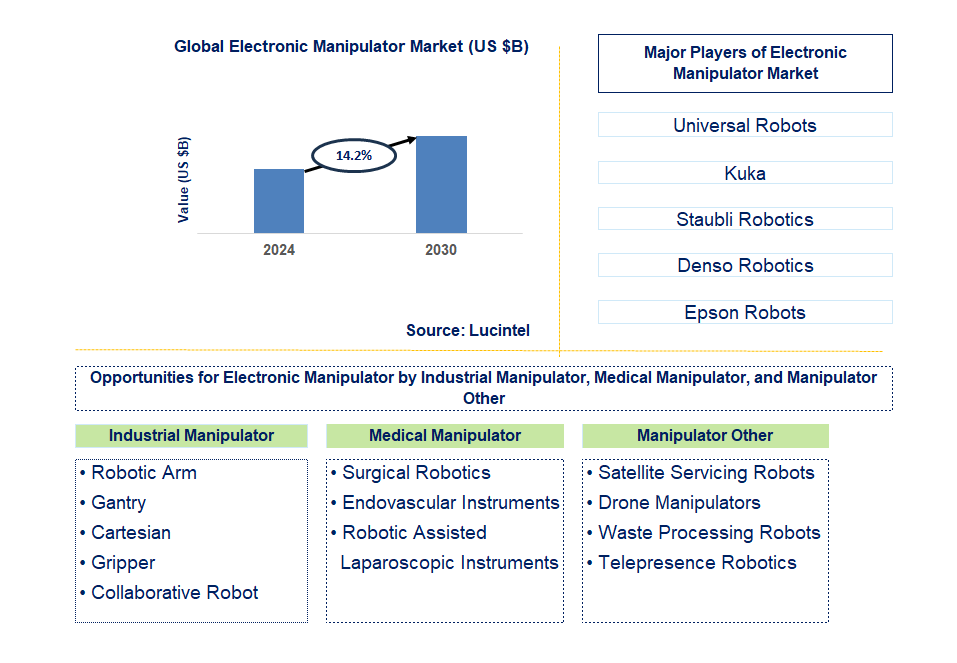
Key data points: The growth forecast = 14.2% annually for the next 6 years. Scroll below to get more insights. This market report covers trends, opportunities, and forecasts in the global electronic manipulator market to 2030 by industrial manipulator (robotic arm, gantry, cartesian, gripper, and collaborative robot), medical manipulator (surgical robotics, endovascular instruments, and robotic assisted laparoscopic instruments), manipulator other (satellite servicing robots, drone manipulators, waste processing robots, and telepresence robotics), and region (North America, Europe, Asia Pacific, and the Rest of the World)
We'll send your sample report shortly.
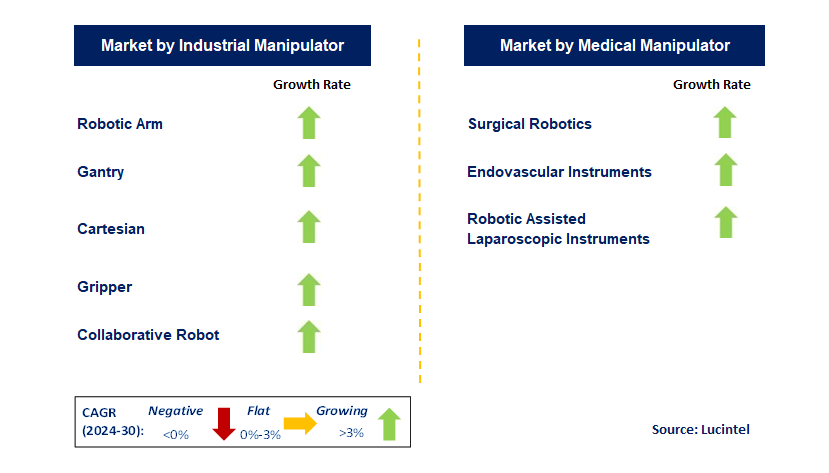
• Lucintel forecasts that, within the industrial manipulator category, robotic arm is expected to witness the highest growth over the forecast period.
• Within the medical manipulator category, surgical robotic is expected to witness the highest growth.
• In terms of region, APAC is expected to witness the highest growth over the forecast period.
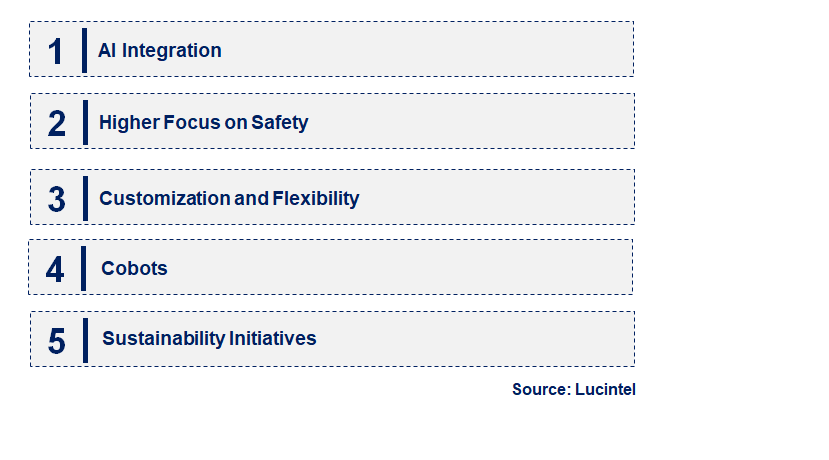
• AI Integration: Integration of AI is making electronic manipulators much more versatile. AI improves decision-making and adaptability, allowing manipulators to learn from their environment and execute multiple tasks autonomously. This is particularly useful in fast-changing industrial settings.
• Higher Focus on Safety: Electronic manipulators are designed with safety in mind. Advanced sensors and safety protocols have been incorporated to ensure that human operators and other equipment can interact safely, reducing the likelihood of accidents and improving safety standards in the workplace.
• Customization and Flexibility: A growing trend in customizable electronic manipulators can be observed, with designs tailored to fit specific applications. Manufacturers are gravitating toward modular designs, allowing manipulators to be configured according to the special requirements of the user, optimizing operational efficiency and flexibility.
• Cobots: Collaborative robots, or cobots, are becoming an important trend in the global market. These manipulators are designed to seamlessly integrate with human handlers. They are ideal for repetitive tasks, allowing humans to be involved in more complex work, thus increasing productivity in a synergistic work environment.
• Sustainability Initiatives: As environmental awareness increases, industries are seeking energy-efficient electronic manipulators. Companies are designing robotic systems with an emphasis on energy savings, aligning with international sustainability goals and regulatory requirements.
• Innovations in Robotic Arms: Recent research on robotic arms has led to better precision and a greater range of motion. Sophisticated sensors and new control systems enhance adaptability, making these arms suitable for a wide range of applications, including manufacturing and healthcare.
• Development of User-Friendly Interfaces: Companies are investing in developing intuitive user interfaces for electronic manipulators, allowing even those with minimal technical expertise to easily control and program robotic systems. This has led to increased adoption across industries.
• Integration with IoT Technologies: The integration of electronic manipulators with IoT technologies enables real-time monitoring and data collection. This advancement enhances operational efficiency, allowing companies to track performance metrics and make informed decisions based on real-time data.
• Expansion in Research and Development: Increased investment in R&D is leading to the development of cutting-edge electronic manipulators. Companies are focusing on innovative materials and designs that enhance durability and performance, positioning themselves competitively in the market.
• Partnerships with Startups: Large companies are collaborating with startups to accelerate the innovation of electronic manipulators. These collaborations leverage new ideas and technologies, speeding up the production of solutions tailored to industry-specific requirements.
• Healthcare Applications: The demand for electronic manipulators in healthcare is growing, particularly for surgery and rehabilitation. Robotic systems could improve patient outcomes and optimize operations in healthcare facilities.
• Manufacturing Automation: Electronic manipulators have immense potential in manufacturing. As industries shift toward automation, the demand for flexible and efficient robotic solutions in assembly lines and production processes is increasing, helping to boost productivity at lower costs.
• Agricultural Innovation: There is a growing trend to deploy electronic manipulators in agriculture for planting, harvesting, and crop monitoring. These manipulators improve resource efficiency and potential yield capture, contributing to increased food production to meet the demands of a growing population.
• Logistics and Warehousing: The logistics sector is increasingly adopting electronic manipulators to sort and manipulate materials faster and without human errors. These robots streamline warehouse processes, making supply chains more efficient.
• R&D: The potential for growth in R&D for next-generation electronic manipulators is significant. Investment in innovative designs and advanced technology will improve performance, safety, and usability across sectors.
• Technological Advancement: Continuous innovation in robotics and AI technologies is a key driver for the electronic manipulators market. Enhanced capabilities, such as higher precision and autonomy, allow manipulators to perform complex tasks more efficiently across various applications.
• Increased Demand for Automation: The growing demand for automation within industries is accelerating the adoption of electronic manipulators. Their focus on efficiency and labor cost reduction is driving the need for sophisticated robotic systems in manufacturing and logistics.
• Investment in Research and Development: Increased investment in R&D is enabling innovation in electronic manipulators. Advancements in technology provide more functionality and cater to the changing requirements of the market.
• Drive for Operational Efficiency: The growing use of electronic manipulators is driven by the need for operational efficiency. These systems help streamline processes, reduce errors, and increase productivity, which is essential in competitive markets.
• Increased Demand for Cobots: The growing interest in cobots (collaborative robots) is opening new opportunities for the development and acceptance of electronic manipulators. Cobots are more productive because they work in partnership with human operators, creating safer work environments.
• High Setup Costs: The high initial cost of electronic manipulators can be a barrier for many organizations, especially smaller ones with limited budgets.
• Compatibility with Current Operations: New electronic manipulators can be difficult to integrate with existing systems in many organizations. Compatibility issues and the need for significant training can hinder their widespread adoption across sectors.
• Regulatory Compliance: Ensuring compliance with safety and regulatory standards can be complex. Companies must navigate various regulations, which can slow down the development and deployment of new robotic systems.
• Universal Robots
• Kuka
• Staubli Robotics
• Denso Robotics
• Epson Robots
• Comau
• Yaskawa Electric Corporation
• Robotic Arm
• Gantry
• Cartesian
• Gripper
• Collaborative Robot
• Surgical Robotics
• Endovascular Instruments
• Robotic Assisted Laparoscopic Instruments
• Satellite Servicing Robots
• Drone Manipulators
• Waste Processing Robots
• Telepresence Robotics
• North America
• Europe
• Asia Pacific
• The Rest of the World
• United States: The U.S. market for electronic manipulators is growing as automation continues to take hold in manufacturing and logistics. AI integrations in robotic arms are enhancing precision and adaptability. Collaborations between tech firms and universities are driving innovation in the development of more sophisticated and user-friendly electronic manipulators.
• China: China is one of the fastest-growing markets for electronic manipulators. Government support for robotics activities has driven the development of affordable robots for assembly lines and manufacturing. The investment in smart factories has significantly increased the use of electronic manipulators, improving production efficiency while reducing labor costs, positioning China as a global leader in the robotics sector.
• Germany: Germany remains a strong player in industrial automation. Electronic manipulators have increasingly penetrated production stages, particularly in automotive manufacturing. German companies emphasize safety and reliability, ensuring that their manipulators meet stringent industry standards while maximizing productivity.
• India: In India, the electronic manipulator market is growing, particularly in the agricultural and healthcare sectors. Startups are developing innovative solutions, such as remotely conducted surgeries and precision farming, with the help of manipulators. The government’s focus on automation is driving the deployment of electronic manipulators to improve efficiency and reduce operational costs.
• Japan: Japan continues to lead in robotics technology. Electronic manipulators are playing an important role in applications ranging from elder care to manufacturing. By integrating AI, Japanese companies are advancing manipulator technology to improve capabilities and create user-friendly designs that make these systems more accessible for everyday applications.


• Universal Robots
• Kuka
• Staubli Robotics
• Denso Robotics
• Epson Robots
• Comau
• Yaskawa Electric Corporation
Q5. Which electronic manipulator market segment will be the largest in future?

Choose a license that fits your team. Instant PDF delivery.
Prices exclude taxes. Instant delivery. Custom licensing available on request.
Market Report · July 29, 2026
Market Report · July 20, 2026
Market Report · July 20, 2026
Trusted partner for strategic intelligence and business growth


Receive a complimentary market analysis tailored to your industry. Our analysts will identify key growth opportunities and competitive dynamics specific to your business.

Market size, growth rate, and key trend analysis for your specific sector.

Top competitor positioning and market share analysis.

Strategic recommendations backed by data-driven insights.
Get curated market intelligence and competitive moves straight to your inbox.
By subscribing, you agree to receive our monthly insights. Unsubscribe anytime.
Receive a complimentary market analysis tailored to your industry. Our analysts will identify key growth opportunities and competitive dynamics specific to your business.
Market size, growth rate, and key trend analysis for your specific sector.
Top competitor positioning and market share analysis.
Strategic recommendations backed by data-driven insights.
Get curated market intelligence, emerging trends, and competitive moves straight to your inbox each month.
By subscribing, you agree to receive our monthly insights. Unsubscribe anytime.
We'll send your sample report shortly.