
Market Report · July 31, 2026

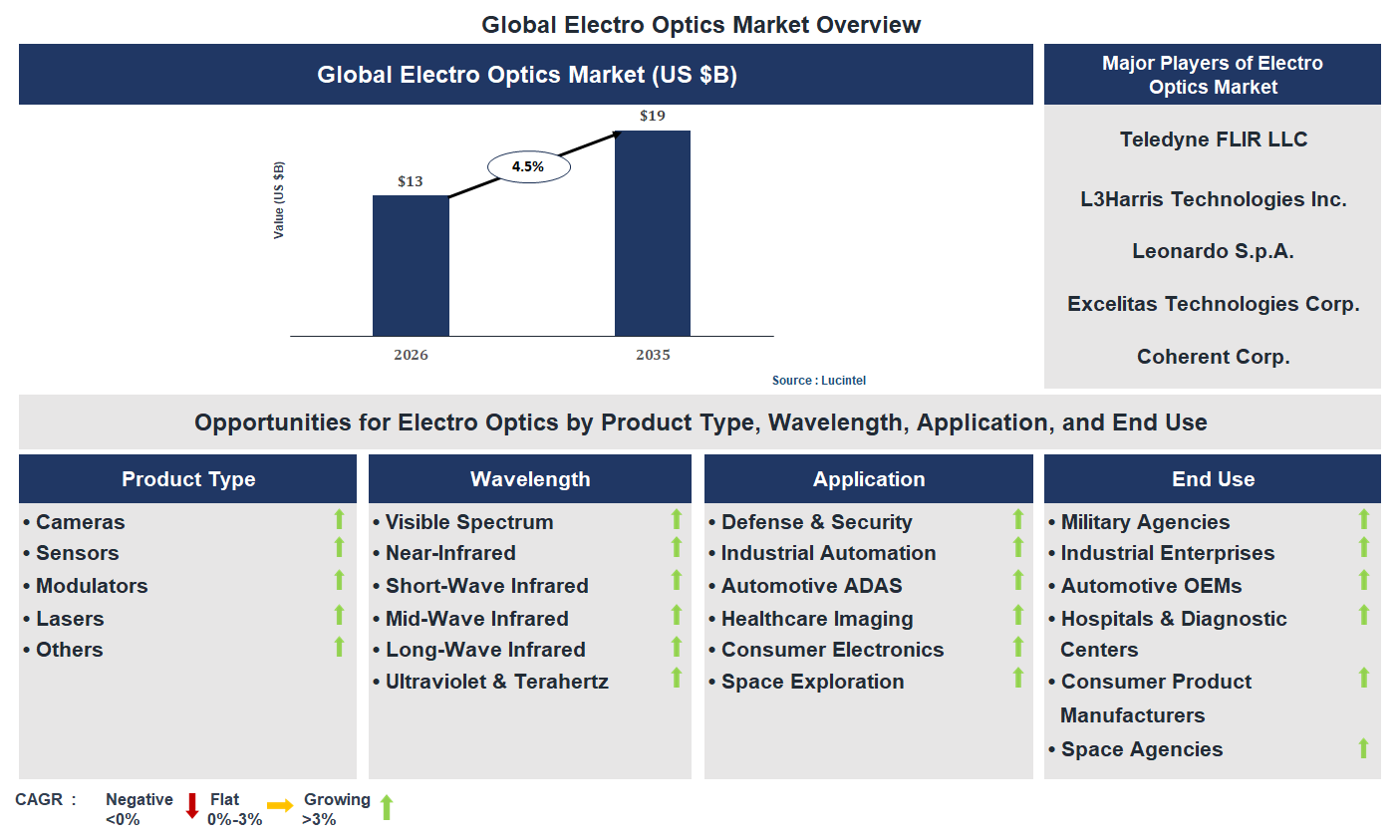
Key data points: The market size in 2035 = $19 billion, growth forecast = 4.5% annually for the next 8 years. Scroll below to get more insights. This market report covers trends, opportunities and forecasts in electro optics market to 2035 by product type (cameras, sensors, modulators, lasers, and others), wavelength (visible spectrum, near-infrared, short-wave infrared, mid-wave infrared, long-wave infrared, and ultraviolet & terahertz), application (defense & security, industrial automation, automotive ADAS, healthcare imaging, consumer electronics, and space exploration), end use (military agencies, industrial enterprises, automotive OEMs, hospitals & diagnostic centers, consumer product manufacturers, and space agencies), and region (North America, Europe, Asia Pacific, and the Rest of the World)
We'll send your sample report shortly.
• Lucintel forecasts that, within the product type category, camera is expected to witness the highest growth over the forecast period.
• Within the end use category, military agency is expected to witness the highest growth.
• In terms of region, North America is expected to witness the highest growth over the forecast period. Gain valuable insights for your business decisions with our comprehensive 150+ page report. Sample figures with some insights are shown below.
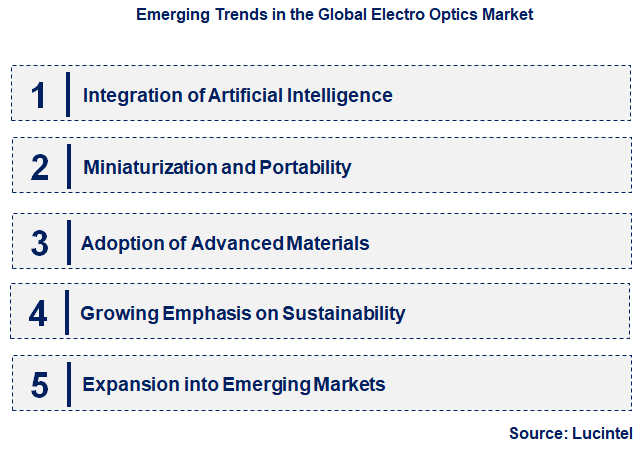
• Integration of Artificial Intelligence: AI is increasingly integrated into electro-optic systems to enhance functionality, automate processes, and improve accuracy. AI-driven algorithms enable real-time data analysis, predictive maintenance, and adaptive responses, which are critical in defense, medical imaging, and autonomous vehicles. This integration boosts system intelligence, reduces operational costs, and accelerates innovation cycles, making electro-optic devices more efficient and user-friendly. As AI continues to evolve, its synergy with electro optics is expected to unlock new capabilities and applications, significantly impacting market growth and technological advancement.
• Miniaturization and Portability: The trend toward smaller, more portable electro-optic devices is driven by consumer demand for convenience and the need for compact solutions in industrial and military applications. Advances in materials and fabrication techniques allow for the development of miniaturized components without compromising performance. This trend enhances the usability of devices in space-constrained environments, such as wearable health monitors, drone sensors, and handheld diagnostic tools. Miniaturization not only broadens application scope but also reduces manufacturing costs, making electro-optic products more accessible and fostering innovation across sectors.
• Adoption of Advanced Materials: The development and utilization of novel materials like graphene, quantum dots, and nanostructured composites are transforming electro-optic technologies. These materials offer superior optical properties, faster response times, and greater sensitivity, enabling the creation of high-performance devices. For example, graphene-based modulators and sensors are gaining traction due to their exceptional conductivity and transparency. The adoption of advanced materials is crucial for pushing the boundaries of device capabilities, improving energy efficiency, and enabling new functionalities, thereby driving market expansion and technological breakthroughs.
• Growing Emphasis on Sustainability: Environmental concerns and regulatory pressures are prompting the electro-optics industry to adopt sustainable practices. This includes developing energy-efficient devices, utilizing eco-friendly materials, and implementing recycling protocols. Sustainable innovations reduce carbon footprints and operational costs, aligning with global efforts to combat climate change. Companies investing in green technologies are gaining competitive advantages and meeting consumer demand for environmentally responsible products. The focus on sustainability is reshaping product development strategies and influencing market standards, ultimately fostering a more responsible and resilient industry.
• Expansion into Emerging Markets: Increasing infrastructure development, urbanization, and technological adoption in emerging economies are opening new markets for electro-optic products. Countries in Asia-Pacific, Latin America, and Africa are witnessing rising investments in defense, healthcare, and telecommunications sectors. This expansion offers significant growth opportunities for manufacturers and suppliers, driven by government initiatives and rising consumer demand. Market players are tailoring products to meet local needs and regulatory requirements, which enhances market penetration. The expansion into emerging markets is a key driver of global market growth, diversifying revenue streams and fostering innovation tailored to diverse applications. These trends are collectively reshaping the electro optics market by fostering innovation, expanding application areas, and promoting sustainable practices. They are enabling the industry to meet evolving technological demands, penetrate new markets, and deliver more efficient, compact, and environmentally friendly solutions. As these trends continue to develop, they will significantly influence the competitive landscape and future growth trajectory of the market.
• Growth in Defense and Aerospace: Expanding applications in military and space exploration are driving demand for advanced laser systems and optical sensors, enhancing surveillance, targeting, and communication capabilities, which boosts market revenue and innovation.
• Advancements in Laser Technologies: Development of high-power, compact lasers is enabling new uses in manufacturing, medical procedures, and communication, leading to increased adoption and market expansion.
• Integration of AI and IoT: Incorporating artificial intelligence and Internet of Things (IoT) in electro-optic devices improves system efficiency, predictive maintenance, and real-time data processing, opening new market segments.
• Miniaturization and Portability: The trend toward smaller, lightweight optical components enhances portability for consumer electronics, medical devices, and wearable tech, broadening market reach and consumer adoption.
• Growing Healthcare Applications: Innovations in optical sensors and imaging are revolutionizing diagnostics, treatment, and patient monitoring, significantly impacting healthcare markets and increasing demand for electro-optic solutions. These developments are significantly impacting the electro-optics market by fostering innovation, expanding application areas, and increasing competitiveness. The integration of advanced technologies and miniaturization is opening new revenue streams and driving global growth. As industries continue to adopt these innovations, the market is poised for sustained expansion, transforming various sectors and enhancing technological capabilities worldwide.
• Growing Adoption of Laser Technologies in Industrial and Medical Applications: The increasing use of laser systems in manufacturing, healthcare, and research is fueling market growth. Advances in laser precision, power, and wavelength customization are enabling new applications such as laser surgery, material processing, and spectroscopy. This trend is driven by the need for high accuracy, efficiency, and minimally invasive procedures, prompting manufacturers to develop innovative laser solutions tailored to specific industry requirements.
• Rising Demand for Advanced Sensors in Defense and Aerospace: The defense and aerospace sectors are increasingly relying on electro-optic sensors for surveillance, reconnaissance, and navigation. The demand for high-resolution imaging, infrared sensors, and LIDAR systems is expanding due to the need for enhanced situational awareness and autonomous operations. Technological improvements in sensor sensitivity, miniaturization, and integration are creating opportunities for market players to supply cutting-edge solutions to these high-growth sectors.
• Expansion of Optical Communication Networks and Data Centers: The surge in data traffic and the rollout of 5G networks are driving the need for high-speed optical communication components. Electro-optic devices such as modulators, switches, and detectors are critical for efficient data transmission. The increasing deployment of fiber-optic infrastructure and data centers worldwide presents significant growth opportunities, encouraging investments in innovative, energy-efficient, and scalable electro-optic solutions to meet the rising bandwidth demands.
• Increasing Use of Electro-Optic Components in Healthcare Diagnostics and Imaging: The healthcare industry is adopting electro-optic technologies for advanced diagnostics, imaging, and therapeutic applications. Innovations in optical coherence tomography (OCT), endoscopy, and laser-based treatments are improving patient outcomes. The demand for miniaturized, high-performance components that enable real-time imaging and minimally invasive procedures is creating a lucrative market for electro-optic device manufacturers.
• Strategic Collaborations and Geographic Expansion to Capture Emerging Markets: Companies are forming strategic alliances and expanding into emerging regions such as Asia-Pacific and Latin America to tap into growing demand. These collaborations facilitate technology sharing, cost reduction, and market penetration. Geographic expansion allows firms to access new customer bases, adapt products to local needs, and strengthen their global presence, thereby accelerating overall market growth and competitiveness. The electro-optics markets growth opportunities are poised to significantly influence industry dynamics, fostering innovation and expanding application horizons. Companies that leverage these opportunities through strategic investments, technological advancements, and regional expansion are likely to secure a competitive edge. Overall, these developments will drive sustained growth, diversify applications, and enhance the markets global footprint, shaping the future landscape of electro-optic technologies.
• Technological Innovation: The continuous development of advanced sensors, laser systems, and imaging technologies enhances performance, reliability, and application scope. Innovations such as miniaturization and integration with AI enable new uses in defense, healthcare, and industrial sectors, fueling market expansion. Rapid R&D investments and collaborations further accelerate technological progress, making electro-optic solutions more efficient and cost-effective.
• Growing Defense and Military Spending: Increasing defense budgets worldwide, especially in emerging economies, drive demand for electro-optic systems like night vision, missile guidance, and surveillance equipment. Governments prioritize modernization of military capabilities, leading to sustained investments in electro-optic technologies, which directly boost market growth and innovation.
• Rising Adoption in Healthcare: The healthcare sector is increasingly adopting electro-optic devices such as optical coherence tomography (OCT), laser surgical tools, and diagnostic imaging systems. The demand for minimally invasive procedures and high-precision diagnostics propels market growth, supported by technological advancements and regulatory approvals.
• Industrial Automation and Security: The expansion of industrial automation, including machine vision and quality control, relies heavily on electro-optic components. Additionally, security applications like biometric identification, surveillance, and access control are expanding rapidly, driven by the need for enhanced safety and efficiency, thereby broadening market opportunities. The challenges facing the electro optics market include:-
• Regulatory and Export Restrictions: Stringent regulations related to national security, export controls, and environmental standards can hinder market growth. Compliance costs and restrictions on cross-border trade of sensitive electro-optic technologies limit market accessibility and slow down international expansion.
• High Development and Manufacturing Costs: The advanced nature of electro-optic components involves significant R&D investments and complex manufacturing processes. These high costs can restrict entry for smaller players and impact profit margins for existing companies, potentially slowing innovation and market penetration.
• Rapid Technological Obsolescence: The fast pace of technological change can render existing products obsolete quickly. Companies face pressure to continuously innovate, which increases R&D expenses and risks of product failure, challenging long-term market stability and competitiveness. The electro optics market is driven by rapid technological innovations, increased defense and healthcare investments, and expanding industrial and security applications. However, regulatory hurdles, high development costs, and rapid obsolescence pose significant challenges. These factors collectively influence market growth trajectories, requiring stakeholders to navigate complex regulatory landscapes, invest strategically, and innovate continuously. Overall, the markets future depends on balancing these drivers and challenges to capitalize on emerging opportunities while mitigating risks, ensuring sustainable development in this dynamic sector.
• Teledyne FLIR LLC
• L3Harris Technologies Inc.
• Leonardo S.p.A.
• Excelitas Technologies Corp.
• Coherent Corp.
• Hamamatsu Photonics K.K.
• Jenoptik AG
• Raytheon Technologies Corporation
• Northrop Grumman Corporation
• Keysight Technologies Inc.
• Cameras
• Sensors
• Modulators
• Lasers
• Others
• Visible Spectrum
• Near-Infrared
• Short-Wave Infrared
• Mid-Wave Infrared
• Long-Wave Infrared
• Ultraviolet & Terahertz
• Defense & Security
• Industrial Automation
• Automotive ADAS
• Healthcare Imaging
• Consumer Electronics
• Space Exploration
• Military Agencies
• Industrial Enterprises
• Automotive OEMs
• Hospitals & Diagnostic Centers
• Consumer Product Manufacturers
• Space Agencies
• North America
• Europe
• Asia Pacific
• The Rest of the World
• United States: The US has seen significant advancements in laser technology and optical sensors, driven by defense and aerospace applications. Major companies are investing in miniaturization and high-speed data transmission solutions, with increased government funding for research. The integration of AI with electro-optic systems is enhancing performance and automation. Additionally, the US is focusing on developing sustainable and energy-efficient optical components to meet environmental standards.
• China: China is rapidly expanding its electro-optics manufacturing capabilities, focusing on high-volume production of optical fibers and laser diodes. The government’s strategic initiatives aim to reduce dependence on imports and boost domestic innovation. Chinese firms are making strides in 5G infrastructure, optical communication, and laser processing technologies. The country is also investing in advanced research to develop new materials like quantum dots and photonic integrated circuits.
• Germany: Germany remains a leader in precision optical components and laser systems, with a strong emphasis on industrial applications such as manufacturing and automotive sectors. Recent developments include the integration of smart sensors and IoT-enabled electro-optic devices for automation. German research institutions are pioneering in the development of high-power lasers and fiber optics, supported by EU funding. Sustainability and energy efficiency are also key focus areas in new product designs.
• India: India is witnessing rapid growth in the electro-optics sector, driven by government initiatives like Make in India and Digital India. The focus is on developing indigenous manufacturing capabilities for optical components and laser systems. The country is also expanding its research in optical communication, defense, and healthcare applications. Startups and academia are collaborating to innovate in photonics and integrated optics, aiming to position India as a key player in the global market.
• Japan: Japan continues to innovate in laser technology and optical materials, with a strong emphasis on consumer electronics, healthcare, and industrial automation. Recent developments include the commercialization of ultra-precise laser systems and advanced optical sensors. Japanese companies are investing in quantum photonics and integrated photonic circuits to enhance performance and miniaturization. The government supports R&D through grants and collaborations, focusing on sustainable and energy-efficient electro-optic solutions.


• Teledyne FLIR LLC
• L3Harris Technologies Inc.
• Leonardo S.p.A.
• Excelitas Technologies Corp.
• Coherent Corp.
• Hamamatsu Photonics K.K.
• Jenoptik AG
• Raytheon Technologies Corporation
• Northrop Grumman Corporation
• Keysight Technologies Inc. Q6. Which electro optics market segment will be the largest in future? Answer: Lucintel forecasts that, within the product type category, camera is expected to witness the highest growth over the forecast period. Q7. In electro optics market, which region is expected to be the largest in next 8 years? Answer: In terms of region, North America is expected to witness the highest growth over the forecast period. Q8. Do we receive customization in this report? Answer: Yes, Lucintel provides 10% customization without any additional cost.


Choose a license that fits your team. Instant PDF delivery.
Prices exclude taxes. Instant delivery. Custom licensing available on request.
Market Report · July 31, 2026
Market Report · July 31, 2026
Market Report · July 31, 2026
Trusted partner for strategic intelligence and business growth


Receive a complimentary market analysis tailored to your industry. Our analysts will identify key growth opportunities and competitive dynamics specific to your business.

Market size, growth rate, and key trend analysis for your specific sector.

Top competitor positioning and market share analysis.

Strategic recommendations backed by data-driven insights.
Get curated market intelligence and competitive moves straight to your inbox.
By subscribing, you agree to receive our monthly insights. Unsubscribe anytime.
Receive a complimentary market analysis tailored to your industry. Our analysts will identify key growth opportunities and competitive dynamics specific to your business.
Market size, growth rate, and key trend analysis for your specific sector.
Top competitor positioning and market share analysis.
Strategic recommendations backed by data-driven insights.
Get curated market intelligence, emerging trends, and competitive moves straight to your inbox each month.
By subscribing, you agree to receive our monthly insights. Unsubscribe anytime.
We'll send your sample report shortly.