
Electrically Conductive Adhesive Market Trends and Forecast
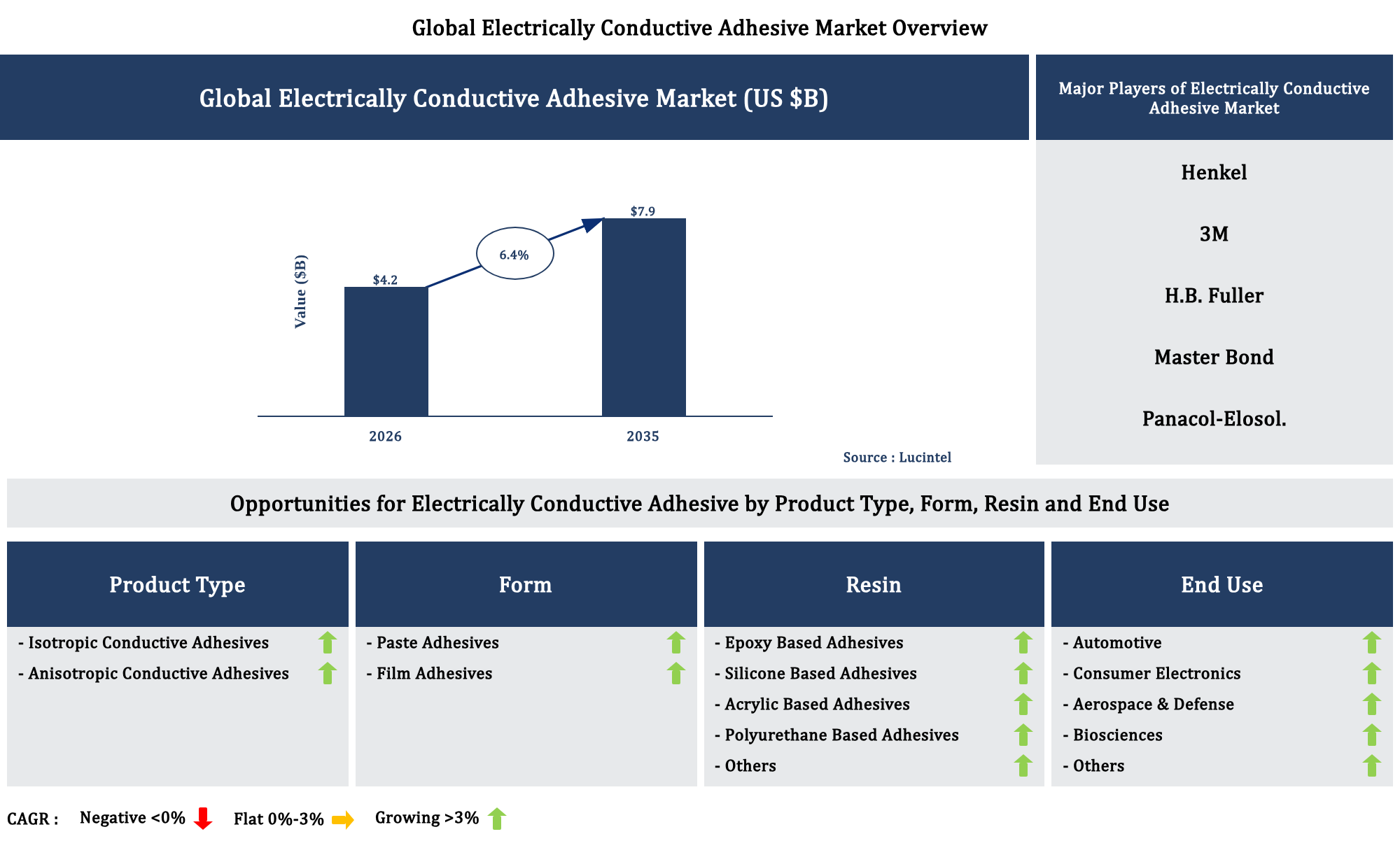
The future of the global electrically conductive adhesive market looks promising with opportunities in the automotive, consumer electronic, aerospace & defense, and bioscience markets. The global electrically conductive adhesive market is expected to reach an estimated $7924 million by 2035 with a CAGR of 6.5% from 2026 to 2035. The major drivers for this market are the increasing demand for flexible & wearable electronics, the growing adoption in renewable energy systems like solar panels, and the rising demand for investments in semiconductor & pcb industries.
• Lucintel forecasts that, within the product type category, isotropic conductive adhesive is expected to witness higher growth over the forecast period.
• Within the end use category, consumer electronic is expected to witness the highest growth.
• In terms of region, APAC is expected to witness the highest growth over the forecast period.
Gain valuable insights for your business decisions with our comprehensive 150+ page report. Sample figures with some insights are shown below.
Emerging Trends in the Electrically Conductive Adhesive Market
The electrically conductive adhesive market is experiencing rapid growth driven by technological advancements and increasing demand across various industries such as electronics, automotive, and healthcare. As devices become more compact and complex, the need for reliable, efficient, and versatile conductive adhesives is rising. Innovations in material science, sustainability initiatives, and the integration of smart technologies are shaping the market landscape. These developments are not only expanding the applications of electrically conductive adhesives but also transforming manufacturing processes and product design. Understanding these emerging trends is crucial for stakeholders aiming to stay competitive and leverage new opportunities in this dynamic market.
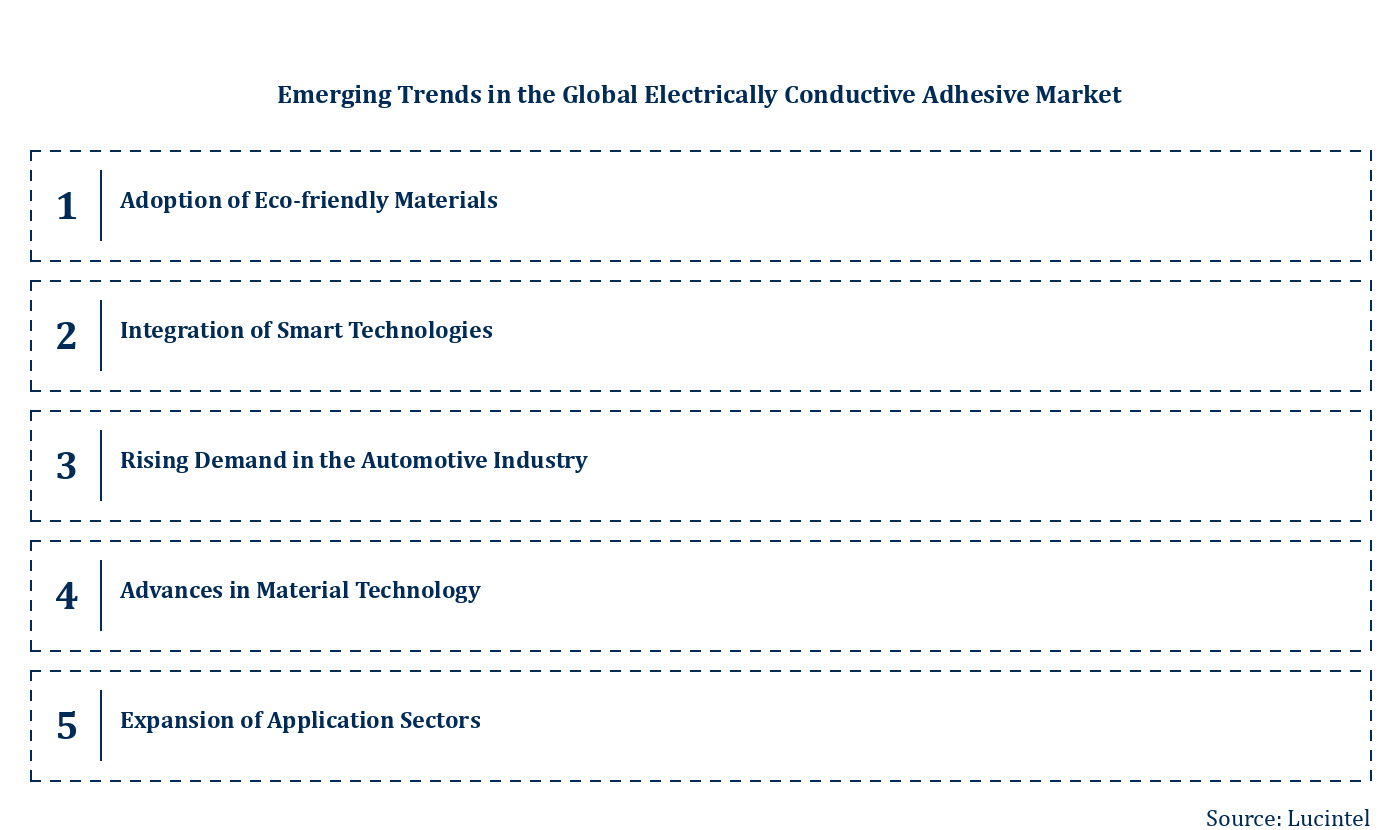
• Adoption of Eco-Friendly Materials: The market is shifting towards environmentally sustainable adhesives, driven by regulatory pressures and consumer preferences. Manufacturers are developing bio-based and recyclable conductive adhesives that reduce environmental impact without compromising performance. This trend enhances brand reputation and aligns with global sustainability goals, opening new avenues for market growth. The use of eco-friendly materials also addresses concerns related to hazardous substances, making products safer for users and the environment.
• Integration of Smart Technologies: Smart adhesives embedded with sensors and IoT capabilities are gaining traction. These adhesives enable real-time monitoring of device performance, structural health, and environmental conditions. The integration of smart features enhances product functionality, especially in healthcare, aerospace, and automotive sectors. This trend is fostering the development of intelligent systems that improve safety, efficiency, and predictive maintenance, thereby expanding the scope of electrically conductive adhesives.
• Rising Demand in the Automotive Industry: The automotive sector is increasingly adopting electrically conductive adhesives for applications such as battery assembly, electronic component bonding, and electromagnetic interference shielding. The shift towards electric vehicles (EVs) and autonomous driving systems is a significant driver. These adhesives offer advantages like lightweighting, improved durability, and enhanced electrical conductivity, which are critical for modern automotive design. This trend is expected to propel market growth substantially as the automotive industry continues to innovate.
• Advances in Material Technology: Innovations in nanomaterials, such as carbon nanotubes and graphene, are improving the electrical conductivity and mechanical properties of adhesives. These advancements enable the creation of high-performance adhesives suitable for demanding applications. Enhanced material properties also allow for thinner, more flexible, and more durable adhesives, broadening their application scope. This trend is crucial for meeting the evolving technical requirements of electronics and other high-tech industries.
• Expansion of Application Sectors: Beyond traditional electronics, electrically conductive adhesives are increasingly used in emerging sectors like wearable devices, medical diagnostics, and renewable energy systems. Their versatility, ease of application, and reliability make them suitable for innovative product designs. This diversification is opening new markets and driving demand, encouraging manufacturers to develop specialized formulations tailored to specific industry needs. The expansion signifies a broader acceptance and integration of these adhesives across various high-growth sectors.
These trends are collectively reshaping the electrically conductive adhesive market by fostering innovation, promoting sustainability, and expanding application horizons. They are enabling manufacturers to develop smarter, more efficient, and environmentally friendly solutions, thereby driving market growth and competitiveness in a rapidly evolving technological landscape.
Recent Development in the Electrically Conductive Adhesive Market
The electrically conductive adhesive market is experiencing rapid growth driven by technological advancements and increasing demand across various industries. Innovations in materials and application methods are expanding its use in electronics, automotive, and healthcare sectors. Market players are investing in research to develop more efficient, durable, and environmentally friendly adhesives. These developments are creating new opportunities for manufacturers and end-users, fostering a competitive landscape. The following key developments highlight the current trajectory and future potential of this dynamic market.
• Growing Adoption in Consumer Electronics: The increasing integration of electrically conductive adhesives in smartphones, wearables, and IoT devices is boosting market growth. These adhesives offer superior electrical connectivity, flexibility, and ease of assembly, reducing manufacturing costs. As consumer demand for smarter, more compact devices rises, the need for reliable conductive adhesives intensifies. This trend is expected to continue, expanding applications and driving innovation in adhesive formulations to meet specific device requirements.
• Advancements in Material Formulations: Researchers are developing novel conductive materials, such as nanomaterials and eco-friendly polymers, to enhance adhesive performance. These innovations improve electrical conductivity, thermal stability, and environmental safety. The new formulations enable adhesives to withstand harsh conditions, making them suitable for high-performance applications in automotive and aerospace industries. Such advancements are also reducing reliance on hazardous substances, aligning with sustainability goals and regulatory standards.
• Expansion into the Automotive Industry: Electrically conductive adhesives are increasingly used in electric vehicles (EVs) and hybrid cars for battery assembly, wiring, and sensor integration. They offer lightweight, corrosion-resistant, and vibration-dampening properties, improving vehicle safety and efficiency. The automotive sector‘s shift toward electrification is a significant growth driver, prompting manufacturers to adopt these adhesives for better performance and reliability. This trend is expected to accelerate as EV adoption expands globally.
• Focus on Environmentally Friendly Solutions: The market is witnessing a shift toward eco-friendly adhesives with low volatile organic compounds (VOCs) and biodegradable components. These sustainable options reduce environmental impact and comply with strict regulations. Innovations include water-based and bio-based conductive adhesives that maintain high performance while minimizing health and environmental risks. This focus on sustainability is influencing product development, attracting environmentally conscious consumers and industries seeking greener manufacturing practices.
• Integration with Emerging Technologies: Electrically conductive adhesives are being integrated into flexible electronics, wearable devices, and 3D printing applications. Their adaptability allows for complex, lightweight, and durable assemblies. The development of printable conductive adhesives facilitates rapid prototyping and customized solutions, expanding market reach. As these emerging technologies gain traction, the demand for versatile, high-performance adhesives is expected to grow, fostering innovation and opening new market segments.
The overall impact of these developments is a more versatile, sustainable, and high-performance market. Increased adoption across industries enhances technological innovation, reduces manufacturing costs, and promotes environmentally friendly practices. These trends are positioning the electrically conductive adhesive market for sustained growth, driven by evolving industry needs and technological advancements.
Strategic Growth Opportunities in the Electrically Conductive Adhesive Market
The electrically conductive adhesive market is experiencing rapid expansion driven by technological advancements and increasing demand across various industries. Innovations in materials and application methods are opening new avenues for growth. The integration of these adhesives into electronics, automotive, and healthcare sectors is creating significant opportunities. Market players are focusing on product development, strategic partnerships, and geographic expansion to capitalize on emerging trends. This dynamic environment offers substantial potential for companies to enhance their market share and meet evolving customer needs.
• Expansion into Consumer Electronics: Electrically conductive adhesives are increasingly used in smartphones, wearables, and tablets, offering lightweight, reliable, and efficient solutions for component assembly. The demand for miniaturization and improved device performance drives adoption. Innovations in adhesive formulations enhance conductivity and durability, making them suitable for complex electronic assemblies. As consumer electronics continue to evolve rapidly, the market for these adhesives is expected to grow significantly, supported by technological advancements and increasing production volumes.
• Growing Adoption in Automotive Electronics: The automotive industry is a major growth driver for electrically conductive adhesives, especially with the rise of electric vehicles (EVs) and advanced driver-assistance systems (ADAS). These adhesives provide reliable electrical connections, vibration resistance, and thermal stability essential for automotive applications. The shift toward lightweight, efficient, and safer vehicles encourages manufacturers to adopt these adhesives for sensors, wiring, and electronic modules. Increasing automotive electronics integration is expected to propel market growth substantially over the coming years.
• Rising Use in Healthcare Devices and Medical Equipment: Electrically conductive adhesives are increasingly utilized in medical devices, diagnostic equipment, and wearable health monitors due to their biocompatibility and reliable electrical performance. They enable miniaturization and improve device flexibility, essential for patient comfort and device efficiency. The healthcare sector’s focus on innovative, portable, and precise medical solutions is fueling demand. Regulatory approvals and technological improvements further support market expansion, making these adhesives vital for next-generation medical electronics.
• Innovation in Material Formulations and Application Techniques: Continuous R&D efforts are leading to advanced adhesive formulations with enhanced conductivity, flexibility, and environmental resistance. New application techniques, such as screen printing and dispensing, improve manufacturing efficiency and precision. These innovations enable broader use cases, including flexible electronics and wearable devices. As companies invest in developing high-performance adhesives, the market is poised for accelerated growth driven by improved product capabilities and manufacturing processes.
• Strategic Collaborations and Geographic Expansion: Companies are forming strategic alliances, joint ventures, and partnerships to access new markets and technologies. Expanding into emerging regions with growing electronics and automotive industries offers significant growth potential. Investments in local manufacturing facilities and R&D centers facilitate market penetration and customization. These strategic moves help companies stay competitive, meet regional demands, and accelerate adoption of electrically conductive adhesives globally, ensuring sustained market growth and innovation.
The overall market outlook indicates robust growth driven by technological innovation, expanding application areas, and strategic industry collaborations. These opportunities collectively enhance the market’s potential, enabling companies to meet increasing demand across diverse sectors. As industries continue to innovate and adopt advanced electronic solutions, the electrically conductive adhesive market is set to experience sustained expansion, offering lucrative prospects for stakeholders worldwide.
Electrically Conductive Adhesive Market Driver and Challenges
The electrically conductive adhesive market is influenced by a variety of technological, economic, and regulatory factors. Rapid advancements in electronics and electrical components demand innovative bonding solutions that offer both conductivity and durability. Economic growth in emerging markets fuels demand for consumer electronics, automotive, and industrial applications, further propelling market expansion. Regulatory standards concerning environmental safety and material compliance also shape product development and market strategies. Additionally, technological innovations such as nanotechnology and improved formulations enhance adhesive performance, creating new opportunities. However, the market faces challenges related to material costs, environmental regulations, and competition from alternative bonding methods. These factors collectively determine the growth trajectory and competitive landscape of the market.
The factors responsible for driving the electrically conductive adhesive market include:-
• Technological Innovation: Rapid advancements in nanotechnology and material science enable the development of high-performance adhesives with superior conductivity, adhesion strength, and environmental resistance. These innovations meet the increasing demands of electronics, automotive, and aerospace industries, fostering market growth. Companies investing in R&D can introduce specialized products that cater to niche applications, thus expanding market reach. The continuous evolution of formulations also allows for better integration with flexible and miniaturized devices, aligning with industry trends. Overall, technological progress enhances product capabilities, opening new avenues for market expansion.
• Growing Electronics and Automotive Industries: The surge in consumer electronics, wearable devices, and electric vehicles significantly boosts demand for electrically conductive adhesives. As devices become more compact and complex, traditional bonding methods are replaced by adhesives that provide reliable electrical connectivity and mechanical stability. The automotive sector‘s shift toward electric and hybrid vehicles further amplifies this demand, requiring adhesives that can withstand harsh environments while maintaining conductivity. This growth in end-use industries directly correlates with increased adoption of conductive adhesives, making them a critical component in modern manufacturing processes.
• Environmental Regulations and Sustainability: Increasing regulatory standards concerning hazardous substances and environmental safety influence the market by encouraging the development of eco-friendly adhesives. Governments and industry bodies are imposing restrictions on volatile organic compounds (VOCs) and toxic materials, prompting manufacturers to innovate greener formulations. This shift not only ensures compliance but also appeals to environmentally conscious consumers and companies. Sustainable adhesives with low VOC emissions and recyclable components are gaining popularity, driving market growth while addressing regulatory challenges. Companies investing in sustainable solutions can gain competitive advantages and expand their market share.
• Cost Reduction and Material Efficiency: The need to optimize manufacturing costs and improve material efficiency drives innovation in adhesive formulations. Economies of scale, along with advancements in raw material processing, help reduce production costs, making electrically conductive adhesives more accessible across various sectors. Efficient formulations that require less material without compromising performance are highly desirable, especially in high-volume applications. Cost-effective adhesives enable manufacturers to offer competitive pricing, expand their customer base, and accelerate adoption in price-sensitive markets, thereby fueling overall market growth.
• Integration with Emerging Technologies: The integration of electrically conductive adhesives with emerging technologies such as flexible electronics, IoT devices, and 3D printing creates new opportunities. These adhesives facilitate the development of lightweight, flexible, and miniaturized electronic components, essential for wearable tech and smart devices. Their compatibility with additive manufacturing processes allows for innovative product designs and rapid prototyping. As these technologies evolve, the demand for specialized conductive adhesives tailored to specific applications increases, further driving market expansion and diversification.
The challenges facing the electrically conductive adhesive market include:-
• High Material Costs: The production of high-performance electrically conductive adhesives often involves expensive raw materials like silver nanoparticles or specialized polymers. These costs can significantly impact the overall pricing, limiting adoption in cost-sensitive sectors. Manufacturers face pressure to balance performance with affordability, which can restrict market penetration, especially in developing regions. Additionally, fluctuations in raw material prices can lead to supply chain uncertainties, affecting production schedules and profitability. Overcoming cost barriers remains a critical challenge for widespread adoption and market growth.
• Stringent Regulatory Compliance: Increasing environmental and safety regulations impose restrictions on hazardous substances used in adhesive formulations. Compliance requires significant R&D investment to develop eco-friendly alternatives, which can be time-consuming and costly. Non-compliance risks legal penalties, product recalls, and damage to brand reputation. Navigating diverse regulatory landscapes across regions adds complexity for global manufacturers. Ensuring that products meet evolving standards while maintaining performance is a persistent challenge that can hinder innovation and market expansion.
• Competition from Alternative Bonding Methods: Traditional soldering, welding, and mechanical fastening continue to compete with electrically conductive adhesives. These methods often offer lower costs, established supply chains, and familiarity among manufacturers. In some applications, they provide superior electrical or mechanical properties, making adhesives less attractive. The need for specialized equipment or processes can also be a barrier to adoption. Overcoming entrenched preferences and demonstrating the clear advantages of adhesives in specific scenarios is essential for increasing market share amid existing alternatives.
The electrically conductive adhesive market is shaped by rapid technological advancements, expanding end-use industries, and regulatory pressures that promote innovation and sustainability. However, high material costs, regulatory hurdles, and competition from traditional methods pose significant challenges. These factors collectively influence market dynamics, requiring manufacturers to innovate continuously, optimize costs, and navigate complex regulatory environments. The overall impact is a market poised for growth, driven by technological progress and increasing demand, yet tempered by economic and regulatory constraints that must be strategically managed for sustained success.
List of Electrically Conductive Adhesive Companies
Companies in the market compete on the basis of product quality offered. Major players in this market focus on expanding their manufacturing facilities, R&D investments, infrastructural development, and leverage integration opportunities across the value chain. With these strategies electrically conductive adhesive companies cater increasing demand, ensure competitive effectiveness, develop innovative products & technologies, reduce production costs, and expand their customer base. Some of the electrically conductive adhesive companies profiled in this report include-
• Henkel
• 3M
• H.B. Fuller
• Master Bond
• Panacol-Elosol.
Electrically Conductive Adhesive Market by Segment
The study includes a forecast for the global electrically conductive adhesive market by product type, form, resin, end use, and region.
Electrically Conductive Adhesive Market by Product Type [Value from 2019 to 2035]:
• Isotropic Conductive Adhesives
• Anisotropic Conductive Adhesives
Electrically Conductive Adhesive Market by Form [Value from 2019 to 2035]:
• Paste Adhesives
• Film Adhesives
Electrically Conductive Adhesive Market by Resin [Value from 2019 to 2035]:
• Epoxy Based Adhesives
• Silicone Based Adhesives
• Acrylic Based Adhesives
• Polyurethane Based Adhesives
• Others
Electrically Conductive Adhesive Market by End Use [Value from 2019 to 2035]:
• Automotive
• Consumer Electronics
• Aerospace & Defense
• Biosciences
• Others
Electrically Conductive Adhesive Market by Region [Value from 2019 to 2035]:
• North America
• Europe
• Asia Pacific
• The Rest of the World
Country Wise Outlook for the Electrically Conductive Adhesive Market
The electrically conductive adhesive market has experienced significant growth driven by advancements in electronics, automotive, and renewable energy sectors. Innovations in material formulations, increased demand for lightweight and flexible components, and the integration of smart technologies have propelled market expansion globally. Countries are focusing on sustainable and cost-effective solutions, leading to new product developments and strategic collaborations. The market‘s evolution reflects a shift towards more efficient, durable, and environmentally friendly adhesives, aligning with the technological and industrial trends shaping the future of electronics and manufacturing industries worldwide.
• United States: The US market has seen substantial innovation with the development of high-performance, environmentally friendly conductive adhesives. Major companies are investing in R&D to improve adhesion strength and thermal stability, catering to the automotive and consumer electronics sectors. The adoption of smart adhesives with enhanced conductivity and flexibility is increasing, driven by the growth of IoT devices and electric vehicles. Regulatory standards are also influencing product formulations, emphasizing sustainability and safety. Overall, the US remains a leader in technological advancements and market expansion in this sector.
• China: China continues to dominate the global market with rapid industrialization and a booming electronics manufacturing industry. The focus is on cost-effective, high-quality conductive adhesives to support the expansion of consumer electronics, 5G infrastructure, and electric vehicles. Local companies are innovating in nanomaterial-based adhesives to improve conductivity and durability. Government policies promoting green manufacturing and technological innovation are further boosting market growth. Additionally, China is investing heavily in research to develop eco-friendly adhesives, aligning with global sustainability goals.
• Germany: Germany‘s market is characterized by a strong emphasis on high-performance, durable, and environmentally sustainable conductive adhesives. The automotive sector, especially electric vehicles, is a significant driver, with companies focusing on adhesives that can withstand extreme conditions. Germany‘s advanced manufacturing and engineering expertise contribute to innovations in adhesive formulations, including the integration of nanomaterials. The country also emphasizes regulatory compliance and eco-friendly solutions, fostering collaborations between industry and research institutions to develop next-generation adhesives.
• India: The Indian market is witnessing rapid growth due to expanding electronics and automotive industries. Companies are focusing on affordable, reliable conductive adhesives to meet domestic demand and export requirements. There is a rising trend of local innovation, with startups and research institutions developing cost-effective formulations using nanomaterials. Government initiatives promoting Make in India and digital infrastructure development are fueling market expansion. Additionally, India is increasingly adopting environmentally friendly adhesives, aligning with global sustainability trends, which presents new opportunities for market players.
• Japan: Japan remains a key player with a focus on high-quality, technologically advanced conductive adhesives. The market is driven by the automotive, electronics, and renewable energy sectors, with a particular emphasis on miniaturization and high performance. Japanese companies are investing in nanotechnology and innovative materials to enhance adhesive properties, including thermal management and flexibility. The country’s strict regulatory environment encourages eco-friendly and safe products. Japan’s strong R&D capabilities and focus on sustainability continue to position it as a leader in developing cutting-edge conductive adhesive solutions.
Features of the Global Electrically Conductive Adhesive Market
Market Size Estimates: Electrically conductive adhesive market size estimation in terms of value ($M).
Trend and Forecast Analysis: Market trends (2019 to 2025) and forecast (2026 to 2035) by various segments and regions.
Segmentation Analysis: Electrically conductive adhesive market size by various segments, such as by product type, form, resin, end use, and region in terms of value ($M).
Regional Analysis: Electrically conductive adhesive market breakdown by North America, Europe, Asia Pacific, and Rest of the World.
Growth Opportunities: Analysis of growth opportunities in different product type, form, resin, end use, and regions for the electrically conductive adhesive market.
Strategic Analysis: This includes M&A, new product development, and competitive landscape of the electrically conductive adhesive market.
Analysis of competitive intensity of the industry based on Porter’s Five Forces model.
FAQ
Q1. What is the electrically conductive adhesive market size?
Answer: The global electrically conductive adhesive market is expected to reach an estimated $7924 million by 2035.
Q2. What is the growth forecast for electrically conductive adhesive market?
Answer: The global electrically conductive adhesive market is expected to grow with a CAGR of 6.5% from 2026 to 2035.
Q3. What are the major drivers influencing the growth of the electrically conductive adhesive market?
Answer: The major drivers for this market are the increasing demand for flexible & wearable electronics, the growing adoption in renewable energy systems like solar panels, and the rising demand for investments in semiconductor & pcb industries.
Q4. What are the major segments for electrically conductive adhesive market?
Answer: The future of the electrically conductive adhesive market looks promising with opportunities in the automotive, consumer electronic, aerospace & defense, and bioscience markets.
Q5. Who are the key electrically conductive adhesive market companies?
Answer: Some of the key electrically conductive adhesive companies are as follows:
• Henkel
• 3M
• H.B. Fuller
• Master Bond
• Panacol-Elosol.
Q6. Which electrically conductive adhesive market segment will be the largest in future?
Answer: Lucintel forecasts that, within the product type category, isotropic conductive adhesive is expected to witness higher growth over the forecast period.
Q7. In electrically conductive adhesive market, which region is expected to be the largest in next 8 years?
Answer: In terms of region, APAC is expected to witness the highest growth over the forecast period.
Q8. Do we receive customization in this report?
Answer: Yes, Lucintel provides 10% customization without any additional cost.
This report answers following 11 key questions:
Q.1. What are some of the most promising, high-growth opportunities for the electrically conductive adhesive market by product type (isotropic conductive adhesives and anisotropic conductive adhesives), form (paste adhesives and film adhesives), resin (epoxy based adhesives, silicone based adhesives, acrylic based adhesives, polyurethane based adhesives, and others), end use (automotive, consumer electronics, aerospace & defense, biosciences, and others), and region (North America, Europe, Asia Pacific, and the Rest of the World)?
Q.2. Which segments will grow at a faster pace and why?
Q.3. Which region will grow at a faster pace and why?
Q.4. What are the key factors affecting market dynamics? What are the key challenges and business risks in this market?
Q.5. What are the business risks and competitive threats in this market?
Q.6. What are the emerging trends in this market and the reasons behind them?
Q.7. What are some of the changing demands of customers in the market?
Q.8. What are the new developments in the market? Which companies are leading these developments?
Q.9. Who are the major players in this market? What strategic initiatives are key players pursuing for business growth?
Q.10. What are some of the competing products in this market and how big of a threat do they pose for loss of market share by material or product substitution?
Q.11. What M&A activity has occurred in the last 7 years and what has its impact been on the industry?
For any questions related to Electrically Conductive Adhesive Market, Electrically Conductive Adhesive Market Size, Electrically Conductive Adhesive Market Growth, Electrically Conductive Adhesive Market Analysis, Electrically Conductive Adhesive Market Report, Electrically Conductive Adhesive Market Share, Electrically Conductive Adhesive Market Trends, Electrically Conductive Adhesive Market Forecast, Electrically Conductive Adhesive Companies, write Lucintel analyst at email: helpdesk@lucintel.com. We will be glad to get back to you soon.
