
'
...

The Impact of COVID-19 is included in Electric Boat Market Report. Buy it today to get an advantage.

Request the impact of COVID-19 on your product or industry


Electric Boat Market Trends and Forecast

The future of the global electric boat market looks promising with opportunities in the passenger boat and cargo boat markets. The global electric boat market is expected to reach an estimated $27 billion by 2035 with a CAGR of 13.1% from 2026 to 2035. The major drivers for this market are the increasing demand for eco friendly marine transport, the rising adoption of electric propulsion systems, and the growing focus on reducing marine emissions.

• Lucintel forecasts that, within the battery type category, lithium-ion battery is expected to witness the highest growth over the forecast period.
• Within the application category, cargo boat is expected to witness higher growth.
• In terms of region, North America is expected to witness the highest growth over the forecast period.
Gain valuable insights for your business decisions with our comprehensive 150+ page report. Sample figures with some insights are shown below.
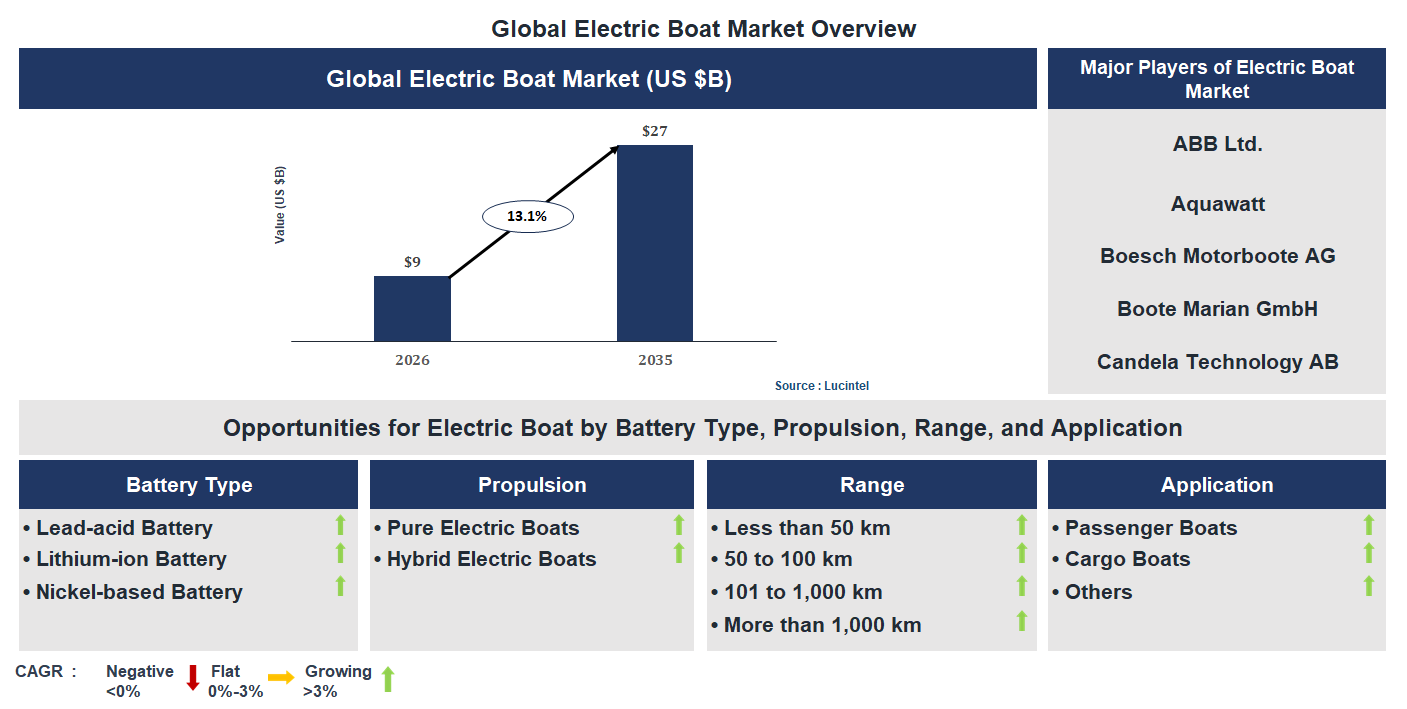
Electric Boat Market Trends and Forecast

Emerging Trends in the Electric Boat Market

The electric boat market is experiencing rapid growth driven by technological advancements, environmental concerns, and changing consumer preferences. As the world shifts towards sustainable transportation solutions, the marine industry is also embracing electric propulsion to reduce emissions and operational costs. Innovations in battery technology, regulatory pressures, and increasing awareness of eco-friendly practices are fueling this transformation. Market players are investing heavily in research and development to enhance performance, range, and affordability of electric boats. These developments are not only reshaping the competitive landscape but also expanding the markets reach across recreational, commercial, and governmental sectors. The following key trends highlight the evolving dynamics of this industry.

• Improved Battery Technology: Advances in lithium-ion and solid-state batteries are significantly increasing energy density, reducing charging times, and extending the range of electric boats. These innovations make electric propulsion more viable for larger vessels and longer trips, thereby broadening market applications. Enhanced battery durability and safety features also contribute to consumer confidence and operational reliability. As technology continues to evolve, electric boats are becoming more competitive with traditional fuel-powered vessels, encouraging wider adoption across various segments.
• Stricter Emission Regulations: Governments worldwide are implementing stricter emission standards and offering incentives for electric vessel adoption. These policies aim to reduce marine pollution and greenhouse gas emissions, pushing manufacturers and operators toward cleaner alternatives. Subsidies, tax benefits, and low-interest loans are making electric boats more financially accessible. Regulatory frameworks are also encouraging the development of charging infrastructure and sustainable maritime practices, which collectively accelerate market growth and adoption rates.
• Sustainability and Cost Efficiency: Increasing awareness of environmental issues is driving consumers and commercial operators to seek eco-friendly transportation options. Electric boats offer lower operational costs, reduced noise pollution, and minimal maintenance requirements, making them attractive for recreational and commercial use. The demand is particularly strong in regions with strict environmental policies and a focus on sustainable tourism and fisheries. This trend is expanding the market beyond niche segments into mainstream recreational and commercial boating sectors.
• Entry into Commercial and Public Sectors: Traditionally dominated by recreational users, the electric boat market is now expanding into commercial applications such as ferries, patrol boats, and research vessels. Public sector adoption is also increasing, with municipalities investing in electric water taxis and patrol boats to meet sustainability goals. This diversification is opening new revenue streams and encouraging innovation tailored to different operational needs, thereby broadening the overall market scope and accelerating growth.
• Smart and Modular Electric Boats: The integration of smart technologies, such as IoT sensors and autonomous navigation systems, is enhancing safety, efficiency, and user experience. Modular designs allow for easier upgrades and customization, catering to diverse customer preferences. These innovations are making electric boats more versatile, user-friendly, and appealing to a broader audience. Additionally, aesthetic and ergonomic improvements are boosting market attractiveness, encouraging adoption across various sectors and fostering a competitive environment focused on innovation.

These trends are collectively transforming the electric boat market by making it more technologically advanced, environmentally compliant, and commercially viable. The shift towards sustainable maritime transportation is not only reducing environmental impact but also creating new opportunities for growth and innovation. As these developments continue, the market is poised for significant expansion, reshaping the future of marine mobility worldwide.
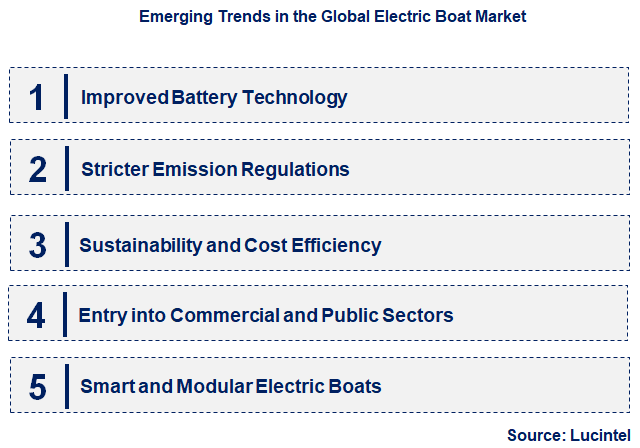
Emerging Trends in the Electric Boat Market

Recent Development in the Electric Boat Market

The electric boat market is experiencing rapid growth driven by technological advancements, environmental concerns, and shifting consumer preferences. As governments implement stricter regulations on emissions, manufacturers are innovating to develop sustainable, efficient, and cost-effective electric vessels. The increasing adoption of renewable energy sources and the rising popularity of recreational boating further fuel this expansion. These developments are transforming the industry landscape, creating new opportunities for stakeholders and encouraging sustainable practices across the maritime sector.

• Growing Demand for Sustainable Marine Transportation: The shift towards eco-friendly transportation options is boosting electric boat adoption. Consumers and governments seek to reduce carbon footprints, leading to increased investments in electric propulsion systems. This trend is encouraging manufacturers to innovate, resulting in a broader range of electric vessels suitable for commercial and recreational use. The markets expansion is driven by environmental policies and consumer awareness, positioning electric boats as a viable alternative to traditional fuel-powered vessels.
• Technological Advancements in Battery Technology: Improvements in battery capacity, charging speed, and lifespan are significantly impacting the electric boat market. These innovations enable longer travel distances and faster recharging, making electric boats more practical and appealing. Enhanced battery efficiency reduces operational costs and increases vessel reliability. As battery technology continues to evolve, it will facilitate the development of larger, more powerful electric vessels, broadening their application scope and accelerating market growth.
• Increasing Investment in Charging Infrastructure: The development of dedicated charging stations at marinas and ports is crucial for widespread electric boat adoption. Governments and private companies are investing heavily in charging networks to support the growing fleet of electric vessels. This infrastructure expansion reduces range anxiety and enhances user convenience. Improved accessibility to charging facilities is expected to boost consumer confidence and accelerate market penetration, making electric boats a more practical choice for both recreational and commercial users.
• Regulatory Support and Incentives: Governments worldwide are implementing policies and incentives to promote electric mobility, including in the maritime sector. These measures include tax credits, subsidies, and stricter emission standards, encouraging manufacturers and consumers to adopt electric boats. Regulatory support accelerates market development by reducing costs and fostering innovation. As policies become more favorable, the electric boat market is poised for substantial growth, driven by increased adoption and technological progress.
• Rising Popularity of Recreational Electric Boating: The recreational boating segment is witnessing a surge in electric vessel adoption due to environmental awareness and technological improvements. Electric boats offer quieter, cleaner, and more cost-effective operation, appealing to eco-conscious consumers. The trend is supported by increasing product availability and affordability. This growth in recreational electric boating is expanding market size, encouraging manufacturers to develop diverse models, and fostering a sustainable, eco-friendly boating culture.

The overall impact of these developments is transforming the electric boat market into a more sustainable, technologically advanced, and accessible industry. Increased investments, innovation, and supportive policies are driving rapid growth, positioning electric boats as a key component of future maritime transportation and recreation. This evolution is fostering a cleaner environment and creating new economic opportunities within the sector.

Strategic Growth Opportunities in the Electric Boat Market

The electric boat market is experiencing rapid growth driven by technological advancements, environmental regulations, and increasing consumer demand for sustainable transportation options. As awareness of climate change rises, manufacturers are innovating to develop efficient, eco-friendly vessels. The market presents significant opportunities for expansion across various applications, including recreational, commercial, and defense sectors. Strategic investments and technological breakthroughs are expected to accelerate growth, making electric boats a vital component of future maritime transportation.

• Increasing Adoption of Electric Propulsion Systems in Recreational Boats: The rising preference for eco-friendly leisure activities is boosting demand for electric recreational boats. Consumers seek quieter, cleaner, and cost-effective alternatives to traditional fuel-powered vessels. Advances in battery technology and motor efficiency are making electric recreational boats more accessible and practical. Manufacturers are expanding product lines to cater to this growing segment, which is expected to significantly contribute to overall market growth.
• Expansion of Commercial Electric Vessel Operations for Sustainability Goals: Commercial sectors, including ferries, cargo ships, and tour boats, are adopting electric propulsion to meet stringent environmental regulations and reduce operational costs. Governments and organizations are incentivizing electric vessel deployment through subsidies and policy support. This shift enhances sustainability credentials and operational efficiency, opening new revenue streams. The increasing adoption of electric commercial vessels is poised to transform maritime logistics and passenger services, driving substantial market expansion.
• Technological Innovations in Battery and Charging Infrastructure: Breakthroughs in battery energy density, charging speed, and durability are critical for the widespread adoption of electric boats. Development of fast-charging stations and integrated energy management systems enhances operational convenience. These innovations reduce downtime and extend vessel range, making electric boats more viable for various applications. As infrastructure improves, market penetration accelerates, supporting the transition from traditional to electric maritime transportation.
• Growing Focus on Autonomous and Connected Electric Boats: Integration of autonomous navigation and IoT connectivity in electric boats offers enhanced safety, efficiency, and user experience. These technologies enable remote monitoring, predictive maintenance, and optimized routing, reducing operational costs. The development of smart electric vessels appeals to commercial operators and recreational users alike. This convergence of electric propulsion and automation is expected to open new market segments and accelerate adoption across the maritime industry.
• Rising Investment and Strategic Partnerships in Electric Marine Technology: Increased funding from venture capital, government grants, and industry players fuels innovation and market expansion. Strategic collaborations between technology providers, boat manufacturers, and energy companies facilitate the development of comprehensive solutions. These partnerships accelerate product development, scale manufacturing, and expand distribution channels. The influx of investment and collaboration is vital for overcoming technical challenges and establishing a robust electric boat ecosystem, ensuring sustained market growth.

The overall impact of these opportunities is set to revolutionize the electric boat market, fostering sustainable maritime transportation and opening new avenues for growth. As technological, regulatory, and consumer trends align, the market is poised for significant expansion, contributing to global environmental goals and economic development.

Electric Boat Market Driver and Challenges

The electric boat market is influenced by a variety of technological, economic, and regulatory factors that shape its growth trajectory. Advances in battery technology and electric propulsion systems are making electric boats more viable and appealing to consumers. Economic factors such as rising fuel costs and increasing environmental awareness are driving demand for cleaner alternatives. Regulatory policies aimed at reducing emissions and promoting sustainable transportation further support market expansion. However, challenges such as high initial costs, limited battery range, and infrastructural gaps pose significant hurdles. Understanding these drivers and challenges is essential for stakeholders to navigate the evolving landscape and capitalize on emerging opportunities.

The factors responsible for driving the electric boat market include:
• Technological Innovation: The rapid development of battery technology, including higher energy density and faster charging capabilities, enhances the performance and feasibility of electric boats. Innovations in electric propulsion systems reduce maintenance costs and improve efficiency, making electric boats more attractive to consumers and commercial operators. These advancements also enable longer ranges and better reliability, which are critical for market adoption. As technology continues to evolve, the cost of components decreases, further accelerating market growth and expanding application areas such as leisure, commercial, and military sectors.
• Environmental Regulations and Policies: Governments worldwide are implementing stringent emission standards and promoting sustainable transportation solutions. Regulations aimed at reducing greenhouse gases and air pollution incentivize the adoption of electric boats, especially in environmentally sensitive areas like lakes, rivers, and coastal zones. Subsidies, tax incentives, and grants for electric vessel manufacturing and infrastructure development further stimulate market growth. These policies not only encourage manufacturers to innovate but also influence consumer preferences towards eco-friendly options, thereby expanding the market base.
• Rising Fuel Costs and Economic Benefits: Fluctuating fuel prices and the economic benefits of electric propulsion are significant drivers. Electric boats offer lower operating costs due to reduced fuel consumption and maintenance requirements. Over time, the total cost of ownership becomes more economical compared to traditional fuel-powered boats. This economic advantage appeals to commercial operators, fleet owners, and recreational users seeking cost-effective and sustainable transportation solutions. As fuel prices continue to rise, the economic case for electric boats becomes increasingly compelling, fostering wider adoption.
• Growing Consumer Awareness and Environmental Concerns: Increasing awareness about environmental issues and the impact of traditional marine engines on ecosystems is driving consumer preference for electric boats. Eco-conscious consumers and organizations prioritize sustainable practices, leading to higher demand for zero-emission vessels. Marketing campaigns, environmental certifications, and social responsibility initiatives further influence consumer choices. This shift in consumer behavior supports market expansion, especially in regions with strong environmental advocacy and active boating communities.
• Market Expansion and Infrastructure Development: The development of charging infrastructure and supportive supply chains are crucial for market growth. Investments in charging stations at marinas, ports, and popular boating destinations facilitate easier access and reduce range anxiety. Additionally, expanding manufacturing capacities and distribution networks make electric boats more accessible and affordable. As infrastructure improves, it encourages adoption across various segments, including commercial fishing, tourism, and private recreation, thereby broadening the market scope and accelerating growth.

The challenges facing the electric boat market include:
• High Initial Investment Costs: Despite decreasing component costs, the upfront expense of electric boats remains higher than traditional counterparts. The cost of advanced batteries, electric motors, and charging infrastructure can be prohibitive for many consumers and small operators. This financial barrier limits market penetration, especially in developing regions where budget constraints are significant. Overcoming this challenge requires innovative financing options, subsidies, and economies of scale to make electric boats more affordable and attractive.
• Limited Battery Range and Charging Infrastructure: Range anxiety and insufficient charging facilities are significant obstacles. Current battery technology limits the distance electric boats can travel on a single charge, restricting their use for longer trips or commercial applications. Additionally, the lack of widespread charging stations hampers convenience and adoption, particularly in remote or less-developed areas. Addressing these issues necessitates ongoing technological improvements and strategic infrastructure investments to ensure reliable and accessible charging options.
• Technological and Regulatory Uncertainties: Rapid technological changes can lead to obsolescence and increased costs for manufacturers and consumers. Moreover, inconsistent regulations across regions create uncertainty, complicating product development and market entry strategies. Unclear standards for safety, emissions, and certification can delay adoption and increase compliance costs. Navigating these uncertainties requires proactive engagement with regulators and continuous innovation to stay ahead of evolving standards.

The electric boat market is driven by technological advancements, supportive policies, economic benefits, consumer awareness, and infrastructure development. However, high initial costs, limited range, and regulatory uncertainties pose significant challenges. These factors collectively influence market dynamics, requiring stakeholders to innovate and collaborate to overcome barriers. The overall impact is a growing but cautiously optimistic market, with substantial potential for sustainable growth as solutions to current challenges are implemented.

List of Electric Boat Companies

Companies in the market compete on the basis of product quality offered. Major players in this market focus on expanding their manufacturing facilities, R&D investments, infrastructural development, and leverage integration opportunities across the value chain. With these strategies electric boat companies cater increasing demand, ensure competitive effectiveness, develop innovative products & technologies, reduce production costs, and expand their customer base. Some of the electric boat companies profiled in this report include-
• ABB Ltd.
• Aquawatt
• Boesch Motorboote AG
• Boote Marian GmbH
• Candela Technology AB
• Corvus Energy
• Domini Yachts
• Duffy Electric Boat Company
• Echandia AB
• ElectraCraft, Inc.

Electric Boat Market by Segment

The study includes a forecast for the global electric boat market by battery type, propulsion, range, application, and region.

Electric Boat Market by Battery Type [Value from 2019 to 2035]:


• Lead-acid Battery
• Lithium-ion Battery
• Nickel-based Battery

Electric Boat Market by Propulsion [Value from 2019 to 2035]:


• Pure Electric Boats
• Hybrid Electric Boats

Electric Boat Market by Range [Value from 2019 to 2035]:


• Less than 50 km
• 50 to 100 km
• 101 to 1,000 km
• More than 1,000 km

Electric Boat Market by Application [Value from 2019 to 2035]:


• Passenger Boats
• Cargo Boats
• Others

Electric Boat Market by Region [Value from 2019 to 2035]:


• North America
• Europe
• Asia Pacific
• The Rest of the World

Country Wise Outlook for the Electric Boat Market

The electric boat market has experienced significant growth driven by technological advancements, increasing environmental awareness, and government policies promoting clean transportation. As countries aim to reduce carbon emissions and adopt sustainable practices, the demand for electric boats has surged globally. Innovations in battery technology, expanding charging infrastructure, and supportive regulations are shaping the market landscape. Each country is adopting unique strategies to capitalize on this trend, reflecting their economic priorities and environmental commitments. The following summaries highlight recent developments in the electric boat market across the United States, China, Germany, India, and Japan, illustrating their respective contributions and initiatives.

• United States: United States, the electric boat market has seen rapid expansion with increased investments in battery technology and charging infrastructure. Major manufacturers are launching new models with longer ranges and improved performance, supported by government incentives and environmental regulations. The adoption of electric boats is also driven by recreational and commercial sectors, including marinas and rental services. Additionally, collaborations between tech firms and boat manufacturers are fostering innovation, making electric boats more accessible and affordable for consumers.
• China: China continues to lead in electric boat production and adoption, leveraging its robust manufacturing base and government support. The country has introduced policies to promote electric watercraft, especially in urban waterways and tourist destinations. Domestic companies are expanding their product portfolios with advanced battery systems and smart features. China’s focus on integrating electric boats into its broader green transportation initiatives is accelerating market growth, with significant investments in charging infrastructure and research and development.
• Germany: Germany is emphasizing sustainable maritime transportation, with a focus on integrating electric boats into its existing maritime and inland waterway networks. The country has seen increased R&D activity aimed at improving battery efficiency and reducing costs. Several pilot projects and collaborations between industry and academia are underway to develop innovative electric vessel designs. Germany’s strict environmental standards and commitment to renewable energy are driving the adoption of electric boats in both commercial and leisure sectors.
• India: India’s electric boat market is emerging, supported by government initiatives promoting clean transportation and renewable energy. The country is witnessing a rise in local startups and manufacturers developing affordable electric watercraft suitable for inland waterways and tourism. Efforts are being made to improve charging infrastructure and battery technology to enhance operational range and reliability. The government’s focus on reducing pollution in major water bodies is also encouraging the adoption of electric boats for fishing, transportation, and recreational activities.
• Japan: Japan is advancing its electric boat market through technological innovation and sustainability goals. The country’s focus on marine conservation and reducing maritime emissions has led to increased R&D investments. Several companies are developing hybrid and fully electric vessels tailored for both commercial and leisure use. Japan is also expanding its charging infrastructure and promoting policies that support eco-friendly maritime practices. The integration of smart technologies and renewable energy sources is further strengthening Japan’s position in the global electric boat market.

Lucintel Analytics Dashboard

Features of the Global Electric Boat Market

Market Size Estimates: Electric boat market size estimation in terms of value ($B).
Trend and Forecast Analysis: Market trends (2019 to 2025) and forecast (2026 to 2035) by various segments and regions.
Segmentation Analysis: Electric boat market size by various segments, such as by battery type, propulsion, range, application, and region in terms of value ($B).
Regional Analysis: Electric boat market breakdown by North America, Europe, Asia Pacific, and Rest of the World.
Growth Opportunities: Analysis of growth opportunities in different battery types, propulsion, range, applications, and regions for the electric boat market.
Strategic Analysis: This includes M&A, new product development, and competitive landscape of the electric boat market.
Analysis of competitive intensity of the industry based on Porter’s Five Forces model.

Lucintel Consulting Services

FAQ

Q1. What is the electric boat market size?
Answer: The global electric boat market is expected to reach an estimated $27 billion by 2035.
Q2. What is the growth forecast for electric boat market?
Answer: The global electric boat market is expected to grow with a CAGR of 13.1% from 2026 to 2035.
Q3. What are the major drivers influencing the growth of the electric boat market?
Answer: The major drivers for this market are the increasing demand for eco friendly marine transport, the rising adoption of electric propulsion systems, and the growing focus on reducing marine emissions.
Q4. What are the major segments for electric boat market?
Answer: The future of the electric boat market looks promising with opportunities in the passenger boat and cargo boat markets.
Q5. Who are the key electric boat market companies?
Answer: Some of the key electric boat companies are as follows:
• ABB Ltd.
• Aquawatt
• Boesch Motorboote AG
• Boote Marian GmbH
• Candela Technology AB
• Corvus Energy
• Domini Yachts
• Duffy Electric Boat Company
• Echandia AB
• ElectraCraft, Inc.
Q6. Which electric boat market segment will be the largest in future?
Answer: Lucintel forecasts that, within the battery type category, lithium-ion battery is expected to witness the highest growth over the forecast period.
Q7. In electric boat market, which region is expected to be the largest in next 8 years?
Answer: In terms of region, North America is expected to witness the highest growth over the forecast period.
Q8. Do we receive customization in this report?
Answer: Yes, Lucintel provides 10% customization without any additional cost.

This report answers following 11 key questions:

Q.1. What are some of the most promising, high-growth opportunities for the electric boat market by battery type (lead-acid battery, lithium-ion battery, and nickel-based battery), propulsion (pure electric boats and hybrid electric boats), range (less than 50 km, 50 to 100 km, 101 to 1,000 km, and more than 1,000 km), application (passenger boats, cargo boats, and others), and region (North America, Europe, Asia Pacific, and the Rest of the World)?
Q.2. Which segments will grow at a faster pace and why?
Q.3. Which region will grow at a faster pace and why?
Q.4. What are the key factors affecting market dynamics? What are the key challenges and business risks in this market?
Q.5. What are the business risks and competitive threats in this market?
Q.6. What are the emerging trends in this market and the reasons behind them?
Q.7. What are some of the changing demands of customers in the market?
Q.8. What are the new developments in the market? Which companies are leading these developments?
Q.9. Who are the major players in this market? What strategic initiatives are key players pursuing for business growth?
Q.10. What are some of the competing products in this market and how big of a threat do they pose for loss of market share by material or product substitution?
Q.11. What M&A activity has occurred in the last 5 years and what has its impact been on the industry?

For any questions related to Electric Boat Market, Electric Boat Market Size, Electric Boat Market Growth, Electric Boat Market Analysis, Electric Boat Market Report, Electric Boat Market Share, Electric Boat Market Trends, Electric Boat Market Forecast, Electric Boat Companies, write Lucintel analyst at email: helpdesk@lucintel.com. We will be glad to get back to you soon.
                                           Table of Contents

            1. Executive Summary

            2. Market Overview

                        2.1 Background and Classifications
                        2.2 Supply Chain

            3. Market Trends & Forecast Analysis

                        3.1 Macroeconomic Trends and Forecasts
                        3.2 Industry Drivers and Challenges
                        3.3 PESTLE Analysis
                        3.4 Patent Analysis
                        3.5 Regulatory Environment
                        3.6 Global Electric Boat Market Trends and Forecast

            4. Global Electric Boat Market by Battery Type

                        4.1 Overview
                        4.2 Attractiveness Analysis by Battery Type
                        4.3 Lead-acid Battery : Trends and Forecast (2019 to 2035)
                        4.4 Lithium-ion Battery : Trends and Forecast (2019 to 2035)
                        4.5 Nickel-based Battery : Trends and Forecast (2019 to 2035)

            5. Global Electric Boat Market by Propulsion

                        5.1 Overview
                        5.2 Attractiveness Analysis by Propulsion
                        5.3 Pure Electric Boats : Trends and Forecast (2019 to 2035)
                        5.4 Hybrid Electric Boats : Trends and Forecast (2019 to 2035)

            6. Global Electric Boat Market by Range

                        6.1 Overview
                        6.2 Attractiveness Analysis by Range
                        6.3 Less than 50 km : Trends and Forecast (2019 to 2035)
                        6.4 50 to 100 km : Trends and Forecast (2019 to 2035)
                        6.5 101 to 1,000 km : Trends and Forecast (2019 to 2035)
                        6.6 More than 1,000 km : Trends and Forecast (2019 to 2035)

            7. Global Electric Boat Market by Application

                        7.1 Overview
                        7.2 Attractiveness Analysis by Application
                        7.3 Passenger Boats : Trends and Forecast (2019 to 2035)
                        7.4 Cargo Boats : Trends and Forecast (2019 to 2035)
                        7.5 Others : Trends and Forecast (2019 to 2035)

            8. Regional Analysis

                        8.1 Overview
                        8.2 Global Electric Boat Market by Region

            9. North American Electric Boat Market

                        9.1 Overview
                        9.2 North American Electric Boat Market by Battery Type
                        9.3 North American Electric Boat Market by Application
                        9.4 The United States Electric Boat Market
                        9.5 Canadian Electric Boat Market
                        9.6 Mexican Electric Boat Market

            10. European Electric Boat Market

                        10.1 Overview
                        10.2 European Electric Boat Market by Battery Type
                        10.3 European Electric Boat Market by Application
                        10.4 German Electric Boat Market
                        10.5 French Electric Boat Market
                        10.6 Italian Electric Boat Market
                        10.7 Spanish Electric Boat Market
                        10.8 The United Kingdom Electric Boat Market

            11. APAC Electric Boat Market

                        11.1 Overview
                        11.2 APAC Electric Boat Market by Battery Type
                        11.3 APAC Electric Boat Market by Application
                        11.4 Chinese Electric Boat Market
                        11.5 Indian Electric Boat Market
                        11.6 Japanese Electric Boat Market
                        11.7 South Korean Electric Boat Market
                        11.8 Indonesian Electric Boat Market

            12. ROW Electric Boat Market

                        12.1 Overview
                        12.2 ROW Electric Boat Market by Battery Type
                        12.3 ROW Electric Boat Market by Application
                        12.4 Middle Eastern Electric Boat Market
                        12.5 South American Electric Boat Market
                        12.6 African Electric Boat Market

            13. Competitor Analysis

                        13.1 Product Portfolio Analysis
                        13.2 Operational Integration
                        13.3 Porter’s Five Forces Analysis
                                    • Competitive Rivalry
                                    • Bargaining Power of Buyers
                                    • Bargaining Power of Suppliers
                                    • Threat of Substitutes
                                    • Threat of New Entrants
                        13.4 Market Share Analysis

            14. Opportunities & Strategic Analysis

                        14.1 Value Chain Analysis
                        14.2 Growth Opportunity Analysis
                                    14.2.1 Growth Opportunity by Battery Type
                                    14.2.2 Growth Opportunity by Propulsion
                                    14.2.3 Growth Opportunity by Range
                                    14.2.4 Growth Opportunity by Application
                                    14.2.5 Growth Opportunity by Region
                        14.3 Emerging Trends in the Global Electric Boat Market
                        14.4 Strategic Analysis
                                    14.4.1 New Product Development
                                    14.4.2 Certification and Licensing
                                    14.4.3 Mergers, Acquisitions, Agreements, Collaborations, and Joint Ventures

            15. Company Profiles of the Leading Players Across the Value Chain

                        15.1 Competitive Analysis Overview
                        15.2 ABB Ltd.
                                    • Company Overview
                                    • Electric Boat Market Business Overview
                                    • New Product Development
                                    • Merger, Acquisition, and Collaboration
                                    • Certification and Licensing
                        15.3 Aquawatt
                                    • Company Overview
                                    • Electric Boat Market Business Overview
                                    • New Product Development
                                    • Merger, Acquisition, and Collaboration
                                    • Certification and Licensing
                        15.4 Boesch Motorboote AG
                                    • Company Overview
                                    • Electric Boat Market Business Overview
                                    • New Product Development
                                    • Merger, Acquisition, and Collaboration
                                    • Certification and Licensing
                        15.5 Boote Marian GmbH
                                    • Company Overview
                                    • Electric Boat Market Business Overview
                                    • New Product Development
                                    • Merger, Acquisition, and Collaboration
                                    • Certification and Licensing
                        15.6 Candela Technology AB
                                    • Company Overview
                                    • Electric Boat Market Business Overview
                                    • New Product Development
                                    • Merger, Acquisition, and Collaboration
                                    • Certification and Licensing
                        15.7 Corvus Energy
                                    • Company Overview
                                    • Electric Boat Market Business Overview
                                    • New Product Development
                                    • Merger, Acquisition, and Collaboration
                                    • Certification and Licensing
                        15.8 Domini Yachts
                                    • Company Overview
                                    • Electric Boat Market Business Overview
                                    • New Product Development
                                    • Merger, Acquisition, and Collaboration
                                    • Certification and Licensing
                        15.9 Duffy Electric Boat Company
                                    • Company Overview
                                    • Electric Boat Market Business Overview
                                    • New Product Development
                                    • Merger, Acquisition, and Collaboration
                                    • Certification and Licensing
                        15.10 Echandia AB
                                    • Company Overview
                                    • Electric Boat Market Business Overview
                                    • New Product Development
                                    • Merger, Acquisition, and Collaboration
                                    • Certification and Licensing
                        15.11 ElectraCraft, Inc.
                                    • Company Overview
                                    • Electric Boat Market Business Overview
                                    • New Product Development
                                    • Merger, Acquisition, and Collaboration
                                    • Certification and Licensing

            16. Appendix

                        16.1 List of Figures
                        16.2 List of Tables
                        16.3 Research Methodology
                        16.4 Disclaimer
                        16.5 Copyright
                        16.6 Abbreviations and Technical Units
                        16.7 About Us
                        16.8 Contact Us

                                               List of Figures


            Chapter 1

                        Figure 1.1: Trends and Forecast for the Global Electric Boat Market

            Chapter 2

                        Figure 2.1: Usage of Electric Boat Market
                        Figure 2.2: Classification of the Global Electric Boat Market
                        Figure 2.3: Supply Chain of the Global Electric Boat Market

            Chapter 3

                        Figure 3.1: Trends of the Global GDP Growth Rate
                        Figure 3.2: Trends of the Global Population Growth Rate
                        Figure 3.3: Trends of the Global Inflation Rate
                        Figure 3.4: Trends of the Global Unemployment Rate
                        Figure 3.5: Trends of the Regional GDP Growth Rate
                        Figure 3.6: Trends of the Regional Population Growth Rate
                        Figure 3.7: Trends of the Regional Inflation Rate
                        Figure 3.8: Trends of the Regional Unemployment Rate
                        Figure 3.9: Trends of Regional Per Capita Income
                        Figure 3.10: Forecast for the Global GDP Growth Rate
                        Figure 3.11: Forecast for the Global Population Growth Rate
                        Figure 3.12: Forecast for the Global Inflation Rate
                        Figure 3.13: Forecast for the Global Unemployment Rate
                        Figure 3.14: Forecast for the Regional GDP Growth Rate
                        Figure 3.15: Forecast for the Regional Population Growth Rate
                        Figure 3.16: Forecast for the Regional Inflation Rate
                        Figure 3.17: Forecast for the Regional Unemployment Rate
                        Figure 3.18: Forecast for Regional Per Capita Income
                        Figure 3.19: Driver and Challenges of the Electric Boat Market

            Chapter 4

                        Figure 4.1: Global Electric Boat Market by Battery Type in 2019, 2025, and 2035
                        Figure 4.2: Trends of the Global Electric Boat Market ($B) by Battery Type
                        Figure 4.3: Forecast for the Global Electric Boat Market ($B) by Battery Type
                        Figure 4.4: Trends and Forecast for Lead-acid Battery in the Global Electric Boat Market (2019-2035)
                        Figure 4.5: Trends and Forecast for Lithium-ion Battery in the Global Electric Boat Market (2019-2035)
                        Figure 4.6: Trends and Forecast for Nickel-based Battery in the Global Electric Boat Market (2019-2035)

            Chapter 5

                        Figure 5.1: Global Electric Boat Market by Propulsion in 2019, 2025, and 2035
                        Figure 5.2: Trends of the Global Electric Boat Market ($B) by Propulsion
                        Figure 5.3: Forecast for the Global Electric Boat Market ($B) by Propulsion
                        Figure 5.4: Trends and Forecast for Pure Electric Boats in the Global Electric Boat Market (2019-2035)
                        Figure 5.5: Trends and Forecast for Hybrid Electric Boats in the Global Electric Boat Market (2019-2035)

            Chapter 6

                        Figure 6.1: Global Electric Boat Market by Range in 2019, 2025, and 2035
                        Figure 6.2: Trends of the Global Electric Boat Market ($B) by Range
                        Figure 6.3: Forecast for the Global Electric Boat Market ($B) by Range
                        Figure 6.4: Trends and Forecast for Less than 50 km in the Global Electric Boat Market (2019-2035)
                        Figure 6.5: Trends and Forecast for 50 to 100 km in the Global Electric Boat Market (2019-2035)
                        Figure 6.6: Trends and Forecast for 101 to 1,000 km in the Global Electric Boat Market (2019-2035)
                        Figure 6.7: Trends and Forecast for More than 1,000 km in the Global Electric Boat Market (2019-2035)

            Chapter 7

                        Figure 7.1: Global Electric Boat Market by Application in 2019, 2025, and 2035
                        Figure 7.2: Trends of the Global Electric Boat Market ($B) by Application
                        Figure 7.3: Forecast for the Global Electric Boat Market ($B) by Application
                        Figure 7.4: Trends and Forecast for Passenger Boats in the Global Electric Boat Market (2019-2035)
                        Figure 7.5: Trends and Forecast for Cargo Boats in the Global Electric Boat Market (2019-2035)
                        Figure 7.6: Trends and Forecast for Others in the Global Electric Boat Market (2019-2035)

            Chapter 8

                        Figure 8.1: Trends of the Global Electric Boat Market ($B) by Region (2019-2025)
                        Figure 8.2: Forecast for the Global Electric Boat Market ($B) by Region (2026-2035)

            Chapter 9

                        Figure 9.1: Trends and Forecast for the North American Electric Boat Market (2019-2035)
                        Figure 9.2: North American Electric Boat Market by Battery Type in 2019, 2025, and 2035
                        Figure 9.3: Trends of the North American Electric Boat Market ($B) by Battery Type (2019-2025)
                        Figure 9.4: Forecast for the North American Electric Boat Market ($B) by Battery Type (2026-2035)
                        Figure 9.5: North American Electric Boat Market by Propulsion in 2019, 2025, and 2035
                        Figure 9.6: Trends of the North American Electric Boat Market ($B) by Propulsion (2019-2025)
                        Figure 9.7: Forecast for the North American Electric Boat Market ($B) by Propulsion (2026-2035)
                        Figure 9.8: Trends and Forecast for the United States Electric Boat Market ($B) (2019-2035)
                        Figure 9.9: Trends and Forecast for the Mexican Electric Boat Market ($B) (2019-2035)
                        Figure 9.10: Trends and Forecast for the Canadian Electric Boat Market ($B) (2019-2035)

            Chapter 10

                        Figure 10.1: Trends and Forecast for the European Electric Boat Market (2019-2035)
                        Figure 10.2: European Electric Boat Market by Battery Type in 2019, 2025, and 2035
                        Figure 10.3: Trends of the European Electric Boat Market ($B) by Battery Type (2019-2025)
                        Figure 10.4: Forecast for the European Electric Boat Market ($B) by Battery Type (2026-2035)
                        Figure 10.5: European Electric Boat Market by Propulsion in 2019, 2025, and 2035
                        Figure 10.6: Trends of the European Electric Boat Market ($B) by Propulsion (2019-2025)
                        Figure 10.7: Forecast for the European Electric Boat Market ($B) by Propulsion (2026-2035)
                        Figure 10.8: Trends and Forecast for the German Electric Boat Market ($B) (2019-2035)
                        Figure 10.9: Trends and Forecast for the French Electric Boat Market ($B) (2019-2035)
                        Figure 10.10: Trends and Forecast for the Spanish Electric Boat Market ($B) (2019-2035)
                        Figure 10.11: Trends and Forecast for the Italian Electric Boat Market ($B) (2019-2035)
                        Figure 10.12: Trends and Forecast for the United Kingdom Electric Boat Market ($B) (2019-2035)

            Chapter 11

                        Figure 11.1: Trends and Forecast for the APAC Electric Boat Market (2019-2035)
                        Figure 11.2: APAC Electric Boat Market by Battery Type in 2019, 2025, and 2035
                        Figure 11.3: Trends of the APAC Electric Boat Market ($B) by Battery Type (2019-2025)
                        Figure 11.4: Forecast for the APAC Electric Boat Market ($B) by Battery Type (2026-2035)
                        Figure 11.5: APAC Electric Boat Market by Propulsion in 2019, 2025, and 2035
                        Figure 11.6: Trends of the APAC Electric Boat Market ($B) by Propulsion (2019-2025)
                        Figure 11.7: Forecast for the APAC Electric Boat Market ($B) by Propulsion (2026-2035)
                        Figure 11.8: Trends and Forecast for the Japanese Electric Boat Market ($B) (2019-2035)
                        Figure 11.9: Trends and Forecast for the Indian Electric Boat Market ($B) (2019-2035)
                        Figure 11.10: Trends and Forecast for the Chinese Electric Boat Market ($B) (2019-2035)
                        Figure 11.11: Trends and Forecast for the South Korean Electric Boat Market ($B) (2019-2035)
                        Figure 11.12: Trends and Forecast for the Indonesian Electric Boat Market ($B) (2019-2035)

            Chapter 12

                        Figure 12.1: Trends and Forecast for the ROW Electric Boat Market (2019-2035)
                        Figure 12.2: ROW Electric Boat Market by Battery Type in 2019, 2025, and 2035
                        Figure 12.3: Trends of the ROW Electric Boat Market ($B) by Battery Type (2019-2025)
                        Figure 12.4: Forecast for the ROW Electric Boat Market ($B) by Battery Type (2026-2035)
                        Figure 12.5: ROW Electric Boat Market by Propulsion in 2019, 2025, and 2035
                        Figure 12.6: Trends of the ROW Electric Boat Market ($B) by Propulsion (2019-2025)
                        Figure 12.7: Forecast for the ROW Electric Boat Market ($B) by Propulsion (2026-2035)
                        Figure 12.8: Trends and Forecast for the Middle Eastern Electric Boat Market ($B) (2019-2035)
                        Figure 12.9: Trends and Forecast for the South American Electric Boat Market ($B) (2019-2035)
                        Figure 12.10: Trends and Forecast for the African Electric Boat Market ($B) (2019-2035)

            Chapter 13

                        Figure 13.1: Porter’s Five Forces Analysis of the Global Electric Boat Market
                        Figure 13.2: Market Share (%) of Top Players in the Global Electric Boat Market (2025)

            Chapter 14

                        Figure 14.1: Growth Opportunities for the Global Electric Boat Market by Battery Type
                        Figure 14.2: Growth Opportunities for the Global Electric Boat Market by Propulsion
                        Figure 14.3: Growth Opportunities for the Global Electric Boat Market by Range
                        Figure 14.4: Growth Opportunities for the Global Electric Boat Market by Application
                        Figure 14.5: Growth Opportunities for the Global Electric Boat Market by Region
                        Figure 14.6: Emerging Trends in the Global Electric Boat Market

                                               List of Tables


            Chapter 1

                        Table 1.1: Growth Rate (%, 2024-2025) and CAGR (%, 2026-2035) of the Electric Boat Market by Battery Type, Propulsion, Range, and Application
                        Table 1.2: Attractiveness Analysis for the Electric Boat Market by Region
                        Table 1.3: Global Electric Boat Market Parameters and Attributes

            Chapter 3

                        Table 3.1: Trends of the Global Electric Boat Market (2019-2025)
                        Table 3.2: Forecast for the Global Electric Boat Market (2026-2035)

            Chapter 4

                        Table 4.1: Attractiveness Analysis for the Global Electric Boat Market by Battery Type
                        Table 4.2: Market Size and CAGR of Various Battery Type in the Global Electric Boat Market (2019-2025)
                        Table 4.3: Market Size and CAGR of Various Battery Type in the Global Electric Boat Market (2026-2035)
                        Table 4.4: Trends of Lead-acid Battery in the Global Electric Boat Market (2019-2025)
                        Table 4.5: Forecast for Lead-acid Battery in the Global Electric Boat Market (2026-2035)
                        Table 4.6: Trends of Lithium-ion Battery in the Global Electric Boat Market (2019-2025)
                        Table 4.7: Forecast for Lithium-ion Battery in the Global Electric Boat Market (2026-2035)
                        Table 4.8: Trends of Nickel-based Battery in the Global Electric Boat Market (2019-2025)
                        Table 4.9: Forecast for Nickel-based Battery in the Global Electric Boat Market (2026-2035)

            Chapter 5

                        Table 5.1: Attractiveness Analysis for the Global Electric Boat Market by Propulsion
                        Table 5.2: Market Size and CAGR of Various Propulsion in the Global Electric Boat Market (2019-2025)
                        Table 5.3: Market Size and CAGR of Various Propulsion in the Global Electric Boat Market (2026-2035)
                        Table 5.4: Trends of Pure Electric Boats in the Global Electric Boat Market (2019-2025)
                        Table 5.5: Forecast for Pure Electric Boats in the Global Electric Boat Market (2026-2035)
                        Table 5.6: Trends of Hybrid Electric Boats in the Global Electric Boat Market (2019-2025)
                        Table 5.7: Forecast for Hybrid Electric Boats in the Global Electric Boat Market (2026-2035)

            Chapter 6

                        Table 6.1: Attractiveness Analysis for the Global Electric Boat Market by Range
                        Table 6.2: Market Size and CAGR of Various Range in the Global Electric Boat Market (2019-2025)
                        Table 6.3: Market Size and CAGR of Various Range in the Global Electric Boat Market (2026-2035)
                        Table 6.4: Trends of Less than 50 km in the Global Electric Boat Market (2019-2025)
                        Table 6.5: Forecast for Less than 50 km in the Global Electric Boat Market (2026-2035)
                        Table 6.6: Trends of 50 to 100 km in the Global Electric Boat Market (2019-2025)
                        Table 6.7: Forecast for 50 to 100 km in the Global Electric Boat Market (2026-2035)
                        Table 6.8: Trends of 101 to 1,000 km in the Global Electric Boat Market (2019-2025)
                        Table 6.9: Forecast for 101 to 1,000 km in the Global Electric Boat Market (2026-2035)
                        Table 6.10: Trends of More than 1,000 km in the Global Electric Boat Market (2019-2025)
                        Table 6.11: Forecast for More than 1,000 km in the Global Electric Boat Market (2026-2035)

            Chapter 7

                        Table 7.1: Attractiveness Analysis for the Global Electric Boat Market by Application
                        Table 7.2: Market Size and CAGR of Various Application in the Global Electric Boat Market (2019-2025)
                        Table 7.3: Market Size and CAGR of Various Application in the Global Electric Boat Market (2026-2035)
                        Table 7.4: Trends of Passenger Boats in the Global Electric Boat Market (2019-2025)
                        Table 7.5: Forecast for Passenger Boats in the Global Electric Boat Market (2026-2035)
                        Table 7.6: Trends of Cargo Boats in the Global Electric Boat Market (2019-2025)
                        Table 7.7: Forecast for Cargo Boats in the Global Electric Boat Market (2026-2035)
                        Table 7.8: Trends of Others in the Global Electric Boat Market (2019-2025)
                        Table 7.9: Forecast for Others in the Global Electric Boat Market (2026-2035)

            Chapter 8

                        Table 8.1: Market Size and CAGR of Various Regions in the Global Electric Boat Market (2019-2025)
                        Table 8.2: Market Size and CAGR of Various Regions in the Global Electric Boat Market (2026-2035)

            Chapter 9

                        Table 9.1: Trends of the North American Electric Boat Market (2019-2025)
                        Table 9.2: Forecast for the North American Electric Boat Market (2026-2035)
                        Table 9.3: Market Size and CAGR of Various Battery Type in the North American Electric Boat Market (2019-2025)
                        Table 9.4: Market Size and CAGR of Various Battery Type in the North American Electric Boat Market (2026-2035)
                        Table 9.5: Market Size and CAGR of Various Propulsion in the North American Electric Boat Market (2019-2025)
                        Table 9.6: Market Size and CAGR of Various Propulsion in the North American Electric Boat Market (2026-2035)
                        Table 9.7: Trends and Forecast for the United States Electric Boat Market (2019-2035)
                        Table 9.8: Trends and Forecast for the Mexican Electric Boat Market (2019-2035)
                        Table 9.9: Trends and Forecast for the Canadian Electric Boat Market (2019-2035)

            Chapter 10

                        Table 10.1: Trends of the European Electric Boat Market (2019-2025)
                        Table 10.2: Forecast for the European Electric Boat Market (2026-2035)
                        Table 10.3: Market Size and CAGR of Various Battery Type in the European Electric Boat Market (2019-2025)
                        Table 10.4: Market Size and CAGR of Various Battery Type in the European Electric Boat Market (2026-2035)
                        Table 10.5: Market Size and CAGR of Various Propulsion in the European Electric Boat Market (2019-2025)
                        Table 10.6: Market Size and CAGR of Various Propulsion in the European Electric Boat Market (2026-2035)
                        Table 10.7: Trends and Forecast for the German Electric Boat Market (2019-2035)
                        Table 10.8: Trends and Forecast for the French Electric Boat Market (2019-2035)
                        Table 10.9: Trends and Forecast for the Spanish Electric Boat Market (2019-2035)
                        Table 10.10: Trends and Forecast for the Italian Electric Boat Market (2019-2035)
                        Table 10.11: Trends and Forecast for the United Kingdom Electric Boat Market (2019-2035)

            Chapter 11

                        Table 11.1: Trends of the APAC Electric Boat Market (2019-2025)
                        Table 11.2: Forecast for the APAC Electric Boat Market (2026-2035)
                        Table 11.3: Market Size and CAGR of Various Battery Type in the APAC Electric Boat Market (2019-2025)
                        Table 11.4: Market Size and CAGR of Various Battery Type in the APAC Electric Boat Market (2026-2035)
                        Table 11.5: Market Size and CAGR of Various Propulsion in the APAC Electric Boat Market (2019-2025)
                        Table 11.6: Market Size and CAGR of Various Propulsion in the APAC Electric Boat Market (2026-2035)
                        Table 11.7: Trends and Forecast for the Japanese Electric Boat Market (2019-2035)
                        Table 11.8: Trends and Forecast for the Indian Electric Boat Market (2019-2035)
                        Table 11.9: Trends and Forecast for the Chinese Electric Boat Market (2019-2035)
                        Table 11.10: Trends and Forecast for the South Korean Electric Boat Market (2019-2035)
                        Table 11.11: Trends and Forecast for the Indonesian Electric Boat Market (2019-2035)

            Chapter 12

                        Table 12.1: Trends of the ROW Electric Boat Market (2019-2025)
                        Table 12.2: Forecast for the ROW Electric Boat Market (2026-2035)
                        Table 12.3: Market Size and CAGR of Various Battery Type in the ROW Electric Boat Market (2019-2025)
                        Table 12.4: Market Size and CAGR of Various Battery Type in the ROW Electric Boat Market (2026-2035)
                        Table 12.5: Market Size and CAGR of Various Propulsion in the ROW Electric Boat Market (2019-2025)
                        Table 12.6: Market Size and CAGR of Various Propulsion in the ROW Electric Boat Market (2026-2035)
                        Table 12.7: Trends and Forecast for the Middle Eastern Electric Boat Market (2019-2035)
                        Table 12.8: Trends and Forecast for the South American Electric Boat Market (2019-2035)
                        Table 12.9: Trends and Forecast for the African Electric Boat Market (2019-2035)

            Chapter 13

                        Table 13.1: Product Mapping of Electric Boat Suppliers Based on Segments
                        Table 13.2: Operational Integration of Electric Boat Manufacturers
                        Table 13.3: Rankings of Suppliers Based on Electric Boat Revenue

            Chapter 14

                        Table 14.1: New Product Launches by Major Electric Boat Producers (2019-2025)
                        Table 14.2: Certification Acquired by Major Competitor in the Global Electric Boat Market

.

Buy full report or by chapter as follows

Price by License Type:
[-] Hide Chapter Details
[Chapter Number] [Chapter Name] [Chapter Number Of Pages] [Chapter Price]
Title/Chapter Name Pages Price
Full Report: Electric Boat Market Report: Trends, Forecast and Competitive Analysis to 2035 Full Report $ 4,850
A 150 Page Report
Lucintel has been in the business of market research and management consulting since 2000 and has published over 1000 market intelligence reports in various markets / applications and served over 1,000 clients worldwide. This study is a culmination of four months of full-time effort performed by Lucintel's analyst team. The analysts used the following sources for the creation and completion of this valuable report:
  • In-depth interviews of the major players in this market
  • Detailed secondary research from competitors’ financial statements and published data 
  • Extensive searches of published works, market, and database information pertaining to industry news, company press releases, and customer intentions
  • A compilation of the experiences, judgments, and insights of Lucintel’s professionals, who have analyzed and tracked this market over the years.
Extensive research and interviews are conducted across the supply chain of this market to estimate market share, market size, trends, drivers, challenges, and forecasts. Below is a brief summary of the primary interviews that were conducted by job function for this report.
 
Thus, Lucintel compiles vast amounts of data from numerous sources, validates the integrity of that data, and performs a comprehensive analysis. Lucintel then organizes the data, its findings, and insights into a concise report designed to support the strategic decision-making process. The figure below is a graphical representation of Lucintel’s research process. 
 

Please sign in below to get report brochure - Electric Boat Market Report.

At Lucintel, we respect your privacy and maintain the confidentiality of information / data provided by you
(Please enter your corporate email. * These fields are mandatory )

Follow us on