
Report Feature
eLearning Development Service Market Trends and Forecast
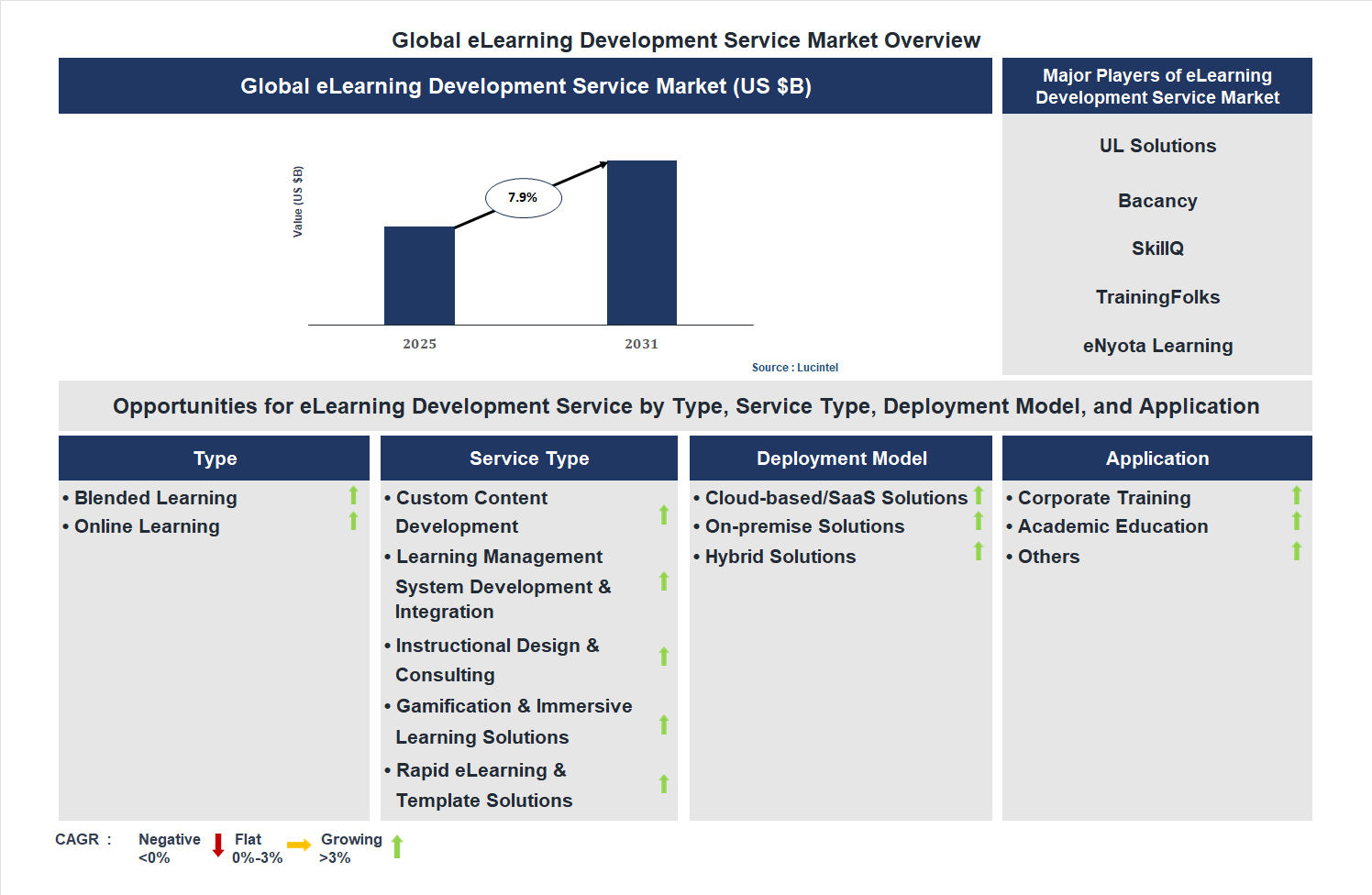
The future of the global eLearning development service market looks promising with opportunities in the corporate training and academic education markets. The global eLearning development service market is expected to grow with a CAGR of 7.9% from 2025 to 2031. The major drivers for this market are the increasing demand for online learning platforms, the rising adoption of digital education tools, and the growing focus on corporate training solutions.• Lucintel forecasts that, within the type category, online learning is expected to witness higher growth over the forecast period.
• Within the application category, corporate training is expected to witness higher growth.
• In terms of region, APAC is expected to witness the highest growth over the forecast period. Gain valuable insights for your business decisions with our comprehensive 150+ page report. Sample figures with some insights are shown below.
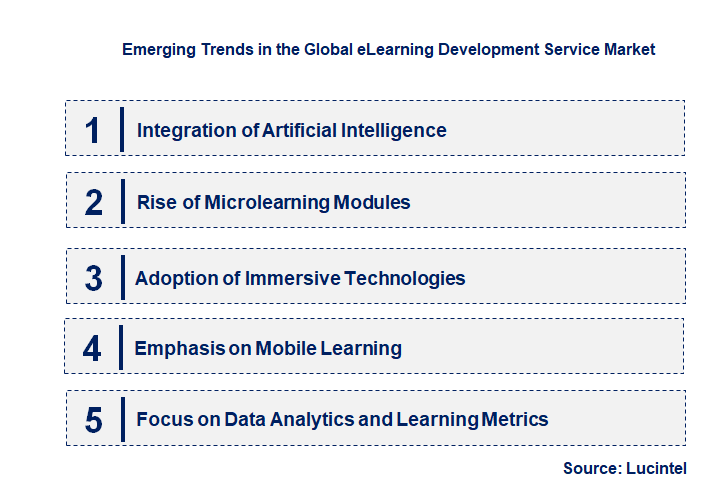
Emerging Trends in the eLearning Development Service Market
The eLearning development service market is experiencing rapid growth driven by technological advancements, changing educational needs, and increasing demand for flexible learning solutions. As organizations and educational institutions seek innovative ways to deliver content, several emerging trends are shaping the future of this industry. These developments are not only enhancing the quality and accessibility of eLearning but also transforming how learners engage with digital content. Understanding these key trends is essential for stakeholders aiming to stay competitive and leverage new opportunities in this evolving landscape.• Integration of Artificial Intelligence : AI is revolutionizing eLearning by enabling personalized learning experiences. Adaptive learning platforms analyze individual learner behaviors and preferences to tailor content, assessments, and feedback accordingly. This customization improves engagement, retention, and overall learning outcomes. AI-powered chatbots and virtual tutors provide real-time support, making learning more interactive and accessible. As AI technology advances, its integration into eLearning services will become more sophisticated, offering highly individualized educational pathways and automating administrative tasks, thus reducing costs and increasing efficiency.
• Rise of Microlearning Modules : Microlearning involves delivering content in small, focused segments that can be consumed quickly. This trend caters to the modern learner's preference for on-the-go, bite-sized information, making learning more flexible and less time-consuming. Microlearning modules are highly effective for skill development, onboarding, and continuous learning initiatives. They can be easily integrated into mobile platforms, enabling learners to access content anytime and anywhere. This approach enhances engagement, improves knowledge retention, and allows organizations to update content rapidly, keeping pace with industry changes and technological advancements.
• Adoption of Immersive Technologies : Augmented Reality (AR), Virtual Reality (VR), and Extended Reality (XR) are increasingly being incorporated into eLearning development. These immersive technologies create realistic, interactive environments that enhance experiential learning. They are particularly useful for complex training scenarios such as medical procedures, technical skills, and safety protocols. Immersive learning increases learner engagement, improves understanding of difficult concepts, and provides hands-on practice in a risk-free setting. As hardware costs decrease and technology becomes more accessible, immersive eLearning solutions are expected to become mainstream, transforming traditional training methods.
• Emphasis on Mobile Learning : The proliferation of smartphones and tablets has made mobile learning a dominant trend in the eLearning market. Mobile-friendly content allows learners to access courses anytime and anywhere, promoting continuous learning outside traditional classroom settings. Responsive design, offline access, and app-based platforms enhance user experience and engagement. Mobile learning supports just-in-time training, enabling employees and students to quickly acquire skills or knowledge when needed. This trend is driving content developers to optimize their offerings for mobile devices, ensuring compatibility and ease of use, which ultimately broadens the reach and impact of eLearning programs.
• Focus on Data Analytics and Learning Metrics : Data-driven decision-making is transforming eLearning development by providing insights into learner behavior, engagement levels, and content effectiveness. Advanced analytics tools track progress, identify knowledge gaps, and measure the impact of training programs. This information helps organizations tailor content, improve instructional design, and demonstrate return on investment. Real-time analytics enable continuous improvement and personalization of learning experiences. As data collection and analysis become more sophisticated, eLearning providers can deliver more targeted, effective, and measurable training solutions, enhancing overall learning outcomes and stakeholder satisfaction. In summary, these emerging trends are fundamentally reshaping the eLearning development service market by making learning more personalized, accessible, immersive, and data-driven. They are driving innovation, improving learner engagement, and enabling organizations to deliver more effective training solutions. As these trends continue to evolve, the market is poised for significant growth and transformation, offering new opportunities for providers and learners alike.
Recent Development in the eLearning Development Service Market
The eLearning development service market is experiencing rapid growth driven by technological advancements, increasing demand for remote education, and the need for customized learning solutions. Organizations and educational institutions are investing heavily in innovative platforms to enhance learner engagement and improve training efficiency. As digital transformation accelerates, the market is poised for significant expansion, creating new opportunities for service providers. This dynamic environment demands continuous innovation and strategic adaptation to meet evolving customer needs and stay competitive.• Growing Adoption of Digital Learning Platforms: The shift towards online education and corporate training is fueling demand for eLearning development services. Organizations seek scalable, interactive, and engaging digital solutions to reach wider audiences efficiently. This trend is driven by remote work policies, cost-effectiveness, and the need for flexible learning schedules. As a result, service providers are expanding their offerings to include mobile learning, gamification, and AI-driven personalized content, significantly impacting market growth and competitiveness.
• Increasing Investment in Custom eLearning Content: Customization is becoming a key differentiator in the eLearning market. Companies and educational institutions prefer tailored content that aligns with specific learning objectives and branding requirements. This trend boosts demand for specialized content development, including multimedia, simulations, and assessments. The focus on personalized learning experiences enhances learner engagement and retention, thereby expanding the market for bespoke eLearning solutions and creating new revenue streams for developers.
• Integration of Artificial Intelligence and Machine Learning: AI and ML are transforming eLearning development by enabling adaptive learning paths, intelligent assessments, and real-time feedback. These technologies improve learner engagement, retention, and overall effectiveness of training programs. Service providers investing in AI-driven tools can offer more sophisticated, personalized experiences, giving them a competitive edge. The integration of these technologies is expected to accelerate market growth, foster innovation, and meet the increasing demand for smarter, data-driven learning solutions.
• Rising Demand for Mobile Learning Solutions: The proliferation of smartphones and tablets has made mobile learning essential. Learners now prefer on-the-go access to educational content, prompting providers to develop mobile-optimized courses and apps. This trend enhances accessibility, flexibility, and user engagement, especially among remote and adult learners. The market for mobile eLearning solutions is expanding rapidly, encouraging developers to adopt responsive design and mobile-first strategies, thereby significantly impacting overall market dynamics.
• Focus on Compliance and Certification Training: Regulatory requirements and industry standards are driving the need for specialized compliance and certification courses. Organizations seek efficient ways to train employees on legal, safety, and operational standards. eLearning development services are increasingly tailored to meet these needs, offering scalable, trackable, and up-to-date training modules. This focus ensures workforce compliance, reduces training costs, and minimizes risks, thereby creating a steady demand for compliance-focused eLearning solutions and expanding the market. The overall impact of these developments is a robust, innovative, and competitive eLearning development service market. Continuous technological integration and customization are driving growth, expanding opportunities for providers, and enhancing learner experiences. As the market evolves, these opportunities will shape future trends, ensuring sustained expansion and increased adoption across various sectors.
Strategic Growth Opportunities in the eLearning Development Service Market
The eLearning development service market is experiencing rapid expansion driven by technological advancements, increasing adoption across industries, and the need for flexible, scalable training solutions. Organizations seek innovative ways to enhance learning experiences, improve engagement, and reduce costs. This growth presents numerous opportunities for service providers to innovate, expand their offerings, and capture new market segments. Strategic investments and collaborations are essential to capitalize on these evolving demands and stay competitive in this dynamic landscape.• Custom Content Development for Niche Markets: Tailoring eLearning content to specific industries and audiences offers significant growth potential. As organizations recognize the importance of personalized training, providers can develop specialized modules that address unique needs, compliance standards, and skill gaps. This approach enhances learner engagement and retention, leading to higher customer satisfaction and loyalty. Investing in niche content creation allows companies to differentiate themselves and tap into underserved markets, fueling overall market expansion.
• Integration of Artificial Intelligence for Personalized Learning: Incorporating AI technologies into eLearning platforms enables adaptive learning experiences tailored to individual learner preferences and progress. AI-driven analytics can identify knowledge gaps, recommend relevant content, and adjust difficulty levels in real-time. This personalization improves learning outcomes, increases engagement, and reduces dropout rates. As AI adoption grows, service providers that develop intelligent solutions will gain a competitive edge, driving market growth and innovation.
• Expansion of Mobile Learning Solutions: The proliferation of smartphones and tablets has made mobile learning a critical component of eLearning strategies. Developing mobile-optimized content and applications allows learners to access training anytime and anywhere, increasing flexibility and convenience. Mobile learning also supports microlearning and just-in-time training, which are highly effective for busy professionals. Providers focusing on seamless, user-friendly mobile experiences can capture a larger share of the market and meet the evolving needs of modern learners.
• Adoption of Gamification to Enhance Engagement: Implementing gamification elements such as badges, leaderboards, and rewards can significantly boost learner motivation and participation. Gamified eLearning experiences make training more interactive and enjoyable, leading to improved knowledge retention and skill acquisition. As organizations seek innovative ways to motivate employees and students, integrating gamification into development services offers a strategic opportunity to differentiate offerings and increase market penetration.
• Development of Virtual and Augmented Reality Training Modules: VR and AR technologies provide immersive, experiential learning environments that enhance understanding of complex concepts and practical skills. These technologies are particularly valuable in fields like healthcare, manufacturing, and technical training. As costs decrease and technology becomes more accessible, service providers can develop cutting-edge VR/AR modules to meet demand for realistic, engaging training solutions. This innovation opens new avenues for market growth and high-value client engagement. In conclusion, these strategic growth opportunities will significantly influence the eLearning development service market by fostering innovation, expanding reach, and improving learner outcomes. Embracing personalized, mobile, gamified, and immersive solutions will enable providers to stay competitive and meet the diverse needs of global learners. Overall, these opportunities will drive sustained market expansion, technological advancement, and increased adoption across various sectors.
eLearning Development Service Market Driver and Challenges
The eLearning development service market is influenced by a variety of technological, economic, and regulatory factors that shape its growth trajectory. Rapid advancements in digital technology, increasing internet penetration, and the need for flexible learning solutions are key drivers. Simultaneously, evolving regulatory standards and data security concerns pose challenges. Economic factors such as rising investments in education technology and the shift towards remote learning due to global events further impact the market. Understanding these drivers and challenges is essential for stakeholders to navigate the dynamic landscape effectively and capitalize on emerging opportunities. The factors responsible for driving the eLearning development service market include:-• Technological Advancements: The continuous evolution of digital tools, cloud computing, and mobile technology has revolutionized eLearning development. These innovations enable the creation of more interactive, engaging, and personalized learning experiences. As technology becomes more accessible and affordable, educational institutions and corporate clients increasingly adopt eLearning solutions. The integration of artificial intelligence, virtual reality, and gamification further enhances content delivery, making learning more effective and appealing. This technological progress accelerates market growth by expanding the scope and quality of eLearning services, attracting a broader customer base and fostering innovation within the industry.
• Increasing Adoption of Remote Learning: The global shift towards remote and hybrid learning models, especially accelerated by the COVID-19 pandemic, has significantly boosted demand for eLearning development services. Educational institutions, corporate training programs, and government agencies seek scalable, flexible solutions to deliver content remotely. This trend is driven by the need for cost-effective, accessible, and customizable learning options that can reach diverse audiences regardless of geographical barriers. As organizations recognize the benefits of remote learning, investments in eLearning platforms and content development continue to rise, fueling market expansion and encouraging the development of innovative delivery methods.
• Growing Focus on Skill Development and Lifelong Learning: The increasing emphasis on continuous skill enhancement and lifelong learning is a major driver for the eLearning development market. Employers and individuals alike recognize the importance of upskilling to stay competitive in a rapidly changing job landscape. Governments and educational bodies promote eLearning programs to address skill gaps and improve workforce productivity. This demand for specialized, industry-specific courses and certifications encourages the development of tailored eLearning content and platforms. As the need for flexible, on-demand learning grows, the market experiences sustained growth driven by the desire for accessible, high-quality educational resources.
• Rising Investments and Funding in EdTech: The eLearning development market benefits from substantial investments by venture capitalists, private equity firms, and government grants aimed at expanding educational technology infrastructure. These investments facilitate the development of advanced eLearning platforms, content, and tools, enabling providers to enhance their offerings. Increased funding also supports research and innovation, leading to the integration of emerging technologies such as AI and AR/VR. This financial backing accelerates market growth, encourages startups, and fosters competitive innovation, ultimately broadening the scope and quality of eLearning services available to various sectors.
• Increasing Use of Artificial Intelligence and Data Analytics: The integration of AI and data analytics into eLearning platforms is transforming content personalization, learner engagement, and performance tracking. AI-driven algorithms enable adaptive learning paths tailored to individual needs, improving learning outcomes. Data analytics provide insights into learner behavior, preferences, and progress, allowing developers to optimize content and delivery methods. This technological enhancement increases the effectiveness and appeal of eLearning solutions, attracting more users and organizations. As AI and analytics become more sophisticated and widespread, they are expected to further drive market growth by enabling highly customized and efficient learning experiences. The challenges facing this eLearning development service market include:-
• Data Security and Privacy Concerns: As eLearning platforms collect vast amounts of personal and performance data, ensuring data security and privacy becomes critical. Breaches and misuse of sensitive information can undermine user trust and lead to legal repercussions. Regulatory frameworks such as GDPR impose strict compliance requirements, increasing operational complexities for providers. Additionally, the risk of cyberattacks and hacking attempts necessitates robust security measures, which can be costly and technically challenging. Addressing these concerns is vital for maintaining user confidence and ensuring sustainable growth in the eLearning development market.
• Rapid Technological Changes and High Development Costs: The fast-paced evolution of technology demands continuous updates and innovations in eLearning content and platforms. Keeping pace with emerging tools like AR/VR, AI, and mobile integration requires significant investment in research, development, and skilled personnel. High development costs can be a barrier for smaller providers and startups, limiting market competition and innovation. Moreover, frequent technological shifts may lead to obsolescence of existing content and platforms, necessitating ongoing upgrades that strain resources and budgets.
• Regulatory and Standardization Challenges: The lack of uniform regulatory standards across regions complicates the development and deployment of eLearning solutions. Variations in accreditation, content quality, and data handling regulations create compliance challenges for providers operating internationally. Ensuring adherence to diverse legal frameworks can delay product launches and increase operational costs. Additionally, evolving standards require continuous monitoring and adaptation, which can hinder rapid innovation and market responsiveness. Addressing these regulatory complexities is essential for sustainable growth and global expansion. In summary, the eLearning development service market is driven by technological innovations, increasing demand for remote and skill-based learning, and substantial investments in EdTech. However, challenges such as data security, high development costs, and regulatory complexities pose significant hurdles. These factors collectively influence the market’s growth trajectory, requiring stakeholders to balance innovation with risk management. Overall, the market is poised for continued expansion, provided that providers effectively navigate these drivers and challenges to deliver high-quality, secure, and compliant eLearning solutions.
List of eLearning Development Service Companies
Companies in the market compete on the basis of product quality offered. Major players in this market focus on expanding their manufacturing facilities, R&D investments, infrastructural development, and leverage integration opportunities across the value chain. With these strategies eLearning development service companies cater increasing demand, ensure competitive effectiveness, develop innovative products & technologies, reduce production costs, and expand their customer base. Some of the eLearning development service companies profiled in this report include-• UL Solutions
• Bacancy
• SkillQ
• TrainingFolks
• eNyota Learning
• First Media
• Day One Technologies
• Learning Pool
• Aleido
• WillowDNA
eLearning Development Service Market by Segment
The study includes a forecast for the global eLearning development service market by type, service type, deployment model, application, and region.eLearning Development Service Market by Type [Value from 2019 to 2031]:
• Blended Learning
• Online Learning
eLearning Development Service Market by Service Type [Value from 2019 to 2031]:
• Custom Content Development
• Learning Management System Development & Integration
• Instructional Design & Consulting
• Gamification & Immersive Learning Solutions
• Rapid eLearning & Template Solutions
eLearning Development Service Market by Deployment Model [Value from 2019 to 2031]:
• Cloud-based/SaaS Solutions
• On-premise Solutions
• Hybrid Solutions
eLearning Development Service Market by Application [Value from 2019 to 2031]:
• Corporate Training
• Academic Education
• Others
eLearning Development Service Market by Region [Value from 2019 to 2031]:
• North America
• Europe
• Asia Pacific
• The Rest of the World
Country Wise Outlook for the eLearning Development Service Market
The eLearning development service market has experienced rapid growth globally, driven by technological advancements, increased internet penetration, and the rising demand for remote education and corporate training solutions. Countries are investing heavily in digital infrastructure and innovative content delivery methods to meet evolving learner needs. The COVID-19 pandemic accelerated adoption, prompting governments and organizations to prioritize eLearning platforms. As the market matures, countries are focusing on personalized learning, AI integration, and mobile accessibility to enhance user engagement and learning outcomes. These developments reflect a broader shift towards digital education, shaping the future of learning across diverse regions.• United States: The US market has seen significant investments in AI-powered personalized learning platforms and immersive technologies like AR and VR. Major tech companies are partnering with educational institutions to develop innovative eLearning solutions, and there is a growing emphasis on corporate training programs. The government is also supporting digital education initiatives to bridge learning gaps, especially in underserved communities. Additionally, the adoption of mobile learning apps has surged, making education more accessible and flexible for learners nationwide.
• China: China’s eLearning market is expanding rapidly, driven by government policies promoting digital education and technological innovation. Major domestic companies are developing advanced online learning platforms with AI and big data analytics to tailor content to individual learners. The country is also focusing on integrating 5G technology to enhance real-time interactive learning experiences. Furthermore, there is a strong push towards vocational and skill-based training to support economic growth, with a significant increase in mobile-based learning solutions to reach rural and urban populations alike.
• Germany: Germany’s eLearning development is characterized by a focus on corporate training and professional development, supported by stringent data privacy regulations. The market is witnessing increased adoption of blended learning models combining online and face-to-face instruction. Universities and businesses are investing in digital content and learning management systems (LMS) to facilitate remote collaboration. There is also a growing emphasis on sustainability and digital literacy, with government initiatives promoting digital skills across various sectors. The integration of AI and analytics is helping personalize learning experiences and improve training effectiveness.
• India: India’s eLearning market is experiencing exponential growth, fueled by widespread smartphone adoption and affordable internet access. EdTech startups are innovating with localized content, vernacular languages, and affordable pricing models to reach diverse populations. The government’s Digital India initiative is supporting digital literacy and online education expansion. Corporate training and skill development are also expanding rapidly, with a focus on employability skills. Additionally, the integration of AI and data analytics is enhancing personalized learning experiences, making education more accessible and inclusive for India’s vast and varied demographic.
• Japan: Japan’s eLearning market is evolving with a focus on lifelong learning and corporate training. The country is investing in advanced technologies such as AI, AR, and VR to create engaging learning environments. There is a notable trend towards microlearning and mobile-based education to cater to busy professionals. The government is promoting digital transformation in education through policies aimed at improving digital literacy and integrating eLearning into school curricula. Additionally, partnerships between tech firms and educational institutions are fostering innovative content development, supporting Japan’s aging population’s need for continuous skill development.

Features of the Global eLearning Development Service Market
Market Size Estimates: Elearning development service market size estimation in terms of value ($B). Trend and Forecast Analysis: Market trends (2019 to 2024) and forecast (2025 to 2031) by various segments and regions. Segmentation Analysis: Elearning development service market size by various segments, such as by type, service type, deployment model, application, and region in terms of value ($B). Regional Analysis: Elearning development service market breakdown by North America, Europe, Asia Pacific, and Rest of the World. Growth Opportunities: Analysis of growth opportunities in different types, service types, deployment models, applications, and regions for the eLearning development service market. Strategic Analysis: This includes M&A, new product development, and competitive landscape of the eLearning development service market. Analysis of competitive intensity of the industry based on Porter’s Five Forces model.
FAQ
Q1. What is the growth forecast for eLearning development service market? Answer: The global eLearning development service market is expected to grow with a CAGR of 7.9% from 2025 to 2031. Q2. What are the major drivers influencing the growth of the eLearning development service market? Answer: The major drivers for this market are the increasing demand for online learning platforms, the rising adoption of digital education tools, and the growing focus on corporate training solutions. Q3. What are the major segments for eLearning development service market? Answer: The future of the eLearning development service market looks promising with opportunities in the corporate training and academic education markets. Q4. Who are the key eLearning development service market companies? Answer: Some of the key eLearning development service companies are as follows:• UL Solutions
• Bacancy
• SkillQ
• TrainingFolks
• eNyota Learning
• First Media
• Day One Technologies
• Learning Pool
• Aleido
• WillowDNA Q5. Which eLearning development service market segment will be the largest in future? Answer: Lucintel forecasts that, within the type category, online learning is expected to witness higher growth over the forecast period. Q6. In eLearning development service market, which region is expected to be the largest in next 5 years? Answer: In terms of region, APAC is expected to witness the highest growth over the forecast period. Q7. Do we receive customization in this report? Answer: Yes, Lucintel provides 10% customization without any additional cost.
Table of Contents
List of Figures
List of Tables
Methodology
- In-depth interviews of the major players in this market
- Detailed secondary research from competitors’ financial statements and published data
- Extensive searches of published works, market, and database information pertaining to industry news, company press releases, and customer intentions
- A compilation of the experiences, judgments, and insights of Lucintel’s professionals, who have analyzed and tracked this market over the years.


Buy Now
Choose a license that fits your team. Instant PDF delivery.
Prices exclude taxes. Instant delivery. Custom licensing available on request.
Key Questions
- • What are some of the most promising, high-growth opportunities for the eLearning development service market by type (blended learning and online learning), service type (custom content development, learning management system development & integration, instructional design & consulting, gamification & immersive learning solutions, and rapid eLearning & template solutions), deployment model (cloud-based/SaaS solutions, on-premise solutions, and hybrid solutions), application (corporate training, academic education, and others), and region (North America, Europe, Asia Pacific, and the Rest of the World)?
- • Which segments will grow at a faster pace and why?
- • Which region will grow at a faster pace and why?
- • What are the key factors affecting market dynamics? What are the key challenges and business risks in this market?
- • What are the business risks and competitive threats in this market?
- • What are the emerging trends in this market and the reasons behind them?
- • What are some of the changing demands of customers in the market?
- • What are the new developments in the market? Which companies are leading these developments?
- • Who are the major players in this market? What strategic initiatives are key players pursuing for business growth?
- • What are some of the competing products in this market and how big of a threat do they pose for loss of market share by material or product substitution?
- • What M&A activity has occurred in the last 6 years and what has its impact been on the industry? For any questions related to eLearning Development Service Market, eLearning Development Service Market Size, eLearning Development Service Market Growth, eLearning Development Service Market Analysis, eLearning Development Service Market Report, eLearning Development Service Market Share, eLearning Development Service Market Trends, eLearning Development Service Market Forecast, eLearning Development Service Companies, write Lucintel analyst at email: helpdesk@lucintel.com. We will be glad to get back to you soon.


