
Elastomeric Foam Insulation Market Trends and Forecast
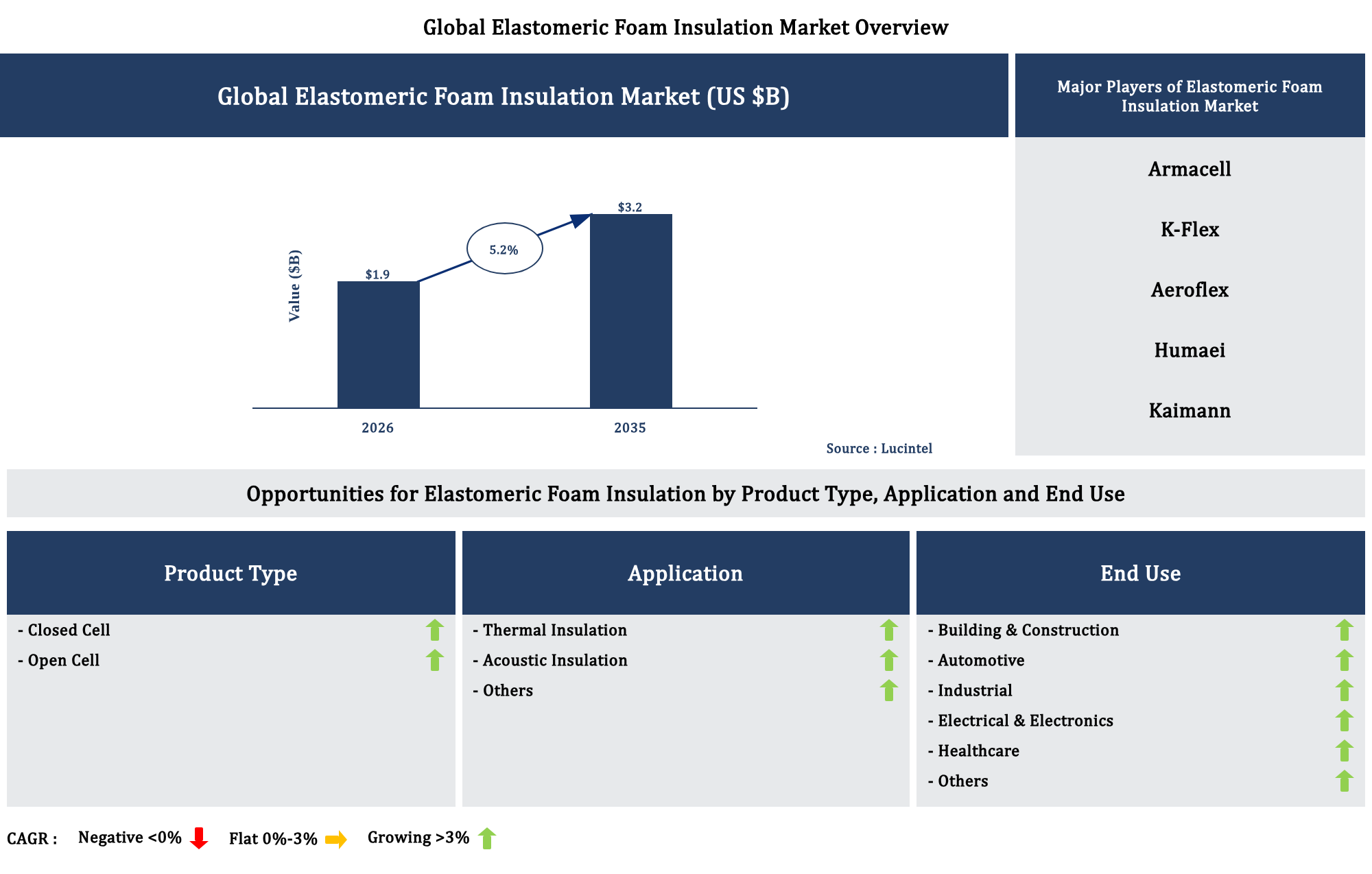
The future of the global elastomeric foam insulation market looks promising with opportunities in the building & construction, automotive, industrial, electrical & electronic, and healthcare markets. The global elastomeric foam insulation market is expected to reach an estimated $3,245 million by 2035 with a CAGR of 5.2% from 2026 to 2035. The major drivers for this market are the increasing demand for energy efficient buildings, the rising demand from refrigeration & cold storage sectors, and the growing demand for urbanization & infrastructure development.
• Lucintel forecasts that, within the product type category, closed cell is expected to witness higher growth over the forecast period.
• Within the end use category, building & construction is expected to witness the highest growth.
• In terms of region, APAC is expected to witness the highest growth over the forecast period.
Gain valuable insights for your business decisions with our comprehensive 150+ page report. Sample figures with some insights are shown below.
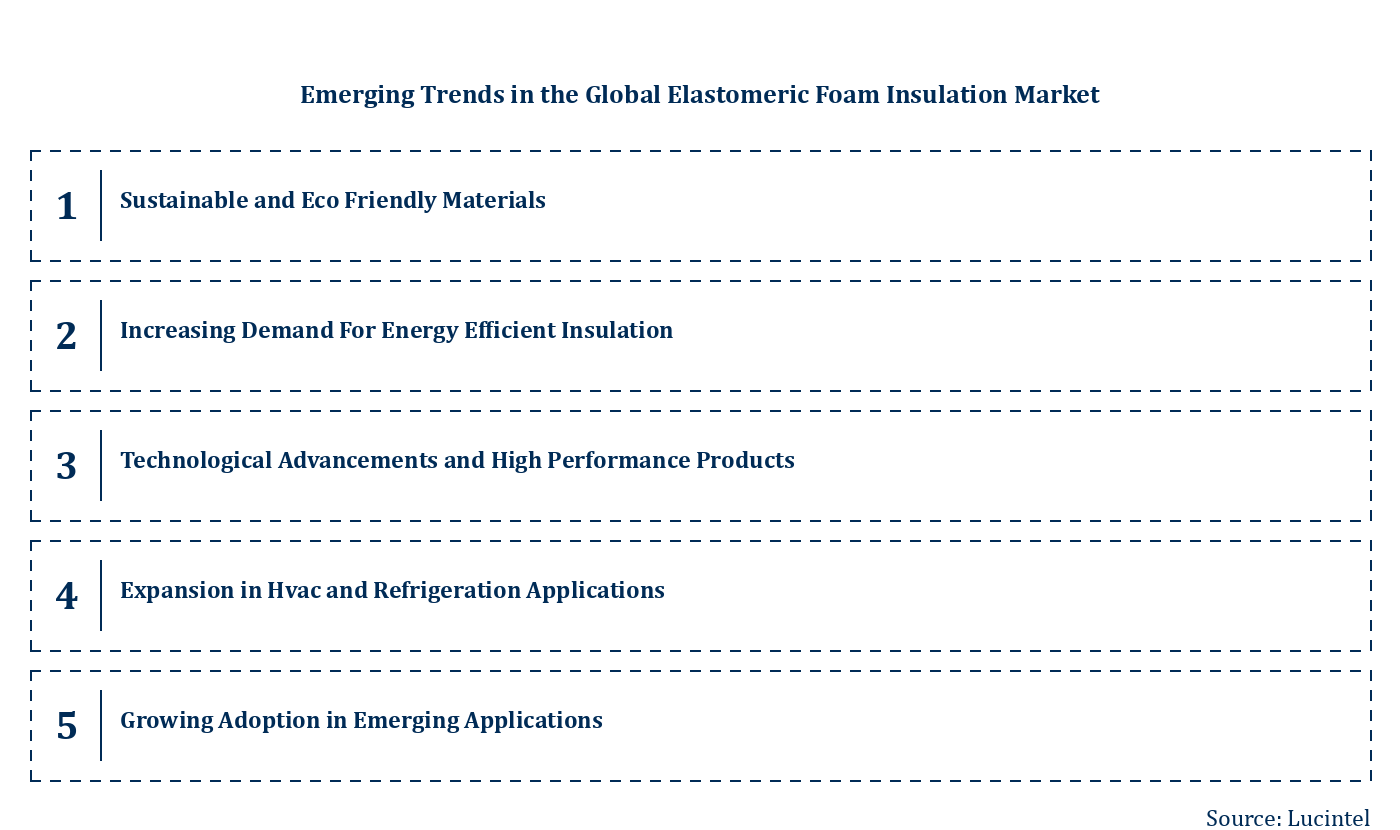
Emerging Trends in the Elastomeric Foam Insulation Market
The elastomeric foam insulation market is evolving rapidly, driven by increasing emphasis on energy efficiency, sustainability, and advanced material performance. Growing demand from construction, HVAC, automotive, and industrial sectors is encouraging manufacturers to innovate and improve product functionality. Regulatory pressure to reduce carbon emissions and enhance building efficiency is accelerating adoption of high performance insulation materials. Additionally, emerging applications in electric vehicles, data centers, and cold chain logistics are expanding the scope of elastomeric foam insulation. These trends reflect a shift toward environmentally responsible, technologically advanced, and application specific insulation solutions across global markets.
• Sustainable and Eco Friendly Materials: Increasing focus on sustainability is driving the adoption of eco friendly elastomeric foam insulation. Manufacturers are developing products using recycled rubber and low emission materials to meet green building standards and environmental regulations. The use of recycled EPDM and reduced VOC formulations is gaining traction, supporting carbon footprint reduction goals. This trend is particularly strong in North America and Europe, where regulatory compliance is critical. As industries shift toward circular economy practices, sustainable insulation solutions are becoming a key differentiator, influencing purchasing decisions and long term market growth.
• Increasing Demand for Energy Efficient Insulation: Rising global demand for energy efficient buildings and systems is a major trend shaping the market. Elastomeric foam insulation is widely adopted due to its low thermal conductivity and superior moisture resistance, making it ideal for HVAC and refrigeration applications. Governments are enforcing stricter energy efficiency regulations, encouraging the use of high performance insulation materials. This trend is further supported by growing awareness of energy conservation and cost savings. As a result, elastomeric foam is increasingly replacing traditional insulation materials across residential, commercial, and industrial sectors.
• Technological Advancements and High Performance Products: Continuous innovation is leading to the development of advanced elastomeric foam products with enhanced properties. Manufacturers are introducing hybrid formulations combining materials like NBR and EPDM to improve flexibility, durability, and weather resistance. Additionally, new products offer improved fire resistance, anti condensation features, and acoustic insulation capabilities. These advancements are expanding the application scope of elastomeric foam in complex environments such as industrial systems and commercial buildings. The focus on performance enhancement is helping companies meet evolving customer requirements and regulatory standards.
• Expansion in HVAC and Refrigeration Applications: The growing demand for efficient HVAC systems and cold chain infrastructure is significantly influencing the market. Elastomeric foam insulation is extensively used in ducting, piping, and refrigeration systems due to its ability to prevent energy loss and moisture accumulation. Increasing urbanization and industrialization are driving the installation of HVAC systems in residential and commercial buildings. Additionally, the expansion of cold storage and logistics networks is boosting demand for reliable insulation materials. This trend is particularly strong in emerging economies, where infrastructure development is accelerating.
• Growing Adoption in Emerging Applications: Elastomeric foam insulation is gaining traction in new and emerging applications such as electric vehicles, data centers, and smart infrastructure. In electric vehicles, it is used for thermal management to improve battery efficiency and safety. Data centers are adopting advanced insulation solutions to enhance cooling efficiency and reduce operational costs. Furthermore, the integration of elastomeric foam in industrial and electronic applications is increasing due to its flexibility and durability. These emerging use cases are creating new growth opportunities and diversifying the market beyond traditional construction applications.
These emerging trends are collectively transforming the elastomeric foam insulation market by driving innovation, sustainability, and application diversification. The increasing emphasis on energy efficiency and environmental compliance is pushing manufacturers to develop advanced and eco friendly solutions. At the same time, technological advancements and expansion into new applications are broadening the market scope. As developed regions focus on high performance and regulatory compliance, emerging economies contribute through infrastructure growth and rising demand. Together, these trends are reshaping the competitive landscape and ensuring steady long term market expansion.
Recent Developments in the Elastomeric Foam Insulation Market
The elastomeric foam insulation market is undergoing notable transformation due to technological advancements, regulatory shifts, and expanding application areas. Increasing demand for energy efficiency and sustainable construction is encouraging manufacturers to innovate and diversify product offerings. Key developments include improved material performance, expansion into new industries, and alignment with environmental standards. These changes are influencing production strategies, competitive positioning, and market growth across regions. As industries adopt advanced insulation solutions, the market continues to evolve with a focus on efficiency, durability, and long term sustainability.
• Development of Eco Friendly and low Emission Products: Manufacturers are increasingly focusing on producing elastomeric foam insulation with low VOC emissions and environmentally friendly materials. This development aligns with global sustainability goals and green building certifications, encouraging wider adoption in construction and industrial sectors. Companies are investing in recycled raw materials and cleaner production technologies to reduce environmental impact. This shift is improving brand value and regulatory compliance while attracting environmentally conscious consumers. As sustainability becomes a priority, eco friendly insulation solutions are gaining significant traction across developed and emerging markets.
• Advancements in Fire Resistant and High Performance Materials: Continuous innovation has led to the development of elastomeric foam insulation with enhanced fire resistance and thermal performance. These advanced materials meet stringent safety standards and are increasingly used in commercial buildings, industrial facilities, and transportation sectors. Improved formulations provide better durability, flexibility, and resistance to extreme conditions. This development is expanding application areas and improving product reliability. As safety regulations become stricter, the demand for high performance insulation materials is rising, encouraging further research and development investments in the market.
• Expansion of Production Capacities in Emerging Economies: Companies are expanding manufacturing facilities in emerging economies to meet growing regional demand and reduce production costs. This development is particularly evident in Asia Pacific, where rapid urbanization and industrial growth are driving insulation needs. Local production helps manufacturers improve supply chain efficiency and respond quickly to market changes. It also supports regional economic growth and job creation. Increased capacity is enabling companies to cater to large infrastructure projects and industrial applications, strengthening their presence in high growth markets.
• Integration in Electric Vehicles and Advanced Applications: Elastomeric foam insulation is increasingly being used in electric vehicles and other advanced applications such as data centers and electronics. This development is driven by the need for efficient thermal management and energy conservation. In electric vehicles, insulation helps maintain battery temperature and improve performance. Similarly, in data centers, it enhances cooling efficiency and reduces operational costs. This expansion into new sectors is diversifying market demand and creating additional revenue streams for manufacturers. It also highlights the material versatility and adaptability.
• Adoption of Smart and Energy Efficient Building Solutions: The growing adoption of smart buildings and energy efficient infrastructure is driving the use of advanced insulation materials. Elastomeric foam insulation is being integrated into modern building systems to enhance energy performance and reduce operational costs. This development is supported by government regulations and incentives promoting energy conservation. Builders and developers are increasingly choosing high quality insulation to meet performance standards and sustainability goals. As smart construction practices expand globally, the demand for efficient insulation solutions continues to increase significantly.
These developments are significantly shaping the elastomeric foam insulation market by driving innovation, sustainability, and application diversification. The focus on eco friendly materials and high performance products is improving market competitiveness and regulatory compliance. Expansion in emerging economies and new applications is creating strong growth opportunities. Additionally, the integration of insulation in advanced technologies and smart infrastructure is broadening its market scope. Collectively, these developments are enhancing product value, strengthening industry dynamics, and supporting long term market growth across global regions.
Strategic Growth Opportunities in the Elastomeric Foam Insulation Market
The elastomeric foam insulation market is expanding steadily due to rising demand for energy efficient solutions across multiple industries. Growth opportunities are emerging from increasing infrastructure development, technological advancements, and the need for improved thermal management systems. Key applications such as construction, HVAC, automotive, and industrial sectors are driving adoption. Market players are focusing on innovation and application specific solutions to strengthen their position. These evolving dynamics are creating significant opportunities for growth, diversification, and long term value creation across global and regional markets.
• Increasing Demand for Energy Efficient Building Applications: The construction sector presents strong growth opportunities due to rising demand for energy efficient buildings. Elastomeric foam insulation is widely used in residential and commercial structures to improve thermal performance and reduce energy consumption. Governments are enforcing stricter building codes and promoting green construction practices, which is increasing product adoption. Additionally, retrofitting of existing buildings is contributing to demand. This opportunity is further supported by urbanization and infrastructure expansion, making construction one of the most significant application areas for elastomeric foam insulation globally.
• Expanding use In HVAC Systems for Thermal Efficiency: HVAC systems represent a major application area with strong growth potential. Elastomeric foam insulation is used extensively in ducting and piping systems to minimize energy loss and prevent condensation. Increasing installation of HVAC systems in commercial and residential buildings is driving demand. The need for efficient climate control and cost savings is encouraging adoption. Technological improvements in insulation materials are further enhancing performance. As demand for indoor comfort and energy efficiency rises, HVAC applications are expected to remain a key driver of market growth.
• Growing Adoption in Automotive and Electric Vehicle Applications: The automotive sector is emerging as a promising growth area, especially with the rise of electric vehicles. Elastomeric foam insulation is used for thermal and acoustic management in vehicles, improving comfort and efficiency. In electric vehicles, it helps maintain optimal battery temperature, enhancing performance and safety. Increasing production of electric vehicles and advancements in automotive technology are supporting this trend. As the industry shifts toward sustainable mobility, the demand for advanced insulation materials is expected to grow significantly in this application segment.
• Rising Demand in Industrial and Manufacturing Processes: Industrial applications are creating significant growth opportunities due to the need for efficient thermal insulation in manufacturing processes. Elastomeric foam insulation is used in pipelines, equipment, and machinery to maintain temperature stability and reduce energy loss. Rapid industrialization in emerging economies is increasing demand for such solutions. Additionally, industries are focusing on improving operational efficiency and reducing costs, which supports insulation adoption. This opportunity is strengthened by the expansion of sectors such as chemicals, oil and gas, and food processing.
• Increasing Application in Cold Chain and Refrigeration Systems: The expansion of cold chain logistics and refrigeration systems is driving demand for elastomeric foam insulation. It is widely used in cold storage facilities, refrigerated transport, and food preservation systems due to its moisture resistance and thermal efficiency. Growing demand for perishable goods, pharmaceuticals, and temperature sensitive products is supporting this trend. Investments in cold storage infrastructure, particularly in developing regions, are further boosting adoption. This application area offers strong growth potential as global supply chains continue to evolve.
These growth opportunities are reshaping the elastomeric foam insulation market by expanding its application scope and increasing demand across industries. The strong presence in construction and HVAC sectors, combined with emerging applications in automotive and cold chain systems, is driving market expansion. Industrial growth and technological advancements are further enhancing product adoption. As industries focus on energy efficiency and sustainability, these opportunities are expected to support long term growth, innovation, and competitive development in the global elastomeric foam insulation market.
Elastomeric Foam Insulation Market Driver and Challenges
The elastomeric foam insulation market is influenced by a combination of technological, economic, and regulatory factors that shape its growth trajectory. Increasing demand for energy efficiency, infrastructure expansion, and innovation in material science are driving market expansion. At the same time, regulatory pressures and cost related concerns are creating challenges for manufacturers and end users. The balance between performance, sustainability, and affordability remains critical for market success. Understanding these drivers and challenges is essential for stakeholders to make informed decisions and adapt to evolving industry dynamics across global markets.
The factors responsible for driving the elastomeric foam insulation market include:-
• Increasing Demand for Energy Efficient Construction: Rising emphasis on energy conservation is a major driver for the elastomeric foam insulation market. Governments and regulatory bodies are implementing strict building codes to reduce energy consumption in residential and commercial structures. Elastomeric foam insulation plays a key role in improving thermal efficiency and minimizing energy loss in HVAC systems and building envelopes. This demand is further supported by growing awareness among consumers regarding long term cost savings and environmental benefits. As urbanization continues and infrastructure projects expand globally, the need for high performance insulation materials is expected to increase significantly, driving sustained market growth.
• Rapid Growth in HVAC and Refrigeration Systems: The increasing installation of HVAC systems across residential, commercial, and industrial sectors is significantly driving market demand. Elastomeric foam insulation is widely used in ducts, pipes, and refrigeration units due to its excellent thermal and moisture resistance properties. The rising need for climate control, especially in regions with extreme temperatures, is accelerating HVAC adoption. Additionally, the expansion of cold chain logistics and food preservation systems is boosting demand for efficient insulation solutions. This trend is creating continuous growth opportunities for manufacturers, as industries prioritize energy efficiency and system performance improvements.
• Technological Advancements in Insulation Materials: Continuous innovation in material science is enhancing the performance and application range of elastomeric foam insulation. Manufacturers are developing products with improved fire resistance, durability, flexibility, and environmental compatibility. Advanced formulations such as low VOC and halogen free materials are gaining popularity due to regulatory compliance requirements. These innovations are expanding the use of elastomeric foam in complex industrial environments and high performance applications. As research and development investments increase, technological advancements are expected to further improve product efficiency and create competitive advantages for market players.
• Expansion of Industrial and Infrastructure Development: Rapid industrialization and infrastructure development, particularly in emerging economies, are key drivers of the market. Growing construction of commercial buildings, manufacturing facilities, and transportation infrastructure is increasing the demand for reliable insulation solutions. Elastomeric foam insulation is widely used in industrial pipelines, equipment, and machinery to maintain temperature stability and reduce energy loss. Government investments in infrastructure projects and smart city initiatives are further supporting market growth. This expansion is creating significant opportunities for manufacturers to scale production and strengthen their presence in high growth regions.
The challenges in the elastomeric foam insulation market are:
• High Raw Material Costs and Price Volatility: One of the major challenges faced by the market is the fluctuation in raw material prices, particularly for rubber and petrochemical based inputs. These price variations can significantly impact production costs and profit margins for manufacturers. Dependence on crude oil derivatives makes the market vulnerable to global supply chain disruptions and economic uncertainties. As a result, companies often struggle to maintain competitive pricing while ensuring product quality. This challenge is particularly critical for small and medium sized manufacturers, who may lack the resources to absorb cost fluctuations effectively.
• Stringent Environmental and Regulatory Compliance: Increasing environmental concerns and regulatory requirements pose challenges for manufacturers in the elastomeric foam insulation market. Governments are enforcing strict guidelines related to emissions, waste management, and product safety. Compliance with these regulations often requires significant investment in research, development, and process modifications. While these measures promote sustainability, they can increase operational costs and limit flexibility in production. Companies must continuously adapt to evolving standards, which can be time consuming and resource intensive, especially for firms operating in multiple regions with varying regulatory frameworks.
• Competition from Alternative Insulation Materials: The presence of alternative insulation materials such as fiberglass, mineral wool, and polyurethane foam presents a significant challenge to market growth. These materials may offer cost advantages or specific performance benefits, making them attractive to certain end users. Intense competition forces elastomeric foam manufacturers to continuously innovate and differentiate their products. Additionally, price sensitive markets may prefer lower cost alternatives, limiting adoption. To overcome this challenge, companies must focus on highlighting the unique advantages of elastomeric foam, such as flexibility, moisture resistance, and durability.
The elastomeric foam insulation market is shaped by a dynamic interplay of drivers and challenges that influence its overall growth and competitiveness. Strong demand from construction, HVAC, and industrial sectors, along with technological advancements, is supporting market expansion. However, challenges such as raw material cost volatility, regulatory pressures, and competition from alternative materials require strategic management. Companies that invest in innovation, sustainability, and cost efficiency are better positioned to succeed. Overall, the market is expected to grow steadily as it adapts to evolving industry requirements and global economic conditions.
List of Elastomeric Foam Insulation Companies
Companies in the market compete on the basis of product quality offered. Major players in this market focus on expanding their manufacturing facilities, R&D investments, infrastructural development, and leverage integration opportunities across the value chain. With these strategies elastomeric foam insulation companies cater increasing demand, ensure competitive effectiveness, develop innovative products & technologies, reduce production costs, and expand their customer base. Some of the elastomeric foam insulation companies profiled in this report include-
• Armacell
• K-Flex
• Aeroflex
• Humaei
• Kaimann
• Zotefoams
• Hira Industries
Elastomeric Foam Insulation Market by Segment
The study includes a forecast for the global elastomeric foam insulation market by product type, application, end use, and region.
Elastomeric Foam Insulation Market by Product Type [Value from 2019 to 2035]:
• Closed Cell
• Open Cell
Elastomeric Foam Insulation Market by Application [Value from 2019 to 2035]:
• Thermal Insulation
• Acoustic Insulation
• Others
Elastomeric Foam Insulation Market by End Use [Value from 2019 to 2035]:
• Building & Construction
• Automotive
• Industrial
• Electrical & Electronics
• Healthcare
• Others
Elastomeric Foam Insulation Market by Region [Value from 2019 to 2035]:
• North America
• Europe
• Asia Pacific
• The Rest of the World
Country Wise Outlook for the Elastomeric Foam Insulation Market
The elastomeric foam insulation market is witnessing steady global expansion driven by increasing demand for energy efficient construction, HVAC system optimization, and sustainable building materials. Recent developments across major economies reflect advancements in low VOC formulations, fire resistant materials, and high performance insulation solutions. Countries are focusing on regulatory compliance, green building standards, and industrial efficiency improvements. Asia Pacific leads demand due to rapid urbanization, while North America and Europe emphasize retrofitting and sustainability. Technological innovation, infrastructure growth, and rising industrial applications are collectively shaping the evolution of this market across the United States, China, Germany, India, and Japan.
• United States: The United States market is experiencing strong growth driven by increasing HVAC retrofitting and stringent building energy codes. A significant share of demand comes from building and construction applications, particularly for duct insulation and chilled water systems. Recent developments include the introduction of low VOC and fire resistant elastomeric foam products to meet indoor air quality and safety standards. The country is also seeing increased adoption in electric vehicle thermal management and data center cooling systems. Manufacturers are focusing on sustainable materials and improved thermal efficiency, supported by regulatory mandates and rising demand for energy efficient infrastructure.
• China: China is witnessing rapid expansion in elastomeric foam insulation due to large scale infrastructure development and industrial growth. The country dominates regional demand, supported by rising construction activities and HVAC installations. Recent developments include increased production capacity, adoption of advanced insulation technologies, and expansion into cold chain logistics and refrigeration sectors. Government initiatives promoting energy efficiency and green buildings are accelerating market penetration. Additionally, growth in manufacturing and urbanization is driving higher consumption of insulation materials, positioning China as a key global contributor in both production and demand.
• Germany: Germany is focusing on high performance and environmentally compliant insulation solutions, driven by strict energy efficiency regulations and sustainability goals. Recent developments include the adoption of halogen free and low emission elastomeric foam materials in construction and industrial applications. The automotive sector is also contributing significantly, particularly in thermal management for electric vehicles. Industrial retrofitting and energy conservation initiatives are boosting demand. Germany continues to lead innovation in Europe, with manufacturers emphasizing advanced material engineering and compliance with stringent environmental standards.
• India: India is emerging as a high growth market due to rapid urbanization, infrastructure expansion, and increasing awareness of energy efficiency. Recent developments include rising demand from residential and commercial construction, along with expanding HVAC and refrigeration sectors. Government initiatives promoting smart cities and green buildings are supporting the adoption of elastomeric foam insulation. Additionally, growth in industrial and cold storage infrastructure is driving usage. Manufacturers are expanding local production and distribution networks to cater to increasing demand, making India a key growth hub in the Asia Pacific region.
• Japan: Japan is focusing on advanced and compact insulation technologies to support its energy efficient and space optimized infrastructure. Recent developments include increased use of elastomeric foam in electronics, automotive, and high precision industrial applications. The country is emphasizing high quality, durable, and environmentally friendly insulation materials. Growth in data centers and technological industries is also contributing to demand. Japan’s mature market is characterized by innovation, strict regulatory compliance, and a shift toward sustainable and high performance insulation systems in both construction and industrial sectors.
Features of the Global Elastomeric Foam Insulation Market
Market Size Estimates: Elastomeric foam insulation market size estimation in terms of value ($M).
Trend and Forecast Analysis: Market trends (2019 to 2025) and forecast (2026 to 2035) by various segments and regions.
Segmentation Analysis: Elastomeric foam insulation market size by product type, application, end use, and region in terms of value ($M).
Regional Analysis: Elastomeric foam insulation market breakdown by North America, Europe, Asia Pacific, and Rest of the World.
Growth Opportunities: Analysis of growth opportunities in different product type, application, end use, and regions for the elastomeric foam insulation market.
Strategic Analysis: This includes M&A, new product development, and competitive landscape of the elastomeric foam insulation market.
Analysis of competitive intensity of the industry based on Porter’s Five Forces model.
FAQ
Q1. What is the elastomeric foam insulation market size?
Answer: The global elastomeric foam insulation market is expected to reach an estimated $3,245 million by 2035.
Q2. What is the growth forecast for elastomeric foam insulation market?
Answer: The global elastomeric foam insulation market is expected to grow with a CAGR of 5.2% from 2026 to 2035.
Q3. What are the major drivers influencing the growth of the elastomeric foam insulation market?
Answer: The major drivers for this market are the increasing demand for energy efficient buildings, the rising demand from refrigeration & cold storage sectors, and the growing demand for urbanization & infrastructure development.
Q4. What are the major segments for elastomeric foam insulation market?
Answer: The future of the elastomeric foam insulation market looks promising with opportunities in the building & construction, automotive, industrial, electrical & electronic, and healthcare markets.
Q5. Who are the key elastomeric foam insulation market companies?
Answer: Some of the key elastomeric foam insulation companies are as follows:
• Armacell
• K-Flex
• Aeroflex
• Humaei
• Kaimann
• Zotefoams
• Hira Industries
Q6. Which elastomeric foam insulation market segment will be the largest in future?
Answer: Lucintel forecasts that, within the product type category, closed cell is expected to witness higher growth over the forecast period.
Q7. In elastomeric foam insulation market, which region is expected to be the largest in next 8 years?
Answer: In terms of region, APAC is expected to witness the highest growth over the forecast period.
Q8. Do we receive customization in this report?
Answer: Yes, Lucintel provides 10% customization without any additional cost.
This report answers following 11 key questions:
Q.1. What are some of the most promising, high-growth opportunities for the elastomeric foam insulation market by product type (closed cell and open cell), application (thermal insulation, acoustic insulation, and others), end use (building & construction, automotive, industrial, electrical & electronics, healthcare, and others), and region (North America, Europe, Asia Pacific, and the Rest of the World)?
Q.2. Which segments will grow at a faster pace and why?
Q.3. Which region will grow at a faster pace and why?
Q.4. What are the key factors affecting market dynamics? What are the key challenges and business risks in this market?
Q.5. What are the business risks and competitive threats in this market?
Q.6. What are the emerging trends in this market and the reasons behind them?
Q.7. What are some of the changing demands of customers in the market?
Q.8. What are the new developments in the market? Which companies are leading these developments?
Q.9. Who are the major players in this market? What strategic initiatives are key players pursuing for business growth?
Q.10. What are some of the competing products in this market and how big of a threat do they pose for loss of market share by material or product substitution?
Q.11. What M&A activity has occurred in the last 5 years and what has its impact been on the industry?
For any questions related to Elastomeric Foam Insulation Market, Elastomeric Foam Insulation Market Size, Elastomeric Foam Insulation Market Growth, Elastomeric Foam Insulation Market Analysis, Elastomeric Foam Insulation Market Report, Elastomeric Foam Insulation Market Share, Elastomeric Foam Insulation Market Trends, Elastomeric Foam Insulation Market Forecast, Elastomeric Foam Insulation Companies, write Lucintel analyst at email: helpdesk@lucintel.com. We will be glad to get back to you soon.