
Market Report · July 29, 2026

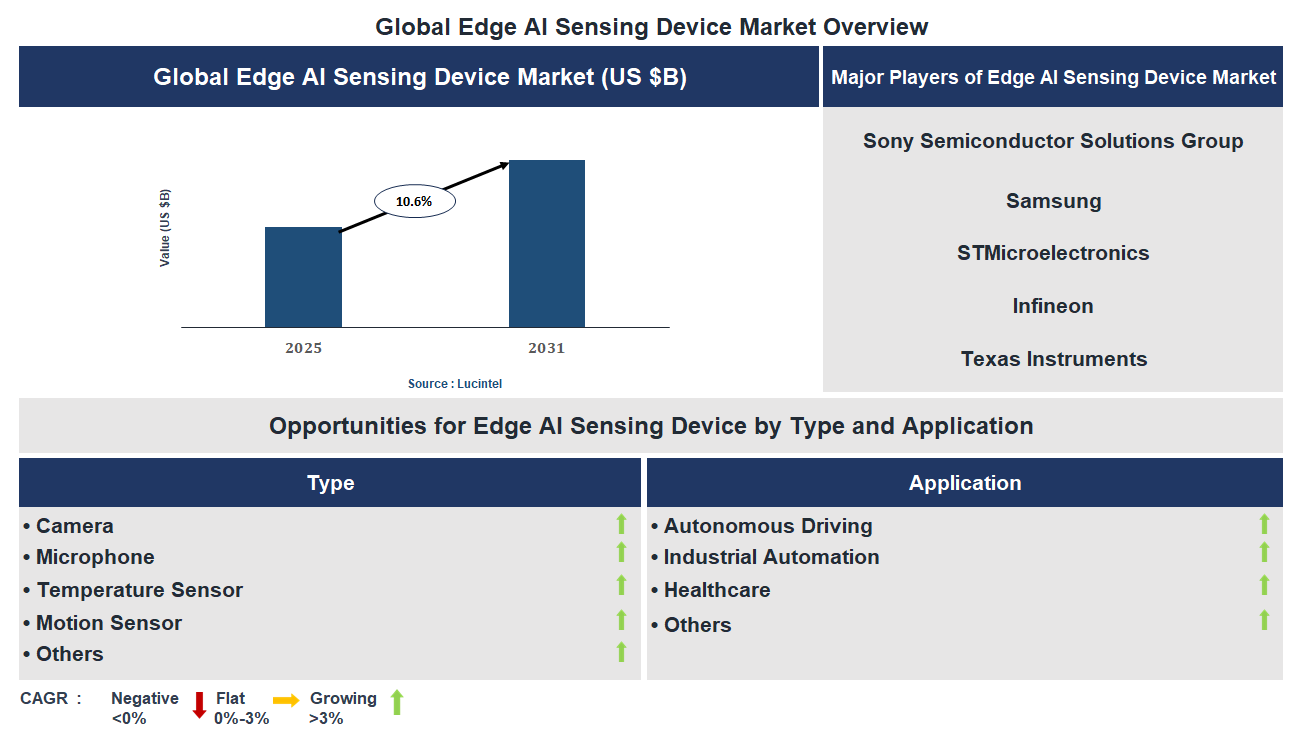
Key data points: The growth forecast = 10.6% annually for the next 6 years. Scroll below to get more insights. This market report covers trends, opportunities and forecasts in edge AI sensing device market to 2031 by type (camera, microphone, temperature sensor, motion sensor, and others), application (autonomous driving, industrial automation, healthcare, and others), and region (North America, Europe, Asia Pacific, and the Rest of the World)
We'll send your sample report shortly.
• Lucintel forecasts that, within the type category, motion sensor is expected to witness the highest growth over the forecast period.
• Within the application category, autonomous driving is expected to witness the highest growth.
• In terms of region, APAC is expected to witness the highest growth over the forecast period. Gain valuable insights for your business decisions with our comprehensive 150+ page report. Sample figures with some insights are shown below.
• Increased Adoption of AI-Enabled Sensors: The integration of AI capabilities into sensing devices allows for real-time data analysis and decision-making at the edge. This reduces latency, enhances responsiveness, and minimizes reliance on cloud infrastructure, making applications more efficient and reliable. Industries such as manufacturing and healthcare benefit from predictive maintenance and remote diagnostics, respectively. The trend is driven by advancements in miniaturization, improved AI algorithms, and decreasing costs of sensors, making AI-enabled sensing devices more accessible and widespread.
• Growth of IoT and Edge Computing Infrastructure: The expansion of IoT networks and edge computing infrastructure is fueling demand for sensing devices that can process data locally. This trend supports the deployment of smart devices in urban environments, industrial settings, and consumer electronics. The ability to analyze data at the source reduces bandwidth requirements and enhances data security. As IoT ecosystems become more sophisticated, edge AI sensing devices are increasingly integrated into complex networks, enabling smarter, more autonomous systems that improve operational efficiency and user experience.
• Focus on Data Privacy and Security: With the proliferation of edge sensing devices collecting sensitive data, there is a heightened emphasis on privacy and security measures. Edge AI devices are designed to process data locally, reducing exposure to cyber threats and ensuring compliance with data protection regulations. Enhanced encryption, secure boot processes, and tamper-proof hardware are becoming standard features. This focus not only builds consumer trust but also opens new markets for secure edge AI solutions, especially in healthcare, finance, and government sectors.
• Advancements in Sensor Technologies: Innovations in sensor materials and designs are leading to more accurate, durable, and energy-efficient sensing devices. Developments such as flexible sensors, multispectral sensors, and low-power consumption components expand the application scope of edge AI sensing devices. These technological improvements enable deployment in challenging environments, including harsh industrial settings and wearable health devices. As sensor technology advances, the market benefits from increased device longevity, better data quality, and broader application possibilities.
• Integration of 5G and High-Speed Connectivity: The rollout of 5G networks is significantly impacting the edge AI sensing device market by providing faster, more reliable connectivity. This enables real-time data transmission and seamless integration of sensing devices into broader networks. The high bandwidth and low latency of 5G facilitate more complex and data-intensive applications, such as autonomous vehicles and smart city infrastructure. This trend accelerates the deployment of edge AI devices across various sectors, fostering innovation and enabling new use cases that require rapid data exchange and processing. In summary, these trends are collectively transforming the edge AI sensing device market by enhancing device capabilities, expanding application areas, and improving data security. The market is moving toward more intelligent, secure, and connected sensing solutions that support the growing demands of digital transformation across industries. This evolution promises increased efficiency, better decision-making, and new opportunities for innovation in the coming years.

• Advancements in Sensor Technology: Enhanced sensor accuracy and miniaturization are enabling more precise data collection at the edge, reducing reliance on cloud processing. This improves response times and reduces bandwidth costs, making edge AI sensing devices more viable for critical applications like autonomous vehicles and industrial automation. The increased sensor capabilities are also supporting new use cases, fostering innovation and expanding market reach.
• Integration of 5G Connectivity: The deployment of 5G networks is revolutionizing edge AI sensing by providing faster, more reliable wireless communication. This integration allows real-time data transfer and remote device management, essential for applications such as smart cities and remote healthcare monitoring. The improved connectivity enhances device performance, scalability, and security, driving adoption across diverse sectors and accelerating market growth.
• Development of Energy-Efficient Devices: Focusing on low-power consumption is leading to the creation of energy-efficient edge AI sensors, extending device lifespan and reducing operational costs. These devices are crucial for remote or hard-to-access locations where power supply is limited. Energy efficiency also supports sustainable practices, appealing to environmentally conscious markets and enabling longer deployment periods, thus broadening the scope of edge AI applications.
• Expansion of AI Algorithms and Software: Advances in AI algorithms tailored for edge devices are improving data processing capabilities and decision-making accuracy. Lightweight models enable faster inference on limited hardware, facilitating real-time analytics in various sectors. Enhanced software tools also simplify deployment and management, reducing technical barriers. These developments are making edge AI sensing devices more intelligent, versatile, and accessible, fueling market expansion and innovation.
• Growing Adoption in Healthcare and Automotive Sectors: Increasing use of edge AI sensors in healthcare for patient monitoring and diagnostics, and in automotive for driver assistance systems, is driving market growth. These sectors demand high reliability, low latency, and real-time data processing, which edge devices provide. The integration of AI sensing devices enhances safety, efficiency, and patient outcomes, creating significant opportunities for manufacturers and fostering industry-wide technological progress. The overall impact of these developments is a dynamic, expanding market characterized by innovative solutions, increased adoption across critical sectors, and enhanced capabilities of edge AI sensing devices. This growth is fostering new business models, improving operational efficiencies, and enabling smarter, more connected environments worldwide.
• Expansion into Healthcare Monitoring Devices: The integration of Edge AI sensing devices in healthcare enables real-time patient monitoring, early diagnosis, and personalized treatment. These devices reduce reliance on centralized data centers, ensuring faster response times and enhanced privacy. Growing adoption of wearable health tech and remote patient management systems presents significant growth opportunities, especially in aging populations and the telemedicine sectors.
• Growth in Industrial Automation and Smart Manufacturing: Edge AI sensors are transforming industrial environments by providing real-time insights into machinery health, production processes, and safety conditions. This facilitates predictive maintenance, reduces downtime, and improves efficiency. The increasing adoption of Industry 4.0 practices and IoT-enabled factories drives demand for rugged, reliable sensing devices capable of operating in harsh environments.
• Expansion in Autonomous Vehicles and Transportation: Edge AI sensing devices are critical for autonomous vehicle navigation, obstacle detection, and traffic management. They enable low-latency decision-making essential for safety and efficiency. As the automotive industry shifts toward autonomous and connected vehicles, the deployment of advanced sensing solutions is expected to grow rapidly, supported by regulatory standards and consumer demand for safer transportation options.
• Adoption in Smart Cities and Infrastructure: Edge AI sensors are vital for smart city initiatives, including traffic management, surveillance, environmental monitoring, and public safety. These devices provide localized data processing, reducing bandwidth needs and latency. Governments and urban planners are investing heavily in sensor networks to improve urban living conditions, optimize resource use, and enhance security, creating substantial market opportunities.
• Integration with Consumer Electronics and IoT Devices: The proliferation of smart home devices, wearables, and personal gadgets relies heavily on Edge AI sensing technology for enhanced functionality and privacy. These sensors enable real-time data analysis directly on devices, reducing cloud dependency. The rising consumer demand for connected, intelligent devices offers significant growth potential, especially as AI capabilities become more affordable and accessible. The overall market growth is poised to accelerate as these opportunities converge, fostering innovation and expanding the application landscape. Companies that strategically invest in these areas will likely gain competitive advantages, driving technological progress and market dominance. This evolution will shape the future of Edge AI sensing devices, making them integral to diverse sectors worldwide.
• Technological Innovation: The continuous evolution of AI algorithms, sensor miniaturization, and improved processing power enable more sophisticated edge sensing devices. These advancements facilitate real-time data analysis, reduce latency, and improve decision-making accuracy, making edge devices more attractive across industries such as healthcare, manufacturing, and smart cities. As technology becomes more affordable and efficient, adoption rates increase, fueling market expansion.
• Growing IoT Ecosystem: The proliferation of Internet of Things (IoT) devices creates a vast network of interconnected sensors and systems. Edge AI sensing devices are critical for processing data locally, reducing bandwidth requirements, and enabling faster responses. The expanding IoT ecosystem drives demand for scalable, intelligent sensing solutions that can operate seamlessly across diverse applications, thereby boosting market growth.
• Increasing Focus on Data Privacy and Security: As data generation at the edge grows, concerns over data privacy and security intensify. Edge AI devices offer localized data processing, minimizing the need to transmit sensitive information to centralized servers. This enhances data security and compliance with privacy regulations such as GDPR. The emphasis on secure, privacy-preserving solutions encourages organizations to adopt edge sensing devices, supporting market expansion.
• Rising Adoption in Industrial Automation: Industries are increasingly deploying edge AI sensing devices for predictive maintenance, quality control, and process optimization. These devices enable real-time monitoring and autonomous decision-making, reducing downtime and operational costs. The push towards Industry 4.0 and smart manufacturing accelerates the adoption of edge sensing solutions, significantly contributing to market growth.
• Cost Reduction and Energy Efficiency: Advances in low-power sensors and energy-efficient processing enable longer device lifespans and reduced operational costs. Cost-effective edge AI sensing devices make deployment feasible across small and medium enterprises, expanding market reach. Energy efficiency also aligns with sustainability goals, further incentivizing adoption in various sectors. The challenges facing this edge AI sensing device market include:
• Data Privacy and Regulatory Compliance: Despite the benefits of localized data processing, navigating complex regulatory landscapes remains challenging. Different regions have varying data privacy laws, requiring companies to adapt their solutions accordingly. Ensuring compliance while maintaining device performance and security can be resource-intensive, potentially hindering rapid deployment and innovation within the market.
• Integration with Legacy Systems: Many industries still operate with legacy infrastructure that may not be compatible with advanced edge AI sensing devices. Integrating new technologies into existing systems often involves significant customization, costs, and technical expertise. This integration challenge can slow down adoption rates and limit market penetration, especially in highly regulated or traditional sectors.
• High Initial Investment and Cost Barriers: Although operational costs decrease over time, the initial investment in edge AI sensing devices, infrastructure, and training can be substantial. Small and medium-sized enterprises may find these costs prohibitive, restricting market growth to larger organizations with greater budgets. Overcoming these financial barriers is essential for broader adoption and market expansion. In summary, the edge AI sensing device market is driven by rapid technological innovations, expanding IoT ecosystems, and increasing emphasis on data security, which collectively foster growth across multiple sectors. However, challenges such as regulatory complexities, integration issues, and high initial costs pose significant hurdles. Addressing these challenges through technological advancements, regulatory clarity, and cost-effective solutions will be crucial for sustained market development. Overall, the markets future hinges on balancing innovation with practical implementation, ensuring scalable, secure, and affordable edge sensing solutions that meet diverse industry needs.
• Sony Semiconductor Solutions Group
• Samsung
• STMicroelectronics
• Infineon
• Texas Instruments
• Hikvision
• SenseTime
• NVIDIA
• Bosch Sensortec
• Intel
• Camera
• Microphone
• Temperature Sensor
• Motion Sensor
• Others
• Autonomous Driving
• Industrial Automation
• Healthcare
• Others
• North America
• Europe
• Asia Pacific
• The Rest of the World
• United States: The US leads in innovation with significant investments from tech giants and startups in edge AI sensing devices. Recent developments include the deployment of advanced sensors in autonomous vehicles, smart cities, and healthcare applications. Government initiatives promote AI research, fostering a robust ecosystem for the commercialization and integration of edge AI solutions. The US also emphasizes data privacy and security, influencing device design and deployment strategies.
•• China: China has rapidly advanced in edge AI sensing technology, focusing on smart manufacturing, surveillance, and consumer electronics. Major companies are developing cost-effective, high-performance sensors to support smart city projects and industrial automation. Government policies encourage domestic innovation and infrastructure development, resulting in a competitive edge in mass deployment and scale. Recent collaborations between tech firms and local governments have accelerated market growth.
•• Germany: Germany’s market is characterized by a strong emphasis on industrial automation and automotive applications. Recent developments include the integration of edge AI sensors in manufacturing plants to optimize production processes and predictive maintenance. The country’s focus on Industry 4.0 initiatives and smart factory standards has driven innovation. Additionally, collaborations between automotive giants and sensor manufacturers are enhancing the deployment of intelligent sensing devices.
•• India: India is witnessing the rapid adoption of edge AI sensing devices across agriculture, healthcare, and urban infrastructure. Recent advancements include affordable sensor solutions tailored for rural and semi-urban areas, supporting smart agriculture and healthcare monitoring. Government schemes promote digital transformation and IoT adoption, fostering local innovation. The market is also benefiting from increased investments in startups developing cost-effective edge AI solutions.
•• Japan: Japan continues to innovate in robotics, manufacturing, and transportation sectors with advanced edge AI sensing devices. Recent developments include the integration of sensors in autonomous robots and smart transportation systems to improve safety and efficiency. The country’s focus on aging population solutions and disaster management has spurred the development of specialized sensing technologies. Collaborations between industry and academia are driving cutting-edge research and deployment in various sectors.


• Sony Semiconductor Solutions Group
• Samsung
• STMicroelectronics
• Infineon
• Texas Instruments
• Hikvision
• SenseTime
• NVIDIA
• Bosch Sensortec
• Intel Q5. Which edge AI sensing device market segment will be the largest in future? Answer: Lucintel forecasts that, within the type category, motion sensor is expected to witness the highest growth over the forecast period. Q6. In edge AI sensing device market, which region is expected to be the largest in next 5 years? Answer: In terms of region, APAC is expected to witness the highest growth over the forecast period. Q7. Do we receive customization in this report? Answer: Yes, Lucintel provides 10% customization without any additional cost.


Choose a license that fits your team. Instant PDF delivery.
Prices exclude taxes. Instant delivery. Custom licensing available on request.
Market Report · July 29, 2026
Market Report · July 20, 2026
Market Report · July 20, 2026
Trusted partner for strategic intelligence and business growth


Receive a complimentary market analysis tailored to your industry. Our analysts will identify key growth opportunities and competitive dynamics specific to your business.

Market size, growth rate, and key trend analysis for your specific sector.

Top competitor positioning and market share analysis.

Strategic recommendations backed by data-driven insights.
Get curated market intelligence and competitive moves straight to your inbox.
By subscribing, you agree to receive our monthly insights. Unsubscribe anytime.
Receive a complimentary market analysis tailored to your industry. Our analysts will identify key growth opportunities and competitive dynamics specific to your business.
Market size, growth rate, and key trend analysis for your specific sector.
Top competitor positioning and market share analysis.
Strategic recommendations backed by data-driven insights.
Get curated market intelligence, emerging trends, and competitive moves straight to your inbox each month.
By subscribing, you agree to receive our monthly insights. Unsubscribe anytime.
We'll send your sample report shortly.