
Market Report · May 18, 2026

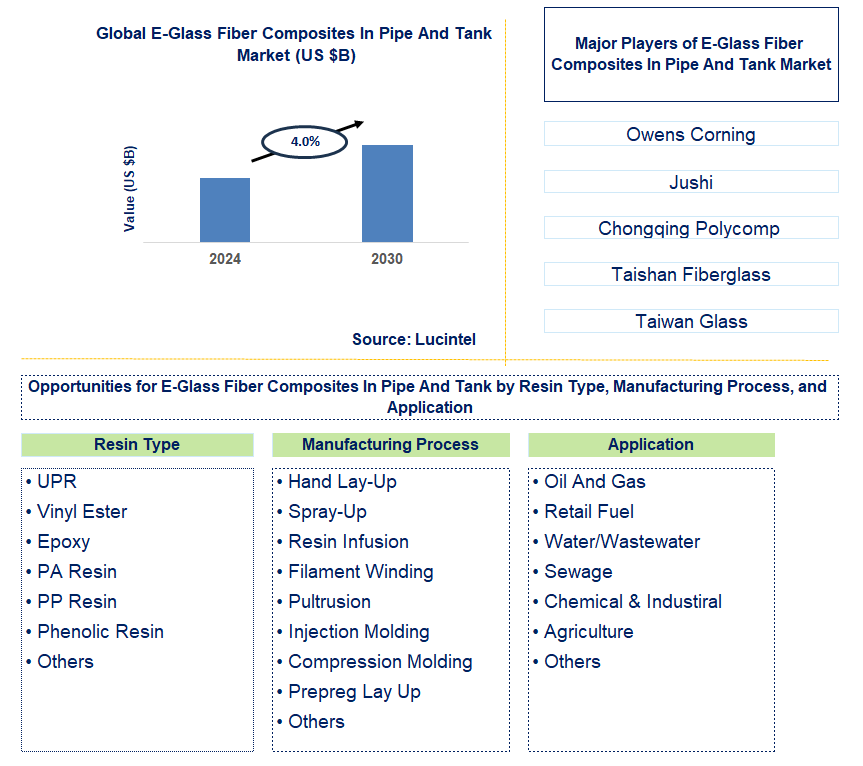
Key data points: The growth forecast = 4.0% annually for the next 6 years. Scroll below to get more insights. This market report covers trends, opportunities, and forecasts in the global e-glass fiber composites in pipe and tank market to 2030 by resin type (UPR, vinyl ester, epoxy, pa resin, PP resin, phenolic resin, and others), manufacturing process (hand lay-up, spray-up, resin infusion, filament winding, pultrusion, injection molding, compression molding, prepreg lay up, and others), application (oil and gas, retail fuel, water/wastewater, sewage, chemical & industiral, agriculture, and others), and region (North America, Europe, Asia Pacific, and the Rest of the World)
We'll send your sample report shortly.
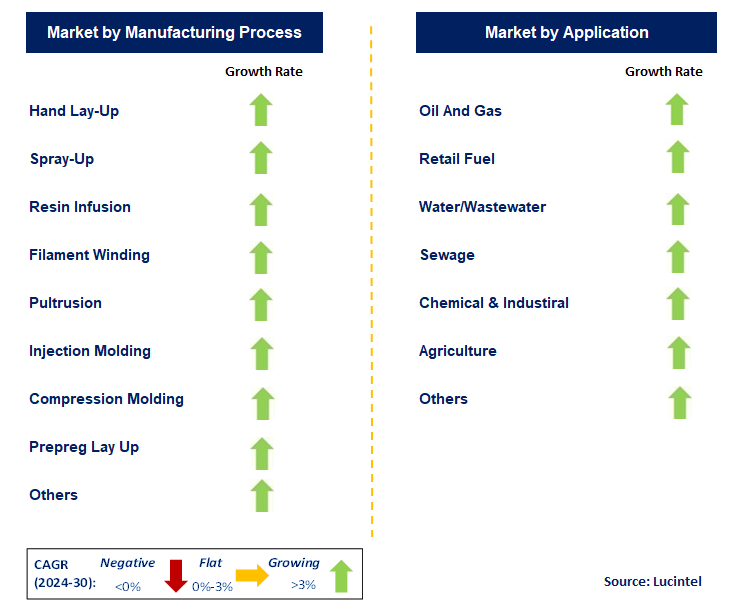
• Lucintel forecasts that, within the resin type category, vinyl ester is expected to witness the highest growth over the forecast period.
• Within the application category, oil and gas is expected to witness the highest growth.
• In terms of regions, APAC is expected to witness highest growth over the forecast period. A more than 150-page report is developed to help in your business decisions.
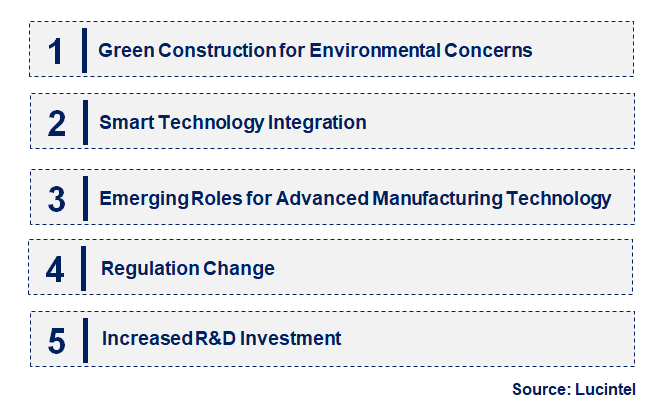
• Green Construction for Environmental Concerns: Increasing concerns about environmental factors are fueling the need for the incorporation of green construction materials. Manufacturers of E-Glass composites are focusing more on bio-based resins and disposal strategies to manufacture products in an environmentally friendly manner.
• Smart Technology Integration: It is now common practice to incorporate smart features such as sensors for health monitoring of structures. These features are becoming more common in tanks and pipes, increasing their safety and efficacy under critical circumstances.
• Emerging Roles for Advanced Manufacturing Technology: The use of more effective, automated, and advanced manufacturing techniques in the production of E-Glass composites is driving efficiency and consistency, enhancing quality assurance, and reducing costs.
• Regulation Change: The ongoing shift in policies and the focus on advanced material use in modern infrastructure construction is benefiting the increased use of E-Glass fiber composites for pipes and tanks.
• Increased R&D Investment: A significant part of development strategies for companies includes substantial investment in research and development to synthesize and formulate composite materials for specific purposes, improving performance and increasing market penetration. Such emerging trends are redefining the E-Glass fiber composites market for pipes and tanks, bringing forth innovations and environmentally friendly practices that cater to the development of various industries.
• Improved Durability Solutions: New E-Glass composites with formulations that enhance chemical and environmental resistance are being developed for application in extreme industrial environments.
• Production Automation: The implementation of automation in the fabrication of E-Glass composite pipes and tanks has improved quality, productivity, decreased lead times, and reduced costs.
• Recycling Initiatives: Attempts are being made to add recycled materials to E-Glass composites, presenting opportunities to improve their sustainability.
• Smart Composite Technologies: The use of smart composites with built-in sensors has been initiated, improving the management of operational performance and monitoring the conditions of pipes and tanks.
• Focus on Water Infrastructure: As investment in water treatment and supply increases, E-Glass composites are being used due to their lightweight and corrosion-resistant properties, aligning with the focus on modernization. These recent developments are changing the E-Glass fiber composites market for pipes and tanks by improving performance, sustainability, and the variety of applications.
• Municipal Water Systems: Growing investment in renewing old water infrastructure creates an opportunity for E-Glass composites in pipes, offering resistance to corrosive conditions and long-term reliability.
• Chemical Storage Applications: The need for safe storage of chemicals and the desire for secure chemical storage provide a market for E-Glass, as it can withstand most harsh chemicals.
• Agricultural Irrigation Systems: Irrigation systems using E-Glass fiber composites can be promoted due to their lightweight and strength, encouraging better water usage in farming.
• Oil and Gas Industry: E-Glass composites are increasingly used for pipelines and storage tanks because of the growing demand for lightweight and corrosion-resistant materials in oil and gas applications.
• Wastewater Treatment Facilities: With the rise of smart cities and international wastewater treatment plants, E-Glass composites will increasingly be used due to their long-lasting and chemical-resistant qualities. Companies in the E-Glass fiber composites market can increase competitiveness through these strategic growth opportunities and enhance infrastructure development focused on environmental friendliness.
• Rising Demand for Durable and Aesthetic Materials: Developments and demand for E-Glass composites in various industries, especially construction, are increasing due to the growing requirement for durable and corrosion-resistant materials.
• Technological Features: Advances in material science and organizational dynamics have made the manufacture and use of E-Glass fiber composites more effective and efficient, attracting investments and attention.
• Funding Support: Investments in water supply, sewerage treatment, and infrastructure development worldwide encourage the use of E-Glass composites in pipes and tanks.
• Product Remodeling: E-Glass composites made from non-virgin, eco-friendly, or recycled materials are actively marketed due to rising environmental consciousness.
• Regulatory Support for Advanced Materials: Evolving regulations promoting the use of advanced materials in infrastructure projects create a favorable environment for E-Glass composites, encouraging their adoption. Challenges in the E-Glass fiber composites in pipes and tanks market are:
• High Production Costs: The initial costs for advanced composite materials can be a hindrance. Some manufacturers target only 180- or 270-degree fabric.
• Cut-Throat Competition: There is competition between E-Glass fiber composites and other matrix materials, necessitating continuous improvement to avoid market loss.
• Understanding and Meeting Requirements: The successful introduction of any new product, particularly E-Glass fiber composite products, is dependent on compliance with material and environmental attributes. Despite the positive factors driving the E-Glass fiber composites market in pipes and tanks, addressing these challenges is crucial to maximizing market prospects.
• Owens Corning
• Jushi
• Chongqing Polycomp International
• Taishan Fiberglass
• Taiwan Glass
• Nippon Electric Glass
• Sichuan Weibo
• 3B the Fiber Glass
• Johns Manville
• Nitto Boseki
• UPR
• Vinyl Ester
• Epoxy
• PA Resin
• PP Resin
• Phenolic Resin
• Others
• Hand Lay-Up
• Spray-Up
• Resin Infusion
• Filament Winding
• Pultrusion
• Injection Molding
• Compression Molding
• Prepreg Lay Up
• Others
• Oil And Gas
• Retail Fuel
• Water/Wastewater
• Sewage
• Chemical & Industiral
• Agriculture
• North America
• Europe
• Asia Pacific
• The Rest of the World
• U.S.A.: In the United States, the E-Glass fiber composites segment has made great progress with strategies aimed at cost-effective production and better performance. The adoption of automated manufacturing systems is rising to improve quality and speed. Environmentally friendly materials have contributed positively to the economy. Governance institutions are fostering the use of high technologies in the construction of water treatment centers and industrial installations. Top companies are focusing on R&D to develop composites for high-heat and corrosive applications.
• China: China is rapidly positioning itself as a dominant player in the E-Glass fiber composite pipes and tanks market due to its vast industrial base and increasing demand for infrastructure. Recent developments include expanding production plants and establishing offshore manufacturing facilities. Government initiatives for environmental protection have led to investments in green technologies, particularly bio-based composites. New composite technologies have enabled the production of stronger, lighter pipes for water supply, sewage treatment, and chemical industries.
• Germany: Germany remains one of the leaders in the development of E-Glass fiber composites, with a strong focus on engineering and quality improvement. Companies are introducing new composite designs for chemically and wastewater-resistant applications that reduce weight. Advanced monitoring capabilities, such as smart wireless sensors, are being integrated into composite pipes and tanks to enhance safety and efficiency.
• India: The E-Glass fiber composites market in India is growing rapidly due to increasing infrastructure development and the need for material improvements in various industries. Local production of E-Glass composites is reducing dependence on foreign products and optimizing the supply chain. Indian firms are focusing on affordable composite technologies for water treatment plants, agricultural irrigation, and industrial storage. Government policies promoting the use of advanced materials in construction and infrastructure development are fueling progress.
• Japan: Japan is leveraging technological advancements in the E-Glass fiber composites market. Recent developments have resulted in new composite materials with better mechanical properties, capable of withstanding diverse weather conditions. Japanese manufacturers are pursuing lightweight, high-strength materials for automobiles and chemical applications. Sustainability efforts have led to improved manufacturing capabilities, with recycling incorporated into processes. Industry-academia collaboration is also advancing composite R&D to support market development.


• Owens Corning
• Jushi
• Chongqing Polycomp International
• Taishan Fiberglass
• Taiwan Glass
• Nippon Electric Glass
• Sichuan Weibo
• 3B the Fiber Glass
• Johns Manville
• Nitto Boseki Q5. Which E-glass fiber composites in pipe and tank market segment will be the largest in future? Answer: Lucintel forecasts that vinyl ester is expected to witness the highest growth over the forecast period. Q6. In E-glass fiber composites in pipe and tank market, which region is expected to be the largest in next 6 years? Answer: APAC is expected to witness highest growth over the forecast period. Q.7 Do we receive customization in this report? Answer: Yes, Lucintel provides 10% customization without any additional cost.


Choose a license that fits your team. Instant PDF delivery.
Prices exclude taxes. Instant delivery. Custom licensing available on request.
Market Report · May 18, 2026
Market Report · May 16, 2026
Market Report · May 16, 2026
Trusted partner for strategic intelligence and business growth


Receive a complimentary market analysis tailored to your industry. Our analysts will identify key growth opportunities and competitive dynamics specific to your business.

Market size, growth rate, and key trend analysis for your specific sector.

Top competitor positioning and market share analysis.

Strategic recommendations backed by data-driven insights.
Get curated market intelligence and competitive moves straight to your inbox.
By subscribing, you agree to receive our monthly insights. Unsubscribe anytime.
Receive a complimentary market analysis tailored to your industry. Our analysts will identify key growth opportunities and competitive dynamics specific to your business.
Market size, growth rate, and key trend analysis for your specific sector.
Top competitor positioning and market share analysis.
Strategic recommendations backed by data-driven insights.
Get curated market intelligence, emerging trends, and competitive moves straight to your inbox each month.
By subscribing, you agree to receive our monthly insights. Unsubscribe anytime.
We'll send your sample report shortly.