
Report Feature
E-Commerce Personal Care Product Market Trends and Forecast
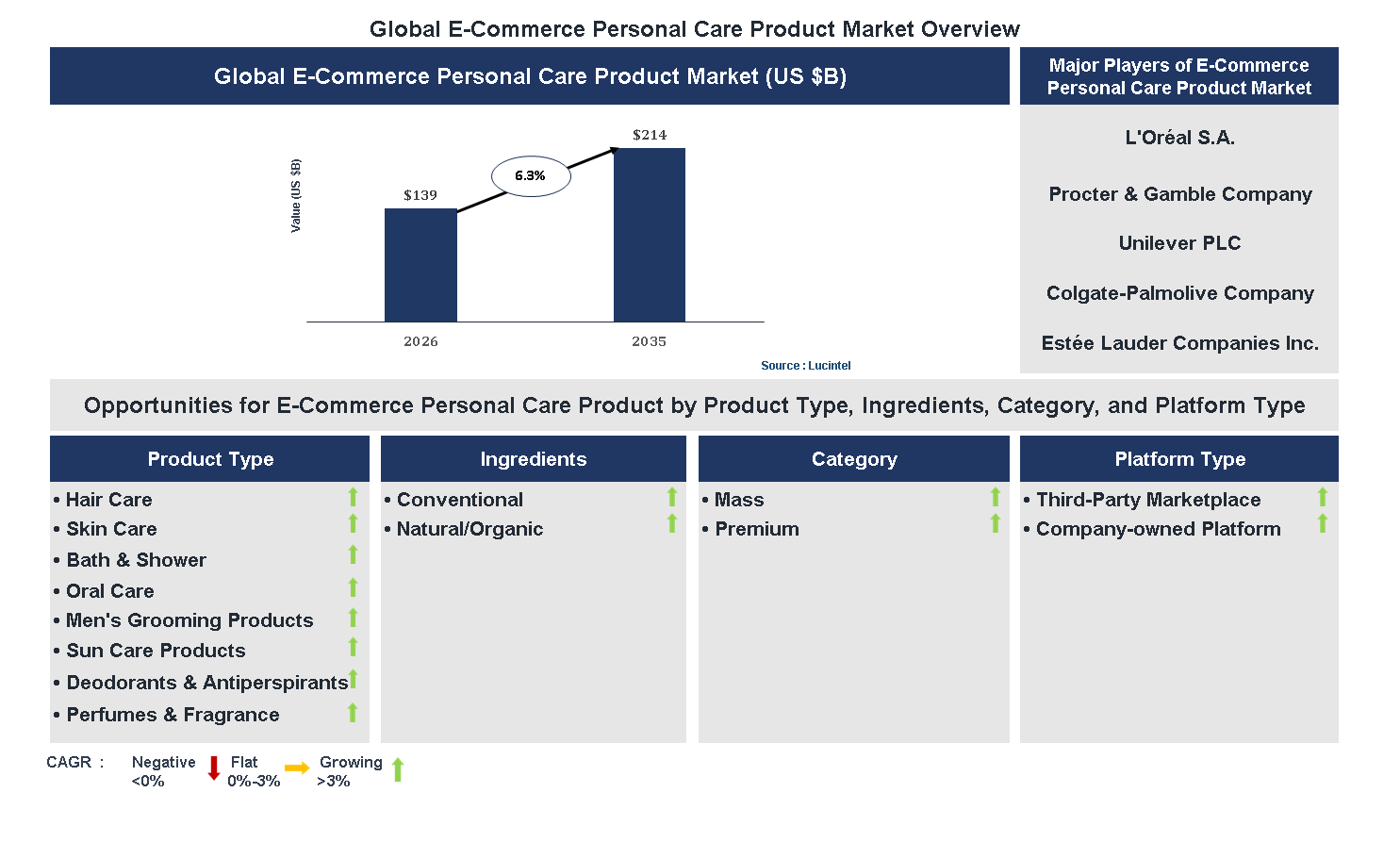
The future of the global e-commerce personal care product market looks promising with opportunities in the hair care, skin care, bath & shower, oral care, men's grooming product, sun care product, deodorant & antiperspirant, and perfume & fragrance markets. The global e-commerce personal care product market is expected to reach an estimated $214 billion by 2035 with a CAGR of 6.3% from 2026 to 2035. The major drivers for this market are the increasing adoption of online shopping, the rising demand for personalized products, and the growing influence of digital marketing strategies.• Lucintel forecasts that, within the platform type category, company-owned platform is expected to witness higher growth over the forecast period.
• Within the product type category, skin care is expected to witness the highest growth.
• In terms of region, APAC is expected to witness the highest growth over the forecast period. Gain valuable insights for your business decisions with our comprehensive 150+ page report. Sample figures with some insights are shown below.
Emerging Trends in the E-Commerce Personal Care Product Market
The E-commerce personal care product market is experiencing rapid transformation driven by technological advancements, changing consumer preferences, and innovative marketing strategies. As digital platforms become more sophisticated, consumers demand personalized, sustainable, and convenient solutions. The integration of new technologies and shifting trends are reshaping how brands engage with customers and deliver products. These developments are not only expanding market reach but also enhancing customer experience, leading to increased competition and innovation. Understanding these emerging trends is crucial for stakeholders aiming to stay ahead in this dynamic landscape and capitalize on new opportunities.• Rise of Personalization and Customization: Consumers increasingly seek tailored personal care solutions that cater to their unique needs. E-commerce platforms leverage data analytics and AI to offer personalized product recommendations, formulations, and routines. This trend enhances customer satisfaction and loyalty by providing a more relevant shopping experience. Brands investing in customization tools are gaining a competitive edge, as consumers value products that reflect their individual preferences and skin or hair types. The shift towards personalization is also driving innovation in product development, encouraging brands to create more targeted and effective offerings.
• Growing Demand for Natural and Organic Products: Consumers are becoming more conscious of ingredient safety, sustainability, and environmental impact. This has led to a surge in demand for natural, organic, and clean-label personal care products available online. E-commerce platforms facilitate access to a wide range of these products, often with detailed ingredient transparency. This trend influences brands to reformulate products with eco-friendly ingredients and adopt sustainable packaging. The emphasis on health and environmental responsibility is reshaping product portfolios and marketing strategies, making natural and organic offerings a key differentiator in the competitive market.
• Integration of Augmented Reality (AR) and Virtual Try-Ons: Advanced AR technology is transforming the online shopping experience by allowing consumers to virtually try on products such as makeup, skincare, and hair colors before purchasing. This innovation reduces uncertainty and enhances confidence in online purchases, leading to higher conversion rates. Brands incorporating AR tools are providing immersive, interactive experiences that mimic in-store consultations. The convenience and engagement offered by virtual try-ons are attracting tech-savvy consumers and reducing product return rates. This trend is set to redefine how consumers interact with personal care products digitally, making online shopping more experiential and personalized.
• Expansion of Subscription and Replenishment Services: Subscription models are gaining popularity as consumers seek convenience and consistent product supply. E-commerce platforms offer personalized subscription plans for skincare, haircare, and grooming products, often with automatic replenishment options. This trend fosters brand loyalty and ensures steady revenue streams for companies. It also provides valuable data on consumer preferences and usage patterns, enabling better inventory management and targeted marketing. The ease of recurring deliveries appeals to busy consumers and those looking to maintain their routines without hassle, significantly influencing purchasing behavior and market growth.
• Emphasis on Sustainability and Eco-Friendly Packaging: Environmental concerns are prompting brands to adopt sustainable packaging solutions, such as biodegradable, recyclable, or refillable containers. Consumers are increasingly prioritizing eco-friendly practices when choosing personal care products online. E-commerce companies are responding by highlighting their sustainability initiatives and offering eco-conscious options. This trend not only reduces environmental impact but also enhances brand reputation and consumer trust. As sustainability becomes a key purchase criterion, companies investing in green packaging and transparent supply chains are gaining a competitive advantage, reshaping industry standards and consumer expectations. These emerging trends are fundamentally reshaping the E-commerce personal care product market by fostering innovation, enhancing consumer engagement, and emphasizing sustainability. They are driving increased personalization, technological integration, and eco-conscious practices, which collectively are creating a more dynamic, responsive, and responsible market landscape.

Recent Development in the E-Commerce Personal Care Product Market
The e-commerce personal care product market has experienced rapid growth driven by technological advancements, changing consumer preferences, and increased internet penetration. Consumers now prioritize convenience, product variety, and personalized experiences, fueling online sales. Innovations in digital marketing, sustainable products, and direct-to-consumer brands are reshaping the landscape. This dynamic environment presents significant opportunities for brands to expand their reach, improve customer engagement, and introduce innovative offerings, ultimately transforming the way personal care products are marketed and purchased globally.• Digital Marketing Innovations: Enhanced targeting and personalized advertising are increasing consumer engagement. Advanced data analytics and AI-driven campaigns enable brands to deliver tailored content, boosting conversion rates and customer loyalty. Social media platforms facilitate direct interaction with consumers, fostering brand loyalty and real-time feedback. These innovations are making marketing more efficient and cost-effective, leading to higher sales and brand recognition in the competitive online space.
• Growth of Sustainable and Natural Products: Consumers are increasingly seeking eco-friendly, organic, and cruelty-free personal care options. Brands adopting sustainable practices and transparent ingredient sourcing are gaining market share. This shift is encouraging companies to innovate with eco-conscious packaging and formulations, aligning with consumer values. The demand for sustainable products is driving market expansion, attracting environmentally conscious buyers and fostering brand trust and loyalty.
• Expansion of Direct-to-Consumer Brands: DTC brands are disrupting traditional retail channels by offering personalized products and seamless online shopping experiences. These brands leverage social media and influencer marketing to build strong customer relationships. The direct approach reduces costs and allows for competitive pricing, while providing valuable customer data. This model enhances brand control, accelerates product innovation, and increases market penetration, making DTC brands a significant growth driver in the personal care e-commerce sector.
• Technological Advancements in Product Development: Innovations such as AI, 3D printing, and biotechnology are enabling personalized and innovative personal care products. These technologies facilitate rapid formulation adjustments and customized solutions, meeting individual consumer needs. Enhanced product efficacy and safety are achieved through advanced testing and ingredient analysis. Such technological progress is attracting consumers seeking tailored, effective, and safe products, thereby expanding market opportunities and encouraging brands to invest in R&D.
• Rise of Subscription and Convenience Services: Subscription models and online convenience services are increasing customer retention and lifetime value. Consumers enjoy the ease of auto-replenishment and curated product selections, enhancing their shopping experience. These services provide brands with predictable revenue streams and valuable consumer data. The convenience factor appeals to busy lifestyles, fostering brand loyalty and increasing market share. This trend is transforming traditional purchasing behaviors and expanding the reach of online personal care retail. These developments are significantly transforming the e-commerce personal care market by enhancing consumer engagement, promoting sustainability, and fostering innovation. They are driving market expansion, increasing competition, and encouraging brands to adopt more personalized, eco-friendly, and technologically advanced strategies. As a result, the market is becoming more dynamic, customer-centric, and sustainable, promising continued growth and innovation.
Strategic Growth Opportunities in the E-Commerce Personal Care Product Market
The e-commerce personal care product market is experiencing rapid expansion driven by changing consumer preferences, technological advancements, and increased online accessibility. As consumers seek convenience, personalized options, and innovative formulations, companies are exploring new avenues for growth. The integration of digital platforms and data analytics further enhances targeted marketing and product development. This dynamic environment presents numerous opportunities for brands to capture market share, improve customer engagement, and introduce novel products tailored to evolving demands.• Expansion Into Niche And Premium Segments: The market is witnessing growth in niche and premium personal care products sold online. Consumers are increasingly seeking specialized formulations, organic ingredients, and luxury brands, creating opportunities for companies to develop targeted offerings. E-commerce platforms facilitate easy access to these segments, allowing brands to reach a global audience. This trend encourages innovation and diversification, enabling brands to differentiate themselves and command higher margins through unique, high-quality products tailored to specific consumer needs.
• Adoption Of Personalized And Customizable Products: Personalization is transforming the personal care industry, with consumers demanding tailored solutions for their unique skin, hair, and wellness needs. E-commerce enables brands to collect data and offer customized products through online quizzes, AI-driven recommendations, and bespoke formulations. This approach enhances customer satisfaction, loyalty, and engagement. The ability to deliver personalized products at scale provides a significant growth opportunity, fostering brand differentiation and allowing companies to capitalize on the rising demand for individualized care solutions.
• Integration Of Augmented Reality And Virtual Try-Ons: Augmented reality (AR) and virtual try-on technologies are revolutionizing online shopping experiences in personal care. Consumers can virtually test products such as makeup, skincare, and hair color before purchase, reducing uncertainty and increasing confidence in buying decisions. These immersive tools improve customer engagement, decrease return rates, and enhance brand loyalty. As AR technology becomes more accessible and sophisticated, brands that incorporate virtual try-ons can differentiate themselves, attract tech-savvy consumers, and boost sales in the competitive e-commerce landscape.
• Growth Of Subscription And Replenishment Services: Subscription models and automatic replenishment services are gaining popularity in the personal care e-commerce sector. Consumers prefer the convenience of regular deliveries of their favorite products, ensuring they never run out. These services foster customer retention, provide predictable revenue streams, and enable brands to gather valuable usage data for product improvements. The convenience and personalized options offered through subscriptions create a seamless shopping experience, encouraging long-term loyalty and expanding market share in the growing online personal care space.
• Expansion Into Emerging Markets And Developing Economies: Emerging markets present significant growth opportunities due to rising disposable incomes, increasing internet penetration, and shifting consumer preferences toward personal grooming. E-commerce platforms facilitate access to these regions, overcoming traditional distribution barriers. Companies can tailor products to local preferences, leverage digital marketing, and establish regional logistics networks. Expanding into these markets allows brands to tap into a large, underserved customer base, diversify revenue streams, and establish a strong foothold in the global personal care e-commerce landscape. The overall growth opportunities in the e-commerce personal care product market are poised to reshape industry dynamics, fostering innovation, expanding consumer reach, and enhancing personalized shopping experiences. Companies that strategically leverage these opportunities can achieve sustainable growth, strengthen brand loyalty, and gain competitive advantage in an increasingly digital and globalized environment.
E-Commerce Personal Care Product Market Driver and Challenges
The E-commerce personal care product market is influenced by a variety of technological, economic, and regulatory factors that shape its growth and development. Advances in digital technology have revolutionized how consumers access and purchase personal care items, while economic shifts impact consumer spending patterns. Regulatory frameworks around product safety and advertising also play a crucial role in shaping market dynamics. Additionally, evolving consumer preferences for natural and organic products, along with increasing awareness of health and wellness, drive demand. However, challenges such as intense competition, regulatory compliance, and supply chain disruptions also pose significant hurdles. Understanding these drivers and challenges is essential for stakeholders aiming to capitalize on market opportunities and navigate potential risks effectively. The factors responsible for driving the E-commerce personal care product market include:• Technological Advancements: The rapid development of e-commerce platforms, mobile shopping apps, and digital payment solutions has made purchasing personal care products more convenient and accessible. Augmented reality (AR) and virtual try-on features enhance customer experience, increasing engagement and sales. Data analytics enable personalized marketing, improving customer retention and loyalty. These technological innovations facilitate a seamless shopping experience, expanding market reach and enabling brands to target niche segments effectively.
• Growing Consumer Preference for Natural and Organic Products: Consumers are increasingly seeking natural, organic, and chemical-free personal care items due to health consciousness and environmental concerns. This shift is driven by greater awareness of product ingredients and their impact on health. Brands that offer eco-friendly, cruelty-free, and sustainable products are gaining popularity, fueling market growth. The demand for transparency and authenticity in product labeling further encourages companies to innovate and diversify their offerings to meet consumer expectations.
• Rising Disposable Income and Urbanization: Economic growth in emerging markets has led to increased disposable income, enabling consumers to spend more on personal care products. Urbanization contributes to higher living standards and greater exposure to global beauty trends, influencing purchasing behavior. As urban populations become more brand-conscious and beauty-aware, the demand for premium and luxury personal care items rises, expanding market opportunities across regions.
• Expansion of E-Commerce Logistics and Supply Chain Infrastructure: Improvements in logistics, warehousing, and last-mile delivery services have enhanced the efficiency and reliability of online shopping. Faster delivery times and improved product availability attract more consumers to e-commerce platforms. Enhanced supply chain management reduces costs and ensures product freshness and quality, which is critical for personal care items. These developments support market scalability and enable brands to reach wider audiences, including rural and remote areas.
• Increasing Use of Social Media and Influencer Marketing: Social media platforms serve as powerful marketing channels for personal care brands. Influencers and beauty bloggers influence consumer purchasing decisions through reviews, tutorials, and endorsements. User-generated content fosters trust and authenticity, boosting brand visibility and engagement. The viral nature of social media campaigns accelerates product adoption and drives sales, making influencer marketing a vital component of market growth strategies. The challenges facing the E-commerce personal care product market include:
• Intense Competition and Market Saturation: The e-commerce personal care sector is highly competitive, with numerous established brands and new entrants vying for consumer attention. Differentiating products and maintaining brand loyalty becomes challenging amid price wars and promotional activities. Market saturation limits growth potential for some segments, requiring companies to innovate continuously and adopt aggressive marketing strategies to sustain their market share.
• Regulatory Compliance and Product Safety Standards: Stringent regulations regarding ingredient disclosures, labeling, and advertising practices pose compliance challenges for brands. Navigating diverse regulatory environments across regions increases operational complexity and costs. Failure to adhere to safety standards can lead to legal penalties, product recalls, and damage to brand reputation. Staying updated with evolving regulations is essential to avoid compliance risks and ensure consumer trust.
• Supply Chain Disruptions and Logistics Challenges: Global supply chain disruptions, caused by factors such as pandemics, geopolitical tensions, or natural disasters, impact the availability and delivery of personal care products. Delays, increased costs, and inventory shortages can hinder sales and customer satisfaction. Managing complex logistics networks and sourcing sustainable raw materials further complicate supply chain resilience, requiring strategic planning and diversification to mitigate risks. The E-commerce personal care product market is driven by technological innovation, changing consumer preferences, economic growth, and improved logistics, which collectively foster expansion and diversification. However, challenges such as intense competition, regulatory hurdles, and supply chain vulnerabilities threaten market stability and growth prospects. Navigating these drivers and challenges requires strategic agility, innovation, and compliance to capitalize on emerging opportunities and sustain competitive advantage in this dynamic landscape.
List of E-Commerce Personal Care Product Companies
Companies in the market compete on the basis of product quality offered. Major players in this market focus on expanding their manufacturing facilities, R&D investments, infrastructural development, and leverage integration opportunities across the value chain. With these strategies e-commerce personal care product companies cater increasing demand, ensure competitive effectiveness, develop innovative products & technologies, reduce production costs, and expand their customer base. Some of the e-commerce personal care product companies profiled in this report include-• L'Oréal S.A.
• Procter & Gamble Company
• Unilever PLC
• Colgate-Palmolive Company
• Estée Lauder Companies Inc.
• Natura & Co Holding SA
• Kenvue Inc.
• Beiersdorf AG
• Shiseido Co. Ltd.
• Oriflame Holding AG
E-Commerce Personal Care Product Market by Segment
The study includes a forecast for the global e-commerce personal care product market by product type, ingredients, category, platform type, and region.E-Commerce Personal Care Product Market by Product Type [Value from 2019 to 2035]:
• Hair Care
• Skin Care
• Bath & Shower
• Oral Care
• Men's Grooming Products
• Sun Care Products
• Deodorants & Antiperspirants
• Perfumes & Fragrance
E-Commerce Personal Care Product Market by Ingredients [Value from 2019 to 2035]:
• Conventional
• Natural/Organic
E-Commerce Personal Care Product Market by Category [Value from 2019 to 2035]:
• Mass
• Premium
E-Commerce Personal Care Product Market by Platform Type [Value from 2019 to 2035]:
• Third-Party Marketplace
• Company-owned Platform
E-Commerce Personal Care Product Market by Region [Value from 2019 to 2035]:
• North America
• Europe
• Asia Pacific
• The Rest of the World
Country Wise Outlook for the E-Commerce Personal Care Product Market
The E-commerce personal care product market has experienced rapid growth globally, driven by technological advancements, changing consumer preferences, and increased internet penetration. The COVID-19 pandemic accelerated online shopping habits, prompting brands to innovate and expand their digital presence. Countries are witnessing shifts in product offerings, sustainability initiatives, and personalized shopping experiences. Market players are investing in AI, AR, and supply chain improvements to meet rising demand. Regulatory changes and consumer awareness about ingredients also influence market dynamics. Here is a country-specific overview of recent developments in this sector for the United States, China, Germany, India, and Japan.• United States: The US market has seen a surge in organic and clean-label personal care products sold online, with brands focusing on transparency and sustainability. E-commerce platforms like Amazon and direct-to-consumer brands are expanding their offerings. Innovations in personalized skincare, driven by AI and data analytics, are gaining popularity. Subscription services and virtual consultations are also on the rise, enhancing customer engagement and loyalty.
• China: China’s online personal care market continues to grow rapidly, fueled by mobile commerce and social media influence. Live-streaming sales and influencer collaborations are key drivers. There is a significant shift towards natural and herbal products, with consumers seeking health-conscious options. E-commerce giants like Alibaba and JD.com are investing heavily in logistics and technology to improve delivery speed and customer experience. Local brands are gaining prominence through innovative marketing strategies.
• Germany: The German market emphasizes sustainability and eco-friendly products, with a strong preference for cruelty-free and organic options. Online sales channels are expanding, with consumers demanding transparency about ingredients and sourcing. Digital innovations such as augmented reality for virtual try-ons are enhancing the shopping experience. Regulatory compliance and product safety remain priorities, influencing product development and marketing strategies.
• India: The Indian e-commerce personal care sector is experiencing rapid growth, driven by increasing internet penetration and smartphone usage. Affordable pricing and regional product offerings are key factors. There is a rising demand for herbal and Ayurvedic products, reflecting traditional preferences. E-commerce platforms are leveraging localized marketing and logistics improvements to reach rural areas. Brands are also adopting influencer marketing and social commerce to boost sales.
• Japan: Japan’s market is characterized by a focus on premium and innovative personal care products sold online. Consumers value quality, safety, and advanced formulations. E-commerce platforms are integrating AI and AR to provide personalized recommendations and virtual try-ons. The trend towards natural and minimally processed ingredients continues. Companies are also emphasizing sustainability and eco-conscious packaging to meet consumer expectations. Digital marketing and cross-channel strategies are vital for engaging Japanese consumers effectively.

Features of the Global E-Commerce Personal Care Product Market
Market Size Estimates: E-commerce personal care product market size estimation in terms of value ($B). Trend and Forecast Analysis: Market trends (2019 to 2025) and forecast (2026 to 2035) by various segments and regions. Segmentation Analysis: E-commerce personal care product market size by various segments, such as by product type, ingredients, category, platform type, and region in terms of value ($B). Regional Analysis: E-commerce personal care product market breakdown by North America, Europe, Asia Pacific, and Rest of the World. Growth Opportunities: Analysis of growth opportunities in different product types, ingredients, categories, platform types, and regions for the e-commerce personal care product market. Strategic Analysis: This includes M&A, new product development, and competitive landscape of the e-commerce personal care product market. Analysis of competitive intensity of the industry based on Porter’s Five Forces model.
FAQ
Q1. What is the e-commerce personal care product market size? Answer: The global e-commerce personal care product market is expected to reach an estimated $214 billion by 2035. Q2. What is the growth forecast for e-commerce personal care product market? Answer: The global e-commerce personal care product market is expected to grow with a CAGR of 6.3% from 2026 to 2035. Q3. What are the major drivers influencing the growth of the e-commerce personal care product market? Answer: The major drivers for this market are the increasing adoption of online shopping, the rising demand for personalized products, and the growing influence of digital marketing strategies. Q4. What are the major segments for e-commerce personal care product market? Answer: The future of the e-commerce personal care product market looks promising with opportunities in the hair care, skin care, bath & shower, oral care, men's grooming product, sun care product, deodorant & antiperspirant, and perfume & fragrance markets. Q5. Who are the key e-commerce personal care product market companies? Answer: Some of the key e-commerce personal care product companies are as follows:• L'Oréal S.A.
• Procter & Gamble Company
• Unilever PLC
• Colgate-Palmolive Company
• Estée Lauder Companies Inc.
• Natura & Co Holding SA
• Kenvue Inc.
• Beiersdorf AG
• Shiseido Co. Ltd.
• Oriflame Holding AG Q6. Which e-commerce personal care product market segment will be the largest in future? Answer: Lucintel forecasts that, within the platform type category, company-owned platform is expected to witness higher growth over the forecast period. Q7. In e-commerce personal care product market, which region is expected to be the largest in next 5 years? Answer: In terms of region, APAC is expected to witness the highest growth over the forecast period. Q8. Do we receive customization in this report? Answer: Yes, Lucintel provides 10% customization without any additional cost.
Table of Contents
List of Figures
List of Tables
Methodology
- In-depth interviews of the major players in this market
- Detailed secondary research from competitors’ financial statements and published data
- Extensive searches of published works, market, and database information pertaining to industry news, company press releases, and customer intentions
- A compilation of the experiences, judgments, and insights of Lucintel’s professionals, who have analyzed and tracked this market over the years.


Buy Now
Choose a license that fits your team. Instant PDF delivery.
Prices exclude taxes. Instant delivery. Custom licensing available on request.
Key Questions
- • What are some of the most promising, high-growth opportunities for the e-commerce personal care product market by product type (hair care, skin care, bath & shower, oral care, men's grooming products, sun care products, deodorants & antiperspirants, and perfumes & fragrance), ingredients (conventional and natural/organic), category (mass and premium), platform type (third-party marketplace and company-owned platform), and region (North America, Europe, Asia Pacific, and the Rest of the World)?
- • Which segments will grow at a faster pace and why?
- • Which region will grow at a faster pace and why?
- • What are the key factors affecting market dynamics? What are the key challenges and business risks in this market?
- • What are the business risks and competitive threats in this market?
- • What are the emerging trends in this market and the reasons behind them?
- • What are some of the changing demands of customers in the market?
- • What are the new developments in the market? Which companies are leading these developments?
- • Who are the major players in this market? What strategic initiatives are key players pursuing for business growth?
- • What are some of the competing products in this market and how big of a threat do they pose for loss of market share by material or product substitution?
- • What M&A activity has occurred in the last 7 years and what has its impact been on the industry? For any questions related to E-Commerce Personal Care Product Market, E-Commerce Personal Care Product Market Size, E-Commerce Personal Care Product Market Growth, E-Commerce Personal Care Product Market Analysis, E-Commerce Personal Care Product Market Report, E-Commerce Personal Care Product Market Share, E-Commerce Personal Care Product Market Trends, E-Commerce Personal Care Product Market Forecast, E-Commerce Personal Care Product Companies, write Lucintel analyst at email: helpdesk@lucintel.com. We will be glad to get back to you soon.


