
Market Report · July 20, 2026

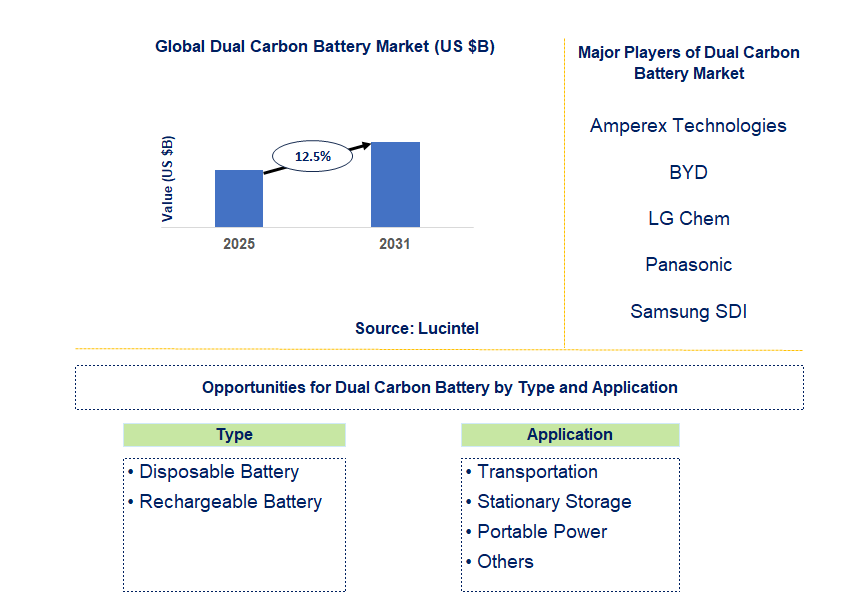
Key data points: The growth forecast = 12.5% annually for the next 7 years. Scroll below to get more insights. This market report covers Trends, opportunities and forecasts in dual carbon battery market to 2031 by type (disposable battery and rechargeable battery), application (transportation, stationary storage, portable power, and others), and region (North America, Europe, Asia Pacific, and the Rest of the World)
We'll send your sample report shortly.
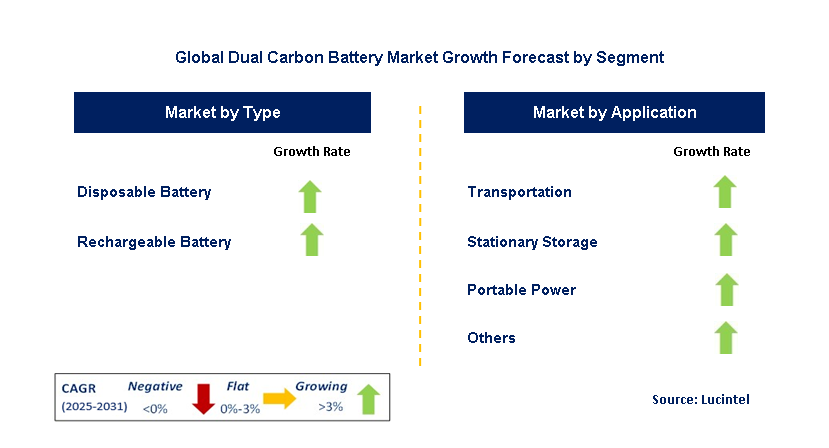
• Lucintel forecasts that, within the type category, rechargeable battery is expected to witness higher growth over the forecast period.
• Within the application category, transportation is expected to witness the highest growth.
• In terms of region, APAC is expected to witness the highest growth over the forecast period.
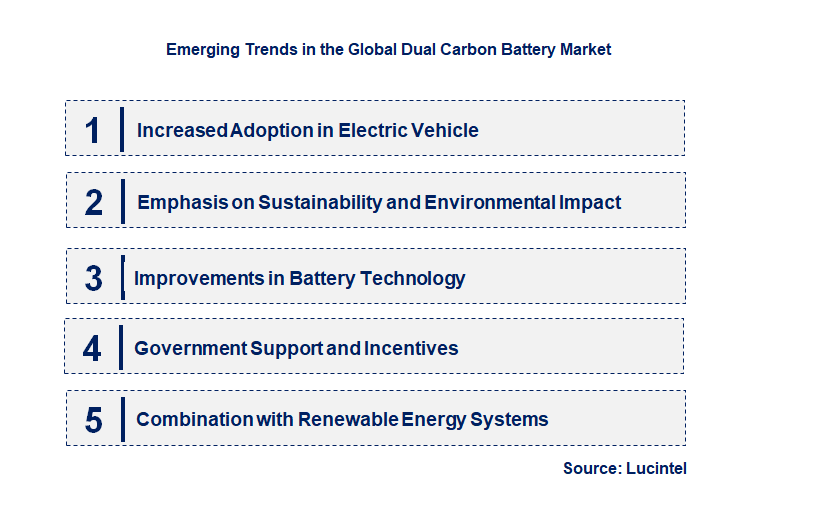
• Increased Adoption in Electric Vehicle: Dual carbon batteries are becoming increasingly popular in the EV industry because of their energy density, increased charging speed, and longer lifetime. Dual carbon batteries have the ability to enhance the driving range of EVs substantially, thus appealing to consumers and manufacturers alike.
• Emphasis on Sustainability and Environmental Impact: Carbon-based materials used in dual carbon batteries minimize the dependency on rare and environmentally harmful metals. This supports worldwide initiatives for lowering carbon emissions and encouraging eco-friendly energy options.
• Improvements in Battery Technology: Ongoing research and innovation are contributing to enhanced battery efficiency, safety, and affordability. Developments in electrode materials and battery chemistry are improving the performance of dual carbon batteries.
• Government Support and Incentives: Governments around the globe are offering incentives and capital for the production and utilization of dual carbon batteries. Clean energy and greenhouse gas emission reduction policies are fueling the growth of the market.
• Combination with Renewable Energy Systems: Dual carbon batteries are being combined with renewable energy systems, including solar and wind power, to offer effective energy storage solutions. It supports grid power stabilization and a stable supply of power. These new trends are transforming the dual carbon battery market by encouraging innovation, fostering sustainability, and expanding adoption in a wide range of applications. The market is set to grow dramatically as these trends keep changing.
• Technological Improvements in Battery Efficiency: Recent studies have resulted in considerable increases in the efficiency of dual carbon batteries, making their energy density and charge-discharge rates higher. These developments are making the batteries increasingly comparable with conventional lithium-ion batteries.
• Increase in Production Capacity: Organizations are investing in increasing their production capacities to satisfy the increasing demand for dual carbon batteries. This involves establishing new factories and upgrading old ones.
• Commercialization of New Battery Technologies: The mass commercialization of new dual carbon battery technologies, like the Ryden battery by Power Japan Plus, is a major breakthrough. The batteries have faster charging times, longer lifetimes, and enhanced safety.
• Government Initiatives and Funding: Governments are offering funding and incentives to encourage the development and use of dual carbon batteries. This includes research and development grants, manufacturing subsidies, and tax credits for consumers.
• Integration with Renewable Energy Projects: Dual carbon batteries are being incorporated into renewable energy projects for the purpose of offering efficient energy storage solutions. This incorporation stabilizes the power grid and provides a sure energy supply. All these developments are propelled towards market expansion of the dual carbon battery by improving battery performance, scaling up production capacity, and encouraging the acceptance of sustainable energy solutions.
• Electric Vehicles (EVs): Electric vehicle industry is one of the top growing sectors due to the market's adoption of eco-friendly dual carbon batteries that can also charge extremely quickly. Dual carbon batteries do not have a traditional lithium-ion structure which means there is no focus on scarce metals so they can easily meet the demand without having to depend on anyone. Their full charge capabilities, which can be attained in just a couple of minutes, increase the practicality for EV’s making them much easier to adopt. These batteries also improve the safety and lifespan, making them a much better alternative to conventional battery technologies. With the energy storage device making dual carbon batteries easy to adopt worldwide, it is truly a sustainable option for EV manufacturers.
• Renewable Energy Storage: Investments in solar and wind power have increased tremendously, therefore ensuring effective energy storage systems must be created to maintain grid stability and credibility of energy supply. With their fast charging and discharging cycles, dual carbon batteries serve as a powerful solution for storing renewable energy efficiently. These batteries have increased longevity compared to traditional systems which deplete over time, lowering the costs of maintenance and replacements. Their recyclability and sustainability makes them ideal for energy grids looking to transition towards cleaner energy sources. This application will be one of the most important factors in achieving advancement towards a global renewable energy target.
• Consumer Electronics: The shift towards dual carbon batteries in smartphones, laptops, and wearable electronics tends to keep pace with the constant market demand for increased user safety, reduced risk for overheating, and prolonged device autonomy. By effectively addressing the common limitations of current lithium-ion alternatives, dual carbon batteries are able to charge quickly and maintain efficiency even with prolonged extended use. While tech companies are actively looking to improve the efficiency of their devices batteries, dual carbon batteries have already become the preferred choice for modern consumer electronics.
• Industrial and Grid-Scale Applications: Large-scale energy storage systems plays a significant role in the operation of industries such as data centers,and smart grids. Dual carbon batteries serve as a reliable and mid-cost option to current storage systems because of their energy efficiency and reduced environmental impact. Such systems allow industrial users that continuously need power to be supported, thus aiding productivity and minimizing downtime due to slow charge times. During grid level energy storage, they improve load leveling and assist demand response, which are key components for development in modern power infrastructure. This ultimately results in improved energy efficiency and reduced operational costs for industries and utilities.
• Aerospace and Defense: The aerospace and defense industries have specific energy storage needs, including utmost care for safety, dependability, and performance in extreme conditions. Due to light weight structure, Dual carbon batteries also a great work in military vehicles, satellites, and unmanned aerial vehicles (UAV). Since there is no worry over thermal runaway, it is safer than other battery chemistries. As defense and government agencies are looking for new technologies for their operations, the use of dual carbon batteries in these applications is set to rise, thus capturing more market. The dual carbon battery market is set to grow alongside the development of energy storage systems for electric vehicles, consumer electronics, renewables, industrials, and even aerospace nicaraguan. The exceptional capabilities these batteries possess, including low charge time and longer lifetime together thinner production, allow them to fill carbon battery gaps. Addressing key issues enables them to excel in energy storage.
• Amperex Technologies
• BYD
• LG Chem
• Panasonic
• Samsung SDI
• Johnson Controls
• Lishen Tianjin
• Hitachi Chemical
• Loxus
• JSR
• Disposable Battery
• Rechargeable Battery
• Transportation
• Stationary Storage
• Portable Power
• Others
• North America
• Europe
• Asia Pacific
• The Rest of the World
• United State: The dual carbon battery market in the United States is growing as a result of rising demand for high-performance batteries for electric vehicles (EVs) and renewable energy storage systems. Firms are investing in research and development to increase efficiency in batteries while lowering the cost of production. The U.S. government is also encouraging the market through incentives and the provision of funds for clean energy projects.
• China: China is leading the charge in the dual carbon battery market as part of its overall green transition ambitions. The nation is concentrating on weaning itself from fossil fuels and ramping up the use of clean energy. Recent trends include innovation in battery technology and expanding production capacity to keep up with the surging demand for EVs and renewable energy storage.
• Germany: Germany is experiencing an increase in battery storage initiatives, facilitated by growth in renewable energy sources and falling prices of battery cells. The government of Germany has implemented legislative amendments to facilitate growth in battery storage capacities, such as flexible grid connection contracts and incentives for the costs of construction.
• India: India's dual carbon battery market is on the rise, spurred by the demand for energy-efficient storage devices and the government's initiative for green energy technology. The nation is also set to initiate a carbon market by 2026, further propelling the use of renewable energy technologies.
• Japan: Japan leads in dual carbon battery technology, and Power Japan Plus is a front-runner in this regard. Development of the dual carbon battery that is faster in charging and lasts longer is an important milestone. Mass production and commercialization in Japan are under focus for this battery for its uses in EVs and renewable energy storage.


• Amperex Technologies
• BYD
• LG Chem
• Panasonic
• Samsung SDI
• Johnson Controls
• Lishen Tianjin
• Hitachi Chemical
• Loxus
• JSR Q5. Which dual carbon battery market segment will be the largest in future? Answer: Lucintel forecasts that, within the type category, rechargeable battery is expected to witness higher growth over the forecast period. Q6. In dual carbon battery market, which region is expected to be the largest in next 5 years? Answer: In terms of region, APAC is expected to witness the highest growth over the forecast period. Q7. Do we receive customization in this report? Answer: Yes, Lucintel provides 10% customization without any additional cost.


Choose a license that fits your team. Instant PDF delivery.
Prices exclude taxes. Instant delivery. Custom licensing available on request.
Market Report · July 20, 2026
Market Report · July 20, 2026
Market Report · July 20, 2026
Trusted partner for strategic intelligence and business growth


Receive a complimentary market analysis tailored to your industry. Our analysts will identify key growth opportunities and competitive dynamics specific to your business.

Market size, growth rate, and key trend analysis for your specific sector.

Top competitor positioning and market share analysis.

Strategic recommendations backed by data-driven insights.
Get curated market intelligence and competitive moves straight to your inbox.
By subscribing, you agree to receive our monthly insights. Unsubscribe anytime.
Receive a complimentary market analysis tailored to your industry. Our analysts will identify key growth opportunities and competitive dynamics specific to your business.
Market size, growth rate, and key trend analysis for your specific sector.
Top competitor positioning and market share analysis.
Strategic recommendations backed by data-driven insights.
Get curated market intelligence, emerging trends, and competitive moves straight to your inbox each month.
By subscribing, you agree to receive our monthly insights. Unsubscribe anytime.
We'll send your sample report shortly.