
Close Lucintel Chat
Didn't Find What You're Looking for?
Call us at +1972 636 5056 or write at helpdesk@Lucintel.com
Ask an Expert Provide Custom Requirements Download Sample Report Search Available Reports
  • helpdesk@Lucintel.com
  • |
  • Call Lucintel +1 972 636 5056
  • |
  • Login
  • |
  • Register
  • |
  • Search
  • |
'
...

The Impact of COVID-19 is included in Drywall Tool Market Report. Buy it today to get an advantage.

Request the impact of COVID-19 on your product or industry


Drywall Tool Market Trends and Forecast

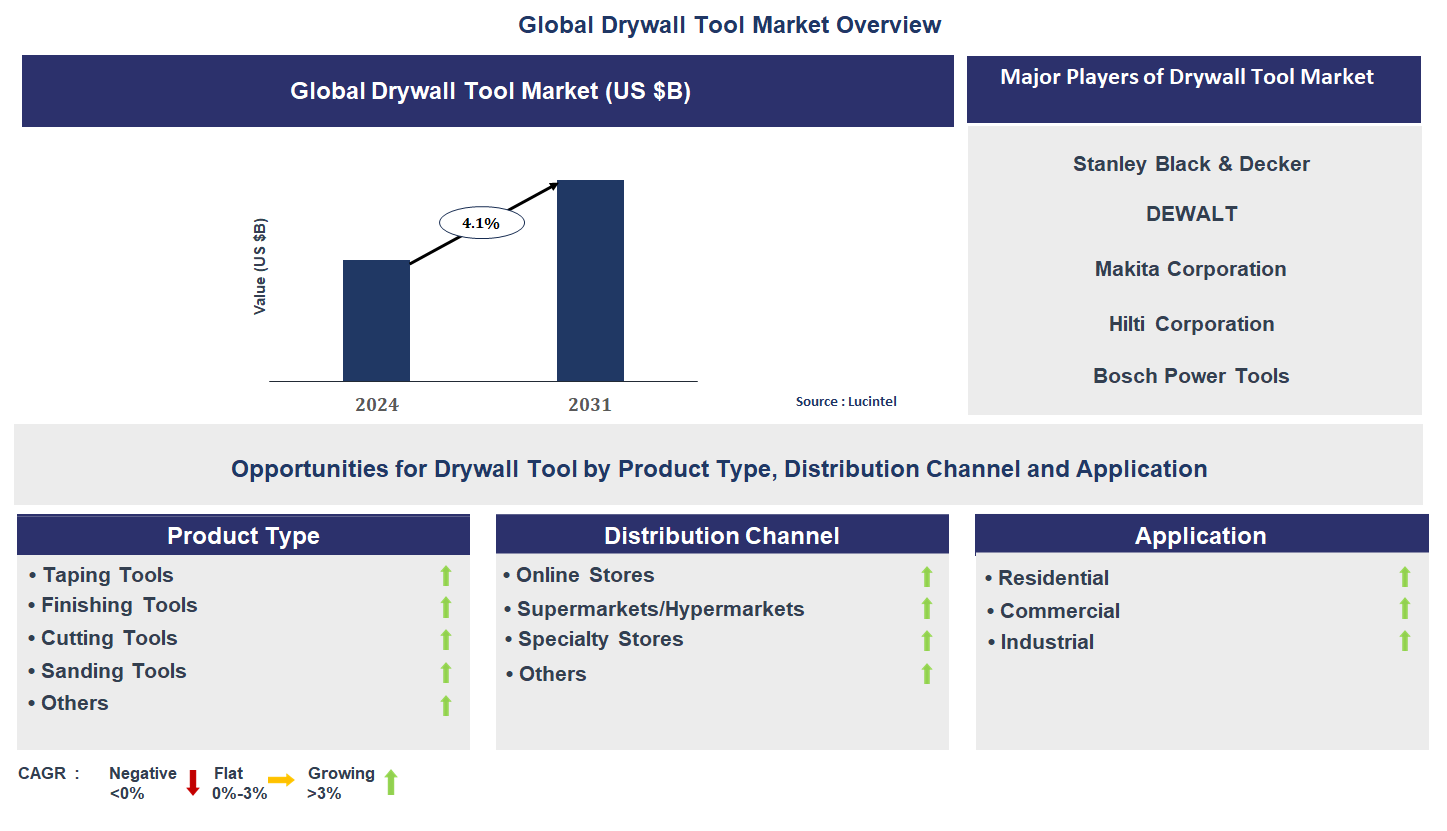
The future of the global drywall tool market looks promising with opportunities in the residential, commercial, and industrial markets. The global drywall tool market is expected to grow with a CAGR of 4.1% from 2025 to 2031. The major drivers for this market are the increasing demand for home renovations, the rising construction activities in urban areas, and the growing adoption of advanced drywall tools.

• Lucintel forecasts that, within the product type category, taping tool is expected to witness the highest growth over the forecast period.
• Within the application category, residential is expected to witness the highest growth.
• In terms of region, North America is expected to witness the highest growth over the forecast period.
Gain valuable insights for your business decisions with our comprehensive 150+ page report. Sample figures with some insights are shown below.
Drywall Tool Market Trends and Forecast

Emerging Trends in the Drywall Tool Market

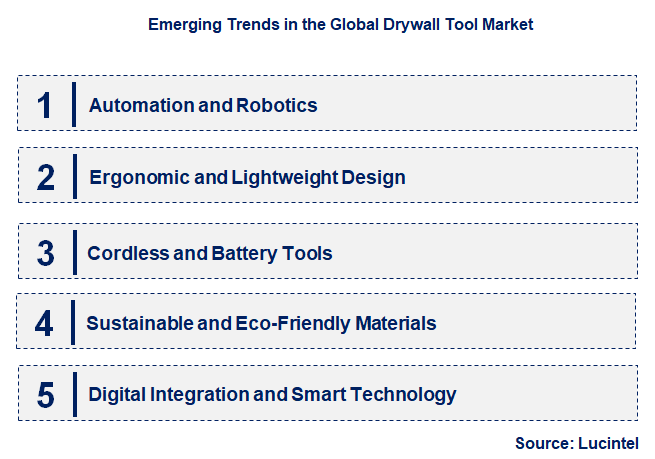
The market for drywall tool is experiencing a seismic transition, driven by technological advancements, changing construction methods, and an increased emphasis on efficiency and sustainability. These emerging trends are transforming the design, production, and use of tools, leading the industry towards more intelligent, ergonomic, and eco-friendly solutions. The use of smart technology, a trend towards cordless and lightened designs, and the increasing power of e-commerce are laying the groundwork for a new age of drywall finishing and installation, affecting professionals and DIYers alike.
• Automation and Robotics: The use of automation and robotics is widely practiced in the industry to meet labor shortages and increase productivity. This trend involves the creation of robotic arms capable of handling full drywall sheets, and semi-automated equipment for such operations as sanding and taping. The intention is to reduce labor, cut worker physical stress, and provide a greater level of precision and uniformity in each project. This is especially effective on large commercial projects where efficiency and speed take priority.
• Ergonomic and Lightweight Design: In an increased focus on worker safety and well-being, companies are focusing on ergonomic designs. This trend means designing tools to be lighter, having comfortable handles, and being balanced to minimize the fatigue of the users and the risk of repetitive strain injury. The application of composite and carbon fiber materials is enabling this while not sacrificing durability. This emphasis on user comfort and protection is enhancing the appeal of tools to a wider spectrum of consumers, from experienced professionals to do-it-yourself home owners.
• Cordless and Battery Tools: The shift toward cordless and battery tools is a dominant trend spurred by demands for greater mobility and convenience on the jobsite. Advancements in the technology of lithium-ion batteries have led to extended run times and more rapid charging, and cordless tools have become a convenient and effective option over their corded equivalents. This does away with the inconvenience of entangled cables and the necessity of power sockets, enhancing workflow and safety, and enabling increased flexibility, particularly in distant or hard-to-reach areas.
• Sustainable and Eco-Friendly Materials: As the construction industry as a whole moves towards sustainability, the drywall tool market is also seeing a shift towards eco-friendly practices. This includes the use of recycled or sustainably sourced materials in tool manufacturing, as well as the development of tools that are energy-efficient. There is also increased demand for products that operate with low-VOC or water-based products and assist in the minimization of waste on-site. This trend is supported by world environmental regulation and consumer demand for more environmentally friendly products.
• Digital Integration and Smart Technology: Smart technology integration is revolutionizing drywall tools. Some of the tools include built-in sensors, digital screens, and even linkage to smartphone applications. These technologies can deliver real-time information about tool performance, monitor usage, and assist in achieving best results. Instances include screw guns equipped with automatic depth control and laser-cutters that improve accuracy. This phenomenon is not just about making tools more efficient but also about giving contractors data-driven insights to better manage projects.
These trends are transforming the drywall tool industry by challenging manufacturers to do more than just make incremental mechanical changes. The emphasis now is on building complete solutions that enhance project efficiency, worker comfort, and environmental friendliness. The industry is departing from an assortment of standalone tools towards a family of networked, intelligent, and ergonomic systems that meet the changing needs of today’s construction.
Emerging Trends in the Drywall Tool Market

Recent Development in the Drywall Tool Market

The drywall tool market is undergoing considerable change, fueled by a convergence of technological innovation, shifting user requirements, and a heightened focus on jobsite productivity. Not only are these trends enhancing the functionality of individual tools but also transforming the overall workflow of drywall installation and finishing. The market is shifting towards products that are more automated, precise, and long-lasting and also more consumer-friendly and eco-friendly. This change is affecting the whole value chain, ranging from manufacturers and distributors to professional contractors and do-it-yourselfers.
• High-Tech Finishing and Taping Tools: One of the major innovations is the emergence of very advanced finishing and taping tools. Compound applicators and automatic taping tools are more efficient and accurate than ever before, greatly saving labor and time in taping seams and joint finishing. This is a very important application for high-profile commercial jobs where precision finishes and quick turnaround times are necessary. The tools are engineered to deliver consistent, even mud application, reducing the necessity for manual touch-ups and large amounts of sanding.
• User-Friendly and Ergonomic Design: Tool manufacturers are now paying greater attention to designing their tools ergonomically to meet the physical challenges involved with working with drywall. This innovation involves designing lighter tools, adding cushion grips, and designing tools with improved balance to minimize strain on wrists and shoulders. The aim is to increase user comfort and minimize workplace injuries, which is a major issue for the construction industry. This trend is working to the advantage of professional drywallers who work long hours on site as well as DIY homeowners who are not used to the physical demands of the job.
• Cordless Power Tool Integration: The industry is witnessing a great movement towards cordless power tools, which provide unmatched mobility and convenience. New battery technology offers enough power and run time for heavy chores such as cutting and screwing, and they are a convenient substitute for corded tools. High-capacity, high-speed-charging batteries have all but eliminated earlier limitations. This shift renders extension cords unnecessary, enhancing jobsite safety and boosting overall productivity as workers are not tethered in place.
• Dust Extraction and Management Systems: One significant advancement is the incorporation of dust management and extraction systems into drywall tools. Drywall sanding produces a tremendous amount of fine dust, which is harmful to health. Latest sanders and sanding systems come equipped with built-in or compatible vacuum attachments that extract dust at the point of origin. This innovation not only provides a healthier and cleaner workplace but also saves time on post-project cleanup, thus increasing efficiency and job satisfaction for contractors.
• Multi-Functional Tools: The industry is shifting towards more special-purpose and multi-functional tools that satisfy particular needs. This involves tools specifically for specific applications such as cutting round holes or finishing interior corners. Meanwhile, certain tools are also being designed with double functionality, like screw guns that double as a router. This development provides contractors with the convenience of performing a greater variety of tasks using a reduced tool set, saving on expenses and easing equipment control.
These innovations are revolutionizing the drywall tool industry at its core by raising performance, safety, and efficiency standards. The trend is towards intelligent, networked, and highly technical tools that simplify complicated tasks, enhance user comfort, and produce cleaner work sites. In the end, these innovations are giving contractors and DIY consumers the ability to obtain professional-level results faster and with less work, making the entire drywall installation and finishing process more accessible and efficient.

Strategic Growth Opportunities in the Drywall Tool Market

The drywall tool market offers several strategic growth prospects in the different applications on the back of a worldwide rise in construction and demand for more specialized and efficient tools. Strategic growth opportunities exist in serving particular market segments, ranging from large-sized commercial construction to the growing do-it-yourself segment. By targeting primary application areas, suppliers and manufacturers can take advantage of these trends, offering focused solutions that meet the distinct requirements of various end-users.
• Home Remodeling and New Home Construction: One of the largest opportunities for growth is in the residential market, driven by new home building and the universal practice of home remodeling. As remodelers and homeowners alike grow in their adoption of interior finishing work, there is a high volume of demand for a complete range of drywall tools, from simple hand tools to sophisticated power tools. This is a particularly significant opportunity in the DIY segment, where there is a demand for easy-to-use, low-cost, and multifunctional tools that make the entire process simple for amateur users.
• Commercial and Institutional Projects: The commercial and institutional markets, such as office building construction, hospitals, and schools, present a significant growth opportunity. These kinds of large-scale projects need high-performance, long-lasting, and frequently semi-automatic tools that allow high-volume work with pace and accuracy. The strategic advantage here is to offer a full range of professional-quality tools, such as robotic taping systems and heavy-duty sanders, that can dramatically lower labor costs and project schedules, which would be attractive to large-scale construction companies.
• Specialty and Custom Drywall Applications: The specialty and custom drywall application marketplace, for applications such as curved walls, ornate ceiling designs, or soundproofing installations, is a niche but high-value opportunity. These jobs use specialized equipment that is not found in the average contractor’s toolbox. Creating and selling tools for use in these applications, like flexible corner beads or custom cutting jigs, can assist businesses in tapping into a premium price market and establishing a reputation for special skill and innovation.
• Prefabricated and Modular Construction: The increasing popularity of prefabricated and modular construction, where building elements are manufactured off-site and assembled together, presents a special growth opportunity. This process necessitates extremely accurate and automated equipment for repetitive work in a factory environment. Manufacturers can strategically position this application by creating tools that can be integrated with automated assembly lines, providing consistency and quality.
• Drywall Maintenance and Repair: Drywall maintenance and repair is a consistent and frequently underappreciated growth market. This industry is spurred by demands for repairing cracks, holes, and other forms of damage in current structures. The potential is in the delivery of targeted repair kits and simple-to-use tools that are appropriate for both the small-scale work of homeowners and large-scale activities by professional handymen. The tools must be small, efficient, and versatile enough to accomplish a number of general repair situations.
These opportunity for growth are remaking the drywall tool industry by promoting a departure from a one-size-fits-all strategy to a more segmented, application-driven strategy. The firms that are able to effectively identify and serve the individual needs of each application, from the volume-oriented demand of commercial construction to the ease-of-use requirements of the DIY market, will best be positioned to thrive and grow in the future. The market’s future is in offering intelligent, targeted solutions that create value and efficiency for every end-user.

Drywall Tool Market Driver and Challenges

The drywall tool industry is evolving, with different drivers and challenges informing the market. The prime movers are propelling the industry, while the challenges pose threats that need to be strategically navigated. These drivers and challenges are a combination of technologies, economic trends, and labor market dynamics. It is essential to understand these forces for industry players in making decisions and staying competitive. The entire market is a dynamic interplay of all these factors, with innovation coming out as a reaction to both drivers and challenges.
The factors responsible for driving the drywall tool market include:
1. Increasing Construction and Renovation Activities: The biggest driver of the drywall tool market is the growth of both residential and commercial construction globally. Increased urbanization, population increase, and an international infrastructure boom are all generating a continuous requirement for interior finishing products and the equipment to fit them. The growing popularity of home remodeling and do-it-yourself also contributes to demand for a host of tools, ranging from fundamental hand tools to sophisticated power tools.
2. Technological Developments: Ongoing technological developments in tool technology are one of the main market drivers. These involve the innovation of more powerful and longer-lasting batteries for cordless tools as well as the incorporation of intelligent features such as dust extraction and digital sensors. These improvements increase the efficiency, safety, and ease of use of tools, which subsequently boosts their uptake by both professional contractors and homeowners.
3. Call for Productivity and Efficiency: With increasing labor expenses and a lack of skilled labor in numerous locations, contractors have a strong motive to employ equipment that will enhance productivity. Equipment that streamlines or automates procedures, including robotic sanders and automatic taping tools, is very popular because it enables contractors to finish jobs sooner and with less personnel, which makes them more profitable.
4. Safety and Ergonomic Regulations: An increasing focus on employee health and safety is fueling the need for ergonomic tools to minimize physical exertion and risk of injury. Lighter-weight tools, improved grips, and functionality that reduces dust exposure are now the norm. This driver is backed by greater regulations and an overall trend within the industry for on-site workers’ well-being.
5. DIY Segment Growth: Growing popularity of do-it-yourself home remodeling jobs is a key driver of the market. With more homeowners deciding to perform renovations independently, there is an expanding requirement for easy-to-use, inexpensive, and easily accessible drywall equipment. This segment has led firms to provide simpler, more intuitive equipment and full kits in most cases, offered through online and retailer outlets.
Challenges in the drywall tool market are:
1. Variable Raw Material Prices: The market for drywall tools is prone to varying prices of important raw materials such as steel, plastic, and electronic components. These variations in prices can reflect in the cost of manufacturing as well as the ultimate retail price of the tools. This becomes a concern for manufacturers to keep the pricing consistent and also for buyers, particularly in price-conscious markets.
2. Fierce Competition: The competition is intense and oligopolistic with many local and international players competing for market share. This competition tends to result in price wars that can narrow the profit margins of manufacturers and distributors. The arrival of new entrants from emerging economies with cheaper alternatives creates additional competitive pressure.
3. Lack of Skilled Workforce: The construction sector in most of the world is lacking in skilled workforce. Even though this driver compels the use of automated equipment, it can also be a challenge. An absence of skilled professionals can delay the uptake of sophisticated, high-technology equipment that involves specialized knowledge to operate and maintain. This can restrict the market for high-tech equipment in some areas.
Overall, the drywall tool industry is being driven by powerful drivers such as increasing construction activity and technology innovation, which are opening up huge opportunities. However, it also has to face notable challenges such as fluctuating material prices and an intensely competitive market. The strong need for productivity and safety is pushing the industry towards newer, more advanced and ergonomic tools, while the shortage of skilled labor is a paradox that is pushing demand for automation at the same time and also hindering full-fledged implementation.

List of Drywall Tool Companies

Companies in the market compete on the basis of product quality offered. Major players in this market focus on expanding their manufacturing facilities, R&D investments, infrastructural development, and leverage integration opportunities across the value chain. With these strategies drywall tool companies cater increasing demand, ensure competitive effectiveness, develop innovative products & technologies, reduce production costs, and expand their customer base. Some of the drywall tool companies profiled in this report include-
• Stanley Black & Decker
• DEWALT
• Makita Corporation
• Hilti Corporation
• Bosch Power Tools
• Milwaukee Tool
• Hyde Tools
• Goldblatt Tool Company
• Kraft Tool
• Marshalltown Company

Drywall Tool Market by Segment

The study includes a forecast for the global drywall tool market by product type, distribution channel, application, and region.

Drywall Tool Market by Product Type [Value from 2019 to 2031]:


• Taping Tools
• Finishing Tools
• Cutting Tools
• Sanding Tools
• Others

Drywall Tool Market by Distribution Channel [Value from 2019 to 2031]:


• Online Stores
• Supermarkets/Hypermarkets
• Specialty Stores
• Others

Drywall Tool Market by Application [Value from 2019 to 2031]:


• Residential
• Commercial
• Industrial

Drywall Tool Market by Region [Value from 2019 to 2031]:


• North America
• Europe
• Asia Pacific
• The Rest of the World

Country Wise Outlook for the Drywall Tool Market

The drywall tool market is also witnessing a dramatic change led by the global construction patterns, technology advancements, and evolving consumer attitude. There is a growing demand for effective, ergonomic, and automated tools that is stimulated by the demand for higher productivity and lack of skilled workers. This transformation is reaching large markets such as the United States, China, Germany, India, and Japan, with each nation having distinctive patterns of growth and market behavior.
• United States: In the United States, the drywall tool industry is driven by an aggressive demand from both professional building contractors and the large residential and commercial construction industries. One of the major developments is the rapid take-up of cordless power tools driven by high-technology lithium-ion batteries. The industry is also placing a great emphasis on ergonomic design to minimize the fatigue of users and on smart technology integration to ensure jobsite productivity and monitoring.
• China: China is a fast-growing market for drywall tools, driven by fast urbanization and massive infrastructure development projects. The market is undergoing a transition towards more quality, professional-level tools, but price continues to be an important consideration for most consumers. Construction automation and robotics are on the rise, particularly in large-scale construction projects, resulting in a high demand for advanced, half-automatic tools. Local producers are competing more with multinational brands by selling a variety of products at competitive prices, prioritizing satisfying the demands of a varied construction environment.
• Germany: The German drywall tool industry is dominated by high precision, reliability, and first-class engineering. Professional builders form the main consumers, for whom the priority is equipment that meets tough safety and quality standards. Sustainability is also increasingly important, with calls for energy-efficient equipment and environmentally friendly materials. There is also consistent demand for specialty, high-performance equipment and systems for automating processes and limiting manual intervention, in line with the nation’s developed construction standards and skilled labor force.
• India: India’s drywall tool industry is in the growth phase, driven by massive government investment in infrastructure and a housing construction boom. The market is highly price-sensitive, with a high requirement for tough, yet affordable, manual tools. However, there is a creeping trend towards semi-automatic and electric tools as the professional building sector becomes more organized and efficiency-focused. The growth in e-commerce is opening the door to a broader range of tools, including global brands, for contractors and builders in regions around the world.
• Japan: The drywall tool industry in Japan is technologically advanced and sophisticated. There is a demand for high-performance, lightweight, and compact tools that suit the densely populated urban environments and low-rise construction sites in Japan. Automation and robotics are finding their way into construction, which has brought about the need for tools to complement these systems. Tools that are precision-based and fast-working are also being emphasized in the market, meeting the country’s high quality requirements as well as an efficient and innovative workforce.

Lucintel Analytics Dashboard

Features of the Global Drywall Tool Market

Market Size Estimates: Drywall tool market size estimation in terms of value ($B).
Trend and Forecast Analysis: Market trends (2019 to 2024) and forecast (2025 to 2031) by various segments and regions.
Segmentation Analysis: Drywall tool market size by product type, distribution channel, application, and region in terms of value ($B).
Regional Analysis: Drywall tool market breakdown by North America, Europe, Asia Pacific, and Rest of the World.
Growth Opportunities: Analysis of growth opportunities in different product types, distribution channels, applications, and regions for the drywall tool market.
Strategic Analysis: This includes M&A, new product development, and competitive landscape of the drywall tool market.
Analysis of competitive intensity of the industry based on Porter’s Five Forces model.

Lucintel Consulting Services

FAQ

Q1. What is the growth forecast for drywall tool market?
Answer: The global drywall tool market is expected to grow with a CAGR of 4.1% from 2025 to 2031.
Q2. What are the major drivers influencing the growth of the drywall tool market?
Answer: The major drivers for this market are the increasing demand for home renovations, the rising construction activities in urban areas, and the growing adoption of advanced drywall tools.
Q3. What are the major segments for drywall tool market?
Answer: The future of the drywall tool market looks promising with opportunities in the residential, commercial, and industrial markets.
Q4. Who are the key drywall tool market companies?
Answer: Some of the key drywall tool companies are as follows:
• Stanley Black & Decker
• DEWALT
• Makita Corporation
• Hilti Corporation
• Bosch Power Tools
• Milwaukee Tool
• Hyde Tools
• Goldblatt Tool Company
• Kraft Tool
• Marshalltown Company
Q5. Which drywall tool market segment will be the largest in future?
Answer: Lucintel forecasts that, within the product type category, taping tool is expected to witness the highest growth over the forecast period.
Q6. In drywall tool market, which region is expected to be the largest in next 5 years?
Answer: In terms of region, North America is expected to witness the highest growth over the forecast period.
Q7. Do we receive customization in this report?
Answer: Yes, Lucintel provides 10% customization without any additional cost.

This report answers following 11 key questions:

Q.1. What are some of the most promising, high-growth opportunities for the drywall tool market by product type (taping tools, finishing tools, cutting tools, sanding tools, and others), distribution channel (online stores, supermarkets/hypermarkets, specialty stores, and others), application (residential, commercial, and industrial), and region (North America, Europe, Asia Pacific, and the Rest of the World)?
Q.2. Which segments will grow at a faster pace and why?
Q.3. Which region will grow at a faster pace and why?
Q.4. What are the key factors affecting market dynamics? What are the key challenges and business risks in this market?
Q.5. What are the business risks and competitive threats in this market?
Q.6. What are the emerging trends in this market and the reasons behind them?
Q.7. What are some of the changing demands of customers in the market?
Q.8. What are the new developments in the market? Which companies are leading these developments?
Q.9. Who are the major players in this market? What strategic initiatives are key players pursuing for business growth?
Q.10. What are some of the competing products in this market and how big of a threat do they pose for loss of market share by material or product substitution?
Q.11. What M&A activity has occurred in the last 5 years and what has its impact been on the industry?

For any questions related to Drywall Tool Market, Drywall Tool Market Size, Drywall Tool Market Growth, Drywall Tool Market Analysis, Drywall Tool Market Report, Drywall Tool Market Share, Drywall Tool Market Trends, Drywall Tool Market Forecast, Drywall Tool Companies, write Lucintel analyst at email: helpdesk@lucintel.com. We will be glad to get back to you soon.
                                           Table of Contents

            1. Executive Summary

            2. Market Overview

                        2.1 Background and Classifications
                        2.2 Supply Chain

            3. Market Trends & Forecast Analysis

                        3.1 Macroeconomic Trends and Forecasts
                        3.2 Industry Drivers and Challenges
                        3.3 PESTLE Analysis
                        3.4 Patent Analysis
                        3.5 Regulatory Environment
                        3.6 Global Drywall Tool Market Trends and Forecast

            4. Global Drywall Tool Market by Product Type

                        4.1 Overview
                        4.2 Attractiveness Analysis by Product Type
                        4.3 Taping Tools : Trends and Forecast 2025 to 2031
                        4.4 Finishing Tools : Trends and Forecast 2025 to 2031
                        4.5 Cutting Tools : Trends and Forecast 2025 to 2031
                        4.6 Sanding Tools : Trends and Forecast 2025 to 2031
                        4.7 Others : Trends and Forecast 2025 to 2031

            5. Global Drywall Tool Market by Distribution Channel

                        5.1 Overview
                        5.2 Attractiveness Analysis by Distribution Channel
                        5.3 Online Stores : Trends and Forecast 2025 to 2031
                        5.4 Supermarkets/Hypermarkets : Trends and Forecast 2025 to 2031
                        5.5 Specialty Stores : Trends and Forecast 2025 to 2031
                        5.6 Others : Trends and Forecast 2025 to 2031

            6. Global Drywall Tool Market by Application

                        6.1 Overview
                        6.2 Attractiveness Analysis by Application
                        6.3 Residential : Trends and Forecast 2025 to 2031
                        6.4 Commercial : Trends and Forecast 2025 to 2031
                        6.5 Industrial : Trends and Forecast 2025 to 2031

            7. Regional Analysis

                        7.1 Overview
                        7.2 Global Drywall Tool Market by Region

            8. North American Drywall Tool Market

                        8.1 Overview
                        8.2 North American Drywall Tool Market by Product Type
                        8.3 North American Drywall Tool Market by Application
                        8.4 The United States Drywall Tool Market
                        8.5 Canadian Drywall Tool Market
                        8.6 Mexican Drywall Tool Market

            9. European Drywall Tool Market

                        9.1 Overview
                        9.2 European Drywall Tool Market by Product Type
                        9.3 European Drywall Tool Market by Application
                        9.4 German Drywall Tool Market
                        9.5 French Drywall Tool Market
                        9.6 Italian Drywall Tool Market
                        9.7 Spanish Drywall Tool Market
                        9.8 The United Kingdom Drywall Tool Market

            10. APAC Drywall Tool Market

                        10.1 Overview
                        10.2 APAC Drywall Tool Market by Product Type
                        10.3 APAC Drywall Tool Market by Application
                        10.4 Chinese Drywall Tool Market
                        10.5 Indian Drywall Tool Market
                        10.6 Japanese Drywall Tool Market
                        10.7 South Korean Drywall Tool Market
                        10.8 Indonesian Drywall Tool Market

            11. ROW Drywall Tool Market

                        11.1 Overview
                        11.2 ROW Drywall Tool Market by Product Type
                        11.3 ROW Drywall Tool Market by Application
                        11.4 Middle Eastern Drywall Tool Market
                        11.5 South American Drywall Tool Market
                        11.6 African Drywall Tool Market

            12. Competitor Analysis

                        12.1 Product Portfolio Analysis
                        12.2 Operational Integration
                        12.3 Porter’s Five Forces Analysis
                                    • Competitive Rivalry
                                    • Bargaining Power of Buyers
                                    • Bargaining Power of Suppliers
                                    • Threat of Substitutes
                                    • Threat of New Entrants
                        12.4 Market Share Analysis

            13. Opportunities & Strategic Analysis

                        13.1 Value Chain Analysis
                        13.2 Growth Opportunity Analysis
                                    13.2.1 Growth Opportunity by Product Type
                                    13.2.2 Growth Opportunity by Distribution Channel
                                    13.2.3 Growth Opportunity by Application
                        13.3 Emerging Trends in the Global Drywall Tool Market
                        13.4 Strategic Analysis
                                    13.4.1 New Product Development
                                    13.4.2 Certification and Licensing
                                    13.4.3 Mergers, Acquisitions, Agreements, Collaborations, and Joint Ventures

            14. Company Profiles of the Leading Players Across the Value Chain

                        14.1 Competitive Analysis
                        14.2 Stanley Black & Decker
                                    • Company Overview
                                    • Drywall Tool Market Business Overview
                                    • New Product Development
                                    • Merger, Acquisition, and Collaboration
                                    • Certification and Licensing
                        14.3 DEWALT
                                    • Company Overview
                                    • Drywall Tool Market Business Overview
                                    • New Product Development
                                    • Merger, Acquisition, and Collaboration
                                    • Certification and Licensing
                        14.4 Makita Corporation
                                    • Company Overview
                                    • Drywall Tool Market Business Overview
                                    • New Product Development
                                    • Merger, Acquisition, and Collaboration
                                    • Certification and Licensing
                        14.5 Hilti Corporation
                                    • Company Overview
                                    • Drywall Tool Market Business Overview
                                    • New Product Development
                                    • Merger, Acquisition, and Collaboration
                                    • Certification and Licensing
                        14.6 Bosch Power Tools
                                    • Company Overview
                                    • Drywall Tool Market Business Overview
                                    • New Product Development
                                    • Merger, Acquisition, and Collaboration
                                    • Certification and Licensing
                        14.7 Milwaukee Tool
                                    • Company Overview
                                    • Drywall Tool Market Business Overview
                                    • New Product Development
                                    • Merger, Acquisition, and Collaboration
                                    • Certification and Licensing
                        14.8 Hyde Tools
                                    • Company Overview
                                    • Drywall Tool Market Business Overview
                                    • New Product Development
                                    • Merger, Acquisition, and Collaboration
                                    • Certification and Licensing
                        14.9 Goldblatt Tool Company
                                    • Company Overview
                                    • Drywall Tool Market Business Overview
                                    • New Product Development
                                    • Merger, Acquisition, and Collaboration
                                    • Certification and Licensing
                        14.10 Kraft Tool
                                    • Company Overview
                                    • Drywall Tool Market Business Overview
                                    • New Product Development
                                    • Merger, Acquisition, and Collaboration
                                    • Certification and Licensing
                        14.11 Marshalltown Company
                                    • Company Overview
                                    • Drywall Tool Market Business Overview
                                    • New Product Development
                                    • Merger, Acquisition, and Collaboration
                                    • Certification and Licensing

            15. Appendix

                        15.1 List of Figures
                        15.2 List of Tables
                        15.3 Research Methodology
                        15.4 Disclaimer
                        15.5 Copyright
                        15.6 Abbreviations and Technical Units
                        15.7 About Us
                        15.8 Contact Us

                                               List of Figures


            Chapter 1

                        Figure 1.1: Trends and Forecast for the Global Drywall Tool Market

            Chapter 2

                        Figure 2.1: Usage of Drywall Tool Market
                        Figure 2.2: Classification of the Global Drywall Tool Market
                        Figure 2.3: Supply Chain of the Global Drywall Tool Market

            Chapter 3

                        Figure 3.1: Trends of the Global GDP Growth Rate
                        Figure 3.2: Trends of the Global Population Growth Rate
                        Figure 3.3: Trends of the Global Inflation Rate
                        Figure 3.4: Trends of the Global Unemployment Rate
                        Figure 3.5: Trends of the Regional GDP Growth Rate
                        Figure 3.6: Trends of the Regional Population Growth Rate
                        Figure 3.7: Trends of the Regional Inflation Rate
                        Figure 3.8: Trends of the Regional Unemployment Rate
                        Figure 3.9: Trends of Regional Per Capita Income
                        Figure 3.10: Forecast for the Global GDP Growth Rate
                        Figure 3.11: Forecast for the Global Population Growth Rate
                        Figure 3.12: Forecast for the Global Inflation Rate
                        Figure 3.13: Forecast for the Global Unemployment Rate
                        Figure 3.14: Forecast for the Regional GDP Growth Rate
                        Figure 3.15: Forecast for the Regional Population Growth Rate
                        Figure 3.16: Forecast for the Regional Inflation Rate
                        Figure 3.17: Forecast for the Regional Unemployment Rate
                        Figure 3.18: Forecast for Regional Per Capita Income
                        Figure 3.19: Driver and Challenges of the Drywall Tool Market

            Chapter 4

                        Figure 4.1: Global Drywall Tool Market by Product Type in 2019, 2024, and 2031
                        Figure 4.2: Trends of the Global Drywall Tool Market ($B) by Product Type
                        Figure 4.3: Forecast for the Global Drywall Tool Market ($B) by Product Type
                        Figure 4.4: Trends and Forecast for Taping Tools in the Global Drywall Tool Market (2019-2031)
                        Figure 4.5: Trends and Forecast for Finishing Tools in the Global Drywall Tool Market (2019-2031)
                        Figure 4.6: Trends and Forecast for Cutting Tools in the Global Drywall Tool Market (2019-2031)
                        Figure 4.7: Trends and Forecast for Sanding Tools in the Global Drywall Tool Market (2019-2031)
                        Figure 4.8: Trends and Forecast for Others in the Global Drywall Tool Market (2019-2031)

            Chapter 5

                        Figure 5.1: Global Drywall Tool Market by Distribution Channel in 2019, 2024, and 2031
                        Figure 5.2: Trends of the Global Drywall Tool Market ($B) by Distribution Channel
                        Figure 5.3: Forecast for the Global Drywall Tool Market ($B) by Distribution Channel
                        Figure 5.4: Trends and Forecast for Online Stores in the Global Drywall Tool Market (2019-2031)
                        Figure 5.5: Trends and Forecast for Supermarkets/Hypermarkets in the Global Drywall Tool Market (2019-2031)
                        Figure 5.6: Trends and Forecast for Specialty Stores in the Global Drywall Tool Market (2019-2031)
                        Figure 5.7: Trends and Forecast for Others in the Global Drywall Tool Market (2019-2031)

            Chapter 6

                        Figure 6.1: Global Drywall Tool Market by Application in 2019, 2024, and 2031
                        Figure 6.2: Trends of the Global Drywall Tool Market ($B) by Application
                        Figure 6.3: Forecast for the Global Drywall Tool Market ($B) by Application
                        Figure 6.4: Trends and Forecast for Residential in the Global Drywall Tool Market (2019-2031)
                        Figure 6.5: Trends and Forecast for Commercial in the Global Drywall Tool Market (2019-2031)
                        Figure 6.6: Trends and Forecast for Industrial in the Global Drywall Tool Market (2019-2031)

            Chapter 7

                        Figure 7.1: Trends of the Global Drywall Tool Market ($B) by Region (2019-2024)
                        Figure 7.2: Forecast for the Global Drywall Tool Market ($B) by Region (2025-2031)

            Chapter 8

                        Figure 8.1: Trends and Forecast for the North American Drywall Tool Market (2019-2031)
                        Figure 8.2: North American Drywall Tool Market by Product Type in 2019, 2024, and 2031
                        Figure 8.3: Trends of the North American Drywall Tool Market ($B) by Product Type (2019-2024)
                        Figure 8.4: Forecast for the North American Drywall Tool Market ($B) by Product Type (2025-2031)
                        Figure 8.5: North American Drywall Tool Market by Distribution Channel in 2019, 2024, and 2031
                        Figure 8.6: Trends of the North American Drywall Tool Market ($B) by Distribution Channel (2019-2024)
                        Figure 8.7: Forecast for the North American Drywall Tool Market ($B) by Distribution Channel (2025-2031)
                        Figure 8.8: North American Drywall Tool Market by Application in 2019, 2024, and 2031
                        Figure 8.9: Trends of the North American Drywall Tool Market ($B) by Application (2019-2024)
                        Figure 8.10: Forecast for the North American Drywall Tool Market ($B) by Application (2025-2031)
                        Figure 8.11: Trends and Forecast for the United States Drywall Tool Market ($B) (2019-2031)
                        Figure 8.12: Trends and Forecast for the Mexican Drywall Tool Market ($B) (2019-2031)
                        Figure 8.13: Trends and Forecast for the Canadian Drywall Tool Market ($B) (2019-2031)

            Chapter 9

                        Figure 9.1: Trends and Forecast for the European Drywall Tool Market (2019-2031)
                        Figure 9.2: European Drywall Tool Market by Product Type in 2019, 2024, and 2031
                        Figure 9.3: Trends of the European Drywall Tool Market ($B) by Product Type (2019-2024)
                        Figure 9.4: Forecast for the European Drywall Tool Market ($B) by Product Type (2025-2031)
                        Figure 9.5: European Drywall Tool Market by Distribution Channel in 2019, 2024, and 2031
                        Figure 9.6: Trends of the European Drywall Tool Market ($B) by Distribution Channel (2019-2024)
                        Figure 9.7: Forecast for the European Drywall Tool Market ($B) by Distribution Channel (2025-2031)
                        Figure 9.8: European Drywall Tool Market by Application in 2019, 2024, and 2031
                        Figure 9.9: Trends of the European Drywall Tool Market ($B) by Application (2019-2024)
                        Figure 9.10: Forecast for the European Drywall Tool Market ($B) by Application (2025-2031)
                        Figure 9.11: Trends and Forecast for the German Drywall Tool Market ($B) (2019-2031)
                        Figure 9.12: Trends and Forecast for the French Drywall Tool Market ($B) (2019-2031)
                        Figure 9.13: Trends and Forecast for the Spanish Drywall Tool Market ($B) (2019-2031)
                        Figure 9.14: Trends and Forecast for the Italian Drywall Tool Market ($B) (2019-2031)
                        Figure 9.15: Trends and Forecast for the United Kingdom Drywall Tool Market ($B) (2019-2031)

            Chapter 10

                        Figure 10.1: Trends and Forecast for the APAC Drywall Tool Market (2019-2031)
                        Figure 10.2: APAC Drywall Tool Market by Product Type in 2019, 2024, and 2031
                        Figure 10.3: Trends of the APAC Drywall Tool Market ($B) by Product Type (2019-2024)
                        Figure 10.4: Forecast for the APAC Drywall Tool Market ($B) by Product Type (2025-2031)
                        Figure 10.5: APAC Drywall Tool Market by Distribution Channel in 2019, 2024, and 2031
                        Figure 10.6: Trends of the APAC Drywall Tool Market ($B) by Distribution Channel (2019-2024)
                        Figure 10.7: Forecast for the APAC Drywall Tool Market ($B) by Distribution Channel (2025-2031)
                        Figure 10.8: APAC Drywall Tool Market by Application in 2019, 2024, and 2031
                        Figure 10.9: Trends of the APAC Drywall Tool Market ($B) by Application (2019-2024)
                        Figure 10.10: Forecast for the APAC Drywall Tool Market ($B) by Application (2025-2031)
                        Figure 10.11: Trends and Forecast for the Japanese Drywall Tool Market ($B) (2019-2031)
                        Figure 10.12: Trends and Forecast for the Indian Drywall Tool Market ($B) (2019-2031)
                        Figure 10.13: Trends and Forecast for the Chinese Drywall Tool Market ($B) (2019-2031)
                        Figure 10.14: Trends and Forecast for the South Korean Drywall Tool Market ($B) (2019-2031)
                        Figure 10.15: Trends and Forecast for the Indonesian Drywall Tool Market ($B) (2019-2031)

            Chapter 11

                        Figure 11.1: Trends and Forecast for the ROW Drywall Tool Market (2019-2031)
                        Figure 11.2: ROW Drywall Tool Market by Product Type in 2019, 2024, and 2031
                        Figure 11.3: Trends of the ROW Drywall Tool Market ($B) by Product Type (2019-2024)
                        Figure 11.4: Forecast for the ROW Drywall Tool Market ($B) by Product Type (2025-2031)
                        Figure 11.5: ROW Drywall Tool Market by Distribution Channel in 2019, 2024, and 2031
                        Figure 11.6: Trends of the ROW Drywall Tool Market ($B) by Distribution Channel (2019-2024)
                        Figure 11.7: Forecast for the ROW Drywall Tool Market ($B) by Distribution Channel (2025-2031)
                        Figure 11.8: ROW Drywall Tool Market by Application in 2019, 2024, and 2031
                        Figure 11.9: Trends of the ROW Drywall Tool Market ($B) by Application (2019-2024)
                        Figure 11.10: Forecast for the ROW Drywall Tool Market ($B) by Application (2025-2031)
                        Figure 11.11: Trends and Forecast for the Middle Eastern Drywall Tool Market ($B) (2019-2031)
                        Figure 11.12: Trends and Forecast for the South American Drywall Tool Market ($B) (2019-2031)
                        Figure 11.13: Trends and Forecast for the African Drywall Tool Market ($B) (2019-2031)

            Chapter 12

                        Figure 12.1: Porter’s Five Forces Analysis of the Global Drywall Tool Market
                        Figure 12.2: Market Share (%) of Top Players in the Global Drywall Tool Market (2024)

            Chapter 13

                        Figure 13.1: Growth Opportunities for the Global Drywall Tool Market by Product Type
                        Figure 13.2: Growth Opportunities for the Global Drywall Tool Market by Distribution Channel
                        Figure 13.3: Growth Opportunities for the Global Drywall Tool Market by Application
                        Figure 13.4: Growth Opportunities for the Global Drywall Tool Market by Region
                        Figure 13.5: Emerging Trends in the Global Drywall Tool Market

                                               List of Tables


            Chapter 1

                        Table 1.1: Growth Rate (%, 2023-2024) and CAGR (%, 2025-2031) of the Drywall Tool Market by Product Type, Distribution Channel, and Application
                        Table 1.2: Attractiveness Analysis for the Drywall Tool Market by Region
                        Table 1.3: Global Drywall Tool Market Parameters and Attributes

            Chapter 3

                        Table 3.1: Trends of the Global Drywall Tool Market (2019-2024)
                        Table 3.2: Forecast for the Global Drywall Tool Market (2025-2031)

            Chapter 4

                        Table 4.1: Attractiveness Analysis for the Global Drywall Tool Market by Product Type
                        Table 4.2: Market Size and CAGR of Various Product Type in the Global Drywall Tool Market (2019-2024)
                        Table 4.3: Market Size and CAGR of Various Product Type in the Global Drywall Tool Market (2025-2031)
                        Table 4.4: Trends of Taping Tools in the Global Drywall Tool Market (2019-2024)
                        Table 4.5: Forecast for Taping Tools in the Global Drywall Tool Market (2025-2031)
                        Table 4.6: Trends of Finishing Tools in the Global Drywall Tool Market (2019-2024)
                        Table 4.7: Forecast for Finishing Tools in the Global Drywall Tool Market (2025-2031)
                        Table 4.8: Trends of Cutting Tools in the Global Drywall Tool Market (2019-2024)
                        Table 4.9: Forecast for Cutting Tools in the Global Drywall Tool Market (2025-2031)
                        Table 4.10: Trends of Sanding Tools in the Global Drywall Tool Market (2019-2024)
                        Table 4.11: Forecast for Sanding Tools in the Global Drywall Tool Market (2025-2031)
                        Table 4.12: Trends of Others in the Global Drywall Tool Market (2019-2024)
                        Table 4.13: Forecast for Others in the Global Drywall Tool Market (2025-2031)

            Chapter 5

                        Table 5.1: Attractiveness Analysis for the Global Drywall Tool Market by Distribution Channel
                        Table 5.2: Market Size and CAGR of Various Distribution Channel in the Global Drywall Tool Market (2019-2024)
                        Table 5.3: Market Size and CAGR of Various Distribution Channel in the Global Drywall Tool Market (2025-2031)
                        Table 5.4: Trends of Online Stores in the Global Drywall Tool Market (2019-2024)
                        Table 5.5: Forecast for Online Stores in the Global Drywall Tool Market (2025-2031)
                        Table 5.6: Trends of Supermarkets/Hypermarkets in the Global Drywall Tool Market (2019-2024)
                        Table 5.7: Forecast for Supermarkets/Hypermarkets in the Global Drywall Tool Market (2025-2031)
                        Table 5.8: Trends of Specialty Stores in the Global Drywall Tool Market (2019-2024)
                        Table 5.9: Forecast for Specialty Stores in the Global Drywall Tool Market (2025-2031)
                        Table 5.10: Trends of Others in the Global Drywall Tool Market (2019-2024)
                        Table 5.11: Forecast for Others in the Global Drywall Tool Market (2025-2031)

            Chapter 6

                        Table 6.1: Attractiveness Analysis for the Global Drywall Tool Market by Application
                        Table 6.2: Market Size and CAGR of Various Application in the Global Drywall Tool Market (2019-2024)
                        Table 6.3: Market Size and CAGR of Various Application in the Global Drywall Tool Market (2025-2031)
                        Table 6.4: Trends of Residential in the Global Drywall Tool Market (2019-2024)
                        Table 6.5: Forecast for Residential in the Global Drywall Tool Market (2025-2031)
                        Table 6.6: Trends of Commercial in the Global Drywall Tool Market (2019-2024)
                        Table 6.7: Forecast for Commercial in the Global Drywall Tool Market (2025-2031)
                        Table 6.8: Trends of Industrial in the Global Drywall Tool Market (2019-2024)
                        Table 6.9: Forecast for Industrial in the Global Drywall Tool Market (2025-2031)

            Chapter 7

                        Table 7.1: Market Size and CAGR of Various Regions in the Global Drywall Tool Market (2019-2024)
                        Table 7.2: Market Size and CAGR of Various Regions in the Global Drywall Tool Market (2025-2031)

            Chapter 8

                        Table 8.1: Trends of the North American Drywall Tool Market (2019-2024)
                        Table 8.2: Forecast for the North American Drywall Tool Market (2025-2031)
                        Table 8.3: Market Size and CAGR of Various Product Type in the North American Drywall Tool Market (2019-2024)
                        Table 8.4: Market Size and CAGR of Various Product Type in the North American Drywall Tool Market (2025-2031)
                        Table 8.5: Market Size and CAGR of Various Distribution Channel in the North American Drywall Tool Market (2019-2024)
                        Table 8.6: Market Size and CAGR of Various Distribution Channel in the North American Drywall Tool Market (2025-2031)
                        Table 8.7: Market Size and CAGR of Various Application in the North American Drywall Tool Market (2019-2024)
                        Table 8.8: Market Size and CAGR of Various Application in the North American Drywall Tool Market (2025-2031)
                        Table 8.9: Trends and Forecast for the United States Drywall Tool Market (2019-2031)
                        Table 8.10: Trends and Forecast for the Mexican Drywall Tool Market (2019-2031)
                        Table 8.11: Trends and Forecast for the Canadian Drywall Tool Market (2019-2031)

            Chapter 9

                        Table 9.1: Trends of the European Drywall Tool Market (2019-2024)
                        Table 9.2: Forecast for the European Drywall Tool Market (2025-2031)
                        Table 9.3: Market Size and CAGR of Various Product Type in the European Drywall Tool Market (2019-2024)
                        Table 9.4: Market Size and CAGR of Various Product Type in the European Drywall Tool Market (2025-2031)
                        Table 9.5: Market Size and CAGR of Various Distribution Channel in the European Drywall Tool Market (2019-2024)
                        Table 9.6: Market Size and CAGR of Various Distribution Channel in the European Drywall Tool Market (2025-2031)
                        Table 9.7: Market Size and CAGR of Various Application in the European Drywall Tool Market (2019-2024)
                        Table 9.8: Market Size and CAGR of Various Application in the European Drywall Tool Market (2025-2031)
                        Table 9.9: Trends and Forecast for the German Drywall Tool Market (2019-2031)
                        Table 9.10: Trends and Forecast for the French Drywall Tool Market (2019-2031)
                        Table 9.11: Trends and Forecast for the Spanish Drywall Tool Market (2019-2031)
                        Table 9.12: Trends and Forecast for the Italian Drywall Tool Market (2019-2031)
                        Table 9.13: Trends and Forecast for the United Kingdom Drywall Tool Market (2019-2031)

            Chapter 10

                        Table 10.1: Trends of the APAC Drywall Tool Market (2019-2024)
                        Table 10.2: Forecast for the APAC Drywall Tool Market (2025-2031)
                        Table 10.3: Market Size and CAGR of Various Product Type in the APAC Drywall Tool Market (2019-2024)
                        Table 10.4: Market Size and CAGR of Various Product Type in the APAC Drywall Tool Market (2025-2031)
                        Table 10.5: Market Size and CAGR of Various Distribution Channel in the APAC Drywall Tool Market (2019-2024)
                        Table 10.6: Market Size and CAGR of Various Distribution Channel in the APAC Drywall Tool Market (2025-2031)
                        Table 10.7: Market Size and CAGR of Various Application in the APAC Drywall Tool Market (2019-2024)
                        Table 10.8: Market Size and CAGR of Various Application in the APAC Drywall Tool Market (2025-2031)
                        Table 10.9: Trends and Forecast for the Japanese Drywall Tool Market (2019-2031)
                        Table 10.10: Trends and Forecast for the Indian Drywall Tool Market (2019-2031)
                        Table 10.11: Trends and Forecast for the Chinese Drywall Tool Market (2019-2031)
                        Table 10.12: Trends and Forecast for the South Korean Drywall Tool Market (2019-2031)
                        Table 10.13: Trends and Forecast for the Indonesian Drywall Tool Market (2019-2031)

            Chapter 11

                        Table 11.1: Trends of the ROW Drywall Tool Market (2019-2024)
                        Table 11.2: Forecast for the ROW Drywall Tool Market (2025-2031)
                        Table 11.3: Market Size and CAGR of Various Product Type in the ROW Drywall Tool Market (2019-2024)
                        Table 11.4: Market Size and CAGR of Various Product Type in the ROW Drywall Tool Market (2025-2031)
                        Table 11.5: Market Size and CAGR of Various Distribution Channel in the ROW Drywall Tool Market (2019-2024)
                        Table 11.6: Market Size and CAGR of Various Distribution Channel in the ROW Drywall Tool Market (2025-2031)
                        Table 11.7: Market Size and CAGR of Various Application in the ROW Drywall Tool Market (2019-2024)
                        Table 11.8: Market Size and CAGR of Various Application in the ROW Drywall Tool Market (2025-2031)
                        Table 11.9: Trends and Forecast for the Middle Eastern Drywall Tool Market (2019-2031)
                        Table 11.10: Trends and Forecast for the South American Drywall Tool Market (2019-2031)
                        Table 11.11: Trends and Forecast for the African Drywall Tool Market (2019-2031)

            Chapter 12

                        Table 12.1: Product Mapping of Drywall Tool Suppliers Based on Segments
                        Table 12.2: Operational Integration of Drywall Tool Manufacturers
                        Table 12.3: Rankings of Suppliers Based on Drywall Tool Revenue

            Chapter 13

                        Table 13.1: New Product Launches by Major Drywall Tool Producers (2019-2024)
                        Table 13.2: Certification Acquired by Major Competitor in the Global Drywall Tool Market

.

Buy full report or by chapter as follows

Limited Time Offer

Price by License Type:
[-] Hide Chapter Details
[Chapter Number] [Chapter Name] [Chapter Number Of Pages] [Chapter Price]
Title/Chapter Name Pages Price
Full Report: Drywall Tool Market Report: Trends, Forecast and Competitive Analysis to 2031 Full Report $ 2,990
A 150 Page Report
Lucintel has been in the business of market research and management consulting since 2000 and has published over 1000 market intelligence reports in various markets / applications and served over 1,000 clients worldwide. This study is a culmination of four months of full-time effort performed by Lucintel's analyst team. The analysts used the following sources for the creation and completion of this valuable report:
  • In-depth interviews of the major players in this market
  • Detailed secondary research from competitors’ financial statements and published data 
  • Extensive searches of published works, market, and database information pertaining to industry news, company press releases, and customer intentions
  • A compilation of the experiences, judgments, and insights of Lucintel’s professionals, who have analyzed and tracked this market over the years.
Extensive research and interviews are conducted across the supply chain of this market to estimate market share, market size, trends, drivers, challenges, and forecasts. Below is a brief summary of the primary interviews that were conducted by job function for this report.
 
Thus, Lucintel compiles vast amounts of data from numerous sources, validates the integrity of that data, and performs a comprehensive analysis. Lucintel then organizes the data, its findings, and insights into a concise report designed to support the strategic decision-making process. The figure below is a graphical representation of Lucintel’s research process. 
 

Please sign in below to get report brochure - Drywall Tool Market Report.

At Lucintel, we respect your privacy and maintain the confidentiality of information / data provided by you
(Please enter your corporate email. * These fields are mandatory )

Follow us on