
Report Feature
Drug Screening Market Trends and Forecast
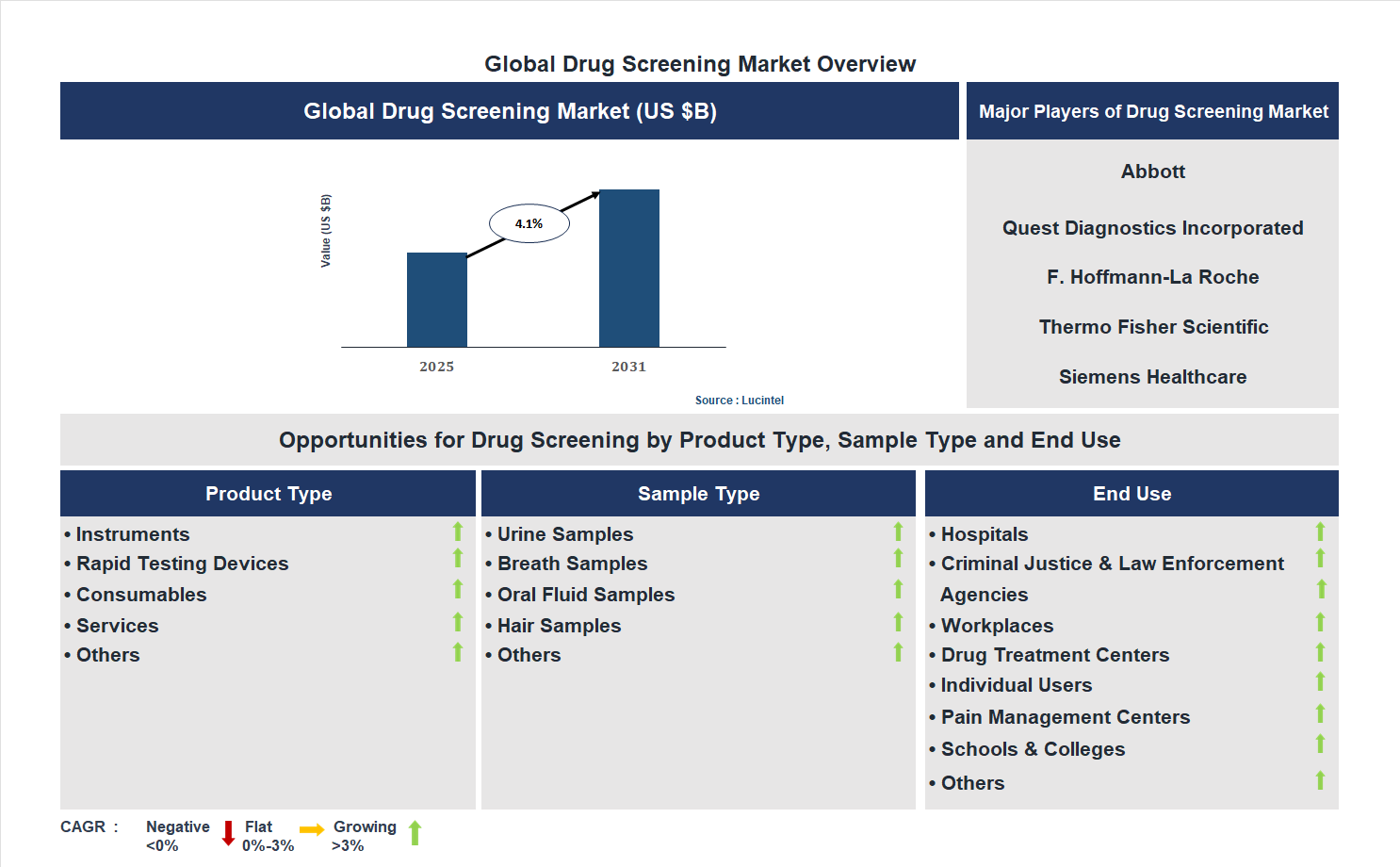
The future of the global drug screening market looks promising with opportunities in the hospital, criminal justice & law enforcement agency, workplace, drug treatment center, individual user, pain management center, and school & college markets. The global drug screening market is expected to grow with a CAGR of 4.1% from 2025 to 2031. The major drivers for this market are the increasing cases of drug abuse detection, the rising implementation of workplace testing programs, and the growing demand for rapid testing kits.• Lucintel forecasts that, within the product type category, consumable is expected to witness the highest growth over the forecast period.
• Within the end use category, drug treatment center is expected to witness the highest growth.
• In terms of region, APAC is expected to witness the highest growth over the forecast period. Gain valuable insights for your business decisions with our comprehensive 150+ page report. Sample figures with some insights are shown below.
Emerging Trends in the Drug Screening Market
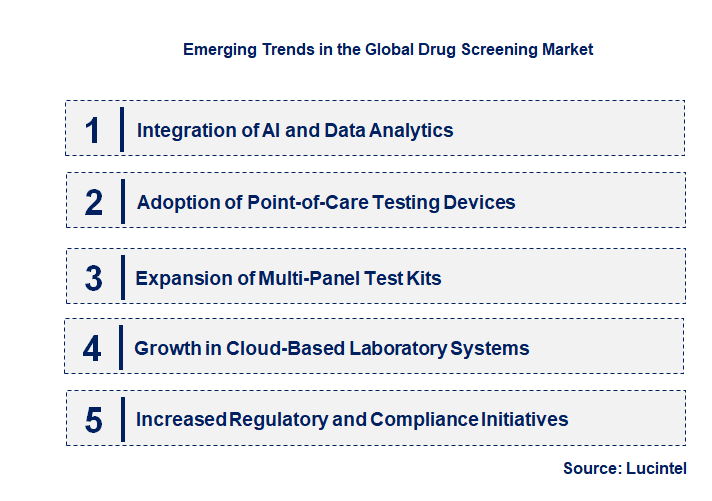
The drug screening market is undergoing significant transformation driven by automation, advanced detection technologies, and digital integration. As awareness and regulatory enforcement increase, testing processes are becoming faster, more accurate, and accessible. The following trends highlight how technological innovation and policy evolution are redefining global standards in drug testing and monitoring systems.• Integration of AI and Data Analytics: Artificial intelligence and analytics are improving data accuracy and reducing human error in drug testing. Automated data interpretation enables early detection of drug misuse trends and supports faster reporting, enhancing efficiency and reliability across healthcare and workplace screening environments.
• Adoption of Point-of-Care Testing Devices: Portable point-of-care drug testing devices are gaining popularity for rapid onsite analysis. These devices offer high accuracy with minimal setup, improving screening accessibility in non-laboratory environments such as schools, workplaces, and roadside law enforcement operations.
• Expansion of Multi-Panel Test Kits: Multi-panel kits capable of detecting multiple substances simultaneously are becoming more widely used. They enhance testing efficiency and reduce costs, enabling comprehensive screening in clinical and forensic settings while supporting broader drug monitoring programs.
• Growth in Cloud-Based Laboratory Systems: Cloud-enabled laboratory information systems are streamlining drug testing workflows by allowing secure data sharing and remote result analysis. These systems enhance transparency, reduce turnaround times, and enable real-time collaboration among healthcare professionals and regulatory bodies.
• Increased Regulatory and Compliance Initiatives: Governments are strengthening policies to standardize testing protocols and ensure reliability. Mandatory screening programs in workplaces, transport sectors, and healthcare institutions are driving consistent market growth and promoting a drug-free environment across industries. Emerging trends in drug screening reflect a shift toward technology-driven, automated, and accessible solutions. Enhanced accuracy, data integration, and regulatory alignment are ensuring that drug screening evolves into a more efficient and standardized component of global safety and healthcare practices.
Recent Development in the Drug Screening Market
The drug screening market is witnessing key developments centered around automation, precision, and accessibility. Innovations in analytical technology and growing public-private collaborations are driving adoption across diverse end-use sectors. These advancements are reshaping the market by improving diagnostic accuracy, reducing testing time, and expanding the scope of screening applications worldwide.• Launch of AI-Powered Screening Platforms: The introduction of AI-integrated testing systems is improving detection precision, reducing manual errors, and optimizing laboratory workflows for faster results.
• Expansion of Portable Testing Solutions: Compact and mobile drug screening kits are being developed for on-site testing, increasing flexibility in workplace and field-based environments.
• Technological Progress in Chromatography and Mass Spectrometry: Enhanced analytical instruments are offering improved sensitivity and specificity for detecting complex drug compounds.
• Collaboration between Research Institutions and Manufacturers: Partnerships are promoting product innovation and validation, ensuring that devices meet stringent regulatory and performance standards.
• Digitalization of Laboratory Operations: Cloud-based systems and automated reporting platforms are streamlining data management and enabling faster decision-making across testing facilities. These developments are advancing the drug screening market toward higher precision, accessibility, and operational efficiency. Integration of smart technologies and collaborative innovation is ensuring better compliance and broader adoption across healthcare, corporate, and forensic domains.
Strategic Growth Opportunities in the Drug Screening Market
The drug screening market presents vast growth opportunities across multiple application areas. As organizations and institutions emphasize safety and regulatory compliance, the demand for accurate and scalable testing solutions is increasing. The following applications highlight key areas where technological innovation and policy support are fostering significant market expansion.• Workplace Drug Testing: Corporates are increasingly implementing regular screening programs to ensure employee safety and compliance, driving demand for reliable and quick-testing devices.
• Hospitals and Clinical Laboratories: Healthcare facilities are adopting advanced testing technologies to monitor patient compliance, support diagnosis, and prevent drug misuse in clinical care.
• Forensic and Law Enforcement: Crime laboratories and police departments are investing in advanced analytical systems for drug detection in criminal investigations and evidence analysis.
• Educational Institutions: Schools and universities are initiating preventive screening programs to promote safe environments and discourage substance misuse among students.
• Home and Personal Testing: Growing awareness of health monitoring is driving the adoption of easy-to-use, at-home drug testing kits that provide quick results and confidentiality. These applications are creating diverse avenues for market growth. Expanding drug screening across public, professional, and personal domains is reinforcing safety measures and ensuring regulatory alignment across global industries.
Drug Screening Market Driver and Challenges
The drug screening market is influenced by technological advancements, regulatory frameworks, and social awareness initiatives. While innovation and automation are enhancing efficiency and accuracy, the market also faces challenges related to cost, standardization, and privacy concerns. Understanding these factors provides insight into how the market is adapting to evolving global safety and compliance needs. The factors responsible for driving the drug screening market include: 1. Increasing Focus on Workplace Safety: Growing employer emphasis on drug-free environments is driving widespread adoption of screening programs across industries. 2. Advancement in Analytical and Detection Technologies: Innovations in immunoassay, chromatography, and spectroscopy are enabling faster and more precise results. 3. Rising Government and Regulatory Support: Policies mandating drug testing for transportation, healthcare, and defense sectors are boosting market expansion. 4. Growing Awareness of Substance Abuse Issues: Public health campaigns and community awareness initiatives are increasing acceptance of regular drug screening. 5. Integration of Digital and Automated Systems: Automated laboratory systems and digital data management platforms are improving operational efficiency and reducing turnaround times. Challenges in the drug screening market are: 1. High Cost of Advanced Equipment: The expense of analytical instruments and maintenance restricts adoption among smaller laboratories. 2. Concerns Over Privacy and Data Security: The digitalization of testing raises issues regarding data confidentiality and misuse of personal health information. 3. Lack of Standardized Testing Protocols: Variations in testing methodologies and regulations across regions can lead to inconsistent results and compliance challenges. The drug screening market is expanding rapidly, supported by innovation and policy reinforcement. However, addressing challenges related to cost, privacy, and standardization is essential to ensure equitable access, data security, and consistent testing practices across global healthcare and occupational environments.List of Drug Screening Companies
Companies in the market compete on the basis of product quality offered. Major players in this market focus on expanding their manufacturing facilities, R&D investments, infrastructural development, and leverage integration opportunities across the value chain. With these strategies drug screening companies cater increasing demand, ensure competitive effectiveness, develop innovative products & technologies, reduce production costs, and expand their customer base. Some of the drug screening companies profiled in this report include-• Abbott
• Quest Diagnostics Incorporated
• F. Hoffmann-La Roche
• Thermo Fisher Scientific
• Siemens Healthcare
• Laboratory Corporation of America Holdings
• Alfa Scientific Designs
• OraSure Technologies
• Omega Laboratories
• Drägerwerk
Drug Screening Market by Segment
The study includes a forecast for the global drug screening market by product type, sample type, end use, and region.Drug Screening Market by Product Type [Value from 2019 to 2031]:
• Instruments
• Rapid Testing Devices
• Consumables
• Services
• Others
Drug Screening Market by Sample Type [Value from 2019 to 2031]:
• Urine Samples
• Breath Samples
• Oral Fluid Samples
• Hair Samples
• Others
Drug Screening Market by End Use [Value from 2019 to 2031]:
• Hospitals
• Criminal Justice & Law Enforcement Agencies
• Workplaces
• Drug Treatment Centers
• Individual Users
• Pain Management Centers
• Schools & Colleges
• Others
Drug Screening Market by Region [Value from 2019 to 2031]:
• North America
• Europe
• Asia Pacific
• The Rest of the World
Country Wise Outlook for the Drug Screening Market
The drug screening market is advancing globally with significant innovation in testing technologies, automation, and digital integration. Growing focus on workplace safety, healthcare compliance, and law enforcement initiatives has accelerated the adoption of efficient and accurate screening methods. Countries are investing in improved detection platforms, rapid testing kits, and integrated analytical systems to enhance drug monitoring and regulatory control.• United States: In the United States, drug screening adoption is rising across corporate, healthcare, and government sectors. Technological innovations in immunoassay and chromatography-based methods are improving result accuracy and speed. The expansion of mandatory workplace testing programs and integration of automated laboratory systems are strengthening the country’s focus on drug-free workplace environments and enhanced compliance.
• China: China’s drug screening market is growing rapidly through government initiatives aimed at improving forensic and clinical testing capacity. Local laboratories are adopting advanced analytical platforms, including mass spectrometry and high-throughput systems. Increased investment in healthcare diagnostics and stringent regulations against drug abuse are supporting the development of a modernized testing ecosystem with improved quality standards.
• Germany: Germany is witnessing steady progress in drug screening technology with advancements in liquid chromatography and spectrometry techniques. The emphasis on precision, quality assurance, and research-driven solutions is improving detection capabilities for a wide range of substances. Growing demand from healthcare institutions, workplaces, and law enforcement agencies is driving market expansion and modernization of laboratory networks.
• India: India’s drug screening market is growing with increased awareness and adoption of rapid testing devices. Hospitals, corporate organizations, and educational institutions are implementing drug detection programs to ensure safety and compliance. Local manufacturers are producing cost-effective, portable test kits that offer quick results, helping expand screening accessibility across both urban and rural healthcare settings.
• Japan: Japan’s drug screening market is characterized by high investment in precision instruments and automated testing systems. Hospitals and forensic laboratories are adopting digital data management tools and integrated analyzers to improve efficiency and reliability. The country’s strong focus on clinical accuracy and regulatory compliance continues to enhance its testing infrastructure and operational consistency.

Features of the Global Drug Screening Market
Market Size Estimates: Drug screening market size estimation in terms of value ($B). Trend and Forecast Analysis: Market trends (2019 to 2024) and forecast (2025 to 2031) by various segments and regions. Segmentation Analysis: Drug screening market size by product type, sample type, end use, and region in terms of value ($B). Regional Analysis: Drug screening market breakdown by North America, Europe, Asia Pacific, and Rest of the World. Growth Opportunities: Analysis of growth opportunities in different product types, sample types, end uses, and regions for the drug screening market. Strategic Analysis: This includes M&A, new product development, and competitive landscape of the drug screening market. Analysis of competitive intensity of the industry based on Porter’s Five Forces model.
FAQ
Q1. What is the growth forecast for drug screening market? Answer: The global drug screening market is expected to grow with a CAGR of 4.1% from 2025 to 2031. Q2. What are the major drivers influencing the growth of the drug screening market? Answer: The major drivers for this market are the increasing cases of drug abuse detection, the rising implementation of workplace testing programs, and the growing demand for rapid testing kits. Q3. What are the major segments for drug screening market? Answer: The future of the drug screening market looks promising with opportunities in the hospital, criminal justice & law enforcement agency, workplace, drug treatment center, individual user, pain management center, and school & college markets. Q4. Who are the key drug screening market companies? Answer: Some of the key drug screening companies are as follows:• Abbott
• Quest Diagnostics Incorporated
• F. Hoffmann-La Roche
• Thermo Fisher Scientific
• Siemens Healthcare
• Laboratory Corporation of America Holdings
• Alfa Scientific Designs
• OraSure Technologies
• Omega Laboratories
• Drägerwerk Q5. Which drug screening market segment will be the largest in future? Answer: Lucintel forecasts that, within the product type category, consumable is expected to witness the highest growth over the forecast period. Q6. In drug screening market, which region is expected to be the largest in next 5 years? Answer: In terms of region, APAC is expected to witness the highest growth over the forecast period. Q7. Do we receive customization in this report? Answer: Yes, Lucintel provides 10% customization without any additional cost.
Table of Contents
List of Figures
List of Tables
Methodology
- In-depth interviews of the major players in this market
- Detailed secondary research from competitors’ financial statements and published data
- Extensive searches of published works, market, and database information pertaining to industry news, company press releases, and customer intentions
- A compilation of the experiences, judgments, and insights of Lucintel’s professionals, who have analyzed and tracked this market over the years.


Buy Now
Choose a license that fits your team. Instant PDF delivery.
Prices exclude taxes. Instant delivery. Custom licensing available on request.
Key Questions
- • What are some of the most promising, high-growth opportunities for the drug screening market by product type (instruments, rapid testing devices, consumables, services, and others), sample type (urine samples, breath samples, oral fluid samples, hair samples, and others), end use (hospitals, criminal justice & law enforcement agencies, workplaces, drug treatment centers, individual users, pain management centers, schools & colleges, and others), and region (North America, Europe, Asia Pacific, and the Rest of the World)?
- • Which segments will grow at a faster pace and why?
- • Which region will grow at a faster pace and why?
- • What are the key factors affecting market dynamics? What are the key challenges and business risks in this market?
- • What are the business risks and competitive threats in this market?
- • What are the emerging trends in this market and the reasons behind them?
- • What are some of the changing demands of customers in the market?
- • What are the new developments in the market? Which companies are leading these developments?
- • Who are the major players in this market? What strategic initiatives are key players pursuing for business growth?
- • What are some of the competing products in this market and how big of a threat do they pose for loss of market share by material or product substitution?
- • What M&A activity has occurred in the last 5 years and what has its impact been on the industry? For any questions related to Drug Screening Market, Drug Screening Market Size, Drug Screening Market Growth, Drug Screening Market Analysis, Drug Screening Market Report, Drug Screening Market Share, Drug Screening Market Trends, Drug Screening Market Forecast, Drug Screening Companies, write Lucintel analyst at email: helpdesk@lucintel.com. We will be glad to get back to you soon.


