
Market Report · July 31, 2026

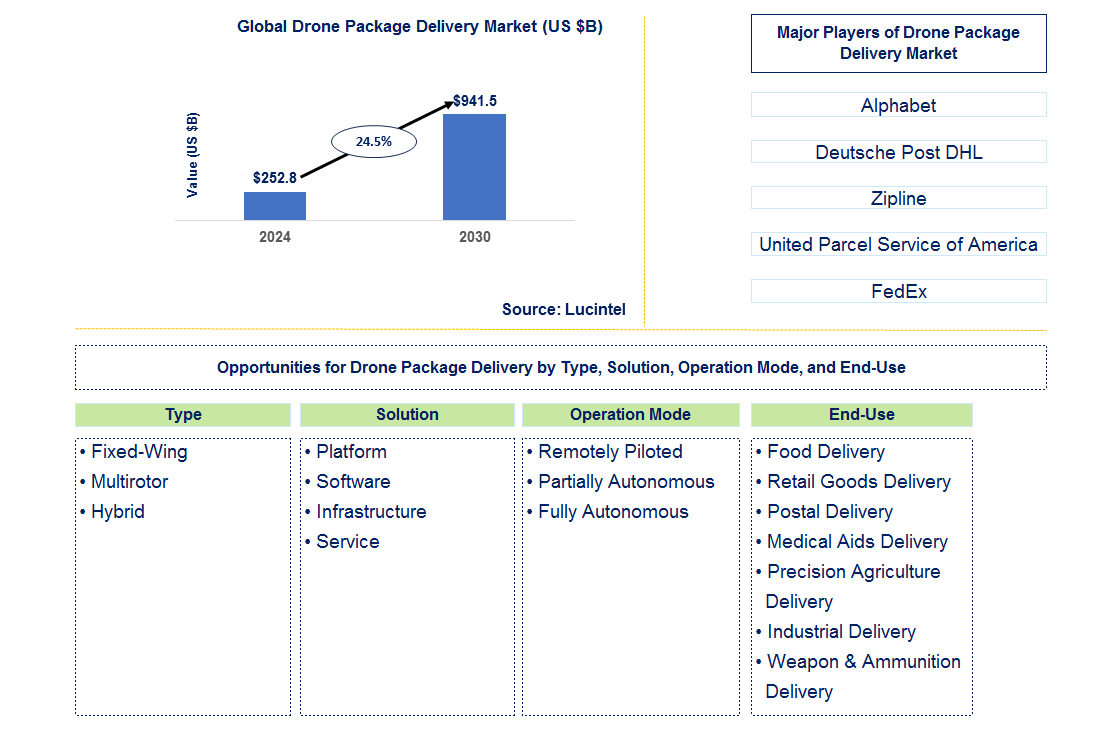
Key data points: The market size in 2030 = $941.5 billion, growth forecast = 24.5% annually for the next 6 years. Scroll below to get more insights. This market report covers trends, opportunities, and forecasts in the global drone package delivery market to 2030 by type (fixed-wing, multirotor, and hybrid), solution (platform, software, infrastructure, and service), operation mode (remotely piloted, partially autonomous, and fully autonomous), end-use (food delivery, retail goods delivery, postal delivery, medical aids delivery, precision agriculture delivery, industrial delivery, and weapon & ammunition delivery), and region (North America, Europe, Asia Pacific, and the Rest of the World)
We'll send your sample report shortly.
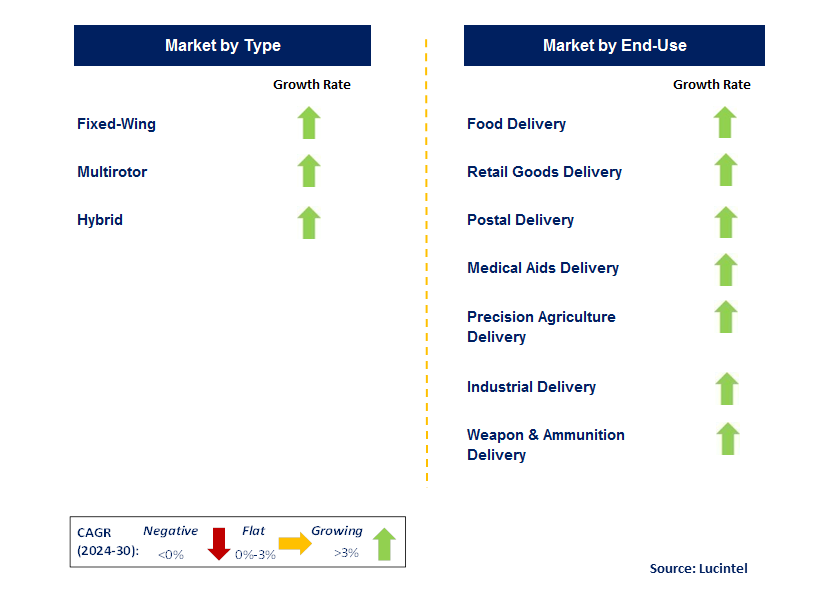
• Lucintel forecasts that, within the type category, fixed-wing is expected to witness the highest growth over the forecast period because the wings that provide longer battery life, less drag, and the ability to generate upward push to stay airborne, and the fixed wing drones are a better option for oil pipeline surveys owing to its advantages.
• In terms of regions, North America is expected to witness the highest growth over the forecast period due to flourishing network of tech entrepreneurs, delivery service companies, and drone manufacturers, as well as, advantageous legal regimes that facilitate drone operations and support the growth of the business in the region. Gain valuable insights for your business decisions with our comprehensive 150+ page report.
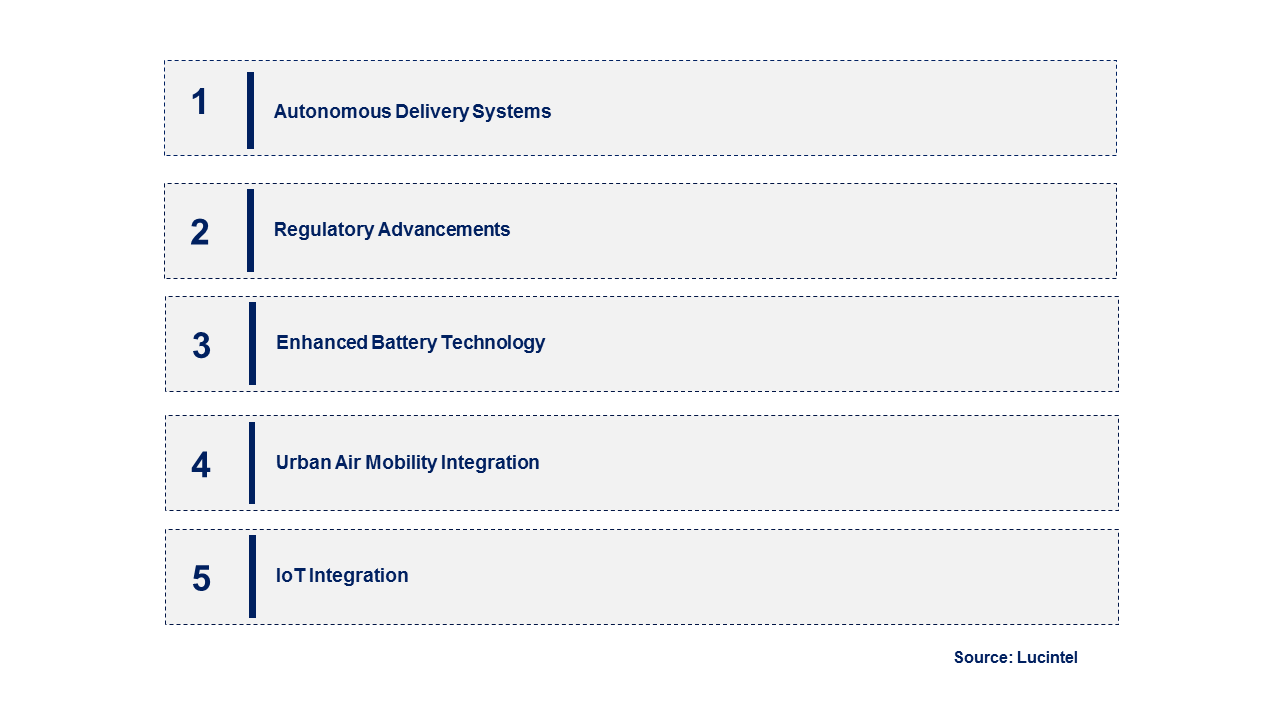
• Autonomous Delivery Systems: Autonomous drones equipped with advanced AI and machine learning algorithms are becoming more common. With these systems, drones can navigate complex environments without human intervention, thus increasing efficiency and reducing operational costs associated with manual piloting during flights.
• Regulatory Advancements: Regulatory frameworks have evolved to support growth in drone delivery services. Governments around the world have introduced new rules for managing airspace integration, ensuring safety and handling privacy concerns, among others, to increase the adoption of drone deliveries.
• Enhanced Battery Technology: Advances in battery technology, such as improved lithium-ion batteries and emerging solid-state batteries, are enabling drones to fly longer while carrying heavier payloads. This leads to longer distances covered by a single flight, enhancing their ability to deliver heavy packages.
• Urban Air Mobility Integration: Urban air mobility integration is becoming increasingly popular as drones are used for short-distance deliveries in urban areas. This helps solve problems of traffic congestion and provides quicker delivery options.
• IoT Integration: The Internet of Things is integrated into drone systems to improve real-time tracking and operational efficiency. IoT-enabled drones can connect with other devices and systems, providing better visibility over delivery processes. The above trends have driven changes in the drone package delivery market, which is now characterized by technological advances, regulatory changes, and sustainability commitments, indicating a new landscape ahead.
• Development of Delivery Drones with Improved Payload and Range: Recent advances include the creation of drones with greater payload capacity and the ability to fly longer distances. These advancements have been achieved through battery technology innovations coupled with lightweight materials, allowing drones to carry heavy packages for longer distances, thus improving overall efficiency in the delivery process.
• Regulatory Framework Enhancements: Governments globally are developing rules to support drone delivery services. To facilitate the smooth integration of drones into national airspace, new laws and guidelines regarding operations related to safety and privacy, among other aspects, have been enacted. Such support is instrumental in the expansion of drone delivery services.
• Advancements in Autonomous Drone Technologies: Autonomous drone systems have seen significant developments. These drones rely on AI and machine learning for navigation and delivery, making human intervention less necessary and enhancing operational efficiency. This trend has made drone deliveries more reliable and scalable.
• Expansion of Drone Delivery Trials and Pilot Programs: Numerous enterprises are expanding their drone delivery trials and pilot programs. These initiatives involve testing drones in various locations, such as urban centers and rural areas, to assess their performance in real-life settings. The conclusions from these experiments are shaping the future of drone delivery firms.
• Collaboration with E-commerce Platforms: Growth in the market is driven by strategic partnerships between drone manufacturers and e-commerce giants. These partnerships have enabled the seamless incorporation of drones into existing logistics networks, resulting in improved service delivery speed to customers. This collaboration accelerates the adoption of drone delivery solutions by leveraging established marketplaces. These developments mark a pronounced technological leap, regulatory enhancement, and operational improvement that have significantly driven the growth and efficiency of the drone package delivery market.
• Urban Logistics Solutions: Urban areas offer significant prospects for drone delivery services. Drones can help ease traffic congestion and provide faster delivery options in cities. Offering tailor-made solutions for urban logistics could lead to considerable market size increases and resolve last-mile delivery challenges.
• Integration with E-commerce Platforms: Collaborating with e-commerce firms provides avenues for the smooth integration of drone delivery services into existing supply chains. This allows for speedy deliveries, giving online retailers an edge in the fast-growing online retail industry.
• Development of Specialized Delivery Solutions: Creating specific offerings for sectors such as medical supplies, groceries, or large packages can open new markets. Tailored solutions enable meeting individual needs and expanding the range of services.
• Advancements in Drone Technology: Investing in more advanced drones, such as those with improved flight capabilities, autonomous systems, and better safety features, presents growth opportunities. Technological innovation will enhance operational efficiency and increase service offerings, driving adoption trends in the market.
• Regulatory Compliance and Advocacy: Engaging with regulatory bodies and contributing to the development of industry standards creates opportunities for growth. This can lead to market expansion achieved through adherence to regulations and advocating for supportive policies. These strategic growth opportunities underscore areas of focus aimed at expanding business activities in urban logistics, technological advancements, industry partnerships, and interactions with regulators, thus supporting the development and success of the drone package delivery market.
• Technological Advancements: Improved flight capabilities, battery life, and autonomous systems are some technological advances in drone technology that drive market growth. These developments make drone delivery services more efficient and reliable, making them a more viable alternative.
• E-commerce Growth: The increase in e-commerce has led to a higher demand for quick and efficient delivery methods. Rapid delivery services provide drones an advantage by meeting the expectations of online shoppers and retailers.
• Urban Logistics Solutions: Drones address urban logistics challenges such as traffic congestion and fast deliveries. This adoption supports their ability to deliver last-mile packages efficiently in densely populated areas.
• Regulatory Support: Progressive regulatory frameworks and approvals facilitate the integration of drones into airspace. Market expansion is realized through enabling regulations that foster wider deployment options and provide operational flexibility.
• Cost Reduction: Reducing labor costs and transport expenses are possible benefits of using drones. These result in cost optimization through route efficiency and automation, lowering overall delivery charges. Challenges in the drone package delivery market include:
• Regulatory Hurdles: Navigating complex and evolving regulatory frameworks can be challenging. Rules governing airspace, safety, and privacy have implications for the adoption and scalability of drone delivery services.
• Safety and Security Concerns: Ensuring the safe operation of drones is crucial. Challenges include preventing crashes, ensuring data security, and addressing risks associated with drone technologies.
• Infrastructure and Logistics: Developing drone operation infrastructure, such as charging stations and maintenance facilities, is expensive and logistically complex. Heavy investment is required to integrate drones into existing logistics networks. These factors shape the drone package delivery market, with technological advancements and regulatory support driving growth, while regulatory and logistical challenges must be addressed for successful market expansion.
• Alphabet
• Deutsche Post DHL
• Zipline
• United Parcel Service of America
• FedEx
• Matternet
• EHang Wingcopter
• Fixed-Wing
• Multirotor
• Hybrid
• Platform
• Software
• Infrastructure
• Service
• Remotely Piloted
• Partially Autonomous
• Fully Autonomous
• Food Delivery
• Retail Goods Delivery
• Postal Delivery
• Medical Aids Delivery
• Precision Agriculture Delivery
• Industrial Delivery
• Weapon & Ammunition Delivery
• North America
• Europe
• Asia Pacific
• The Rest of the World
• United States: Major firms such as Amazon and UPS have made substantial progress with their drone delivery trials domestically. The Federal Aviation Administration has introduced new regulations to support the integration of drones into national airspace, facilitating wider deployment capabilities. Operational capabilities have also been enhanced by better drone technologies, including improved navigation systems and longer battery life.
• China: China is leading in drone package delivery with extensive use by companies like SF Express and JD.com. Innovations include advanced drone designs for heavier payloads and longer flights. Recent regulations implemented by the Chinese government allow for more extensive testing, including in urban and rural areas.
• Germany: In Germany, drone delivery trials increasingly focus on urban logistics and last-mile solutions. Supported by advances in technology and infrastructure, companies are testing drones for parcel deliveries in urban settings. The German government is working to develop a regulatory framework that allows safe operations of drones in densely populated areas.
• India: The Indian market for drone package delivery is developing, with pilot projects initiated to enhance last-mile delivery, especially in remote locations. These advancements include collaborations with government agencies to create regulatory guidelines and advancements in drone technology to address local logistical challenges such as infrastructure constraints and varied terrain.
• Japan: Japan is exploring drone deliveries to remote areas that are hard to reach. Companies are developing drones with superior capabilities to meet the requirements for precision and reliability. The Japanese government is also developing frameworks necessary for the safe integration of drones into national airspace, focusing on both urban and rural delivery scenarios.


• Alphabet
• Deutsche Post DHL
• Zipline
• United Parcel Service of America
• FedEx
• Matternet
• EHang Wingcopter Q6. Which drone package delivery market segment will be the largest in future? Answer: Lucintel forecasts that fixed-wing is expected to witness the highest growth over the forecast period because the wings that provide longer battery life, less drag, and the ability to generate upward push to stay airborne, and the fixed wing drones are a better option for oil pipeline surveys owing to its advantages. Q7. In drone package delivery market, which region is expected to be the largest in next 5 years? Answer: North America is expected to witness highest growth over the forecast period due to flourishing network of tech entrepreneurs, delivery service companies, and drone manufacturers, as well as, advantageous legal regimes that facilitate drone operations and support the growth of the business in the region. Q.8 Do we receive customization in this report? Answer: Yes, Lucintel provides 10% customization without any additional cost.


Choose a license that fits your team. Instant PDF delivery.
Prices exclude taxes. Instant delivery. Custom licensing available on request.
Market Report · July 31, 2026
Market Report · July 31, 2026
Market Report · July 31, 2026
Trusted partner for strategic intelligence and business growth


Receive a complimentary market analysis tailored to your industry. Our analysts will identify key growth opportunities and competitive dynamics specific to your business.

Market size, growth rate, and key trend analysis for your specific sector.

Top competitor positioning and market share analysis.

Strategic recommendations backed by data-driven insights.
Get curated market intelligence and competitive moves straight to your inbox.
By subscribing, you agree to receive our monthly insights. Unsubscribe anytime.
Receive a complimentary market analysis tailored to your industry. Our analysts will identify key growth opportunities and competitive dynamics specific to your business.
Market size, growth rate, and key trend analysis for your specific sector.
Top competitor positioning and market share analysis.
Strategic recommendations backed by data-driven insights.
Get curated market intelligence, emerging trends, and competitive moves straight to your inbox each month.
By subscribing, you agree to receive our monthly insights. Unsubscribe anytime.
We'll send your sample report shortly.