
Market Report · July 29, 2026

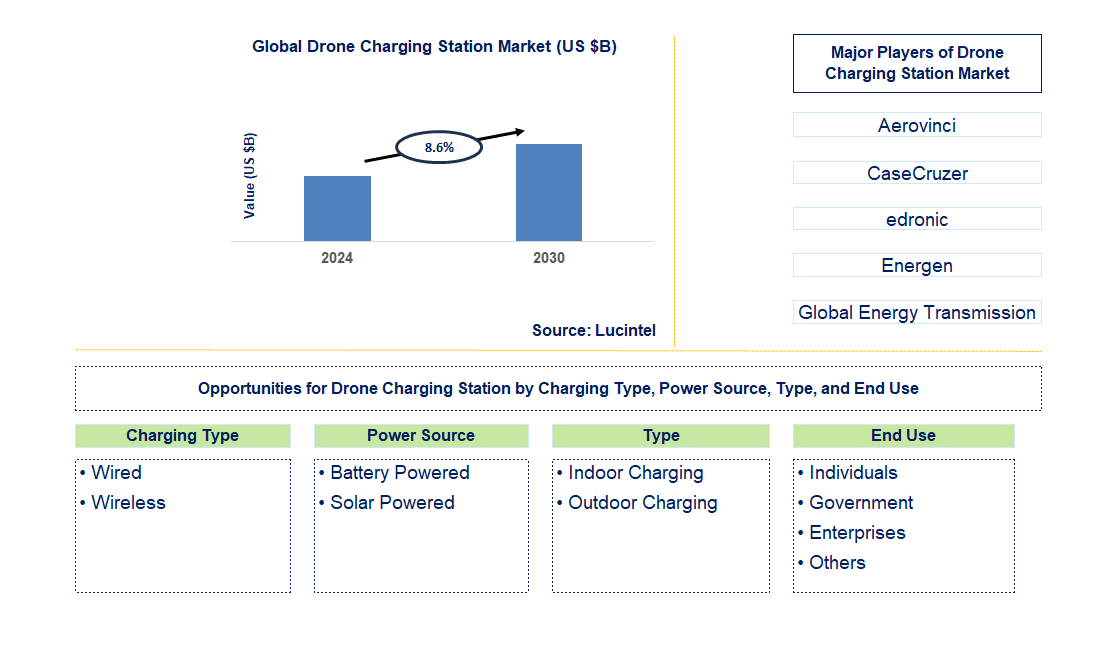
Key data points: The growth forecast = 8.6% annually for the next 6 years. Scroll below to get more insights. This market report covers trends, opportunities, and forecasts in the global drone charging station market to 2030 by charging type (wired and wireless), power source (battery powered and solar powered), type (indoor charging and outdoor charging), end use (individuals, government, enterprises, and others), and region (North America, Europe, Asia Pacific, and the Rest of the World)
We'll send your sample report shortly.
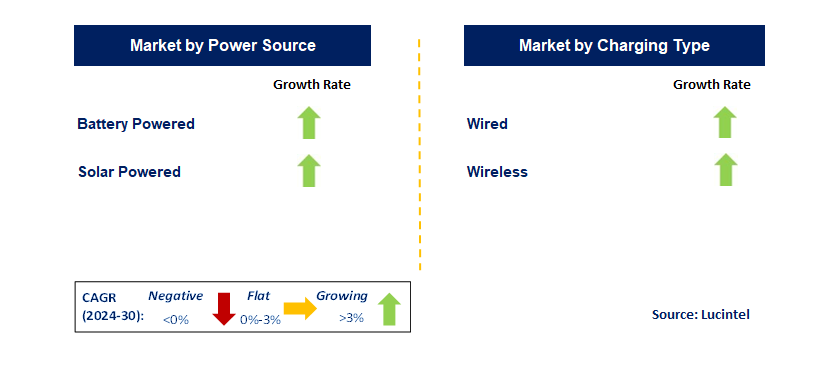
• Lucintel forecasts that, within the charging type category, wireless is expected to witness a higher growth over the forecast period as it enables unmanned aerial vehicles to recharge efficiently without physical connections.
• Within the end use category, enterprises will remain the largest segment due to its growing usage in commercial applications, such as surveillance, logistics, and aerial inspections.
• In terms of region, North America will remain the largest region over the forecast period due to extensive drone adoption and presence of advanced technological infrastructure in the region. Gain valuable insights for your business decisions with our comprehensive 150+ page report.
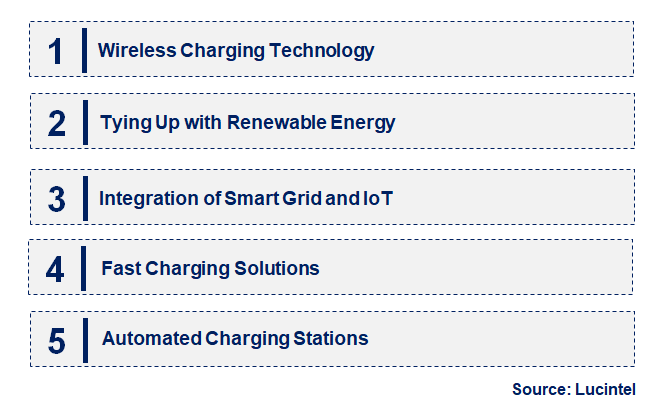
• Wireless Charging Technology: Wirelessly or inductively charging drones is a trend gaining momentum, eliminating the need for a direct physical connection between a drone and a charging station. This enhances operational efficiency and reduces wear and tear. In this way, effortless and fast recharging supports long-duration operations of drones in sectors like surveillance and delivery, generally raising productivity levels.
• Tying Up with Renewable Energy: The incorporation of solar and wind energy sources into drone charging stations is becoming increasingly common. This aspect supports sustainability initiatives and reduces dependence on conventional power sources. With clean energy, charging stations can operate in a more sustainable manner and save on operational costs, aligning with global environmental initiatives.
• Integration of Smart Grid and IoT: Drone charging stations are increasingly integrating smart grid technology and the Internet of Things (IoT) to enable real-time monitoring and optimization of energy consumption. This improves efficiency and reliability while allowing for predictive maintenance and remote management, further enhancing the operational capabilities of drone fleets.
• Fast Charging Solutions: Rapid charging solutions are trending. Downtime and working time for drones can be improved as stations support quick turnaround times and can charge at high power with advanced battery technology. This trend will prove vital for applications that require repeated drone deployment during the day, such as delivery services and industrial inspections.
• Automated Charging Stations: The use of robotics and AI in charging stations is increasing. Such systems involve a docking and charging process with minimal human intervention, reducing errors in the process. This streamlines and scales up charging effectively. Automated stations will benefit large-scale organizations and remote bases by increasing the efficiency of drone fleets. These emerging trends have significantly reshaped the market for drone charging stations. By enhancing efficiency, sustainability, and operational capacities, these trends are expected to drive further changes and innovations in the drone industry as technology continues to advance.
• Advanced Battery Technologies: New high-capacity and rapid-charging battery technologies continue to transform drone operations. These advancements offer higher recharge rates and extended flying times, enabling support for more intense drone use. Companies are interested in new chemistries and designs that improve performance, reduce charging time, and increase the efficiency of the drone fleet.
• Modular Charging Solutions: Modular charging stations are flexible and scalable, making them applicable in various use cases and environments. These solutions can be easily extended or reconfigured as needs change, making them cost-effective and adaptable. Modular systems are especially effective in highly dynamic environments, such as disaster response and large-scale industrial operations.
• Integrability with Smart Infrastructure: Drone charging stations are now being established as integral parts of smart city frameworks and IoT ecosystems. Such charging stations promote real-time monitoring, data collection, and management of energy. Smart infrastructure provides fleets of drones with significant increases in operational efficiency and supports applications such as urban monitoring and autonomous logistics.
• Sustainability Initiatives: There is a growing emphasis on sustainability at both the design and operational levels of drone charging stations. The use of renewable energy sources, energy-saving technologies, and "green" materials is increasing. These efforts align directly with international environmental goals and contribute to reducing the carbon footprint of drone operations as part of a broader sustainability initiative.
• Regulatory Developments: Regulations are evolving to accommodate the development of drone charging infrastructure. Governments are introducing guidelines and standards to ensure safety, interoperability, and efficiency. These guidelines facilitate the installation of recharging stations and create a clearer path for market expansion. Market expansion, in turn, drives innovation and investment in the sector. Such new technologies are driving major transformations in the drone charging station market, improving technology, sustainability, and supporting regulations. Over time, these developments are set to characterize the future of drones in terms of operational and infrastructural elements.
• Logistics and Delivery Services: With the growth of e-commerce and the demand for last-mile delivery services, drone charging stations are emerging as a growth area. The frequency and high volumes of deliveries require efficient solutions to address the challenges of frequent charging. Improved investment in advanced charging infrastructure can boost logistics operational efficiency and reliability, becoming a key growth area.
• Agricultural Monitoring: Drones are increasingly used for precision agriculture, including crop monitoring and management. Charging stations that can operate in remote and rural areas become indispensable as the value of these applications extends beyond urban environments. Cost-efficient and robust charging solutions for agricultural drones will further propel growth in this sector and enhance better farming practices.
• Urban Surveillance and Security: Urban areas are leveraging drones for surveillance and security. Charging stations integrated into smart city infrastructure will improve continual operations while enhancing public safety. Opportunities include the development of innovative charging solutions that can be easily integrated with urban systems, providing reliable support for security applications.
• Emergency Response and Disaster Relief: This is especially important in disaster response and emergency services, where speed of deployment and readiness to operate are paramount. Rapid-deployment charging stations that can be easily set up in disaster-impacted areas can be mission-critical. The availability of mobile and rugged charging solutions is likely to make a significant difference in timely and effective responses.
• Public Sector and Government Applications: Government agencies are increasingly utilizing drones for infrastructure inspections and environmental monitoring, among other uses. Growth in this segment will be driven by charging stations that are customized for public sector operations. Opportunities include offering specialized charging solutions that meet the specific needs and regulatory requirements of government agencies. The major strategic growth opportunities reflect varied applications of drone charging stations and the scope for expansion within the market. A focus on key sectors and the identification of specific needs can drive innovation and growth in the drone charging station market.
• Technological Advancement: Rapid development in battery technology and charging solutions augments growth in the drone charging station market. Improvements in technologies, including wireless charging and fast-charging systems, enhance operational efficiency and support the expansion of drone applications across all industries.
• Increasing Adoption of Drones: One key growth driver is the increasing use of drones in commercial, industrial, and public sector applications. In logistics, agriculture, surveillance, and more, where drone usage is rising, the demand for efficient and reliable charging infrastructure is growing. This trend drives investment in drone charging stations and contributes to market growth.
• Investment in Smart Infrastructure: Integration into smart city infrastructure and IoT systems drives market growth for drone charging stations. Real-time monitoring, optimization, and data collection with smart infrastructure improve the efficiency and effectiveness of drone operations. Investment in this area supports powerful charging solutions, promoting market growth.
• Sustainability Concerns and Environmental Impact: Growing emphasis on sustainability and reduction of carbon footprints is driving the adoption of eco-friendly charging solutions. Integrating renewable energy with charging stations aligns with global environmental goals and further reduces operational costs. This trend influences the development of greener and more sustainable charging infrastructure.
• Regulatory Support and Standards: The demand for drone charging stations is supported by regulations and industry needs. Timely regulations increase safety, interoperability, and efficiency, providing room for expansion and innovation in the market. Challenges in the drone charging station market include:
• Regulatory Challenges: Complexities in this market may make it challenging for companies to enter and expand. The UAV charging station market is impacted by regional differences in safety, interoperability, and operational standards, which create barriers to market entry and expansion. Overcoming these regulatory challenges is the first step toward market growth.
• High Initial Costs: High upfront development and deployment costs can create significant barriers. High-tech drone charging stations are expensive and require substantial capital investment in emerging systems and infrastructure. This can be a barrier for market participants, necessitating affordable solutions and financial support.
• Technical Limitations and Compatibility Issues: Technical restrictions and compatibility problems arising from the diversity of drone models and charging systems may restrict market growth. Compatibility with a wide range of drone models and the necessary technical aids are important for achieving coverage and operational efficiency. The drivers and challenges affecting the drone charging station market indicate that this industry is constantly evolving. Technological advancements and growing adoption are driving expansion, but regulatory and financial challenges must be addressed to realize market potential. Such knowledge is essential for market participants aiming to navigate this dynamic environment successfully.
• Aerovinci
• CaseCruzer
• edronic
• Energen
• Global Energy Transmission
• H3 Dynamics
• HeishTech
• HSE - Unmanned Aerial Vehicles
• Nando Technologies
• Powermat
• Wired
• Wireless
• Battery Powered
• Solar Powered
• Indoor Charging
• Outdoor Charging
• Individuals
• Government
• Enterprises
• Others
• North America
• Europe
• Asia Pacific
• The Rest of the World
• United States: The development of charging technology for drones in the U.S. is mainly due to growth in drone applications from both commercial and public sectors. Companies have developed fast-charging solutions that can be equipped with high energy density and automated docking systems. The integration of these stations is being heavily invested in as part of smart city infrastructure and logistics networks. The FAA is also focused on regulations that must support these developments to ensure safety and efficiency in drone operations.
• China: China is steadily gaining a strong edge in drone technology, with advancements in charging stations underway. Such advancements in technology support the drone fleet and aim to accommodate the increasing number of drones in the country. The nation is investing heavily in battery technology and rapid-charging solutions to enhance the operational range and effectiveness of drones. Additionally, its persistent push for the incorporation of these stations into massive projects like smart cities and surveillance systems presents opportunities for innovative charging solutions.
• Germany: Germany is one of the front-runners in drone charging technologies, emphasizing green solutions where renewable energy sources generate power. The country is integrating solar and wind energy into drone charging stations to promote sustainability. German companies are developing modular and scalable charging systems that can be easily deployed in urban environments, industrial sites, or other locations. These developments are bolstering efforts to advance drone technology and infrastructure within the European Union.
• India: The Indian drone sector is growing rapidly, driven by the need for efficient agricultural monitoring and urban management. It focuses on building low-cost and compact charging stations and deploying them in remote and rural areas. Indian startups and government initiatives are encouraging innovation in battery technology and renewable energy integration to support a viable drone ecosystem across India. Additionally, mobile and portable charging solutions are advancing in the market.
• Japan: Drone technology is significantly advanced in Japan, with integrated robotics and automation. Improvements in drone charging stations are made possible by robotics, enabling equipment to charge and maintain itself. Japan is focused on smart city activities and disaster relief. Innovations are occurring in rapid-charging stations, which support emergency logistics operations. The government of Japan is implementing regulations to facilitate the smooth integration of such technologies.


• Aerovinci
• CaseCruzer
• edronic
• Energen
• Global Energy Transmission
• H3 Dynamics
• HeishTech
• HSE - Unmanned Aerial Vehicles
• Nando Technologies
• Powermat Q5. Which drone charging station market segment will be the largest in future? Answer: Lucintel forecasts that wireless is expected to witness highest growth over the forecast period due to flexibility, enabling unmanned aerial vehicles to recharge efficiently without physical connections. Q6. In drone charging station market, which region is expected to be the largest in next 6 years? Answer: North America will remain the largest region over the forecast period due to extensive drone adoption and presence of advanced technological infrastructure in the region. Q.7 Do we receive customization in this report? Answer: Yes, Lucintel provides 10% customization without any additional cost.


Choose a license that fits your team. Instant PDF delivery.
Prices exclude taxes. Instant delivery. Custom licensing available on request.
Market Report · July 29, 2026
Market Report · July 20, 2026
Market Report · July 20, 2026
Trusted partner for strategic intelligence and business growth


Receive a complimentary market analysis tailored to your industry. Our analysts will identify key growth opportunities and competitive dynamics specific to your business.

Market size, growth rate, and key trend analysis for your specific sector.

Top competitor positioning and market share analysis.

Strategic recommendations backed by data-driven insights.
Get curated market intelligence and competitive moves straight to your inbox.
By subscribing, you agree to receive our monthly insights. Unsubscribe anytime.
Receive a complimentary market analysis tailored to your industry. Our analysts will identify key growth opportunities and competitive dynamics specific to your business.
Market size, growth rate, and key trend analysis for your specific sector.
Top competitor positioning and market share analysis.
Strategic recommendations backed by data-driven insights.
Get curated market intelligence, emerging trends, and competitive moves straight to your inbox each month.
By subscribing, you agree to receive our monthly insights. Unsubscribe anytime.
We'll send your sample report shortly.