
Report Feature
Drone Camera Market Trends and Forecast
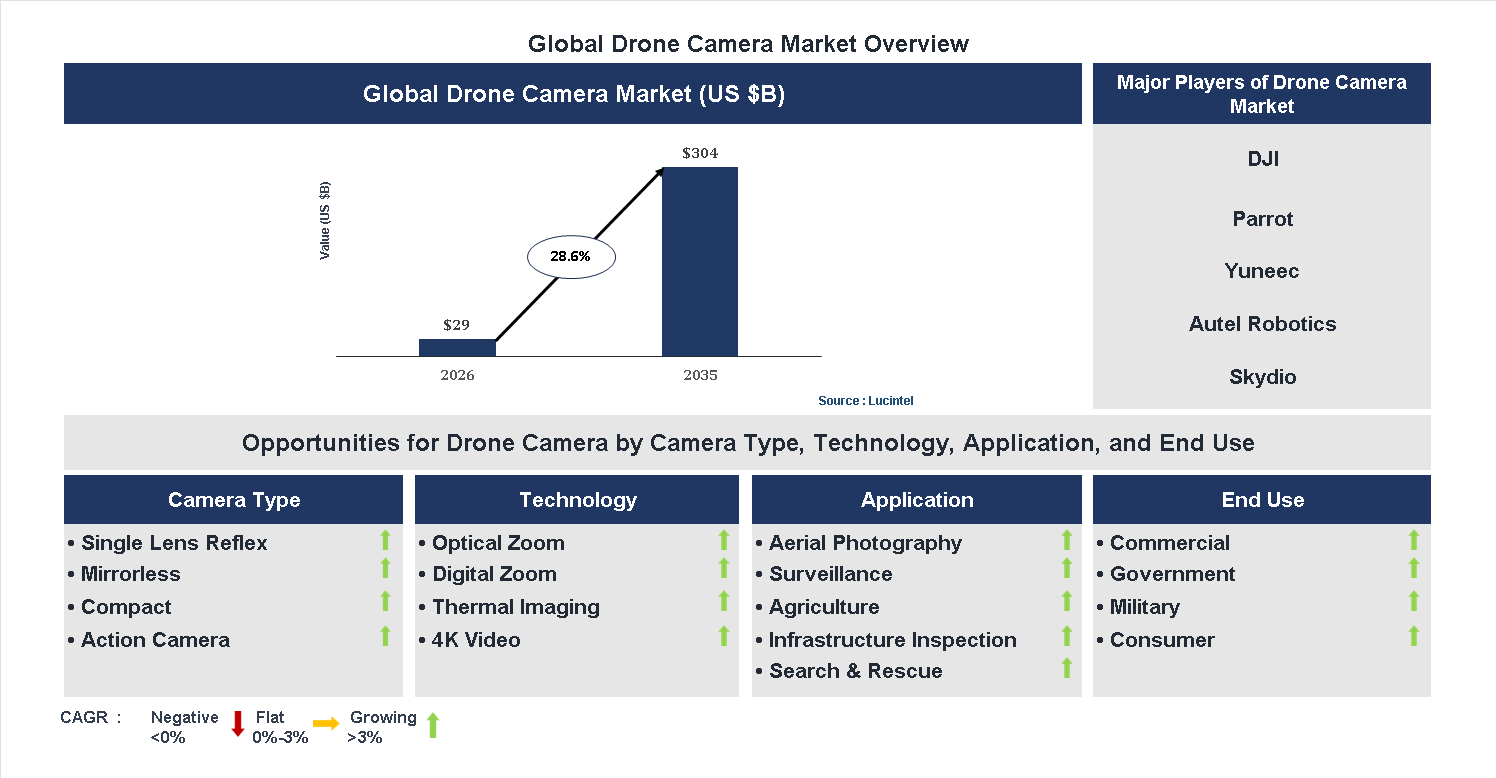
The future of the global drone camera market looks promising with opportunities in the commercial, government, military, and consumer markets. The global drone camera market is expected to reach an estimated $304 billion by 2035 with a CAGR of 28.6% from 2026 to 2035. The major drivers for this market are the increasing demand for aerial photography solutions, the rising adoption of drones across industries, and the growing use of high resolution imaging cameras.• Lucintel forecasts that, within the camera type category, mirrorless is expected to witness the highest growth over the forecast period.
• Within the end use category, commercial is expected to witness the highest growth.
• In terms of region, APAC is expected to witness the highest growth over the forecast period. Gain valuable insights for your business decisions with our comprehensive 150+ page report. Sample figures with some insights are shown below.
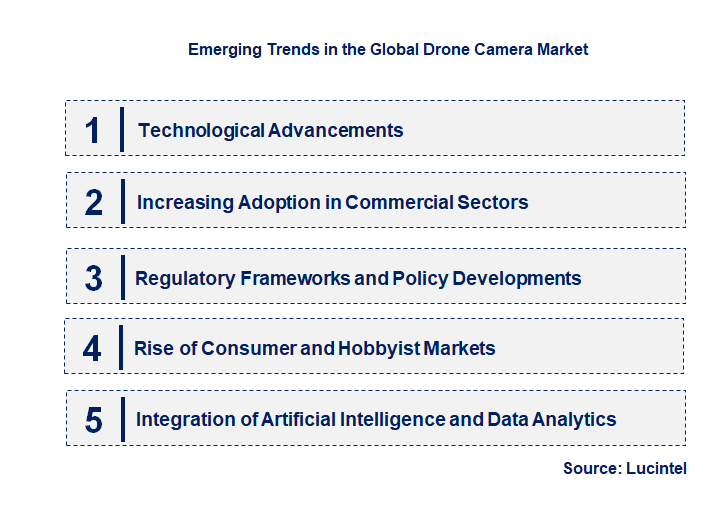
Emerging Trends in the Drone Camera Market
The drone camera market is experiencing rapid growth driven by technological advancements, increasing demand across various sectors, and evolving consumer preferences. As industries adopt drone technology for photography, surveillance, agriculture, and delivery, the market landscape is shifting significantly. Innovations in camera quality, flight capabilities, and data integration are fueling this expansion. Additionally, regulatory changes and the rise of commercial applications are creating new opportunities and challenges. These developments are not only transforming how businesses operate but also redefining consumer experiences, making the drone camera market a dynamic and competitive space with promising future prospects.• Technological Advancements: The market is witnessing significant improvements in camera resolution, stabilization, and image processing. High-definition sensors, 4K and 8K video capabilities, and advanced gimbal systems are enabling clearer, more professional-quality footage. These innovations are expanding the use of drone cameras in filmmaking, real estate, and industrial inspections. As technology becomes more affordable and compact, even hobbyists can access high-quality imaging. This trend boosts market growth by attracting a broader customer base and encouraging innovation in camera features, ultimately elevating the standards of aerial imaging.
• Increasing Adoption in Commercial Sectors: Industries such as agriculture, construction, security, and media are increasingly integrating drone cameras into their workflows. In agriculture, drones monitor crop health and optimize resource use; in construction, they assist in site surveys and progress tracking. Security firms deploy drones for surveillance, while media outlets use them for live coverage and event documentation. This diversification of applications is expanding market reach and creating new revenue streams. The growing reliance on drone cameras for operational efficiency and safety is a key driver, fostering market expansion and technological development tailored to sector-specific needs.
• Regulatory Frameworks and Policy Developments: Evolving regulations are shaping the drone camera market by establishing safety standards and operational guidelines. Governments worldwide are implementing licensing, no-fly zones, and privacy laws to regulate drone usage. While these policies can pose initial barriers, they also promote responsible adoption and innovation. Clear regulations boost consumer confidence and facilitate commercial deployment, especially in sensitive areas like urban surveillance and infrastructure inspection. As regulatory frameworks become more refined, they will enable broader market participation, ensuring sustainable growth and addressing safety and privacy concerns.
• Rise of Consumer and Hobbyist Markets: The affordability and user-friendliness of drone cameras are fueling a surge in the consumer segment. Enthusiasts and amateur photographers are adopting drones for recreational photography and videography, driving demand for compact, easy-to-operate models. This trend is supported by online communities, tutorials, and social media sharing, which enhance consumer engagement. The growth of the hobbyist market encourages manufacturers to innovate with features like intelligent flight modes and integrated editing tools. This segments expansion is vital for market diversification, fostering innovation, and creating a foundation for future professional-grade applications.
• Integration of Artificial Intelligence and Data Analytics: AI-powered features such as obstacle avoidance, automated flight paths, and real-time image analysis are transforming drone camera capabilities. These advancements enable drones to perform complex tasks with minimal human intervention, improving safety and efficiency. Data analytics tools allow for better interpretation of captured footage, supporting applications like crop monitoring, infrastructure inspection, and security surveillance. The integration of AI enhances the value proposition of drone cameras by enabling smarter, more autonomous operations. This trend is expected to accelerate market growth, open new application avenues, and push the boundaries of aerial imaging technology. These emerging trends are collectively reshaping the drone camera market by enhancing technological capabilities, expanding application areas, and fostering responsible regulation. The market is becoming more versatile, accessible, and intelligent, paving the way for innovative solutions across industries and consumer segments. This evolution promises sustained growth and a competitive landscape driven by continuous innovation and adaptation.
Recent Development in the Drone Camera Market
The drone camera market is experiencing rapid growth driven by technological advancements, increasing demand across various sectors, and expanding applications. Innovations in camera quality, battery life, and autonomous flight are opening new opportunities. The market is also benefiting from rising adoption in commercial, industrial, and recreational sectors. As regulations evolve, the industry is poised for further expansion, creating a competitive landscape with diverse offerings. These developments are shaping the future of aerial imaging and surveillance, making drone cameras more accessible and versatile.• Technological Innovations in Camera Quality: Enhanced resolution, stabilization, and low-light performance are improving image clarity and usability. These advancements enable applications in filmmaking, surveying, and security, attracting more users. Higher-quality cameras provide detailed imagery, supporting precision tasks like mapping and inspection. As technology progresses, affordability increases, broadening market reach. This growth in camera capabilities is driving demand for more sophisticated drones, fostering innovation and expanding market segments.
• Expansion of Commercial Applications: Drone cameras are increasingly used in agriculture, construction, and real estate for aerial surveys, monitoring, and marketing. These applications improve efficiency, reduce costs, and enhance data accuracy. For instance, in agriculture, drones assist in crop health assessment; in construction, they facilitate site inspections. The versatility of drone cameras is attracting businesses seeking innovative solutions. This expansion is creating new revenue streams and encouraging industry adoption, significantly impacting market growth and diversification.
• Rising Adoption in Industrial and Security Sectors: Industrial inspections, infrastructure monitoring, and security surveillance are major growth drivers. Drone cameras enable real-time data collection in hazardous or inaccessible areas, improving safety and operational efficiency. Governments and private firms are investing heavily in these technologies. Enhanced features like thermal imaging and night vision are expanding capabilities. This trend is boosting market size, fostering technological integration, and encouraging regulatory frameworks to support widespread industrial and security use.
• Advances in Autonomous Flight and AI Integration: Autonomous drones equipped with AI are improving navigation, obstacle avoidance, and data processing. These features enable complex tasks like autonomous mapping and real-time analytics. AI integration reduces human intervention, increasing efficiency and safety. Such innovations are attracting sectors like logistics, emergency response, and environmental monitoring. The development of intelligent drone systems is propelling market growth, creating opportunities for new services and applications, and setting the stage for smarter aerial solutions.
• Growing Regulatory Support and Market Accessibility: Governments are establishing clearer regulations, licensing, and safety standards, facilitating market entry. This regulatory clarity encourages investment and innovation while ensuring safety. Additionally, the availability of affordable consumer-grade drones is expanding the recreational segment. Increased market accessibility is attracting startups and established players alike, fostering competition and technological advancements. These regulatory developments are crucial for sustainable growth, enabling broader adoption across commercial, industrial, and consumer markets. The overall impact of these developments is a dynamic, expanding drone camera market characterized by technological innovation, diversified applications, and increased accessibility. This growth is fostering new business opportunities, enhancing operational efficiencies, and driving industry competitiveness. As the market matures, it is expected to see continued innovation, broader adoption, and regulatory support, shaping the future landscape of aerial imaging and surveillance.
Strategic Growth Opportunities in the Drone Camera Market
The drone camera market is experiencing rapid expansion driven by technological advancements, increasing demand across various industries, and evolving consumer preferences. As applications diversify from aerial photography to industrial inspections, new growth avenues emerge. Companies are investing heavily in innovation, regulatory compliance, and strategic partnerships to capture market share. This dynamic environment offers significant opportunities for stakeholders to develop tailored solutions, expand geographic reach, and enhance product capabilities, ultimately shaping the future landscape of drone camera technology and its applications worldwide.• Increasing Adoption in Aerial Photography and Videography: The popularity of drone cameras for professional and amateur photography is surging, driven by high-resolution imaging, stabilization features, and user-friendly interfaces. Sub-segments like cinematic filmmaking, real estate marketing, and event coverage benefit from advanced drone camera capabilities. As affordability improves and regulations become clearer, the market for aerial content creation is expected to grow substantially, encouraging manufacturers to develop lightweight, high-quality, and easy-to-operate drone cameras.
• Expansion into Industrial Inspection and Monitoring: Drone cameras are increasingly used for inspecting infrastructure such as power lines, pipelines, and wind turbines, reducing risks and costs associated with manual inspections. High-resolution imaging, thermal sensors, and AI integration enable detailed analysis and real-time monitoring. This opportunity is particularly significant in sectors like energy, construction, and agriculture, where precision and safety are paramount. The development of rugged, specialized drone cameras tailored for harsh environments is a key growth driver.
• Growth in Defense and Security Applications: Governments and security agencies are adopting drone cameras for surveillance, border patrol, and tactical operations. The demand for long-endurance, night-vision, and multi-sensor capabilities is rising. Enhanced data transmission, AI-powered analytics, and autonomous flight features are transforming military and law enforcement applications. This segment offers lucrative opportunities for innovation, especially in developing covert, resilient, and high-capacity drone camera systems to meet evolving security needs.
• Integration of AI and Machine Learning for Enhanced Functionality: Incorporating AI and ML into drone cameras enables autonomous navigation, object detection, and real-time data processing. These advancements improve operational efficiency and accuracy across applications like search and rescue, traffic management, and environmental monitoring. The development of intelligent algorithms and edge computing solutions is expected to revolutionize drone camera capabilities, making them more adaptable and capable of complex tasks, thus opening new markets and use cases.
• Development of Compact, Lightweight, and High-Performance Cameras: The demand for portable, easy-to-mount drone cameras is rising, especially for consumer drones and small commercial units. Innovations focus on miniaturization without compromising image quality, stabilization, and battery life. Sub-segments such as handheld gimbals, 4K cameras, and 360-degree imaging are expanding. These developments cater to hobbyists, journalists, and professionals seeking versatile, high-performance solutions that enhance mobility and usability in diverse environments. These growth opportunities collectively drive the evolution of the drone camera market, fostering innovation and expanding application horizons. As technological integration, industry-specific solutions, and regulatory frameworks advance, the market is poised for sustained growth. Stakeholders who capitalize on these opportunities will shape the future landscape, delivering more sophisticated, efficient, and versatile drone camera solutions across multiple sectors worldwide.
Drone Camera Market Driver and Challenges
The drone camera market is influenced by a variety of technological, economic, and regulatory factors that shape its growth trajectory. Rapid advancements in drone technology, decreasing costs, and increasing demand across sectors such as photography, surveillance, agriculture, and logistics are key drivers. Simultaneously, regulatory hurdles, privacy concerns, and technological limitations pose significant challenges. The interplay of these factors determines the markets expansion potential and the hurdles it must overcome to achieve sustainable growth. Understanding these drivers and challenges is essential for stakeholders to navigate the evolving landscape effectively and capitalize on emerging opportunities. The factors responsible for driving the drone camera market include:• Technological Innovation: The continuous development of lightweight, high-resolution cameras integrated with drones enhances image quality and operational efficiency. Innovations such as AI-powered stabilization, obstacle avoidance, and longer battery life expand drone capabilities, making them more attractive for commercial and recreational use. These advancements lower costs and improve user experience, fueling market growth. As technology evolves, new applications emerge, further boosting demand and encouraging manufacturers to invest in R&D to stay competitive.
• Cost Reduction and Accessibility: The decreasing costs of drone hardware and camera components have made drone cameras more accessible to a broader audience, including hobbyists, small businesses, and large enterprises. Economies of scale and technological improvements have driven prices down, enabling wider adoption. This affordability accelerates market penetration across various sectors, from real estate to agriculture, creating new revenue streams and expanding the overall market size.
• Growing Adoption in Commercial Sectors: Industries such as agriculture, construction, media, and security are increasingly integrating drone cameras into their operations. For example, farmers use drones for crop monitoring, while media companies utilize them for aerial photography and videography. This sector-specific adoption is driven by the need for real-time data, improved accuracy, and cost savings. As these industries recognize the benefits, demand for specialized drone camera solutions continues to rise, propelling market growth.
• Regulatory Developments and Support: Governments worldwide are establishing frameworks to regulate drone operations, which can both facilitate and hinder market growth. Progressive policies, such as relaxed restrictions for commercial drone use and the development of no-fly zones, encourage adoption. Conversely, stringent regulations and licensing requirements can slow deployment. Overall, clear and supportive regulatory environments are crucial for fostering innovation and expanding market opportunities. The challenges facing the drone camera market include:
• Regulatory and Privacy Concerns: The evolving regulatory landscape presents significant hurdles, with many regions imposing strict rules on drone flights, licensing, and data collection. Privacy issues also arise from the potential misuse of drone cameras, leading to public apprehension and legal restrictions. These concerns can limit operational flexibility, increase compliance costs, and slow market expansion, especially in densely populated areas where privacy is a major concern.
• Technological Limitations: Despite rapid advancements, drone cameras still face challenges such as limited battery life, payload capacity, and susceptibility to weather conditions. These technical constraints restrict operational duration and image quality in certain environments. Overcoming these limitations requires ongoing R&D investment, which can be costly and time-consuming, potentially delaying product launches and market growth.
• Market Fragmentation and Competition: The drone camera industry is highly fragmented, with numerous players ranging from established tech giants to startups. Intense competition leads to price wars, reduced profit margins, and rapid product obsolescence. Additionally, the lack of standardized regulations across regions complicates international expansion. This fragmentation can hinder innovation, increase marketing costs, and create barriers for new entrants trying to establish a foothold. The drone camera market is driven by technological innovations, decreasing costs, sector-specific adoption, and supportive regulations. However, it faces challenges such as regulatory and privacy issues, technological limitations, and market fragmentation. These factors collectively influence the pace and direction of market growth. While opportunities abound, stakeholders must navigate regulatory complexities and technological hurdles to capitalize on emerging trends. Strategic investments in R&D, compliance, and market diversification will be essential for sustained success in this dynamic industry.
List of Drone Camera Companies
Companies in the market compete on the basis of product quality offered. Major players in this market focus on expanding their manufacturing facilities, R&D investments, infrastructural development, and leverage integration opportunities across the value chain. With these strategies drone camera companies cater increasing demand, ensure competitive effectiveness, develop innovative products & technologies, reduce production costs, and expand their customer base. Some of the drone camera companies profiled in this report include-• DJI
• Parrot
• Yuneec
• Autel Robotics
• Skydio
• GoPro
• Insitu
Drone Camera Market by Segment
The study includes a forecast for the global drone camera market by camera type, technology, application, end use, and region.Drone Camera Market by Camera Type [Value from 2019 to 2035]:
• Single Lens Reflex
• Mirrorless
• Compact
• Action Camera
Drone Camera Market by Technology [Value from 2019 to 2035]:
• Optical Zoom
• Digital Zoom
• Thermal Imaging
• 4K Video
Drone Camera Market by Application [Value from 2019 to 2035]:
• Aerial Photography
• Surveillance
• Agriculture
• Infrastructure Inspection
• Search & Rescue
Drone Camera Market by End Use [Value from 2019 to 2035]:
• Commercial
• Government
• Military
• Consumer
Drone Camera Market by Region [Value from 2019 to 2035]:
• North America
• Europe
• Asia Pacific
• The Rest of the World
Country Wise Outlook for the Drone Camera Market
The drone camera market has experienced rapid growth driven by technological advancements, increasing demand across various sectors, and expanding applications in photography, surveillance, agriculture, and logistics. As countries invest in innovation and infrastructure, the competitive landscape continues to evolve, with new products and regulations shaping the industry. The United States, China, Germany, India, and Japan are key players, each contributing unique developments that influence global trends. These nations are focusing on enhancing drone capabilities, regulatory frameworks, and market adoption to capitalize on the expanding opportunities within this dynamic sector.• United States: The US drone camera market has seen significant innovation with the integration of AI and advanced stabilization systems. Major companies like DJI and Skydio are launching models with improved flight autonomy and high-resolution imaging. Regulatory updates, such as the FAAs relaxed rules for commercial drone operations, have facilitated broader adoption. The US government is also investing in drone technology for defense and infrastructure inspection, boosting market growth. Additionally, the commercial sector is expanding with applications in real estate, filmmaking, and agriculture, driving demand for high-quality camera drones.
• China: China remains a dominant force in the drone camera industry, with companies like DJI leading global sales. Recent developments include the launch of lightweight, portable drones equipped with 4K and 8K cameras, catering to both professional and consumer markets. The Chinese government is promoting drone innovation through favorable policies and subsidies, encouraging domestic manufacturing. There is also a focus on developing industrial-grade drones for logistics and surveillance, with advancements in obstacle avoidance and flight time. The market is witnessing increased exports and collaborations, strengthening Chinas position in the global drone ecosystem.
• Germany: Germany is emphasizing precision engineering and regulatory compliance in its drone camera market. Companies like Quantum Systems and Microdrones are developing sophisticated drones with high-resolution cameras for industrial inspections, mapping, and environmental monitoring. Recent initiatives include stricter safety standards and certification processes to ensure drone operations reliability. Germanys focus on integrating drone technology into smart city projects and infrastructure management is notable. The country is also investing in research to improve drone autonomy and data security, fostering innovation while maintaining strict regulatory oversight.
• India: The Indian drone camera market is rapidly expanding, driven by government initiatives like the Digital Sky Platform and the Drone Rules 2021, which aim to streamline drone registration and operations. Recent developments include the launch of affordable, lightweight drones with HD cameras for agriculture, surveillance, and disaster management. Startups and local manufacturers are entering the market, offering customized solutions for diverse applications. The government is also promoting drone use in rural areas for crop monitoring and delivery services. Regulatory reforms and increased investment are expected to accelerate market growth, making India a significant emerging player in the global drone camera industry.
• Japan: Japan is focusing on integrating drone technology into its industrial and disaster response sectors. Recent advancements include drones equipped with high-resolution cameras for infrastructure inspection, disaster assessment, and security surveillance. The government has introduced guidelines to promote safe drone operations, including no-fly zones and certification standards. Japanese companies are investing in developing autonomous drones with extended flight times and enhanced imaging capabilities. The country is also exploring the use of drone cameras in agriculture and urban planning, emphasizing safety, reliability, and technological innovation to support its aging infrastructure and disaster preparedness efforts.

Features of the Global Drone Camera Market
Market Size Estimates: Drone camera market size estimation in terms of value ($B). Trend and Forecast Analysis: Market trends (2019 to 2025) and forecast (2026 to 2035) by various segments and regions. Segmentation Analysis: Drone camera market size by various segments, such as by camera type, technology, application, end use, and region in terms of value ($B). Regional Analysis: Drone camera market breakdown by North America, Europe, Asia Pacific, and Rest of the World. Growth Opportunities: Analysis of growth opportunities in different camera types, technologies, applications, end uses, and regions for the drone camera market. Strategic Analysis: This includes M&A, new product development, and competitive landscape of the drone camera market. Analysis of competitive intensity of the industry based on Porter’s Five Forces model.
FAQ
Q1. What is the drone camera market size? Answer: The global drone camera market is expected to reach an estimated $304 billion by 2035. Q2. What is the growth forecast for drone camera market? Answer: The global drone camera market is expected to grow with a CAGR of 28.6% from 2026 to 2035. Q3. What are the major drivers influencing the growth of the drone camera market? Answer: The major drivers for this market are the increasing demand for aerial photography solutions, the rising adoption of drones across industries, and the growing use of high resolution imaging cameras. Q4. What are the major segments for drone camera market? Answer: The future of the drone camera market looks promising with opportunities in the commercial, government, military, and consumer markets. Q5. Who are the key drone camera market companies? Answer: Some of the key drone camera companies are as follows:• DJI
• Parrot
• Yuneec
• Autel Robotics
• Skydio
• GoPro
• Insitu Q6. Which drone camera market segment will be the largest in future? Answer: Lucintel forecasts that, within the camera type category, mirrorless is expected to witness the highest growth over the forecast period. Q7. In drone camera market, which region is expected to be the largest in next 8 years? Answer: In terms of region, APAC is expected to witness the highest growth over the forecast period. Q8. Do we receive customization in this report? Answer: Yes, Lucintel provides 10% customization without any additional cost.
Table of Contents
List of Figures
List of Tables
Methodology
- In-depth interviews of the major players in this market
- Detailed secondary research from competitors’ financial statements and published data
- Extensive searches of published works, market, and database information pertaining to industry news, company press releases, and customer intentions
- A compilation of the experiences, judgments, and insights of Lucintel’s professionals, who have analyzed and tracked this market over the years.


Buy Now
Choose a license that fits your team. Instant PDF delivery.
Prices exclude taxes. Instant delivery. Custom licensing available on request.
Key Questions
- • What are some of the most promising, high-growth opportunities for the drone camera market by camera type (single lens reflex, mirrorless, compact, and action camera), technology (optical zoom, digital zoom, thermal imaging, and 4k video), application (aerial photography, surveillance, agriculture, infrastructure inspection, and search & rescue), end use (commercial, government, military, and consumer), and region (North America, Europe, Asia Pacific, and the Rest of the World)?
- • Which segments will grow at a faster pace and why?
- • Which region will grow at a faster pace and why?
- • What are the key factors affecting market dynamics? What are the key challenges and business risks in this market?
- • What are the business risks and competitive threats in this market?
- • What are the emerging trends in this market and the reasons behind them?
- • What are some of the changing demands of customers in the market?
- • What are the new developments in the market? Which companies are leading these developments?
- • Who are the major players in this market? What strategic initiatives are key players pursuing for business growth?
- • What are some of the competing products in this market and how big of a threat do they pose for loss of market share by material or product substitution?
- • What M&A activity has occurred in the last 5 years and what has its impact been on the industry? For any questions related to Drone Camera Market, Drone Camera Market Size, Drone Camera Market Growth, Drone Camera Market Analysis, Drone Camera Market Report, Drone Camera Market Share, Drone Camera Market Trends, Drone Camera Market Forecast, Drone Camera Companies, write Lucintel analyst at email: helpdesk@lucintel.com. We will be glad to get back to you soon.


