
Report Feature
Drone Battery System Market Trends and Forecast
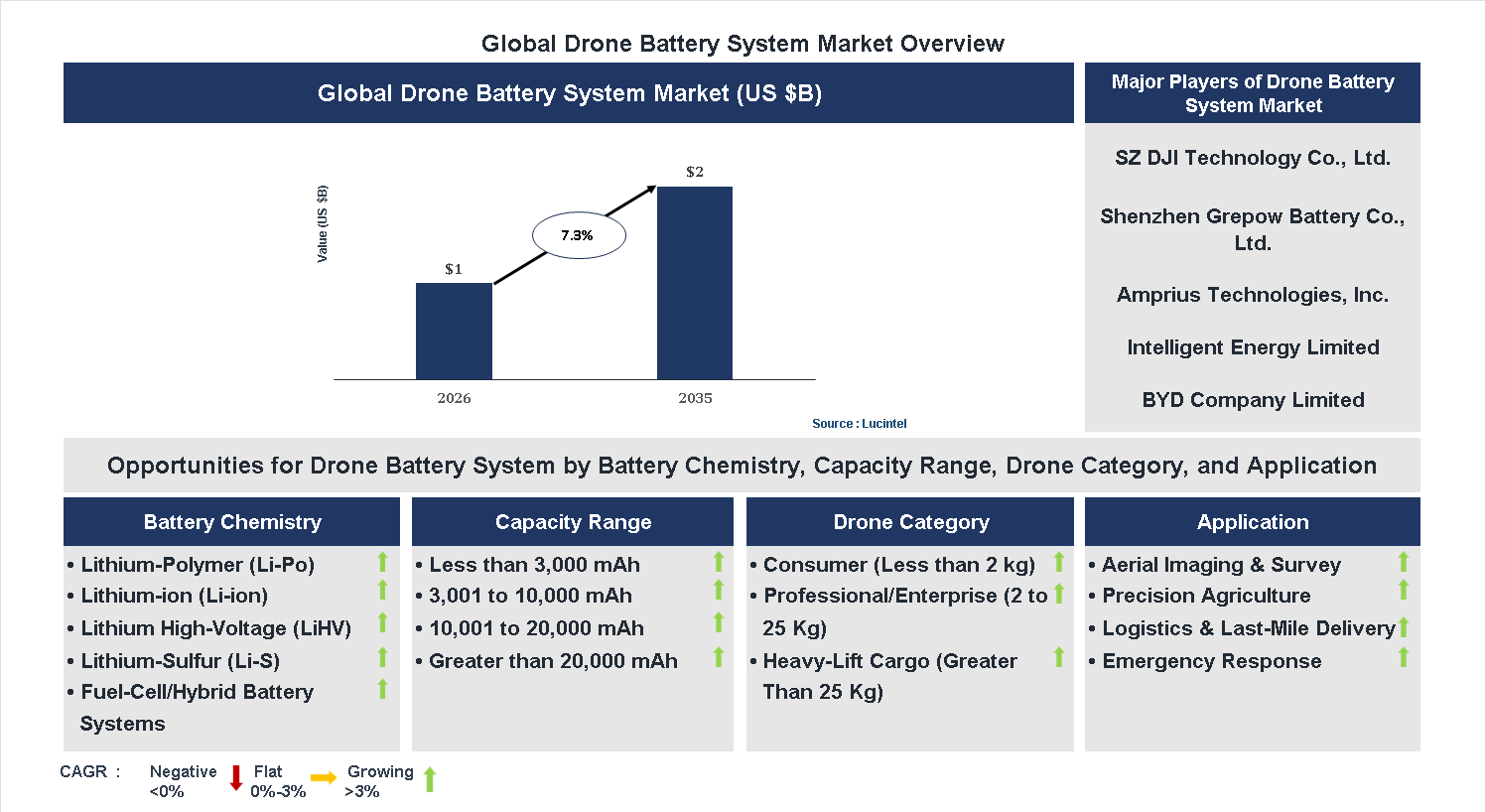
The future of the global drone battery system market looks promising with opportunities in the aerial imaging & survey, precision agriculture, logistic & last-mile delivery, and emergency response markets. The global drone battery system market is expected to reach an estimated $2 billion by 2035 with a CAGR of 7.3% from 2026 to 2035. The major drivers for this market are the growing adoption of drones in agriculture & crop monitoring, the rising demand for better-performing, longer-lasting, & safer batteries, and the increasing need for miniaturized batteries with high energy densities.• Lucintel forecasts that, within the battery chemistry category, lithium-polymer (li-Po) is expected to witness the highest growth over the forecast period.
• Within the application category, aerial imaging & survey is expected to witness the highest growth.
• In terms of region, APAC is expected to witness the highest growth over the forecast period. Gain valuable insights for your business decisions with our comprehensive 150+ page report. Sample figures with some insights are shown below.
Emerging Trends in the Drone Battery System Market
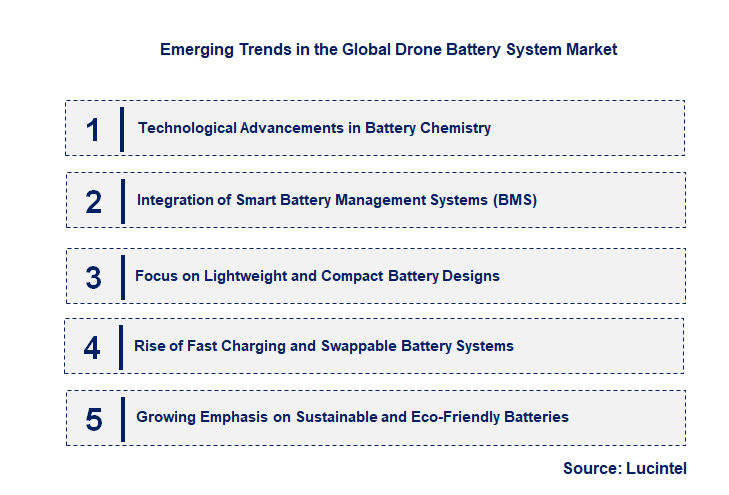
The drone battery system market is experiencing rapid growth driven by advancements in drone technology, increasing demand across various sectors, and the need for longer flight times and improved performance. As industries such as agriculture, logistics, surveillance, and entertainment expand their use of drones, the demand for efficient, lightweight, and high-capacity battery systems is intensifying. Innovations in battery chemistry, integration of smart battery management systems, and the rise of electric propulsion are shaping the market landscape. These developments are not only enhancing drone capabilities but also creating new opportunities and challenges for manufacturers, regulators, and end-users. The following key trends highlight the evolving dynamics of this market.• Technological Advancements in Battery Chemistry: The shift towards lithium-polymer (LiPo) and solid-state batteries is improving energy density and safety. These batteries offer longer flight times, faster charging, and better thermal stability, which are critical for commercial and industrial drone applications. Continuous research aims to develop even more efficient chemistries, such as lithium-silicon and lithium-air, to further extend drone endurance and payload capacity. This trend is driving innovation and competitive differentiation among battery manufacturers, ultimately enabling drones to perform more complex tasks with greater reliability.
• Integration of Smart Battery Management Systems (BMS): Smart BMS technology is becoming standard in drone batteries, providing real-time monitoring of voltage, current, temperature, and state of charge. These systems enhance safety by preventing overcharging, overheating, and short circuits, while also optimizing performance and lifespan. Data collected by smart BMS can be used for predictive maintenance and performance analytics, reducing downtime and operational costs. This trend is transforming battery systems into intelligent components that improve overall drone reliability and efficiency, fostering greater trust and adoption in commercial sectors.
• Focus on Lightweight and Compact Battery Designs: As drones become more sophisticated and payload-sensitive, manufacturers are prioritizing lightweight and space-efficient battery designs. Innovations include flexible batteries, 3D-printed battery components, and advanced packaging techniques that reduce weight without compromising capacity. These developments enable longer flight durations, increased payloads, and enhanced maneuverability. The emphasis on miniaturization and weight reduction is crucial for applications like aerial photography, delivery services, and military operations, where every gram counts. This trend is reshaping drone design paradigms and expanding operational capabilities.
• Rise of Fast Charging and Swappable Battery Systems: The demand for rapid turnaround times has led to the development of fast-charging technologies and swappable battery solutions. Fast chargers can recharge batteries in under 30 minutes, minimizing downtime during missions. Swappable battery stations allow drones to quickly replace depleted batteries, enabling continuous operation without long charging breaks. This trend is particularly impactful in commercial delivery, surveillance, and emergency response scenarios, where time efficiency is critical. It also supports the deployment of larger drone fleets and enhances operational scalability, making drone services more practical and cost-effective.
• Growing Emphasis on Sustainable and Eco-Friendly Batteries: Environmental concerns are prompting the industry to explore sustainable battery options, such as recyclable materials and eco-friendly chemistries. Manufacturers are investing in batteries with reduced toxic components and improved recyclability to minimize ecological impact. Additionally, the development of energy-efficient manufacturing processes and biodegradable packaging is gaining traction. This trend aligns with global sustainability goals and regulatory pressures, encouraging companies to adopt greener practices. It not only enhances corporate responsibility but also appeals to environmentally conscious consumers and clients, shaping a more sustainable future for the drone industry. These emerging trends are significantly transforming the drone battery system market by enhancing performance, safety, and sustainability. They are enabling drones to operate longer, more efficiently, and in a broader range of applications, thereby reshaping industry standards and opening new avenues for growth and innovation.
Recent Development in the Drone Battery System Market
The drone battery system market is experiencing rapid growth driven by advancements in drone technology, increasing demand across various industries, and innovations in battery efficiency. As drones become more integral to sectors like agriculture, logistics, and surveillance, the need for reliable, long-lasting power sources intensifies. Recent developments focus on enhancing battery performance, safety, and sustainability, creating new opportunities for manufacturers and users alike. These innovations are shaping the future landscape of drone operations and market expansion.• Improved Battery Energy Density: This development enhances drone flight times and payload capacity by increasing energy storage within smaller, lighter batteries. It allows drones to operate longer without recharging, expanding their application scope in delivery, mapping, and surveillance. The increased efficiency reduces operational costs and improves productivity, making drone systems more competitive and versatile across industries.
• Fast-Charging Technologies: The integration of rapid charging solutions significantly reduces downtime for drone operations. These advancements enable drones to recharge in minutes rather than hours, increasing operational efficiency and turnaround times. Fast-charging batteries support continuous workflows in commercial applications, such as agriculture and emergency response, thereby boosting market adoption and expanding the use cases for drone technology.
• Enhanced Safety Features: New safety protocols and battery management systems improve reliability and reduce risks of overheating, fires, or failures. These innovations increase consumer and industry confidence in drone operations, especially in sensitive environments like urban areas or critical infrastructure. Safer batteries also comply with stricter regulations, facilitating broader market acceptance and deployment of drone systems globally.
• Sustainable Battery Solutions: Focus on eco-friendly materials and recycling methods reduces environmental impact. These sustainable batteries appeal to environmentally conscious consumers and companies, aligning with global sustainability goals. The development of biodegradable or recyclable components not only minimizes waste but also enhances brand reputation, encouraging wider adoption of green practices within the drone industry.
• Integration of Smart Battery Management Systems: Advanced monitoring and diagnostics optimize battery performance and lifespan. These systems provide real-time data on charge levels, temperature, and health status, enabling predictive maintenance and reducing unexpected failures. Improved management extends battery life, lowers replacement costs, and ensures consistent drone performance, thereby increasing reliability and customer trust in drone operations. The overall impact of these developments is a more efficient, safe, and sustainable drone battery market. Enhanced performance and safety features are driving higher adoption rates across industries, while innovations in sustainability and management systems are aligning the market with environmental and operational standards. These advancements collectively foster market growth, innovation, and broader application of drone technology worldwide.
Strategic Growth Opportunities in the Drone Battery System Market
The drone battery system market is experiencing rapid expansion driven by increasing adoption across commercial, military, and recreational sectors. Innovations in battery technology, rising demand for longer flight times, and the integration of advanced power management systems are key factors fueling growth. Market players are focusing on developing lightweight, high-capacity batteries to meet diverse application needs. Strategic collaborations and technological advancements are expected to further accelerate market penetration and innovation, creating significant opportunities for stakeholders.• Increasing Demand for Longer Flight Times and Higher Payload Capacities: The need for extended operational endurance in commercial and military drones is driving innovation in high-capacity, lightweight batteries. Enhanced energy density and faster charging capabilities are critical to meet the growing requirements for surveillance, delivery, and industrial applications. This trend encourages research into advanced battery chemistries and system integrations, fostering market growth and competitive differentiation.
• Adoption of Lithium-Polymer and Solid-State Batteries for Improved Performance: Lithium-polymer and solid-state batteries offer superior energy density, safety, and durability compared to traditional lithium-ion batteries. Their adoption in drone systems enhances flight stability, reduces weight, and extends operational life. As these technologies mature, they are expected to replace conventional batteries, opening new avenues for high-performance drone applications and boosting overall market expansion.
• Integration of Smart Battery Management Systems for Enhanced Safety and Efficiency: Smart battery management systems (BMS) enable real-time monitoring of battery health, temperature, and charge cycles, improving safety and operational efficiency. These systems facilitate predictive maintenance, reduce downtime, and prevent failures, which are crucial for commercial and industrial drone operations. The integration of BMS is a key trend that enhances reliability, fosters customer confidence, and supports market growth.
• Growing Focus on Lightweight, Compact Battery Designs for Mini and Micro Drones: The proliferation of mini and micro drones in surveillance, agriculture, and entertainment sectors demands compact, lightweight power sources. Innovations in battery design aim to reduce weight without compromising capacity, enabling longer flight times and maneuverability. This focus on miniaturization is expected to expand the market for specialized batteries tailored to small-scale drone applications.
• Strategic Collaborations and Technological Innovations to Accelerate Market Growth: Partnerships between battery manufacturers, drone OEMs, and research institutions are fostering innovation in battery technology. These collaborations facilitate the development of next-generation batteries with higher energy densities and safety features. Continuous technological advancements and strategic alliances are vital for maintaining competitive edge and expanding market reach in the evolving drone industry. The overall impact of these opportunities is set to significantly enhance drone capabilities, expand application scopes, and accelerate market growth. As technological innovations and strategic initiatives continue, the drone battery system market is poised for substantial expansion, supporting diverse industry needs and fostering sustainable development in drone technology.
Drone Battery System Market Driver and Challenges
The drone battery system market is influenced by a variety of technological, economic, and regulatory factors that shape its growth trajectory. Advances in battery technology, increasing demand for longer flight times, and the proliferation of drone applications across industries are key drivers. Conversely, challenges such as regulatory restrictions, battery safety concerns, and high costs pose significant hurdles. Understanding these drivers and challenges is essential for stakeholders aiming to capitalize on market opportunities and mitigate risks. The dynamic interplay of innovation, policy, and market demand continues to define the evolution of this sector, impacting manufacturers, consumers, and regulatory bodies alike. The factors responsible for driving the drone battery system market include:• Technological Advancements: The rapid development of high-capacity, lightweight batteries such as lithium-polymer and lithium-ion variants has significantly enhanced drone performance. These innovations enable longer flight durations, increased payload capacity, and improved safety features. As research continues, new materials and battery architectures are emerging, promising even greater efficiency and reliability. This technological progress directly correlates with expanding drone applications in sectors like agriculture, surveillance, and delivery services, fueling market growth. Companies investing in R&D are gaining competitive advantages, making technological innovation a primary driver of market expansion.
• Growing Adoption of Drones Across Industries: The increasing integration of drones into various sectors is a major growth catalyst. In agriculture, drones facilitate precision farming, crop monitoring, and spraying, requiring reliable, long-lasting battery systems. In logistics, drone delivery services are expanding rapidly, demanding high-performance batteries for extended range and payload. Surveillance, filmmaking, and infrastructure inspection also rely heavily on efficient drone operations. The rising demand for these applications is pushing the need for advanced battery systems that can support diverse operational requirements, thereby propelling market growth.
• Regulatory Support and Policy Frameworks: Governments worldwide are recognizing the potential of drone technology and are establishing supportive regulatory environments. Initiatives such as relaxed flight restrictions, certification standards, and safety protocols encourage industry growth. Regulatory bodies are also promoting the development of safer, more reliable battery systems to prevent accidents and ensure compliance. These policies foster innovation and investment, creating a conducive environment for market expansion. As regulatory frameworks evolve to accommodate technological advancements, they serve as a significant driver for the adoption of advanced drone battery systems.
• Increasing Investment and Funding: The market is witnessing substantial investments from venture capitalists, government agencies, and private firms aimed at developing next-generation battery technologies. Funding supports research, manufacturing scale-up, and commercialization efforts, reducing costs and improving performance. This influx of capital accelerates innovation cycles and enables companies to bring advanced products to market faster. The availability of funding also encourages startups and established players to explore new battery chemistries and designs, further driving the market forward and expanding its scope.
• Rising Consumer and Commercial Demand: The surge in consumer interest for recreational drones and the expanding commercial use cases are key drivers. Consumers seek longer flight times and better battery life for personal photography and racing drones. Commercial sectors demand reliable, high-capacity batteries for applications like aerial mapping, inspection, and delivery. This increasing demand pushes manufacturers to innovate and improve battery performance, which in turn fuels market growth. The expanding user base and diverse application spectrum create a robust demand pipeline, ensuring sustained market development. The challenges facing this Market include:
• Regulatory Restrictions and Airspace Management: Stringent regulations and complex airspace management policies pose significant hurdles. Many countries impose restrictions on drone operations, especially in urban areas or near airports, limiting market expansion. Compliance with evolving rules requires significant investment in safety systems and operational adjustments. These restrictions can delay deployment, increase costs, and restrict the use of certain drone applications. Navigating regulatory landscapes remains a critical challenge for market participants seeking to scale operations and innovate freely.
• Battery Safety and Reliability Concerns: Safety issues related to battery overheating, fires, and explosions continue to be a concern. The high energy density of drone batteries increases the risk of thermal runaway, which can cause accidents and damage. Ensuring battery safety involves rigorous testing, quality control, and the development of advanced safety features, all of which add to costs. Reliability issues can undermine consumer confidence and hinder widespread adoption. Addressing these safety challenges is essential for sustainable market growth and regulatory approval.
• High Cost of Advanced Battery Systems: Despite technological improvements, high-performance drone batteries remain expensive, limiting affordability for some users and applications. The costs associated with research, raw materials, and manufacturing processes contribute to elevated prices. This financial barrier restricts market penetration, especially in price-sensitive segments. Reducing costs without compromising performance is a key challenge for manufacturers aiming to expand their customer base and achieve economies of scale, thereby impacting overall market growth. The drone battery system market is driven by rapid technological innovations, expanding industry applications, supportive regulatory frameworks, increased investments, and rising demand. However, challenges such as regulatory restrictions, safety concerns, and high costs must be addressed to sustain growth. The interplay of these factors will shape the future landscape, requiring strategic focus on safety, cost reduction, and regulatory compliance to unlock the full potential of drone battery systems. Overall, the markets evolution hinges on balancing innovation with safety and affordability, promising significant opportunities amid ongoing challenges.
List of Drone Battery System Companies
Companies in the market compete on the basis of product quality offered. Major players in this market focus on expanding their manufacturing facilities, R&D investments, infrastructural development, and leverage integration opportunities across the value chain. With these strategies drone battery system companies cater increasing demand, ensure competitive effectiveness, develop innovative products & technologies, reduce production costs, and expand their customer base. Some of the drone battery system companies profiled in this report include-• SZ DJI Technology Co., Ltd.
• Shenzhen Grepow Battery Co., Ltd.
• Amprius Technologies, Inc.
• Intelligent Energy Limited
• BYD Company Limited
• Murata Manufacturing Co., Ltd.
• Saft Groupe SAS
• Parrot Drones SAS
• Autel Robotics Co., Ltd.
• Hextronics LLC
Drone Battery System Market by Segment
The study includes a forecast for the global drone battery system market by battery chemistry, capacity range, drone category, application, and region.Drone Battery System Market by Battery Chemistry [Value from 2019 to 2035]:
• Lithium-Polymer (Li-Po)
• Lithium-ion (Li-ion)
• Lithium High-Voltage (LiHV)
• Lithium-Sulfur (Li-S)
• Fuel-Cell/Hybrid Battery Systems
Drone Battery System Market by Capacity Range [Value from 2019 to 2035]:
• Less than 3,000 mAh
• 3,001 to 10,000 mAh
• 10,001 to 20,000 mAh
• Greater than 20,000 mAh
Drone Battery System Market by Drone Category [Value from 2019 to 2035]:
• Consumer (Less than 2 kg)
• Professional/Enterprise (2 to 25 kg)
• Heavy-Lift Cargo (Greater than 25 kg)
Drone Battery System Market by Application [Value from 2019 to 2035]:
• Aerial Imaging & Survey
• Precision Agriculture
• Logistics & Last-Mile Delivery
• Emergency Response
Drone Battery System Market by Region [Value from 2019 to 2035]:
• North America
• Europe
• Asia Pacific
• The Rest of the World
Country Wise Outlook for the Drone Battery System Market
The drone battery system market has experienced significant growth driven by advancements in drone technology, increasing demand across various sectors, and innovations in battery efficiency and sustainability. As industries such as logistics, agriculture, and surveillance expand their use of drones, countries are investing heavily in research and development to enhance battery performance, safety, and environmental impact. Regulatory frameworks are also evolving to accommodate these technological shifts, fostering a competitive landscape. The following summaries highlight recent developments in this dynamic market across the United States, China, Germany, India, and Japan, reflecting their unique contributions and strategic priorities.• United States: The US market has seen substantial investments in high-capacity lithium-polymer batteries, with major companies focusing on extending drone flight times and safety features. Innovations in fast-charging technologies and battery management systems are prominent, alongside increased regulatory support for commercial drone applications. Collaborations between tech firms and government agencies aim to develop sustainable and lightweight battery solutions, boosting the industry’s growth.
• China: China remains a global leader in drone battery manufacturing, with rapid advancements in solid-state battery technology to improve energy density and safety. Domestic companies are expanding production capacities and investing in research to reduce costs and enhance performance. The government’s strategic initiatives promote innovation in battery recycling and environmentally friendly materials, positioning China as a key player in sustainable drone battery development.
• Germany: Germany’s focus is on integrating advanced battery systems with precision engineering to improve reliability and operational efficiency. The country emphasizes research into alternative energy sources and the development of modular battery packs for diverse drone applications. Strong collaborations between academia and industry are fostering innovations in battery longevity and eco-friendly materials, aligning with Europe’s sustainability goals.
• India: India is witnessing rapid growth in drone adoption across agriculture, defense, and logistics sectors, prompting increased demand for durable and cost-effective batteries. Local startups and established firms are investing in developing lithium-ion and alternative battery chemistries suited for varied climatic conditions. Government initiatives support innovation and manufacturing, aiming to make India a significant hub for drone battery production.
• Japan: Japan’s market is characterized by advancements in high-performance batteries with enhanced safety features, driven by the country’s expertise in electronics and materials science. Focus areas include improving battery lifespan and thermal management for extended drone operations. Japanese companies are also exploring eco-friendly battery options and integrating smart battery management systems to optimize performance and safety.

Features of the Global Drone Battery System Market
Market Size Estimates: Drone battery system market size estimation in terms of value ($B). Trend and Forecast Analysis: Market trends (2019 to 2025) and forecast (2026 to 2035) by various segments and regions. Segmentation Analysis: Drone battery system market size by various segments, such as by battery chemistry, capacity range, drone category, application, and region in terms of value ($B). Regional Analysis: Drone battery system market breakdown by North America, Europe, Asia Pacific, and Rest of the World. Growth Opportunities: Analysis of growth opportunities in different battery chemistry, capacity range, drone category, applications, and regions for the drone battery system market. Strategic Analysis: This includes M&A, new product development, and competitive landscape of the drone battery system market. Analysis of competitive intensity of the industry based on Porter’s Five Forces model.
FAQ
Q1. What is the drone battery system market size? Answer: The global drone battery system market is expected to reach an estimated $2 billion by 2035. Q2. What is the growth forecast for drone battery system market? Answer: The global drone battery system market is expected to grow with a CAGR of 7.3% from 2026 to 2035. Q3. What are the major drivers influencing the growth of the drone battery system market? Answer: The major drivers for this market are the growing adoption of drones in agriculture & crop monitoring, the rising demand for better-performing, longer-lasting, & safer batteries, and the increasing need for miniaturized batteries with high energy densities. Q4. What are the major segments for drone battery system market? Answer: The future of the drone battery system market looks promising with opportunities in the aerial imaging & survey, precision agriculture, logistic & last-mile delivery, and emergency response markets. Q5. Who are the key drone battery system market companies? Answer: Some of the key drone battery system companies are as follows:• SZ DJI Technology Co., Ltd.
• Shenzhen Grepow Battery Co., Ltd.
• Amprius Technologies, Inc.
• Intelligent Energy Limited
• BYD Company Limited
• Murata Manufacturing Co., Ltd.
• Saft Groupe SAS
• Parrot Drones SAS
• Autel Robotics Co., Ltd.
• Hextronics LLC Q6. Which drone battery system market segment will be the largest in future? Answer: Lucintel forecasts that, within the battery chemistry category, lithium-polymer (li-Po) is expected to witness the highest growth over the forecast period. Q7. In drone battery system market, which region is expected to be the largest in next 8 years? Answer: In terms of region, APAC is expected to witness the highest growth over the forecast period. Q8. Do we receive customization in this report? Answer: Yes, Lucintel provides 10% customization without any additional cost.
Table of Contents
List of Figures
List of Tables
Methodology
- In-depth interviews of the major players in this market
- Detailed secondary research from competitors’ financial statements and published data
- Extensive searches of published works, market, and database information pertaining to industry news, company press releases, and customer intentions
- A compilation of the experiences, judgments, and insights of Lucintel’s professionals, who have analyzed and tracked this market over the years.


Buy Now
Choose a license that fits your team. Instant PDF delivery.
Prices exclude taxes. Instant delivery. Custom licensing available on request.
Key Questions
- • What are some of the most promising, high-growth opportunities for the drone battery system market by battery chemistry (lithium-polymer (Li-Po), lithium-ion (Li-ion), lithium high-voltage (LiHV), lithium-sulfur (Li-S), and fuel-cell/hybrid battery systems), capacity range (less than 3,000 mAH, 3,001 to 10,000 mAH, 10,001 to 20,000 mAH, and greater than 20,000 mAH), drone category (consumer (less than 2 kg), professional/enterprise (2 to 25 kg), and heavy-lift cargo (greater than 25 kg)), application (aerial imaging & survey, precision agriculture, logistics & last-mile delivery, and emergency response), and region (North America, Europe, Asia Pacific, and the Rest of the World)?
- • Which segments will grow at a faster pace and why?
- • Which region will grow at a faster pace and why?
- • What are the key factors affecting market dynamics? What are the key challenges and business risks in this market?
- • What are the business risks and competitive threats in this market?
- • What are the emerging trends in this market and the reasons behind them?
- • What are some of the changing demands of customers in the market?
- • What are the new developments in the market? Which companies are leading these developments?
- • Who are the major players in this market? What strategic initiatives are key players pursuing for business growth?
- • What are some of the competing products in this market and how big of a threat do they pose for loss of market share by material or product substitution?
- • What M&A activity has occurred in the last 5 years and what has its impact been on the industry? For any questions related to Drone Battery System Market, Drone Battery System Market Size, Drone Battery System Market Growth, Drone Battery System Market Analysis, Drone Battery System Market Report, Drone Battery System Market Share, Drone Battery System Market Trends, Drone Battery System Market Forecast, Drone Battery System Companies, write Lucintel analyst at email: helpdesk@lucintel.com. We will be glad to get back to you soon.


