
Report Feature
Drone-Based Floodplain Mapping Market Trends and Forecast
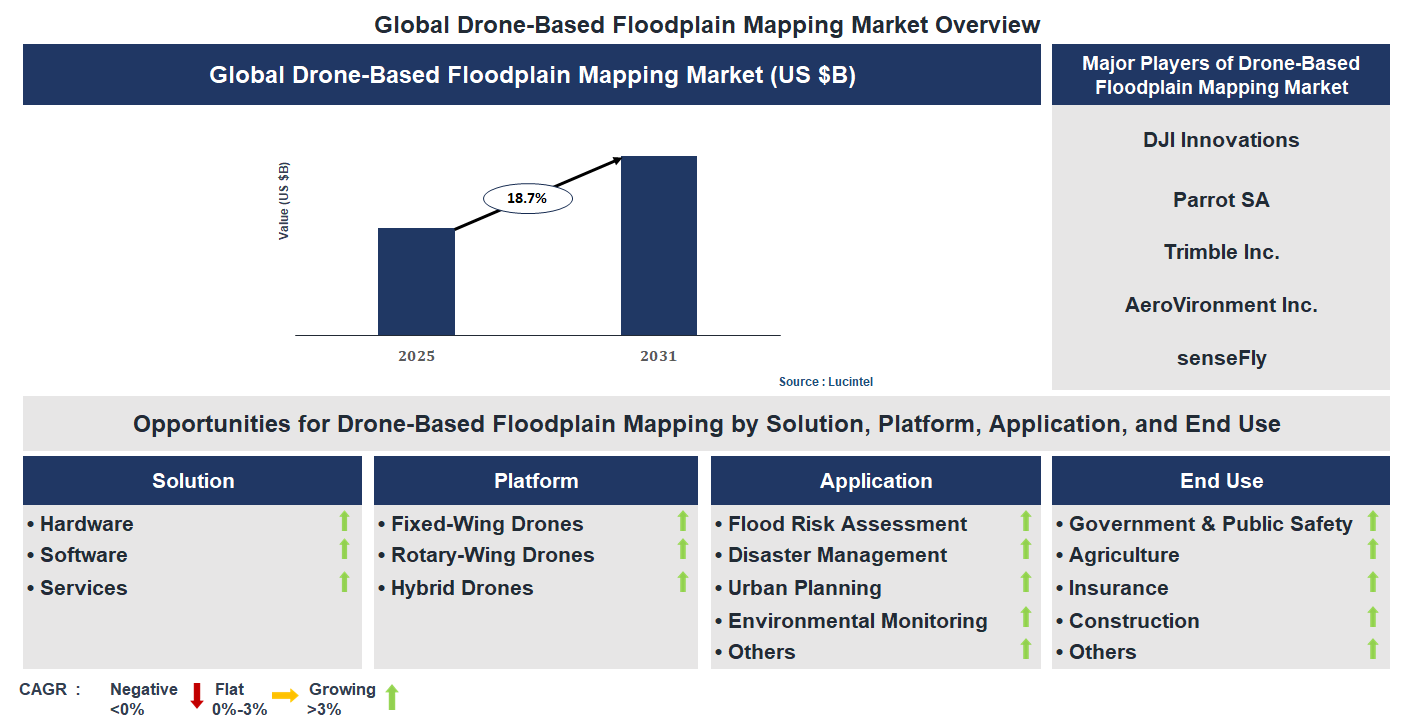
The future of the global drone-based floodplain mapping market looks promising with opportunities in the government & public safety, agriculture, insurance, and construction markets. The global drone-based floodplain mapping market is expected to grow with a CAGR of 18.7% from 2025 to 2031. The major drivers for this market are the increasing frequency of flood events, the rising need for high-resolution topographic data, and the growing adoption of drone-based floodplain mapping solutions.• Lucintel forecasts that, within the solution category, hardware is expected to witness the highest growth over the forecast period.
• Within the end use category, government & public safety is expected to witness the highest growth.
• In terms of region, North America is expected to witness the highest growth over the forecast period. Gain valuable insights for your business decisions with our comprehensive 150+ page report. Sample figures with some insights are shown below.
Emerging Trends in the Drone-Based Floodplain Mapping Market
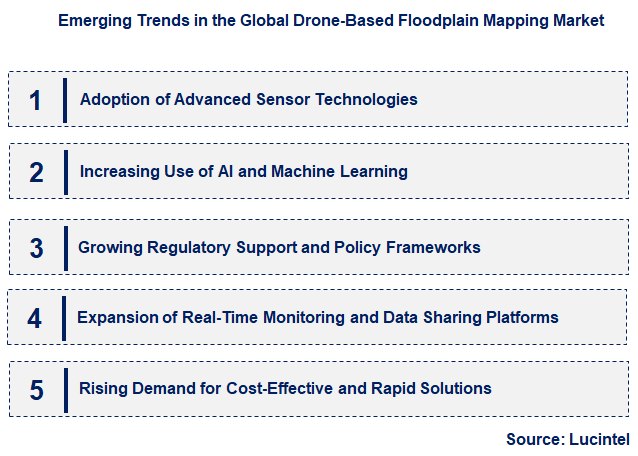
The drone-based floodplain mapping market is experiencing rapid growth driven by technological advancements, increasing climate change impacts, and the need for precise flood risk assessment. Drones offer cost-effective, quick, and detailed mapping solutions that traditional methods cannot match. As urbanization expands and climate-related disasters become more frequent, stakeholders are prioritizing innovative tools for disaster management and planning. This markets evolution is influenced by regulatory changes, technological innovations, and increasing demand for real-time data. These developments are transforming floodplain management, enabling better preparedness, and reducing flood-related damages. The following key trends highlight the markets dynamic landscape and future potential.• Adoption of Advanced Sensor Technologies: The integration of multispectral, LiDAR, and thermal sensors into drones enhances data accuracy and detail. These sensors allow for precise topographical and hydrological mapping, even in challenging environments. As sensor technology becomes more affordable and compact, drone-based floodplain mapping can deliver high-resolution data rapidly. This trend improves flood risk assessment, supports better urban planning, and enables real-time monitoring, ultimately leading to more effective flood mitigation strategies.
• Increasing Use of AI and Machine Learning: The incorporation of AI algorithms and machine learning models into drone data processing is revolutionizing floodplain mapping. These technologies enable automated data analysis, feature recognition, and predictive modeling, reducing manual effort and increasing efficiency. AI-driven insights help identify flood-prone areas more accurately and forecast potential flood events. This trend enhances decision-making, accelerates response times, and improves the overall reliability of flood risk assessments, making flood management more proactive and data-driven.
• Growing Regulatory Support and Policy Frameworks: Governments and regulatory bodies are establishing guidelines and policies to facilitate drone operations for floodplain mapping. Streamlined regulations and certification processes are encouraging wider adoption among public agencies, environmental organizations, and private firms. Supportive policies also promote data sharing and collaboration, leading to more comprehensive flood risk databases. This regulatory environment fosters innovation, ensures safety, and accelerates market growth by reducing operational barriers for drone deployment in flood management.
• Expansion of Real-Time Monitoring and Data Sharing Platforms: The development of cloud-based platforms and IoT integration enables real-time data collection, analysis, and dissemination. Drones equipped with live streaming capabilities can provide immediate flood situation updates to authorities and communities. These platforms facilitate collaborative decision-making, improve emergency response, and enhance transparency. As data sharing becomes more seamless, stakeholders can respond more swiftly to flood threats, minimizing damages and saving lives. This trend is pivotal in creating resilient flood management systems.
• Rising Demand for Cost-Effective and Rapid Solutions: The need for quick, affordable floodplain mapping solutions is driving market growth. Drones offer a significant advantage over traditional survey methods by reducing labor, time, and costs. This affordability makes flood risk assessment accessible to a broader range of users, including local governments and disaster response teams. The ability to rapidly deploy drones during emergencies ensures timely data collection, supporting swift decision-making. This trend underscores the markets focus on scalable, efficient solutions that enhance flood preparedness and response capabilities. In summary, these emerging trends are reshaping the drone-based floodplain mapping market by making data collection more accurate, efficient, and accessible. Technological innovations, supportive policies, and real-time data sharing are collectively enhancing flood risk management. As these trends continue to evolve, they will enable more resilient communities, smarter urban planning, and more effective disaster response strategies, ultimately reducing the devastating impacts of floods worldwide.
Recent Development in the Drone-Based Floodplain Mapping Market
The drone-based floodplain mapping market has experienced significant growth driven by technological advancements, increasing demand for accurate flood risk assessment, and the need for rapid response systems. As climate change intensifies, the importance of precise floodplain data has become critical for urban planning, disaster management, and environmental conservation. Recent developments reflect innovations in drone technology, data processing, and regulatory frameworks, which are transforming how floodplain mapping is conducted globally. These advancements are enabling more efficient, cost-effective, and detailed flood risk analysis, thereby supporting better decision-making and disaster preparedness strategies.• Technological Innovations: Integration of AI and machine learning with drone data processing has enhanced the accuracy and speed of floodplain mapping, allowing for real-time analysis and improved predictive capabilities. This development reduces manual effort and minimizes errors, leading to more reliable flood risk assessments.
• Regulatory Frameworks: Governments and regulatory bodies are establishing clearer guidelines for drone operations in floodplain areas, facilitating wider adoption. These regulations ensure safety, privacy, and data security, encouraging organizations to utilize drone technology for flood mapping.
• Enhanced Drone Capabilities: Advances in drone hardware, such as longer flight times, higher-resolution sensors, and improved stability, have expanded the scope and quality of floodplain surveys. These improvements enable detailed topographical mapping even in challenging environments.
• Data Integration and Visualization: The development of sophisticated GIS and data visualization tools allows for seamless integration of drone-collected data with existing geographic information systems. This integration enhances the interpretability and usability of floodplain maps for stakeholders.
• Market Expansion and Adoption: Increasing awareness of drone benefits and decreasing costs have led to broader adoption across government agencies, environmental organizations, and private sectors. This expansion is driving market growth and encouraging innovation in floodplain mapping solutions. In summary, these recent developments are significantly impacting the drone-based floodplain mapping market by improving accuracy, efficiency, and accessibility. The integration of advanced technologies and supportive regulatory environments is fostering widespread adoption, which ultimately enhances flood risk management and disaster preparedness efforts worldwide.
Strategic Growth Opportunities in the Drone-Based Floodplain Mapping Market
The drone-based floodplain mapping market is experiencing rapid growth driven by technological advancements and increasing demand for precise flood risk assessment. As climate change intensifies, the need for accurate, timely floodplain data becomes critical for urban planning, disaster management, and environmental conservation. Drones offer cost-effective, high-resolution mapping solutions that enhance decision-making processes. Key applications such as urban planning, agriculture, environmental monitoring, disaster response, and insurance are fueling this expansion. These developments are transforming floodplain management by providing faster, more accurate data, ultimately reducing risks and improving resilience in vulnerable regions.• Enhanced flood risk assessment : Drones provide detailed topographical data, enabling urban planners to design resilient infrastructure and optimize land use, reducing flood vulnerability in cities.
• Precision flood monitoring : Drone technology allows farmers to monitor flood-prone areas accurately, facilitating better water management and crop protection, which boosts productivity and sustainability.
• Ecosystem preservation : Drones help track floodplain changes and habitat conditions, supporting conservation efforts and informing policy decisions to protect vulnerable ecosystems.
• Rapid damage assessment : In flood emergencies, drones deliver real-time imagery, enabling authorities to evaluate damage swiftly, coordinate rescue operations, and allocate resources effectively.
• Risk assessment and claims processing : Drone-based mapping improves accuracy in flood risk evaluation, streamlining claims processing and reducing fraud, which benefits insurers and policyholders alike. In summary, these growth opportunities are significantly impacting the drone-based floodplain mapping market by enhancing data accuracy, operational efficiency, and response times. They are enabling stakeholders to better predict, prepare for, and respond to flood events, thereby fostering safer, more resilient communities and transforming floodplain management practices worldwide.
Drone-Based Floodplain Mapping Market Driver and Challenges
The drone-based floodplain mapping market is influenced by a variety of technological, economic, and regulatory factors. Advances in drone technology, such as improved sensors and autonomous flight capabilities, have made floodplain mapping more accurate and accessible. Economic factors, including increasing infrastructure investments and disaster management budgets, drive demand for precise floodplain data. Regulatory frameworks around drone usage, privacy, and safety also shape market growth, either facilitating or constraining operations. Additionally, environmental concerns and climate change impacts heighten the need for detailed floodplain mapping to mitigate risks. These interconnected drivers and challenges collectively determine the markets trajectory, influencing innovation, adoption, and regulatory compliance. The factors responsible for driving the drone-based floodplain mapping market include:• Technological Advancements: The rapid development of drone hardware and software has significantly enhanced floodplain mapping capabilities. High-resolution cameras, LiDAR sensors, and real-time data processing enable detailed, accurate, and timely flood assessments. Autonomous flight systems reduce operational costs and improve efficiency, making flood mapping accessible to a broader range of users. These innovations support disaster preparedness, urban planning, and environmental monitoring, fostering market growth. As technology continues to evolve, the scope and precision of floodplain mapping are expected to expand, further driving demand.
• Increasing Infrastructure and Urban Development: Rapid urbanization and infrastructure projects in flood-prone areas necessitate precise floodplain data to ensure safety and compliance. Governments and private developers are investing heavily in resilient infrastructure, which requires detailed flood risk assessments. Drone-based mapping offers a cost-effective and quick solution compared to traditional methods, enabling planners to identify vulnerable zones and design mitigation strategies. This trend boosts market growth as stakeholders seek reliable data to support sustainable development and disaster risk reduction.
• Climate Change and Rising Flood Risks: The increasing frequency and severity of floods due to climate change have heightened the need for accurate floodplain mapping. Droughts, storms, and rising sea levels threaten communities and ecosystems, demanding proactive risk management. Drone technology provides high-resolution, real-time data essential for early warning systems and emergency response planning. Governments and organizations are investing in advanced flood mapping solutions to adapt to these changing conditions, thereby expanding the market and emphasizing the importance of innovative floodplain assessment tools.
• Regulatory Support and Policy Frameworks: Governments worldwide are establishing policies to promote drone usage for environmental monitoring and disaster management. Regulatory frameworks that facilitate drone operations, such as streamlined licensing and safety protocols, encourage market participation. Additionally, international agreements on climate resilience and disaster preparedness incentivize the adoption of drone-based floodplain mapping. Supportive policies reduce operational barriers, foster innovation, and attract investments, collectively propelling market growth.
• Growing Adoption of GIS and Data Integration: The integration of drone-collected data with Geographic Information Systems (GIS) enhances floodplain analysis and decision-making. Advanced data analytics, modeling, and visualization tools enable stakeholders to interpret complex flood risk information effectively. The increasing adoption of GIS-compatible drone data accelerates the development of comprehensive flood management strategies. This synergy improves accuracy, efficiency, and stakeholder collaboration, further fueling the markets expansion. The challenges facing this drone-based floodplain mapping market include:
• Regulatory and Legal Constraints: Despite supportive policies, regulatory hurdles such as airspace restrictions, licensing requirements, and privacy concerns pose significant challenges. Navigating complex legal frameworks can delay project deployment and increase operational costs. Inconsistent regulations across regions create barriers to market expansion and limit the scalability of drone-based floodplain mapping solutions. Ensuring compliance while maintaining operational efficiency remains a critical challenge for market players.
• Technical Limitations and Data Accuracy: Although technological advancements have improved drone capabilities, limitations such as battery life, weather dependency, and sensor accuracy can affect data quality. Inaccurate or incomplete data may lead to flawed flood risk assessments, undermining trust and adoption. Overcoming these technical constraints requires ongoing innovation and investment, which can be resource-intensive and slow market growth.
• High Initial Investment and Operational Costs: While drones offer cost advantages over traditional methods, the initial investment in high-quality equipment, training, and data processing infrastructure can be substantial. Small and medium-sized organizations may find these costs prohibitive, limiting widespread adoption. Additionally, ongoing maintenance and regulatory compliance expenses add to the financial burden, posing a barrier to market expansion, especially in developing regions. In summary, the drone-based floodplain mapping market is driven by technological innovations, increasing infrastructure needs, climate change impacts, supportive policies, and data integration advancements. However, regulatory complexities, technical limitations, and high costs present significant hurdles. These factors collectively shape the markets growth trajectory, requiring stakeholders to navigate challenges while leveraging opportunities to enhance flood risk management and resilience strategies globally.
List of Drone-Based Floodplain Mapping Companies
Companies in the market compete on the basis of product quality offered. Major players in this market focus on expanding their manufacturing facilities, R&D investments, infrastructural development, and leverage integration opportunities across the value chain. With these strategies drone-based floodplain mapping companies cater increasing demand, ensure competitive effectiveness, develop innovative products & technologies, reduce production costs, and expand their customer base. Some of the drone-based floodplain mapping companies profiled in this report include-• DJI Innovations
• Parrot SA
• Trimble Inc.
• AeroVironment Inc.
• senseFly
• PrecisionHawk
• Delair
• Quantum Systems
• 3D Robotics
• Teledyne FLIR
Drone-Based Floodplain Mapping Market by Segment
The study includes a forecast for the global drone-based floodplain mapping market by solution, platform, application, end use, and region.Drone-Based Floodplain Mapping Market by Solution [Value from 2019 to 2031]:
• Hardware
• Software
• Services
Drone-Based Floodplain Mapping Market by Platform [Value from 2019 to 2031]:
• Fixed-Wing Drones
• Rotary-Wing Drones
• Hybrid Drones
Drone-Based Floodplain Mapping Market by Application [Value from 2019 to 2031]:
• Flood Risk Assessment
• Disaster Management
• Urban Planning
• Environmental Monitoring
• Others
Drone-Based Floodplain Mapping Market by End Use [Value from 2019 to 2031]:
• Government & Public Safety
• Agriculture
• Insurance
• Construction
• Others
Drone-Based Floodplain Mapping Market by Region [Value from 2019 to 2031]:
• North America
• Europe
• Asia Pacific
• The Rest of the World
Country Wise Outlook for the Drone-Based Floodplain Mapping Market
The drone-based floodplain mapping market has experienced significant growth driven by technological advancements, increasing demand for accurate flood risk assessment, and the need for efficient disaster management solutions. Governments, environmental agencies, and private companies are investing heavily in drone technology to improve floodplain monitoring and response strategies. The markets evolution is also influenced by regulatory changes, innovations in drone sensors, and the integration of AI and GIS technologies. As climate change intensifies, the importance of precise floodplain mapping becomes more critical, prompting countries worldwide to adopt and develop advanced drone solutions for better flood management and mitigation.• United States: The US market has seen rapid adoption of drone technology for floodplain mapping, driven by federal agencies like FEMA and NOAA. Innovations include high-resolution sensors and AI integration for real-time data analysis. Regulatory frameworks are evolving to facilitate commercial drone operations, boosting market growth. Private sector involvement is increasing, with startups developing specialized flood mapping solutions. The US also invests in research collaborations to enhance drone capabilities, making flood risk assessment more accurate and timely.
• China: China is rapidly expanding its drone-based floodplain mapping capabilities, supported by government initiatives aimed at disaster prevention. The country has developed advanced drone fleets equipped with multispectral sensors and AI for detailed flood analysis. Urban flood management projects are a priority, with significant investments in infrastructure and technology. Regulatory policies are being streamlined to promote commercial drone use, and domestic manufacturers are leading innovation. China’s focus on smart city development further accelerates the adoption of drone-based flood mapping solutions.
• Germany: Germany emphasizes precision and regulatory compliance in its drone floodplain mapping market. The country leverages advanced GIS integration and high-accuracy sensors to improve flood risk assessments. Public-private partnerships are common, with government agencies collaborating with tech firms to develop innovative solutions. Germany’s strict drone regulations ensure safety and data privacy, fostering trust in drone applications. The market also benefits from EU funding programs aimed at disaster resilience, supporting research and deployment of cutting-edge drone technologies.
• India: India is increasingly adopting drone technology for floodplain mapping amid rising flood incidents. The government promotes drone use through policies encouraging innovation and cost-effective solutions. Indian startups and tech firms are developing affordable drone systems with multispectral sensors for flood monitoring. Challenges include regulatory hurdles and limited infrastructure, but ongoing reforms aim to address these issues. The focus is on deploying drones in flood-prone regions to improve early warning systems and disaster response, with collaborations between government agencies and private firms gaining momentum.
• Japan: Japan’s market for drone-based floodplain mapping is driven by its vulnerability to natural disasters. The country employs advanced drone systems with high-resolution imaging and AI for precise flood risk analysis. Regulatory frameworks are well-established, facilitating safe drone operations. Japan invests heavily in research to enhance drone capabilities, including autonomous flight and data processing. The integration of drone data with existing disaster management systems improves response efficiency. Public awareness and government support further bolster the adoption of drone technology for floodplain mapping and disaster preparedness.

Features of the Global Drone-Based Floodplain Mapping Market
Market Size Estimates: Drone-based floodplain mapping market size estimation in terms of value ($B). Trend and Forecast Analysis: Market trends (2019 to 2024) and forecast (2025 to 2031) by various segments and regions. Segmentation Analysis: Drone-based floodplain mapping market size by various segments, such as by solution, platform, application, end use, and region in terms of value ($B). Regional Analysis: Drone-based floodplain mapping market breakdown by North America, Europe, Asia Pacific, and Rest of the World. Growth Opportunities: Analysis of growth opportunities in different solutions, platforms, applications, end uses, and regions for the drone-based floodplain mapping market. Strategic Analysis: This includes M&A, new product development, and competitive landscape of the drone-based floodplain mapping market. Analysis of competitive intensity of the industry based on Porter’s Five Forces model.
FAQ
Q1. What is the growth forecast for drone-based floodplain mapping market? Answer: The global drone-based floodplain mapping market is expected to grow with a CAGR of 18.7% from 2025 to 2031. Q2. What are the major drivers influencing the growth of the drone-based floodplain mapping market? Answer: The major drivers for this market are the increasing frequency of flood events, the rising need for high-resolution topographic data, and the growing adoption of drone-based floodplain mapping solutions. Q3. What are the major segments for drone-based floodplain mapping market? Answer: The future of the drone-based floodplain mapping market looks promising with opportunities in the government & public safety, agriculture, insurance, and construction markets. Q4. Who are the key drone-based floodplain mapping market companies? Answer: Some of the key drone-based floodplain mapping companies are as follows:• DJI Innovations
• Parrot SA
• Trimble Inc.
• AeroVironment Inc.
• senseFly
• PrecisionHawk
• Delair
• Quantum Systems
• 3D Robotics
• Teledyne FLIR Q5. Which drone-based floodplain mapping market segment will be the largest in future? Answer: Lucintel forecasts that, within the solution category, hardware is expected to witness the highest growth over the forecast period. Q6. In drone-based floodplain mapping market, which region is expected to be the largest in next 5 years? Answer: In terms of region, North America is expected to witness the highest growth over the forecast period. Q7. Do we receive customization in this report? Answer: Yes, Lucintel provides 10% customization without any additional cost.
Table of Contents
List of Figures
List of Tables
Methodology
- In-depth interviews of the major players in this market
- Detailed secondary research from competitors’ financial statements and published data
- Extensive searches of published works, market, and database information pertaining to industry news, company press releases, and customer intentions
- A compilation of the experiences, judgments, and insights of Lucintel’s professionals, who have analyzed and tracked this market over the years.


Buy Now
Choose a license that fits your team. Instant PDF delivery.
Prices exclude taxes. Instant delivery. Custom licensing available on request.
Key Questions
- • What are some of the most promising, high-growth opportunities for the drone-based floodplain mapping market by solution (hardware, software, and services), platform (fixed-wing drones, rotary-wing drones, and hybrid drones), application (flood risk assessment, disaster management, urban planning, environmental monitoring, and others), end use (government & public safety, agriculture, insurance, construction, and others), and region (North America, Europe, Asia Pacific, and the Rest of the World)?
- • Which segments will grow at a faster pace and why?
- • Which region will grow at a faster pace and why?
- • What are the key factors affecting market dynamics? What are the key challenges and business risks in this market?
- • What are the business risks and competitive threats in this market?
- • What are the emerging trends in this market and the reasons behind them?
- • What are some of the changing demands of customers in the market?
- • What are the new developments in the market? Which companies are leading these developments?
- • Who are the major players in this market? What strategic initiatives are key players pursuing for business growth?
- • What are some of the competing products in this market and how big of a threat do they pose for loss of market share by material or product substitution?
- • What M&A activity has occurred in the last 5 years and what has its impact been on the industry? For any questions related to Drone-Based Floodplain Mapping Market, Drone-Based Floodplain Mapping Market Size, Drone-Based Floodplain Mapping Market Growth, Drone-Based Floodplain Mapping Market Analysis, Drone-Based Floodplain Mapping Market Report, Drone-Based Floodplain Mapping Market Share, Drone-Based Floodplain Mapping Market Trends, Drone-Based Floodplain Mapping Market Forecast, Drone-Based Floodplain Mapping Companies, write Lucintel analyst at email: helpdesk@lucintel.com. We will be glad to get back to you soon.


