
Report Feature
Drone Analytics Market Trends and Forecast
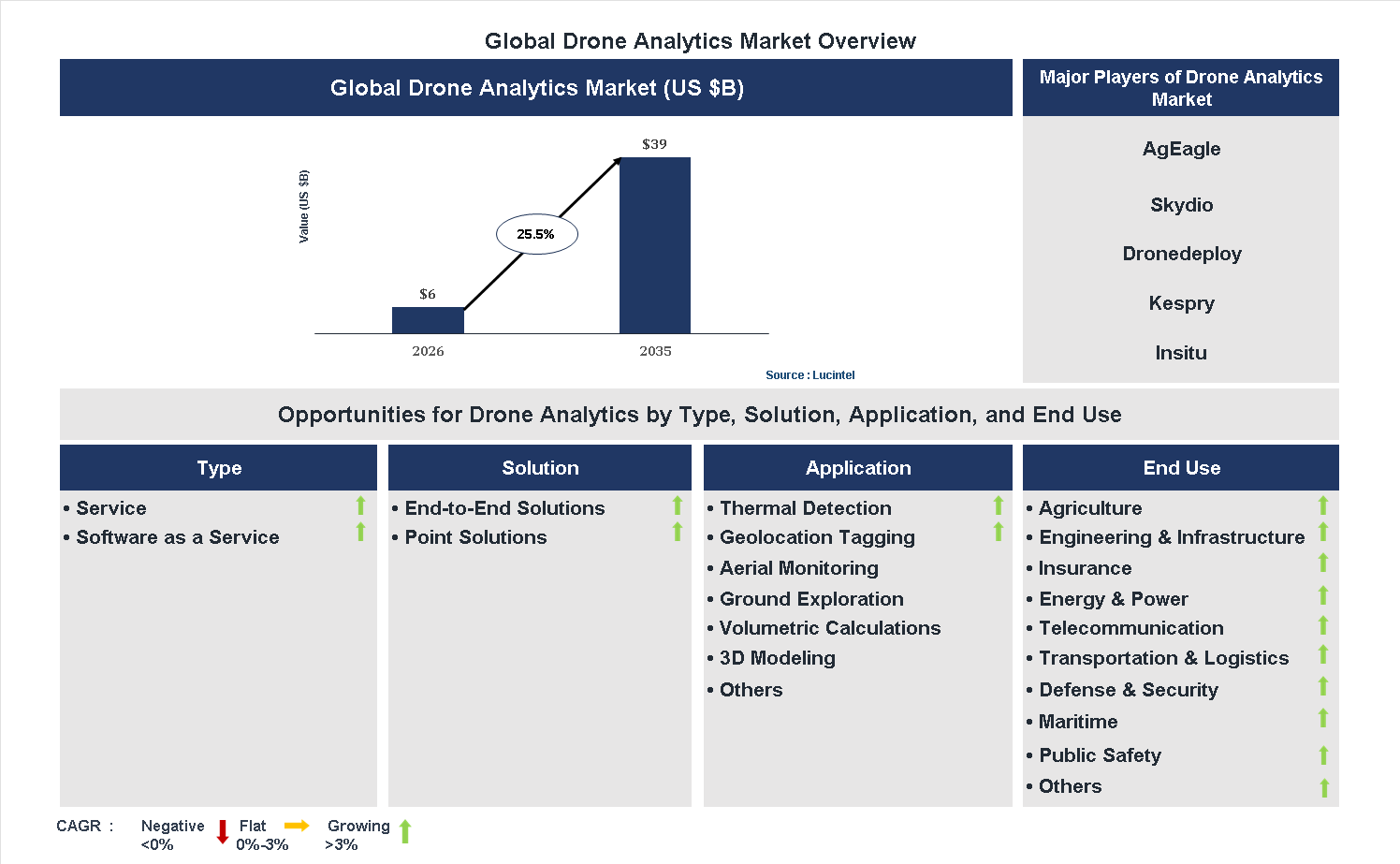
The future of the global drone analytics market looks promising with opportunities in the thermal detection, geolocation tagging, aerial monitoring, ground exploration, volumetric calculation, and 3d modeling markets. The global drone analytics market is expected to reach an estimated $39 billion by 2035 with a CAGR of 25.5% from 2026 to 2035. The major drivers for this market are the increasing demand for real time aerial data insights, the growing need for cost effective & faster data collection, and the rising demand for disaster management & emergency response solution.• Lucintel forecasts that, within the type category, software as a service is expected to witness higher growth over the forecast period.
• Within the application category, aerial monitoring is expected to witness the highest growth.
• In terms of region, APAC is expected to witness the highest growth over the forecast period. Gain valuable insights for your business decisions with our comprehensive 150+ page report. Sample figures with some insights are shown below.
Emerging Trends in the Drone Analytics Market
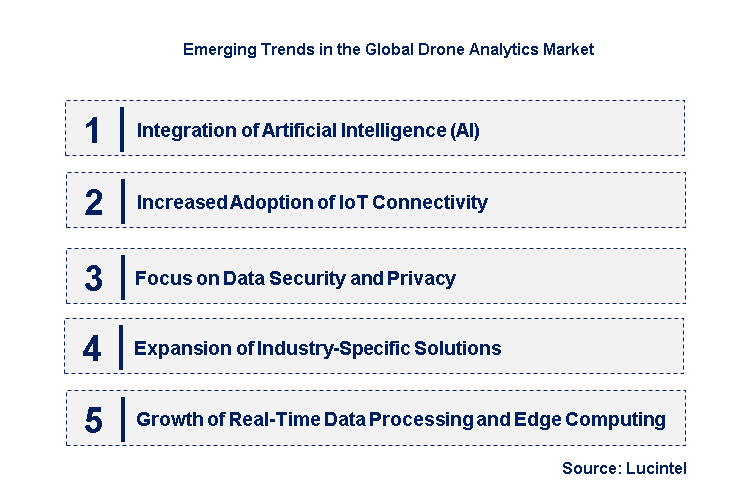
The drone analytics market is experiencing rapid growth driven by technological advancements, increasing adoption across various industries, and the need for enhanced data collection and analysis. As drones become more sophisticated and accessible, their applications in sectors such as agriculture, construction, defense, and environmental monitoring are expanding. This evolution is fostering innovative solutions that improve efficiency, safety, and decision-making processes. The markets trajectory indicates a shift towards more integrated, AI-powered, and real-time analytics capabilities. These developments are not only transforming operational workflows but also creating new opportunities and challenges for stakeholders involved in drone technology and data analytics.• Integration of Artificial Intelligence (AI): AI-powered analytics are enabling drones to process large volumes of data autonomously, improving accuracy and speed. This integration allows for real-time insights, predictive analytics, and enhanced decision-making, especially in complex environments like disaster zones or large-scale agricultural fields. The ability of AI to identify patterns and anomalies reduces human intervention, making drone analyticss more efficient and reliable. As AI technology advances, its incorporation into drone analyticss is expected to become more sophisticated, further expanding the market’s capabilities and applications.
• Increased Adoption of IoT Connectivity: The integration of Internet of Things (IoT) technology with drone analyticss is facilitating seamless data sharing and remote monitoring. IoT-enabled drones can transmit data in real-time to centralized systems, enabling faster response times and better coordination across industries such as logistics, agriculture, and infrastructure management. This connectivity enhances operational efficiency, reduces downtime, and supports predictive maintenance. As IoT infrastructure expands, the synergy between drones and connected devices will drive more comprehensive and scalable analytics solutions, transforming how industries leverage drone data.
• Focus on Data Security and Privacy: As drone analyticss handle sensitive and large-scale data, concerns around cybersecurity and privacy are intensifying. Market players are investing in advanced encryption, secure data storage, and compliance with regulatory standards to protect against cyber threats and unauthorized access. Ensuring data integrity and privacy is crucial for gaining user trust and meeting legal requirements, especially in defense and government applications. The emphasis on robust security measures is shaping the development of secure drone analyticss platforms, fostering market growth while addressing critical ethical and legal considerations.
• Expansion of Industry-Specific Solutions: Customized drone analyticss solutions tailored to specific industry needs are emerging, offering targeted insights and functionalities. For example, in agriculture, analytics focus on crop health and yield prediction; in construction, they assist with site surveying and progress tracking; in environmental monitoring, they help track wildlife or pollution levels. These specialized solutions improve operational efficiency, reduce costs, and enhance decision-making accuracy. The trend toward industry-specific analytics is driving market diversification and encouraging vendors to develop more tailored, value-added services that meet unique sector demands.
• Growth of Real-Time Data Processing and Edge Computing: The demand for instant insights is fueling the adoption of edge computing in drone analyticss. Processing data locally on the drone or nearby devices reduces latency, enabling real-time decision-making in critical scenarios such as disaster response or security surveillance. This trend enhances operational responsiveness and reduces reliance on cloud connectivity, which can be limited in remote areas. As edge computing technology matures, it will enable more autonomous drone operations and faster analytics, significantly impacting industries that require immediate data interpretation and action. These emerging trends are fundamentally reshaping the drone analytics market by enhancing technological capabilities, improving security, and enabling industry-specific solutions. The integration of AI, IoT, and edge computing is making drone analyticss more intelligent, secure, and adaptable. As these trends continue to evolve, they will unlock new opportunities for innovation, efficiency, and strategic decision-making across diverse sectors, positioning the market for sustained growth and transformation.
Recent Developments in the Drone Analytics Market
The drone analytics market is experiencing rapid growth driven by technological advancements and increasing demand across various industries. Innovations in data processing, AI integration, and sensor technology are expanding applications in agriculture, security, infrastructure, and entertainment. As businesses seek efficient, real-time insights, the market is poised for significant expansion. This evolution presents new opportunities for stakeholders to enhance operational efficiency, reduce costs, and improve decision-making processes, ultimately transforming how industries utilize drone analyticss for strategic advantages.• Growing Adoption of AI-powered Analytics: The integration of artificial intelligence with drone data analytics is revolutionizing the market by enabling real-time processing, predictive insights, and automation. This advancement improves accuracy and efficiency, making drone analyticss more accessible and valuable across sectors like agriculture, security, and construction. As AI technology becomes more sophisticated, the market will see increased demand for intelligent solutions that can handle complex data sets, leading to smarter decision-making and operational optimization.
• Expansion of Drone Applications in Agriculture: Drones equipped with advanced sensors and analytics are transforming agriculture by providing precise crop monitoring, soil analysis, and resource management. This development enhances yield prediction, reduces resource wastage, and enables early detection of pests and diseases. The market benefits from increased adoption by farmers and agribusinesses seeking sustainable, cost-effective solutions. As technology becomes more affordable and accessible, the agricultural sector will continue to be a major growth driver for drone analyticss.
• Rising Demand for Security and Surveillance Solutions: Governments and private entities are increasingly deploying drone analyticss for perimeter security, disaster management, and urban surveillance. Enhanced data analytics capabilities allow for real-time threat detection, crowd monitoring, and infrastructure inspection. This trend boosts market growth by expanding the scope of drone applications in security, especially in high-risk or inaccessible areas. As regulations evolve and technology advances, the demand for sophisticated analytics solutions in security will accelerate, creating new revenue streams.
• Advancements in Sensor Technology and Data Processing: Improvements in sensor resolution, multispectral imaging, and data processing speed are significantly enhancing drone analyticss capabilities. These innovations enable detailed environmental mapping, infrastructure assessment, and disaster response. The market benefits from higher-quality data and faster insights, which are critical for timely decision-making. As sensor technology becomes more compact and affordable, a broader range of industries will adopt drone analyticss, fueling market expansion and diversification.
• Increasing Focus on Regulatory Compliance and Data Security: As drone analyticss become more widespread, regulatory frameworks are evolving to ensure safety, privacy, and data security. Compliance requirements are prompting vendors to develop secure, transparent solutions, fostering trust among users. This focus on regulation and security is driving innovation in data encryption, access controls, and legal standards. The market will grow as organizations seek compliant solutions that mitigate risks, ensuring sustainable adoption and long-term growth in the drone analyticss industry. The overall impact of these developments is a dynamic, expanding market characterized by technological innovation, broader application scope, and increased regulatory clarity. These factors are driving higher adoption rates, improving operational efficiencies, and opening new revenue opportunities across industries. As the market matures, stakeholders will benefit from more sophisticated, secure, and integrated drone analyticss solutions, shaping the future landscape of data-driven decision-making.
Strategic Growth Opportunities in the Drone Analytics Market
The drone analytics market is experiencing rapid expansion driven by technological advancements, increasing adoption across industries, and the need for enhanced data insights. As organizations seek efficient, real-time solutions for surveillance, mapping, and data collection, the market presents significant growth opportunities. Innovations in AI, machine learning, and sensor technology are further fueling this growth, enabling more sophisticated analytics. Strategic investments and partnerships are expected to accelerate market penetration, making drone analyticss a vital component of modern operational strategies across various sectors.• Integration of AI and Machine Learning for Advanced Data Analysis: The incorporation of AI and machine learning into drone analyticss enhances data processing capabilities, enabling real-time insights, predictive analytics, and automated decision-making. This integration improves accuracy, reduces manual effort, and broadens application scope across industries such as agriculture, construction, and security. As AI technology advances, drone analyticss will become more intelligent, scalable, and capable of handling complex datasets, driving market growth and expanding use cases.
• Growing Adoption of Drone Analytics in Agriculture for Precision Farming: Precision farming benefits significantly from drone analyticss by providing detailed crop health assessments, soil analysis, and irrigation management. Drones equipped with multispectral sensors enable farmers to monitor large areas efficiently, optimize resource use, and increase yields. The demand for sustainable farming practices and food security initiatives is fueling adoption. As technology becomes more affordable and accessible, the agriculture sector is expected to be a major growth driver for drone analyticss.
• Expansion of Drone Analytics in Infrastructure Inspection and Maintenance: Drone analytics are increasingly used for inspecting infrastructure such as bridges, power lines, and pipelines, reducing risks and costs associated with manual inspections. Advanced analytics enable detailed defect detection, structural health monitoring, and predictive maintenance. Governments and private companies are investing in these solutions to improve safety and operational efficiency. The growing need for regular inspections and the ability to access hard-to-reach areas are key factors propelling this market segment.
• Increasing Deployment of Drone Analytics in Security and Surveillance Applications: Security agencies and private organizations leverage drone analyticss for perimeter monitoring, crowd control, and threat detection. The ability to analyze aerial footage in real-time enhances situational awareness and response times. The integration of facial recognition, thermal imaging, and behavioral analytics further boosts effectiveness. As security concerns rise globally, demand for sophisticated drone analyticss solutions is expected to grow, making this a prominent opportunity in the market.
• Rising use of Drone Analytics in Environmental Monitoring and Disaster Management: Drone analytics facilitate detailed environmental assessments, wildlife monitoring, and disaster response planning. They enable rapid data collection over large areas, providing critical insights for conservation efforts and emergency response. The ability to monitor climate change impacts, deforestation, and natural disasters in real-time supports sustainable development goals. Increasing environmental awareness and regulatory support are driving investments in drone analyticss for these applications, promising significant market expansion. These growth opportunities are set to transform the drone analytics market by enhancing operational efficiency, safety, and sustainability across diverse sectors, fostering innovation and competitive advantage.
Drone Analytics Market Driver and Challenges
The drone analytics market is influenced by a variety of technological, economic, and regulatory factors that shape its growth and development. Advances in drone technology, data analytics, and artificial intelligence are driving innovation and expanding application areas. Economic factors such as increasing demand for surveillance, agriculture, and infrastructure monitoring contribute to market expansion. However, regulatory challenges related to airspace management, privacy concerns, and safety standards pose significant hurdles. Additionally, technological challenges like data security and integration complexities impact market progression. Understanding these drivers and challenges is essential for stakeholders to navigate the evolving landscape effectively and capitalize on emerging opportunities. The factors responsible for driving the drone analytics market include:• Technological Innovation: The rapid development of drone hardware, sensors, and data analytics software enhances the capabilities of drone analyticss. Improved flight stability, longer battery life, and high-resolution imaging enable more precise data collection. Integration of artificial intelligence and machine learning allows for real-time data processing and predictive analytics, broadening application scopes in sectors like agriculture, construction, and security. These technological advancements reduce costs, increase efficiency, and open new revenue streams, making drone analyticss more accessible and valuable to various industries.
• Growing Adoption Across Industries: Increasing utilization of drone analyticss in agriculture for crop monitoring, in construction for site surveying, and in security for surveillance is fueling market growth. Businesses recognize the benefits of real-time insights, improved decision-making, and operational efficiency. Governments and private organizations are investing heavily in drone-based solutions for infrastructure inspection, disaster management, and environmental monitoring. This widespread adoption accelerates market expansion, encourages innovation, and creates a competitive landscape with diverse service providers.
• Regulatory Developments and Support: Evolving regulations and policies aimed at integrating drones into national airspace systems are facilitating market growth. Governments are establishing frameworks for safe drone operations, including licensing, flight restrictions, and privacy protections. These regulatory developments provide clarity and confidence for commercial users, encouraging investment and deployment of drone analyticss solutions. Supportive policies and incentives further stimulate market expansion by reducing legal uncertainties and fostering innovation.
• Economic Growth and Investment: The increasing economic value derived from drone analyticss is attracting significant investments from venture capitalists, technology firms, and government agencies. The potential for cost savings, enhanced safety, and new business models drives funding into research, development, and deployment. Economic growth in emerging markets also expands the customer base, creating opportunities for market players to scale operations and diversify offerings, ultimately accelerating industry growth.
• Rising Data-Driven Decision Making: The shift towards data-centric strategies across industries is a major driver. Drone analytics provides actionable insights through high-resolution imagery, thermal imaging, and sensor data, enabling better decision-making in agriculture, urban planning, and disaster response. The ability to analyze large datasets quickly and accurately enhances operational efficiency and strategic planning, making drone analyticss indispensable for organizations seeking competitive advantages in a data-driven economy. The challenges facing the drone analytics market include:
• Regulatory Uncertainty and Restrictions: Despite progress, inconsistent regulations across regions create barriers to market expansion. Restrictions on drone flight altitude, no-fly zones, and licensing requirements complicate deployment, especially for international operations. Privacy concerns and safety regulations often lead to delays and increased compliance costs. Unclear or evolving policies can hinder innovation and deter investment, limiting the growth potential of drone analyticss solutions in certain markets.
• Data Security and Privacy Concerns: The collection and storage of vast amounts of sensitive data raise significant security and privacy issues. Unauthorized access, data breaches, and misuse of information can undermine trust among users and the public. Regulatory frameworks around data privacy are still developing, creating uncertainty for companies handling large datasets. Ensuring robust cybersecurity measures and compliance with privacy laws is essential but challenging, potentially slowing market adoption.
• Technological Integration and Standardization Challenges: Integrating drone analyticss with existing enterprise systems and ensuring interoperability remains complex. Lack of standardized protocols and data formats hampers seamless data sharing and analysis. Additionally, technological limitations such as limited battery life, data processing speeds, and sensor accuracy can restrict operational efficiency. Overcoming these technical barriers requires significant investment and innovation, which may delay widespread adoption and scalability. The drone analytics market is propelled by rapid technological advancements, expanding industry applications, supportive regulatory developments, economic investments, and a shift towards data-driven decision-making. However, regulatory uncertainties, data security issues, and technological integration challenges pose significant hurdles. These drivers and challenges collectively influence the market’s trajectory, requiring stakeholders to navigate complexities carefully. Strategic innovation, regulatory clarity, and robust security measures will be crucial for sustained growth and competitive advantage in this evolving landscape.
List of Drone Analytics Companies
Companies in the market compete on the basis of product quality offered. Major players in this market focus on expanding their manufacturing facilities, R&D investments, infrastructural development, and leverage integration opportunities across the value chain. With these strategies drone analytics companies cater increasing demand, ensure competitive effectiveness, develop innovative products & technologies, reduce production costs, and expand their customer base. Some of the drone analytics companies profiled in this report include-• AgEagle
• Skydio
• Dronedeploy
• Kespry
• Insitu
• Parrot
• AeroVironment
Drone Analytics Market by Segment
The study includes a forecast for the global drone analytics market by type, solution, application, end use, and region.Drone Analytics Market by Type [Value from 2019 to 2035]:
• Service
• Software as a Service
Drone Analytics Market by Solution [Value from 2019 to 2035]:
• End-to-End Solutions
• Point Solutions
Drone Analytics Market by Application [Value from 2019 to 2035]:
• Thermal Detection
• Geolocation Tagging
• Aerial Monitoring
• Ground Exploration
• Volumetric Calculations
• 3D Modeling
• Others
Drone Analytics Market by End Use [Value from 2019 to 2035]:
• Agriculture
• Engineering & Infrastructure
• Insurance
• Energy & Power
• Telecommunication
• Transportation & Logistics
• Defense & Security
• Maritime
• Public Safety
• Others
Drone Analytics Market by Region [Value from 2019 to 2035]:
• North America
• Europe
• Asia Pacific
• The Rest of the World
Country Wise Outlook for the Drone Analytics Market
The drone analytics market has experienced rapid growth driven by technological advancements, increasing adoption across various industries, and expanding applications in surveillance, agriculture, and logistics. As countries seek to leverage drone data for improved decision-making and operational efficiency, regional developments reflect diverse priorities and innovations. The United States leads in technological innovation and market size, while China emphasizes manufacturing and integration. Germany focuses on precision and industrial applications, India is rapidly expanding its drone ecosystem, and Japan emphasizes safety and regulatory frameworks. These developments collectively shape the evolving landscape of drone analyticss globally.• United States: The US drone analytics market has seen significant growth with advancements in AI-powered data processing, increased adoption in agriculture, defense, and infrastructure monitoring, and the emergence of major tech companies investing in drone analyticss solutions. Regulatory frameworks are evolving to support commercial drone operations, fostering innovation and market expansion.
• China: China is rapidly expanding its drone manufacturing capabilities and integrating analytics into commercial and military applications. The government promotes drone technology for agriculture, surveillance, and delivery services, leading to increased domestic production and innovative analytics platforms tailored to local needs.
• Germany: Germany emphasizes precision and industrial applications of drone analyticss, particularly in manufacturing, infrastructure inspection, and environmental monitoring. The focus on safety standards and regulatory compliance has driven the development of sophisticated analytics tools that enhance operational efficiency and safety.
• India: India’s drone analyticss market is experiencing rapid growth driven by government initiatives, startups, and increased adoption in agriculture, defense, and disaster management. The country is investing in local R&D, developing affordable analytics solutions, and establishing regulatory frameworks to support market expansion.
• Japan: Japan prioritizes safety, regulatory compliance, and technological innovation in drone analyticss. The market is advancing with developments in autonomous drone operations, integration with IoT, and applications in disaster management, infrastructure inspection, and urban planning, supported by strong government and industry collaborations.

Features of the Global Drone Analytics Market
Market Size Estimates: Drone analytics market size estimation in terms of value ($B). Trend and Forecast Analysis: Market trends (2019 to 2025) and forecast (2026 to 2035) by various segments and regions. Segmentation Analysis: Drone analytics market size by various segments, such as by type, solution, application, end use, and region in terms of value ($B). Regional Analysis: Drone analytics market breakdown by North America, Europe, Asia Pacific, and Rest of the World. Growth Opportunities: Analysis of growth opportunities in different types, solutions, applications, end uses, and regions for the drone analytics market. Strategic Analysis: This includes M&A, new product development, and competitive landscape of the drone analytics market. Analysis of competitive intensity of the industry based on Porter’s Five Forces model.
FAQ
Q1. What is the drone analytics market size? Answer: The global drone analytics market is expected to reach an estimated $39 billion by 2035. Q2. What is the growth forecast for drone analytics market? Answer: The global drone analytics market is expected to grow with a CAGR of 25.5% from 2026 to 2035. Q3. What are the major drivers influencing the growth of the drone analytics market? Answer: The major drivers for this market are the increasing demand for real time aerial data insights, the growing need for cost effective & faster data collection, and the rising demand for disaster management & emergency response solution. Q4. What are the major segments for drone analytics market? Answer: The future of the drone analytics market looks promising with opportunities in the thermal detection, geolocation tagging, aerial monitoring, ground exploration, volumetric calculation, and 3d modeling markets. Q5. Who are the key drone analytics market companies? Answer: Some of the key drone analytics companies are as follows:• AgEagle
• Skydio
• Dronedeploy
• Kespry
• Insitu
• Parrot
• AeroVironment Q6. Which drone analytics market segment will be the largest in future? Answer: Lucintel forecasts that, within the type category, software as a service is expected to witness higher growth over the forecast period. Q7. In drone analytics market, which region is expected to be the largest in next 8 years? Answer: In terms of region, APAC is expected to witness the highest growth over the forecast period. Q8. Do we receive customization in this report? Answer: Yes, Lucintel provides 10% customization without any additional cost.
Table of Contents
List of Figures
List of Tables
Methodology
- In-depth interviews of the major players in this market
- Detailed secondary research from competitors’ financial statements and published data
- Extensive searches of published works, market, and database information pertaining to industry news, company press releases, and customer intentions
- A compilation of the experiences, judgments, and insights of Lucintel’s professionals, who have analyzed and tracked this market over the years.


Buy Now
Choose a license that fits your team. Instant PDF delivery.
Prices exclude taxes. Instant delivery. Custom licensing available on request.
Key Questions
- • What are some of the most promising, high-growth opportunities for the drone analytics market by type (service and software as a service), solution (end-to-end solutions and point solutions), application (thermal detection, geolocation tagging, aerial monitoring, ground exploration, volumetric calculations, 3d modeling, and others), end use (agriculture, engineering & infrastructure, insurance, energy & power, telecommunication, transportation & logistics, defense & security, maritime, public safety, and others), and region (North America, Europe, Asia Pacific, and the Rest of the World)?
- • Which segments will grow at a faster pace and why?
- • Which region will grow at a faster pace and why?
- • What are the key factors affecting market dynamics? What are the key challenges and business risks in this market?
- • What are the business risks and competitive threats in this market?
- • What are the emerging trends in this market and the reasons behind them?
- • What are some of the changing demands of customers in the market?
- • What are the new developments in the market? Which companies are leading these developments?
- • Who are the major players in this market? What strategic initiatives are key players pursuing for business growth?
- • What are some of the competing products in this market and how big of a threat do they pose for loss of market share by material or product substitution?
- • What M&A activity has occurred in the last 5 years and what has its impact been on the industry? For any questions related to Drone Analytics Market, Drone Analytics Market Size, Drone Analytics Market Growth, Drone Analytics Market Analysis, Drone Analytics Market Report, Drone Analytics Market Share, Drone Analytics Market Trends, Drone Analytics Market Forecast, Drone Analytics Companies, write Lucintel analyst at email: helpdesk@lucintel.com. We will be glad to get back to you soon.


