
Market Report · July 31, 2026

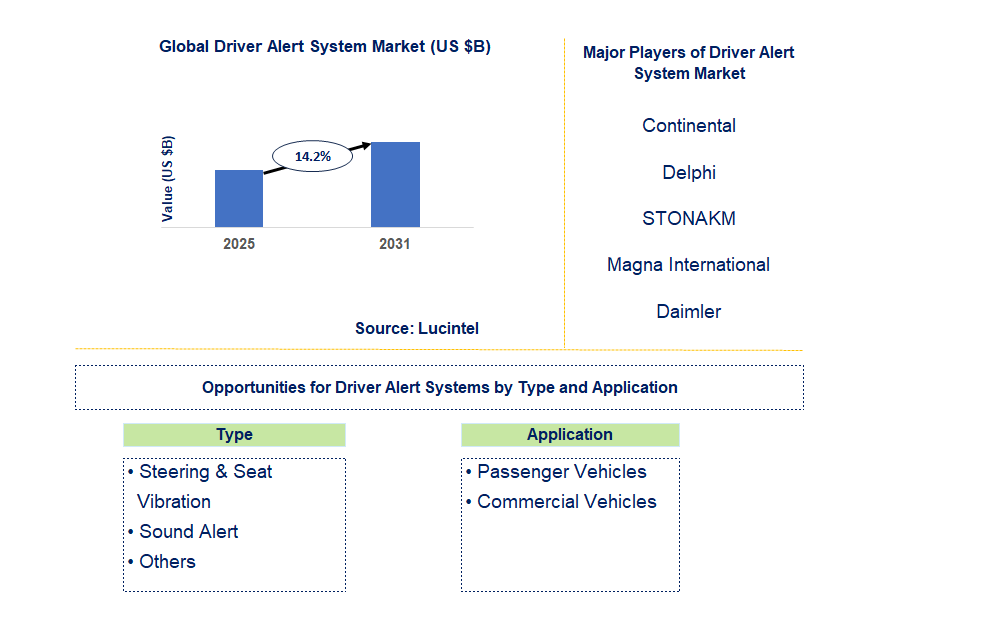
Key data points: The growth forecast = 14.2% annually for the next 7 years. Scroll below to get more insights. This market report covers trends, opportunities and forecasts in driver alert system market to 2031 by type (steering & seat vibration, sound alert, and others), application (passenger vehicles and commercial vehicles), and region (North America, Europe, Asia Pacific, and the Rest of the World)
We'll send your sample report shortly.
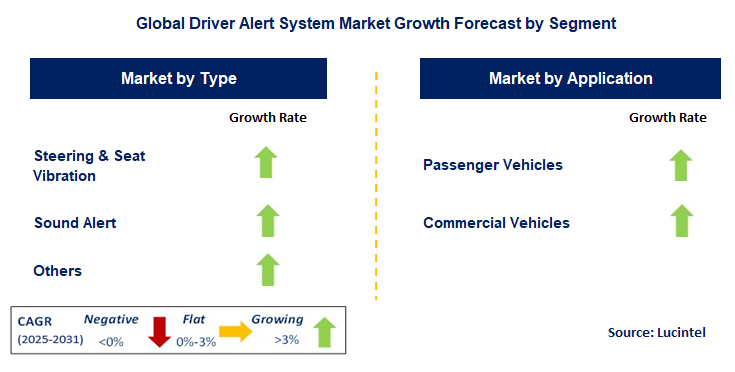
• Lucintel forecasts that, within the type category, steering & seat vibration is expected to witness higher growth over the forecast period.
• Within the application category, passenger vehicle is expected to witness higher growth.
• In terms of region, APAC is expected to witness the highest growth over the forecast period. Gain valuable insights for your business decisions with our comprehensive 150+ page report. Sample figures with some insights are shown below.
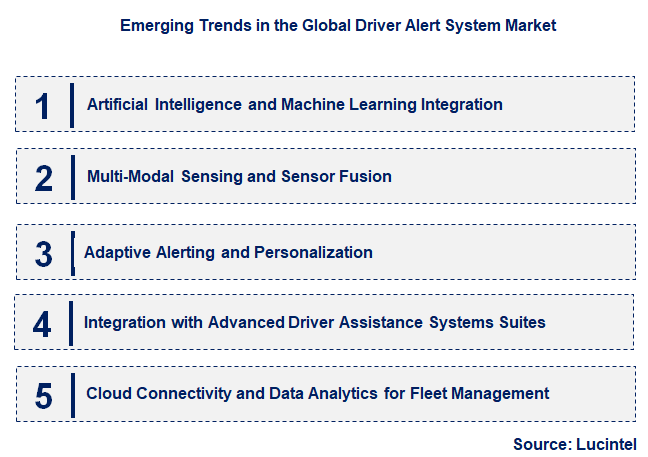
• Artificial Intelligence and Machine Learning Integration: The most notable trend is the growing integration of AI and machine learning algorithms into driver alert systems. These sophisticated algorithms allow systems to recognize intricate information from multiple sensors, i.e., cameras and radars, to clearly identify fine cues for driver fatigue, distraction, or impairment. This influence makes systems shift from reactive alarms to proactive predictors, providing more timely and accurate interventions, hence radically improving road safety by minimizing human mistakes.
• Multi-Modal Sensing and Sensor Fusion: Driver alert systems are shifting towards the use of multiple types of sensors, such as cameras, radar, lidar, and ultrasonic sensors, along with advanced sensor fusion algorithms. This method offers a holistic view of the state of the driver and the environment around the vehicle. The effect is a significant enhancement in the reliability and precision of warnings, minimizing false alarms and misses, making the systems more reliable under varying driving conditions and environmental hardships such as inclement weather or low light.
• Adaptive Alerting and Personalization: New systems are becoming more personalized, with alert mechanisms that cater to unique driver behavior and tendencies. These range from variable sensitivity levels for warnings, haptic feedback by steering wheel vibration, or seat pulsations, to customized audio alerts. The effect is better driver acceptance and less annoyance, with alerts being less obtrusive and more competent, higher adoption rates, and greater interaction with safety features, ultimately enhancing overall road safety.
• Integration with Advanced Driver Assistance Systems Suites: Driver alert systems are becoming more and more an integral part of comprehensive ADAS suites, instead of standalone features. This integration provides a comprehensive in-cabin safety system that integrates driver monitoring with features such as lane-keeping assist, adaptive cruise control, and automatic emergency braking. The effect is a more holistic safety solution that actively manages different driving hazards with a synergistic effect that notably increases overall vehicle safety and readies for higher degrees of autonomous driving.
• Cloud Connectivity and Data Analytics for Fleet Management: For fleet operators and commercial vehicles, a major trend is the combination of driver alert systems with cloud-based systems for real-time data analytics and remote monitoring. This enables managers to monitor driver habits, detect at-risk drivers, and apply targeted training. The effect is enhanced safety performance records, lower operations costs through fewer accidents, maximized driver performance, and enhanced safety regulation compliance, resulting in a more efficient and safer logistics operation. These nascent trends are redefining the driver alert system market at its core by evolving these technologies into extremely savvy, integrated, and customized safety solutions. The paradigm shift in AI, multi-modal sensing, and transparent integration with ADAS is making cars far safer and more proactive in avoiding accidents. In addition, the emphasis on personalization and cloud connectivity for fleet monitoring is enhancing individual driver experience as well as wider operational safety and efficiency for commercial industries.
• Compulsory Fitment in New Cars: One of the most important recent additions is regulatory mandates in a number of major markets, including the European Union's General Safety Regulation (GSR II) as well as the addition of Driver Monitoring Systems (DMS) to the China C-NCAP test protocols. These mandates require automakers to fit sophisticated driver distraction warning systems and driver fatigue and attention warning systems across new car models. The effect will be a certain boost in market penetration and standardization of such safety features, thereby substantially augmenting market growth and making advanced safety features commonplace.
• Innovation in Camera-Based Driver Monitoring Systems: There has been considerable innovation in camera-based driver monitoring systems (DMS), building on progress in image processing and computer vision. These systems are able to detect subtle facial expressions, gaze, and head postures accurately to look out for signs of fatigue, distraction, or phone use. The effect is very accurate, non-intrusive surveillance, with instant alerts that are more effective in averting accidents than older, less technologically advanced approaches, which in turn improves the overall safety on the road.
• In-Vehicle Alcohol and Drug Detection System Development: One recent interesting innovation is the development of in-vehicle systems to detect alcohol or drug intoxication in drivers. Although still at early stages of mass commercialization, prototypes and pilot programs are concentrating on non-invasive technologies for evaluating driver sobriety. The effect, if universally implemented, would be a paradigm shift from post-incident accountability to pre-incident prevention, substantially minimizing impaired driving accidents and making the road environment safer for all.
• Integration with Electric and Autonomous Cars: Driver alert systems are being increasingly integrated into electric cars (EVs) and cars with increased levels of autonomous driving features (L2+ to L4). For electric vehicles, these systems guarantee driver attention during lengthy silent drives, while for self-driving cars, they are essential in the monitoring of driver preparedness to resume control. The effect is that driver alert systems become an essential safety layer for future mobility, guaranteeing human watching and intervention capability, essential for the successful adoption of automated driving.
• Collaborations and Partnerships between Automakers and Tech Firms: One major trend is strategic collaborations and partnerships between conventional automakers and technology-specialist firms (e.g., Mobileye, NVIDIA, Continental, Bosch). These partnerships seek to incorporate state-of-the-art AI, sensor technology, and software platforms into vehicle designs. The effect is faster development and implementation of highly sophisticated driver alert systems, combining expertise to provide more advanced, trustworthy, and competitive safety functions to the world market. These developments in recent years are strongly influencing the driver alert system market to drive mandatory implementation, increase technological complexity, and widen the functional applications of these systems. The regulatory requirements guarantee market growth, while innovation in camera-based systems and the introduction of alcohol detection systems are rendering them more accurate and proactive. In addition, their inclusion in EVs and autonomous cars, and strategic collaborations between industries, are propelling driver alert systems as unavoidable elements of coming mobility and contributing enormously to road safety worldwide.
• Passenger Vehicles: The biggest and most imminent growth potential is in the further integration of driver alert systems as original equipment manufacturer (OEM) standard equipment in new passenger vehicles. With growing safety ratings and customer demands for ADAS features, manufacturers are being forced to install sophisticated drowsiness and distraction detection systems in their cars. With an emphasis on smooth integration, affordability for mass-market vehicles, and conformity to changing international safety standards, this segment is likely to experience massive volume growth.
• Fleet Commercial Vehicles: Fleet commercial vehicles, such as trucks, buses, and logistics fleets, are a massive opportunity for growth. Driver distraction and fatigue are compelling issues for fleet owners because of the dire consequences for safety, insurance, and efficiency. Strategic expansion includes providing tough, telematics-based driver alert systems that inform drivers in real-time and transmit information to fleet managers to enable active intervention, post-incident analysis, and driver training. It involves both aftermarket solutions for fleets already in operation and OEM collaborations for new commercial vehicles.
• Public Transportation: Public transport, including city buses, intercity coaches, and taxi services, provides a key expansion opportunity. Passenger safety comes first, and so driver attentiveness is a high priority. Using driver alert systems in these trucks can greatly minimize accidents due to tiredness or distraction, enhancing public confidence and minimizing operational liabilities. There are opportunities to develop specific solutions that consider multi-driver shifts and varying driving conditions on urban and intercity routes.
• Autonomous and Semi-Autonomous Vehicles: With advancements in autonomous driving technologies, driver alert systems will find applications in higher levels of vehicle automation (Level 2+ to Level 4), where human intervention is still necessary. Potential lies in creating systems that check for driver readiness to take control back, detect disengagement, or keep drivers alert even when the car is in self-driving mode. This application maintains a secure transition between driverless and driver-driven modes, filling a vital safety gap in developing mobility.
• Specialized and Niche Vehicles: In addition to traditional road vehicles, there is an increasing potential in specialized industries such as construction, mining, and agriculture, where drivers operate for extended periods in demanding conditions. Heavy machinery driver alert systems designed for these industries can avoid accidents due to fatigue, enhancing worker safety and productivity in these hazardous sectors. Strategic expansion entails creating ruggedized systems that can operate in harsh environments and interface with specialized vehicle control systems. These strategic growth prospects are significantly transforming the driver alert system market by increasing its base of applications and hastening technology advancements. The concerted emphasis on passenger and commercial vehicles, both OEM and aftermarket, guarantees continued market expansion. In addition, the growth into public transit, autonomous transport, and heavy industrial machinery emphasizes the range and growing importance of driver alert systems in a broad spectrum of mobility and application environments, ultimately leading to increased safety in a variety of industries.
• Continental
• Delphi
• STONAKM
• Magna International
• Daimler
• DENSO Corporation
• Infineon Technologies
• HELLA
• Robert Bosch
• Faurecia
• Steering & Seat Vibration
• Sound Alert
• Others
• Passenger Vehicles
• Commercial Vehicles
• North America
• Europe
• Asia Pacific
• The Rest of the World
• United States: The driver alert systems market in the United States is driven mainly by the demand from consumers for safety features and government initiatives to curb road accidents. New trends have been the extensive inclusion of advanced driver assistance systems (ADAS) as standard equipment in new cars. There is particular emphasis on camera-based driver monitoring systems for drowsiness and distraction, with ongoing advancements in radar and lidar technologies for enhanced forward collision warning and blind spot detection.
• China: The driver alert system market in China is growing rapidly, driven by government regulations and fast take-up of smart driving tech in domestic cars. Key advancements in recent times have been a sharp increase in the installation rate of driver and occupant monitoring systems in passenger vehicles. Localized, full-stack ADAS solutions are being developed fast by Chinese manufacturers, frequently with AI-enabled vision-based systems. Efforts are also mounting to enforce safe deployment and sale of these advanced systems.
• Germany: Germany, the current leader in automotive technology, emphasizes high-precision and solid driver alert systems as part of its overall ADAS development. Recent developments have seen OEMs and Tier 1 suppliers raise investment in research and development of advanced sensing technologies, especially for driver state and health monitoring. There is significant focus on blending these systems into both conventional internal combustion engine vehicles as well as the increasingly popular electric vehicle market to promote a safe driving experience.
• India: The Indian driver alert system market is growing significantly, led mainly by growing awareness of road safety and new government regulations. Latest additions include the compulsory inclusion of certain ADAS features, such as advanced emergency braking and driver drowsiness and attention warning in new cars for more than eight passengers from April 2026. Local automakers are increasingly offering ADAS features on mass-market SUVs, and there is a growing demand for local ADAS solutions, despite the challenges posed by varied road conditions.
• Japan: The driver alert system market in Japan is defined by high safety standards and the adoption of highly advanced technologies in its highly developed auto industry. New trends consist of the widespread adoption of ADAS features such as collision avoidance systems and adaptive cruise control, even in small cars. Japanese automakers are actively incorporating artificial intelligence and machine learning algorithms into ADAS systems aimed at improving the accuracy and reliability of driver alerts across various driving situations.


• Continental
• Delphi
• STONAKM
• Magna International
• Daimler
• DENSO Corporation
• Infineon Technologies
• HELLA
• Robert Bosch
• Faurecia Q5. Which driver alert system market segment will be the largest in future? Answer: Lucintel forecasts that, within the type category, steering & seat vibration is expected to witness higher growth over the forecast period. Q6. In driver alert system market, which region is expected to be the largest in next 5 years? Answer: In terms of region, APAC is expected to witness the highest growth over the forecast period. Q7. Do we receive customization in this report? Answer: Yes, Lucintel provides 10% customization without any additional cost.


Choose a license that fits your team. Instant PDF delivery.
Prices exclude taxes. Instant delivery. Custom licensing available on request.
Market Report · July 31, 2026
Market Report · July 22, 2026
Market Report · July 17, 2026
Trusted partner for strategic intelligence and business growth


Receive a complimentary market analysis tailored to your industry. Our analysts will identify key growth opportunities and competitive dynamics specific to your business.

Market size, growth rate, and key trend analysis for your specific sector.

Top competitor positioning and market share analysis.

Strategic recommendations backed by data-driven insights.
Get curated market intelligence and competitive moves straight to your inbox.
By subscribing, you agree to receive our monthly insights. Unsubscribe anytime.
Receive a complimentary market analysis tailored to your industry. Our analysts will identify key growth opportunities and competitive dynamics specific to your business.
Market size, growth rate, and key trend analysis for your specific sector.
Top competitor positioning and market share analysis.
Strategic recommendations backed by data-driven insights.
Get curated market intelligence, emerging trends, and competitive moves straight to your inbox each month.
By subscribing, you agree to receive our monthly insights. Unsubscribe anytime.
We'll send your sample report shortly.