
Report Feature
DNA Forensic Market Trends and Forecast
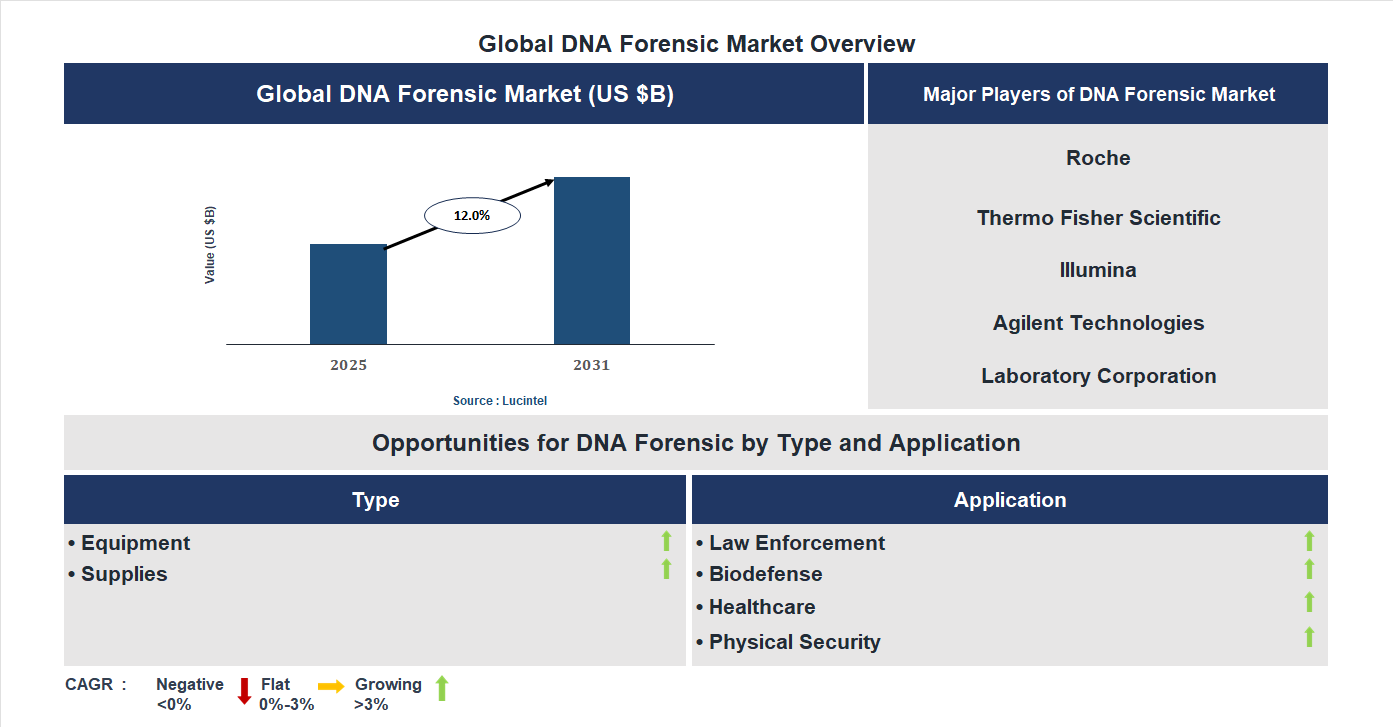
The future of the global DNA forensic market looks promising with opportunities in the law enforcement, biodefense, healthcare, and physical security markets. The global DNA forensic market is expected to grow with a CAGR of 12% from 2025 to 2031. The major drivers for this market are the increasing use of DNA in crime investigations, the rising government investment in forensic infrastructure, and the growing adoption of advanced genetic analysis.• Lucintel forecasts that, within the type category, supply is expected to witness higher growth over the forecast period.
• Within the application category, law enforcement is expected to witness the highest growth.
• In terms of region, APAC is expected to witness the highest growth over the forecast period. Gain valuable insights for your business decisions with our comprehensive 150+ page report. Sample figures with some insights are shown below.
Emerging Trends in the DNA Forensic Market
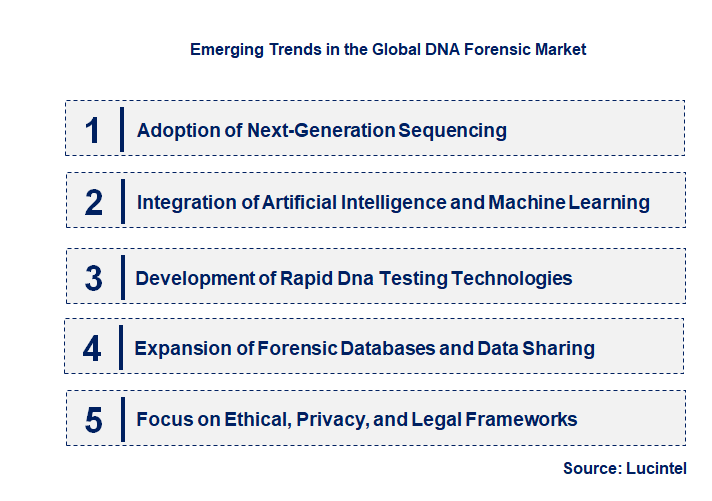
The DNA forensic market is experiencing rapid evolution driven by technological advancements, increasing demand for criminal justice, and the need for more accurate and rapid forensic analysis. As law enforcement agencies and private laboratories seek innovative solutions, the market is shifting towards more sophisticated, efficient, and accessible DNA analysis methods. These developments are not only improving the accuracy of forensic investigations but also expanding the scope of applications, including disaster victim identification and civil cases. The following key trends highlight the transformative changes shaping this dynamic industry, reflecting its move towards greater precision, automation, and integration with emerging technologies.• Adoption of Next-Generation Sequencing (NGS): NGS technology is revolutionizing DNA analysis by enabling comprehensive genetic profiling with high accuracy and speed. Unlike traditional methods, NGS can analyze multiple genetic markers simultaneously, providing detailed insights into complex samples. This trend enhances forensic capabilities in identifying individuals from degraded or mixed samples, improving case resolution. The increased adoption of NGS is driven by decreasing costs and technological improvements, making it more accessible to forensic labs worldwide. Ultimately, NGS is expanding the scope and depth of forensic investigations, leading to more reliable and detailed results.
• Integration of Artificial Intelligence (AI) and Machine Learning: AI and machine learning algorithms are increasingly integrated into forensic workflows to automate data analysis and improve accuracy. These technologies assist in pattern recognition, DNA mixture interpretation, and database searches, reducing human error and processing time. AI-driven tools can analyze large datasets efficiently, enabling faster case turnaround and more precise matches. This trend is transforming forensic laboratories into more intelligent, automated systems, which enhances overall efficiency and reliability. As AI continues to evolve, its application in forensic DNA analysis is expected to become more sophisticated, further improving investigative outcomes.
• Development of Rapid DNA Testing Technologies: Rapid DNA systems are designed to deliver quick results at the crime scene or in the field, significantly reducing turnaround times. These portable devices automate the entire process from sample collection to DNA profile generation within an hour. The impact is substantial, enabling law enforcement to make immediate decisions and streamline investigations. The growing demand for on-site testing is driven by the need for faster justice delivery and resource optimization. As these technologies become more affordable and user-friendly, their adoption is expected to increase, transforming traditional laboratory-dependent processes into real-time forensic solutions.
• Expansion of Forensic Databases and Data Sharing: The growth of national and international DNA databases is facilitating more effective cross-border cooperation and case solving. Enhanced data sharing platforms enable law enforcement agencies to access a broader pool of genetic profiles, increasing the likelihood of matches and reducing investigation times. Privacy and ethical considerations are also being addressed to ensure responsible use. This trend promotes a more collaborative approach to forensic investigations, leading to higher success rates in solving cold cases and identifying unknown individuals. The expansion of databases is a key driver in making forensic analysis more comprehensive and impactful.
• Focus on Ethical, Privacy, and Legal Frameworks: As DNA analysis becomes more advanced and widespread, there is a growing emphasis on establishing robust ethical, privacy, and legal guidelines. This trend aims to balance investigative benefits with individual rights, ensuring responsible use of genetic data. Governments and organizations are developing policies to regulate data collection, storage, and sharing, addressing concerns about misuse and discrimination. Strengthening legal frameworks also enhances public trust and supports the sustainable growth of the market. This focus on regulation is crucial for maintaining ethical standards while leveraging technological innovations to improve forensic outcomes. In summary, these emerging trends are collectively reshaping the DNA forensic market by making investigations faster, more accurate, and ethically responsible. The integration of advanced technologies like NGS and AI, coupled with rapid testing and expanded data sharing, is driving innovation and efficiency. Simultaneously, a focus on ethical frameworks ensures that these advancements are sustainable and socially acceptable. Together, these developments are transforming forensic science into a more powerful tool for justice, security, and civil applications, paving the way for a more reliable and accessible forensic landscape.
Recent Development in the DNA Forensic Market
The DNA forensic market has experienced significant growth driven by technological advancements, increasing crime rates, and the need for accurate forensic analysis. As law enforcement agencies and private laboratories seek more reliable and rapid DNA testing methods, the market is evolving rapidly. Innovations in automation, data analysis, and sample processing are transforming forensic investigations worldwide. Additionally, regulatory changes and rising investments in forensic infrastructure are further propelling market expansion. These developments are not only enhancing the efficiency and accuracy of forensic procedures but also expanding the scope of applications, including criminal justice, paternity testing, and disaster victim identification. The following are five key recent developments shaping this market.• Technological Advancements in DNA Sequencing: The adoption of next-generation sequencing (NGS) technology has revolutionized forensic DNA analysis by enabling faster, more detailed genetic profiling. This development improves the ability to analyze degraded or mixed samples, increasing the accuracy of results. It also allows for the identification of a broader range of genetic markers, enhancing forensic investigations scope. The impact is a significant reduction in analysis time and an increase in the reliability of forensic evidence, leading to more convictions and exonerations.
• Automation and Robotics in Sample Processing: The integration of automation and robotic systems in DNA extraction and analysis has streamlined forensic workflows. These systems reduce human error, increase throughput, and ensure consistency in sample handling. As a result, laboratories can process larger volumes of samples more efficiently, reducing turnaround times. This development enhances the capacity of forensic labs to handle high caseloads, especially in large-scale investigations, and improves overall accuracy and reliability.
• Development of Rapid DNA Technology: Rapid DNA systems enable on-site DNA analysis within hours, significantly speeding up forensic investigations. These portable devices are increasingly being adopted by law enforcement agencies for quick identification of suspects and victims. The impact includes faster case resolution, improved crime scene processing, and enhanced operational efficiency. Rapid DNA technology is particularly valuable in mass disaster scenarios and border security, where quick identification is critical.
• Expansion of Forensic Databases and Data Sharing: The growth of national and international DNA databases has improved the ability to match DNA profiles across different jurisdictions. Enhanced data sharing platforms facilitate faster identification of suspects and linking of crime scenes. This development increases the effectiveness of forensic investigations and supports collaborative efforts in crime prevention. It also raises concerns about privacy and data security, prompting regulatory discussions to balance security and civil liberties.
• Regulatory and Legal Framework Enhancements: Governments and regulatory bodies are updating laws and standards to accommodate new forensic technologies. These changes ensure the admissibility of DNA evidence in court and promote standardized procedures across laboratories. The impact is increased confidence in forensic results, wider acceptance of advanced techniques, and improved quality control. These frameworks also encourage investment in forensic infrastructure and research, further driving market growth. In summary, these recent developments are significantly transforming the DNA forensic market by improving analysis speed, accuracy, and scope. They are enabling law enforcement and forensic laboratories to operate more efficiently and reliably, ultimately strengthening criminal justice systems worldwide. The market is poised for continued growth as technological innovations and regulatory support advance the field further.
Strategic Growth Opportunities in the DNA Forensic Market
The DNA forensic market is experiencing rapid growth driven by technological advancements, increasing crime rates, and the need for accurate forensic analysis. As law enforcement agencies and private laboratories seek more reliable and faster solutions, key application areas are expanding, creating significant opportunities for market players. These developments are shaping the future landscape of forensic science, emphasizing innovation, efficiency, and broader application scopes. Understanding these growth opportunities is essential for stakeholders aiming to capitalize on emerging trends and enhance their market positioning.• Criminal Justice and Law Enforcement: Enhanced forensic techniques are improving crime scene investigations, leading to higher conviction rates and more efficient case resolutions. The adoption of advanced DNA analysis methods allows for quicker identification of suspects, reducing investigation times and increasing overall law enforcement effectiveness.
• Paternity and Family Testing: Growing demand for accurate paternity and familial relationship testing is expanding the market. These applications are crucial in legal disputes, immigration cases, and inheritance claims, driving technological improvements and increasing accessibility to testing services.
• Disaster Victim Identification: DNA analysis plays a vital role in identifying victims of natural disasters, accidents, and mass casualties. The ability to rapidly and accurately identify individuals provides closure to families and aids in legal and administrative processes, boosting demand for forensic DNA services.
• Wildlife and Conservation Forensics: The application of DNA analysis in wildlife forensics helps combat illegal poaching and trafficking. This growth opportunity supports conservation efforts and enforces wildlife protection laws, expanding the scope of forensic DNA applications beyond human crime.
• Cold Case Resolution: Advances in DNA technology enable law enforcement to revisit and solve long-standing unsolved cases. This not only helps deliver justice but also enhances the credibility and utility of forensic DNA analysis, encouraging agencies to invest in more sophisticated solutions. In summary, these growth opportunities are significantly impacting the DNA forensic market by broadening application areas, improving accuracy and speed, and fostering technological innovation. As a result, the market is poised for sustained expansion, driven by increasing demand across various sectors and the continuous evolution of forensic science capabilities.
DNA Forensic Market Driver and Challenges
The DNA forensic market is influenced by a complex interplay of technological advancements, economic factors, and regulatory frameworks. Rapid innovations in DNA sequencing and analysis techniques have enhanced the accuracy and speed of forensic investigations. Economic growth in various regions has increased investments in forensic laboratories and law enforcement agencies, boosting market expansion. Additionally, evolving regulatory standards and legal requirements shape the adoption and application of DNA forensic solutions. These factors collectively drive market growth, but they also present challenges such as technological complexities, ethical concerns, and regulatory hurdles that need to be addressed for sustainable development. The factors responsible for driving the DNA forensic market include:-• Technological Advancements: The continuous development of high-throughput DNA sequencing, automation, and bioinformatics tools has significantly improved the efficiency, accuracy, and speed of forensic analysis. These innovations enable forensic labs to process complex samples rapidly, leading to quicker crime resolution and increased case success rates. As technology becomes more affordable and accessible, law enforcement agencies worldwide are adopting these solutions, fueling market growth. Moreover, advancements in DNA databases and software enhance data management and comparison, further strengthening forensic capabilities. The integration of artificial intelligence and machine learning is expected to revolutionize forensic analysis, making it more precise and reliable, thus expanding market opportunities.
• Increasing Crime Rates and Need for Forensic Evidence: Rising global crime rates, including violent crimes, cybercrimes, and terrorism, have heightened the demand for forensic evidence to support investigations. DNA evidence is considered highly reliable and crucial in solving complex cases, leading to increased adoption by law enforcement agencies. The growing need for evidence-based investigations has driven investments in forensic laboratories and technology upgrades. Additionally, the increasing number of cold cases being reopened with advanced DNA techniques has contributed to market expansion. The demand for quick, accurate, and cost-effective forensic solutions is expected to continue rising, further propelling market growth.
• Government Initiatives and Funding: Governments worldwide are recognizing the importance of forensic science in maintaining law and order, leading to increased funding and policy support. Many countries have established national DNA databases and invested in modernizing forensic infrastructure. Funding initiatives aim to improve forensic capabilities, train personnel, and develop new technologies. These efforts facilitate the standardization and expansion of forensic services, making DNA analysis more accessible and reliable. Regulatory frameworks and legal mandates also encourage the adoption of DNA forensic solutions, ensuring their integration into criminal justice systems. Such government support is a key driver for market growth and technological innovation.
• Growing Adoption of Forensic DNA Testing in Civil and Paternity Cases: Beyond criminal investigations, DNA forensic testing is increasingly used in civil cases such as paternity, immigration, and disaster victim identification. The expanding application scope broadens the market base and creates new revenue streams for service providers. The demand for accurate and quick DNA testing in civil cases is driven by legal requirements, increasing awareness, and technological improvements that reduce costs and turnaround times. This diversification of applications enhances market stability and growth prospects, encouraging companies to innovate and expand their service offerings.
• Rising Awareness and Acceptance of Forensic Evidence: Increased awareness about the importance of forensic evidence in solving crimes and ensuring justice has led to greater acceptance among law enforcement, legal entities, and the public. Educational campaigns, high-profile cases, and media coverage have highlighted the reliability and significance of DNA evidence. This societal acceptance encourages policymakers to implement supportive regulations and allocate resources for forensic science. As trust in forensic methods grows, so does the demand for advanced DNA analysis solutions, fostering market expansion and technological development. The challenges facing this DNA forensic market include:-
• Technological Complexities and High Costs: Despite advancements, the implementation of sophisticated DNA forensic technologies involves significant costs related to equipment, software, and skilled personnel. Smaller laboratories and developing regions often face financial constraints, limiting access to cutting-edge solutions. Additionally, maintaining and updating complex systems require ongoing investment, which can hinder widespread adoption. The need for specialized training and expertise further complicates implementation, potentially leading to inconsistencies in results. These technological and financial barriers pose challenges to market growth, especially in regions with limited resources, and may slow down the overall adoption of advanced forensic solutions.
• Ethical and Privacy Concerns: The use of DNA data raises significant ethical issues related to privacy, consent, and data security. Unauthorized access or misuse of genetic information can lead to privacy violations and discrimination. The collection and storage of DNA samples also raise concerns about civil liberties and potential misuse by authorities or third parties. Regulatory frameworks are still evolving to address these issues, creating uncertainty and resistance among stakeholders. Balancing the benefits of DNA forensic technology with ethical considerations remains a critical challenge that could impact market development and public trust.
• Regulatory and Legal Challenges: The forensic DNA market is heavily influenced by legal and regulatory standards that vary across regions. Inconsistent regulations, lack of standardization, and lengthy approval processes can delay the deployment of new technologies and solutions. Legal challenges related to admissibility, chain of custody, and evidence handling further complicate forensic operations. Additionally, evolving laws around data privacy and genetic information can restrict the use of certain forensic methods. Navigating these regulatory landscapes requires significant effort and resources, and uncertainties can hinder innovation and market expansion, especially in emerging markets. In summary, the DNA forensic market is driven by technological innovations, increasing crime rates, government support, expanding application areas, and societal acceptance. However, it faces challenges such as high costs, ethical concerns, and regulatory complexities. These drivers and challenges collectively shape the market’s trajectory, influencing technological development, adoption rates, and overall growth. While opportunities for expansion are substantial, addressing the challenges effectively will be crucial for sustainable progress and maximizing the benefits of DNA forensic solutions in criminal justice and civil applications worldwide.
List of DNA Forensic Companies
Companies in the market compete on the basis of product quality offered. Major players in this market focus on expanding their manufacturing facilities, R&D investments, infrastructural development, and leverage integration opportunities across the value chain. With these strategies DNA forensic companies cater increasing demand, ensure competitive effectiveness, develop innovative products & technologies, reduce production costs, and expand their customer base. Some of the DNA forensic companies profiled in this report include-• Roche
• Thermo Fisher Scientific
• Illumina
• Agilent Technologies
• Laboratory Corporation
• Promega
• GE Healthcare
• QIAGEN
• LGC Forensics
• Smiths Detection
DNA Forensic Market by Segment
The study includes a forecast for the global DNA forensic market by type, application, and region.DNA Forensic Market by Type [Value from 2019 to 2031]:
• Equipment
• Supplies
DNA Forensic Market by Application [Value from 2019 to 2031]:
• Law Enforcement
• Biodefense
• Healthcare
• Physical Security
DNA Forensic Market by Region [Value from 2019 to 2031]:
• North America
• Europe
• Asia Pacific
• The Rest of the World
Country Wise Outlook for the DNA Forensic Market
The DNA forensic market has experienced significant growth driven by technological advancements, increasing demand for criminal justice solutions, and expanding applications in civil cases. Governments and private sectors worldwide are investing heavily in forensic technologies to improve accuracy, speed, and reliability. The United States, China, Germany, India, and Japan are key players in this evolving landscape, each contributing unique developments based on their legal frameworks, technological capabilities, and research initiatives. These countries are adopting innovative methods such as next-generation sequencing, automation, and AI integration to enhance forensic analysis and meet rising forensic demands.• United States: The US leads in DNA forensic technology adoption, with substantial investments in automation and AI-driven analysis. Recent developments include the integration of rapid DNA testing systems for law enforcement, enabling faster case resolutions. Federal agencies are also focusing on expanding forensic databases and improving data sharing protocols to enhance criminal investigations. The US also sees increased research into forensic genomics and the use of cloud-based data management solutions, boosting overall efficiency and accuracy in forensic labs.
• China: China has made notable progress in forensic DNA analysis, emphasizing technological innovation and large-scale database development. Recent advancements include the deployment of high-throughput sequencing platforms and the establishment of national forensic DNA databases to support criminal investigations across provinces. The country is also investing in AI and machine learning to automate DNA data interpretation, reducing analysis time and human error. Additionally, China is expanding forensic research collaborations and improving legal frameworks to support forensic science advancements.
• Germany: Germany continues to focus on precision and reliability in forensic DNA analysis, with recent developments emphasizing standardization and quality control. The country has adopted advanced forensic DNA sequencing techniques, including massively parallel sequencing, to improve resolution in complex cases. Germany is also investing in forensic research to develop more sensitive and specific testing methods. Furthermore, there is a focus on data privacy and ethical considerations, ensuring that forensic practices align with strict legal and ethical standards.
• India: India is rapidly expanding its forensic DNA capabilities, driven by increasing crime rates and judicial reforms. Recent developments include the establishment of new forensic laboratories equipped with advanced DNA analysis tools and the implementation of national DNA databases. The country is also adopting automation and digital solutions to streamline forensic workflows. Efforts are underway to train personnel in cutting-edge forensic techniques, and collaborations with international agencies are enhancing research and development in forensic genomics and data management.
• Japan: Japan has advanced its forensic DNA analysis through innovations in automation and miniaturization of testing equipment. Recent developments include the integration of next-generation sequencing technologies to improve the resolution of forensic samples, especially in complex cases. Japan is also focusing on developing portable DNA analysis devices for on-site investigations, increasing response times. Additionally, the country emphasizes research into forensic bioinformatics and data security, ensuring that DNA data is handled with the highest standards of privacy and integrity.

Features of the Global DNA Forensic Market
Market Size Estimates: DNA forensic market size estimation in terms of value ($B). Trend and Forecast Analysis: Market trends (2019 to 2024) and forecast (2025 to 2031) by various segments and regions. Segmentation Analysis: DNA forensic market size by type, application, and region in terms of value ($B). Regional Analysis: DNA forensic market breakdown by North America, Europe, Asia Pacific, and Rest of the World. Growth Opportunities: Analysis of growth opportunities in different type, application, and regions for the DNA forensic market. Strategic Analysis: This includes M&A, new product development, and competitive landscape of the DNA forensic market. Analysis of competitive intensity of the industry based on Porter’s Five Forces model.
FAQ
Q1. What is the growth forecast for DNA forensic market? Answer: The global DNA forensic market is expected to grow with a CAGR of 12% from 2025 to 2031. Q2. What are the major drivers influencing the growth of the DNA forensic market? Answer: The major drivers for this market are the increasing use of DNA in crime investigations, the rising government investment in forensic infrastructure, and the growing adoption of advanced genetic analysis. Q3. What are the major segments for DNA forensic market? Answer: The future of the DNA forensic market looks promising with opportunities in the law enforcement, biodefense, healthcare, and physical security markets. Q4. Who are the key DNA forensic market companies? Answer: Some of the key DNA forensic companies are as follows:• Roche
• Thermo Fisher Scientific
• Illumina
• Agilent Technologies
• Laboratory Corporation
• Promega
• GE Healthcare
• QIAGEN
• LGC Forensics
• Smiths Detection Q5. Which DNA forensic market segment will be the largest in future? Answer: Lucintel forecasts that, within the type category, supply is expected to witness higher growth over the forecast period. Q6. In DNA forensic market, which region is expected to be the largest in next 5 years? Answer: In terms of region, APAC is expected to witness the highest growth over the forecast period. Q7. Do we receive customization in this report? Answer: Yes, Lucintel provides 10% customization without any additional cost.
Table of Contents
List of Figures
List of Tables
Methodology
- In-depth interviews of the major players in this market
- Detailed secondary research from competitors’ financial statements and published data
- Extensive searches of published works, market, and database information pertaining to industry news, company press releases, and customer intentions
- A compilation of the experiences, judgments, and insights of Lucintel’s professionals, who have analyzed and tracked this market over the years.


Buy Now
Choose a license that fits your team. Instant PDF delivery.
Prices exclude taxes. Instant delivery. Custom licensing available on request.
Key Questions
- • What are some of the most promising, high-growth opportunities for the DNA forensic market by type (equipment and supplies), application (law enforcement, biodefense, healthcare, and physical security), and region (North America, Europe, Asia Pacific, and the Rest of the World)?
- • Which segments will grow at a faster pace and why?
- • Which region will grow at a faster pace and why?
- • What are the key factors affecting market dynamics? What are the key challenges and business risks in this market?
- • What are the business risks and competitive threats in this market?
- • What are the emerging trends in this market and the reasons behind them?
- • What are some of the changing demands of customers in the market?
- • What are the new developments in the market? Which companies are leading these developments?
- • Who are the major players in this market? What strategic initiatives are key players pursuing for business growth?
- • What are some of the competing products in this market and how big of a threat do they pose for loss of market share by material or product substitution?
- • What M&A activity has occurred in the last 5 years and what has its impact been on the industry? For any questions related to DNA Forensic Market, DNA Forensic Market Size, DNA Forensic Market Growth, DNA Forensic Market Analysis, DNA Forensic Market Report, DNA Forensic Market Share, DNA Forensic Market Trends, DNA Forensic Market Forecast, DNA Forensic Companies, write Lucintel analyst at email: helpdesk@lucintel.com. We will be glad to get back to you soon.


