
Distillation Random Packing Market Trends and Forecast
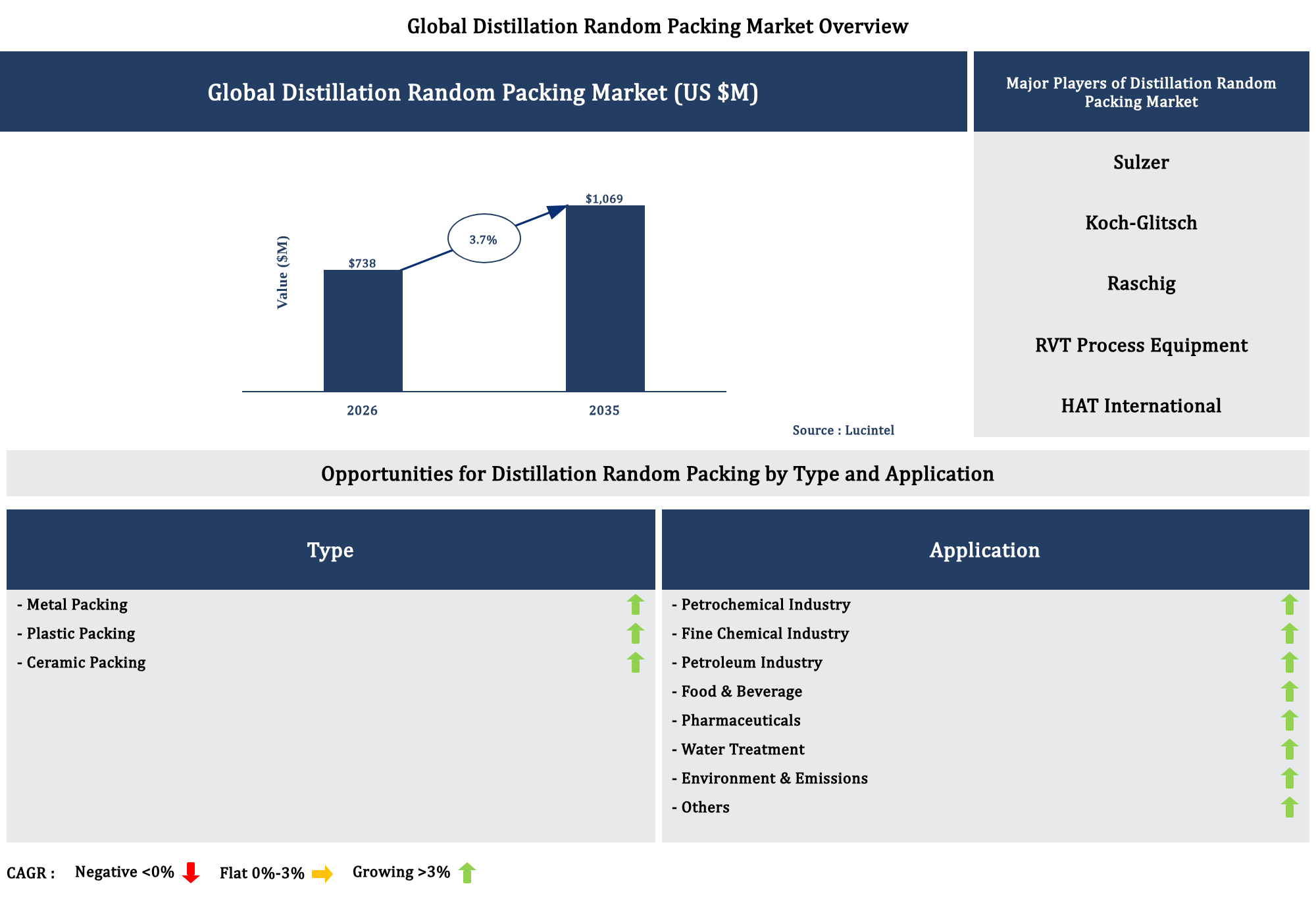
The future of the global distillation random packing market looks promising with opportunities in the petrochemical industry, fine chemical industry, petroleum industry, food & beverage, pharmaceutical, water treatment, and environment & emission markets. The global distillation random packing market is expected to reach an estimated $1,069 million by 2035 with a CAGR of 3.7% from 2026 to 2035. The major drivers for this market are the increasing adoption in oil & gas processing plants, the rising demand for industrialization in developing economies, and the growing demand for improved mass transfer efficiency.
• Lucintel forecasts that, within the type category, metal packing is expected to witness the highest growth over the forecast period.
• Within the application category, petrochemical industry is expected to witness the highest growth.
• In terms of region, APAC is expected to witness the highest growth over the forecast period.
Gain valuable insights for your business decisions with our comprehensive 150+ page report. Sample figures with some insights are shown below.
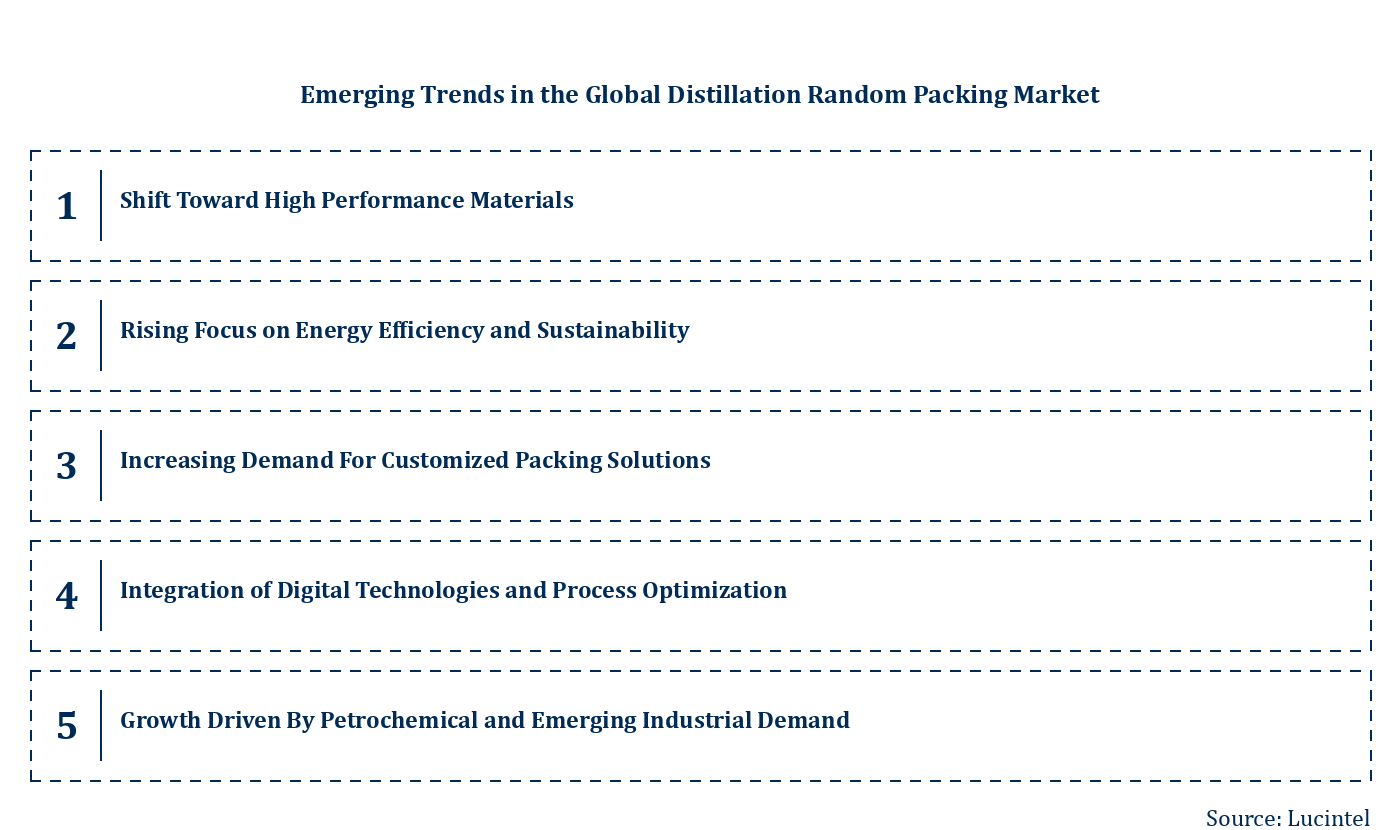
Emerging Trends in the Distillation Random Packing Market
The distillation random packing market is evolving rapidly due to increasing demand for efficient separation technologies across petrochemical, chemical, and environmental industries. Recent developments are strongly influenced by advancements in material science, stricter environmental regulations, and the need to reduce operational costs and energy consumption. Manufacturers are focusing on innovation, customization, and digital integration to enhance performance and reliability. At the same time, global industrial expansion and sustainability goals are accelerating the adoption of advanced packing solutions. These factors are collectively shaping new trends that are redefining product design, application scope, and competitive dynamics across the global market.
• Shift Toward High Performance Materials: The market is increasingly adopting advanced materials such as stainless steel alloys, hybrid ceramics, and engineered plastics to improve durability and efficiency. These materials enhance corrosion resistance and thermal stability, making them suitable for harsh industrial environments. They also reduce pressure drop and improve mass transfer efficiency, leading to lower energy consumption. This trend is particularly important in petrochemical and refining industries where operational reliability is critical. Continuous innovation in material science is enabling manufacturers to deliver longer lasting and more efficient packing solutions, significantly improving overall process performance.
• Rising Focus on Energy Efficiency and Sustainability: Energy efficiency has become a central trend as industries aim to reduce operational costs and carbon emissions. Modern random packing designs are engineered to minimize pressure drop and enhance separation efficiency, reducing energy use in distillation processes. Environmental regulations are further accelerating this shift by pushing companies to adopt cleaner and more efficient technologies. Sustainable materials and recyclable packing solutions are also gaining traction. This trend is transforming the market by encouraging innovation that aligns with global sustainability goals while improving economic performance for industrial operators.
• Increasing Demand for Customized Packing Solutions: Industries are moving away from standard products toward customized packing solutions tailored to specific applications. Different processes require unique separation characteristics, temperature resistance, and chemical compatibility. Manufacturers are responding by offering bespoke designs that optimize efficiency and reduce downtime. This trend is particularly evident in specialty chemicals and pharmaceutical sectors, where precision is crucial. Customization not only enhances operational performance but also strengthens customer relationships, as companies seek solutions that match their exact process requirements and improve productivity.
• Integration of Digital Technologies and Process Optimization: The integration of digital tools such as process simulation, digital twins, and real time monitoring is becoming increasingly important. These technologies help optimize the design and performance of distillation systems by predicting behavior and identifying inefficiencies. Operators can make data driven decisions to improve throughput and reduce maintenance costs. Digitalization also supports predictive maintenance, minimizing downtime and enhancing operational reliability. This trend is reshaping the market by combining traditional chemical engineering with advanced analytics, leading to smarter and more efficient distillation operations.
• Growth Driven by Petrochemical and Emerging Industrial Demand: The expansion of petrochemical, refining, and chemical industries, especially in emerging economies, is significantly driving demand for random packing solutions. These sectors rely heavily on efficient distillation processes for product purity and yield. Increasing investments in infrastructure and industrial capacity are further supporting market growth. Additionally, the rise of biofuels and cleaner energy applications is creating new opportunities for distillation technologies. This trend highlights the strong link between industrial growth and the increasing adoption of advanced packing solutions across global markets.
These emerging trends are collectively transforming the distillation random packing market by emphasizing efficiency, sustainability, and technological advancement. The shift toward advanced materials and energy efficient designs is improving performance while reducing environmental impact. Customization and digital integration are enabling more precise and optimized operations, enhancing productivity and reliability. At the same time, strong industrial growth continues to expand application areas and demand. Together, these trends are reshaping the competitive landscape and positioning the market for steady innovation and long term growth across global industries.
Recent Developments in the Distillation Random Packing Market
The distillation random packing market is experiencing steady transformation driven by technological innovation, industrial expansion, and increasing environmental compliance requirements. Recent developments are focused on enhancing efficiency, reducing energy consumption, and improving durability in complex processing environments. Manufacturers are investing in advanced materials, digital tools, and customized solutions to meet evolving industrial needs. These developments are reshaping operational performance and cost structures while expanding application areas across industries such as petrochemicals, chemicals, and environmental engineering, making the market more competitive and innovation driven.
• Advanced Material Innovation: Manufacturers are increasingly developing high performance materials such as advanced alloys, ceramics, and engineered plastics to improve the efficiency and durability of random packing solutions. These materials provide enhanced resistance to corrosion, high temperatures, and chemical exposure, making them suitable for demanding industrial environments. The innovation also reduces maintenance requirements and extends product lifespan. As a result, industries are adopting these advanced materials to improve operational reliability, reduce downtime, and achieve higher separation efficiency, contributing to improved productivity and cost savings.
• Energy Efficient Design Improvements: Recent developments focus on optimizing packing geometry and surface area to reduce pressure drop and enhance mass transfer efficiency. These improvements directly lower energy consumption in distillation processes, making operations more cost effective. Companies are investing in research to design structures that maximize contact between liquid and vapor phases. This development is particularly important in industries with high energy usage, such as refining and petrochemicals, where reducing operational costs is a priority. Energy efficient designs are becoming a key competitive factor in the market.
• Expansion of Petrochemical and Chemical Industries: The continuous expansion of petrochemical and chemical industries, especially in emerging economies, is driving demand for advanced distillation random packing solutions. New refinery projects and chemical plants require efficient separation technologies to meet production targets. This development is encouraging manufacturers to scale production and enhance product offerings. Increasing investments in infrastructure and industrial capacity are further supporting this trend. The growing need for high purity products and efficient processing is reinforcing the importance of reliable and high performance packing systems in industrial applications.
• Integration of Digital Monitoring and Simulation Tools: The integration of digital technologies such as process simulation and real time monitoring is transforming the way distillation systems are designed and operated. These tools help optimize performance by predicting system behavior and identifying inefficiencies. Operators can use data driven insights to improve throughput and reduce maintenance costs. This development enhances operational control and minimizes downtime through predictive maintenance strategies. The adoption of digital solutions is making distillation processes more efficient, reliable, and adaptable to changing industrial requirements.
• Focus on Environmental Compliance and Sustainability: Increasing environmental regulations are pushing industries to adopt cleaner and more sustainable distillation technologies. Manufacturers are developing eco friendly packing solutions that reduce emissions and energy usage. This includes the use of recyclable materials and designs that improve process efficiency. Companies are also upgrading existing systems to meet regulatory standards. This development is driving innovation and encouraging the adoption of environmentally responsible practices. Sustainability is becoming a critical factor influencing purchasing decisions and shaping the long term direction of the distillation random packing market.
These developments are significantly impacting the distillation random packing market by driving innovation, efficiency, and sustainability. Advanced materials and energy efficient designs are improving performance while reducing costs. Industrial expansion is increasing demand, and digital technologies are enhancing operational control. At the same time, environmental compliance is encouraging the adoption of cleaner solutions. Together, these factors are reshaping the market landscape, making it more competitive and technology driven while creating opportunities for growth and long term development across various industrial sectors.
Strategic Growth Opportunities in the Distillation Random Packing Market
The distillation random packing market is witnessing strong growth opportunities driven by expanding industrial applications and the need for efficient separation technologies. Increasing investments in petrochemical, chemical, and environmental sectors are accelerating demand for advanced packing solutions. Technological advancements and sustainability requirements are further shaping application specific innovations. As industries aim to optimize performance and reduce costs, strategic opportunities are emerging across diverse applications, enabling manufacturers to expand their market presence and enhance competitiveness in a rapidly evolving global landscape.
• Petrochemical Industry Driving Demand for High Efficiency Separation Solutions: The petrochemical industry presents a major growth opportunity due to its continuous expansion and need for efficient distillation processes. Random packing solutions are widely used to enhance separation efficiency and reduce energy consumption in refining operations. Increasing investments in new petrochemical plants and capacity expansions are supporting demand. Additionally, the need for improved product purity and operational reliability is encouraging adoption of advanced packing materials. This opportunity is further strengthened by the global demand for fuels and petrochemical derivatives, making it a key application area for market growth.
• Chemical Processing Sector Expanding use of Customized Packing Designs: The chemical processing sector offers significant opportunities as manufacturers require tailored packing solutions for diverse applications. Different chemical processes demand specific material properties, temperature resistance, and separation efficiency. Customized random packing designs help optimize performance and reduce downtime. The growth of specialty chemicals and fine chemicals is further increasing demand for precision based solutions. Companies are focusing on innovation to meet these requirements, creating opportunities for differentiation. This application is becoming increasingly important as industries prioritize efficiency, flexibility, and process optimization in chemical production systems.
• Environmental Applications Supporting Growth in Wastewater and Emission Control Systems: Environmental applications such as wastewater treatment and emission control are creating new growth opportunities for random packing solutions. These systems rely on efficient mass transfer for effective treatment and pollutant removal. Increasing regulatory pressure and environmental awareness are driving investments in sustainable technologies. Random packing is used in scrubbers and treatment units to enhance performance. This application is expanding rapidly as industries adopt cleaner processes and comply with regulations. The growing focus on sustainability and environmental protection is making this a critical area for market expansion.
• Oil and Gas Refining Enhancing Adoption of Advanced Packing Technologies: The oil and gas refining sector continues to be a strong growth driver for the market. Refineries require efficient distillation systems to improve throughput and reduce operational costs. Advanced random packing technologies help achieve better separation performance and energy efficiency. Ongoing modernization of existing refineries and development of new facilities are increasing demand. The need to process diverse crude types and meet stringent quality standards is further supporting adoption. This opportunity highlights the importance of technological advancements in improving refining efficiency and supporting industry growth.
• Pharmaceutical and Specialty Industries Increasing Need for Precision Separation: Pharmaceutical and specialty industries are emerging as important growth areas due to their requirement for high purity and precise separation processes. Random packing solutions are used to achieve accurate control over distillation parameters. The growth of pharmaceutical production and research activities is driving demand for advanced technologies. These industries also require materials that meet strict regulatory standards and ensure product safety. This opportunity is supported by increasing investments in healthcare and specialty manufacturing, making it a promising segment for high value applications in the market.
These strategic growth opportunities are significantly shaping the distillation random packing market by expanding its application scope and driving innovation. Key industries such as petrochemicals, chemicals, environmental systems, oil and gas, and pharmaceuticals are increasing demand for efficient and customized solutions. Advancements in technology and rising sustainability requirements are further enhancing market potential. Together, these opportunities are strengthening industry growth, encouraging product development, and enabling companies to achieve competitive advantages while addressing evolving industrial and environmental challenges globally.
Distillation Random Packing Market Driver and Challenges
The distillation random packing market is influenced by a combination of technological advancements, economic expansion, and evolving regulatory frameworks across global industries. Increasing demand for efficient separation processes in petrochemical, chemical, and environmental applications is driving innovation and adoption of advanced packing solutions. At the same time, cost pressures, material limitations, and compliance requirements are creating challenges for manufacturers and end users. These dynamic factors are shaping market growth, competitiveness, and long term sustainability, requiring companies to balance performance improvements with economic and regulatory considerations in a rapidly changing industrial landscape.
The Factors Responsible For Driving the distillation random packing market Include:-
• Growing Demand for Energy Efficient Separation Technologies: The increasing need to reduce energy consumption in industrial processes is a major driver for the distillation random packing market. Industries such as petrochemicals and refining rely heavily on distillation, which is energy intensive. Advanced random packing solutions help minimize pressure drop and improve mass transfer efficiency, significantly lowering energy usage. This results in reduced operational costs and improved sustainability. Companies are increasingly adopting these solutions to meet environmental goals and enhance profitability. As energy costs continue to rise globally, the demand for efficient distillation technologies is expected to remain strong, driving continuous innovation and market expansion.
• Expansion of Petrochemical and Chemical Industries Worldwide: Rapid growth in petrochemical and chemical industries, particularly in emerging economies, is fueling demand for distillation random packing solutions. New plant constructions and capacity expansions require efficient separation technologies to ensure product quality and process efficiency. Increasing consumption of chemicals, plastics, and fuels is further supporting this trend. Manufacturers are responding by scaling production and introducing advanced packing designs. This driver is significant because it directly correlates with industrial growth and infrastructure development. As global demand for chemical products continues to increase, the need for high performance distillation solutions is expected to grow steadily.
• Advancements in Material Science and Product Innovation: Continuous advancements in material science are enabling the development of high performance random packing solutions with improved durability and efficiency. Materials such as advanced alloys, ceramics, and engineered plastics offer better resistance to corrosion, high temperatures, and chemical exposure. These innovations enhance the lifespan and reliability of packing systems, reducing maintenance requirements. Companies are investing in research and development to create innovative designs that optimize separation performance. This driver is crucial as it allows manufacturers to differentiate their products and meet diverse industrial requirements, ultimately contributing to improved process efficiency and market competitiveness.
• Increasing Focus on Environmental Regulations and Sustainability: Stringent environmental regulations are encouraging industries to adopt cleaner and more efficient technologies. Governments and regulatory bodies are imposing strict standards on emissions and energy consumption, pushing companies to upgrade their distillation systems. Random packing solutions play a key role in improving process efficiency and reducing environmental impact. Additionally, the use of recyclable and eco friendly materials is gaining importance. This driver is shaping market trends by promoting sustainable practices and innovation. Companies that align with these regulations are likely to gain a competitive advantage and strengthen their market position.
The Challenges in the distillation random packing market Are:
• High Initial Investment and Installation Costs: One of the major challenges in the market is the high initial cost associated with advanced random packing solutions. The use of high quality materials and complex designs increases production costs, which can be a barrier for small and medium enterprises. Installation and system upgrades also require significant capital investment. While these solutions offer long term cost savings through improved efficiency, the upfront expense can discourage adoption. This challenge is particularly evident in price sensitive markets where companies prioritize cost over performance, limiting the penetration of advanced technologies.
• Operational Complexity and Maintenance Requirements: The implementation of advanced distillation random packing systems can increase operational complexity. Proper installation, design optimization, and maintenance are critical to achieving desired performance levels. Skilled labor and technical expertise are required to manage these systems effectively. Any inefficiencies in operation can lead to reduced performance and increased downtime. Additionally, maintenance of packing materials in harsh environments can be challenging. This issue creates a barrier for industries with limited technical capabilities, impacting the widespread adoption of advanced solutions and increasing operational risks.
• Fluctuations In Raw Material Prices and Supply Chain Constraints: The market is significantly affected by fluctuations in the prices of raw materials such as metals and specialized plastics. Volatility in supply chains can lead to increased production costs and delays in product delivery. Global economic uncertainties and geopolitical factors further exacerbate these challenges. Manufacturers may face difficulties in maintaining consistent pricing and profitability. This challenge impacts both suppliers and end users, as cost variations can influence purchasing decisions. Addressing supply chain resilience and cost management is essential for sustaining growth in the distillation random packing market.
The interplay of these drivers and challenges is shaping the future of the distillation random packing market. While technological advancements, industrial expansion, and sustainability initiatives are driving growth, challenges such as high costs, operational complexity, and supply chain uncertainties require careful management. Companies must focus on innovation, cost optimization, and strategic planning to overcome these barriers. Overall, the market is expected to grow steadily, supported by increasing demand for efficient and sustainable solutions, while continuous adaptation to challenges will determine long term success and competitiveness.
List of Distillation Random Packing Companies
Companies in the market compete on the basis of product quality offered. Major players in this market focus on expanding their manufacturing facilities, R&D investments, infrastructural development, and leverage integration opportunities across the value chain. With these strategies distillation random packing companies cater increasing demand, ensure competitive effectiveness, develop innovative products & technologies, reduce production costs, and expand their customer base. Some of the distillation random packing companies profiled in this report include-
• Sulzer
• Koch-Glitsch
• Raschig
• RVT Process Equipment
• HAT International
• Sumitomo Heavy Industries
• Montz, Haiyan New Century
• Zehua Chemical Engineering
• Tianjin Univtech
• GTC Technology
Distillation Random Packing Market by Segment
The study includes a forecast for the global distillation random packing market by type, application, and region.
Distillation Random Packing Market by Type [Value from 2019 to 2035]:
• Metal Packing
• Plastic Packing
• Ceramic Packing
Distillation Random Packing Market by Application [Value from 2019 to 2035]:
• Petrochemical Industry
• Fine Chemical Industry
• Petroleum Industry
• Food & Beverage
• Pharmaceuticals
• Water Treatment
• Environment & Emissions
• Others
Distillation Random Packing Market by Region [Value from 2019 to 2035]:
• North America
• Europe
• Asia Pacific
• The Rest of the World
Country Wise Outlook for the Distillation Random Packing Market
The distillation random packing market is witnessing notable developments across major economies, driven by expanding petrochemical, chemical, and refining industries along with increasing emphasis on energy efficiency and process optimization. Technological innovation in packing materials such as corrosion resistant metals and advanced plastics is improving separation performance and reducing operational costs. Regional dynamics vary significantly, with mature markets focusing on retrofits and sustainability, while emerging economies emphasize capacity expansion. Additionally, stricter environmental regulations and investments in carbon capture and cleaner production technologies are shaping demand patterns, making the market highly dynamic across the United States, China, Germany, India, and Japan.
• United States: The market in the United States is characterized by strong investments in refinery upgrades, petrochemical expansions, and process optimization technologies. Companies are increasingly adopting high performance random packing to enhance efficiency and reduce energy consumption in distillation processes. The presence of established chemical and oil and gas industries continues to support steady demand. In addition, sustainability initiatives and carbon capture projects are driving retrofitting of existing distillation columns with advanced packing solutions. Continuous innovation by leading manufacturers and a focus on operational efficiency are key recent developments shaping the US market landscape.
• China: China is experiencing rapid growth in the distillation random packing market due to its expanding chemical, petrochemical, and refining sectors. Industrialization and large scale capacity additions are encouraging the adoption of advanced separation technologies. Domestic manufacturers are increasingly focusing on cost effective and high efficiency packing materials to compete globally. Environmental regulations in China are also pushing industries toward energy efficient and low emission solutions, accelerating demand for innovative packing products. The country remains a key contributor to Asia Pacific growth, supported by strong infrastructure investments and rising chemical production capacity.
• Germany: Germany represents a technologically advanced market with a strong focus on innovation and sustainability. The country’s well established chemical and specialty manufacturing industries are adopting high performance packing solutions to improve process precision and efficiency. Recent developments include increased investment in environmentally friendly materials and energy efficient distillation systems aligned with strict European regulations. German companies are also emphasizing research and development to create durable and corrosion resistant packing products. The trend toward green chemistry and reduced carbon emissions is significantly influencing the adoption of next generation distillation packing technologies in the region.
• India: India is emerging as a high growth market driven by rapid industrial expansion and increasing investments in petrochemical and chemical manufacturing. Government initiatives supporting domestic production and infrastructure development are encouraging the adoption of modern distillation technologies. Local manufacturers are focusing on affordable yet efficient packing solutions to meet rising demand. Additionally, the expansion of oil refining capacity and growing demand for specialty chemicals are contributing to market growth. Increasing awareness of energy efficiency and environmental compliance is also pushing industries in India to upgrade to advanced random packing systems.
• Japan: Japan’s distillation random packing market is driven by advanced manufacturing capabilities and a strong emphasis on precision engineering. The country is focusing on high quality and high efficiency packing materials to support its sophisticated chemical and pharmaceutical industries. Recent developments include innovations in compact and high performance packing designs that enhance separation efficiency while reducing operational costs. Japan is also investing in sustainable and energy efficient technologies in response to environmental concerns. The market benefits from continuous research and technological advancements, positioning Japan as a leader in premium distillation packing solutions.
Features of the Global Distillation Random Packing Market
Market Size Estimates: Distillation random packing market size estimation in terms of value ($M).
Trend and Forecast Analysis: Market trends (2019 to 2025) and forecast (2026 to 2035) by various segments and regions.
Segmentation Analysis: Distillation random packing market size by type, application, and region in terms of value ($M).
Regional Analysis: Distillation random packing market breakdown by North America, Europe, Asia Pacific, and Rest of the World.
Growth Opportunities: Analysis of growth opportunities in different type, application, and regions for the distillation random packing market.
Strategic Analysis: This includes M&A, new product development, and competitive landscape of the distillation random packing market.
Analysis of competitive intensity of the industry based on Porter’s Five Forces model.
FAQ
Q1. What is the distillation random packing market size?
Answer: The global distillation random packing market is expected to reach an estimated $1,069 million by 2035.
Q2. What is the growth forecast for distillation random packing market?
Answer: The global distillation random packing market is expected to grow with a CAGR of 3.7% from 2026 to 2035.
Q3. What are the major drivers influencing the growth of the distillation random packing market?
Answer: The major drivers for this market are the increasing adoption in oil & gas processing plants, the rising demand for industrialization in developing economies, and the growing demand for improved mass transfer efficiency.
Q4. What are the major segments for distillation random packing market?
Answer: The future of the distillation random packing market looks promising with opportunities in the petrochemical industry, fine chemical industry, petroleum industry, food & beverage, pharmaceutical, water treatment, and environment & emission markets.
Q5. Who are the key distillation random packing market companies?
Answer: Some of the key distillation random packing companies are as follows:
• Sulzer
• Koch-Glitsch
• Raschig
• RVT Process Equipment
• HAT International
• Sumitomo Heavy Industries
• Montz, Haiyan New Century
• Zehua Chemical Engineering
• Tianjin Univtech
• GTC Technology
Q6. Which distillation random packing market segment will be the largest in future?
Answer: Lucintel forecasts that, within the type category, metal packing is expected to witness the highest growth over the forecast period.
Q7. In distillation random packing market, which region is expected to be the largest in next 8 years?
Answer: In terms of region, APAC is expected to witness the highest growth over the forecast period.
Q8. Do we receive customization in this report?
Answer: Yes, Lucintel provides 10% customization without any additional cost.
This report answers following 11 key questions:
Q.1. What are some of the most promising, high-growth opportunities for the distillation random packing market by type (metal packing, plastic packing, and ceramic packing), application (petrochemical industry, fine chemical industry, petroleum industry, food & beverage, pharmaceuticals, water treatment, environment & emissions, and others), and region (North America, Europe, Asia Pacific, and the Rest of the World)?
Q.2. Which segments will grow at a faster pace and why?
Q.3. Which region will grow at a faster pace and why?
Q.4. What are the key factors affecting market dynamics? What are the key challenges and business risks in this market?
Q.5. What are the business risks and competitive threats in this market?
Q.6. What are the emerging trends in this market and the reasons behind them?
Q.7. What are some of the changing demands of customers in the market?
Q.8. What are the new developments in the market? Which companies are leading these developments?
Q.9. Who are the major players in this market? What strategic initiatives are key players pursuing for business growth?
Q.10. What are some of the competing products in this market and how big of a threat do they pose for loss of market share by material or product substitution?
Q.11. What M&A activity has occurred in the last 5 years and what has its impact been on the industry?
For any questions related to Distillation Random Packing Market, Distillation Random Packing Market Size, Distillation Random Packing Market Growth, Distillation Random Packing Market Analysis, Distillation Random Packing Market Report, Distillation Random Packing Market Share, Distillation Random Packing Market Trends, Distillation Random Packing Market Forecast, Distillation Random Packing Companies, write Lucintel analyst at email: helpdesk@lucintel.com. We will be glad to get back to you soon.