
Report Feature
Dissolving Wood Pulp Market Trends and Forecast
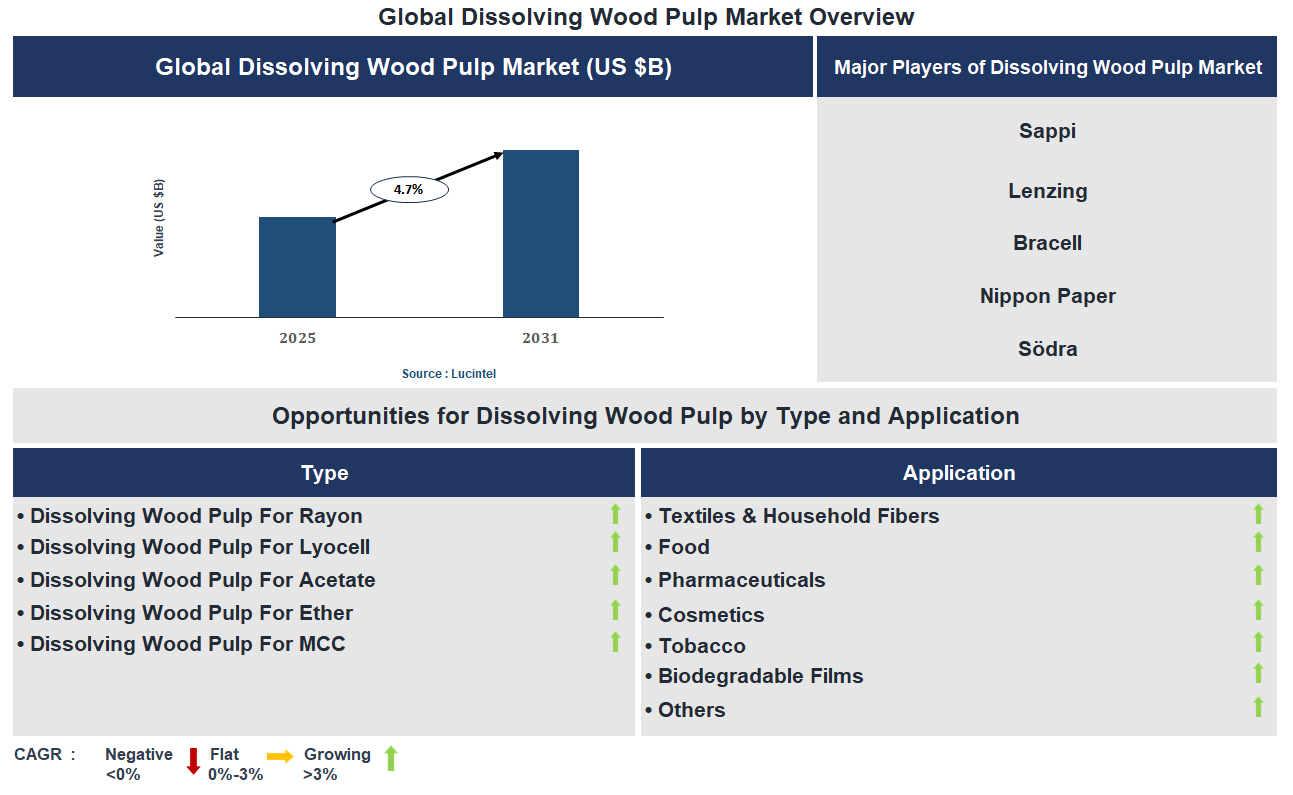
The future of the global dissolving wood pulp market looks promising with opportunities in the textile & household fiber, food, pharmaceutical, cosmetic, tobacco, and biodegradable film markets. The global dissolving wood pulp market is expected to grow with a CAGR of 4.7% from 2025 to 2031. The major drivers for this market are the increasing demand for eco-friendly products, the rising use in textile manufacturing, and the growing adoption in paper industry.• Lucintel forecasts that, within the type category, dissolving wood pulp for lyocell is expected to witness the highest growth over the forecast period.
• Within the application category, textile & household fiber is expected to witness the highest growth.
• In terms of region, APAC is expected to witness the highest growth over the forecast period. Gain valuable insights for your business decisions with our comprehensive 150+ page report. Sample figures with some insights are shown below.
Emerging Trends in the Dissolving Wood Pulp Market
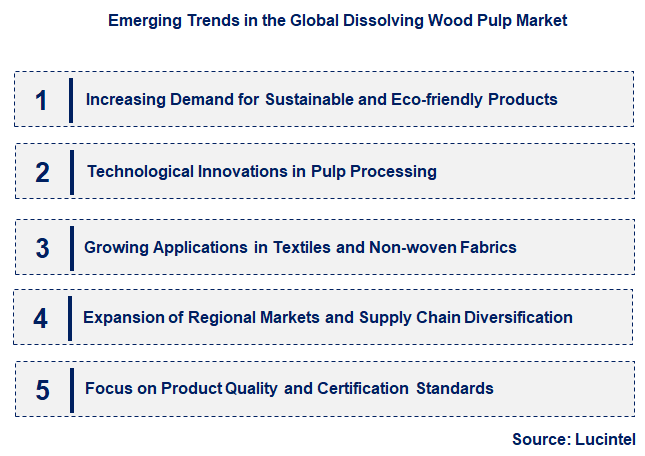
The dissolving wood pulp market is experiencing rapid evolution driven by technological advancements, shifting consumer preferences, and sustainability initiatives. As industries such as textiles, pharmaceuticals, and chemicals increasingly seek eco-friendly and high-quality raw materials, the market is adapting to meet these demands. Emerging trends are shaping the future landscape, influencing supply chains, product development, and environmental policies. These developments are not only expanding market opportunities but also prompting companies to innovate and adopt sustainable practices. Understanding these key trends is essential for stakeholders aiming to capitalize on the markets growth and navigate its dynamic environment effectively.• Increasing Demand for Sustainable and Eco-friendly Products: The market is witnessing a surge in demand for environmentally sustainable dissolving wood pulp, driven by consumer awareness and stricter environmental regulations. Companies are adopting eco-friendly harvesting and processing techniques, reducing carbon footprints, and promoting responsible sourcing. This trend enhances brand reputation and aligns with global sustainability goals, encouraging investments in green technologies. As sustainability becomes a key purchasing criterion, the market is expected to see increased adoption of certified and recycled DWP, fostering long-term growth and environmental conservation.
• Technological Innovations in Pulp Processing: Advances in pulping technologies are improving yield, quality, and processing efficiency. Innovations such as enzyme-assisted pulping and chemical-free methods reduce environmental impact and production costs. These technological developments enable producers to meet the high purity and quality standards required for applications like textiles and pharmaceuticals. Enhanced processing techniques also allow for customization of pulp properties, expanding application possibilities. Overall, technological innovation is driving cost-effective production and elevating product quality, which boosts competitiveness and market expansion.
• Growing Applications in Textiles and Non-woven Fabrics: The demand for dissolving wood pulp in the textile industry, especially for viscose, lyocell, and modal fibers, is rising rapidly. These fibers are favored for their eco-friendly, biodegradable, and comfortable properties. The shift towards sustainable fashion and increased use of non-woven fabrics in hygiene and medical products further fuels this trend. As consumer preferences lean towards natural and sustainable textiles, the market is expanding its product portfolio to cater to these needs, leading to increased production capacities and innovation in fiber technology.
• Expansion of Regional Markets and Supply Chain Diversification: Emerging markets in Asia-Pacific and Latin America are experiencing significant growth due to increasing industrialization and demand for eco-friendly products. Companies are diversifying supply chains to reduce dependency on traditional sources, ensuring stability and cost efficiency. This regional expansion also involves establishing local processing facilities and partnerships, which facilitate faster delivery and better market penetration. Supply chain diversification enhances resilience against geopolitical and environmental disruptions, supporting sustained growth and market competitiveness.
• Focus on Product Quality and Certification Standards: As applications for dissolving wood pulp become more specialized, there is a heightened emphasis on meeting stringent quality and safety standards. Certifications such as FSC, PEFC, and ISO are increasingly sought after to ensure sustainable sourcing and product integrity. This focus on quality assurance helps companies differentiate their products in competitive markets and gain consumer trust. Additionally, adherence to regulatory standards ensures market access across regions, fostering global trade and innovation. The emphasis on certification and quality standards is thus pivotal in maintaining market credibility and driving industry growth. In summary, these emerging trends are collectively reshaping the dissolving wood pulp market by promoting sustainability, technological advancement, application diversification, regional expansion, and quality assurance. These developments are fostering a more resilient, innovative, and environmentally conscious industry, poised for sustained growth in the coming years.
Recent Development in the Dissolving Wood Pulp Market
The dissolving wood pulp market has experienced significant shifts driven by technological advancements, environmental concerns, and changing global demand patterns. As industries such as textiles, pharmaceuticals, and chemicals increasingly seek sustainable and high-quality raw materials, the market is evolving rapidly. Recent developments reflect a focus on innovation, sustainability, and supply chain resilience, shaping the future landscape of dissolving wood pulp. These changes are influencing pricing, production strategies, and global trade flows, ultimately impacting stakeholders across the value chain. Understanding these key developments is essential for market participants to adapt and capitalize on emerging opportunities.• Technological Innovations: New processing techniques have improved pulp quality and production efficiency, reducing costs and environmental impact. These innovations enable manufacturers to meet stricter regulatory standards and customer demands for sustainable products, boosting competitiveness and expanding application scopes.
• Sustainability Initiatives: Increasing emphasis on eco-friendly practices has led to the adoption of sustainable forestry and recycling methods. Companies are investing in certified sourcing and reducing carbon footprints, which enhances brand reputation and aligns with global environmental goals, attracting eco-conscious clients.
• Supply Chain Diversification: To mitigate risks from geopolitical tensions and supply disruptions, firms are diversifying sourcing regions and establishing strategic partnerships. This approach ensures a stable supply of raw materials, reduces dependency on single sources, and enhances market resilience.
• Rising Demand from End-Use Industries: The textile industry, especially viscose and lyocell production, is driving demand for dissolving pulp. Additionally, pharmaceuticals and specialty chemicals sectors are expanding their use, contributing to overall market growth and encouraging capacity expansions.
• Price Fluctuations and Market Dynamics: Market prices have experienced volatility due to fluctuating raw material costs, demand-supply imbalances, and trade policies. These dynamics influence profitability and investment decisions, prompting companies to adopt flexible strategies to navigate uncertainties. In summary, recent developments in the dissolving wood pulp market are fostering a more sustainable, resilient, and innovative industry landscape. Technological advancements and sustainability efforts are improving product quality and environmental impact, while supply chain diversification and market demand shifts are shaping future growth trajectories. These changes collectively enhance market stability and open new opportunities for stakeholders, positioning the industry for sustained evolution.
Strategic Growth Opportunities in the Dissolving Wood Pulp Market
The dissolving wood pulp market is experiencing significant growth driven by increasing demand across various industries such as textiles, pharmaceuticals, and chemicals. As sustainability and eco-friendly products gain prominence, the market is poised for innovative developments and expansion. Key applications are presenting unique opportunities for growth, driven by technological advancements and shifting consumer preferences. These opportunities are shaping the future landscape of the market, fostering increased competition and diversification. Companies that capitalize on these trends can enhance their market share and sustainability credentials, ultimately contributing to a more resilient and dynamic industry environment.• Expansion in viscose and lyocell fibers : The textile sector is a major driver, with rising demand for sustainable, biodegradable fibers. Innovations in fiber production improve quality and cost-efficiency, boosting adoption in fashion and home textiles. This growth enhances market revenue and encourages eco-friendly product development.
• Use in medicinal and health products : Dissolving wood pulp is increasingly used in pharmaceuticals for capsules and drug delivery systems. The demand for natural, safe excipients supports market growth, fostering innovation in drug formulation and expanding the application scope.
• As a raw material for specialty chemicals : The chemical industry utilizes dissolving pulp for producing cellulose derivatives and specialty chemicals. This creates opportunities for high-value product development, driving profitability and diversification within the market.
• As a food additive and packaging material : The pulp’s biocompatibility and safety make it suitable for edible films and packaging. Growing consumer preference for natural packaging solutions boosts demand, opening new avenues for market expansion.
• Use in cosmetics and hygiene products : Dissolving pulp is increasingly incorporated into personal care items like wipes and absorbent materials. The trend towards natural and biodegradable ingredients enhances market potential and product innovation. In summary, these key growth opportunities across applications are significantly impacting the dissolving wood pulp market by driving innovation, expanding application scope, and promoting sustainable practices. This diversification is fostering market resilience, attracting new investments, and positioning the industry for long-term growth.
Dissolving Wood Pulp Market Driver and Challenges
The dissolving wood pulp market is influenced by a complex interplay of technological advancements, economic conditions, and regulatory frameworks. As industries such as textiles, pharmaceuticals, and specialty chemicals expand, the demand for high-quality dissolving pulp increases. Innovations in pulp processing and sustainable forestry practices are shaping market dynamics, while economic factors like fluctuating raw material prices and global trade policies impact supply chains. Additionally, stringent environmental regulations and sustainability initiatives influence production methods and market growth. Navigating these multifaceted drivers and challenges is essential for stakeholders aiming to capitalize on emerging opportunities and mitigate risks within this evolving industry. The factors responsible for driving the dissolving wood pulp market include:• Technological Innovation: The development of advanced pulping techniques enhances pulp quality and production efficiency. Innovations such as enzyme-assisted pulping and environmentally friendly bleaching processes reduce chemical usage and energy consumption, making production more sustainable and cost-effective. These technological improvements enable manufacturers to meet the increasing demand for high-purity dissolving pulp used in textiles, pharmaceuticals, and food products. As R&D continues, the market benefits from improved product properties, broader application scopes, and reduced environmental impact, thereby fueling growth and competitiveness.
• Growing Demand from End-Use Industries: The textile industry, particularly viscose, lyocell, and modal fibers, is a major consumer of dissolving pulp. Rising global population, urbanization, and increasing disposable incomes drive demand for sustainable and high-quality textiles. Similarly, the pharmaceutical sector utilizes dissolving pulp for capsules and medicinal packaging, while the food industry employs it as a clarifying agent. The expansion of these sectors, especially in emerging economies, significantly boosts market demand. This trend is further supported by consumer preferences shifting towards eco-friendly and natural products, reinforcing the importance of dissolving pulp in various applications.
• Sustainability and Environmental Regulations: Increasing environmental awareness and stringent regulations on deforestation and chemical discharge are shaping market practices. Governments and industry bodies are promoting sustainable forestry management and eco-friendly production processes. Companies adopting certifications like FSC and PEFC gain competitive advantage by demonstrating responsible sourcing. Additionally, regulations limiting the use of hazardous chemicals in bleaching and processing compel manufacturers to innovate greener solutions. These sustainability initiatives not only ensure compliance but also appeal to environmentally conscious consumers, thereby influencing market growth and encouraging investments in sustainable technologies.
• Raw Material Availability and Cost Fluctuations: The primary raw material for dissolving pulp is wood, and its availability directly impacts production capacity and costs. Fluctuations in timber prices, driven by factors such as forest resource management, climate change, and geopolitical issues, create volatility in raw material costs. Limited access to raw materials can lead to supply chain disruptions and increased prices, affecting profit margins. Conversely, investments in plantation forestry and alternative fiber sources are being explored to mitigate these risks. Managing raw material supply efficiently is crucial for maintaining market stability and competitiveness amid fluctuating costs.
• Technological Adoption and Industry Consolidation: The market is witnessing increased adoption of digital technologies, automation, and process optimization to enhance productivity and reduce costs. Industry consolidation through mergers and acquisitions enables companies to expand their market share, diversify product portfolios, and leverage economies of scale. Such strategic moves facilitate access to new markets and advanced technologies, fostering innovation and competitiveness. However, integration challenges and the need for substantial capital investments pose risks. Overall, technological adoption and consolidation are pivotal in shaping a resilient and forward-looking market landscape. The challenges facing this dissolving wood pulp market include:
• Environmental and Regulatory Constraints: Stringent environmental regulations aimed at reducing deforestation, chemical usage, and carbon emissions pose significant hurdles. Compliance requires substantial investments in cleaner technologies and sustainable sourcing, which can increase operational costs. Non-compliance risks legal penalties, reputational damage, and market restrictions, especially as consumers and governments demand higher sustainability standards. Navigating these regulatory landscapes demands continuous adaptation and innovation, which can strain resources, particularly for smaller players, potentially limiting market expansion and increasing barriers to entry.
• Raw Material Scarcity and Price Volatility: Limited availability of quality wood resources and price fluctuations create supply chain uncertainties. Climate change, deforestation, and competing land uses threaten raw material supplies, leading to increased costs and procurement challenges. Price volatility impacts profit margins and can hinder long-term planning. Companies must invest in sustainable forestry practices and diversify raw material sources to mitigate risks. However, these strategies require significant capital and time, making it difficult for some players to adapt swiftly, thereby constraining market growth and stability.
• Technological and Market Risks: Rapid technological changes and evolving consumer preferences pose risks to market players. Failure to adopt innovative, eco-friendly processing methods can result in obsolescence and loss of competitive edge. Additionally, market demand shifts towards alternative fibers or synthetic substitutes can reduce pulp consumption. High R&D costs and uncertain returns on new technologies further complicate innovation efforts. Companies must balance investment in cutting-edge solutions with market realities, which can be challenging, especially for smaller firms with limited resources, potentially impacting overall industry growth. In summary, the dissolving wood pulp market is shaped by technological progress, expanding end-use applications, and sustainability initiatives, which drive growth and innovation. However, challenges such as regulatory pressures, raw material scarcity, and technological risks pose significant hurdles. The interplay of these factors influences market stability, competitiveness, and future development trajectories. Stakeholders must strategically navigate these drivers and challenges to capitalize on opportunities while mitigating risks, ensuring sustainable growth in this dynamic industry.
List of Dissolving Wood Pulp Companies
Companies in the market compete on the basis of product quality offered. Major players in this market focus on expanding their manufacturing facilities, R&D investments, infrastructural development, and leverage integration opportunities across the value chain. With these strategies dissolving wood pulp companies cater increasing demand, ensure competitive effectiveness, develop innovative products & technologies, reduce production costs, and expand their customer base. Some of the dissolving wood pulp companies profiled in this report include-• Sappi
• Lenzing
• Bracell
• Nippon Paper
• Södra
• Oji Paper
• AustroCel Hallein
• Arauco
• APRIL Group
• Aditya Birla
Dissolving Wood Pulp Market by Segment
The study includes a forecast for the global dissolving wood pulp market by type, application, and region.Dissolving Wood Pulp Market by Type [Value from 2019 to 2031]:
• Dissolving Wood Pulp For Rayon
• Dissolving Wood Pulp For Lyocell
• Dissolving Wood Pulp For Acetate
• Dissolving Wood Pulp For Ether
• Dissolving Wood Pulp For MCC
Dissolving Wood Pulp Market by Application [Value from 2019 to 2031]:
• Textiles & Household Fibers
• Food
• Pharmaceuticals
• Cosmetics
• Tobacco
• Biodegradable Films
• Others
Dissolving Wood Pulp Market by Region [Value from 2019 to 2031]:
• North America
• Europe
• Asia Pacific
• The Rest of the World
Country Wise Outlook for the Dissolving Wood Pulp Market
The dissolving wood pulp market has experienced significant shifts driven by technological advancements, environmental concerns, and changing global demand patterns. As industries such as textiles, pharmaceuticals, and specialty chemicals expand, the need for sustainable and high-quality pulp has increased. Countries are investing in innovative production methods, capacity expansions, and sustainable practices to meet rising demand while addressing environmental impacts. These developments reflect a broader trend toward eco-friendly solutions and increased competition among key players. The following summarizes recent developments in the United States, China, Germany, India, and Japan, highlighting key advancements and strategic initiatives in this evolving market.• United States: The US has seen increased investments in sustainable pulp production technologies, including recycling and eco-friendly bleaching processes. Major companies are expanding capacity to meet domestic and export demands, with a focus on reducing carbon footprints and improving product quality. Regulatory support for environmentally sustainable practices is also driving innovation in the sector.
• China: China continues to dominate the global dissolving pulp market with rapid capacity expansion and modernization of existing facilities. The country is investing heavily in green technologies and increasing the use of renewable energy sources in pulp manufacturing. Government policies favor sustainable growth, and Chinese firms are forming strategic alliances to enhance technological capabilities.
• Germany: Germany is focusing on high-quality, specialty dissolving pulp for textile and pharmaceutical applications. The country emphasizes eco-friendly production methods, including the use of certified sustainable raw materials and energy-efficient processes. German companies are also investing in R&D to develop innovative products with enhanced functionalities.
• India: India is witnessing rapid growth in dissolving pulp demand driven by expanding textile industries and export markets. The country is increasing capacity through new plant installations and upgrading existing facilities with modern technology. Government initiatives promoting sustainable forestry and eco-friendly manufacturing are supporting industry growth.
• Japan: Japan is advancing in the development of specialty dissolving pulp with high purity and specific functional properties. The country is investing in cutting-edge processing technologies and sustainable raw material sourcing. Japanese firms are also focusing on reducing environmental impacts and enhancing product performance to meet global standards.

Features of the Global Dissolving Wood Pulp Market
Market Size Estimates: Dissolving wood pulp market size estimation in terms of value ($B). Trend and Forecast Analysis: Market trends (2019 to 2024) and forecast (2025 to 2031) by various segments and regions. Segmentation Analysis: Dissolving wood pulp market size by type, application, and region in terms of value ($B). Regional Analysis: Dissolving wood pulp market breakdown by North America, Europe, Asia Pacific, and Rest of the World. Growth Opportunities: Analysis of growth opportunities in different types, applications, and regions for the dissolving wood pulp market. Strategic Analysis: This includes M&A, new product development, and competitive landscape of the dissolving wood pulp market. Analysis of competitive intensity of the industry based on Porter’s Five Forces model.
FAQ
Q1. What is the growth forecast for dissolving wood pulp market? Answer: The global dissolving wood pulp market is expected to grow with a CAGR of 4.7% from 2025 to 2031. Q2. What are the major drivers influencing the growth of the dissolving wood pulp market? Answer: The major drivers for this market are the increasing demand for eco-friendly products, the rising use in textile manufacturing, and the growing adoption in paper industry. Q3. What are the major segments for dissolving wood pulp market? Answer: The future of the dissolving wood pulp market looks promising with opportunities in the textile & household fiber, food, pharmaceutical, cosmetic, tobacco, and biodegradable film markets. Q4. Who are the key dissolving wood pulp market companies? Answer: Some of the key dissolving wood pulp companies are as follows:• Sappi
• Lenzing
• Bracell
• Nippon Paper
• Södra
• Oji Paper
• AustroCel Hallein
• Arauco
• APRIL Group
• Aditya Birla Q5. Which dissolving wood pulp market segment will be the largest in future? Answer: Lucintel forecasts that, within the type category, dissolving wood pulp for lyocell is expected to witness the highest growth over the forecast period. Q6. In dissolving wood pulp market, which region is expected to be the largest in next 5 years? Answer: In terms of region, APAC is expected to witness the highest growth over the forecast period. Q7. Do we receive customization in this report? Answer: Yes, Lucintel provides 10% customization without any additional cost.
Table of Contents
List of Figures
List of Tables
Methodology
- In-depth interviews of the major players in this market
- Detailed secondary research from competitors’ financial statements and published data
- Extensive searches of published works, market, and database information pertaining to industry news, company press releases, and customer intentions
- A compilation of the experiences, judgments, and insights of Lucintel’s professionals, who have analyzed and tracked this market over the years.


Buy Now
Choose a license that fits your team. Instant PDF delivery.
Prices exclude taxes. Instant delivery. Custom licensing available on request.
Key Questions
- • What are some of the most promising, high-growth opportunities for the dissolving wood pulp market by type (dissolving wood pulp for rayon, dissolving wood pulp for lyocell, dissolving wood pulp for acetate, dissolving wood pulp for ether, and dissolving wood pulp for MCC), application (textiles & household fibers, food, pharmaceuticals, cosmetics, tobacco, biodegradable films, and others), and region (North America, Europe, Asia Pacific, and the Rest of the World)?
- • Which segments will grow at a faster pace and why?
- • Which region will grow at a faster pace and why?
- • What are the key factors affecting market dynamics? What are the key challenges and business risks in this market?
- • What are the business risks and competitive threats in this market?
- • What are the emerging trends in this market and the reasons behind them?
- • What are some of the changing demands of customers in the market?
- • What are the new developments in the market? Which companies are leading these developments?
- • Who are the major players in this market? What strategic initiatives are key players pursuing for business growth?
- • What are some of the competing products in this market and how big of a threat do they pose for loss of market share by material or product substitution?
- • What M&A activity has occurred in the last 5 years and what has its impact been on the industry? For any questions related to Dissolving Wood Pulp Market, Dissolving Wood Pulp Market Size, Dissolving Wood Pulp Market Growth, Dissolving Wood Pulp Market Analysis, Dissolving Wood Pulp Market Report, Dissolving Wood Pulp Market Share, Dissolving Wood Pulp Market Trends, Dissolving Wood Pulp Market Forecast, Dissolving Wood Pulp Companies, write Lucintel analyst at email: helpdesk@lucintel.com. We will be glad to get back to you soon.


