
Close Lucintel Chat
Didn't Find What You're Looking for?
Call us at +1972 636 5056 or write at helpdesk@Lucintel.com
Ask an Expert Provide Custom Requirements Download Sample Report Search Available Reports
  • helpdesk@Lucintel.com
  • |
  • Call Lucintel +1 972 636 5056
  • |
  • Login
  • |
  • Register
  • |
  • Search
  • |
'
...

The Impact of COVID-19 is included in Disodium EDTA Market Report. Buy it today to get an advantage.

Request the impact of COVID-19 on your product or industry


Disodium EDTA Market Trends and Forecast

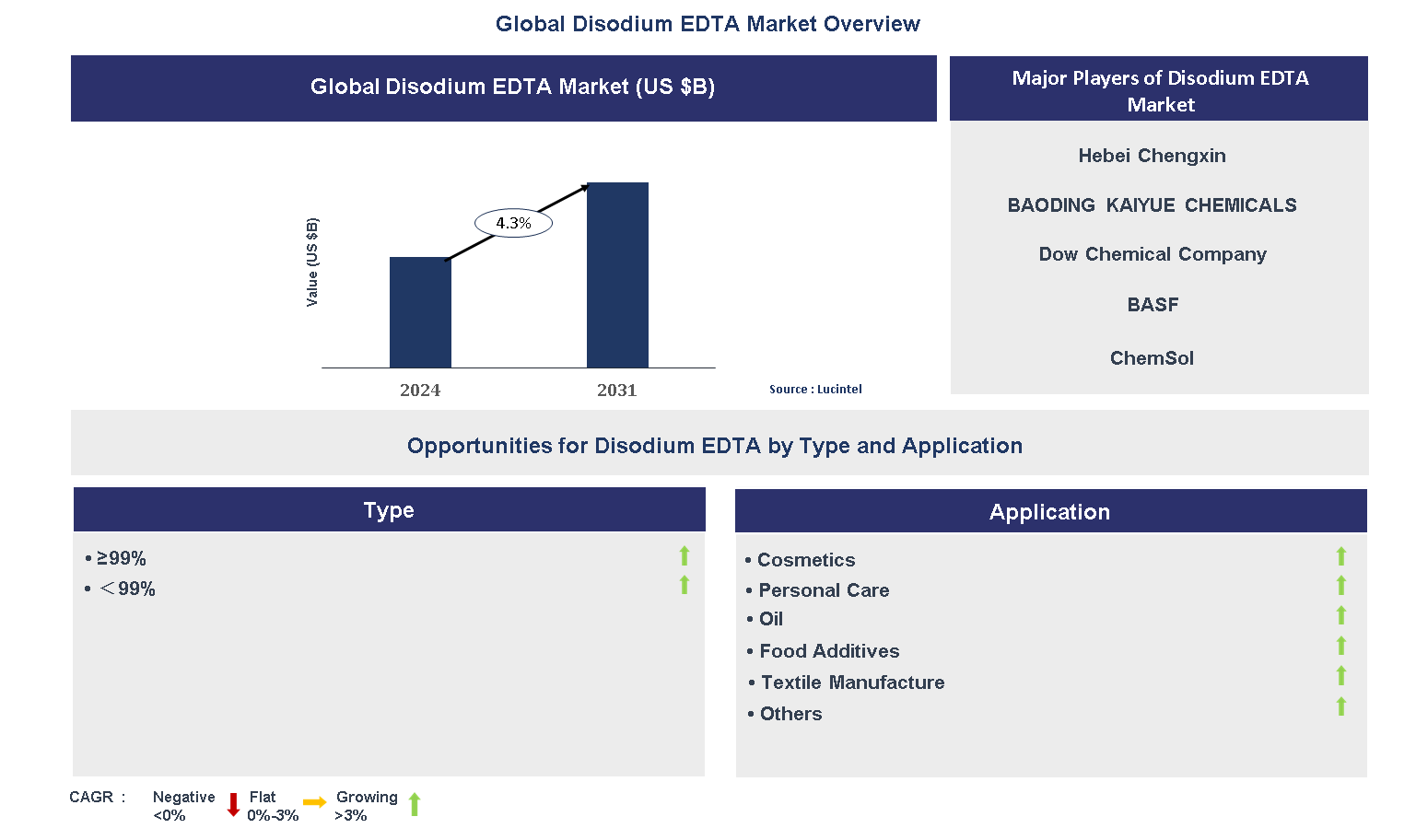
The future of the global disodium EDTA market looks promising with opportunities in the cosmetic, personal care, oil, food additive, and textile manufacture markets. The global disodium EDTA market is expected to grow with a CAGR of 4.3% from 2025 to 2031. The major drivers for this market are the increasing demand in water treatment, the rising use in personal care, and the growing adoption in food preservation.

• Lucintel forecasts that, within the type category, ≥99% is expected to witness higher growth over the forecast period.
• Within the application category, personal care is expected to witness the highest growth.
• In terms of region, APAC is expected to witness the highest growth over the forecast period.
Gain valuable insights for your business decisions with our comprehensive 150+ page report. Sample figures with some insights are shown below.
Disodium EDTA Market Trends and Forecast

Emerging Trends in the Disodium EDTA Market

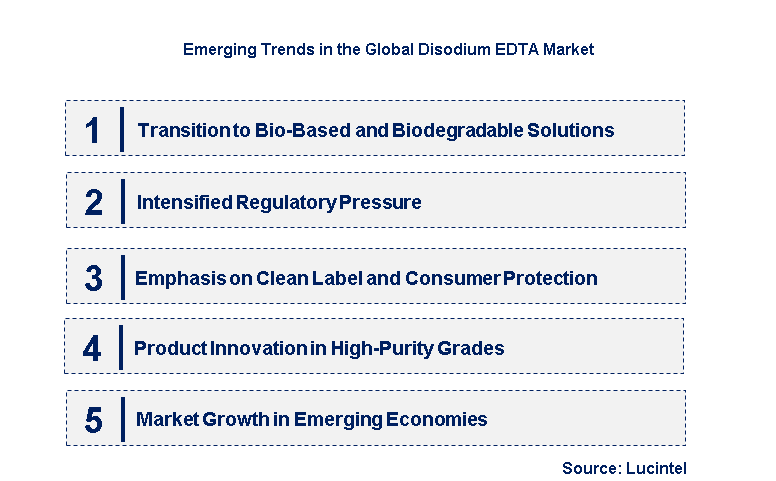
The market for disodium EDTA is experiencing pivotal changes, sparked by an inclination toward sustainability worldwide and increased regulatory pressures. These trends are impacting production processes, product innovation, and the competitive environment as a whole.
• Transition to Bio-Based and Biodegradable Solutions: The market is increasingly shifting towards replacing conventional disodium EDTA with bio-based and biodegradable chelating agents. This shift is mainly due to environmental concerns over EDTAs non-biodegradable nature, which may result in its buildup in water systems. Companies are heavily investing in research to come up with effective and cost-effective alternatives from renewable sources, which are of interest to consumers who are environmentally conscious and comply with regulatory specifications.
• Intensified Regulatory Pressure: Regulatory agencies in Europe and North America, in particular, are imposing tighter restrictions on the application of disodium EDTA in some applications. Such actions are prompted by worries over its environmental persistence and heavy metal mobilization potential. This development is prompting companies to be proactive in reformulating products to stay within regulatory compliance to prevent future bans, thereby dictating ingredient selection throughout industries.
• Emphasis on Clean Label and Consumer Protection: The "clean label" phenomenon is a key driver of the market. Health-conscious consumers are growing more demanding for products with easy-to-understand, recognizable, and "safer" ingredients. Consequently, there are many such brands in the food and personal care space promoting their products as "EDTA-free" to appeal to health-conscious consumers. This trend is developing a niche market for chelating agents that are not EDTA and promoting product development.
• Product Innovation in High-Purity Grades: Increasing demand for high-purity disodium EDTA exists for high-end applications, especially in the pharmaceutical and food sectors. Companies are meeting this by innovating and selling various grades of disodium EDTA that satisfy high-quality and safety requirements. This enables them to address high-value markets where product purity is a major factor.
• Market Growth in Emerging Economies: The fast development of personal care, food, and industrial industries in nations such as China and India is one of the primary trends. This market growth is resulting in a tremendous boost in demand for disodium EDTA. Producers are approaching strategically to broaden their footprint in these markets by new production plants and distribution channels in order to exploit the expanding consumer base and industrial activity.
These trends are collectively pushing the disodium EDTA market towards a future where sustainability, safety, and innovation are key drivers for growth and market differentiation.
Emerging Trends in the Disodium EDTA Market

Recent Development in the Disodium EDTA Market

The disodium EDTA market has seen a number of significant developments, driven by a mix of global sustainability efforts, regulatory change, and customer demand. These trends are compelling businesses to realign business models and product offerings.
• Development of Sustainable Manufacturing Processes: One of the key developments is the emphasis on sustainable manufacturing processes for disodium EDTA. Organizations are investing in water-saving and energy-saving technologies in manufacturing. This aids in minimizing the environmental footprint of manufacturing and complying with corporate sustainability initiatives. These initiatives also aid in the long-term supply by showcasing environmental stewardship.
• Introduction of Cation-Specific Chelating Agents: In order to overcome the limitations and environmental issues of general-purpose chelators such as disodium EDTA, there is a move towards cation-specific chelating agents. The new agents are intended to chelate certain metal ions more efficiently, providing improved performance in specific applications while possibly being more biodegradable. This is an innovation that gives formulators new tools to work with when developing products.
• Strategic Partnerships and Acquisitions: The big players in the chemical industry are entering into strategic partnerships and acquisitions with the aim of gaining strength in the market. The partnerships are generally aimed at joint R&D for new product creation, geographic expansion, and gaining access to raw materials. This kind of business strategy helps companies simplify their supply chains and create a competitive advantage for themselves.
• Expansion in Pharmaceutical and Food Applications: Another interesting trend is the ongoing expansion of disodium EDTAs application in pharmaceuticals and food preservation. For pharmaceuticals, it is employed as a stabilizer to avoid drug degradation. For food, it is used to preserve color and flavor. This steady demand, fueled by an aging global population and the need for processed foods, is a key push factor for the market.
• Regulatory Harmonization Initiatives: There is an increasing initiative from global regulatory agencies to harmonize chemical use standards and regulations. This is affecting the disodium EDTA market by necessitating global compliance initiatives. Products need to comply with diverse and sometimes complex regulation, which can be difficult but can also be an opportunity for players who are able to effectively navigate such requirements.
These changes are pushing the disodium EDTA market to adapt. Disodium EDTA companies are emphasizing innovation and sustainability to overcome regulatory pressures and respond to shifting consumer needs.

Strategic Growth Opportunities in the Disodium EDTA Market

The disodium EDTA market, with certain headwinds, presents various strategic growth opportunities, especially within strategic application areas and growth markets. Leveraging these opportunities demands an emphasis on innovation, market expansion, and product differentiation.
• Personal Care and Cosmetics: Personal care is an area of high growth potential. Disodium EDTA is a widespread ingredient in shampoos, soaps, and lotions where it helps stabilize the product, acts as a preservative, and enhances foaming. Developing countries increase in disposable income is driving the demand for these products, resulting in a huge market for disodium EDTA. Organizations can emphasize the production of high-purity grades for this purpose.
• Food and Beverage Industry: Disodium EDTAs application as a food and beverage preservative and stabilizer offers a major growth opportunity. It inhibits discoloration and spoilage of numerous products, such as canned goods and soft drinks. Rising worldwide demand for processed and packaged foods, led by urbanization and hectic lifestyles, is one of the primary drivers of the industrys growth.
• Water Treatment: Disodium EDTA, as a chelating agent, plays a critical role in industrial water treatment to avoid the formation of scales and corrosion. Growing worldwide interest in clean water and effective industrial processes, along with increasingly stringent environmental regulations, is propelling demand for disodium EDTA in this use. Emerging water treatment developments in industrializing countries represent a significant growth potential.
• Pharmaceutical and Medical Uses: The high-value growth prospect exists in the pharmaceutical market. Disodium EDTA finds application in some drugs and as a chelating agent for removing poisoning from heavy metals. Its application in drug development and as an anticoagulant in laboratory tests is of prime importance. The growing healthcare industry and enhanced research and development efforts in pharmaceuticals are fueling the demand for high-purity disodium EDTA.
• Agriculture and Agrochemicals: Disodium EDTA finds application in agriculture as a micronutrient carrier to enhance the bioavailability of minerals necessary for plants. This use is increasing in significance with farmers looking to maximize crop yield and quality. The international demand for more efficient and sustainable agriculture opens increasing business for disodium EDTA in agrochemicals and fertilizers.
These opportunities point towards the diversity and flexibility of disodium EDTA, showing that in spite of some setbacks, the market has the potential to enjoy strong growth by focusing on selective high-growth applications and geographic regions.

Disodium EDTA Market Driver and Challenges

The disodium EDTA market is driven by a dynamic mix of factors. The most important drivers are largely economic and application-related, and the challenges lie in regulatory pressures, environmental issues, and competition for alternatives.
The factors responsible for driving the disodium EDTA market include:
1. Multi-faceted Chelating Ability: Disodium EDTAs principal impetus is the capacity to chelate metal ions. This characteristic renders it a must-have ingredient across a broad range of goods, including personal care products and cleaning substances, foodstuffs and drug products, where it improves stability, inhibits spoilage, and generally enhances effectiveness.
2. Expanding End-Use Markets: The growth of major end-use markets, such as personal care, food and beverages, and pharmaceuticals, is a leading market driver. As these markets expand, notably in emerging economies, demand for ingredients like disodium EDTA automatically increases to facilitate product formulation and production.
3. Cost-Effectiveness: Disodium EDTA is quite cost-effective compared to many of its substitutes. Being cost-effective is one of the reasons why manufacturers prefer disodium EDTA, particularly where highly price-sensitive markets exist, as this enables them to set products competitively without running into hugely inflated costs.
4. Growing Consumer Awareness of Hygiene: Growing awareness globally of personal hygiene and cleanliness is driving demand for soaps, detergents, and other cleansing products. Consequently, the market for disodium EDTA, a major ingredient in such formulations, is directly gaining from the trend.
5. Technological Developments in Manufacturing: Ongoing developments in the manufacturing technology for disodium EDTA have contributed to increased efficiency, reduced costs, and greater product purity. These advancements in technology allow manufacturers to achieve high quality standards without sacrificing profitability.
Challenges in the disodium EDTA market are:
1. Environmental Issues: The greatest threat to the disodium EDTA market is its non-biodegradability. Its persistence in the environment, especially in water systems, and its ability to mobilize heavy metals, have created serious environmental issues, resulting in tougher regulations and calls for cleaner alternatives.
2. More Strict Regulatory Regimes: Governments and regulatory agencies across the globe are imposing more rigid regulations on disodium EDTA use, particularly in consumer products. Such regulations, either in terms of concentration limits or bans, increase pressure on the manufacturers to look for compliant, and usually more costly, substitute ingredients.
3. Competition with Alternatives: The industry is being increasingly threatened by new, more environmentally friendly chelating agents. The alternatives, including biodegradable glutamates and citrate-based chelators, are currently being developed and promoted as safer, more sustainable alternatives to meet the challenges posed by disodium EDTA.
These drivers and headwinds make it a challenging market environment. Although demand for disodium EDTA continues to be strong based on its cost and efficacy, the industry is at the same time being nudged toward a more sustainable and regulated world.

List of Disodium EDTA Companies

Companies in the market compete on the basis of product quality offered. Major players in this market focus on expanding their manufacturing facilities, R&D investments, infrastructural development, and leverage integration opportunities across the value chain. With these strategies disodium EDTA companies cater increasing demand, ensure competitive effectiveness, develop innovative products & technologies, reduce production costs, and expand their customer base. Some of the disodium EDTA companies profiled in this report include-
• Hebei Chengxin
• BAODING KAIYUE CHEMICALS
• Dow Chemical Company
• BASF
• ChemSol
• Ava Chemicals
• Yufeng International

Disodium EDTA Market by Segment

The study includes a forecast for the global disodium EDTA market by type, application, and region.

Disodium EDTA Market by Type [Value from 2019 to 2031]:


• ≥99%
• <99%

Disodium EDTA Market by Application [Value from 2019 to 2031]:


• Cosmetics
• Personal Care
• Oil
• Food Additives
• Textile Manufacture
• Others

Disodium EDTA Market by Region [Value from 2019 to 2031]:


• North America
• Europe
• Asia Pacific
• The Rest of the World

Country Wise Outlook for the Disodium EDTA Market

The market for disodium EDTA has witnessed recent trends in response to changing regulations, customer demand for safe ingredients, and innovation. As a multifunctional chelating agent, disodium EDTA is crucial across various sectors of personal care, food and beverage, and water treatment. Nevertheless, the need to address its effect on the environment and its health implications is promoting a move towards environmentally friendly substitutes. This has resulted in a dynamic marketplace where innovation and new approaches are paramount to retaining market share and taking advantage of new opportunities.
• United States: In the United States, the disodium EDTA market is greatly affected by regulatory developments and the "clean label" movement. Consumers are more closely examining ingredients, leading manufacturers in the personal care and food sectors to look for alternatives. This has created an expansion of demand for biodegradable and bio-based chelating agents. While disodium EDTA is still a mainstay in most products, businesses are committing to research and development to develop new formulations that can fulfill both performance expectations and changing consumer demands.
• China: China is the largest manufacturer and consumer of disodium EDTA, whose market is driven by accelerated industrialization and the expanding middle class. Latest trends center on increasing manufacturing capacity and improving efficiency in order to satisfy both domestic and international demand. The Chinese market also witnesses increasing standards of quality and environmental protection, driving manufacturers to upgrade production processes and use greener chemical synthesis routes in order to remain competitive and compliant.
• Germany: Germanys market for disodium EDTA is dominated by a high level of concern for sustainability and environmental compliance. The nation is a major force in the chemical industry of Europe and is actively engaged in R&D concerning biodegradable chelating agents. The market indicates a movement toward the use of environmentally friendly formulations in detergents, cosmetics, and industries. German firms are at the forefront of designing substitutes with comparable performance to disodium EDTA but without the environmental persistence issues.
• India: Indias market for disodium EDTA is growing at a fast rate, driven by the growth of the personal care, food, and pharmaceutical industries. Current trends are focused on volume expansion in domestic manufacturing to cut down on imports and meet rising demand. There is also increasing emphasis on quality and safety measures as consumers become more concerned about the ingredients of the products they use. The growth of the market is backed by growing consumer expenditure and the rise of main end-use sectors.
• Japan: Japans disodium EDTA market is characterized by the demand for high-purity and specialty use. Recent trends are led by a strong call for product safety and technology. The market is experiencing growing applications of disodium EDTA in premium cosmetic products and pharmaceuticals, where stability and purity matter the most. The Japanese industry is also leading the way to create new, high-performance chelating agents for the demanding needs of emerging industries.

Lucintel Analytics Dashboard

Features of the Global Disodium EDTA Market

Market Size Estimates: Disodium EDTA market size estimation in terms of value ($B).
Trend and Forecast Analysis: Market trends (2019 to 2024) and forecast (2025 to 2031) by various segments and regions.
Segmentation Analysis: Disodium EDTA market size by type, application, and region in terms of value ($B).
Regional Analysis: Disodium EDTA market breakdown by North America, Europe, Asia Pacific, and Rest of the World.
Growth Opportunities: Analysis of growth opportunities in different types, applications, and regions for the disodium EDTA market.
Strategic Analysis: This includes M&A, new product development, and competitive landscape of the disodium EDTA market.
Analysis of competitive intensity of the industry based on Porter’s Five Forces model.

Lucintel Consulting Services

FAQ

Q1. What is the growth forecast for disodium EDTA market?
Answer: The global disodium EDTA market is expected to grow with a CAGR of 4.3% from 2025 to 2031.
Q2. What are the major drivers influencing the growth of the disodium EDTA market?
Answer: The major drivers for this market are the increasing demand in water treatment, the rising use in personal care, and the growing adoption in food preservation.
Q3. What are the major segments for disodium EDTA market?
Answer: The future of the disodium EDTA market looks promising with opportunities in the cosmetic, personal care, oil, food additive, and textile manufacture markets.
Q4. Who are the key disodium EDTA market companies?
Answer: Some of the key disodium EDTA companies are as follows:
• Hebei Chengxin
• BAODING KAIYUE CHEMICALS
• Dow Chemical Company
• BASF
• ChemSol
• Ava Chemicals
• Yufeng International
Q5. Which disodium EDTA market segment will be the largest in future?
Answer: Lucintel forecasts that, within the type category, ≥99% is expected to witness higher growth over the forecast period.
Q6. In disodium EDTA market, which region is expected to be the largest in next 5 years?
Answer: In terms of region, APAC is expected to witness the highest growth over the forecast period.
Q7. Do we receive customization in this report?
Answer: Yes, Lucintel provides 10% customization without any additional cost.

This report answers following 11 key questions:

Q.1. What are some of the most promising, high-growth opportunities for the disodium EDTA market by type (≥99% and <99%), application (cosmetics, personal care, oil, food additives, textile manufacture, and others), and region (North America, Europe, Asia Pacific, and the Rest of the World)?
Q.2. Which segments will grow at a faster pace and why?
Q.3. Which region will grow at a faster pace and why?
Q.4. What are the key factors affecting market dynamics? What are the key challenges and business risks in this market?
Q.5. What are the business risks and competitive threats in this market?
Q.6. What are the emerging trends in this market and the reasons behind them?
Q.7. What are some of the changing demands of customers in the market?
Q.8. What are the new developments in the market? Which companies are leading these developments?
Q.9. Who are the major players in this market? What strategic initiatives are key players pursuing for business growth?
Q.10. What are some of the competing products in this market and how big of a threat do they pose for loss of market share by material or product substitution?
Q.11. What M&A activity has occurred in the last 5 years and what has its impact been on the industry?

For any questions related to Disodium EDTA Market, Disodium EDTA Market Size, Disodium EDTA Market Growth, Disodium EDTA Market Analysis, Disodium EDTA Market Report, Disodium EDTA Market Share, Disodium EDTA Market Trends, Disodium EDTA Market Forecast, Disodium EDTA Companies, write Lucintel analyst at email: helpdesk@lucintel.com. We will be glad to get back to you soon.
                                           Table of Contents

            1. Executive Summary

            2. Market Overview

                        2.1 Background and Classifications
                        2.2 Supply Chain

            3. Market Trends & Forecast Analysis

                        3.1 Macroeconomic Trends and Forecasts
                        3.2 Industry Drivers and Challenges
                        3.3 PESTLE Analysis
                        3.4 Patent Analysis
                        3.5 Regulatory Environment
                        3.6 Global Disodium EDTA Market Trends and Forecast

            4. Global Disodium EDTA Market by Type

                        4.1 Overview
                        4.2 Attractiveness Analysis by Type
                        4.3 ≥99% : Trends and Forecast 2025 to 2031
                        4.4 <99% : Trends and Forecast 2025 to 2031

            5. Global Disodium EDTA Market by Application

                        5.1 Overview
                        5.2 Attractiveness Analysis by Application
                        5.3 Cosmetics : Trends and Forecast 2025 to 2031
                        5.4 Personal Care : Trends and Forecast 2025 to 2031
                        5.5 Oil : Trends and Forecast 2025 to 2031
                        5.6 Food Additives : Trends and Forecast 2025 to 2031
                        5.7 Textile Manufacture : Trends and Forecast 2025 to 2031
                        5.8 Others : Trends and Forecast 2025 to 2031

            6. Regional Analysis

                        6.1 Overview
                        6.2 Global Disodium EDTA Market by Region

            7. North American Disodium EDTA Market

                        7.1 Overview
                        7.2 North American Disodium EDTA Market by Type
                        7.3 North American Disodium EDTA Market by Application
                        7.4 The United States Disodium EDTA Market
                        7.5 Canadian Disodium EDTA Market
                        7.6 Mexican Disodium EDTA Market

            8. European Disodium EDTA Market

                        8.1 Overview
                        8.2 European Disodium EDTA Market by Type
                        8.3 European Disodium EDTA Market by Application
                        8.4 German Disodium EDTA Market
                        8.5 French Disodium EDTA Market
                        8.6 Italian Disodium EDTA Market
                        8.7 Spanish Disodium EDTA Market
                        8.8 The United Kingdom Disodium EDTA Market

            9. APAC Disodium EDTA Market

                        9.1 Overview
                        9.2 APAC Disodium EDTA Market by Type
                        9.3 APAC Disodium EDTA Market by Application
                        9.4 Chinese Disodium EDTA Market
                        9.5 Indian Disodium EDTA Market
                        9.6 Japanese Disodium EDTA Market
                        9.7 South Korean Disodium EDTA Market
                        9.8 Indonesian Disodium EDTA Market

            10. ROW Disodium EDTA Market

                        10.1 Overview
                        10.2 ROW Disodium EDTA Market by Type
                        10.3 ROW Disodium EDTA Market by Application
                        10.4 Middle Eastern Disodium EDTA Market
                        10.5 South American Disodium EDTA Market
                        10.6 African Disodium EDTA Market

            11. Competitor Analysis

                        11.1 Product Portfolio Analysis
                        11.2 Operational Integration
                        11.3 Porter’s Five Forces Analysis
                                    • Competitive Rivalry
                                    • Bargaining Power of Buyers
                                    • Bargaining Power of Suppliers
                                    • Threat of Substitutes
                                    • Threat of New Entrants
                        11.4 Market Share Analysis

            12. Opportunities & Strategic Analysis

                        12.1 Value Chain Analysis
                        12.2 Growth Opportunity Analysis
                                    12.2.1 Growth Opportunity by Type
                                    12.2.2 Growth Opportunity by Application
                        12.3 Emerging Trends in the Global Disodium EDTA Market
                        12.4 Strategic Analysis
                                    12.4.1 New Product Development
                                    12.4.2 Certification and Licensing
                                    12.4.3 Mergers, Acquisitions, Agreements, Collaborations, and Joint Ventures

            13. Company Profiles of the Leading Players Across the Value Chain

                        13.1 Competitive Analysis
                        13.2 Hebei Chengxin
                                    • Company Overview
                                    • Disodium EDTA Market Business Overview
                                    • New Product Development
                                    • Merger, Acquisition, and Collaboration
                                    • Certification and Licensing
                        13.3 BAODING KAIYUE CHEMICALS
                                    • Company Overview
                                    • Disodium EDTA Market Business Overview
                                    • New Product Development
                                    • Merger, Acquisition, and Collaboration
                                    • Certification and Licensing
                        13.4 Dow Chemical Company
                                    • Company Overview
                                    • Disodium EDTA Market Business Overview
                                    • New Product Development
                                    • Merger, Acquisition, and Collaboration
                                    • Certification and Licensing
                        13.5 BASF
                                    • Company Overview
                                    • Disodium EDTA Market Business Overview
                                    • New Product Development
                                    • Merger, Acquisition, and Collaboration
                                    • Certification and Licensing
                        13.6 ChemSol
                                    • Company Overview
                                    • Disodium EDTA Market Business Overview
                                    • New Product Development
                                    • Merger, Acquisition, and Collaboration
                                    • Certification and Licensing
                        13.7 Ava Chemicals
                                    • Company Overview
                                    • Disodium EDTA Market Business Overview
                                    • New Product Development
                                    • Merger, Acquisition, and Collaboration
                                    • Certification and Licensing
                        13.8 Yufeng International
                                    • Company Overview
                                    • Disodium EDTA Market Business Overview
                                    • New Product Development
                                    • Merger, Acquisition, and Collaboration
                                    • Certification and Licensing

            14. Appendix

                        14.1 List of Figures
                        14.2 List of Tables
                        14.3 Research Methodology
                        14.4 Disclaimer
                        14.5 Copyright
                        14.6 Abbreviations and Technical Units
                        14.7 About Us
                        14.8 Contact Us

                                               List of Figures


            Chapter 1

                        Figure 1.1: Trends and Forecast for the Global Disodium EDTA Market

            Chapter 2

                        Figure 2.1: Usage of Disodium EDTA Market
                        Figure 2.2: Classification of the Global Disodium EDTA Market
                        Figure 2.3: Supply Chain of the Global Disodium EDTA Market
                        Figure 2.4: Driver and Challenges of the Disodium EDTA Market

            Chapter 3

                        Figure 3.1: Trends of the Global GDP Growth Rate
                        Figure 3.2: Trends of the Global Population Growth Rate
                        Figure 3.3: Trends of the Global Inflation Rate
                        Figure 3.4: Trends of the Global Unemployment Rate
                        Figure 3.5: Trends of the Regional GDP Growth Rate
                        Figure 3.6: Trends of the Regional Population Growth Rate
                        Figure 3.7: Trends of the Regional Inflation Rate
                        Figure 3.8: Trends of the Regional Unemployment Rate
                        Figure 3.9: Trends of Regional Per Capita Income
                        Figure 3.10: Forecast for the Global GDP Growth Rate
                        Figure 3.11: Forecast for the Global Population Growth Rate
                        Figure 3.12: Forecast for the Global Inflation Rate
                        Figure 3.13: Forecast for the Global Unemployment Rate
                        Figure 3.14: Forecast for the Regional GDP Growth Rate
                        Figure 3.15: Forecast for the Regional Population Growth Rate
                        Figure 3.16: Forecast for the Regional Inflation Rate
                        Figure 3.17: Forecast for the Regional Unemployment Rate
                        Figure 3.18: Forecast for Regional Per Capita Income

            Chapter 4

                        Figure 4.1: Global Disodium EDTA Market by Type in 2019, 2024, and 2031
                        Figure 4.2: Trends of the Global Disodium EDTA Market ($B) by Type
                        Figure 4.3: Forecast for the Global Disodium EDTA Market ($B) by Type
                        Figure 4.4: Trends and Forecast for ≥99% in the Global Disodium EDTA Market (2019-2031)
                        Figure 4.5: Trends and Forecast for <99% in the Global Disodium EDTA Market (2019-2031)

            Chapter 5

                        Figure 5.1: Global Disodium EDTA Market by Application in 2019, 2024, and 2031
                        Figure 5.2: Trends of the Global Disodium EDTA Market ($B) by Application
                        Figure 5.3: Forecast for the Global Disodium EDTA Market ($B) by Application
                        Figure 5.4: Trends and Forecast for Cosmetics in the Global Disodium EDTA Market (2019-2031)
                        Figure 5.5: Trends and Forecast for Personal Care in the Global Disodium EDTA Market (2019-2031)
                        Figure 5.6: Trends and Forecast for Oil in the Global Disodium EDTA Market (2019-2031)
                        Figure 5.7: Trends and Forecast for Food Additives in the Global Disodium EDTA Market (2019-2031)
                        Figure 5.8: Trends and Forecast for Textile Manufacture in the Global Disodium EDTA Market (2019-2031)
                        Figure 5.9: Trends and Forecast for Others in the Global Disodium EDTA Market (2019-2031)

            Chapter 6

                        Figure 6.1: Trends of the Global Disodium EDTA Market ($B) by Region (2019-2024)
                        Figure 6.2: Forecast for the Global Disodium EDTA Market ($B) by Region (2025-2031)

            Chapter 7

                        Figure 7.1: Trends and Forecast for the North American Disodium EDTA Market (2019-2031)
                        Figure 7.2: North American Disodium EDTA Market by Type in 2019, 2024, and 2031
                        Figure 7.3: Trends of the North American Disodium EDTA Market ($B) by Type (2019-2024)
                        Figure 7.4: Forecast for the North American Disodium EDTA Market ($B) by Type (2025-2031)
                        Figure 7.5: North American Disodium EDTA Market by Application in 2019, 2024, and 2031
                        Figure 7.6: Trends of the North American Disodium EDTA Market ($B) by Application (2019-2024)
                        Figure 7.7: Forecast for the North American Disodium EDTA Market ($B) by Application (2025-2031)
                        Figure 7.8: Trends and Forecast for the United States Disodium EDTA Market ($B) (2019-2031)
                        Figure 7.9: Trends and Forecast for the Mexican Disodium EDTA Market ($B) (2019-2031)
                        Figure 7.10: Trends and Forecast for the Canadian Disodium EDTA Market ($B) (2019-2031)

            Chapter 8

                        Figure 8.1: Trends and Forecast for the European Disodium EDTA Market (2019-2031)
                        Figure 8.2: European Disodium EDTA Market by Type in 2019, 2024, and 2031
                        Figure 8.3: Trends of the European Disodium EDTA Market ($B) by Type (2019-2024)
                        Figure 8.4: Forecast for the European Disodium EDTA Market ($B) by Type (2025-2031)
                        Figure 8.5: European Disodium EDTA Market by Application in 2019, 2024, and 2031
                        Figure 8.6: Trends of the European Disodium EDTA Market ($B) by Application (2019-2024)
                        Figure 8.7: Forecast for the European Disodium EDTA Market ($B) by Application (2025-2031)
                        Figure 8.8: Trends and Forecast for the German Disodium EDTA Market ($B) (2019-2031)
                        Figure 8.9: Trends and Forecast for the French Disodium EDTA Market ($B) (2019-2031)
                        Figure 8.10: Trends and Forecast for the Spanish Disodium EDTA Market ($B) (2019-2031)
                        Figure 8.11: Trends and Forecast for the Italian Disodium EDTA Market ($B) (2019-2031)
                        Figure 8.12: Trends and Forecast for the United Kingdom Disodium EDTA Market ($B) (2019-2031)

            Chapter 9

                        Figure 9.1: Trends and Forecast for the APAC Disodium EDTA Market (2019-2031)
                        Figure 9.2: APAC Disodium EDTA Market by Type in 2019, 2024, and 2031
                        Figure 9.3: Trends of the APAC Disodium EDTA Market ($B) by Type (2019-2024)
                        Figure 9.4: Forecast for the APAC Disodium EDTA Market ($B) by Type (2025-2031)
                        Figure 9.5: APAC Disodium EDTA Market by Application in 2019, 2024, and 2031
                        Figure 9.6: Trends of the APAC Disodium EDTA Market ($B) by Application (2019-2024)
                        Figure 9.7: Forecast for the APAC Disodium EDTA Market ($B) by Application (2025-2031)
                        Figure 9.8: Trends and Forecast for the Japanese Disodium EDTA Market ($B) (2019-2031)
                        Figure 9.9: Trends and Forecast for the Indian Disodium EDTA Market ($B) (2019-2031)
                        Figure 9.10: Trends and Forecast for the Chinese Disodium EDTA Market ($B) (2019-2031)
                        Figure 9.11: Trends and Forecast for the South Korean Disodium EDTA Market ($B) (2019-2031)
                        Figure 9.12: Trends and Forecast for the Indonesian Disodium EDTA Market ($B) (2019-2031)

            Chapter 10

                        Figure 10.1: Trends and Forecast for the ROW Disodium EDTA Market (2019-2031)
                        Figure 10.2: ROW Disodium EDTA Market by Type in 2019, 2024, and 2031
                        Figure 10.3: Trends of the ROW Disodium EDTA Market ($B) by Type (2019-2024)
                        Figure 10.4: Forecast for the ROW Disodium EDTA Market ($B) by Type (2025-2031)
                        Figure 10.5: ROW Disodium EDTA Market by Application in 2019, 2024, and 2031
                        Figure 10.6: Trends of the ROW Disodium EDTA Market ($B) by Application (2019-2024)
                        Figure 10.7: Forecast for the ROW Disodium EDTA Market ($B) by Application (2025-2031)
                        Figure 10.8: Trends and Forecast for the Middle Eastern Disodium EDTA Market ($B) (2019-2031)
                        Figure 10.9: Trends and Forecast for the South American Disodium EDTA Market ($B) (2019-2031)
                        Figure 10.10: Trends and Forecast for the African Disodium EDTA Market ($B) (2019-2031)

            Chapter 11

                        Figure 11.1: Porter’s Five Forces Analysis of the Global Disodium EDTA Market
                        Figure 11.2: Market Share (%) of Top Players in the Global Disodium EDTA Market (2024)

            Chapter 12

                        Figure 12.1: Growth Opportunities for the Global Disodium EDTA Market by Type
                        Figure 12.2: Growth Opportunities for the Global Disodium EDTA Market by Application
                        Figure 12.3: Growth Opportunities for the Global Disodium EDTA Market by Region
                        Figure 12.4: Emerging Trends in the Global Disodium EDTA Market

                                               List of Tables


            Chapter 1

                        Table 1.1: Growth Rate (%, 2023-2024) and CAGR (%, 2025-2031) of the Disodium EDTA Market by Type and Application
                        Table 1.2: Attractiveness Analysis for the Disodium EDTA Market by Region
                        Table 1.3: Global Disodium EDTA Market Parameters and Attributes

            Chapter 3

                        Table 3.1: Trends of the Global Disodium EDTA Market (2019-2024)
                        Table 3.2: Forecast for the Global Disodium EDTA Market (2025-2031)

            Chapter 4

                        Table 4.1: Attractiveness Analysis for the Global Disodium EDTA Market by Type
                        Table 4.2: Market Size and CAGR of Various Type in the Global Disodium EDTA Market (2019-2024)
                        Table 4.3: Market Size and CAGR of Various Type in the Global Disodium EDTA Market (2025-2031)
                        Table 4.4: Trends of ≥99% in the Global Disodium EDTA Market (2019-2024)
                        Table 4.5: Forecast for ≥99% in the Global Disodium EDTA Market (2025-2031)
                        Table 4.6: Trends of <99% in the Global Disodium EDTA Market (2019-2024)
                        Table 4.7: Forecast for <99% in the Global Disodium EDTA Market (2025-2031)

            Chapter 5

                        Table 5.1: Attractiveness Analysis for the Global Disodium EDTA Market by Application
                        Table 5.2: Market Size and CAGR of Various Application in the Global Disodium EDTA Market (2019-2024)
                        Table 5.3: Market Size and CAGR of Various Application in the Global Disodium EDTA Market (2025-2031)
                        Table 5.4: Trends of Cosmetics in the Global Disodium EDTA Market (2019-2024)
                        Table 5.5: Forecast for Cosmetics in the Global Disodium EDTA Market (2025-2031)
                        Table 5.6: Trends of Personal Care in the Global Disodium EDTA Market (2019-2024)
                        Table 5.7: Forecast for Personal Care in the Global Disodium EDTA Market (2025-2031)
                        Table 5.8: Trends of Oil in the Global Disodium EDTA Market (2019-2024)
                        Table 5.9: Forecast for Oil in the Global Disodium EDTA Market (2025-2031)
                        Table 5.10: Trends of Food Additives in the Global Disodium EDTA Market (2019-2024)
                        Table 5.11: Forecast for Food Additives in the Global Disodium EDTA Market (2025-2031)
                        Table 5.12: Trends of Textile Manufacture in the Global Disodium EDTA Market (2019-2024)
                        Table 5.13: Forecast for Textile Manufacture in the Global Disodium EDTA Market (2025-2031)
                        Table 5.14: Trends of Others in the Global Disodium EDTA Market (2019-2024)
                        Table 5.15: Forecast for Others in the Global Disodium EDTA Market (2025-2031)

            Chapter 6

                        Table 6.1: Market Size and CAGR of Various Regions in the Global Disodium EDTA Market (2019-2024)
                        Table 6.2: Market Size and CAGR of Various Regions in the Global Disodium EDTA Market (2025-2031)

            Chapter 7

                        Table 7.1: Trends of the North American Disodium EDTA Market (2019-2024)
                        Table 7.2: Forecast for the North American Disodium EDTA Market (2025-2031)
                        Table 7.3: Market Size and CAGR of Various Type in the North American Disodium EDTA Market (2019-2024)
                        Table 7.4: Market Size and CAGR of Various Type in the North American Disodium EDTA Market (2025-2031)
                        Table 7.5: Market Size and CAGR of Various Application in the North American Disodium EDTA Market (2019-2024)
                        Table 7.6: Market Size and CAGR of Various Application in the North American Disodium EDTA Market (2025-2031)
                        Table 7.7: Trends and Forecast for the United States Disodium EDTA Market (2019-2031)
                        Table 7.8: Trends and Forecast for the Mexican Disodium EDTA Market (2019-2031)
                        Table 7.9: Trends and Forecast for the Canadian Disodium EDTA Market (2019-2031)

            Chapter 8

                        Table 8.1: Trends of the European Disodium EDTA Market (2019-2024)
                        Table 8.2: Forecast for the European Disodium EDTA Market (2025-2031)
                        Table 8.3: Market Size and CAGR of Various Type in the European Disodium EDTA Market (2019-2024)
                        Table 8.4: Market Size and CAGR of Various Type in the European Disodium EDTA Market (2025-2031)
                        Table 8.5: Market Size and CAGR of Various Application in the European Disodium EDTA Market (2019-2024)
                        Table 8.6: Market Size and CAGR of Various Application in the European Disodium EDTA Market (2025-2031)
                        Table 8.7: Trends and Forecast for the German Disodium EDTA Market (2019-2031)
                        Table 8.8: Trends and Forecast for the French Disodium EDTA Market (2019-2031)
                        Table 8.9: Trends and Forecast for the Spanish Disodium EDTA Market (2019-2031)
                        Table 8.10: Trends and Forecast for the Italian Disodium EDTA Market (2019-2031)
                        Table 8.11: Trends and Forecast for the United Kingdom Disodium EDTA Market (2019-2031)

            Chapter 9

                        Table 9.1: Trends of the APAC Disodium EDTA Market (2019-2024)
                        Table 9.2: Forecast for the APAC Disodium EDTA Market (2025-2031)
                        Table 9.3: Market Size and CAGR of Various Type in the APAC Disodium EDTA Market (2019-2024)
                        Table 9.4: Market Size and CAGR of Various Type in the APAC Disodium EDTA Market (2025-2031)
                        Table 9.5: Market Size and CAGR of Various Application in the APAC Disodium EDTA Market (2019-2024)
                        Table 9.6: Market Size and CAGR of Various Application in the APAC Disodium EDTA Market (2025-2031)
                        Table 9.7: Trends and Forecast for the Japanese Disodium EDTA Market (2019-2031)
                        Table 9.8: Trends and Forecast for the Indian Disodium EDTA Market (2019-2031)
                        Table 9.9: Trends and Forecast for the Chinese Disodium EDTA Market (2019-2031)
                        Table 9.10: Trends and Forecast for the South Korean Disodium EDTA Market (2019-2031)
                        Table 9.11: Trends and Forecast for the Indonesian Disodium EDTA Market (2019-2031)

            Chapter 10

                        Table 10.1: Trends of the ROW Disodium EDTA Market (2019-2024)
                        Table 10.2: Forecast for the ROW Disodium EDTA Market (2025-2031)
                        Table 10.3: Market Size and CAGR of Various Type in the ROW Disodium EDTA Market (2019-2024)
                        Table 10.4: Market Size and CAGR of Various Type in the ROW Disodium EDTA Market (2025-2031)
                        Table 10.5: Market Size and CAGR of Various Application in the ROW Disodium EDTA Market (2019-2024)
                        Table 10.6: Market Size and CAGR of Various Application in the ROW Disodium EDTA Market (2025-2031)
                        Table 10.7: Trends and Forecast for the Middle Eastern Disodium EDTA Market (2019-2031)
                        Table 10.8: Trends and Forecast for the South American Disodium EDTA Market (2019-2031)
                        Table 10.9: Trends and Forecast for the African Disodium EDTA Market (2019-2031)

            Chapter 11

                        Table 11.1: Product Mapping of Disodium EDTA Suppliers Based on Segments
                        Table 11.2: Operational Integration of Disodium EDTA Manufacturers
                        Table 11.3: Rankings of Suppliers Based on Disodium EDTA Revenue

            Chapter 12

                        Table 12.1: New Product Launches by Major Disodium EDTA Producers (2019-2024)
                        Table 12.2: Certification Acquired by Major Competitor in the Global Disodium EDTA Market

.

Buy full report or by chapter as follows

Limited Time Offer

Price by License Type:
[-] Hide Chapter Details
[Chapter Number] [Chapter Name] [Chapter Number Of Pages] [Chapter Price]
Title/Chapter Name Pages Price
Full Report: Disodium EDTA Market Report: Trends, Forecast and Competitive Analysis to 2031 Full Report $ 2,990
A 150 Page Report
Lucintel has been in the business of market research and management consulting since 2000 and has published over 1000 market intelligence reports in various markets / applications and served over 1,000 clients worldwide. This study is a culmination of four months of full-time effort performed by Lucintel's analyst team. The analysts used the following sources for the creation and completion of this valuable report:
  • In-depth interviews of the major players in this market
  • Detailed secondary research from competitors’ financial statements and published data 
  • Extensive searches of published works, market, and database information pertaining to industry news, company press releases, and customer intentions
  • A compilation of the experiences, judgments, and insights of Lucintel’s professionals, who have analyzed and tracked this market over the years.
Extensive research and interviews are conducted across the supply chain of this market to estimate market share, market size, trends, drivers, challenges, and forecasts. Below is a brief summary of the primary interviews that were conducted by job function for this report.
 
Thus, Lucintel compiles vast amounts of data from numerous sources, validates the integrity of that data, and performs a comprehensive analysis. Lucintel then organizes the data, its findings, and insights into a concise report designed to support the strategic decision-making process. The figure below is a graphical representation of Lucintel’s research process. 
 

Please sign in below to get report brochure - Disodium EDTA Market Report.

At Lucintel, we respect your privacy and maintain the confidentiality of information / data provided by you
(Please enter your corporate email. * These fields are mandatory )

Follow us on