
Close Lucintel Chat
Didn't Find What You're Looking for?
Call us at +1972 636 5056 or write at helpdesk@Lucintel.com
Ask an Expert Provide Custom Requirements Download Sample Report Search Available Reports
  • helpdesk@Lucintel.com
  • |
  • Call Lucintel +1 972 636 5056
  • |
  • Login
  • |
  • Register
  • |
  • Search
  • |
'
...

The Impact of COVID-19 is included in Disconnect Switch Market Report. Buy it today to get an advantage.

Request the impact of COVID-19 on your product or industry


Disconnect Switch Market Trends and Forecast

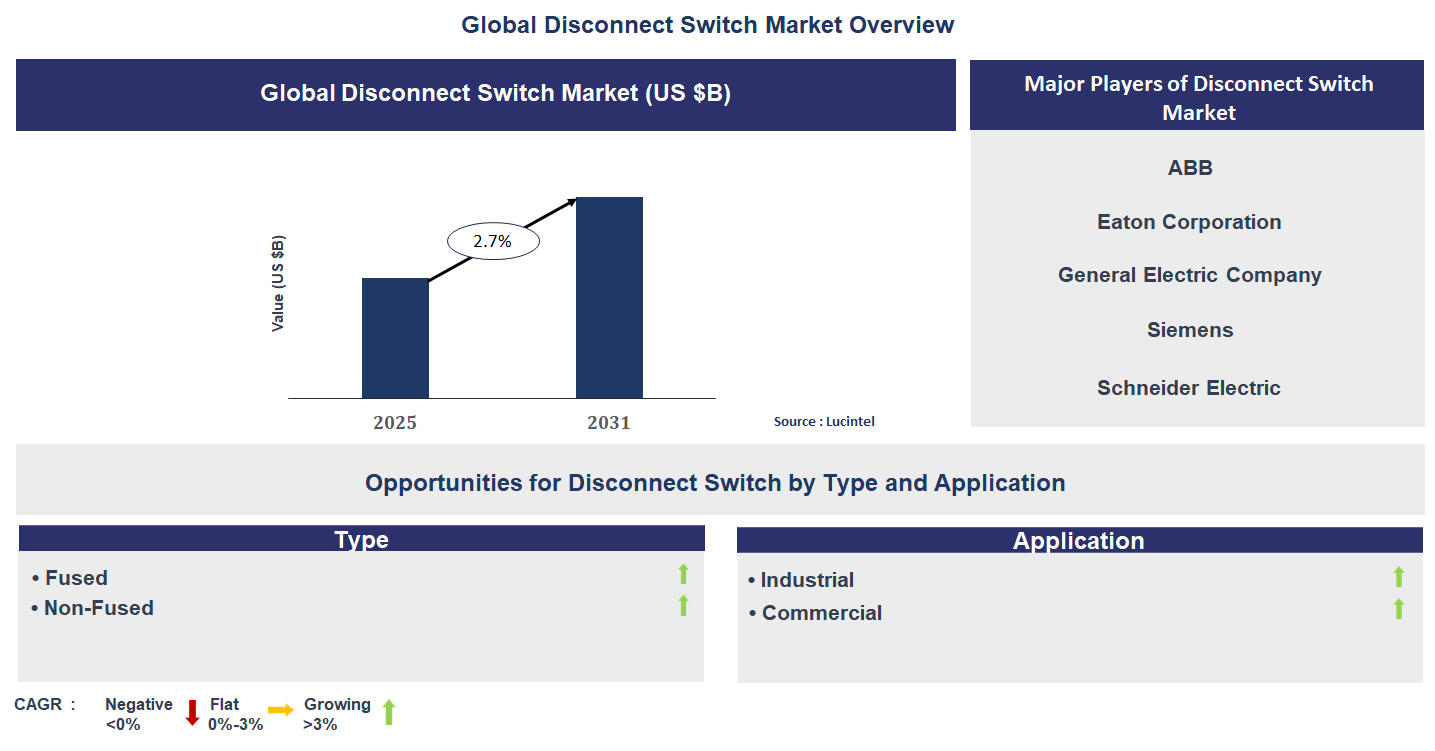
The future of the global disconnect switch market looks promising with opportunities in the industrial and commercial markets. The global disconnect switch market is expected to grow with a CAGR of 2.7% from 2025 to 2031. The major drivers for this market are the increasing adoption of renewable energy sources, the rising technological advancements in switchgear design, and the growing industrial infrastructure development demand.

• Lucintel forecasts that, within the type category, non-fused is expected to witness higher growth over the forecast period.
• Within the application category, industrial is expected to witness higher growth.
• In terms of region, APAC is expected to witness the highest growth over the forecast period.
Gain valuable insights for your business decisions with our comprehensive 150+ page report. Sample figures with some insights are shown below.
Disconnect Switch Market Trends and Forecast

Emerging Trends in the Disconnect Switch Market

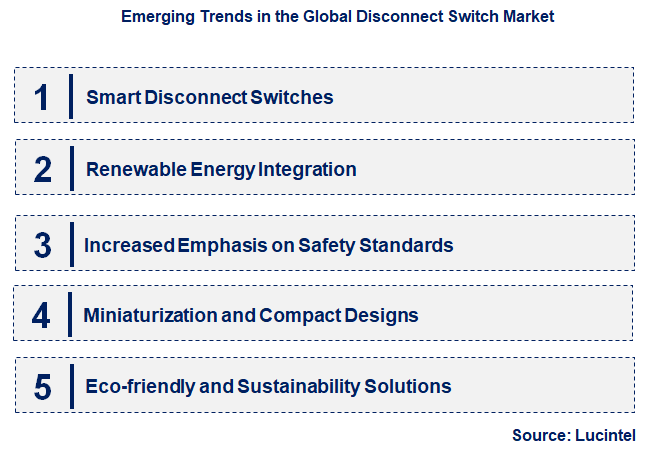
The disconnect switch market is experiencing a transformation with technological advancements, rising energy efficiency demand, and regulatory reform. With the increase in the adoption of renewable energy and advancements in smart grid technology, the market for disconnect switches is transforming as it responds to emerging challenges and opportunities. The following are five emerging trends in this market.
• Smart Disconnect Switches: Adoption of IoT technology in disconnect switches is revolutionizing the industry. Remote monitoring and control are possible with these smart disconnect switches, and they provide real-time information on system performance. Improved fault detection, predictive maintenance, and overall system management are possible with this, especially in smart grids and renewable energy systems.
• Renewable Energy Integration: The shift to renewable energy sources like solar and wind is generating a rush of demand for disconnect switches capable of handling the integration of these intermittent energy sources into the grid. Disconnect switches have a vital function in ensuring grid stability, avoiding overloads, and safe operation while switching between energy sources.
• Increased Emphasis on Safety Standards: Regulatory agencies worldwide are implementing tighter safety standards, which are forcing companies to create disconnect switches that are more durable and reliable. Better safety features, including fault protection systems and arc flash protection, are being integrated in order to minimize the risk of accidents and provide better protection for people and equipment.
• Miniaturization and Compact Designs: In order to address the requirements of contemporary electrical systems, disconnect switches are being made more compact and lighter without sacrificing performance. This miniaturization makes it easy for them to be integrated into confined spaces, especially in residential, commercial, and industrial applications where space may be a concern.
• Eco-friendly and Sustainability Solutions: There is a growing need for eco-friendly products in the electric industry. The makers of disconnect switches are moving towards minimizing the carbon footprint of their products using eco-friendly materials, saving energy while in operation, and enhancing recyclability of the components. The trend supports world sustainability.
The forthcoming trends in the disconnect switch market, such as the growth of smart disconnect switches, integration of renewable energy sources, growing emphasis on safety standards, miniaturization, and green solutions, are revolutionizing the sector. These trends are not simply reacting to existing requirements but are looking ahead to future requirements for more efficient, dependable, and sustainable electrical systems. As the market matures, these trends will propel innovation and address the increasing complexities of energy systems in the future.
Emerging Trends in the Disconnect Switch Market

Recent Development in the Disconnect Switch Market

The disconnect switch market has been changing with advancements and developments that promote functionality, safety, and reliability. These advancements are important to address the needs of new electrical systems, especially in the context of growing energy demand and integration of renewable power sources. Five notable developments driving the market are presented below.
• Arc Fault Detection Advancement: The innovation of sophisticated arc fault detection technologies is a major advancement in the disconnect switch industry. Such technologies are capable of detecting and interrupting electrical arcs rapidly and thereby minimizing the possibility of fires and other risks. More and more manufacturers are integrating these systems into disconnect switches, especially in hazard-prone environments.
• Development in High-Voltage Disconnect Switches: With the growth of transmission systems, demand for high-voltage disconnect switches that can supply larger loads is on the rise. Innovative designs are emerging to make them more efficient and cost-effective to operate while keeping high-voltage systems stable and safe.
• Smart Disconnect Switches for Smart Grids: In the continued drive towards smart grid evolution, manufacturers are developing disconnect switches that can interact with grid management systems. The smart switches support real-time control, fault isolation, and system optimization, enhancing the reliability and robustness of the grid.
• Modular and Miniature Switches: The manufacturers are putting more emphasis on miniaturizing disconnect switches without sacrificing their performance. Modular configurations are easy to install and maintain, which makes them suitable for residential and commercial use when space is limited.
• Use of Sustainable Materials: In response to environmental issues, manufacturers have been using sustainable materials for the production of disconnect switches. This means the use of recyclable metals, minimizing toxic emissions during manufacture, and enhancing energy efficiency in the functioning of switches.
Recent trends in the disconnect switch market mark a collaborative drive towards greater safety, efficiency, and sustainability. Central innovations like smart integration, high-voltage capacity, and sustainable materials mark a market that is becoming increasingly responsive to contemporary power needs and regulatory requirements. Such innovations not only make electrical systems more reliable but also part of a broader shift in power grids across the globe. With industries adopting newer technologies and more stringent safety protocols, disconnect switches are becoming more advanced and critical elements of energy infrastructure.

Strategic Growth Opportunities in the Disconnect Switch Market

The disconnect switch market is poised to grow in many of its applications, driven by innovation and change in the energy sector. Here are five major growth opportunities in this market.
• Renewable Energy Integration: With the worldwide demand for clean energy, disconnect switches in solar, wind, and renewable energy systems are in increased demand. Disconnect switches are instrumental in controlling power distribution and safe integration into the grid. As renewable capacity increases, suppliers can capitalize on an expanded product line to support the unique demands of this market.
• Smart Grid Applications: Smart grid development represents an important opportunity for disconnect switch producers. Intelligent disconnect switches can be integrated in grid management systems to provide real-time control, fault detection, and optimization. The technology is becoming increasingly important to utilities seeking to upgrade their infrastructure and enhance grid resilience.
• Urbanization and Infrastructure Development: With expanding urban cities, the need for efficient and dependable electrical systems is on the rise. Disconnect switches are critical to maintaining power distribution in urban settings, particularly in skyscrapers, business complexes, and industrial plants. This increasing infrastructure development offers an excellent market opportunity for disconnect switch manufacturers.
• Electric Vehicle Charging Stations: Growing demand for electric vehicles (EVs) is driving demand for disconnect switches in EV charging stations. The switches are required to disconnect and isolate the electricity supply during faults or maintenance, ensuring safe operation of charging infrastructure.
• IT Infrastructure and Data Centers: With the increasing demand for data processing and storage, there is also an increasing demand for stable electrical systems in data centers. Disconnect switches are necessary to ensure power stability and avoid downtime in these high-demand environments, providing growth opportunities for manufacturers in the data center segment.
The disconnect switch market has promising growth opportunities in different sectors, including integration of renewable energy, smart grids, city infrastructure development, charging stations for electric vehicles, and data centers. These sectors have different platforms for innovation and growth as the global energy infrastructure develops towards increased sustainability and digitalization. Firms that are capable of embracing these trends and riding the wave of demand for stable, efficient electrical solutions will be well placed for long-term success.

Disconnect Switch Market Driver and Challenges

The disconnect switch market is influenced by a range of factors, including technological advancements, regulatory changes, and evolving market needs. Below are five key drivers and three challenges that are shaping the future of this market.
The factors responsible for driving the disconnect switch market include:
1. Technological Advances: Technological progress, including smart grids and IoT integration, is demanding increasingly advanced disconnect switches with greater functionality and reliability. Such technologies enhance the performance of electrical systems and facilitate more automation.
2. Increasing Demand for Renewable Energy: With global transition to renewable energy sources, the demand for disconnect switches that can manage the intermittent power supply from solar, wind, and other renewable sources is increasing. This trend is fueling the creation of sophisticated switch technologies.
3. Growing Safety Regulations: Tighter safety regulations are driving the manufacture of more dependable disconnect switches that will be able to avoid dangers such as arc faults and electrical fires. Manufacturers are spending money on technology that enhances safety and compliance with changing standards.
4. Infrastructure Development and Urbanization: With the increasing population of cities and industrialization, the need for electrical systems that can support heavy loads and provide grid stability is growing. Disconnect switches play an important role in such systems, particularly in advanced infrastructure such as smart buildings and factories.
5. Increased Interest in Energy Efficiency: The increased interest in energy efficiency is prompting manufacturers to create disconnect switches that are optimized to consume energy and minimize waste. This is especially important with reference to smart grids and renewable integration.
Challenges in the disconnect switch market are:
1. High Initial Cost: Although their long-term advantages, disconnect switches, particularly sophisticated versions like smart switches, have high installation costs. High initial cost poses an entry barrier to many, especially small companies or Third World nations.
2. Elaborate Installation and Maintenance: Disconnect switch installation and maintenance may be elaborate, involving technical knowledge and experienced technicians. This makes operation more costly and results in system implementation delays.
3. Compliance with Regulations: The changing regulatory environment poses a challenge to manufacturers who need to keep updating their products to comply with new standards. Safety and environmental regulations compliance raises manufacturing costs and development duration.
The disconnect switch market is being transformed by technological advancements, changes in legislation, and the growing incorporation of renewable sources of energy. Though there are promising opportunities for growth in smart grids, renewable energy, and urban infrastructure, they come with high costs, intricate installation, and regulatory compliance challenges. Generally, these drivers and challenges will keep shaping the evolution of the market.

List of Disconnect Switch Companies

Companies in the market compete on the basis of product quality offered. Major players in this market focus on expanding their manufacturing facilities, R&D investments, infrastructural development, and leverage integration opportunities across the value chain. With these strategies disconnect switch companies cater increasing demand, ensure competitive effectiveness, develop innovative products & technologies, reduce production costs, and expand their customer base. Some of the disconnect switch companies profiled in this report include-
• ABB
• Eaton Corporation
• General Electric Company
• Siemens
• Schneider Electric
• WEG
• Mersen
• Littelfuse
• Crompton Greaves Limited
• Havells India

Disconnect Switch Market by Segment

The study includes a forecast for the global disconnect switch market by type, application, and region.

Disconnect Switch Market by Type [Value from 2019 to 2031]:


• Fused
• Non-Fused

Disconnect Switch Market by Application [Value from 2019 to 2031]:


• Industrial
• Commercial

Disconnect Switch Market by Region [Value from 2019 to 2031]:


• North America
• Europe
• Asia Pacific
• The Rest of the World

Country Wise Outlook for the Disconnect Switch Market

Disconnect switch market is witnessing high growth rate as a result of growing energy consumption, changing safety norms, and technology development. In countries such as the United States, China, Germany, India, and Japan, the transition towards renewable energy sources, urbanization, and industry growth is fueling demand for more efficient and safe electrical parts. Since these nations continue to place emphasis on grid stability and energy security, disconnect switches are becoming increasingly important in ensuring the safety and reliability of electrical systems.
• United States: The U.S. market for disconnect switches is growing steadily, with increasing dependency on renewable power sources such as wind and solar. Smart grid transformation has also fueled the need for more sophisticated disconnect switches that can be integrated within automated systems. New regulations concerning electrical safety have also prompted stronger standards in switch performance and design. These developments are focused on increasing protection and reducing downtime in essential infrastructure.
• China: In China, Disconnect Switch market development is paralleling the countrys ambitious energy reform initiatives, emphasizing clean energy and grid modernization. The governments expenditure on renewable energy projects and infrastructure planning is stimulating demand for high-performance disconnect switches. Additionally, industrial automation growth in China and the acceleration of electric vehicle growth are generating fresh opportunities for disconnect switch makers to innovate and meet the changing demands of the energy industry.
• Germany: Germanys disconnect switch market is being influenced by the leadership role that Germany has taken in the use of renewable energy. As part of its Energiewende (energy transformation) program, Germany is moving towards a decentralized energy system, which has led to growing demand for disconnect switches that can manage renewable energy inputs. Further, the nations stringent regulatory requirements in terms of electrical safety are encouraging innovation within the disconnect switch industry, driving the need for more efficient and better solutions for grid integration.
• India: Indias disconnect switch market is growing because of increasing urbanization and an increasing emphasis on infrastructure growth. The pressure for renewable energy and government plans to decrease carbon emissions have resulted in an increase in the demand for advanced disconnect switches. Also, the increasing frequency of power outages and demand for greater grid stability have prompted the use of disconnect switches in residential and industrial settings, which is likely to drive market growth further.
• Japan: Japans disconnect switch market is driven by the nations increasing focus on energy resilience, especially following the Fukushima accident. There is mounting pressure for renewable energy sources, driven by which the need for better management of the grid and improved disconnect switch solutions are needed. Japans regulatory system for electrical safety and energy efficiency is also driving manufacturers to create products that are innovative as well as compliant with the highest standards.

Lucintel Analytics Dashboard

Features of the Global Disconnect Switch Market

Market Size Estimates: Disconnect switch market size estimation in terms of value ($B).
Trend and Forecast Analysis: Market trends (2019 to 2024) and forecast (2025 to 2031) by various segments and regions.
Segmentation Analysis: Disconnect switch market size by type, application, and region in terms of value ($B).
Regional Analysis: Disconnect switch market breakdown by North America, Europe, Asia Pacific, and Rest of the World.
Growth Opportunities: Analysis of growth opportunities in different types, applications, and regions for the disconnect switch market.
Strategic Analysis: This includes M&A, new product development, and competitive landscape of the disconnect switch market.
Analysis of competitive intensity of the industry based on Porter’s Five Forces model.

Lucintel Consulting Services

FAQ

Q1. What is the growth forecast for disconnect switch market?
Answer: The global disconnect switch market is expected to grow with a CAGR of 2.7% from 2025 to 2031.
Q2. What are the major drivers influencing the growth of the disconnect switch market?
Answer: The major drivers for this market are the increasing adoption of renewable energy sources, the rising technological advancements in switchgear design, and the growing industrial infrastructure development demand.
Q3. What are the major segments for disconnect switch market?
Answer: The future of the disconnect switch market looks promising with opportunities in the industrial and commercial markets.
Q4. Who are the key disconnect switch market companies?
Answer: Some of the key disconnect switch companies are as follows:
• ABB
• Eaton Corporation
• General Electric Company
• Siemens
• Schneider Electric
• WEG
• Mersen
• Littelfuse
• Crompton Greaves Limited
• Havells India
Q5. Which disconnect switch market segment will be the largest in future?
Answer: Lucintel forecasts that, within the type category, non-fused is expected to witness higher growth over the forecast period.
Q6. In disconnect switch market, which region is expected to be the largest in next 5 years?
Answer: In terms of region, APAC is expected to witness the highest growth over the forecast period.
Q7. Do we receive customization in this report?
Answer: Yes, Lucintel provides 10% customization without any additional cost.

This report answers following 11 key questions:

Q.1. What are some of the most promising, high-growth opportunities for the disconnect switch market by type (fused and non-fused), application (industrial and commercial), and region (North America, Europe, Asia Pacific, and the Rest of the World)?
Q.2. Which segments will grow at a faster pace and why?
Q.3. Which region will grow at a faster pace and why?
Q.4. What are the key factors affecting market dynamics? What are the key challenges and business risks in this market?
Q.5. What are the business risks and competitive threats in this market?
Q.6. What are the emerging trends in this market and the reasons behind them?
Q.7. What are some of the changing demands of customers in the market?
Q.8. What are the new developments in the market? Which companies are leading these developments?
Q.9. Who are the major players in this market? What strategic initiatives are key players pursuing for business growth?
Q.10. What are some of the competing products in this market and how big of a threat do they pose for loss of market share by material or product substitution?
Q.11. What M&A activity has occurred in the last 5 years and what has its impact been on the industry?

For any questions related to Disconnect Switch Market, Disconnect Switch Market Size, Disconnect Switch Market Growth, Disconnect Switch Market Analysis, Disconnect Switch Market Report, Disconnect Switch Market Share, Disconnect Switch Market Trends, Disconnect Switch Market Forecast, Disconnect Switch Companies, write Lucintel analyst at email: helpdesk@lucintel.com. We will be glad to get back to you soon.
                                           Table of Contents

            1. Executive Summary

            2. Market Overview

                        2.1 Background and Classifications
                        2.2 Supply Chain

            3. Market Trends & Forecast Analysis

                        3.1 Macroeconomic Trends and Forecasts
                        3.2 Industry Drivers and Challenges
                        3.3 PESTLE Analysis
                        3.4 Patent Analysis
                        3.5 Regulatory Environment
                        3.6 Global Disconnect Switch Market Trends and Forecast

            4. Global Disconnect Switch Market by Type

                        4.1 Overview
                        4.2 Attractiveness Analysis by Type
                        4.3 Fused : Trends and Forecast 2025 to 2031
                        4.4 Non-Fused : Trends and Forecast 2025 to 2031

            5. Global Disconnect Switch Market by Application

                        5.1 Overview
                        5.2 Attractiveness Analysis by Application
                        5.3 Industrial : Trends and Forecast 2025 to 2031
                        5.4 Commercial : Trends and Forecast 2025 to 2031

            6. Regional Analysis

                        6.1 Overview
                        6.2 Global Disconnect Switch Market by Region

            7. North American Disconnect Switch Market

                        7.1 Overview
                        7.2 North American Disconnect Switch Market by Type
                        7.3 North American Disconnect Switch Market by Application
                        7.4 The United States Disconnect Switch Market
                        7.5 Canadian Disconnect Switch Market
                        7.6 Mexican Disconnect Switch Market

            8. European Disconnect Switch Market

                        8.1 Overview
                        8.2 European Disconnect Switch Market by Type
                        8.3 European Disconnect Switch Market by Application
                        8.4 German Disconnect Switch Market
                        8.5 French Disconnect Switch Market
                        8.6 Italian Disconnect Switch Market
                        8.7 Spanish Disconnect Switch Market
                        8.8 The United Kingdom Disconnect Switch Market

            9. APAC Disconnect Switch Market

                        9.1 Overview
                        9.2 APAC Disconnect Switch Market by Type
                        9.3 APAC Disconnect Switch Market by Application
                        9.4 Chinese Disconnect Switch Market
                        9.5 Indian Disconnect Switch Market
                        9.6 Japanese Disconnect Switch Market
                        9.7 South Korean Disconnect Switch Market
                        9.8 Indonesian Disconnect Switch Market

            10. ROW Disconnect Switch Market

                        10.1 Overview
                        10.2 ROW Disconnect Switch Market by Type
                        10.3 ROW Disconnect Switch Market by Application
                        10.4 Middle Eastern Disconnect Switch Market
                        10.5 South American Disconnect Switch Market
                        10.6 African Disconnect Switch Market

            11. Competitor Analysis

                        11.1 Product Portfolio Analysis
                        11.2 Operational Integration
                        11.3 Porter’s Five Forces Analysis
                                    • Competitive Rivalry
                                    • Bargaining Power of Buyers
                                    • Bargaining Power of Suppliers
                                    • Threat of Substitutes
                                    • Threat of New Entrants
                        11.4 Market Share Analysis

            12. Opportunities & Strategic Analysis

                        12.1 Value Chain Analysis
                        12.2 Growth Opportunity Analysis
                                    12.2.1 Growth Opportunity by Type
                                    12.2.2 Growth Opportunity by Application
                        12.3 Emerging Trends in the Global Disconnect Switch Market
                        12.4 Strategic Analysis
                                    12.4.1 New Product Development
                                    12.4.2 Certification and Licensing
                                    12.4.3 Mergers, Acquisitions, Agreements, Collaborations, and Joint Ventures

            13. Company Profiles of the Leading Players Across the Value Chain

                        13.1 Competitive Analysis Overview
                        13.2 ABB
                                    • Company Overview
                                    • Disconnect Switch Market Business Overview
                                    • New Product Development
                                    • Merger, Acquisition, and Collaboration
                                    • Certification and Licensing
                        13.3 Eaton Corporation
                                    • Company Overview
                                    • Disconnect Switch Market Business Overview
                                    • New Product Development
                                    • Merger, Acquisition, and Collaboration
                                    • Certification and Licensing
                        13.4 General Electric Company
                                    • Company Overview
                                    • Disconnect Switch Market Business Overview
                                    • New Product Development
                                    • Merger, Acquisition, and Collaboration
                                    • Certification and Licensing
                        13.5 Siemens
                                    • Company Overview
                                    • Disconnect Switch Market Business Overview
                                    • New Product Development
                                    • Merger, Acquisition, and Collaboration
                                    • Certification and Licensing
                        13.6 Schneider Electric
                                    • Company Overview
                                    • Disconnect Switch Market Business Overview
                                    • New Product Development
                                    • Merger, Acquisition, and Collaboration
                                    • Certification and Licensing
                        13.7 WEG
                                    • Company Overview
                                    • Disconnect Switch Market Business Overview
                                    • New Product Development
                                    • Merger, Acquisition, and Collaboration
                                    • Certification and Licensing
                        13.8 Mersen
                                    • Company Overview
                                    • Disconnect Switch Market Business Overview
                                    • New Product Development
                                    • Merger, Acquisition, and Collaboration
                                    • Certification and Licensing
                        13.9 Littelfuse
                                    • Company Overview
                                    • Disconnect Switch Market Business Overview
                                    • New Product Development
                                    • Merger, Acquisition, and Collaboration
                                    • Certification and Licensing
                        13.10 Crompton Greaves Limited
                                    • Company Overview
                                    • Disconnect Switch Market Business Overview
                                    • New Product Development
                                    • Merger, Acquisition, and Collaboration
                                    • Certification and Licensing
                        13.11 Havells India
                                    • Company Overview
                                    • Disconnect Switch Market Business Overview
                                    • New Product Development
                                    • Merger, Acquisition, and Collaboration
                                    • Certification and Licensing

            14. Appendix

                        14.1 List of Figures
                        14.2 List of Tables
                        14.3 Research Methodology
                        14.4 Disclaimer
                        14.5 Copyright
                        14.6 Abbreviations and Technical Units
                        14.7 About Us
                        14.8 Contact Us

                                               List of Figures


            Chapter 1

                        Figure 1.1: Trends and Forecast for the Global Disconnect Switch Market

            Chapter 2

                        Figure 2.1: Usage of Disconnect Switch Market
                        Figure 2.2: Classification of the Global Disconnect Switch Market
                        Figure 2.3: Supply Chain of the Global Disconnect Switch Market

            Chapter 3

                        Figure 3.1: Trends of the Global GDP Growth Rate
                        Figure 3.2: Trends of the Global Population Growth Rate
                        Figure 3.3: Trends of the Global Inflation Rate
                        Figure 3.4: Trends of the Global Unemployment Rate
                        Figure 3.5: Trends of the Regional GDP Growth Rate
                        Figure 3.6: Trends of the Regional Population Growth Rate
                        Figure 3.7: Trends of the Regional Inflation Rate
                        Figure 3.8: Trends of the Regional Unemployment Rate
                        Figure 3.9: Trends of Regional Per Capita Income
                        Figure 3.10: Forecast for the Global GDP Growth Rate
                        Figure 3.11: Forecast for the Global Population Growth Rate
                        Figure 3.12: Forecast for the Global Inflation Rate
                        Figure 3.13: Forecast for the Global Unemployment Rate
                        Figure 3.14: Forecast for the Regional GDP Growth Rate
                        Figure 3.15: Forecast for the Regional Population Growth Rate
                        Figure 3.16: Forecast for the Regional Inflation Rate
                        Figure 3.17: Forecast for the Regional Unemployment Rate
                        Figure 3.18: Forecast for Regional Per Capita Income
                        Figure 3.19: Driver and Challenges of the Disconnect Switch Market

            Chapter 4

                        Figure 4.1: Global Disconnect Switch Market by Type in 2019, 2024, and 2031
                        Figure 4.2: Trends of the Global Disconnect Switch Market ($B) by Type
                        Figure 4.3: Forecast for the Global Disconnect Switch Market ($B) by Type
                        Figure 4.4: Trends and Forecast for Fused in the Global Disconnect Switch Market (2019-2031)
                        Figure 4.5: Trends and Forecast for Non-Fused in the Global Disconnect Switch Market (2019-2031)

            Chapter 5

                        Figure 5.1: Global Disconnect Switch Market by Application in 2019, 2024, and 2031
                        Figure 5.2: Trends of the Global Disconnect Switch Market ($B) by Application
                        Figure 5.3: Forecast for the Global Disconnect Switch Market ($B) by Application
                        Figure 5.4: Trends and Forecast for Industrial in the Global Disconnect Switch Market (2019-2031)
                        Figure 5.5: Trends and Forecast for Commercial in the Global Disconnect Switch Market (2019-2031)

            Chapter 6

                        Figure 6.1: Trends of the Global Disconnect Switch Market ($B) by Region (2019-2024)
                        Figure 6.2: Forecast for the Global Disconnect Switch Market ($B) by Region (2025-2031)

            Chapter 7

                        Figure 7.1: Trends and Forecast for the North American Disconnect Switch Market (2019-2031)
                        Figure 7.2: North American Disconnect Switch Market by Type in 2019, 2024, and 2031
                        Figure 7.3: Trends of the North American Disconnect Switch Market ($B) by Type (2019-2024)
                        Figure 7.4: Forecast for the North American Disconnect Switch Market ($B) by Type (2025-2031)
                        Figure 7.5: North American Disconnect Switch Market by Application in 2019, 2024, and 2031
                        Figure 7.6: Trends of the North American Disconnect Switch Market ($B) by Application (2019-2024)
                        Figure 7.7: Forecast for the North American Disconnect Switch Market ($B) by Application (2025-2031)
                        Figure 7.8: Trends and Forecast for the United States Disconnect Switch Market ($B) (2019-2031)
                        Figure 7.9: Trends and Forecast for the Mexican Disconnect Switch Market ($B) (2019-2031)
                        Figure 7.10: Trends and Forecast for the Canadian Disconnect Switch Market ($B) (2019-2031)

            Chapter 8

                        Figure 8.1: Trends and Forecast for the European Disconnect Switch Market (2019-2031)
                        Figure 8.2: European Disconnect Switch Market by Type in 2019, 2024, and 2031
                        Figure 8.3: Trends of the European Disconnect Switch Market ($B) by Type (2019-2024)
                        Figure 8.4: Forecast for the European Disconnect Switch Market ($B) by Type (2025-2031)
                        Figure 8.5: European Disconnect Switch Market by Application in 2019, 2024, and 2031
                        Figure 8.6: Trends of the European Disconnect Switch Market ($B) by Application (2019-2024)
                        Figure 8.7: Forecast for the European Disconnect Switch Market ($B) by Application (2025-2031)
                        Figure 8.8: Trends and Forecast for the German Disconnect Switch Market ($B) (2019-2031)
                        Figure 8.9: Trends and Forecast for the French Disconnect Switch Market ($B) (2019-2031)
                        Figure 8.10: Trends and Forecast for the Spanish Disconnect Switch Market ($B) (2019-2031)
                        Figure 8.11: Trends and Forecast for the Italian Disconnect Switch Market ($B) (2019-2031)
                        Figure 8.12: Trends and Forecast for the United Kingdom Disconnect Switch Market ($B) (2019-2031)

            Chapter 9

                        Figure 9.1: Trends and Forecast for the APAC Disconnect Switch Market (2019-2031)
                        Figure 9.2: APAC Disconnect Switch Market by Type in 2019, 2024, and 2031
                        Figure 9.3: Trends of the APAC Disconnect Switch Market ($B) by Type (2019-2024)
                        Figure 9.4: Forecast for the APAC Disconnect Switch Market ($B) by Type (2025-2031)
                        Figure 9.5: APAC Disconnect Switch Market by Application in 2019, 2024, and 2031
                        Figure 9.6: Trends of the APAC Disconnect Switch Market ($B) by Application (2019-2024)
                        Figure 9.7: Forecast for the APAC Disconnect Switch Market ($B) by Application (2025-2031)
                        Figure 9.8: Trends and Forecast for the Japanese Disconnect Switch Market ($B) (2019-2031)
                        Figure 9.9: Trends and Forecast for the Indian Disconnect Switch Market ($B) (2019-2031)
                        Figure 9.10: Trends and Forecast for the Chinese Disconnect Switch Market ($B) (2019-2031)
                        Figure 9.11: Trends and Forecast for the South Korean Disconnect Switch Market ($B) (2019-2031)
                        Figure 9.12: Trends and Forecast for the Indonesian Disconnect Switch Market ($B) (2019-2031)

            Chapter 10

                        Figure 10.1: Trends and Forecast for the ROW Disconnect Switch Market (2019-2031)
                        Figure 10.2: ROW Disconnect Switch Market by Type in 2019, 2024, and 2031
                        Figure 10.3: Trends of the ROW Disconnect Switch Market ($B) by Type (2019-2024)
                        Figure 10.4: Forecast for the ROW Disconnect Switch Market ($B) by Type (2025-2031)
                        Figure 10.5: ROW Disconnect Switch Market by Application in 2019, 2024, and 2031
                        Figure 10.6: Trends of the ROW Disconnect Switch Market ($B) by Application (2019-2024)
                        Figure 10.7: Forecast for the ROW Disconnect Switch Market ($B) by Application (2025-2031)
                        Figure 10.8: Trends and Forecast for the Middle Eastern Disconnect Switch Market ($B) (2019-2031)
                        Figure 10.9: Trends and Forecast for the South American Disconnect Switch Market ($B) (2019-2031)
                        Figure 10.10: Trends and Forecast for the African Disconnect Switch Market ($B) (2019-2031)

            Chapter 11

                        Figure 11.1: Porter’s Five Forces Analysis of the Global Disconnect Switch Market
                        Figure 11.2: Market Share (%) of Top Players in the Global Disconnect Switch Market (2024)

            Chapter 12

                        Figure 12.1: Growth Opportunities for the Global Disconnect Switch Market by Type
                        Figure 12.2: Growth Opportunities for the Global Disconnect Switch Market by Application
                        Figure 12.3: Growth Opportunities for the Global Disconnect Switch Market by Region
                        Figure 12.4: Emerging Trends in the Global Disconnect Switch Market

                                               List of Tables


            Chapter 1

                        Table 1.1: Growth Rate (%, 2023-2024) and CAGR (%, 2025-2031) of the Disconnect Switch Market by Type and Application
                        Table 1.2: Attractiveness Analysis for the Disconnect Switch Market by Region
                        Table 1.3: Global Disconnect Switch Market Parameters and Attributes

            Chapter 3

                        Table 3.1: Trends of the Global Disconnect Switch Market (2019-2024)
                        Table 3.2: Forecast for the Global Disconnect Switch Market (2025-2031)

            Chapter 4

                        Table 4.1: Attractiveness Analysis for the Global Disconnect Switch Market by Type
                        Table 4.2: Market Size and CAGR of Various Type in the Global Disconnect Switch Market (2019-2024)
                        Table 4.3: Market Size and CAGR of Various Type in the Global Disconnect Switch Market (2025-2031)
                        Table 4.4: Trends of Fused in the Global Disconnect Switch Market (2019-2024)
                        Table 4.5: Forecast for Fused in the Global Disconnect Switch Market (2025-2031)
                        Table 4.6: Trends of Non-Fused in the Global Disconnect Switch Market (2019-2024)
                        Table 4.7: Forecast for Non-Fused in the Global Disconnect Switch Market (2025-2031)

            Chapter 5

                        Table 5.1: Attractiveness Analysis for the Global Disconnect Switch Market by Application
                        Table 5.2: Market Size and CAGR of Various Application in the Global Disconnect Switch Market (2019-2024)
                        Table 5.3: Market Size and CAGR of Various Application in the Global Disconnect Switch Market (2025-2031)
                        Table 5.4: Trends of Industrial in the Global Disconnect Switch Market (2019-2024)
                        Table 5.5: Forecast for Industrial in the Global Disconnect Switch Market (2025-2031)
                        Table 5.6: Trends of Commercial in the Global Disconnect Switch Market (2019-2024)
                        Table 5.7: Forecast for Commercial in the Global Disconnect Switch Market (2025-2031)

            Chapter 6

                        Table 6.1: Market Size and CAGR of Various Regions in the Global Disconnect Switch Market (2019-2024)
                        Table 6.2: Market Size and CAGR of Various Regions in the Global Disconnect Switch Market (2025-2031)

            Chapter 7

                        Table 7.1: Trends of the North American Disconnect Switch Market (2019-2024)
                        Table 7.2: Forecast for the North American Disconnect Switch Market (2025-2031)
                        Table 7.3: Market Size and CAGR of Various Type in the North American Disconnect Switch Market (2019-2024)
                        Table 7.4: Market Size and CAGR of Various Type in the North American Disconnect Switch Market (2025-2031)
                        Table 7.5: Market Size and CAGR of Various Application in the North American Disconnect Switch Market (2019-2024)
                        Table 7.6: Market Size and CAGR of Various Application in the North American Disconnect Switch Market (2025-2031)
                        Table 7.7: Trends and Forecast for the United States Disconnect Switch Market (2019-2031)
                        Table 7.8: Trends and Forecast for the Mexican Disconnect Switch Market (2019-2031)
                        Table 7.9: Trends and Forecast for the Canadian Disconnect Switch Market (2019-2031)

            Chapter 8

                        Table 8.1: Trends of the European Disconnect Switch Market (2019-2024)
                        Table 8.2: Forecast for the European Disconnect Switch Market (2025-2031)
                        Table 8.3: Market Size and CAGR of Various Type in the European Disconnect Switch Market (2019-2024)
                        Table 8.4: Market Size and CAGR of Various Type in the European Disconnect Switch Market (2025-2031)
                        Table 8.5: Market Size and CAGR of Various Application in the European Disconnect Switch Market (2019-2024)
                        Table 8.6: Market Size and CAGR of Various Application in the European Disconnect Switch Market (2025-2031)
                        Table 8.7: Trends and Forecast for the German Disconnect Switch Market (2019-2031)
                        Table 8.8: Trends and Forecast for the French Disconnect Switch Market (2019-2031)
                        Table 8.9: Trends and Forecast for the Spanish Disconnect Switch Market (2019-2031)
                        Table 8.10: Trends and Forecast for the Italian Disconnect Switch Market (2019-2031)
                        Table 8.11: Trends and Forecast for the United Kingdom Disconnect Switch Market (2019-2031)

            Chapter 9

                        Table 9.1: Trends of the APAC Disconnect Switch Market (2019-2024)
                        Table 9.2: Forecast for the APAC Disconnect Switch Market (2025-2031)
                        Table 9.3: Market Size and CAGR of Various Type in the APAC Disconnect Switch Market (2019-2024)
                        Table 9.4: Market Size and CAGR of Various Type in the APAC Disconnect Switch Market (2025-2031)
                        Table 9.5: Market Size and CAGR of Various Application in the APAC Disconnect Switch Market (2019-2024)
                        Table 9.6: Market Size and CAGR of Various Application in the APAC Disconnect Switch Market (2025-2031)
                        Table 9.7: Trends and Forecast for the Japanese Disconnect Switch Market (2019-2031)
                        Table 9.8: Trends and Forecast for the Indian Disconnect Switch Market (2019-2031)
                        Table 9.9: Trends and Forecast for the Chinese Disconnect Switch Market (2019-2031)
                        Table 9.10: Trends and Forecast for the South Korean Disconnect Switch Market (2019-2031)
                        Table 9.11: Trends and Forecast for the Indonesian Disconnect Switch Market (2019-2031)

            Chapter 10

                        Table 10.1: Trends of the ROW Disconnect Switch Market (2019-2024)
                        Table 10.2: Forecast for the ROW Disconnect Switch Market (2025-2031)
                        Table 10.3: Market Size and CAGR of Various Type in the ROW Disconnect Switch Market (2019-2024)
                        Table 10.4: Market Size and CAGR of Various Type in the ROW Disconnect Switch Market (2025-2031)
                        Table 10.5: Market Size and CAGR of Various Application in the ROW Disconnect Switch Market (2019-2024)
                        Table 10.6: Market Size and CAGR of Various Application in the ROW Disconnect Switch Market (2025-2031)
                        Table 10.7: Trends and Forecast for the Middle Eastern Disconnect Switch Market (2019-2031)
                        Table 10.8: Trends and Forecast for the South American Disconnect Switch Market (2019-2031)
                        Table 10.9: Trends and Forecast for the African Disconnect Switch Market (2019-2031)

            Chapter 11

                        Table 11.1: Product Mapping of Disconnect Switch Suppliers Based on Segments
                        Table 11.2: Operational Integration of Disconnect Switch Manufacturers
                        Table 11.3: Rankings of Suppliers Based on Disconnect Switch Revenue

            Chapter 12

                        Table 12.1: New Product Launches by Major Disconnect Switch Producers (2019-2024)
                        Table 12.2: Certification Acquired by Major Competitor in the Global Disconnect Switch Market

.

Buy full report or by chapter as follows

Limited Time Offer

Price by License Type:
[-] Hide Chapter Details
[Chapter Number] [Chapter Name] [Chapter Number Of Pages] [Chapter Price]
Title/Chapter Name Pages Price
Full Report: Disconnect Switch Market Report: Trends, Forecast and Competitive Analysis to 2031 Full Report $ 2,990
A 150 Page Report
Lucintel has been in the business of market research and management consulting since 2000 and has published over 1000 market intelligence reports in various markets / applications and served over 1,000 clients worldwide. This study is a culmination of four months of full-time effort performed by Lucintel's analyst team. The analysts used the following sources for the creation and completion of this valuable report:
  • In-depth interviews of the major players in this market
  • Detailed secondary research from competitors’ financial statements and published data 
  • Extensive searches of published works, market, and database information pertaining to industry news, company press releases, and customer intentions
  • A compilation of the experiences, judgments, and insights of Lucintel’s professionals, who have analyzed and tracked this market over the years.
Extensive research and interviews are conducted across the supply chain of this market to estimate market share, market size, trends, drivers, challenges, and forecasts. Below is a brief summary of the primary interviews that were conducted by job function for this report.
 
Thus, Lucintel compiles vast amounts of data from numerous sources, validates the integrity of that data, and performs a comprehensive analysis. Lucintel then organizes the data, its findings, and insights into a concise report designed to support the strategic decision-making process. The figure below is a graphical representation of Lucintel’s research process. 
 

Please sign in below to get report brochure - Disconnect Switch Market Report.

At Lucintel, we respect your privacy and maintain the confidentiality of information / data provided by you
(Please enter your corporate email. * These fields are mandatory )

Follow us on