
Market Report · July 22, 2026

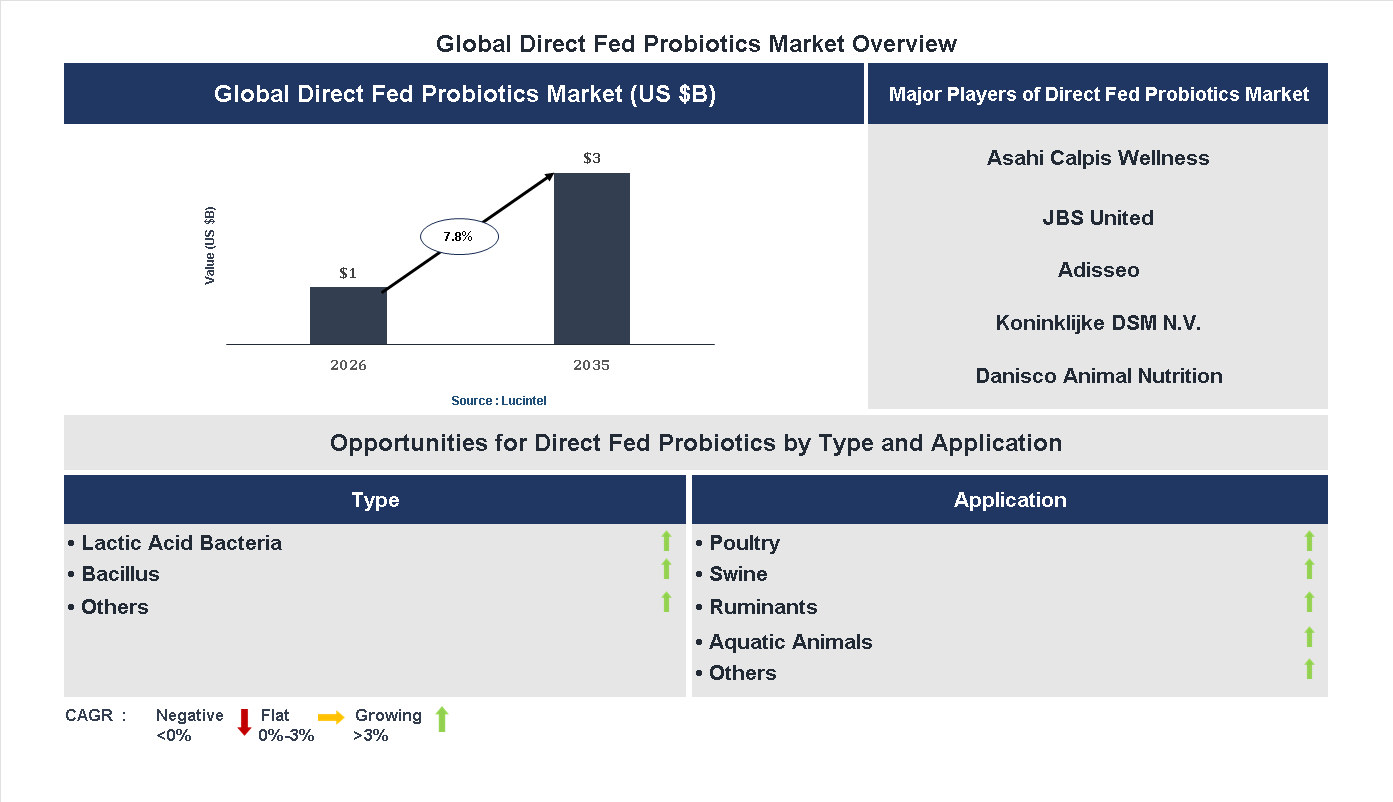
Key data points: The market size in 2035 = $3 billion, growth forecast = 7.8% annually for the next 8 years. Scroll below to get more insights. This market report covers trends, opportunities and forecasts in direct fed probiotics market to 2035 by type (lactic acid bacteria, bacillus, and others), application (poultry, swine, ruminants, aquatic animals, and others), and region (North America, Europe, Asia Pacific, and the Rest of the World)
We'll send your sample report shortly.
• Lucintel forecasts that, within the type category, bacillus is expected to witness higher growth over the forecast period.
• Within the application category, poultry is expected to witness the highest growth.
• In terms of region, APAC is expected to witness the highest growth over the forecast period. Gain valuable insights for your business decisions with our comprehensive 150+ page report. Sample figures with some insights are shown below.
• Growing Consumer Awareness and Demand for Gut Health: Consumers are increasingly recognizing the importance of gut health for overall wellness. This awareness is driven by scientific research linking probiotics to improved digestion, immunity, and mental health. As a result, there is a surge in demand for probiotic products, including supplements and functional foods. This trend encourages companies to develop targeted probiotic strains and educate consumers about their benefits, leading to market expansion and product diversification.
• Innovation in Probiotic Formulations and Delivery Systems: Companies are investing in research to develop more effective probiotic strains with enhanced stability and survivability through the gastrointestinal tract. Innovations include encapsulation technologies, synbiotics, and personalized probiotic solutions tailored to individual health needs. These advancements improve product efficacy and shelf life, attracting health-conscious consumers. The development of novel delivery systems also enables probiotics to be incorporated into a wider range of products, from beverages to snacks, broadening market opportunities.
• Expansion of Distribution Channels and Market Reach: The proliferation of online retail platforms and health stores has made probiotics more accessible to consumers worldwide. E-commerce channels facilitate direct-to-consumer sales, providing convenience and a broader product selection. Additionally, collaborations with healthcare providers and pharmacies are increasing product credibility and reach. This expansion into diverse distribution channels is crucial for market growth, especially in emerging markets where awareness and availability are still developing.
• Regulatory Developments and Quality Standards: Governments and regulatory bodies are establishing clearer guidelines for probiotic products to ensure safety, efficacy, and quality. These regulations help build consumer trust and facilitate international trade. Companies are investing in compliance and quality assurance measures, which may increase production costs but ultimately enhance product credibility. Stricter standards also encourage innovation and differentiation, pushing companies to develop high-quality, scientifically validated probiotic products.
• Technological Advancements and Data-Driven Personalization: The integration of big data, genomics, and artificial intelligence is enabling the development of personalized probiotic solutions. Consumers can now access tailored products based on their genetic makeup, microbiome analysis, and health profiles. This trend enhances product effectiveness and consumer engagement, fostering loyalty. Additionally, technological tools are improving manufacturing processes and quality control, leading to more consistent and reliable probiotic products, thus driving market growth and innovation. These trends are reshaping the direct fed probiotics market by fostering innovation, expanding accessibility, and emphasizing quality and personalization. As consumer preferences shift towards natural and scientifically backed health solutions, the market is poised for sustained growth and diversification, ultimately improving health outcomes and market competitiveness.

• Growing Demand for Natural Animal Health Solutions: The increasing consumer preference for natural and organic products is boosting the demand for direct fed probiotics. Farmers and pet owners are seeking alternatives to antibiotics, emphasizing gut health and disease prevention. This shift is encouraging manufacturers to develop targeted probiotic formulations, expanding market reach and improving animal welfare. The trend is also driven by regulatory pressures to reduce antibiotic use, making probiotics a sustainable choice. Overall, this growth enhances market stability and opens new avenues for innovation.
• Advances in Probiotic Strain Development: Recent scientific research has led to the identification of novel probiotic strains with enhanced efficacy. These strains offer improved gut colonization, disease resistance, and nutrient absorption, making them highly attractive for animal health applications. Companies investing in R&D are creating specialized formulations tailored to specific animal species and health issues. This innovation boosts product effectiveness, customer confidence, and market competitiveness. Consequently, the market benefits from a broader product portfolio and increased consumer trust in probiotic solutions.
• Technological Innovations in Delivery Systems: The development of advanced delivery methods, such as microencapsulation and water-soluble powders, is revolutionizing probiotic administration. These technologies improve probiotic stability, shelf life, and ease of use, ensuring maximum viability upon consumption. Enhanced delivery systems facilitate targeted release in the gastrointestinal tract, increasing efficacy. This progress reduces product wastage and enhances user experience, thereby expanding market adoption across diverse animal sectors. The technological evolution is pivotal in driving market growth and product differentiation.
• Rising Adoption in Livestock and Pet Markets: The integration of probiotics into livestock feed and pet diets is gaining momentum due to proven health benefits. Farmers and pet owners recognize probiotics role in improving digestion, immunity, and overall health, leading to increased adoption. Regulatory support and consumer awareness further accelerate this trend. The expanding application scope is creating new revenue streams for manufacturers and fostering market diversification. This widespread acceptance is instrumental in establishing probiotics as a standard component of animal nutrition.
• Increasing Regulatory Support and Standardization: Governments and industry bodies are implementing guidelines to ensure probiotic safety, efficacy, and quality. Standardization efforts are fostering consumer confidence and facilitating international trade. Regulatory approvals are streamlining product development and market entry, encouraging innovation. This supportive environment reduces market barriers and promotes responsible manufacturing practices. As a result, the market is becoming more organized, transparent, and sustainable, attracting investments and expanding global reach. The overall impact of these developments is a robust, innovative, and expanding market landscape. Enhanced product efficacy, technological advancements, and regulatory support are driving growth, increasing consumer trust, and opening new opportunities. As the market continues to evolve, it is poised for sustained expansion, benefiting stakeholders across the animal health and nutrition sectors.
• Growing Adoption of Probiotics in Livestock Nutrition: The increasing awareness of probiotics benefits for animal health and productivity is driving their adoption in livestock feed. Farmers and feed manufacturers are seeking natural alternatives to antibiotics, leading to higher demand for direct fed probiotics. This shift supports sustainable farming practices, reduces antibiotic resistance concerns, and improves overall animal well-being, creating a substantial growth opportunity for probiotic producers to expand their product portfolios and market presence.
• Innovations in Probiotic Formulations for Enhanced Efficacy: Advances in probiotic strains and delivery methods are enabling more effective and targeted solutions for animal health. Researchers are developing multi-strain formulations with improved stability and shelf life, tailored to specific livestock needs. These innovations help optimize gut health, boost immunity, and improve feed conversion ratios, offering manufacturers a competitive edge and opening new avenues for product differentiation and market expansion.
• Increasing Regulatory Support and Industry Standards: Governments and industry bodies are implementing regulations favoring natural feed additives and probiotics, encouraging their adoption. Certification programs and quality standards are being established to ensure product safety and efficacy, boosting consumer confidence. This regulatory environment fosters market growth by reducing barriers to entry, encouraging innovation, and promoting the adoption of probiotic solutions across various livestock sectors.
• Rising Demand for Organic and Natural Animal Products: Consumer preferences are shifting toward organic and naturally produced animal products, prompting farmers to adopt probiotic-based feed strategies. This trend supports sustainable and chemical-free farming practices, increasing the market for high-quality probiotics. Producers focusing on organic certifications and transparent ingredient sourcing are positioned to capitalize on this demand, expanding their market share and driving overall industry growth.
• Expansion into Emerging Markets with Growing Livestock Industries: Rapidly developing regions in Asia, Africa, and Latin America are witnessing significant growth in livestock populations and feed demand. These markets present untapped opportunities for probiotic companies to establish a foothold through localized products and distribution channels. Strategic investments and partnerships in these regions can facilitate market penetration, support local farmers, and contribute to global market expansion. These growth opportunities collectively are transforming the direct fed probiotics market into a dynamic and expanding sector. By leveraging innovations, regulatory support, and emerging market potential, industry stakeholders can enhance product offerings, meet evolving consumer demands, and achieve sustainable growth. The market’s future is poised for continued expansion, driven by increasing awareness of animal health benefits and the shift toward natural, eco-friendly farming practices.
• Growing Consumer Awareness and Demand: Increasing awareness about gut health benefits and preventive healthcare is boosting demand for probiotic products. Consumers are seeking natural, effective solutions to improve digestion, immunity, and overall wellness. This trend is supported by rising health consciousness and the desire to avoid synthetic drugs, leading to a significant market expansion. The proliferation of health information through digital platforms further accelerates consumer interest, encouraging manufacturers to innovate and diversify their probiotic offerings to meet evolving preferences.
• Technological Advancements in Probiotic Formulations: Innovations in probiotic strains, encapsulation techniques, and delivery systems have improved product stability, shelf life, and efficacy. These technological developments enable manufacturers to create targeted probiotics for specific health issues, enhancing consumer trust and satisfaction. Advanced manufacturing processes also allow for large-scale production while maintaining quality, which reduces costs and increases accessibility. As research continues, new strains with enhanced health benefits are being discovered, further fueling market growth and product differentiation.
• Increasing Healthcare Expenditure and Preventive Care Focus: Rising healthcare costs globally are prompting consumers and healthcare providers to emphasize preventive health measures. Probiotics are increasingly recognized as a cost-effective way to support digestive health and immune function, reducing the need for medication and medical interventions. Governments and healthcare organizations are promoting wellness programs that include probiotic supplementation, which boosts market demand. This economic shift towards prevention over treatment is a key driver, encouraging investment in probiotic research and product development.
• Regulatory Developments and Standardization: Evolving regulatory frameworks aim to ensure the safety, efficacy, and quality of probiotic products. Clear guidelines and standards facilitate consumer confidence and market credibility. Regulatory approval processes can also act as barriers for new entrants, but they ultimately promote innovation by setting quality benchmarks. Companies investing in compliance and quality assurance gain competitive advantages, while regulatory harmonization across regions simplifies international trade and market expansion.
• Expansion of E-commerce and Distribution Channels: The rise of online retail platforms has significantly expanded market reach, allowing consumers easy access to a wide range of probiotic products. E-commerce offers convenience, detailed product information, and competitive pricing, which attract a broader customer base. Additionally, partnerships with pharmacies, health stores, and wellness centers enhance product visibility and credibility. The digital shift also enables targeted marketing and personalized recommendations, further boosting sales. This expansion of distribution channels is crucial for market growth, especially in emerging regions with limited brick-and-mortar presence. The challenges facing the direct fed probiotics market include:-
• Stringent Regulatory Compliance and Approval Processes: Navigating complex regulatory landscapes across different regions poses significant challenges for market players. Probiotic products must meet safety, efficacy, and labeling standards, which can be time-consuming and costly. Delays in approval processes hinder product launches and innovation. Smaller companies may struggle with compliance costs, limiting market entry and competition. Additionally, inconsistent regulations across countries create barriers to international expansion, complicating global market strategies and increasing operational risks.
• Technological and Scientific Uncertainties: Despite advancements, the scientific understanding of probiotic strains and their health benefits remains incomplete. Variability in strain efficacy, stability issues, and delivery methods pose challenges to product development. Uncertainty about long-term effects and clinical validation can hinder consumer trust and regulatory approval. Continuous research is required to substantiate health claims, which demands significant investment. These scientific uncertainties can slow innovation and limit the development of highly targeted or novel probiotic formulations.
• Market Saturation and Intense Competition: The increasing number of players and product offerings leads to market saturation, intensifying competition. Companies must differentiate their products through branding, quality, and efficacy, which can be resource-intensive. Price wars and promotional activities may erode profit margins. Additionally, counterfeit and substandard products threaten consumer trust and market stability. Maintaining innovation and quality standards while managing competitive pressures remains a persistent challenge for market participants aiming for sustainable growth. The direct fed probiotics market is driven by technological innovations, rising health awareness, economic shifts towards preventive care, regulatory improvements, and expanding distribution channels. However, it faces challenges such as regulatory complexities, scientific uncertainties, and intense competition. These factors collectively influence market dynamics, requiring stakeholders to innovate, comply, and differentiate to sustain growth. Overall, the markets future depends on balancing these drivers and challenges to capitalize on emerging opportunities while mitigating risks.
• Asahi Calpis Wellness
• JBS United
• Adisseo
• Koninklijke DSM N.V.
• Danisco Animal Nutrition
• Baolai-leelai
• Evonik Industries AG
• Chr. Hansen
• Biomin Holding GmbH
• Archer Daniels Midland Company
• Lactic Acid Bacteria
• Bacillus
• Others
• Poultry
• Swine
• Ruminants
• Aquatic Animals
• Others
• North America
• Europe
• Asia Pacific
• The Rest of the World
• United States: The US market has seen rapid adoption of direct fed probiotics, driven by rising consumer demand for organic and antibiotic-free meat products. Innovations in probiotic strains and delivery methods have improved efficacy, leading to increased usage in dairy and poultry sectors. Regulatory agencies are supporting growth through guidelines that promote natural feed additives, encouraging manufacturers to develop tailored probiotic solutions. Additionally, the US government’s investments in agricultural research have fostered advancements in probiotic formulations, boosting market competitiveness and expanding distribution channels across the country.
• China: China’s market for direct fed probiotics is expanding due to increasing livestock production and a growing focus on animal health and safety. The government’s initiatives to reduce antibiotic use in animal husbandry have accelerated probiotic adoption. Local companies are investing heavily in research and development to create region-specific probiotic strains suited for local livestock breeds. The rising middle class and demand for high-quality meat products are also fueling market growth. Moreover, partnerships with international firms are facilitating technology transfer and product innovation, positioning China as a key player in the global probiotic market.
• Germany: Germany’s market is characterized by a strong emphasis on sustainable farming practices and animal welfare, which has driven demand for natural probiotic solutions. The country’s strict regulations on feed additives have prompted companies to develop innovative, eco-friendly probiotic products. German research institutions are actively involved in studying probiotic benefits, leading to improved formulations and efficacy. The market is also benefiting from EU-wide policies promoting organic farming and reduced antibiotic use, which support the adoption of probiotics in livestock. Overall, Germany’s focus on quality and sustainability is shaping a competitive and innovative probiotic market landscape.
• India: The Indian market for direct fed probiotics is witnessing rapid growth due to increasing livestock populations and rising awareness of animal health management. The government’s initiatives to improve dairy and poultry productivity are encouraging probiotic use. Local manufacturers are expanding their product portfolios to include affordable probiotic options tailored for small-scale farmers. The rising demand for organic and antibiotic-free meat products is also boosting market prospects. Additionally, collaborations with international companies are facilitating technology transfer and product innovation, helping India establish itself as a significant player in the global probiotic industry.
• Japan: Japan’s market is driven by a focus on high-quality, safe animal products and advanced research in probiotic technology. The country’s aging livestock industry is adopting probiotics to improve animal health and productivity. Japanese companies are investing in R&D to develop highly effective probiotic strains with proven health benefits. Regulatory support for natural feed additives and consumer preference for organic products are further propelling market growth. The integration of probiotics into sustainable farming practices aligns with Japan’s environmental goals. Overall, Japan’s emphasis on innovation and quality is fostering a robust and technologically advanced probiotic market.


• Asahi Calpis Wellness
• JBS United
• Adisseo
• Koninklijke DSM N.V.
• Danisco Animal Nutrition
• Baolai-leelai
• Evonik Industries AG
• Chr. Hansen
• Biomin Holding GmbH
• Archer Daniels Midland Company Q6. Which direct fed probiotics market segment will be the largest in future? Answer: Lucintel forecasts that, within the type category, bacillus is expected to witness higher growth over the forecast period. Q7. In direct fed probiotics market, which region is expected to be the largest in next 5 years? Answer: In terms of region, APAC is expected to witness the highest growth over the forecast period. Q8. Do we receive customization in this report? Answer: Yes, Lucintel provides 10% customization without any additional cost.


Choose a license that fits your team. Instant PDF delivery.
Prices exclude taxes. Instant delivery. Custom licensing available on request.
Market Report · July 22, 2026
Market Report · July 22, 2026
Market Report · July 22, 2026
Trusted partner for strategic intelligence and business growth


Receive a complimentary market analysis tailored to your industry. Our analysts will identify key growth opportunities and competitive dynamics specific to your business.

Market size, growth rate, and key trend analysis for your specific sector.

Top competitor positioning and market share analysis.

Strategic recommendations backed by data-driven insights.
Get curated market intelligence and competitive moves straight to your inbox.
By subscribing, you agree to receive our monthly insights. Unsubscribe anytime.
Receive a complimentary market analysis tailored to your industry. Our analysts will identify key growth opportunities and competitive dynamics specific to your business.
Market size, growth rate, and key trend analysis for your specific sector.
Top competitor positioning and market share analysis.
Strategic recommendations backed by data-driven insights.
Get curated market intelligence, emerging trends, and competitive moves straight to your inbox each month.
By subscribing, you agree to receive our monthly insights. Unsubscribe anytime.
We'll send your sample report shortly.