
Report Feature
Dimethyl Sulfoxide Market Trends and Forecast
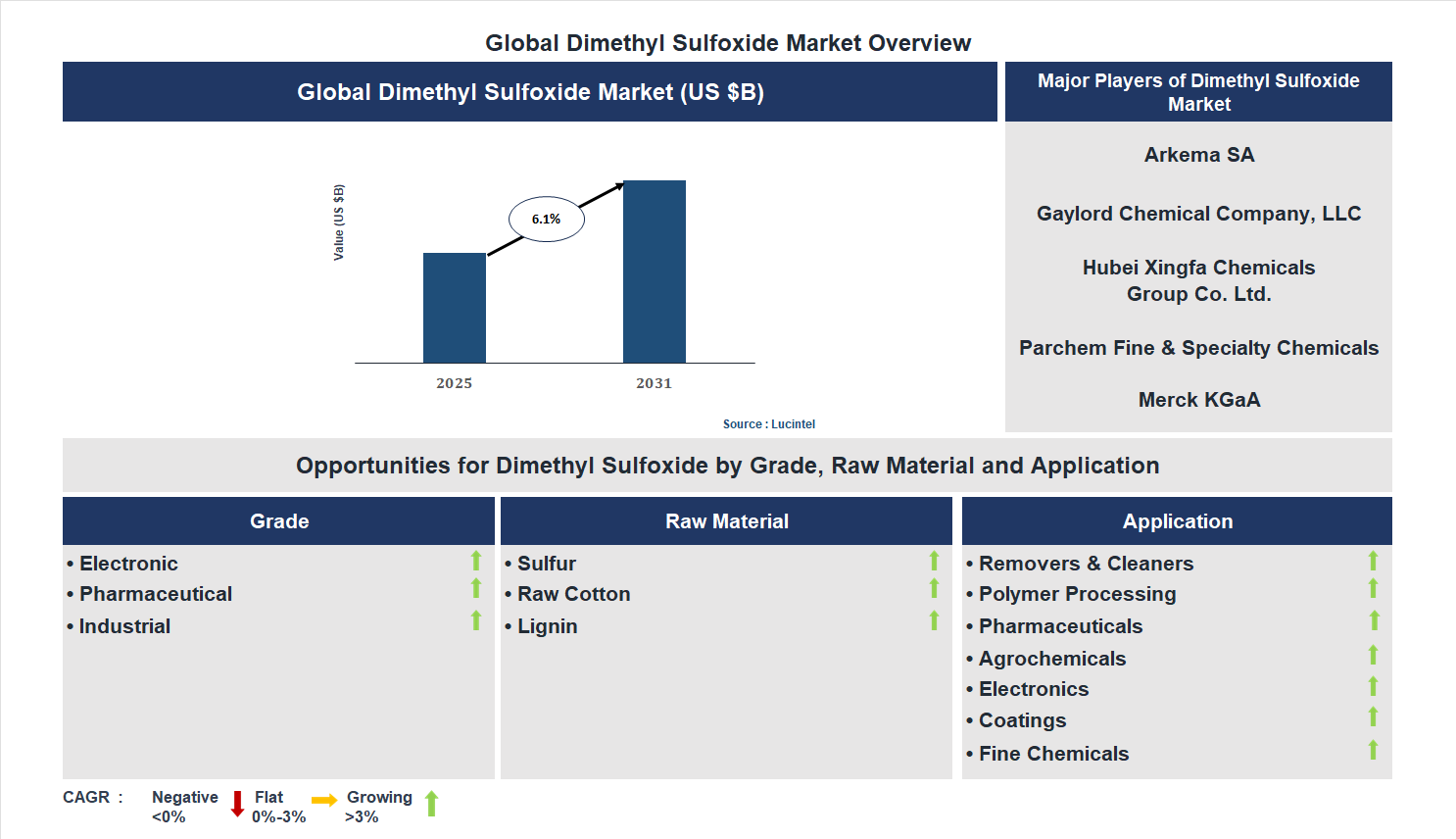
The future of the global dimethyl sulfoxide market looks promising with opportunities in the remover & cleaner, polymer processing, pharmaceutical, agrochemical, electronics, coating and fine chemical markets. The global dimethyl sulfoxide market is expected to grow with a CAGR of 6.1% from 2025 to 2031. The major drivers for this market are the increasing demand for pharmaceutical grade solvents, the rising use in drug delivery formulations, and the growing application in industrial chemical processes.• Lucintel forecasts that, within the grade category, pharmaceutical is expected to witness the highest growth over the forecast period.
• Within the application category, pharmaceutical is expected to witness the highest growth.
• In terms of region, APAC is expected to witness the highest growth over the forecast period. Gain valuable insights for your business decisions with our comprehensive 150+ page report. Sample figures with some insights are shown below.
Emerging Trends in the Dimethyl Sulfoxide Market
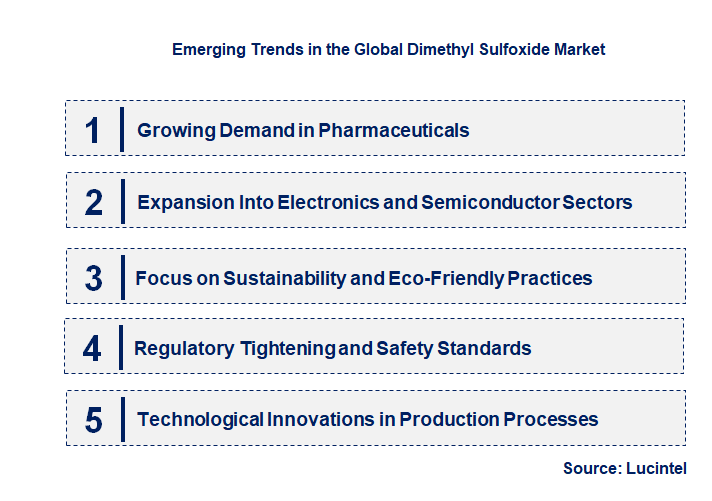
The dimethyl sulfoxide market is experiencing significant transformation driven by technological advancements, regulatory changes, and evolving customer demands. As industries such as pharmaceuticals, electronics, and manufacturing increasingly rely on DMSO for its unique solvent properties, market dynamics are shifting rapidly. Emerging trends are shaping the future landscape, influencing supply chains, innovation, and sustainability practices. Companies are adopting new strategies to stay competitive, while regulatory bodies are implementing stricter standards to ensure safety and environmental compliance. These developments collectively are redefining the market, creating new opportunities and challenges for stakeholders involved in DMSO production, distribution, and application.• Growing demand in pharmaceuticals: The pharmaceutical industry is increasingly utilizing DMSO for drug delivery and cryopreservation, driven by its ability to penetrate biological membranes and its anti-inflammatory properties. This trend boosts market growth as new formulations and therapies emerge, requiring high-purity DMSO. The demand is further supported by research into DMSO’s potential in treating various medical conditions, prompting manufacturers to enhance production capacities and quality standards to meet stringent regulatory requirements.
• Expansion into electronics and semiconductor sectors: DMSO’s excellent solvent properties are making it a preferred choice in electronics manufacturing, especially for cleaning and processing semiconductor components. As the electronics industry advances with miniaturization and complex circuitry, the need for high-purity solvents like DMSO increases. This trend is encouraging suppliers to develop specialized grades of DMSO that meet industry-specific standards, thereby expanding market applications and driving innovation in cleaning technologies.
• Focus on sustainability and eco-friendly practices: Environmental concerns are prompting manufacturers to adopt sustainable production methods for DMSO, including greener solvents and waste reduction techniques. Regulatory pressures and consumer preferences for eco-friendly products are pushing companies to innovate in manufacturing processes, reduce emissions, and improve waste management. This shift not only enhances corporate responsibility but also opens up new market segments for sustainably produced DMSO, aligning with global sustainability goals.
• Regulatory tightening and safety standards: Governments and international agencies are implementing stricter regulations concerning the production, handling, and disposal of DMSO to ensure safety and environmental protection. These regulations influence market dynamics by necessitating compliance investments and quality assurance measures. Companies are focusing on obtaining certifications and improving safety protocols, which may increase costs but ultimately lead to higher product standards and market credibility.
• Technological innovations in production processes: Advances in synthesis and purification technologies are enabling more efficient, cost-effective, and high-quality DMSO production. Innovations such as membrane separation and green synthesis methods are reducing environmental impact and production costs. These technological developments are facilitating increased supply, better product consistency, and the ability to meet diverse application requirements, thereby strengthening the market’s growth potential. In summary, these emerging trends are collectively reshaping the Dimethyl Sulfoxide market by fostering innovation, emphasizing sustainability, and responding to regulatory demands. They are expanding application horizons, improving product quality, and encouraging sustainable practices, which ultimately enhance competitiveness and open new avenues for growth across various industries.
Recent Development in the Dimethyl Sulfoxide Market
The dimethyl sulfoxide market has experienced significant growth driven by advancements in pharmaceutical, chemical, and biomedical industries. Increasing research and development activities, regulatory approvals, and expanding applications have contributed to market expansion. Recent developments reflect technological innovations, new product launches, and shifts in regulatory landscapes, shaping the future trajectory of the industry. These changes are influencing market dynamics, competitive strategies, and investment patterns, ultimately impacting supply chains and end-user sectors. Staying abreast of these developments is crucial for stakeholders aiming to capitalize on emerging opportunities and navigate potential challenges effectively.• Technological Innovations: New extraction and purification methods have improved DMSO quality and reduced production costs, enhancing competitiveness and enabling broader application in sensitive biomedical fields.
• Regulatory Approvals: Recent approvals for DMSO use in clinical therapies and pharmaceuticals have expanded its market scope, boosting demand and encouraging investment in R&D activities.
• Expansion in Pharmaceutical Applications: Growing use of DMSO as a solvent and cryoprotectant in drug formulation and storage has increased market size, especially in regenerative medicine and cryopreservation.
• Sustainable Production Methods: Adoption of greener, more sustainable manufacturing processes has reduced environmental impact, aligning with global sustainability goals and attracting eco-conscious investors.
• Market Consolidation and Strategic Partnerships: Mergers, acquisitions, and collaborations among key players have strengthened market positions, enhanced distribution networks, and accelerated innovation cycles. These developments are collectively driving market growth, improving product quality, and expanding application areas. They are also fostering a more sustainable and competitive environment, positioning the DMSO market for continued expansion and innovation in the coming years.
Strategic Growth Opportunities in the Dimethyl Sulfoxide Market
The dimethyl sulfoxide market is experiencing significant growth driven by expanding applications across various industries such as pharmaceuticals, electronics, and manufacturing. As technological advancements and increasing demand for innovative solutions continue, key growth opportunities are emerging in different application segments. These opportunities are poised to reshape market dynamics, offering new avenues for investment and development. Companies that strategically leverage these growth areas can enhance their market share and drive sustainable expansion. Understanding these opportunities is crucial for stakeholders aiming to capitalize on the evolving landscape of the DMSO market and to meet the rising global demand effectively.• Pharmaceutical Industry: Innovation in drug delivery and cryopreservation : DMSOs unique properties make it essential in pharmaceutical formulations, especially for drug delivery systems and cryopreservation. Growing research and development efforts are expanding its use, leading to increased demand for high-purity DMSO. This growth enhances the pharmaceutical sectors capabilities, enabling more effective treatments and storage solutions, ultimately driving market expansion.
• Electronics Manufacturing: Use in semiconductor fabrication : DMSO is increasingly used as a solvent and processing agent in semiconductor manufacturing. As the electronics industry advances, the demand for high-quality DMSO for cleaning and processing microchips rises. This application offers significant growth potential, supporting the miniaturization of electronic components and improving manufacturing efficiency.
• Chemical Synthesis and Industrial Applications: Catalyst and solvent roles : DMSO serves as a versatile solvent and catalyst in chemical synthesis, facilitating various industrial processes. The expansion of chemical manufacturing and specialty chemicals production fuels demand for DMSO. Its ability to improve reaction efficiency and selectivity makes it a critical component, promoting growth in the chemical sector.
• Personal Care and Cosmetics: Use as a penetration enhancer : The cosmetic industry is adopting DMSO as a penetration enhancer in topical formulations. Its ability to improve ingredient absorption enhances product efficacy. Rising consumer demand for advanced skincare solutions is expected to boost DMSOs application in this sector, contributing to market growth.
• Environmental and Waste Management: Use in remediation processes : DMSO is increasingly utilized in environmental cleanup and waste treatment due to its solvent properties. Its role in removing pollutants and facilitating remediation processes presents new growth opportunities. As environmental regulations tighten, the demand for effective solutions like DMSO is expected to rise, supporting sustainable development. In summary, these growth opportunities across key applications are significantly impacting the Dimethyl Sulfoxide market by expanding its usage, fostering innovation, and opening new revenue streams. The diversification of applications is driving market growth, attracting investments, and encouraging technological advancements, ultimately positioning DMSO as a vital component across multiple industries.
Dimethyl Sulfoxide Market Driver and Challenges
The dimethyl sulfoxide market is influenced by a variety of technological, economic, and regulatory factors that shape its growth trajectory. Advances in pharmaceutical and chemical industries drive demand for DMSO as a solvent and drug delivery agent. Economic factors such as increasing healthcare expenditure and industrial expansion further propel market growth. Regulatory frameworks around safety and environmental impact influence production and usage standards, impacting market dynamics. Additionally, technological innovations in manufacturing processes and product applications open new opportunities, while challenges related to safety concerns and environmental regulations pose hurdles. Understanding these drivers and challenges is essential for stakeholders to navigate the evolving landscape effectively. The factors responsible for driving the dimethyl sulfoxide market include:• Growing Pharmaceutical Applications: The expanding use of DMSO in drug formulation and delivery systems is a major driver. Its unique properties as a solvent and anti-inflammatory agent make it indispensable in pharmaceutical research and production. The rising prevalence of chronic diseases and the demand for innovative drug delivery methods boost the need for DMSO. Moreover, ongoing research into new therapeutic applications enhances its market potential. This growth is supported by increased investments in pharmaceutical R&D, regulatory approvals, and the development of new formulations, all contributing to sustained demand and market expansion.
• Increasing Industrial Usage: DMSOs role as a solvent in chemical manufacturing, electronics, and textile industries is a significant growth factor. Its ability to dissolve a wide range of compounds makes it valuable in various industrial processes. The expansion of chemical production facilities and the electronics sector, especially in emerging economies, drives demand. Additionally, DMSOs use in cleaning and manufacturing processes enhances operational efficiency. As industries seek environmentally friendly and efficient solvents, DMSOs versatility positions it as a preferred choice, further fueling market growth across multiple sectors.
• Technological Advancements in Production: Innovations in manufacturing processes have improved the quality, purity, and cost-effectiveness of DMSO production. Techniques such as membrane separation and catalytic processes reduce impurities and enhance yield, making DMSO more accessible and affordable. These advancements enable large-scale production to meet rising demand while maintaining safety and environmental standards. Enhanced production technology also allows for the development of specialized grades of DMSO tailored for specific applications, broadening its market scope. Continuous R&D efforts are expected to further optimize manufacturing, supporting sustained market growth.
• Rising Research and Development Activities: Increased R&D efforts in pharmaceuticals, biotechnology, and chemical industries are a key driver. Researchers explore new applications of DMSO, including in cryopreservation, drug delivery, and as a reaction solvent. The focus on innovative uses and formulations boosts demand from research institutions and commercial entities. Funding from government agencies and private investors accelerates these activities, leading to new product developments and expanded applications. This ongoing innovation sustains market growth by opening new avenues for DMSO utilization, making it a critical component in cutting-edge scientific and industrial advancements.
• Regulatory Support and Market Expansion: Favorable regulatory policies and standards in key regions promote the safe use and trade of DMSO. Governments and international bodies are establishing guidelines that ensure product safety, quality, and environmental compliance, which encourages market players to expand operations. Additionally, increasing awareness about DMSOs benefits in medical and industrial applications fosters market acceptance. Regulatory approvals for new applications and formulations further stimulate growth. As markets mature and regulations become more streamlined, the overall market environment becomes more conducive to investment and innovation, supporting long-term expansion. The challenges facing this dimethyl sulfoxide market include:
• Safety and Toxicity Concerns: DMSOs potential health risks, including skin absorption and toxicity at high doses, pose significant challenges. Incidents of misuse or improper handling can lead to adverse health effects, prompting strict safety regulations. These concerns necessitate rigorous safety protocols, limiting its widespread use in some applications. Additionally, public and regulatory apprehensions about toxicity hinder market acceptance and restrict certain applications, especially in consumer products. Addressing these safety issues requires ongoing research, education, and compliance measures, which can increase costs and slow market growth.
• Environmental Regulations and Disposal Issues: The environmental impact of DMSO production and disposal is a critical concern. Its biodegradability and potential to contaminate water sources demand strict environmental controls. Regulatory agencies impose limits on emissions, effluents, and waste management, increasing operational costs for manufacturers. Improper disposal can lead to environmental pollution, resulting in legal liabilities and reputational damage. As environmental awareness rises globally, stricter regulations are expected, which could constrain production capacity and increase compliance costs, challenging market expansion.
• Fluctuating Raw Material Prices: The cost of raw materials used in DMSO production, such as methyl chloride and sulfur, is subject to volatility due to geopolitical tensions, supply chain disruptions, and market demand fluctuations. These price swings directly impact manufacturing costs and profit margins. Manufacturers may face difficulties in maintaining stable pricing strategies, which can affect competitiveness and profitability. Additionally, raw material shortages can delay production schedules, impacting supply chains and customer satisfaction. Managing raw material costs is crucial for sustaining market growth amid economic uncertainties. In summary, the Dimethyl Sulfoxide market is driven by technological innovations, expanding applications, and supportive regulatory environments, which collectively foster growth. However, safety concerns, environmental regulations, and raw material price volatility present notable challenges that could hinder progress. The interplay of these factors will shape the markets future trajectory, requiring stakeholders to innovate, adapt, and comply to capitalize on emerging opportunities while mitigating risks. Overall, the markets outlook remains positive, provided that challenges are effectively managed through technological, regulatory, and strategic initiatives.
List of Dimethyl Sulfoxide Companies
Companies in the market compete on the basis of product quality offered. Major players in this market focus on expanding their manufacturing facilities, R&D investments, infrastructural development, and leverage integration opportunities across the value chain. With these strategies dimethyl sulfoxide companies cater increasing demand, ensure competitive effectiveness, develop innovative products & technologies, reduce production costs, and expand their customer base. Some of the dimethyl sulfoxide companies profiled in this report include-• Arkema SA
• Gaylord Chemical Company, LLC
• Hubei Xingfa Chemicals Group Co. Ltd.
• Parchem Fine & Specialty Chemicals
• Merck KGaA
• Toray Fine Chemicals Co. Ltd.
• Zhuzhou Hansen Chemicals Co. Ltd.
• Otto Chemie Pvt. Ltd
• Honeywell International Inc.
• Glentham Life Sciences
Dimethyl Sulfoxide Market by Segment
The study includes a forecast for the global dimethyl sulfoxide market by grade, raw material, application, and region.Dimethyl Sulfoxide Market by Grade [Value from 2019 to 2031]:
• Electronic
• Pharmaceutical
• Industrial
Dimethyl Sulfoxide Market by Raw Material [Value from 2019 to 2031]:
• Sulfur
• Raw Cotton
• Lignin
Dimethyl Sulfoxide Market by Application [Value from 2019 to 2031]:
• Removers & Cleaners
• Polymer Processing
• Pharmaceuticals
• Agrochemicals
• Electronics
• Coatings
• Fine Chemicals
Dimethyl Sulfoxide Market by Region [Value from 2019 to 2031]:
• North America
• Europe
• Asia Pacific
• The Rest of the World
Country Wise Outlook for the Dimethyl Sulfoxide Market
The dimethyl sulfoxide market has experienced significant shifts recently, driven by technological advancements, regulatory changes, and increasing demand across various industries such as pharmaceuticals, electronics, and chemical manufacturing. Countries are investing in research and development to enhance production efficiency and explore new applications. The global landscape is also influenced by environmental considerations and the push for sustainable practices. As markets evolve, key players are expanding their capacities and forming strategic alliances to maintain competitiveness. These developments reflect a dynamic environment where innovation and regulation play crucial roles in shaping future growth trajectories.• United States, the DMSO market is witnessing increased adoption in pharmaceutical and biomedical applications, supported by strong R&D activities and regulatory approvals. Companies are investing in sustainable production methods and expanding manufacturing capacities to meet rising demand. The U.S. government’s focus on healthcare innovation further boosts market growth, with new applications emerging in cryopreservation and drug delivery systems.
• China’s DMSO market is rapidly expanding due to growing industrialization and a surge in pharmaceutical manufacturing. The country is investing heavily in research to develop high-purity DMSO for medical and electronic applications. Government policies favoring chemical industry growth and increasing exports are also contributing to market expansion, alongside efforts to improve environmental standards in production processes.
• Germany remains a key player in the European DMSO market, emphasizing high-quality production and sustainable practices. The market benefits from advanced pharmaceutical research and a strong chemical manufacturing sector. Recent developments include the adoption of eco-friendly production techniques and increased collaborations between industry and academia to innovate new applications, especially in medical and industrial sectors.
• India’s DMSO market is experiencing rapid growth driven by expanding pharmaceutical and chemical industries. The country is focusing on improving manufacturing standards and increasing domestic consumption. Government initiatives to promote chemical exports and investments in research are fostering innovation, with a particular emphasis on developing cost-effective production methods and exploring new medical applications.
• Japan’s DMSO market is characterized by technological innovation and high-quality standards. The country is investing in research to develop advanced applications in healthcare, electronics, and materials science. Recent developments include the adoption of environmentally sustainable production processes and strategic collaborations to enhance product purity and expand application areas, maintaining Japan’s position as a leader in high-tech industries.

Features of the Global Dimethyl Sulfoxide Market
Market Size Estimates: Dimethyl sulfoxide market size estimation in terms of value ($B). Trend and Forecast Analysis: Market trends (2019 to 2024) and forecast (2025 to 2031) by various segments and regions. Segmentation Analysis: Dimethyl sulfoxide market size by grade, raw material, application, and region in terms of value ($B). Regional Analysis: Dimethyl sulfoxide market breakdown by North America, Europe, Asia Pacific, and Rest of the World. Growth Opportunities: Analysis of growth opportunities in different grades, raw materials, applications, and regions for the dimethyl sulfoxide market. Strategic Analysis: This includes M&A, new product development, and competitive landscape of the dimethyl sulfoxide market. Analysis of competitive intensity of the industry based on Porter’s Five Forces model.
FAQ
Q1. What is the growth forecast for dimethyl sulfoxide market? Answer: The global dimethyl sulfoxide market is expected to grow with a CAGR of 6.1% from 2025 to 2031. Q2. What are the major drivers influencing the growth of the dimethyl sulfoxide market? Answer: The major drivers for this market are the increasing demand for pharmaceutical grade solvents, the rising use in drug delivery formulations, and the growing application in industrial chemical processes. Q3. What are the major segments for dimethyl sulfoxide market? Answer: The future of the dimethyl sulfoxide market looks promising with opportunities in the remover & cleaner, polymer processing, pharmaceutical, agrochemical, electronics, coating and fine chemical markets. Q4. Who are the key dimethyl sulfoxide market companies? Answer: Some of the key dimethyl sulfoxide companies are as follows:• Arkema SA
• Gaylord Chemical Company, LLC
• Hubei Xingfa Chemicals Group Co. Ltd.
• Parchem Fine & Specialty Chemicals
• Merck KGaA
• Toray Fine Chemicals Co. Ltd.
• Zhuzhou Hansen Chemicals Co. Ltd.
• Otto Chemie Pvt. Ltd
• Honeywell International Inc.
• Glentham Life Sciences Q5. Which dimethyl sulfoxide market segment will be the largest in future? Answer: Lucintel forecasts that, within the grade category, pharmaceutical is expected to witness the highest growth over the forecast period. Q6. In dimethyl sulfoxide market, which region is expected to be the largest in next 5 years? Answer: In terms of region, APAC is expected to witness the highest growth over the forecast period. Q7. Do we receive customization in this report? Answer: Yes, Lucintel provides 10% customization without any additional cost.
Table of Contents
List of Figures
List of Tables
Methodology
- In-depth interviews of the major players in this market
- Detailed secondary research from competitors’ financial statements and published data
- Extensive searches of published works, market, and database information pertaining to industry news, company press releases, and customer intentions
- A compilation of the experiences, judgments, and insights of Lucintel’s professionals, who have analyzed and tracked this market over the years.


Buy Now
Choose a license that fits your team. Instant PDF delivery.
Prices exclude taxes. Instant delivery. Custom licensing available on request.
Key Questions
- • What are some of the most promising, high-growth opportunities for the dimethyl sulfoxide market by grade (electronic, pharmaceutical, and industrial), raw material (sulfur, raw cotton, and lignin), application (removers & cleaners, polymer processing, pharmaceuticals, agrochemicals, electronics, coatings, and fine chemicals), and region (North America, Europe, Asia Pacific, and the Rest of the World)?
- • Which segments will grow at a faster pace and why?
- • Which region will grow at a faster pace and why?
- • What are the key factors affecting market dynamics? What are the key challenges and business risks in this market?
- • What are the business risks and competitive threats in this market?
- • What are the emerging trends in this market and the reasons behind them?
- • What are some of the changing demands of customers in the market?
- • What are the new developments in the market? Which companies are leading these developments?
- • Who are the major players in this market? What strategic initiatives are key players pursuing for business growth?
- • What are some of the competing products in this market and how big of a threat do they pose for loss of market share by material or product substitution?
- • What M&A activity has occurred in the last 5 years and what has its impact been on the industry? For any questions related to Dimethyl Sulfoxide Market, Dimethyl Sulfoxide Market Size, Dimethyl Sulfoxide Market Growth, Dimethyl Sulfoxide Market Analysis, Dimethyl Sulfoxide Market Report, Dimethyl Sulfoxide Market Share, Dimethyl Sulfoxide Market Trends, Dimethyl Sulfoxide Market Forecast, Dimethyl Sulfoxide Companies, write Lucintel analyst at email: helpdesk@lucintel.com. We will be glad to get back to you soon.


