
Market Report · May 18, 2026

This market report covers trends, opportunities, and forecasts in the global digital signage media player hardware solution market to 2031 by technology (system-on-chip (soc) player, android-based media player, windows-based media player, linux-based media player, and cloud-based media player), application (retail, bfsi, transportation, education, enterprise, entertainment, medical industry, hospitality, and others), and region (North America, Europe, Asia Pacific, and the Rest of the World)
We'll send your sample report shortly.
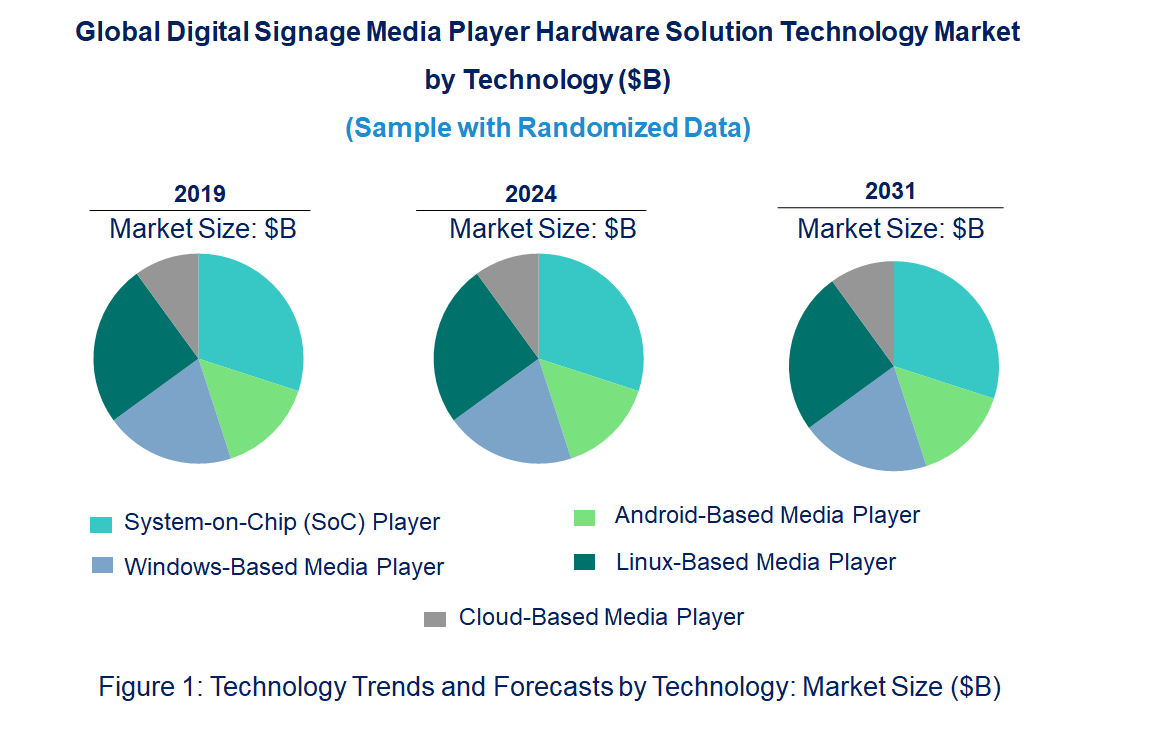
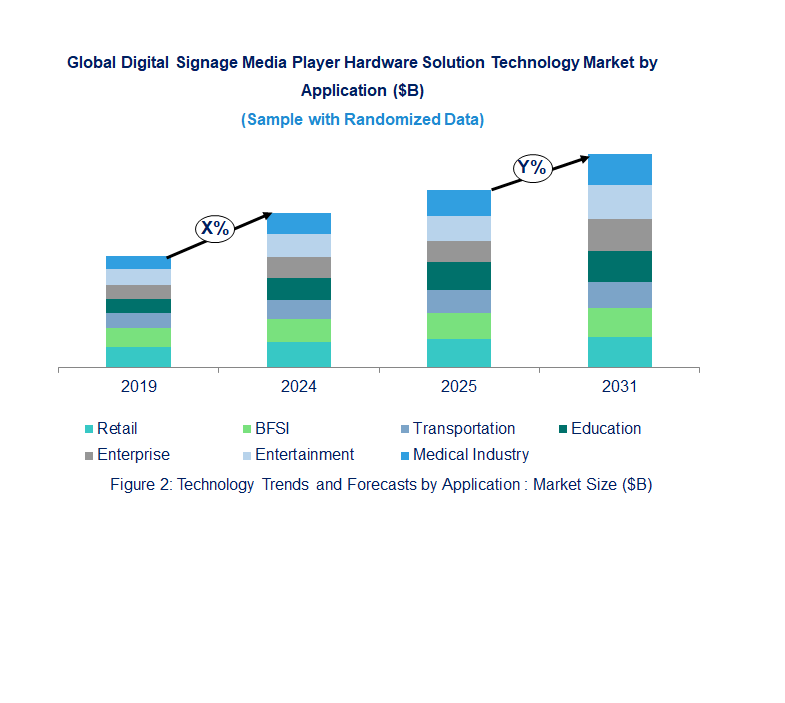
• System-on-Chip (SoC) Integration: SoC technology integrates the media player directly into the display, reducing hardware complexity and enhancing reliability.
• Cloud-Based Content Management: Cloud platforms enable remote management and real-time updates across multiple displays, improving scalability and operational efficiency.
• Artificial Intelligence (AI) and Machine Learning (ML) Integration: AI and ML technologies allow for personalized content delivery based on audience behavior and demographics.
• Touchless and Interactive Displays: Gesture recognition and voice control technologies are incorporated to enhance user engagement and hygiene standards.
• High-Resolution Displays (4K/8K): Adopting ultra-high-definition displays provides sharper and more vibrant visuals, attracting greater audience attention. These trends are collectively transforming the digital signage landscape, making systems more intelligent, user-friendly, and adaptable to various business needs.
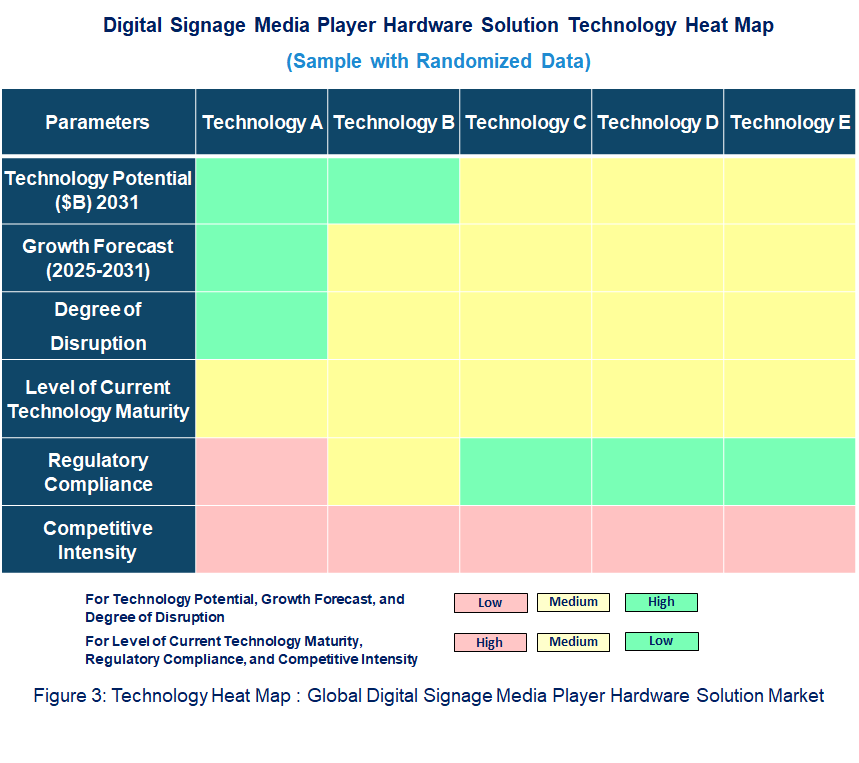
• Technology Potential: High. The integration of AI, cloud computing, and high-resolution displays offers vast opportunities for innovation and enhanced user experiences.
• Degree of Disruption: Moderate to High. Traditional hardware-based systems are being replaced by integrated solutions, leading to changes in deployment strategies and operational models.
• Level of Current Technology Maturity: High. Technologies like SoC integration and cloud-based management are well-established and widely adopted in the industry.
• Regulatory Compliance: Moderate. While there are no specific global regulations for digital signage hardware, compliance with general data protection and environmental standards is essential. These factors indicate a rapidly evolving market with substantial growth potential and a need for ongoing innovation and compliance.
• BrightSign: Launched the Series 5 media players featuring improved processing power and robust cloud connectivity. These upgrades enhance remote management and support advanced digital signage applications.
• Advantech: Introduced ruggedized media players specifically designed for harsh industrial environments. Their durable build ensures reliable performance in challenging operational settings.
• AOPEN: Released compact media players optimized for space-constrained retail environments. These devices offer powerful performance while maintaining a small form factor ideal for kiosks and POS systems.
• IBASE: Focused on energy-efficient media players suitable for large-scale digital signage networks. These solutions reduce power consumption while maintaining performance and reliability.
• IAdea: Prioritized software integration to streamline content management across various platforms. Their solutions support seamless updates and synchronization in complex deployments.
• NEXCOM: Developed highly customizable media players tailored to different industry needs, from healthcare to transportation. Their modular approach allows for flexible system configurations.
• Broadsign: Enhanced its cloud-based digital signage platform to enable real-time content delivery. The updates improve scalability and campaign responsiveness across global networks. The digital signage hardware market is advancing toward smarter, more connected, and energy-efficient solutions. As key players focus on performance, adaptability, and integration, these innovations are set to redefine user experiences and operational efficiency across diverse sectors.
• Rising Demand for Real-Time Content Delivery: The shift toward real-time, dynamic content across industries—especially in retail and transportation—is driving the need for high-performance media players. Enhanced processing capabilities and cloud-based platforms empower businesses to adapt messaging instantly, increasing customer engagement and operational agility.
• Advancements in Cloud Integration: Cloud-connected media players allow centralized control and content distribution across multiple locations. This scalability reduces operational costs and simplifies updates, making cloud integration a cornerstone for large-scale deployments and global signage networks.
• Industry-Specific Customization: Media players are being tailored to meet sector-specific demands, such as rugged builds for industrial use or energy efficiency for enterprise networks. Customization supports better ROI by addressing unique operational environments and compliance requirements.
• Compact and Power-Efficient Hardware Designs: Smaller, more efficient players are enabling deployment in tight spaces and reducing power consumption. This is especially crucial in retail and smart city applications, where discreet installation and sustainability are key factors.
• Enhanced Software-Hardware Integration: Improved integration between software and hardware platforms ensures seamless content management, automated updates, and better device performance. This reduces technical friction and enables consistent, scalable content delivery across devices and locations. Key Market Challenges
• High Initial Costs: Despite long-term ROI benefits, the upfront cost of advanced media players and deployment infrastructure remains a barrier, particularly for small to mid-sized businesses.
• Security and Network Vulnerabilities: Increased cloud connectivity raises concerns around data security and system vulnerabilities. Protecting digital signage networks from cyber threats is becoming a growing priority.
• Hardware Compatibility and Fragmentation: A lack of universal standards can cause integration issues, especially in multi-vendor ecosystems. This challenge affects deployment speed and system interoperability. The digital signage media player hardware market is expanding through innovation and industry-focused customization. Cloud capabilities, real-time content needs, and efficient designs are powering growth. However, cost and security challenges must be addressed to maintain momentum. Overall, these opportunities are reshaping the market into a smarter, more connected ecosystem for digital communication.
• Brightsign
• Advantech
• Aopen
• lBase
• IAdea
• NEXCOM
• Technology Readiness by Technology Type: System-on-Chip players are highly mature for standardized deployments in retail and transportation, with low cost and moderate regulatory requirements, offering mid-to-high competitive performance. Android-based players are market-ready with broad hardware compatibility and active developer ecosystems, suited for dynamic advertising and menu boards, but must ensure compliance with privacy regulations. Windows-based media players are enterprise-ready with strong IT integration and cybersecurity standards, but face higher hardware demands and licensing costs. Linux-based players are technically mature with strong adaptability for industrial signage, but require in-house expertise for full deployment and face varying compliance based on distribution. Cloud-based media players are at the forefront of readiness, enabling remote updates, real-time analytics, and scalability across multiple verticals, though reliant on internet connectivity and stringent cloud security compliance. In terms of competition, cloud and Android platforms are the most contested due to vendor variety. Windows dominates in compliance-heavy sectors. SoC and Linux lead in cost-sensitive or customizable applications.
• Competitive Intensity and Regulatory Compliance: System-on-Chip players face moderate competition but are rapidly gaining traction among OEMs, though compliance with international hardware standards is necessary. Android-based media players operate in a highly competitive, fragmented market with diverse vendors and must adhere to Google’s licensing and data privacy frameworks. Windows-based media players are backed by Microsoft, offering strong enterprise-grade compliance and support, though facing reduced innovation speed. Linux-based players are gaining ground due to open-source flexibility but have varying compliance standards based on distribution. Cloud-based media players are experiencing the fiercest competition from global SaaS providers, with high scrutiny for GDPR, HIPAA, and SOC 2 compliance. Competition is intensifying due to demand for centralized content control and scalability. Market leaders must balance innovation with strict adherence to global cybersecurity and data protection regulations. Open-source and proprietary ecosystems influence the regulatory alignment and competitive edge for each technology.
• Disruption Potential by Technology Type: System-on-Chip (SoC) players have high disruption potential due to their integration, cost efficiency, and minimal maintenance needs. Android-based media players offer flexibility, rapid innovation, and broad developer support, driving market adoption. Windows-based players provide legacy system integration and enterprise security, though with higher costs and complexity. Linux-based players offer open-source adaptability and low cost, but demand technical know-how for customization. Cloud-based media players present the highest disruption through remote management, scalability, and real-time content control. Each technology is reshaping deployment models, with cloud and SoC players leading due to simplicity, cost benefits, and scalability. The rise of edge computing also enhances SoC and cloud integration. Android and Linux offer agile platforms suited to retail and advertising. Windows remains strong in corporate environments requiring IT standardization. The convergence of AI and content analytics further enhances cloud and SoC potential. Overall, the market is shifting toward lighter, integrated, and remotely managed solutions.
• System-on-Chip (SoC) Player
• Android-Based Media Player
• Windows-Based Media Player
• Linux-Based Media Player
• Cloud-Based Media Player
• Retail
• BFSI
• Transportation
• Education
• Enterprise
• Entertainment
• Medical Industry
• Hospitality
• Others
• North America
• Europe
• Asia Pacific
• The Rest of the World
• Latest Developments and Innovations in the Digital Signage Media Player Hardware Solution Technologies
• Companies / Ecosystems
• Strategic Opportunities by Technology Type


Choose a license that fits your team. Instant PDF delivery.
Prices exclude taxes. Instant delivery. Custom licensing available on request.
Market Report · May 18, 2026
Market Report · May 18, 2026
Market Report · May 18, 2026
Trusted partner for strategic intelligence and business growth


Receive a complimentary market analysis tailored to your industry. Our analysts will identify key growth opportunities and competitive dynamics specific to your business.

Market size, growth rate, and key trend analysis for your specific sector.

Top competitor positioning and market share analysis.

Strategic recommendations backed by data-driven insights.
Get curated market intelligence and competitive moves straight to your inbox.
By subscribing, you agree to receive our monthly insights. Unsubscribe anytime.
Receive a complimentary market analysis tailored to your industry. Our analysts will identify key growth opportunities and competitive dynamics specific to your business.
Market size, growth rate, and key trend analysis for your specific sector.
Top competitor positioning and market share analysis.
Strategic recommendations backed by data-driven insights.
Get curated market intelligence, emerging trends, and competitive moves straight to your inbox each month.
By subscribing, you agree to receive our monthly insights. Unsubscribe anytime.
We'll send your sample report shortly.