
Digital Radar Market Report: Trends, Forecast and Competitive Analysis to 2035

Key data points: The market size in 2035 = $39 billion, growth forecast = 17.7% annually for the next 8 years. Scroll below to get more insights. This market report covers trends, opportunities and forecasts in digital radar market to 2035 by type (active and passive), dimension type (2d & 3d and 4d), application (safety, security & surveillance, and others), end use (automotive, aerospace, military & defense, and others), and region (North America, Europe, Asia Pacific, and the Rest of the World)

Publisher: Lucintel Last Updated: July 2026
See Pricing

Download Sample Report

| ✨ New Download Sample report — Get instant insights! | ✨ New Download Sample report — Get instant insights!

Digital Radar Market Report: Trends, Forecast and Competitive Analysis to 2035

Digital Radar Market

The future of the global digital radar market looks promising with opportunities in the automotive, aerospace, and military & defense markets. The global digital radar market is expected to reach an estimated $39 billion by 2035 with a CAGR of 17.7% from 2026 to 2035. The major drivers for this market are the increasing demand for advanced signal processing capabilities, the rising adoption of modern defense radar systems, and the growing need for high-accuracy detection solutions.

  • Lucintel forecasts that, within the type category, active is expected to witness higher growth over the forecast period due to higher accuracy and real-time target detection capabilities.
  • Within the end use category, military & defense is expected to witness the highest growth due to increasing adoption of advanced surveillance and targeting systems.
  • In terms of regions, APAC is expected to witness the highest growth over the forecast period due to rising defense modernization and radar deployment programs.

Gain valuable insights for your business decisions with our comprehensive 150+ page report. Sample figures with some insights are shown below.
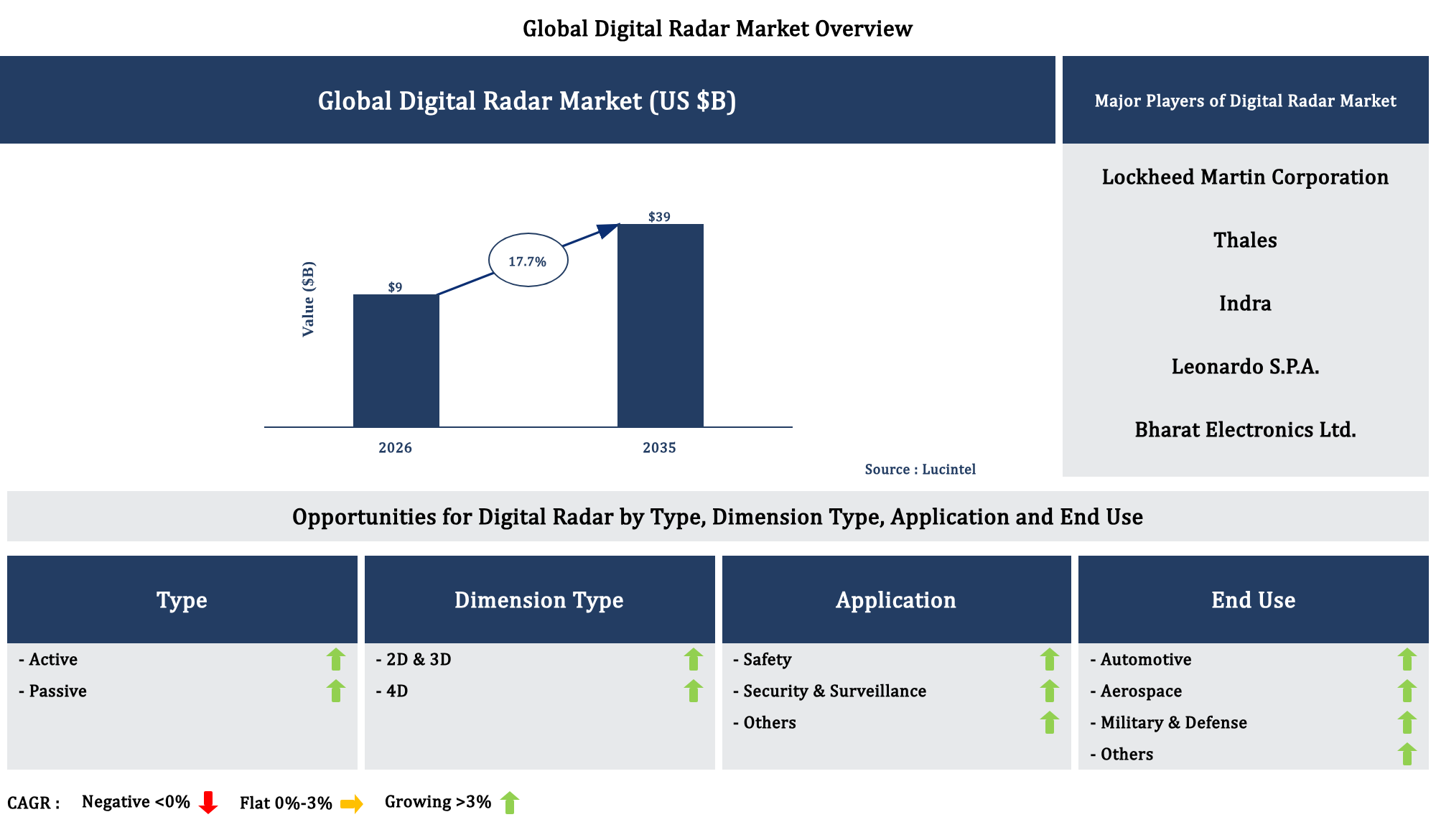
Digital Radar Market

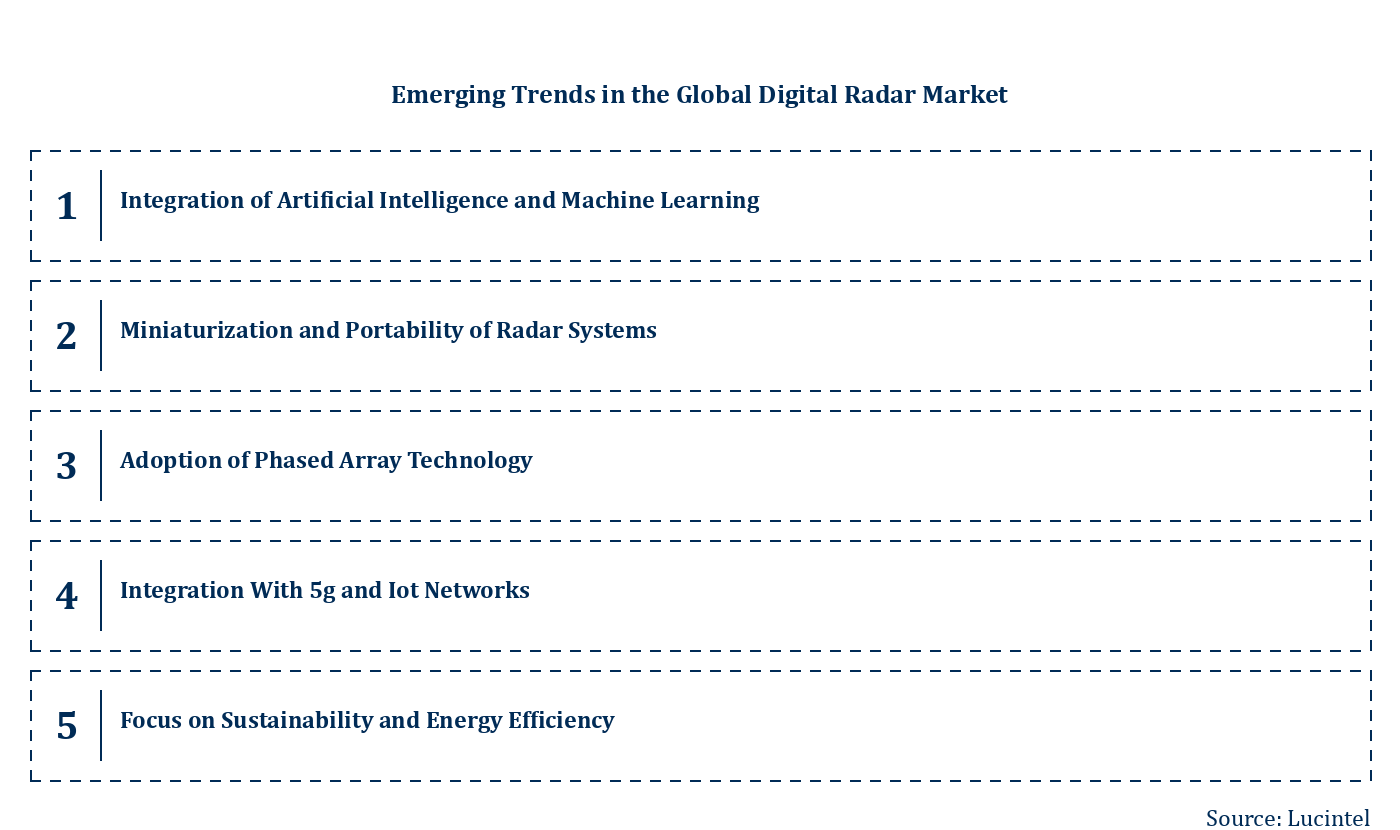
Emerging Trends in the Digital Radar Market

The digital radar market is experiencing rapid evolution driven by technological advancements, increasing demand for precision detection, and the integration of digital solutions across various sectors. As industries such as defense, automotive, aviation, and maritime adopt digital radar systems, new trends are emerging that are transforming the landscape. These developments are enhancing performance, reducing costs, and enabling smarter, more connected systems. Understanding these key trends is essential for stakeholders to capitalize on opportunities and stay competitive in this dynamic market environment.

  • Integration of Artificial Intelligence and Machine Learning: The incorporation of AI and ML algorithms into digital radar systems is revolutionizing data processing and target recognition. These technologies enable real-time analysis, improve accuracy, and facilitate predictive maintenance. AI-driven radars can adapt to changing environments, reduce false alarms, and enhance decision-making capabilities. This trend is particularly impactful in defense and autonomous vehicle applications, where rapid, precise responses are critical. As AI integration deepens, digital radars will become more autonomous, efficient, and capable of handling complex scenarios with minimal human intervention.
  • Miniaturization and Portability of Radar Systems: Advances in materials and electronic components are leading to smaller, lightweight radar units without compromising performance. Portable and compact radars are increasingly used in applications such as drone detection, mobile surveillance, and personal safety devices. This miniaturization expands deployment options, especially in remote or hard-to-reach areas, and reduces overall system costs. The trend enhances flexibility and enables new use cases, including handheld devices and wearable systems, broadening the market scope and fostering innovation in various sectors.
  • Adoption of Phased Array Technology: Phased array radars are gaining prominence due to their rapid beam steering capabilities and high-resolution imaging. These systems offer electronic scanning without moving parts, resulting in faster response times and improved reliability. They are widely adopted in military, aerospace, and weather monitoring applications. The technologys ability to track multiple targets simultaneously and adapt to dynamic environments makes it a preferred choice for advanced defense systems and air traffic management. As phased array technology matures, it is expected to drive significant improvements in radar performance and operational efficiency.
  • Integration with 5G and IoT Networks: The convergence of digital radar systems with 5G and Internet of Things (IoT) networks is creating interconnected, smart sensing environments. This integration allows for real-time data sharing, remote monitoring, and enhanced situational awareness across various sectors. In smart cities, for example, radar data can be combined with other sensors to improve traffic management and security. In defense, connected radars enable coordinated surveillance and faster response times. This trend is fostering the development of intelligent, networked radar ecosystems that enhance operational capabilities and enable new business models.
  • Focus on Sustainability and Energy Efficiency: As environmental concerns grow, the market is shifting towards energy-efficient radar systems that reduce power consumption and environmental impact. Innovations include low-power electronics, improved antenna designs, and energy harvesting techniques. These sustainable radars are particularly important for remote or off-grid applications, such as maritime surveillance and environmental monitoring. The focus on sustainability not only aligns with global environmental goals but also reduces operational costs and extends system lifespan. This trend is shaping the market towards greener, more responsible technological solutions.

These emerging trends are collectively reshaping the digital radar market by enhancing system capabilities, expanding application areas, and promoting sustainable practices. The integration of AI and miniaturization are making radars smarter and more portable, while phased array technology improves speed and resolution. The convergence with 5G and IoT networks is creating interconnected sensing ecosystems, and a focus on energy efficiency aligns with global sustainability goals. Together, these developments are driving innovation, increasing market competitiveness, and opening new opportunities across defense, automotive, aerospace, and civil sectors.
Digital Radar Market by country

Recent Developments in the Digital Radar Market

The digital radar market is experiencing rapid advancements driven by technological innovations and increasing demand across various sectors. These developments are transforming how industries monitor, detect, and analyze signals, leading to enhanced accuracy, efficiency, and operational capabilities. As the market evolves, key opportunities are emerging that promise to reshape the landscape, offering new avenues for growth and competitive advantage. Stakeholders are focusing on integrating advanced features to meet the rising needs of defense, aviation, and weather forecasting sectors.

  • Growing Adoption of Phased Array Radars: The increasing deployment of phased array radars enhances target detection and tracking capabilities. These radars offer rapid beam steering, high resolution, and multi-target tracking, making them ideal for defense and air traffic management. Their ability to operate in cluttered environments improves situational awareness, leading to better decision-making. As governments and industries seek more reliable surveillance systems, the adoption of phased array technology is expected to accelerate, boosting market growth significantly.
  • Integration of Artificial Intelligence in Radar Systems: AI integration is revolutionizing digital radar functionalities by enabling real-time data processing, pattern recognition, and predictive analytics. This advancement improves detection accuracy, reduces false alarms, and enhances operational efficiency. AI-powered radars are increasingly used in autonomous vehicles, military applications, and weather forecasting, providing smarter and more adaptive solutions. The adoption of AI is expected to drive innovation, reduce operational costs, and expand the market scope for advanced radar systems.
  • Expansion of Weather Monitoring and Forecasting: Enhanced digital radars are playing a crucial role in weather monitoring, providing high-resolution data for accurate forecasting. These radars improve storm tracking, precipitation measurement, and climate modeling, which are vital for disaster preparedness and resource management. The growing need for precise weather data in agriculture, aviation, and emergency services is fueling investments in advanced radar technology. This expansion is expected to create new market segments and increase demand for specialized weather radars globally.
  • Development of Compact and Portable Radar Systems: The demand for lightweight, portable radars is rising across military, aviation, and maritime sectors. These compact systems offer flexibility, quick deployment, and cost-effectiveness without compromising performance. Innovations in miniaturization and power efficiency are enabling new applications such as drone-based surveillance and mobile defense units. The market for portable radars is projected to grow as organizations seek versatile solutions for dynamic operational environments, expanding the overall market reach and application scope.
  • Advancements in Signal Processing and Data Analytics: Cutting-edge signal processing techniques and data analytics are enhancing radar performance by enabling better clutter suppression, target identification, and data interpretation. These advancements facilitate higher resolution imaging and more accurate threat detection. They are crucial for defense, aerospace, and security applications, where precision is paramount. As these technologies mature, they will enable more sophisticated, reliable, and scalable radar systems, fostering innovation and opening new revenue streams within the digital radar market.

The overall impact of these developments is significantly transforming the digital radar market by increasing technological capabilities, expanding application areas, and improving operational efficiency. These opportunities are attracting investments, fostering innovation, and driving competitive dynamics, ultimately leading to a more robust and versatile market landscape.

Strategic Growth Opportunities in the Digital Radar Market

The digital radar market is experiencing rapid expansion driven by technological advancements and increasing demand across various sectors such as defense, automotive, and aerospace. Innovations in signal processing, miniaturization, and integration with other sensor systems are creating new opportunities for growth. Market players are focusing on developing more accurate, reliable, and cost-effective radar solutions to meet diverse application needs. This evolving landscape offers significant potential for strategic investments and product development to capture emerging market segments.

  • Growing Adoption of Digital Radar in Defense and Military Applications: Digital radar systems are increasingly adopted in defense for surveillance, missile guidance, and battlefield awareness. Enhanced detection capabilities, resistance to jamming, and real-time data processing make digital radars vital for modern military operations. Governments are investing heavily in upgrading existing systems and deploying advanced digital radars, creating substantial growth opportunities for manufacturers. Sub-segments include phased array radars, AESA radars, and multi-mission systems, which are gaining prominence due to their superior performance.
  • Expansion of Automotive Radar for Advanced Driver Assistance Systems (ADAS): The automotive industry is rapidly integrating digital radar for collision avoidance, adaptive cruise control, and autonomous driving. These radars offer high-resolution detection of objects and precise distance measurement, essential for vehicle safety and automation. Increasing regulatory mandates and consumer demand for safety features are fueling growth. Sub-segments such as short-range, medium-range, and long-range automotive radars are witnessing significant investments, with a focus on miniaturization and cost reduction to enable mass adoption.
  • Increasing Use of Digital Radar in Aerospace and Space Exploration: Digital radar systems are crucial for aircraft navigation, weather monitoring, and space exploration missions. They provide high-resolution imaging, obstacle detection, and tracking capabilities in complex environments. The demand for lightweight, energy-efficient radars is rising in satellite and drone applications. Innovations in phased array and synthetic aperture radar (SAR) technologies are expanding the scope of aerospace applications, offering opportunities for defense agencies, commercial space companies, and research institutions to enhance operational efficiency.
  • Rising Demand for Weather and Environmental Monitoring Radars: Digital radars are essential for accurate weather forecasting, climate monitoring, and disaster management. They enable detailed precipitation analysis, wind profiling, and storm tracking. The need for real-time data and improved accuracy is driving investments in advanced Doppler and polarimetric radars. Sub-segments include ground-based, airborne, and marine radars, each serving specific environmental monitoring needs. Growing concerns over climate change and extreme weather events are further accelerating market growth in this segment.
  • Development of Multi-Function and Integrated Radar Systems: The trend toward multi-function radars that combine surveillance, tracking, and communication capabilities is gaining momentum. These integrated systems reduce size, weight, and power consumption while enhancing operational versatility. They are increasingly used in defense, aviation, and maritime sectors. Advances in digital signal processing and AI integration are enabling smarter radars capable of adaptive targeting and threat detection. This convergence of functionalities opens new avenues for comprehensive situational awareness and strategic advantage across multiple industries.

These growth opportunities are poised to significantly influence the digital radar market by fostering innovation, expanding application domains, and enhancing system capabilities. As technological advancements continue and demand for high-performance radar solutions grows, market players are positioned to capitalize on emerging segments. This dynamic environment promises sustained growth, increased competitiveness, and the development of more sophisticated, versatile radar systems that meet the evolving needs of defense, automotive, aerospace, and environmental sectors.

Digital Radar Market Drivers and Challenges

The digital radar market is influenced by a variety of technological, economic, and regulatory factors that shape its growth trajectory. Advances in digital signal processing, miniaturization, and integration have enhanced radar capabilities, enabling more precise and reliable detection systems. Economic factors such as increased defense budgets and the rising demand for air traffic management solutions further propel market expansion. Regulatory frameworks around safety standards and spectrum management also play a crucial role in shaping product development and deployment. However, the market faces challenges including high development costs, technological complexity, and regulatory hurdles that could impede growth. Understanding these drivers and challenges is essential for stakeholders to navigate the evolving landscape effectively.

The factors responsible for driving the digital radar market include:

  • Technological Innovation: The rapid development of digital signal processing, phased array technology, and AI integration has significantly improved radar accuracy, range, and reliability. These innovations enable real-time data processing and adaptive targeting, which are critical for defense, aviation, and maritime applications. As technology continues to evolve, digital radars are becoming more compact, energy-efficient, and capable of multi-functionality, thus expanding their application scope and market potential.
  • Increasing Defense Spending: Governments worldwide are increasing their defense budgets to modernize military capabilities. Digital radars are integral to modern warfare, providing advanced surveillance, missile guidance, and threat detection. This surge in defense expenditure directly correlates with higher procurement of cutting-edge radar systems, fueling market growth and encouraging innovation within the industry.
  • Growing Air Traffic Management Needs: The exponential rise in air traffic necessitates advanced radar systems for efficient airspace management. Digital radars offer enhanced tracking accuracy, better weather detection, and reduced false alarms, which are vital for safety and operational efficiency. This demand from civil aviation authorities and airports worldwide is a significant driver for market expansion.
  • Regulatory Support and Spectrum Management: Governments and international agencies are establishing regulations to optimize spectrum allocation and ensure safety standards. These regulatory frameworks promote the adoption of digital radar systems that comply with international norms, fostering market growth. Additionally, policies encouraging technological innovation and defense modernization further support industry development.
  • Integration of AI and Big Data Analytics: The incorporation of artificial intelligence and big data analytics into digital radar systems enhances threat detection, predictive maintenance, and operational efficiency. This integration allows for smarter, more autonomous systems capable of handling complex scenarios, thereby opening new avenues for market expansion and technological leadership.

The challenges in the digital radar market are:

  • High Development and Manufacturing Costs: Developing advanced digital radar systems requires significant investment in research, specialized components, and manufacturing facilities. These high costs can limit entry for smaller players and slow down innovation, potentially restricting market growth. Additionally, the need for continuous upgrades to keep pace with technological advancements adds to financial burdens.
  • Technological Complexity and Integration Issues: Digital radar systems involve complex hardware and software integration, which can lead to compatibility issues and increased development time. Ensuring seamless operation across different platforms and environments is challenging, potentially delaying deployment and increasing costs. This complexity also demands specialized expertise, which may be scarce.
  • Regulatory and Spectrum Allocation Challenges: Navigating the complex regulatory landscape and securing spectrum licenses can be time-consuming and costly. Variations in regulations across countries create barriers to international market expansion. Spectrum congestion and interference issues further complicate deployment, especially in densely populated or highly regulated regions, hindering rapid adoption.

The digital radar market is driven by technological advancements, increased defense and civil aviation investments, and supportive regulatory frameworks. However, high costs, technological complexity, and regulatory hurdles pose significant challenges. These factors collectively influence the pace and direction of market growth, requiring stakeholders to innovate strategically and navigate regulatory landscapes effectively. Overall, the markets future depends on balancing these drivers and overcoming challenges to harness the full potential of digital radar technologies.

List of Digital Radar Market Companies

Companies in the market compete on the basis of product quality offered. Major players in this market focus on expanding their manufacturing facilities, R&D investments, infrastructural development, and leverage integration opportunities across the value chain. Through these strategies digital radar market companies cater increasing demand, ensure competitive effectiveness, develop innovative products & technologies, reduce production costs, and expand their customer base. Some of the digital radar market companies profiled in this report include-

  • Lockheed Martin Corporation
  • Thales
  • Indra
  • Leonardo S.P.A.
  • Bharat Electronics Ltd.
  • Advanced Micro Devices Inc.
  • Magna International Inc.
  • Saab AB
  • Uhnder
  • NXP Semiconductors

Digital Radar Market by Segment

The study includes a forecast for the global digital radar market by type, dimension type, application, end use, and region.

  • Digital Radar Market by Type [Value from 2019 to 2035]:
    • Active
    • Passive
  • Digital Radar Market by Dimension Type [Value from 2019 to 2035]:
    • 2D & 3D
    • 4D
  • Digital Radar Market by Application [Value from 2019 to 2035]:
    • Safety
    • Security & Surveillance
    • Others
  • Digital Radar Market by End Use [Value from 2019 to 2035]:
    • Automotive
    • Aerospace
    • Military & Defense
    • Others
  • Digital Radar Market by Region [Value from 2019 to 2035]:
    • North America
    • Europe
    • Asia Pacific
    • The Rest of the World

Country Wise Outlook for the Digital Radar Market

The digital radar market has experienced rapid growth driven by technological advancements, increasing defense and security needs, and expanding applications in automotive, aviation, and maritime sectors. Countries are investing heavily in research and development to enhance radar capabilities, improve accuracy, and integrate AI and machine learning for smarter systems. The market's evolution reflects a global push toward more sophisticated, reliable, and versatile radar solutions to meet emerging challenges and opportunities across various industries. This dynamic landscape is marked by strategic collaborations, government initiatives, and innovation-driven investments, shaping the future of digital radar technology worldwide.

  • United States: The US leads in digital radar innovation with significant investments in defense and aerospace sectors. Recent developments include advancements in phased-array radar systems, integration of AI for threat detection, and increased deployment of automotive radar for autonomous vehicles. The government’s focus on national security has spurred R&D efforts, resulting in cutting-edge solutions for military applications and civilian use. Collaborations between tech giants and defense agencies are accelerating the adoption of next-generation radar technologies.
  • China: China has made substantial progress in digital radar technology, emphasizing military modernization and civilian applications. Recent developments include the deployment of advanced phased-array radars for missile defense and air traffic management. The country is also investing in automotive radar systems to support its rapidly growing electric vehicle industry. Government initiatives aim to enhance indigenous capabilities, with a focus on integrating AI and 5G connectivity into radar systems to improve performance and interoperability.
  • Germany: Germany is focusing on enhancing radar systems for automotive safety, defense, and maritime security. Recent advancements include the development of high-resolution automotive radars for autonomous driving and the integration of digital radar with sensor fusion technologies. The country’s strong industrial base and collaborations with European partners are fostering innovation in radar signal processing and miniaturization. Germany is also investing in maritime radar systems to bolster security along its coastlines and in international waters.
  • India: India is rapidly advancing its digital radar capabilities to strengthen defense and civilian sectors. Recent developments include the deployment of advanced surveillance radars for border security and the development of indigenous phased-array radar systems. The government’s "Make in India" initiative promotes local manufacturing and innovation in radar technology. India is also exploring applications in traffic management and disaster monitoring, with a focus on affordable, scalable solutions to meet domestic needs.
  • Japan: Japan is emphasizing the integration of digital radar in defense, transportation, and disaster management. Recent advancements include the deployment of sophisticated maritime radars for security and navigation, as well as automotive radars for autonomous vehicles. The country is investing in AI-enabled radar systems to improve detection accuracy and response times. Japan’s focus on disaster resilience has led to innovations in radar-based early warning systems for earthquakes and tsunamis, enhancing safety and preparedness.

Features of the Digital Radar Market

  • Market Size Estimates: Digital radar market size estimation in terms of value ($B).
  • Trend and Forecast Analysis: Market trends (2019 to 2025) and forecast (2026 to 2035) by various segments and regions.
  • Segmentation Analysis: Digital radar market size by various segments, such as by type, dimension type, application, end use, and region in terms of value ($B).
  • Regional Analysis: Digital radar market breakdown by North America, Europe, Asia Pacific, and Rest of the World.
  • Growth Opportunities: Analysis of growth opportunities in different types, dimension types, applications, end uses, and regions for the digital radar market.
  • Strategic Analysis: This includes M&A, new product development, and competitive landscape of the digital radar market.
  • Analysis of competitive intensity of the industry based on Porter’s Five Forces model.

Top 5 Companies

  • Lockheed Martin Corporation
  • Thales
  • Indra
  • Leonardo S.P.A.
  • Bharat Electronics Ltd.

Table of Contents

1. Executive Summary
15.1 Competitive Analysis Overview

List of Figures

List of Tables

Methodology

Lucintel has been in the business of market research and management consulting since 2000 and has published over 1000 market intelligence reports in various markets / applications and served over 1,000 clients worldwide. This study is a culmination of four months of full-time effort performed by Lucintel's analyst team. The analysts used the following sources for the creation and completion of this valuable report:

  • In-depth interviews of the major players in this market
  • Detailed secondary research from competitors' financial statements and published data
  • Extensive searches of published works, market, and database information pertaining to industry news, company press releases, and customer intentions
  • A compilation of the experiences, judgments, and insights of Lucintel's professionals, who have analyzed and tracked this market over the years.

Extensive research and interviews are conducted across the supply chain of this market to estimate market share, market size, trends, drivers, challenges, and forecasts. Below is a brief summary of the primary interviews that were conducted by job function for this report.

Lucintel's methodology for market research

Thus, Lucintel compiles vast amounts of data from numerous sources, validates the integrity of that data, and performs a comprehensive analysis. Lucintel then organizes the data, its findings, and insights into a concise report designed to support the strategic decision-making process. The figure below is a graphical representation of Lucintel's research process.

Primary interviews by job function

Buy Now

Choose a license that fits your team. Instant PDF delivery.

Market Report

1 User PDF

$4,850
Buy Now

Market Report

2-5 Users PDF

$6,700
Buy Now

Market Report

Corporate PDF

$8,850
Buy Now

Market Report

Global PDF

$10,000
Buy Now

Prices exclude taxes. Instant delivery. Custom licensing available on request.

Frequently Asked Questions

What is the digital radar market size?
The global digital radar market is expected to reach an estimated $39 billion by 2035.
What is the growth forecast for digital radar market?
The global digital radar market is expected to grow with a CAGR of 17.7% from 2026 to 2035.
What are the major drivers influencing the growth of the digital radar market?
The major drivers for this market are the increasing demand for advanced signal processing capabilities, the rising adoption of modern defense radar systems, and the growing need for high accuracy detection solutions.
What are the major segments for digital radar market?
The future of the digital radar market looks promising with opportunities in the automotive, aerospace, and military & defense markets.
Who are the key digital radar market companies?

Some of the key digital radar companies are as follows:

  • Lockheed Martin Corporation
  • Thales
  • Indra
  • Leonardo S.P.A.
  • Bharat Electronics Ltd.
  • Advanced Micro Devices Inc.
  • Magna International Inc.
  • Saab AB
  • Uhnder
  • NXP Semiconductors
Which digital radar market segment will be the largest in future?
Lucintel forecasts that, within the type category, active is expected to witness higher growth over the forecast period.
In digital radar market, which region is expected to be the largest in next 8 years?
In terms of region, APAC is expected to witness the highest growth over the forecast period.
Do we receive customization in this report?
Yes, Lucintel provides 10% customization without any additional cost.

Key Questions

  • What are some of the most promising, high-growth opportunities for the digital radar market by type (active and passive), dimension type (2d & 3d and 4d), application (safety, security & surveillance, and others), end use (automotive, aerospace, military & defense, and others), and region (North America, Europe, Asia Pacific, and the Rest of the World)?
  • Which segments will grow at a faster pace and why?
  • Which region will grow at a faster pace and why?
  • What are the key factors affecting market dynamics? What are the key challenges and business risks in this market?
  • What are the business risks and competitive threats in this market?
  • What are the emerging trends in this market and the reasons behind them?
  • What are some of the changing demands of customers in the market?
  • What are the new developments in the market? Which companies are leading these developments?
  • Who are the major players in this market? What strategic initiatives are key players pursuing for business growth?
  • What are some of the competing products in this market and how big of a threat do they pose for loss of market share by material or product substitution?
  • What M&A activity has occurred in the last 5 years and what has its impact been on the industry?
Why Choose Us

The Lucintel Advantage

Trusted partner for strategic intelligence and business growth

25+ Years Excellence

25+ Years Excellence

Quarter century of proven expertise in management consulting and market research across global markets.
Game-Changer Ideas

Game-Changer Ideas

Innovative strategies and actionable insights that help clients become the smartest in their industry.
Global Reach

Global Reach

Extensive coverage across 50+ industries and markets worldwide with localized expertise.
Start Your Growth Journey

Get Your Free
Market Intelligence
Briefing

Receive a complimentary market analysis tailored to your industry. Our analysts will identify key growth opportunities and competitive dynamics specific to your business.

Custom Market Snapshot

Market size, growth rate, and key trend analysis for your specific sector.

Competitive Landscape Overview

Top competitor positioning and market share analysis.

Growth Opportunity Identification

Strategic recommendations backed by data-driven insights.

Subscribe

Subscribe to our Newsletter

Get curated market intelligence and competitive moves straight to your inbox.

By subscribing, you agree to receive our monthly insights. Unsubscribe anytime.

Industry Trends Market Signals Opportunities Competitor Moves