
Market Report · July 31, 2026

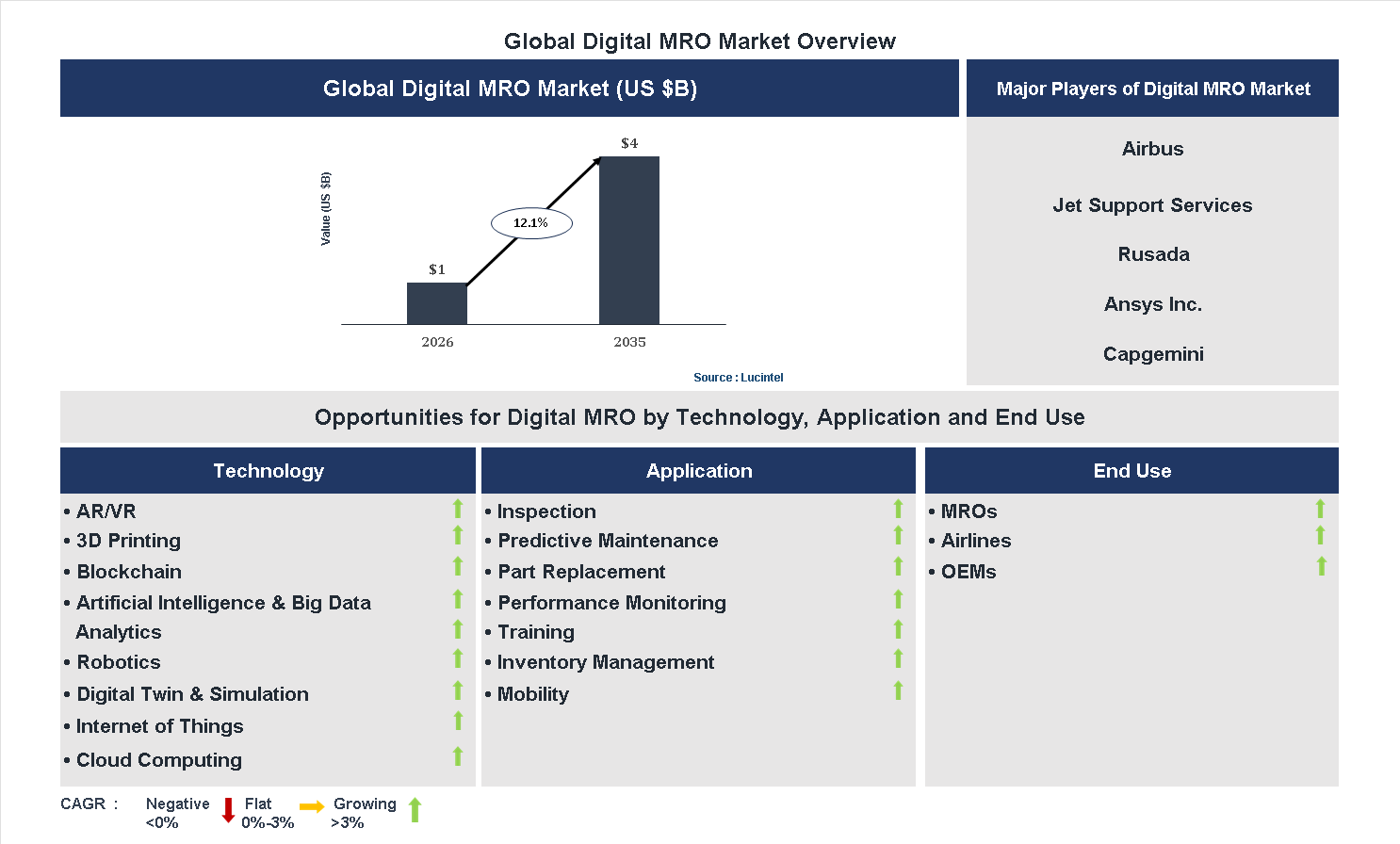
Key data points: The market size in 2035 = $4 billion, growth forecast = 12.1% annually for the next 8 years. Scroll below to get more insights. This market report covers trends, opportunities and forecasts in digital MRO market to 2035 by technology (AR/VR, 3D printing, blockchain, artificial intelligence & big data analytics, robotics, digital twin & simulation, internet of things, and cloud computing), application (inspection, predictive maintenance, part replacement, performance monitoring, training, inventory management, and mobility), end use (MROs, airlines, and OEMs), and region (North America, Europe, Asia Pacific, and the Rest of the World)
We'll send your sample report shortly.
• Lucintel forecasts that, within the technology category, AR/VR is expected to witness the highest growth over the forecast period.
• Within the application category, predictive maintenance is expected to witness the highest growth.
• In terms of region, APAC is expected to witness the highest growth over the forecast period. Gain valuable insights for your business decisions with our comprehensive 150+ page report. Sample figures with some insights are shown below.
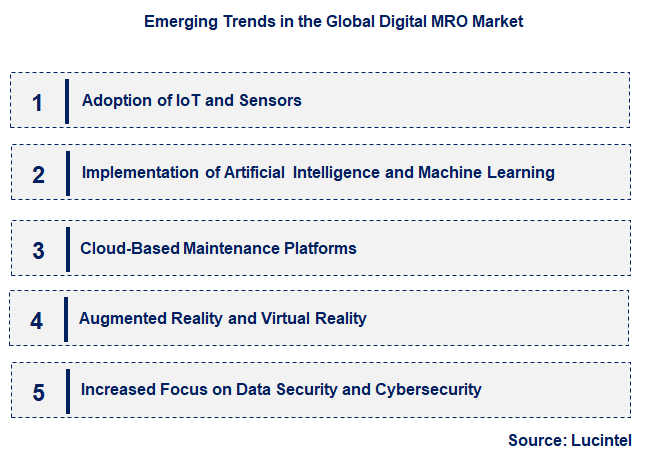
• Adoption of IoT and Sensors: The integration of Internet of Things (IoT) devices and sensors into MRO processes allows real-time monitoring of equipment health. This trend enables predictive maintenance, reducing downtime and preventing costly failures. IoT sensors collect data on temperature, vibration, and other parameters, providing actionable insights. As a result, companies can shift from reactive to proactive maintenance strategies, improving asset longevity and operational efficiency. The widespread adoption of IoT is transforming traditional maintenance practices into data-driven, predictive models, significantly impacting cost savings and operational reliability.
• Implementation of Artificial Intelligence and Machine Learning: AI and ML algorithms are increasingly used to analyze vast amounts of maintenance data. These technologies facilitate predictive analytics, anomaly detection, and decision-making automation. AI-driven insights help identify potential issues before they escalate, optimize maintenance schedules, and allocate resources more effectively. This trend enhances accuracy and reduces human error, leading to more efficient maintenance workflows. As AI and ML become more sophisticated, their integration into digital MRO solutions is expected to revolutionize asset management and maintenance planning, boosting overall productivity.
• Cloud-Based Maintenance Platforms: Cloud technology is enabling centralized, accessible, and scalable MRO solutions. Cloud platforms facilitate real-time data sharing, collaboration, and remote management of maintenance activities. They also support integration with other enterprise systems such as ERP and supply chain management. This trend reduces infrastructure costs, enhances data security, and improves operational agility. Cloud-based platforms enable faster decision-making and streamline workflows, making maintenance operations more flexible and responsive to changing business needs. The shift to cloud solutions is a key driver of digital transformation in the MRO market.
• Augmented Reality and Virtual Reality: AR and VR technologies are increasingly used for training, remote assistance, and maintenance procedures. AR overlays digital information onto physical equipment, guiding technicians through complex tasks with enhanced accuracy. VR provides immersive training environments, reducing the need for physical resources and minimizing errors. These technologies improve workforce skills, reduce downtime, and enhance safety. As AR and VR become more affordable and sophisticated, their adoption is expected to grow, transforming traditional maintenance training and support practices into more interactive and efficient processes.
• Increased Focus on Data Security and Cybersecurity: As digital MRO solutions become more prevalent, protecting sensitive maintenance data and operational systems is critical. Cybersecurity measures are being integrated into digital platforms to prevent data breaches, hacking, and cyber-attacks. This trend emphasizes the importance of secure data transmission, user authentication, and compliance with industry standards. Strengthening cybersecurity not only safeguards assets but also builds trust among stakeholders. As digital MRO solutions expand, ongoing investments in cybersecurity are essential to ensure the integrity and resilience of maintenance operations in an increasingly connected environment. These emerging trends are fundamentally reshaping the digital MRO market by fostering smarter, more efficient, and secure maintenance practices. The integration of IoT, AI, cloud computing, AR/VR, and cybersecurity is driving a digital revolution that enhances operational performance, reduces costs, and creates new opportunities for innovation. As these trends continue to evolve, they will enable organizations to achieve higher levels of reliability, agility, and competitiveness in the dynamic landscape of maintenance and asset management.
• Growing Adoption of IoT and Sensors: The integration of IoT devices and sensors in MRO processes allows real-time data collection and monitoring, leading to predictive maintenance. This reduces downtime, enhances asset lifespan, and minimizes operational costs. The ability to anticipate failures before they occur improves safety and reliability, making IoT a critical component of digital transformation in MRO. As industries increasingly adopt these technologies, market growth accelerates, creating new revenue streams and competitive advantages.
• Implementation of Artificial Intelligence and Machine Learning: AI and ML algorithms analyze vast amounts of maintenance data to optimize scheduling, diagnostics, and inventory management. These technologies enable predictive analytics, reducing unplanned outages and maintenance costs. They also facilitate autonomous decision-making, improving operational efficiency. The adoption of AI-driven solutions is transforming traditional MRO practices, leading to smarter maintenance strategies and fostering innovation within the industry, thus expanding market opportunities.
• Expansion of Cloud-Based Maintenance Platforms: Cloud technology offers scalable, accessible, and cost-effective solutions for managing MRO activities. Cloud platforms enable centralized data storage, real-time collaboration, and remote monitoring, enhancing operational transparency and efficiency. They facilitate seamless integration of various systems and devices, supporting data-driven decision-making. As companies seek flexible and efficient maintenance solutions, cloud-based platforms are becoming essential, driving market growth and enabling widespread digital transformation in MRO.
• Increasing Focus on Data Analytics and Digital Twins: Advanced data analytics and digital twin technology provide detailed insights into asset performance and maintenance needs. Digital twins simulate real-world assets, allowing predictive analysis and scenario testing to optimize maintenance schedules. This reduces costs, improves safety, and extends asset life. The ability to visualize and analyze complex systems digitally is revolutionizing maintenance planning, fostering innovation, and creating new revenue opportunities within the digital MRO landscape.
• Rising Investment in Automation and Robotics: Automation and robotics streamline repetitive and hazardous maintenance tasks, increasing safety and efficiency. Robotic systems perform inspections, repairs, and part replacements with precision, reducing human error and operational downtime. These technologies enable 24/7 operations and improve turnaround times. As industries prioritize safety and productivity, investments in automation are surging, significantly impacting the market by enabling smarter, faster, and safer maintenance processes. The overall impact of these developments is a more efficient, cost-effective, and safer digital MRO market. Enhanced technological integration is driving innovation, reducing operational costs, and improving asset longevity. As digital solutions become mainstream, market players are better positioned to meet evolving industry demands, fostering sustainable growth and competitive advantage across sectors.
• Integration of IoT and Sensors for Predictive Maintenance: The adoption of IoT devices and sensors allows real-time data collection from assets, enabling predictive maintenance strategies that reduce downtime and maintenance costs. This technology helps identify potential failures before they occur, optimizing maintenance schedules and extending equipment lifespan. As industries seek smarter asset management, the integration of IoT in MRO processes is expected to grow significantly, offering substantial efficiency gains and cost savings.
• Adoption of AI and Machine Learning for Maintenance Optimization: AI and machine learning algorithms analyze vast amounts of operational data to predict equipment failures and recommend maintenance actions. These technologies improve decision-making accuracy, reduce unnecessary inspections, and enhance resource allocation. As digital maturity increases, companies are increasingly investing in AI-driven solutions to streamline MRO activities, minimize operational disruptions, and achieve higher reliability and safety standards.
• Expansion of Digital Twin Technology for Asset Management: Digital twin technology creates virtual replicas of physical assets, enabling detailed simulation, monitoring, and analysis. This approach facilitates proactive maintenance planning, performance optimization, and lifecycle management. The growing adoption of digital twins across industries like aerospace, manufacturing, and energy is expected to revolutionize asset management, reduce costs, and improve operational efficiency by providing comprehensive insights into asset health and performance.
• Growth of Cloud-based MRO Solutions for Scalability and Collaboration: Cloud platforms offer scalable, flexible, and accessible MRO solutions that support remote collaboration and data sharing across organizations. These solutions enable real-time updates, centralized data management, and enhanced communication among maintenance teams, suppliers, and stakeholders. As digital transformation accelerates, cloud-based MRO services are poised to become the backbone of modern maintenance operations, improving agility, reducing infrastructure costs, and fostering innovation.
• Increasing Focus on Cybersecurity for Digital MRO Systems: As MRO processes become more digitized, the risk of cyber threats escalates, necessitating robust cybersecurity measures. Protecting sensitive maintenance data, operational systems, and IoT devices is critical to prevent disruptions and ensure safety. The rising importance of cybersecurity in digital MRO solutions drives investments in secure architectures, compliance standards, and threat detection, safeguarding assets and maintaining trust in digital transformation initiatives. The overall market growth is significantly influenced by these opportunities, as they enable organizations to enhance operational efficiency, reduce costs, and improve safety standards. Embracing digital innovations in MRO processes will likely lead to a more resilient, agile, and competitive industry landscape, fostering sustained growth and technological advancement across sectors.
• Technological Innovation: The integration of IoT, AI, and data analytics enhances predictive maintenance, reduces downtime, and improves operational efficiency. These technologies enable real-time monitoring of aircraft components, leading to proactive repairs and cost savings. As digital tools become more sophisticated, airlines and MRO providers are increasingly adopting them to stay competitive, which accelerates market growth. The continuous evolution of digital solutions ensures that maintenance processes are more accurate, faster, and less labor-intensive, ultimately transforming traditional MRO practices.
• Increasing Aircraft Fleet Size: The global expansion of commercial and military aircraft fleets necessitates more efficient maintenance solutions. As airlines expand their operations to meet rising passenger demand, the need for streamlined, digital MRO services grows correspondingly. This trend is driven by the need to minimize aircraft downtime and optimize maintenance schedules, which digital MRO solutions facilitate effectively. The expanding fleet also prompts MRO providers to adopt digital tools to manage complex maintenance workflows, ensuring safety and compliance while supporting growth.
• Regulatory Compliance and Safety Standards: Stringent safety regulations and environmental standards compel airlines and MRO providers to adopt advanced digital solutions. These tools help ensure compliance through accurate record-keeping, real-time monitoring, and automated reporting. Digital MRO systems also support traceability and transparency, which are critical for audits and safety assessments. As regulatory bodies tighten standards, the demand for compliant digital maintenance solutions increases, fostering innovation and adoption within the industry.
• Cost Optimization and Efficiency: Digital MRO solutions significantly reduce operational costs by enabling predictive maintenance, reducing unnecessary inspections, and minimizing aircraft downtime. These efficiencies translate into substantial savings for airlines and maintenance providers. The ability to analyze large volumes of data to predict failures before they occur allows for better resource allocation and planning. As cost pressures mount, stakeholders are increasingly investing in digital technologies to enhance productivity and profitability, driving market expansion.
• Growing Adoption of Cloud Computing and Data Analytics: Cloud-based platforms facilitate seamless data sharing and collaboration across maintenance teams worldwide. Data analytics enable predictive insights, optimizing maintenance schedules and inventory management. The scalability and flexibility of cloud solutions make them attractive for MRO operations seeking cost-effective, real-time data access. This technological shift supports more agile and responsive maintenance practices, fostering innovation and improving overall service quality in the digital MRO landscape. The challenges facing the digital MRO market include:
• Cybersecurity Risks: The increasing reliance on digital systems exposes MRO operations to cyber threats, which can compromise sensitive data and disrupt maintenance activities. Cyberattacks may lead to safety hazards, operational delays, and financial losses. Ensuring robust cybersecurity measures requires significant investment and continuous updates, posing a challenge for providers. As digital MRO solutions become more integrated, safeguarding these systems against evolving cyber threats remains a critical concern for industry stakeholders.
• High Implementation and Maintenance Costs: Transitioning from traditional to digital MRO systems involves substantial initial investments in hardware, software, and training. Ongoing maintenance and updates add to operational expenses, which can be prohibitive for smaller operators. The cost barrier may slow down adoption rates, especially in regions with limited financial resources. Balancing the benefits of digital transformation with the associated costs is a key challenge for market growth.
• Technological Integration and Standardization: Integrating new digital tools with existing legacy systems can be complex and time-consuming. Lack of standardized protocols across different platforms hampers seamless data exchange and interoperability. This fragmentation can lead to inefficiencies and increased operational risks. Achieving industry-wide standards and ensuring compatibility among diverse digital solutions are essential for maximizing the benefits of digital MRO but remain challenging due to technological diversity and resistance to change. The digital MRO market is driven by technological advancements, fleet expansion, regulatory demands, cost efficiencies, and digital transformation trends. However, cybersecurity concerns, high costs, and integration challenges pose significant hurdles. These factors collectively shape the market’s trajectory, requiring stakeholders to innovate while managing risks. The ongoing evolution of digital solutions promises substantial benefits, but success depends on addressing these challenges effectively to ensure safe, efficient, and cost-effective maintenance operations worldwide.
• Airbus
• Jet Support Services
• Rusada
• Ansys Inc.
• Capgemini
• Honeywell
• Siemens
• Rockwell Automation
• IBM
• SAP
• AR/VR
• 3D Printing
• Blockchain
• Artificial Intelligence & Big Data Analytics
• Robotics
• Digital Twin & Simulation
• Internet of Things
• Cloud Computing
• Inspection
• Predictive Maintenance
• Part Replacement
• Performance Monitoring
• Training
• Inventory Management
• Mobility
• MROs
• Airlines
• OEMs
• North America
• Europe
• Asia Pacific
• The Rest of the World
• United States: The US market is leading in digital MRO adoption, with significant investments in AI-driven predictive maintenance and IoT integration. Major corporations are deploying cloud-based platforms for real-time asset monitoring, and startups are innovating with advanced analytics tools. The government’s focus on Industry 4.0 initiatives further accelerates digital transformation, fostering collaborations between tech firms and industrial players. The US also sees increased adoption of drone inspections and augmented reality for maintenance training, enhancing safety and efficiency.
• China: China is rapidly expanding its digital MRO capabilities, driven by government policies supporting industrial modernization. The country emphasizes smart manufacturing and digital twin technologies to streamline maintenance processes. Major Chinese firms are investing heavily in IoT sensors and AI algorithms to enable predictive maintenance across sectors like manufacturing, energy, and transportation. The integration of 5G networks enhances real-time data transmission, boosting operational efficiency and reducing downtime. China’s focus on domestic innovation and infrastructure development propels its digital MRO market forward.
• Germany: Germany’s digital MRO market is characterized by a strong focus on Industry 4.0 and automation. Leading automotive and manufacturing companies are adopting digital twins, AI, and robotics to optimize maintenance workflows. The country emphasizes sustainable practices, integrating digital solutions to reduce energy consumption and waste. Collaborative efforts between industry and research institutions foster innovation, with a growing trend toward predictive analytics and remote diagnostics. Germany’s high standards for quality and safety drive the adoption of advanced digital tools in maintenance operations.
• India: India is witnessing a surge in digital MRO adoption, fueled by government initiatives like Make in India and Digital India. The focus is on improving operational efficiency in manufacturing, energy, and transportation sectors through IoT and cloud computing. Startups and local tech firms are developing affordable digital solutions tailored to Indian industry needs. The adoption of predictive maintenance is increasing, supported by expanding 4G and 5G networks. The market is also driven by the need to modernize aging infrastructure and reduce maintenance costs, with a growing emphasis on skill development in digital technologies.
• Japan: Japan’s digital MRO market is advancing through the integration of AI, robotics, and IoT, especially in aerospace and automotive industries. The country emphasizes precision maintenance and predictive analytics to enhance safety and reliability. Japanese firms are investing in digital twin technology and remote diagnostics to minimize downtime and optimize resource use. The government promotes digital innovation through policies supporting Industry 4.0 and smart manufacturing. Collaboration between industry and academia fosters cutting-edge research, positioning Japan as a leader in high-tech digital MRO solutions.


• Airbus
• Jet Support Services
• Rusada
• Ansys Inc.
• Capgemini
• Honeywell
• Siemens
• Rockwell Automation
• IBM
• SAP Q6. Which digital MRO market segment will be the largest in future? Answer: Lucintel forecasts that, within the technology category, AR/VR is expected to witness the highest growth over the forecast period. Q7. In digital MRO market, which region is expected to be the largest in next 8 years? Answer: In terms of region, APAC is expected to witness the highest growth over the forecast period. Q8. Do we receive customization in this report? Answer: Yes, Lucintel provides 10% customization without any additional cost.


Choose a license that fits your team. Instant PDF delivery.
Prices exclude taxes. Instant delivery. Custom licensing available on request.
Market Report · July 31, 2026
Market Report · July 31, 2026
Market Report · July 22, 2026
Trusted partner for strategic intelligence and business growth


Receive a complimentary market analysis tailored to your industry. Our analysts will identify key growth opportunities and competitive dynamics specific to your business.

Market size, growth rate, and key trend analysis for your specific sector.

Top competitor positioning and market share analysis.

Strategic recommendations backed by data-driven insights.
Get curated market intelligence and competitive moves straight to your inbox.
By subscribing, you agree to receive our monthly insights. Unsubscribe anytime.
Receive a complimentary market analysis tailored to your industry. Our analysts will identify key growth opportunities and competitive dynamics specific to your business.
Market size, growth rate, and key trend analysis for your specific sector.
Top competitor positioning and market share analysis.
Strategic recommendations backed by data-driven insights.
Get curated market intelligence, emerging trends, and competitive moves straight to your inbox each month.
By subscribing, you agree to receive our monthly insights. Unsubscribe anytime.
We'll send your sample report shortly.