
Market Report · July 31, 2026

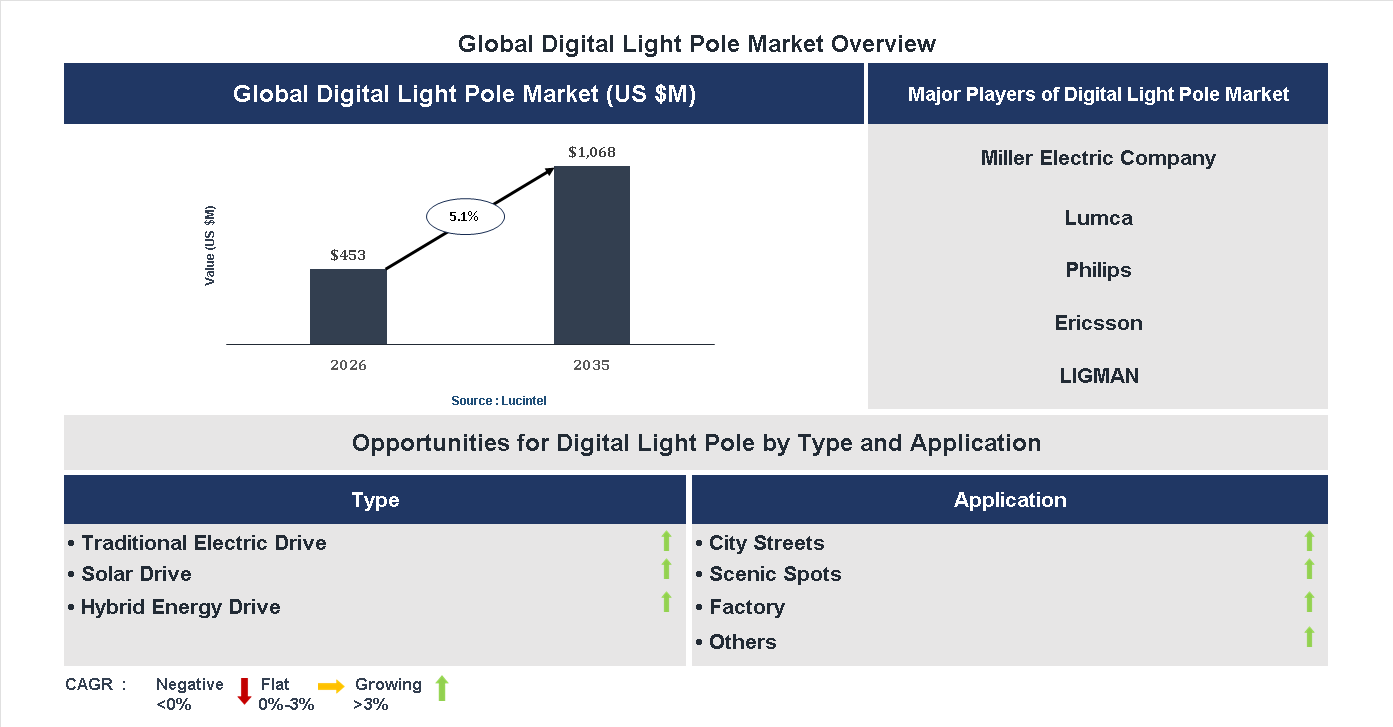
Key data points: The market size in 2035 = $1,068 million, growth forecast = 5.1% annually for the next 8 years. Scroll below to get more insights. This market report covers trends, opportunities and forecasts in digital light pole market to 2035 by type (traditional electric drive, solar drive, and hybrid energy drive), application (city streets, scenic spots, factory, and others), and region (North America, Europe, Asia Pacific, and the Rest of the World)
We'll send your sample report shortly.
• Lucintel forecasts that, within the type category, solar drive is expected to witness the highest growth over the forecast period.
• Within the application category, city street is expected to witness the highest growth.
• In terms of region, APAC is expected to witness the highest growth over the forecast period. Gain valuable insights for your business decisions with our comprehensive 150+ page report. Sample figures with some insights are shown below.
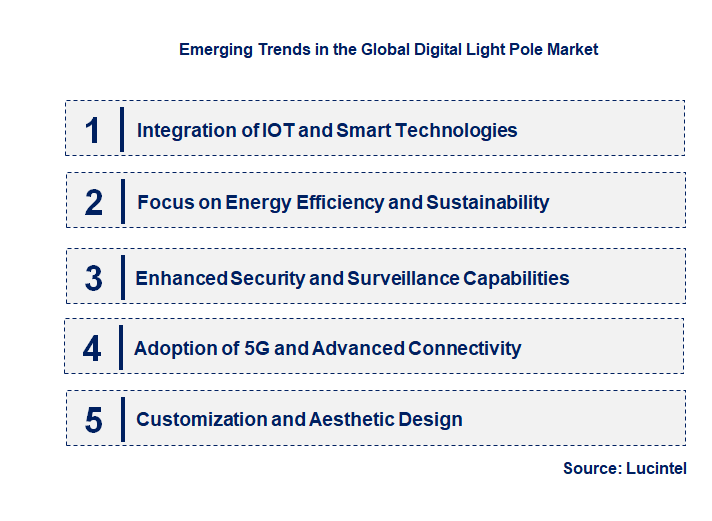
• Integration of IoT and Smart Technologies: The adoption of Internet of Things (IoT) in digital light poles enables real-time data collection, remote management, and automation. These poles can monitor environmental conditions, traffic flow, and public safety, providing valuable insights for city planners. IoT integration enhances operational efficiency, reduces energy consumption, and improves urban living standards. As connectivity becomes more reliable and affordable, the deployment of smart features in light poles is expected to accelerate, making cities more responsive and sustainable.
• Focus on Energy Efficiency and Sustainability: The market is shifting towards energy-efficient solutions, such as LED lighting and renewable energy sources like solar panels. These innovations reduce operational costs and carbon footprints, aligning with global sustainability goals. Governments and municipalities are increasingly adopting green initiatives, incentivizing the deployment of eco-friendly digital light poles. This trend not only supports environmental conservation but also enhances public perception and compliance with regulatory standards, driving market growth.
• Enhanced Security and Surveillance Capabilities: Digital light poles are increasingly equipped with high-resolution cameras, facial recognition, and other security sensors. This integration improves urban safety by enabling real-time monitoring and rapid response to incidents. The deployment of surveillance-enabled poles is particularly prominent in high-traffic areas, public spaces, and critical infrastructure zones. The trend addresses rising security concerns and supports law enforcement efforts, making cities safer and more secure.
• Adoption of 5G and Advanced Connectivity: The rollout of 5G networks is a significant driver for the digital light pole market. These poles serve as essential infrastructure for 5G small cells, enhancing wireless coverage and data transmission speeds. Improved connectivity supports smart city applications, autonomous vehicles, and IoT devices, creating a more interconnected urban environment. The integration of 5G technology into light poles is expected to accelerate digital transformation initiatives and foster innovation across various sectors.
• Customization and Aesthetic Design: As urban aesthetics and branding become priorities, there is a growing demand for customizable and visually appealing digital light poles. Manufacturers are offering design options that blend with cityscapes, incorporate branding elements, and provide modular features. This trend enhances public acceptance and supports city branding efforts. Aesthetic considerations also include vandalism resistance and durability, ensuring long-term functionality. Customization helps cities create unique identities while maintaining functional efficiency. These emerging trends are fundamentally reshaping the digital light pole market by making urban spaces smarter, safer, more sustainable, and visually appealing. The integration of advanced technologies, focus on energy efficiency, enhanced security features, connectivity improvements, and aesthetic customization are collectively driving innovation. These developments are enabling cities worldwide to build more resilient, efficient, and citizen-friendly environments, positioning digital light poles as vital components of future urban infrastructure.
• Adoption of Smart City Initiatives: Governments worldwide are integrating digital light poles into broader smart city projects, aiming to improve urban infrastructure. These poles offer functionalities like Wi-Fi, surveillance, and environmental monitoring, making cities more efficient and livable. The integration enhances public safety, reduces energy consumption, and provides data-driven insights for urban planning. As a result, the market is expanding rapidly, attracting investments from public and private sectors, and fostering innovation in urban management.
• Integration of IoT and Connectivity Solutions: The incorporation of Internet of Things (IoT) technology into digital light poles is revolutionizing urban connectivity. These poles serve as nodes for high-speed internet, smart sensors, and communication networks, enabling real-time data collection and management. This development improves traffic management, public safety, and environmental monitoring. The enhanced connectivity attracts commercial and municipal clients, driving market growth and encouraging the deployment of intelligent urban infrastructure.
• Focus on Energy Efficiency and Sustainability: Recent developments emphasize energy-efficient LED lighting and renewable energy sources like solar panels integrated into digital light poles. These features significantly reduce energy consumption and operational costs while supporting sustainability goals. Governments and organizations are increasingly adopting eco-friendly solutions, which boost market demand. The focus on sustainability also aligns with global climate commitments, positioning digital light poles as vital components of green urban development strategies.
• Technological Innovations in Design and Functionality: Advances in materials, design, and multifunctionality are making digital light poles more versatile and aesthetically appealing. Modern poles incorporate features such as dynamic lighting, digital advertising, and environmental sensors, enhancing urban aesthetics and functionality. These innovations improve user engagement and city branding, while also providing additional revenue streams. The evolving design standards are attracting more municipalities and private investors to adopt these advanced infrastructure solutions.
• Regulatory Support and Public-Private Partnerships: Governments are implementing policies and incentives to promote digital light pole deployment, including subsidies and streamlined approval processes. Public-private partnerships are facilitating large-scale projects, sharing costs, and accelerating market penetration. These collaborations foster innovation, improve infrastructure quality, and expand market reach. Regulatory support ensures standardization and safety, boosting confidence among stakeholders and encouraging widespread adoption of digital light poles in urban environments. The overall impact of these developments is a significant acceleration in market growth, increased urban connectivity, and enhanced sustainability. These opportunities are transforming cityscapes into smarter, safer, and more efficient environments, attracting investments and fostering innovation. As a result, the digital light pole market is poised for sustained expansion, shaping the future of urban infrastructure worldwide.
• Integration of Smart City Technologies: Digital light poles are increasingly integrated with IoT sensors, cameras, and data analytics to improve urban management. These poles support traffic monitoring, environmental sensing, and public safety, enabling cities to optimize resource allocation and respond swiftly to incidents. The convergence of digital infrastructure with urban planning enhances efficiency, reduces costs, and promotes sustainable development, making digital light poles a vital component of future smart cities.
• Growth in Advertising and Digital Signage Opportunities: Digital light poles offer dynamic advertising platforms with high visibility in urban areas. They enable targeted, real-time advertising campaigns, increasing revenue streams for municipalities and private stakeholders. The ability to update content remotely and display interactive content enhances consumer engagement. As digital signage technology advances, the market for advertising on light poles is expected to grow significantly, driven by urban commercialization and digital marketing trends.
• Adoption of Energy-Efficient and Sustainable Solutions: The shift towards energy-efficient lighting, such as LED technology, is a key growth driver. Digital light poles incorporate smart controls for dimming and scheduling, reducing energy consumption and operational costs. Integration with renewable energy sources like solar panels further enhances sustainability. Governments and organizations prioritize eco-friendly infrastructure, making energy-efficient digital light poles a preferred choice for urban development and environmental conservation.
• Expansion in Public Safety and Surveillance Applications: Digital light poles are increasingly equipped with surveillance cameras, emergency communication systems, and sensors to enhance public safety. They facilitate real-time monitoring of public spaces, traffic management, and emergency response coordination. The deployment of these features improves security, reduces crime rates, and supports law enforcement efforts. As safety concerns grow, the adoption of digital light poles for surveillance and emergency services is expected to rise substantially.
• Increasing Adoption in Smart Parking and Traffic Management: Digital light poles are being utilized for smart parking solutions, providing real-time parking availability information to drivers. They also support traffic flow management through connected sensors and data analytics. These applications reduce congestion, improve urban mobility, and enhance user experience. The integration of digital light poles into transportation infrastructure is a strategic move towards smarter, more efficient cities, fostering sustainable urban growth and improved quality of life. The overall impact of these growth opportunities is set to transform the digital light pole market into a crucial element of modern urban infrastructure, fostering smarter, safer, and more sustainable cities worldwide.
• Technological Innovation: The rapid development of IoT-enabled lighting systems enhances urban infrastructure by providing real-time data, remote management, and energy efficiency. These innovations enable cities to optimize lighting schedules, reduce energy consumption, and improve public safety. As technology becomes more affordable and scalable, adoption accelerates, creating a significant market opportunity. The integration of sensors and connectivity features also supports smart city initiatives, making digital light poles a vital component of urban modernization efforts.
• Urbanization and Smart City Initiatives: Increasing urban populations demand smarter infrastructure solutions. Governments worldwide are investing in smart city projects to improve quality of life, reduce environmental impact, and enhance operational efficiency. Digital light poles serve as multifunctional assets, offering lighting, surveillance, Wi-Fi, and environmental monitoring. These features align with urban development goals, driving demand for integrated lighting solutions that support sustainable and connected urban environments.
• Energy Efficiency and Sustainability Goals: Rising awareness of climate change and energy conservation has led to a shift toward energy-efficient lighting technologies such as LED and solar-powered systems. Digital light poles facilitate this transition by enabling adaptive lighting controls, reducing energy wastage, and supporting renewable energy integration. Regulatory pressures and incentives for green infrastructure further motivate municipalities and private entities to adopt these solutions, fostering market growth.
• Government Policies and Regulations: Supportive policies, subsidies, and standards aimed at promoting sustainable urban infrastructure significantly impact the market. Governments are mandating energy-efficient lighting and encouraging smart city development through funding and regulatory frameworks. These policies create a conducive environment for investment in digital light poles, ensuring compliance and fostering innovation within the sector.
• Cost Reduction and Technological Maturity: As manufacturing processes improve and economies of scale are achieved, the costs associated with digital light poles decrease. This reduction makes the technology more accessible to a broader range of municipalities and private entities. Technological maturity also ensures higher reliability, easier maintenance, and better integration with existing infrastructure, further accelerating adoption and expanding market reach. The challenges facing the digital light pole market include:-
• High Installation and Maintenance Costs: Despite decreasing component costs, the initial investment for digital light poles remains substantial. Installation involves complex planning, infrastructure modifications, and skilled labor, which can be prohibitive for smaller municipalities. Ongoing maintenance and upgrades also add to total lifecycle costs, potentially limiting adoption in budget-constrained regions.
• Regulatory and Standardization Barriers: The lack of uniform standards and regulatory frameworks across different regions complicates deployment. Variations in safety, data privacy, and interoperability requirements can delay projects and increase compliance costs. Navigating these regulatory landscapes requires significant effort and expertise, which can hinder market growth.
• Data Security and Privacy Concerns: Digital light poles collect vast amounts of data related to public spaces, surveillance, and environmental conditions. Ensuring data security and protecting user privacy are critical challenges. Breaches or misuse of data can lead to legal issues, public distrust, and resistance from communities, thereby impacting market acceptance and expansion. The digital light pole market is driven by technological advancements, urbanization, sustainability goals, supportive policies, and decreasing costs. However, high installation expenses, regulatory complexities, and data security concerns pose significant hurdles. These factors collectively influence the pace and scope of market growth. While opportunities for innovation and expansion are substantial, addressing these challenges is crucial for sustainable development. Stakeholders must focus on cost-effective solutions, standardization, and robust security measures to harness the full potential of digital light poles in creating smarter, safer, and more sustainable urban environments.
• Miller Electric Company
• Lumca
• Philips
• Ericsson
• LIGMAN
• Telelink City
• Hydro
• Stouch Lighting
• Aeris
• Omniflow
• Traditional Electric Drive
• Solar Drive
• Hybrid Energy Drive
• City Streets
• Scenic Spots
• Factory
• Others
• North America
• Europe
• Asia Pacific
• The Rest of the World
• United States: The US market is leading in technological innovation, with major investments in smart city projects. Companies are developing intelligent light poles equipped with cameras, Wi-Fi, and environmental sensors. Adoption of IoT-enabled lighting systems is increasing, driven by government initiatives for urban safety and energy efficiency. The focus is on integrating AI for data analytics and real-time monitoring, enhancing public safety and infrastructure management. The US also sees a rise in public-private partnerships to deploy advanced digital light poles across urban areas, fostering sustainable and connected cities.
• China: China is rapidly expanding its digital light pole infrastructure as part of its smart city development plans. The government promotes large-scale deployment of intelligent lighting systems with integrated surveillance, environmental monitoring, and 5G connectivity. Chinese companies are innovating with multifunctional poles that support advertising, public Wi-Fi, and traffic management. The market benefits from strong government support and investments aimed at urban modernization, making China a key player in global digital light pole adoption. The focus is on scalable, cost-effective solutions to cover extensive urban areas efficiently.
• Germany: Germany emphasizes energy-efficient and environmentally friendly digital light poles, aligning with its sustainability goals. The market is characterized by high-quality, innovative products with advanced sensors and connectivity features. German companies are integrating smart controls for adaptive lighting and data collection to optimize urban infrastructure. The focus on regulatory compliance and eco-friendly materials is prominent. Germany’s smart city initiatives promote the deployment of digital light poles to improve urban safety, reduce energy consumption, and support sustainable urban development, positioning the country as a leader in eco-conscious smart infrastructure.
• India: India is witnessing rapid growth in digital light pole deployment driven by urbanization and government initiatives like Smart Cities Mission. The focus is on affordable, scalable solutions that incorporate surveillance, Wi-Fi, and environmental sensors. The market is expanding in Tier 1 and Tier 2 cities to improve urban safety, traffic management, and public services. Local manufacturers are increasingly involved, offering cost-effective products tailored to Indian urban needs. The government’s push for digital infrastructure and smart city projects is accelerating adoption, making India a significant emerging market for digital light poles.
• Japan: Japan’s market is characterized by advanced technological integration and emphasis on disaster resilience. Digital light poles are equipped with sensors for environmental monitoring, disaster alerts, and energy-efficient lighting. The country focuses on integrating AI and IoT to enhance urban safety and sustainability. Japan’s smart city initiatives prioritize resilience against natural disasters, with digital light poles serving as critical infrastructure for emergency response and communication. The market also benefits from high-quality manufacturing standards and innovative design, positioning Japan as a leader in smart, resilient urban infrastructure solutions.


• Miller Electric Company
• Lumca
• Philips
• Ericsson
• LIGMAN
• Telelink City
• Hydro
• Stouch Lighting
• Aeris
• Omniflow Q6. Which digital light pole market segment will be the largest in future? Answer: Lucintel forecasts that, within the type category, solar drive is expected to witness the highest growth over the forecast period. Q7. In digital light pole market, which region is expected to be the largest in next 5 years? Answer: In terms of region, APAC is expected to witness the highest growth over the forecast period. Q8. Do we receive customization in this report? Answer: Yes, Lucintel provides 10% customization without any additional cost.


Choose a license that fits your team. Instant PDF delivery.
Prices exclude taxes. Instant delivery. Custom licensing available on request.
Market Report · July 31, 2026
Market Report · July 31, 2026
Market Report · July 31, 2026
Trusted partner for strategic intelligence and business growth


Receive a complimentary market analysis tailored to your industry. Our analysts will identify key growth opportunities and competitive dynamics specific to your business.

Market size, growth rate, and key trend analysis for your specific sector.

Top competitor positioning and market share analysis.

Strategic recommendations backed by data-driven insights.
Get curated market intelligence and competitive moves straight to your inbox.
By subscribing, you agree to receive our monthly insights. Unsubscribe anytime.
Receive a complimentary market analysis tailored to your industry. Our analysts will identify key growth opportunities and competitive dynamics specific to your business.
Market size, growth rate, and key trend analysis for your specific sector.
Top competitor positioning and market share analysis.
Strategic recommendations backed by data-driven insights.
Get curated market intelligence, emerging trends, and competitive moves straight to your inbox each month.
By subscribing, you agree to receive our monthly insights. Unsubscribe anytime.
We'll send your sample report shortly.