
Market Report · July 16, 2026

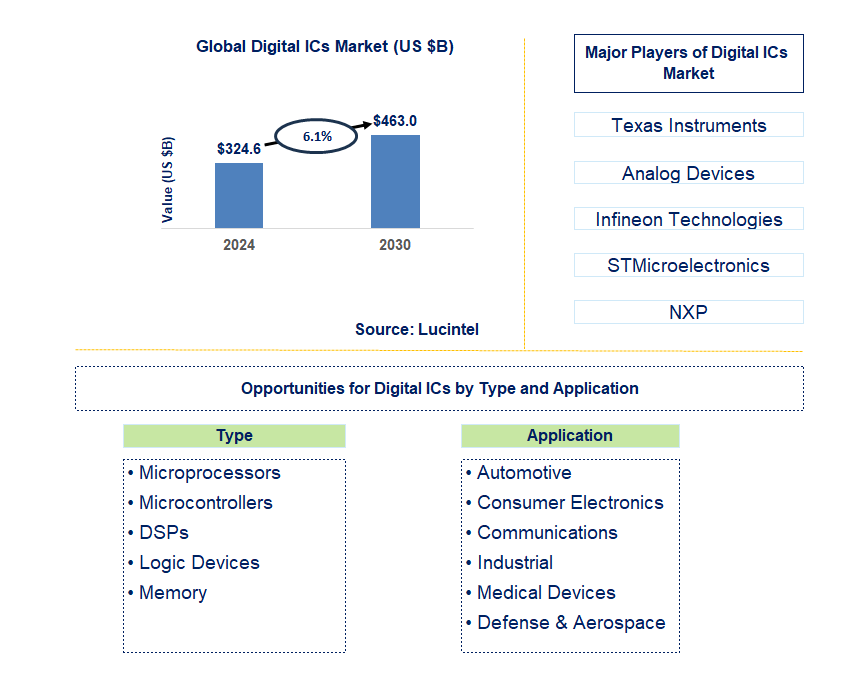
Key data points: The market size in 2030 = $463.0 billion, growth forecast = 6.1% annually for the next 6 years. Scroll below to get more insights. This market report covers trends, opportunities, and forecasts in the global digital ics market to 2030 by type (microprocessors, microcontrollers, DSPs, logic devices, and memory), application (automotive, consumer electronics, communications, industrial, medical devices, and defense & aerospace), and region (North America, Europe, Asia Pacific, and the Rest of the World)
We'll send your sample report shortly.
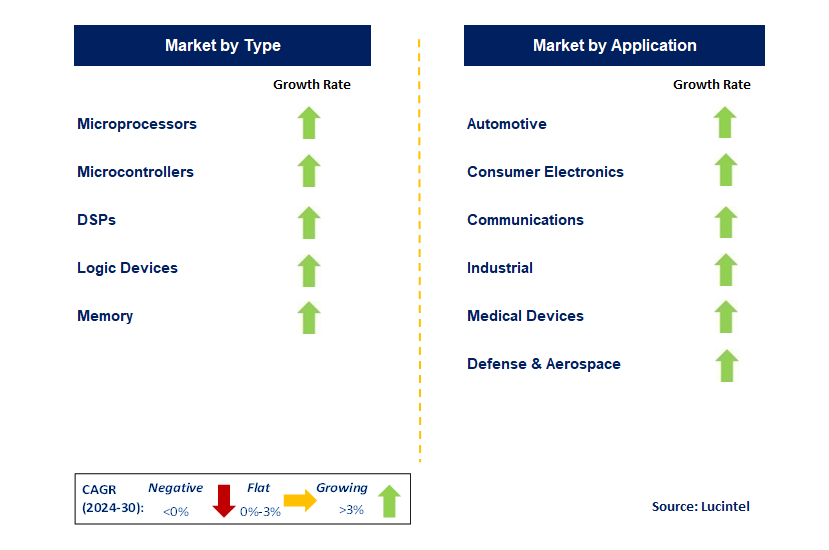
• Lucintel forecasts that, within the type category, microprocessors will remain the largest segment over the forecast period because they are executing instructions and processing data.
• Within the application category, automotive will remain the largest segment due to rising automotive production, increasing investments in automobile manufacturing facilities, advancement in autonomous driving, along with the growing demand for electric vehicles.
• In terms of regions, APAC is expected to witness the highest growth over the forecast period due to rising demand for consumer electronics, significant investments in wireless infrastructure, and growing semiconductor chip manufacturing operations in the region. Gain valuable insights for your business decisions with our comprehensive 150+ page report.
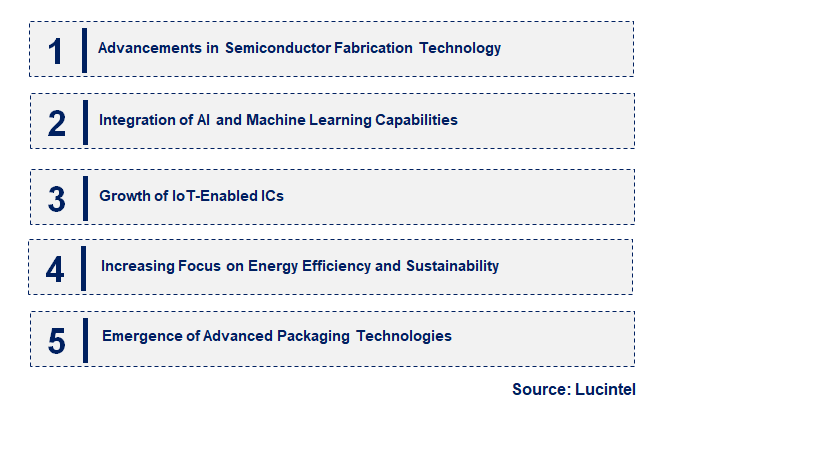
• Advancements in Semiconductor Fabrication Technology: There is a continuous push towards smaller fabrication nodes, with technologies moving from 7nm to 5nm and even 3nm processes. These advancements allow for higher performance, lower power consumption, and increased integration of transistors on a single chip. Companies are investing in EUV (Extreme Ultraviolet) lithography to achieve these cutting-edge nodes, driving significant improvements in computational power and efficiency.
• Integration of AI and Machine Learning Capabilities: Digital ICs are increasingly incorporating AI and machine learning functionalities directly into the chip. This trend is driven by the need for enhanced data processing and real-time analytics. AI-capable ICs can accelerate tasks such as image recognition, natural language processing, and autonomous systems, offering substantial performance gains and new applications in various industries, from consumer electronics to automotive technology.
• Growth of IoT-Enabled ICs: The Internet of Things (IoT) is fueling demand for specialized digital ICs designed to handle the connectivity and processing requirements of IoT devices. These ICs often focus on low power consumption, efficient wireless communication, and compact form factors. The proliferation of smart devices and the expansion of smart cities are key drivers behind this trend, influencing both consumer and industrial markets.
• Increasing Focus on Energy Efficiency and Sustainability: There is a growing emphasis on designing digital ICs with energy efficiency and environmental sustainability in mind. This trend involves optimizing power usage, reducing heat dissipation, and employing eco-friendly materials in chip production. As global awareness of climate change rises, semiconductor companies are adopting greener practices and technologies to meet regulatory requirements and consumer expectations.
• Emergence of Advanced Packaging Technologies: Advanced packaging technologies, such as 3D stacking and chiplets, are gaining prominence. These technologies enhance the performance and versatility of digital ICs by enabling higher density and better interconnectivity between chips. This trend supports the development of more complex and powerful IC solutions while addressing challenges related to chip size, heat management, and manufacturing costs. These emerging trends are significantly reshaping the digital ICs market by driving advancements in technology, improving performance, and addressing new application needs. Companies are focusing on more efficient fabrication processes, integrating advanced functionalities directly into chips, and adopting innovative packaging methods. Together, these trends are leading to a more dynamic and competitive digital IC landscape.
• Advanced Semiconductor Lithography: The adoption of EUV lithography has revolutionized semiconductor fabrication by enabling the production of chips with smaller nodes, such as 5nm and 3nm. This technology allows for the creation of more transistors per square millimeter, enhancing performance and efficiency. The widespread use of EUV lithography marks a significant milestone in advancing chip technology and meeting the demands for higher computational power.
• Emergence of Quantum Computing ICs: Quantum computing is gaining traction, with significant investments being made in developing quantum ICs. Companies and research institutions are working on integrating qubits into digital ICs to leverage quantum phenomena for computation. Although still in the experimental stage, this development has the potential to revolutionize processing power and solve complex problems that classical computers cannot efficiently address.
• Expansion of 5G and Connectivity Solutions: The rollout of 5G networks has spurred demand for digital ICs designed to support high-speed data transmission and connectivity. ICs tailored for 5G applications focus on enhanced signal processing, energy efficiency, and integration with existing communication infrastructure. This development is critical for advancing mobile networks and enabling new applications in areas such as autonomous vehicles and smart cities.
• Increased Investment in Semiconductor Supply Chains: The semiconductor industry is experiencing a surge in investments aimed at strengthening supply chains and addressing bottlenecks. Efforts include building new fabrication plants, expanding production capacities, and securing raw materials. These investments are crucial for mitigating supply chain disruptions and ensuring a stable supply of digital ICs amidst growing global demand.
• Growth in Automotive Electronics: Automotive electronics are becoming increasingly sophisticated, with digital ICs playing a key role in the development of advanced driver-assistance systems (ADAS) and autonomous vehicles. Innovations in this area include enhanced processing capabilities and integration of sensors and communication systems. This development reflects the broader trend of incorporating advanced technology into vehicles for improved safety and performance. Recent developments in the digital ICs market are driving significant changes in technology and industry practices. Advances in lithography, the emergence of quantum computing, and the expansion of 5G connectivity are shaping the future of digital ICs. Investments in supply chains and growth in automotive electronics further underscore the dynamic nature of the market. These developments are setting new standards and opening up opportunities for innovation across various sectors.
• Consumer Electronics: The consumer electronics sector, encompassing smartphones, tablets, and wearables, presents substantial growth opportunities for digital ICs. With the increasing demand for high-performance, energy-efficient devices, there is a push for advanced semiconductor technologies. Innovations such as faster processors, high-resolution displays, and improved power management ICs are driving this growth. Companies investing in these areas can capitalize on the expanding consumer electronics market and meet the rising expectations for cutting-edge, reliable, and feature-rich products.
• Automotive Technology: The automotive industry is rapidly adopting digital ICs for advanced driver-assistance systems (ADAS), autonomous vehicles, and infotainment systems. This shift is driven by the need for enhanced safety features, improved vehicle performance, and the integration of smart technologies. Opportunities in this sector include developing ICs that support real-time data processing, sensor fusion, and connectivity. As vehicles become more sophisticated, the demand for high-performance, reliable, and secure automotive ICs is expected to grow, presenting a significant opportunity for innovation and market expansion.
• Telecommunications: The telecommunications industry is experiencing growth driven by the expansion of 5G networks and infrastructure. Digital ICs play a crucial role in enabling high-speed data transmission, low-latency communication, and efficient network operations. Opportunities exist in developing ICs that enhance signal processing, support higher frequencies, and integrate with network equipment. As the 5G rollout continues globally, there is a growing need for advanced semiconductor solutions that can meet the demands of next-generation communication technologies.
• Industrial Automation: Industrial automation is increasingly relying on digital ICs for improving operational efficiency, reliability, and scalability. ICs are used in various applications such as robotics, control systems, and sensor networks. The demand for high-precision, robust, and energy-efficient ICs is growing as industries seek to automate processes and enhance production capabilities. Opportunities in this sector include developing ICs that support real-time control, data acquisition, and machine learning applications, which can drive significant advancements in industrial automation.
• Healthcare: The healthcare sector is leveraging digital ICs for advancements in medical devices, diagnostics, and wearable health monitors. Opportunities include developing ICs that support high-precision sensors, data analytics, and connectivity for remote monitoring. The increasing focus on personalized medicine, telemedicine, and health data management drives the demand for sophisticated and reliable semiconductor solutions. Investing in healthcare ICs can enable innovations that improve patient care, diagnostic accuracy, and overall health outcomes. The digital ICs market is positioned for substantial growth driven by opportunities across key applications such as consumer electronics, automotive technology, telecommunications, industrial automation, and healthcare. Each sector presents unique challenges and demands, but also significant potential for innovation and market expansion. By capitalizing on these opportunities, companies can enhance their competitive edge and drive technological advancements across multiple industries.
• Technological Advancements: Rapid technological advancements in semiconductor manufacturing, such as smaller process nodes (e.g., 5nm, 3nm), are major drivers of growth in the digital IC market. Innovations like EUV lithography and advanced packaging technologies enable the production of more powerful, efficient, and compact chips. These advancements drive performance improvements and open up new applications for digital ICs, fostering growth in sectors like consumer electronics, automotive, and telecommunications.
• Rising Demand for Consumer Electronics: The increasing adoption of consumer electronics, including smartphones, tablets, and wearables, drives demand for advanced digital ICs. As consumer expectations evolve towards higher performance and functionality, manufacturers invest in more sophisticated semiconductor solutions. This rising demand for high-performance, energy-efficient ICs in consumer devices significantly drives market growth, prompting innovation and expansion in digital IC technologies.
• Growth in 5G and Telecommunications: The expansion of 5G networks and infrastructure is a key driver of growth in the digital IC market. 5G technology requires advanced ICs for high-speed data processing, low-latency communication, and efficient network management. The rollout of 5G drives demand for specialized ICs that support these requirements, creating opportunities for companies involved in semiconductor design and production to address the needs of next-generation communication technologies.
• Increase in Automotive Electronics: The automotive industry's shift towards advanced driver-assistance systems (ADAS), autonomous driving, and connected vehicles drives demand for digital ICs. Innovations in automotive technology require high-performance ICs for real-time processing, sensor integration, and connectivity. This trend creates growth opportunities for semiconductor companies that develop solutions tailored to the automotive sector, driving market expansion and technological advancements in automotive electronics.
• Expansion of Industrial Automation: The rise of industrial automation and smart manufacturing fuels demand for digital ICs used in control systems, robotics, and sensor networks. As industries seek to improve efficiency and reduce costs through automation, the need for advanced ICs that support real-time control, data processing, and machine learning increases. This trend drives growth in the digital IC market and encourages innovation in semiconductor solutions for industrial applications. Challenges in the digital ICs market include:
• Supply Chain Disruptions: Supply chain disruptions, including shortages of raw materials and manufacturing delays, pose significant challenges to the digital IC market. Global events and geopolitical tensions can impact the availability of critical components and materials, leading to production delays and increased costs. Companies must navigate these challenges by diversifying their supply chains, investing in domestic manufacturing capabilities, and securing reliable sources of raw materials.
• Regulatory and Trade Restrictions: Regulatory and trade restrictions, such as export controls and tariffs, can impact the digital IC market by affecting the flow of goods and technology between countries. Geopolitical tensions and changes in trade policies may create barriers to market access and increase operational costs. Companies need to stay informed about regulatory changes and develop strategies to mitigate the impact of trade restrictions on their global operations.
• Rapid Technological Changes: The fast pace of technological change in the semiconductor industry presents a challenge for digital IC manufacturers. Keeping up with rapid advancements and ensuring compatibility with emerging technologies requires significant investment in research and development and agility in product development. Companies must continuously innovate and adapt to stay competitive while managing the risks associated with technological obsolescence and maintaining a robust pipeline of new products. The digital IC market is shaped by a dynamic interplay of drivers and challenges. Technological advancements, rising demand in consumer electronics and automotive sectors, growth in 5G, and industrial automation are key drivers propelling market expansion. However, supply chain disruptions, regulatory and trade restrictions, and rapid technological changes present significant challenges. Navigating these factors effectively will be crucial for companies to leverage growth opportunities and sustain their competitive advantage in the evolving digital IC landscape.
• Texas Instruments
• Analog Devices
• Infineon Technologies
• STMicroelectronics
• NXP
• Microprocessors
• Microcontrollers
• DSPs
• Logic Devices
• Memory
• Automotive
• Consumer Electronics
• Communications
• Industrial
• Medical Devices
• Defense & Aerospace
• North America
• Europe
• Asia Pacific
• The Rest of the World
• United States: The U.S. remains at the forefront of digital IC innovation, with significant advancements in semiconductor technology and design. Companies like Intel and AMD lead the charge with breakthroughs in chip architecture and fabrication processes, including the development of 3nm and 5nm nodes. The U.S. government has also increased investments in domestic semiconductor manufacturing to reduce reliance on foreign suppliers, fostering a more resilient and advanced IC ecosystem.
• China: China has made notable strides in digital ICs, driven by its Made in China 2025 initiative, which aims to reduce dependency on foreign technology. Chinese firms like SMIC and Huawei are advancing their IC designs and production capabilities. The country invests heavily in semiconductor research and development and makes progress in areas such as 7nm technology and beyond. However, geopolitical tensions and trade restrictions challenge China’s ambitions, impacting its global integration and access to advanced fabrication tools.
• Germany: Germany has strengthened its position in the digital IC market through significant investments in semiconductor research and development. German companies and institutions focus on next-generation semiconductor technologies, including advancements in automotive electronics and industrial automation. The European Union's push for strategic autonomy in semiconductor manufacturing has led to increased funding and collaborative efforts within Germany to enhance its semiconductor capabilities and reduce reliance on non-European suppliers.
• India: India’s digital IC sector is growing rapidly, supported by government initiatives like the National Policy on Electronics. The country is becoming a hub for semiconductor design and development, with increasing foreign direct investment and the establishment of semiconductor design houses. India’s focus on boosting its electronic manufacturing ecosystem, coupled with a growing talent pool, drives innovations in IC design and contributes to its emergence as a significant player in the global digital IC market.
• Japan: Japan continues to be a major player in the digital IC market, with advancements in technology driven by companies such as Sony, Toshiba, and Renesas. Japan emphasizes innovations in memory chips and automotive semiconductors. The country’s focus on integrating advanced technologies such as AI and IoT into its ICs is notable, as is its strategy to strengthen domestic manufacturing capabilities in response to global supply chain disruptions.


• Texas Instruments
• Analog Devices
• Infineon Technologies
• STMicroelectronics
• NXP Q6. Which digital ICs market segment will be the largest in future? Answer: Lucintel forecasts that microprocessors will remain the largest segment over the forecast period because they are executing instructions and processing data. Q7. In digital ICs market, which region is expected to be the largest in next 5 years? Answer: In terms of regions, APAC is expected to witness the highest growth over the forecast period due to rising demand for consumer electronics, significant investments in wireless infrastructure, and growing semiconductor chip manufacturing operations in the region. Q.8 Do we receive customization in this report? Answer: Yes, Lucintel provides 10% customization without any additional cost.


Choose a license that fits your team. Instant PDF delivery.
Prices exclude taxes. Instant delivery. Custom licensing available on request.
Market Report · July 16, 2026
Market Report · May 18, 2026
Market Report · May 18, 2026
Trusted partner for strategic intelligence and business growth


Receive a complimentary market analysis tailored to your industry. Our analysts will identify key growth opportunities and competitive dynamics specific to your business.

Market size, growth rate, and key trend analysis for your specific sector.

Top competitor positioning and market share analysis.

Strategic recommendations backed by data-driven insights.
Get curated market intelligence and competitive moves straight to your inbox.
By subscribing, you agree to receive our monthly insights. Unsubscribe anytime.
Receive a complimentary market analysis tailored to your industry. Our analysts will identify key growth opportunities and competitive dynamics specific to your business.
Market size, growth rate, and key trend analysis for your specific sector.
Top competitor positioning and market share analysis.
Strategic recommendations backed by data-driven insights.
Get curated market intelligence, emerging trends, and competitive moves straight to your inbox each month.
By subscribing, you agree to receive our monthly insights. Unsubscribe anytime.
We'll send your sample report shortly.