
Report Feature
Digital Camera Display Market Trends and Forecast
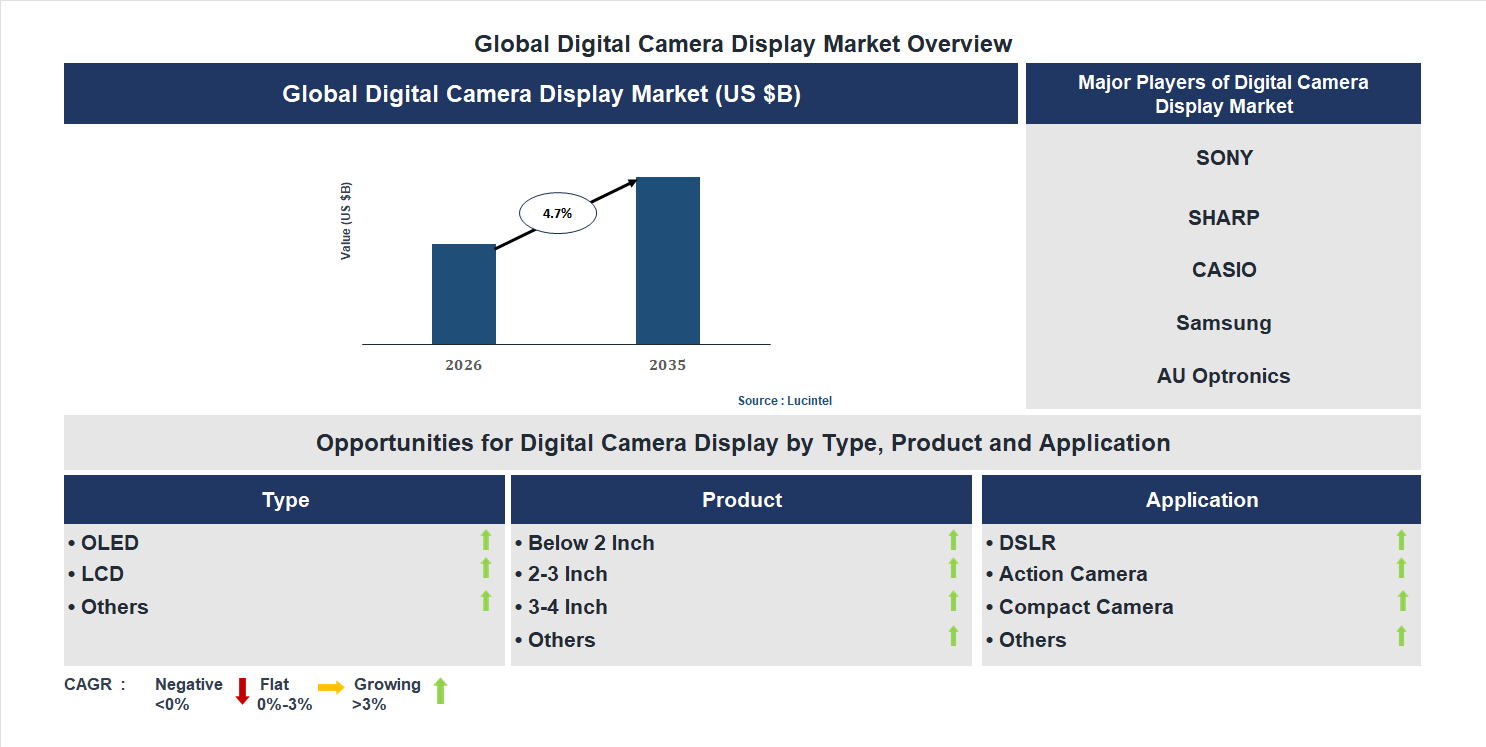
The future of the global digital camera display market looks promising with opportunities in the DSLR, action camera, and compact camera markets. The global digital camera display market is expected to reach an estimated $8 billion by 2035 with a CAGR of 5.3% from 2026 to 2035. The major drivers for this market are the increasing demand for high resolution displays, the rising adoption of advanced camera features, and the growing preference for compact display modules.• Lucintel forecasts that, within the type category, OLED is expected to witness higher growth over the forecast period.
• Within the application category, compact camera is expected to witness the highest growth.
• In terms of region, APAC is expected to witness the highest growth over the forecast period. Gain valuable insights for your business decisions with our comprehensive 150+ page report. Sample figures with some insights are shown below.
Emerging Trends in the Digital Camera Display Market
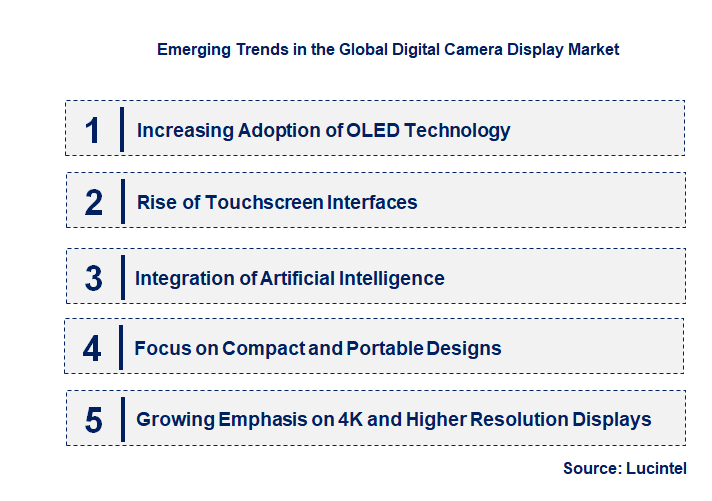
The digital camera display market is experiencing rapid evolution driven by technological advancements, changing consumer preferences, and increasing demand for high-quality imaging solutions. As photography becomes more integrated into daily life and professional work, manufacturers are innovating to meet these needs. Emerging trends are shaping the future landscape of this market, influencing product development, user experience, and competitive dynamics. These developments are not only enhancing the functionality and aesthetics of digital camera displays but also expanding their applications across various sectors. Understanding these trends is crucial for stakeholders aiming to capitalize on new opportunities and stay ahead in this competitive environment.• Increasing Adoption of OLED Technology: OLED displays are gaining popularity in digital cameras due to their superior contrast, vibrant colors, and wider viewing angles. This technology enhances image clarity and provides a more immersive viewing experience, especially in outdoor or brightly lit environments. Manufacturers are integrating OLED screens to meet consumer demand for high-quality visuals, which is driving market growth. The flexibility and thinness of OLEDs also allow for innovative camera designs, making devices more portable and stylish. As OLED technology becomes more affordable, its adoption is expected to accelerate, further elevating display quality standards.
• Rise of Touchscreen Interfaces: Touchscreens are becoming a standard feature in digital camera displays, offering intuitive navigation and quick access to settings. This trend simplifies user interaction, making cameras more accessible to amateurs and professionals alike. Enhanced touchscreen functionalities, such as multi-touch gestures and customizable interfaces, improve user experience and operational efficiency. Manufacturers are focusing on responsive, durable touchscreens that can withstand harsh conditions. The integration of touchscreen technology is also enabling new features like live editing and instant sharing, which are transforming how users interact with their devices and increasing overall market demand.
• Integration of Artificial Intelligence (AI): AI-powered displays are emerging to provide smarter, more personalized user experiences. These displays can automatically adjust settings based on scene recognition, optimize image previews, and offer real-time editing suggestions. AI integration enhances usability, especially for novice photographers, by simplifying complex functions. Additionally, AI-driven analytics can help manufacturers develop better products by understanding user preferences. This trend is making digital cameras more intelligent and versatile, expanding their appeal across different user segments. As AI technology advances, its influence on display features is expected to grow significantly.
• Focus on Compact and Portable Designs: The demand for lightweight, compact digital cameras with high-quality displays is increasing, driven by mobile photography trends. Consumers seek portable devices that do not compromise on display size or quality. Manufacturers are developing foldable, slim, and modular displays that fit into smaller form factors while maintaining clarity and color accuracy. This trend supports the growing need for on-the-go photography and instant sharing. The emphasis on portability is also encouraging innovations in display materials and mounting techniques, making cameras more convenient without sacrificing performance. This shift is broadening market reach and application scope.
• Growing Emphasis on 4K and Higher Resolution Displays: As content quality standards rise, there is a strong push toward incorporating 4K and higher resolution screens in digital cameras. These high-resolution displays provide sharper images, detailed previews, and enhanced editing capabilities. They are particularly valued in professional photography and videography, where precision is critical. The adoption of 4K displays also supports advanced features like real-time video monitoring and high-fidelity color reproduction. As manufacturing costs decrease, higher resolution displays are becoming more accessible, setting new benchmarks for image quality and user expectations in the market. In summary, these trends are collectively transforming the digital camera display market by improving visual quality, user interaction, and device portability. They are fostering innovation, expanding application possibilities, and elevating consumer expectations, ultimately reshaping the competitive landscape and driving future growth.
Recent Development in the Digital Camera Display Market
The digital camera display market is experiencing rapid evolution driven by technological advancements and changing consumer preferences. Innovations in display technology, increased demand for high-resolution screens, and integration with smart devices are shaping the industry landscape. Market players are focusing on enhancing user experience through better visuals, durability, and connectivity features. These developments are creating new opportunities for manufacturers and retailers, ultimately influencing the global market dynamics and consumer choices.• Advancements in Display Technology: The adoption of OLED and AMOLED screens has significantly improved image quality, color accuracy, and contrast ratios. These innovations provide users with more vibrant and immersive viewing experiences, boosting demand for high-end digital cameras. Manufacturers are investing heavily in R&D to develop thinner, more durable displays that are energy-efficient and compatible with various camera models. This progress is expected to drive premium product sales and expand market share for brands offering superior display solutions.
• Rising Demand for High-Resolution Screens: Consumers increasingly seek cameras with ultra-high-definition displays for better image previewing and editing. The trend towards 4K and 8K screens enhances user engagement and satisfaction. This demand encourages manufacturers to incorporate larger, sharper screens into their devices, which can increase production costs but also add value. As a result, the market is witnessing a shift towards premium models with advanced display features, fostering innovation and competitive differentiation among brands.
• Integration of Touchscreen and Smart Features: The convergence of touchscreen technology with digital camera displays has transformed user interaction. Features like intuitive navigation, live editing, and connectivity options such as Wi-Fi and Bluetooth are becoming standard. This integration simplifies operation, appeals to tech-savvy consumers, and enables seamless sharing of images. Manufacturers are focusing on developing multifunctional displays that combine traditional viewing with smart capabilities, thereby expanding the market scope and attracting a broader customer base.
• Focus on Durability and Outdoor Usability: The demand for rugged, weather-resistant displays suitable for outdoor photography is rising. Enhanced durability features such as scratch resistance, waterproofing, and anti-glare coatings are being incorporated into camera displays. These improvements cater to professional photographers and enthusiasts who require reliable performance in challenging environments. The focus on durability not only broadens the application scope but also encourages innovation in display materials, leading to increased market competitiveness and customer trust.
• Growth of Compact and Portable Display Solutions: The market is witnessing a surge in compact, lightweight display options for portable digital cameras and accessories. Small, foldable, or attachable screens offer convenience without compromising quality. This trend supports the rise of mirrorless and compact camera segments, appealing to travelers and casual users. Manufacturers are developing innovative, space-saving display designs that enhance portability and user experience, thereby expanding market reach and fostering growth in niche segments. These developments are significantly transforming the digital camera display market by enhancing visual quality, user interaction, durability, and portability. They are driving innovation, increasing consumer satisfaction, and enabling manufacturers to differentiate their products. As a result, the market is becoming more competitive, with a broader range of advanced, feature-rich displays catering to diverse customer needs, ultimately fueling growth and technological progress across the industry.
Strategic Growth Opportunities in the Digital Camera Display Market
The digital camera display market is experiencing rapid growth driven by technological advancements, increasing consumer demand for high-quality imaging, and expanding applications across professional and personal photography. Innovations in display technology, integration with smart devices, and the rise of social media platforms are fueling market expansion. Companies are investing in R&D to develop more durable, high-resolution, and energy-efficient displays. This evolving landscape presents numerous opportunities for market players to capitalize on emerging trends and meet the diverse needs of consumers and industries worldwide.• Increasing Adoption of High-Resolution Displays in Digital Cameras: The demand for high-resolution displays in digital cameras is rising as consumers seek clearer, more detailed images. Manufacturers are integrating 4K and 8K screens, enhancing user experience with better color accuracy and sharpness. This trend is driven by advancements in display technology and consumer expectations for professional-grade imaging. The growth of high-end cameras with superior display features is expected to boost market revenues and expand application scopes.
• Growing Integration of Touchscreen Displays in Consumer Cameras: Touchscreen technology is becoming a standard feature in digital cameras, offering intuitive control and enhanced user interaction. Consumers prefer devices with easy navigation, quick settings adjustments, and live previews. Manufacturers are incorporating larger, more responsive touchscreens to improve usability. This integration not only enhances the overall user experience but also opens opportunities for innovative features like gesture controls and customizable interfaces, driving market growth in the consumer segment.
• Expansion of Digital Camera Displays in Professional Photography Equipment: Professional photographers require durable, high-performance displays for accurate image editing and review. The market is witnessing increased adoption of rugged, color-accurate, and high-brightness displays in professional-grade cameras and accessories. This segment demands displays with superior resolution, wide viewing angles, and reliable performance in various lighting conditions. The focus on quality and durability is creating opportunities for specialized display solutions tailored to professional needs, fueling growth in this niche market.
• Rising Use of Digital Camera Displays in Action and Sports Cameras: Action and sports cameras demand compact, lightweight, and highly durable displays capable of withstanding extreme conditions. The trend toward outdoor and adventure photography is boosting demand for rugged displays with high brightness and anti-glare features. Manufacturers are developing specialized displays that offer real-time viewing and quick adjustments during activities. This segment’s growth is driven by the expanding sports and adventure markets, creating opportunities for innovative, resilient display solutions.
• Increasing Demand for Smart Camera Displays with Connectivity Features: The integration of smart features and connectivity options in digital camera displays is transforming user experiences. Wireless connectivity, live streaming, and remote control capabilities are becoming standard. Consumers and professionals seek displays that can seamlessly connect with smartphones, tablets, and cloud services. This trend is fostering the development of intelligent displays with enhanced functionalities, opening new avenues for market expansion in IoT-enabled and connected camera systems. The overall market outlook indicates that these growth opportunities will significantly influence the evolution of digital camera displays, fostering innovation and expanding application horizons. Companies that capitalize on these trends will be well-positioned to lead in a competitive landscape, meeting the diverse needs of consumers and professionals alike.
Digital Camera Display Market Driver and Challenges
The digital camera display market is influenced by a variety of technological, economic, and regulatory factors that shape its growth trajectory. Rapid advancements in display technology, increasing consumer demand for high-quality visuals, and the proliferation of digital photography are key drivers. Additionally, economic factors such as rising disposable incomes and decreasing costs of display components contribute to market expansion. Regulatory standards related to electronic waste and energy efficiency also impact product development and marketing strategies. Navigating these complex factors requires industry players to innovate continuously while adhering to evolving regulations, ultimately influencing the markets overall dynamics and future potential. The factors responsible for driving the digital camera display market include:• Technological Innovation: The rapid development of high-resolution, touch-enabled, and energy-efficient display technologies such as OLED and LCD has significantly enhanced user experience. These advancements enable manufacturers to produce more vibrant, clearer, and more responsive displays, which are highly desirable in digital cameras. As consumers increasingly seek superior visual quality, manufacturers are compelled to incorporate the latest display tech, fueling market growth. Moreover, innovations like foldable and flexible displays open new design possibilities, further expanding the market scope and consumer appeal.
• Increasing Consumer Demand for High-Quality Visuals: The growing popularity of digital photography and content sharing platforms has heightened consumer expectations for superior display quality. Users now prefer cameras with larger, sharper, and more color-accurate screens for better image framing and review. This demand drives manufacturers to develop advanced displays that meet these expectations, thereby expanding market opportunities. The trend is particularly prominent among professional photographers and enthusiasts who prioritize display quality for editing and viewing purposes, reinforcing the markets upward trajectory.
• Rising Adoption of Mirrorless and Compact Cameras: The shift towards mirrorless and compact digital cameras, which often feature advanced display screens, is a significant growth factor. These cameras appeal to a broad demographic due to their portability and performance, necessitating high-quality displays for better user interaction. As these camera types gain popularity, manufacturers are investing in innovative display solutions to differentiate their products, thus propelling market expansion. The integration of touchscreens and high-resolution displays enhances user experience, making these cameras more attractive in a competitive landscape.
• Economic Growth and Increasing Disposable Income: As economies grow and disposable incomes rise globally, consumers are more willing to invest in premium digital camera equipment with advanced display features. This economic trend boosts sales of high-end cameras equipped with sophisticated display technologies. Manufacturers benefit from higher profit margins and are motivated to incorporate cutting-edge display features to attract affluent consumers. The increased purchasing power also encourages innovation and diversification in display offerings, further stimulating market growth and expanding the consumer base. The challenges in the digital camera display market are:
• Rapid Technological Obsolescence: The fast-paced nature of display technology means products can become outdated quickly, leading to shorter product life cycles. Manufacturers face pressure to continually innovate and update their offerings, which increases R&D costs and inventory risks. This rapid obsolescence can also result in consumer hesitation, as buyers may delay purchases, anticipating newer, better displays. Balancing innovation with cost-effectiveness remains a key challenge, impacting profitability and market stability.
• Regulatory and Environmental Concerns: Increasing regulations related to electronic waste, hazardous materials, and energy consumption pose significant hurdles. Manufacturers must comply with strict standards, which can increase production costs and limit design flexibility. Additionally, the push for sustainable and eco-friendly products requires investment in recyclable materials and energy-efficient manufacturing processes. Navigating these regulatory landscapes demands strategic planning and can slow down product development cycles, affecting overall market growth.
• Price Competition and Cost Pressures: Intense competition among manufacturers leads to price wars, which can erode profit margins. The high costs associated with advanced display technologies, such as OLED and high-resolution screens, further strain profitability, especially for smaller players. Cost pressures may limit innovation or lead to compromises in display quality, affecting consumer satisfaction. Maintaining a balance between affordability and quality is a persistent challenge that influences market dynamics and the ability to sustain long-term growth. In summary, the digital camera display market is shaped by significant technological advancements, rising consumer expectations, and economic growth, which collectively drive expansion. However, rapid technological obsolescence, regulatory challenges, and intense price competition pose substantial hurdles. These factors create a complex environment requiring continuous innovation, strategic compliance, and cost management. Overall, while the market holds promising growth potential, its success depends on how effectively industry players navigate these drivers and challenges to meet evolving consumer and regulatory demands.
List of Digital Camera Display Companies
Companies in the market compete on the basis of product quality offered. Major players in this market focus on expanding their manufacturing facilities, R&D investments, infrastructural development, and leverage integration opportunities across the value chain. With these strategies digital camera display companies cater increasing demand, ensure competitive effectiveness, develop innovative products & technologies, reduce production costs, and expand their customer base. Some of the digital camera display companies profiled in this report include-• SONY
• SHARP
• CASIO
• Samsung
• AU Optronics
• Innolux
• BOE
• Tianma
• LG
• Ampire
Digital Camera Display Market by Segment
The study includes a forecast for the global digital camera display market by type, product, application, and region.Digital Camera Display Market by Type [Value from 2019 to 2035]:
• OLED
• LCD
• Others
Digital Camera Display Market by Product [Value from 2019 to 2035]:
• Below 2 Inch
• 2-3 Inch
• 3-4 Inch
• Others
Digital Camera Display Market by Application [Value from 2019 to 2035]:
• DSLR
• Action Camera
• Compact Camera
• Others
Digital Camera Display Market by Region [Value from 2019 to 2035]:
• North America
• Europe
• Asia Pacific
• The Rest of the World
Country Wise Outlook for the Digital Camera Display Market
The digital camera display market has experienced significant shifts driven by technological innovations, consumer preferences, and regional economic factors. As digital photography continues to evolve, countries are adopting new display technologies, improving user interfaces, and integrating advanced features to enhance user experience. The United States, China, Germany, India, and Japan are key players in this market, each contributing unique developments that influence global trends. These countries are focusing on enhancing display quality, adopting OLED and LCD technologies, and integrating AI-driven features to meet increasing demand for high-performance digital cameras. The following summarizes recent developments in each country.• United States: The US market has seen a surge in high-resolution OLED display adoption in professional and consumer digital cameras. Major brands are investing in AI-powered interfaces and touch-screen enhancements, improving user interaction and image preview quality. Additionally, there is a focus on integrating 4K and 8K video display capabilities, catering to content creators and videographers. The US also emphasizes sustainability, with manufacturers exploring eco-friendly display materials and energy-efficient technologies.
• China: China remains a dominant force in the digital camera display market, with rapid advancements in LCD and OLED technologies. Local manufacturers are innovating with foldable and flexible display options, aiming to attract a broader consumer base. The market is also witnessing increased integration of AI and IoT features, enabling smarter camera displays with real-time editing and connectivity. Price competitiveness and rapid product launches are key strategies fueling growth in this region.
• Germany: Germanys market is characterized by a focus on high-end, professional-grade displays with superior color accuracy and durability. Innovations include the development of anti-reflective coatings and enhanced brightness levels suitable for outdoor photography. German companies are also investing in research to improve display longevity and energy efficiency. The emphasis on quality and precision aligns with the country's reputation for engineering excellence, catering to professional photographers and industrial applications.
• India: The Indian market is experiencing rapid growth driven by increasing adoption of digital cameras among amateur photographers and content creators. Manufacturers are introducing affordable, compact cameras with high-quality LCD screens and touch interfaces. There is also a rising trend of integrating AI features for scene recognition and automatic adjustments. The market benefits from expanding retail infrastructure and online sales channels, making advanced display technologies more accessible to a broader demographic.
• Japan: Japan continues to lead in innovation with the development of cutting-edge display technologies such as micro-LED and advanced OLED panels. Japanese firms are focusing on enhancing display resolution, color fidelity, and energy efficiency to meet the demands of professional and enthusiast markets. The integration of augmented reality (AR) features into camera displays is also emerging, offering new creative possibilities. Japan's emphasis on quality and technological advancement sustains its position as a key innovator in the global digital camera display market.

Features of the Global Digital Camera Display Market
Market Size Estimates: Digital camera display market size estimation in terms of value ($B). Trend and Forecast Analysis: Market trends (2019 to 2025) and forecast (2026 to 2035) by various segments and regions. Segmentation Analysis: Digital camera display market size by type, product, application, and region in terms of value ($B). Regional Analysis: Digital camera display market breakdown by North America, Europe, Asia Pacific, and Rest of the World. Growth Opportunities: Analysis of growth opportunities in different types, products, applications, and regions for the digital camera display market. Strategic Analysis: This includes M&A, new product development, and competitive landscape of the digital camera display market. Analysis of competitive intensity of the industry based on Porter’s Five Forces model.
FAQ
Q1. What is the market size and growth forecast for digital camera display market? Answer: The global digital camera display market is expected to reach an estimated $8 billion by 2035 and grow with a CAGR of 5.3% from 2026 to 2035. Q2. What are the major drivers influencing the growth of the digital camera display market? Answer: The major drivers for this market are the increasing demand for high resolution displays, the rising adoption of advanced camera features, and the growing preference for compact display modules. Q3. What are the major segments for digital camera display market? Answer: The future of the digital camera display market looks promising with opportunities in the DSLR, action camera, and compact camera markets. Q4. Who are the key digital camera display market companies? Answer: Some of the key digital camera display companies are as follows:• SONY
• SHARP
• CASIO
• Samsung
• AU Optronics
• Innolux
• BOE
• Tianma
• LG
• Ampire Q5. Which digital camera display market segment will be the largest in future? Answer: Lucintel forecasts that, within the type category, OLED is expected to witness higher growth over the forecast period. Q6. In digital camera display market, which region is expected to be the largest in next 5 years? Answer: In terms of region, APAC is expected to witness the highest growth over the forecast period. Q7. Do we receive customization in this report? Answer: Yes, Lucintel provides 10% customization without any additional cost.
Table of Contents
List of Figures
List of Tables
Methodology
- In-depth interviews of the major players in this market
- Detailed secondary research from competitors’ financial statements and published data
- Extensive searches of published works, market, and database information pertaining to industry news, company press releases, and customer intentions
- A compilation of the experiences, judgments, and insights of Lucintel’s professionals, who have analyzed and tracked this market over the years.


Buy Now
Choose a license that fits your team. Instant PDF delivery.
Prices exclude taxes. Instant delivery. Custom licensing available on request.
Key Questions
- • What are some of the most promising, high-growth opportunities for the digital camera display market by type (OLED, LCD, and others), product (below 2 inch, 2-3 inch, 3-4 inch, and others), application (DSLR, action camera, compact camera, and others), and region (North America, Europe, Asia Pacific, and the Rest of the World)?
- • Which segments will grow at a faster pace and why?
- • Which region will grow at a faster pace and why?
- • What are the key factors affecting market dynamics? What are the key challenges and business risks in this market?
- • What are the business risks and competitive threats in this market?
- • What are the emerging trends in this market and the reasons behind them?
- • What are some of the changing demands of customers in the market?
- • What are the new developments in the market? Which companies are leading these developments?
- • Who are the major players in this market? What strategic initiatives are key players pursuing for business growth?
- • What are some of the competing products in this market and how big of a threat do they pose for loss of market share by material or product substitution?
- • What M&A activity has occurred in the last 7 years and what has its impact been on the industry? For any questions related to Digital Camera Display Market, Digital Camera Display Market Size, Digital Camera Display Market Growth, Digital Camera Display Market Analysis, Digital Camera Display Market Report, Digital Camera Display Market Share, Digital Camera Display Market Trends, Digital Camera Display Market Forecast, Digital Camera Display Companies, write Lucintel analyst at email: helpdesk@lucintel.com. We will be glad to get back to you soon.


