
Report Feature
Digital Biomanufacturing Market Trends and Forecast
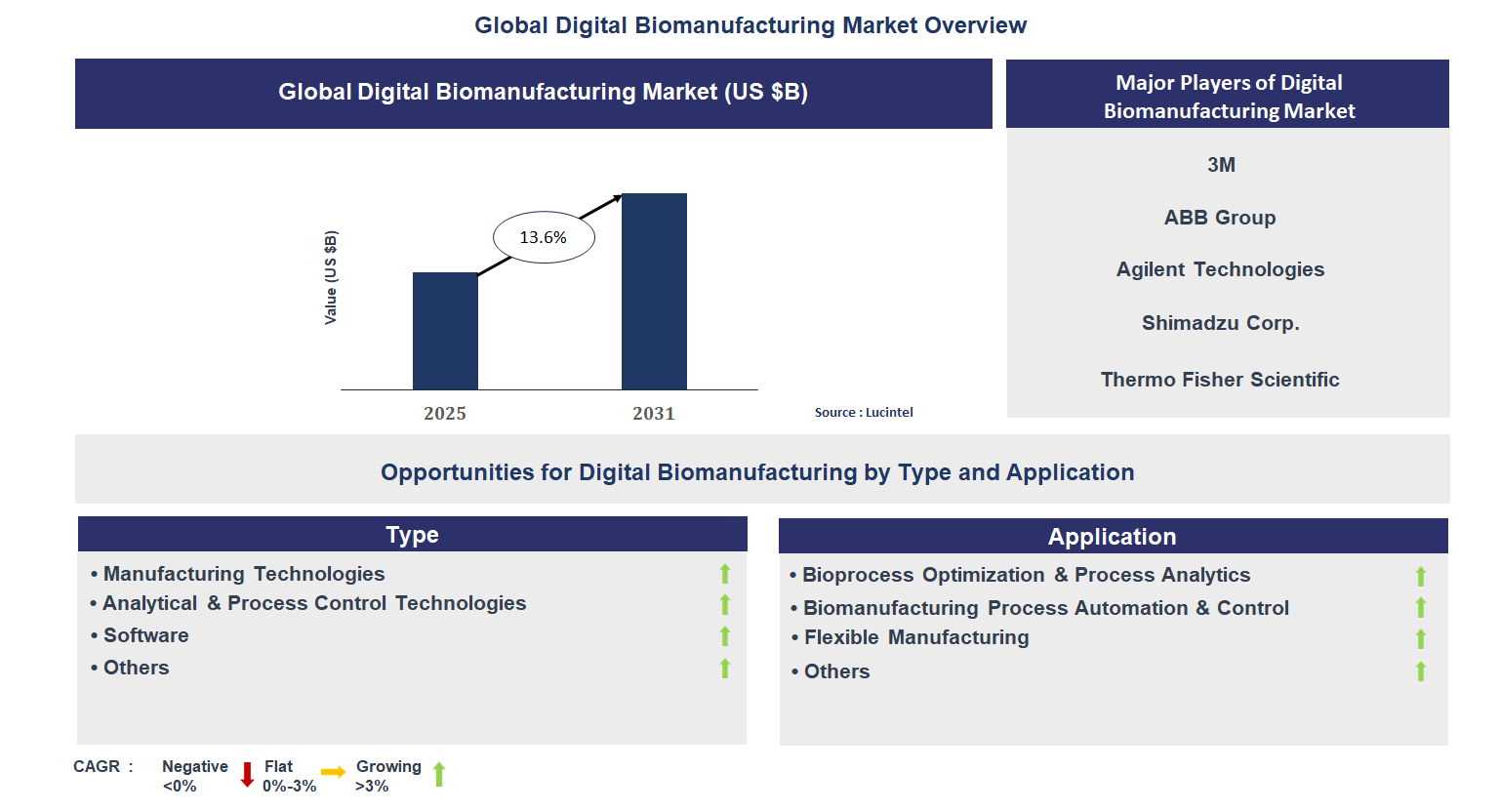
The future of the global digital biomanufacturing market looks promising with opportunities in the bioprocess optimization & process analytics, biomanufacturing process automation & control, and flexible manufacturing markets. The global digital biomanufacturing market is expected to grow with a CAGR of 13.6% from 2025 to 2031. The major drivers for this market are the increasing demand for efficient biomanufacturing processes, the rising adoption of automation in production, and the growing focus on cost-effective manufacturing solutions.• Lucintel forecasts that, within the type category, manufacturing technology is expected to witness higher growth over the forecast period.
• Within the application category, bioprocess optimization & process analytics is expected to witness the highest growth.
• In terms of region, APAC is expected to witness the highest growth over the forecast period. Gain valuable insights for your business decisions with our comprehensive 150+ page report. Sample figures with some insights are shown below.
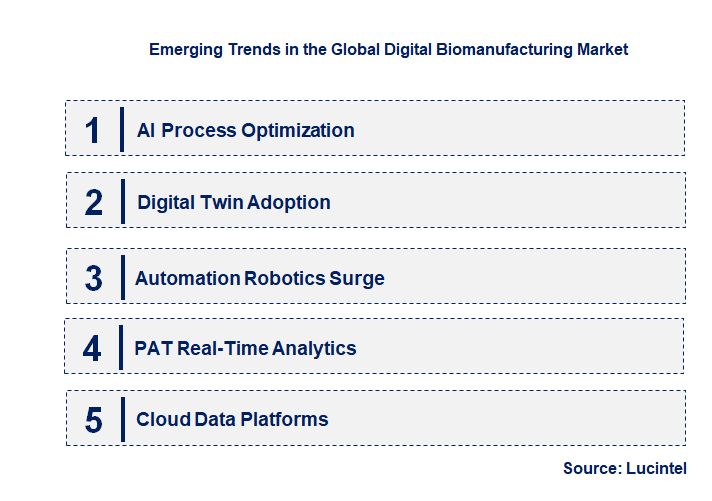
Emerging Trends in the Digital Biomanufacturing Market
Emerging trends in digital biomanufacturing market leverage AI, IoT, and cloud computing to enable predictive, autonomous operations. These innovations address scalability hurdles in biologics and therapies, fostering resilient ecosystems.• AI Process Optimization: Machine learning predicts yields and anomalies in real-time via vast datasets. Impacts slash failures, accelerate scale-ups, and personalize cell therapies for superior outcomes.
• Digital Twin Adoption: Virtual replicas simulate entire bioprocesses for scenario testing. Revolutionizes R&D, cuts physical trials, and ensures robust manufacturing for vaccines and gene therapies.
• Automation Robotics Surge: Robotic systems handle aliquoting and monitoring seamlessly. Boosts throughput, minimizes contamination, and supports continuous operations in high-volume biologics.
• PAT Real-Time Analytics: Inline sensors enable dynamic controls and quality predictions. Enhances compliance, reduces batch losses, and streamlines regulatory approvals dynamically.
• Cloud Data Platforms: Scalable infrastructures unify siloed data for global insights. Empowers collaborations, predictive maintenance, and agile responses to market shifts. These trends propel biomanufacturing toward autonomous, data-driven paradigms. Industry shifts from reactive to predictive models.
Recent Development in the Digital Biomanufacturing Market
Pivotal developments in digital biomanufacturing market underscore AI factories, policy launches, and partnerships fortifying digital infrastructures for next-gen biologics.• Lilly AI Superfactory: World‘s largest pharma AI platform integrates genomics and twins for discovery. Catalyzes precision therapies, accelerates timelines, and redefines computational biopharma.
• China Five-Year Plan: Mandates breakthroughs in AI-biomanufacturing fusion nationwide. Ignites investments, scales production, and cements global leadership in biologics.
• India BioE3 Hubs: Network deploys AI-omics for multi-sector innovation. Bridges gaps, spurs startups, and democratizes advanced manufacturing.
• Tsingke AI Showcase: Solutions debut at biologics festivals globally. Validates predictive platforms, attracts partnerships, and pioneers smart factories.
• Merck-Siemens Alliance: Digital workflows unify discovery to manufacturing seamlessly. Streamlines operations, boosts resilience, and elevates quality standards. These milestones ignite scalable innovations. Embed intelligence into core processes. Propel biomanufacturing toward Industry 5.0 dominance.
Strategic Growth Opportunities in the Digital Biomanufacturing Market
The digital biomanufacturing market growth targets high-value applications, deploying smart tech for biologics and beyond.• Cell Gene Therapies: Twins optimize scale-up and personalization dynamically. Accelerates approvals, cuts costs, and unlocks curative potentials.
• mRNA Vaccine Platforms: AI monitors ensure rapid adaptations to variants. Fortifies pandemics responses, sustains supplies globally.
• Biologics Continuous Production: Automation enables non-stop manufacturing efficiently. Boosts yields, minimizes waste, and meets surging demands.
• Personalized Medicine: Data platforms tailor therapies via patient insights. Revolutionizes oncology, enhances outcomes, and captures premiums.
• Sustainable Bio-Products: Predictive analytics optimize eco-friendly processes. Reduces footprints, aligns regulations, and taps green markets. Application expansions diversify revenues. Amplify efficiencies across therapeutics. Position digital as biopharma powerhouse globally.
Digital Biomanufacturing Market Driver and Challenges
Major drivers and challenges in digital biomanufacturing market encompass AI surges, biologics demands, policy supports, automation leaps alongside data silos, talent voids, integration hurdles. The factors responsible for driving the digital biomanufacturing market include: 1. Biologics Demand Explosion: Surging therapies require scalable smart factories urgently. Ignites investments, adoptions, and efficiency quests. 2. AI Digital Twins: Virtual simulations slash R&D timelines dramatically. Enables predictions, optimizations, and risk-free iterations. 3. Regulatory Quality Push: Agencies endorse PAT for real-time compliance. Builds trusts, fast-tracks approvals, and standardizes excellence. 4. Automation Cost Savings: Robotics minimize errors and labor dynamically. Democratizes access, scales outputs, and sustains margins. 5. Sustainability Imperatives: Green digital tools align with eco-policies. Cuts emissions, attracts funding, and future-proofs operations. Challenges in the digital biomanufacturing market are: 1. Data Silo Barriers: Fragmented systems hinder unified analytics. Demands integrations, clouds, and standards urgently. 2. Talent Expertise Gaps: Specialized skills lag tech pace critically. Slows implementations, necessitates upskilling globally. 3. Cybersecurity Vulnerabilities: Connected factories invite threats relentlessly. Risks disruptions, mandates robust defenses proactively. Drivers decisively outpace challenges. Fuel transformative, resilient evolutions. Digital biomanufacturing ascends as biologics engine.List of Digital Biomanufacturing Companies
Companies in the market compete on the basis of product quality offered. Major players in this market focus on expanding their manufacturing facilities, R&D investments, infrastructural development, and leverage integration opportunities across the value chain. With these strategies digital biomanufacturing companies cater increasing demand, ensure competitive effectiveness, develop innovative products & technologies, reduce production costs, and expand their customer base. Some of the digital biomanufacturing companies profiled in this report include-• 3M
• ABB Group
• Agilent Technologies
• Shimadzu Corp.
• Thermo Fisher Scientific
• Waters Corp.
• AB Sciex
• Sartorius Stedium Biotech
• Alertenterprise
• GE Healthcare
Digital Biomanufacturing Market by Segment
The study includes a forecast for the global digital biomanufacturing market by type, application, and region.Digital Biomanufacturing Market by Type [Value from 2019 to 2031]:
• Manufacturing Technologies
• Analytical & Process Control Technologies
• Software
• Others
Digital Biomanufacturing Market by Application [Value from 2019 to 2031]:
• Bioprocess Optimization & Process Analytics
• Biomanufacturing Process Automation & Control
• Flexible Manufacturing
• Others
Digital Biomanufacturing Market by Region [Value from 2019 to 2031]:
• North America
• Europe
• Asia Pacific
• The Rest of the World
Country Wise Outlook for the Digital Biomanufacturing Market
The digital biomanufacturing market thrives on AI-driven process controls, digital twins, and automation revolutionizing biologics production. Investments in smart factories and policy initiatives accelerate scalability, quality assurance, and sustainability across vaccine, cell therapy, and personalized medicine sectors in leading nations.• United States: United States spearheads via federal biomanufacturing initiatives and Lilly‘s massive AI supercomputing factory optimizing drug discovery alongside Merck-Siemens digital partnerships. Expansive ecosystems integrate real-time analytics, slashing timelines for cell therapies and mRNA platforms nationwide.
• China: China surges through national five-year plans prioritizing biomanufacturing breakthroughs with Tsingke Biotech unveiling AI solutions at global forums. Vast expansions fuse synthetic biology and computing power, fortifying domestic vaccine and biologic supply chains for global leadership.
• Germany: Germany anchors Europe with precision engineering consortia advancing digital twins and PAT systems. Facility upgrades by leaders like Eurofins streamline workflows, enhancing regulatory compliance and efficiency in advanced therapy manufacturing.
• India: India propels via BioE3 policy launching biomanufacturing hubs integrating AI and omics for health, agri sectors. Affordable expansions bridge innovation gaps, empowering scalable vaccine production and biotech corridors nationwide.
• Japan: Japan harnesses regenerative priorities with AI-native platforms and long-read integrations. Collaborations refine predictive modeling, aligning smart factories with chronic care demands for resilient biopharma infrastructures.

Features of the Global Digital Biomanufacturing Market
Market Size Estimates: Digital biomanufacturing market size estimation in terms of value ($B). Trend and Forecast Analysis: Market trends (2019 to 2024) and forecast (2025 to 2031) by various segments and regions. Segmentation Analysis: Digital biomanufacturing market size by type, application, and region in terms of value ($B). Regional Analysis: Digital biomanufacturing market breakdown by North America, Europe, Asia Pacific, and Rest of the World. Growth Opportunities: Analysis of growth opportunities in different types, applications, and regions for the digital biomanufacturing market. Strategic Analysis: This includes M&A, new product development, and competitive landscape of the digital biomanufacturing market. Analysis of competitive intensity of the industry based on Porter’s Five Forces model.
FAQ
Q1. What is the growth forecast for digital biomanufacturing market? Answer: The global digital biomanufacturing market is expected to grow with a CAGR of 13.6% from 2025 to 2031. Q2. What are the major drivers influencing the growth of the digital biomanufacturing market? Answer: The major drivers for this market are the increasing demand for efficient biomanufacturing processes, the rising adoption of automation in production, and the growing focus on cost-effective manufacturing solutions. Q3. What are the major segments for digital biomanufacturing market? Answer: The future of the digital biomanufacturing market looks promising with opportunities in the bioprocess optimization & process analytics, biomanufacturing process automation & control, and flexible manufacturing markets. Q4. Who are the key digital biomanufacturing market companies? Answer: Some of the key digital biomanufacturing companies are as follows:• 3M
• ABB Group
• Agilent Technologies
• Shimadzu Corp.
• Thermo Fisher Scientific
• Waters Corp.
• AB Sciex
• Sartorius Stedium Biotech
• Alertenterprise
• GE Healthcare Q5. Which digital biomanufacturing market segment will be the largest in future? Answer: Lucintel forecasts that, within the type category, manufacturing technology is expected to witness higher growth over the forecast period. Q6. In digital biomanufacturing market, which region is expected to be the largest in next 5 years? Answer: In terms of region, APAC is expected to witness the highest growth over the forecast period. Q7. Do we receive customization in this report? Answer: Yes, Lucintel provides 10% customization without any additional cost.
Table of Contents
List of Figures
List of Tables
Methodology
- In-depth interviews of the major players in this market
- Detailed secondary research from competitors’ financial statements and published data
- Extensive searches of published works, market, and database information pertaining to industry news, company press releases, and customer intentions
- A compilation of the experiences, judgments, and insights of Lucintel’s professionals, who have analyzed and tracked this market over the years.


Buy Now
Choose a license that fits your team. Instant PDF delivery.
Prices exclude taxes. Instant delivery. Custom licensing available on request.
Key Questions
- • What are some of the most promising, high-growth opportunities for the digital biomanufacturing market by type (manufacturing technologies, analytical & process control technologies, software, and others), application (bioprocess optimization & process analytics, biomanufacturing process automation & control, flexible manufacturing, and others), and region (North America, Europe, Asia Pacific, and the Rest of the World)?
- • Which segments will grow at a faster pace and why?
- • Which region will grow at a faster pace and why?
- • What are the key factors affecting market dynamics? What are the key challenges and business risks in this market?
- • What are the business risks and competitive threats in this market?
- • What are the emerging trends in this market and the reasons behind them?
- • What are some of the changing demands of customers in the market?
- • What are the new developments in the market? Which companies are leading these developments?
- • Who are the major players in this market? What strategic initiatives are key players pursuing for business growth?
- • What are some of the competing products in this market and how big of a threat do they pose for loss of market share by material or product substitution?
- • What M&A activity has occurred in the last 5 years and what has its impact been on the industry? For any questions related to Digital Biomanufacturing Market, Digital Biomanufacturing Market Size, Digital Biomanufacturing Market Growth, Digital Biomanufacturing Market Analysis, Digital Biomanufacturing Market Report, Digital Biomanufacturing Market Share, Digital Biomanufacturing Market Trends, Digital Biomanufacturing Market Forecast, Digital Biomanufacturing Companies, write Lucintel analyst at email: helpdesk@lucintel.com. We will be glad to get back to you soon.


