
Market Report · May 18, 2026

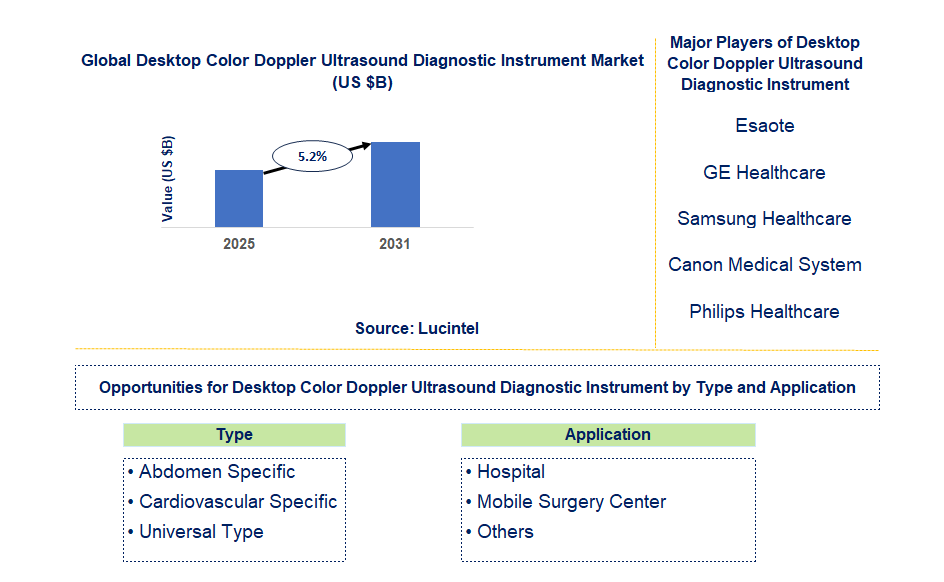
Key data points: The growth forecast = 5.2% annually for the next 7 years. Scroll below to get more insights. This market report covers Trends, opportunities and forecasts in desktop color doppler ultrasound diagnostic instrument market to 2031 by type (abdomen specific, cardiovascular specific, and universal type), application (hospital, mobile surgery center, and others), and region (North America, Europe, Asia Pacific, and the Rest of the World)
We'll send your sample report shortly.
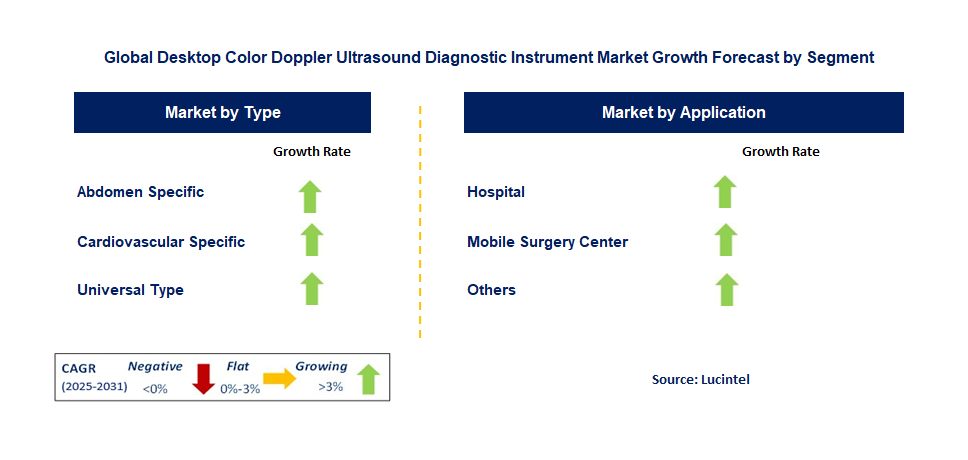
• Lucintel forecasts that, within the type category, cardiovascular specific is expected to witness the highest growth over the forecast period.
• Within the application category, hospital is expected to witness higher growth.
• In terms of region, APAC is expected to witness the highest growth over the forecast period.
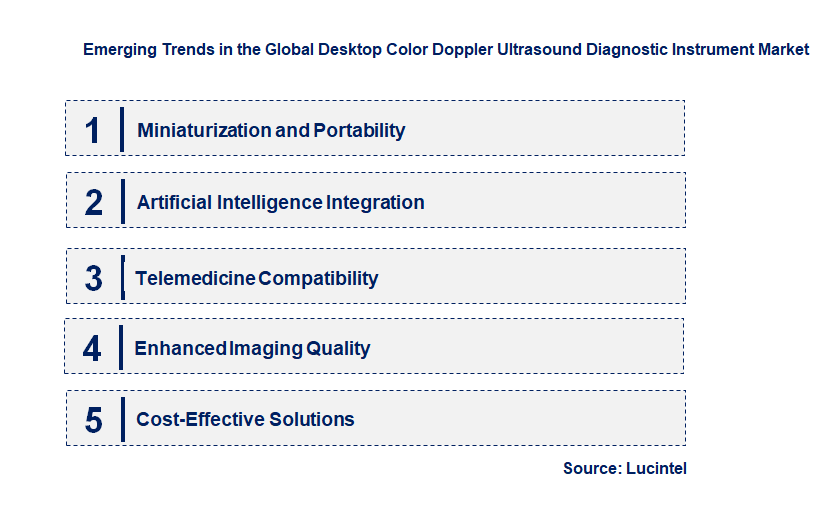
• Miniaturization and Portability: The trend towards smaller, portable ultrasound devices enables point-of-care diagnostics, allowing clinicians to perform imaging at the patient's bedside or in remote locations. This enhances accessibility and convenience in medical diagnostics.
• Artificial Intelligence Integration: Incorporating AI into ultrasound systems enhances image interpretation and diagnostic accuracy. AI-driven features assist clinicians in identifying anomalies more efficiently, reducing the likelihood of human error and improving patient outcomes.
• Telemedicine Compatibility: The integration of ultrasound devices with telemedicine platforms facilitates remote consultations and diagnostics. This trend has gained momentum, especially in response to the need for remote healthcare services, expanding access to quality medical care.
• Enhanced Imaging Quality: Advancements in transducer technology and imaging software have led to superior image resolution. Enhanced imaging quality allows for more precise diagnostics, aiding in the early detection and treatment of medical conditions.
• Cost-Effective Solutions: The development of affordable ultrasound systems addresses the demand in emerging markets and resource-limited settings. Cost-effective solutions ensure that essential diagnostic tools are accessible to a broader population, improving global healthcare equity. These emerging trends are collectively transforming the desktop color doppler ultrasound diagnostic instrument market by enhancing accessibility, diagnostic accuracy, and integration with modern healthcare practices. Stakeholders must adapt to these trends to remain competitive and meet the evolving needs of healthcare providers and patients.
• AI-Enhanced Imaging: The integration of artificial intelligence into ultrasound systems has improved image analysis, enabling faster and more accurate diagnostics. This development enhances clinical decision-making and patient outcomes.
• Wireless Connectivity: The adoption of wireless technology in ultrasound devices facilitates seamless data transfer and integration with hospital information systems. This connectivity streamlines workflows and enhances collaboration among healthcare professionals.
• Battery-Powered Devices: The development of battery-operated ultrasound systems provides greater mobility and flexibility in various clinical settings, including emergency and field applications. This enhances the versatility and responsiveness of medical imaging services.
• User-Friendly Interfaces: Advancements in touchscreen interfaces and intuitive controls have made ultrasound devices more accessible to clinicians, reducing the learning curve and improving usability. This development enhances the efficiency and effectiveness of diagnostic procedures.
• Eco-Friendly Designs: Manufacturers are focusing on environmentally sustainable designs, utilizing recyclable materials and energy-efficient components. These advancements underscore a trend towards more portable, efficient, and user-friendly ultrasound systems, aligning with the increasing demand for point-of-care diagnostics and improved patient outcomes.
• Radiology: Integrating Desktop Color Doppler Ultrasound instruments in radiology departments enhances diagnostic accuracy for vascular and soft tissue assessments. These devices enable real-time blood flow visualization, aiding in the early detection of conditions like deep vein thrombosis and arterial blockages. Their non-invasive nature and portability make them ideal for bedside evaluations, reducing patient wait times and improving workflow efficiency. As radiology continues to evolve with a focus on minimally invasive procedures, adopting advanced ultrasound technology presents a significant growth opportunity.
• Obstetrics and Gynecology: In obstetrics and gynecology, Desktop Color Doppler Ultrasound instruments are invaluable for monitoring fetal development and maternal health. They assist in assessing placental blood flow, detecting fetal anomalies, and evaluating uterine and ovarian conditions. The ability to provide real-time, high-resolution images ensures better prenatal care and early intervention when necessary. With the increasing emphasis on maternal-fetal medicine, investing in advanced ultrasound technology offers substantial growth potential in this application.
• Cardiology: Cardiology benefits from Desktop Color Doppler Ultrasound instruments through enhanced cardiac imaging and hemodynamic assessments. These devices facilitate the evaluation of heart valve functions, detection of congenital heart defects, and monitoring of myocardial perfusion. Their portability allows for bedside cardiac assessments, crucial in critical care settings. As cardiovascular diseases remain a leading health concern globally, integrating advanced ultrasound technology in cardiology practices represents a strategic growth avenue.
• Emergency Medicine: In emergency medicine, rapid and accurate diagnostics are vital. Desktop Color Doppler Ultrasound instruments provide immediate insights into conditions such as internal bleeding, organ lacerations, and vascular injuries. Their ease of use and quick setup make them indispensable tools in emergency departments, enabling prompt decision-making and improving patient outcomes. Expanding the use of these devices in emergency settings offers a significant growth opportunity, aligning with the need for swift and reliable diagnostics.
• Vascular Surgery: Vascular surgeons utilize Desktop Color Doppler Ultrasound instruments for preoperative planning and postoperative monitoring. These devices aid in mapping blood vessels, assessing aneurysms, and evaluating graft patency. Their real-time imaging capabilities ensure precise surgical interventions and effective follow-up care. As the prevalence of vascular diseases increases, incorporating advanced ultrasound technology in vascular surgery practices presents a strategic growth opportunity. Strategic growth in the desktop color doppler ultrasound diagnostic instrument market is closely tied to its application across various medical specialties. By focusing on integrating advanced ultrasound technology in radiology, obstetrics and gynecology, cardiology, emergency medicine, and vascular surgery, stakeholders can effectively meet evolving healthcare demands and drive market expansion.
• Esaote
• GE Healthcare
• Samsung Healthcare
• Canon Medical System
• Philips Healthcare
• Sonosite, Mindray
• Zoncare Electronics
• BK Ultrasound
• Alpinion Medical Systems
• Spectranetics
• Abdomen Specific
• Cardiovascular Specific
• Universal Type
• Hospital
• Mobile Surgery Center
• Others
• North America
• Europe
• Asia Pacific
• The Rest of the World
• United States: In the United States, the Doppler ultrasound market has been influenced by the rising prevalence of chronic diseases and an increasing geriatric population. Technological advancements, such as the integration of artificial intelligence (AI) into ultrasound systems, have improved diagnostic accuracy and efficiency. The market is moderately consolidated, with key players focusing on technological advancements to gain significant market shares.
• China: China's ultrasound market has witnessed rapid growth, driven by technological advancements and increasing healthcare affordability and accessibility. Domestic manufacturers have been focusing on developing cost-effective and portable ultrasound devices to cater to the rising demand for non-invasive diagnostic procedures. Government initiatives and healthcare reforms have further fueled the adoption of advanced diagnostic tools in both urban and rural healthcare facilities.
• Germany: Germany has been at the forefront of integrating high-resolution imaging and ergonomic designs into ultrasound systems. Emphasis on user-friendly interfaces and advanced imaging capabilities has improved diagnostic accuracy and clinician comfort. Collaborations between medical device manufacturers and research institutions have fostered innovation, resulting in state-of-the-art ultrasound technologies. The market is moderately consolidated, with key players focusing on technological advancements to gain significant market shares.
• India: In India, the demand for affordable and portable ultrasound devices has risen, particularly in rural areas. Innovations tailored to the local market, such as cost-effective desktop color Doppler systems, have improved access to diagnostic services. Government initiatives promoting healthcare infrastructure development have further supported the adoption of these technologies. The market is moderately consolidated, with key players focusing on technological advancements to gain significant market shares.
• Japan: Japan's market has been characterized by the development of compact and high-precision ultrasound devices. Japanese manufacturers have focused on miniaturization and enhancing image quality, catering to the needs of both large hospitals and smaller clinics. These advancements align with the country's commitment to technological excellence in medical equipment. The market is moderately consolidated, with key players focusing on technological advancements to gain significant market shares.


• Esaote
• GE Healthcare
• Samsung Healthcare
• Canon Medical System
• Philips Healthcare
• Sonosite, Mindray
• Zoncare Electronics
• BK Ultrasound
• Alpinion Medical Systems
• Spectranetics Q5. Which desktop color doppler ultrasound diagnostic instrument market segment will be the largest in future? Answer: Lucintel forecasts that, within the type category, cardiovascular specific is expected to witness the highest growth over the forecast period. Q6. In desktop color doppler ultrasound diagnostic instrument market, which region is expected to be the largest in next 5 years? Answer: In terms of region, APAC is expected to witness the highest growth over the forecast period. Q7. Do we receive customization in this report? Answer: Yes, Lucintel provides 10% customization without any additional cost.


Choose a license that fits your team. Instant PDF delivery.
Prices exclude taxes. Instant delivery. Custom licensing available on request.
Market Report · May 18, 2026
Market Report · May 18, 2026
Market Report · May 18, 2026
Trusted partner for strategic intelligence and business growth


Receive a complimentary market analysis tailored to your industry. Our analysts will identify key growth opportunities and competitive dynamics specific to your business.

Market size, growth rate, and key trend analysis for your specific sector.

Top competitor positioning and market share analysis.

Strategic recommendations backed by data-driven insights.
Get curated market intelligence and competitive moves straight to your inbox.
By subscribing, you agree to receive our monthly insights. Unsubscribe anytime.
Receive a complimentary market analysis tailored to your industry. Our analysts will identify key growth opportunities and competitive dynamics specific to your business.
Market size, growth rate, and key trend analysis for your specific sector.
Top competitor positioning and market share analysis.
Strategic recommendations backed by data-driven insights.
Get curated market intelligence, emerging trends, and competitive moves straight to your inbox each month.
By subscribing, you agree to receive our monthly insights. Unsubscribe anytime.
We'll send your sample report shortly.