
Market Report · July 22, 2026

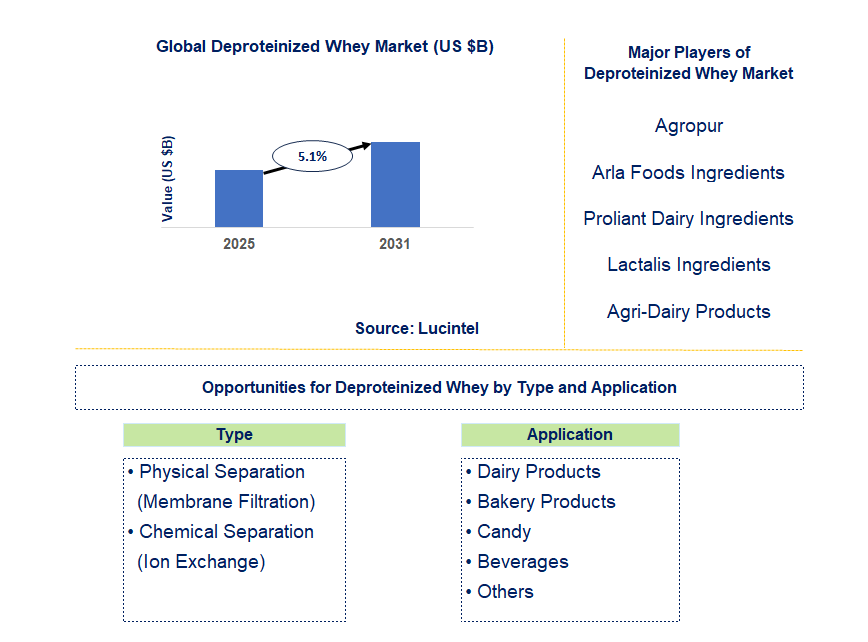
Key data points: The growth forecast = 5.1% annually for the next 7 years. Scroll below to get more insights. This market report covers trends, opportunities and forecasts in deproteinized whey market to 2031 by type (physical separation (membrane filtration) and chemical separation (ion exchange)), application (dairy products, bakery products, candy, beverages, and others), and region (North America, Europe, Asia Pacific, and the Rest of the World)
We'll send your sample report shortly.
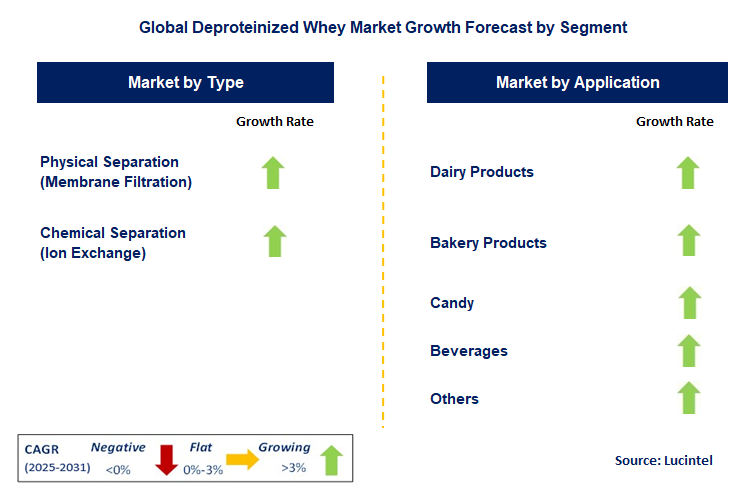
• Lucintel forecasts that, within the type category, physical separation (membrane filtration) is expected to witness higher growth over the forecast period.
• Within the application category, beverage is expected to witness the highest growth.
• In terms of region, APAC is expected to witness the highest growth over the forecast period. Gain valuable insights for your business decisions with our comprehensive 150+ page report. Sample figures with some insights are shown below.
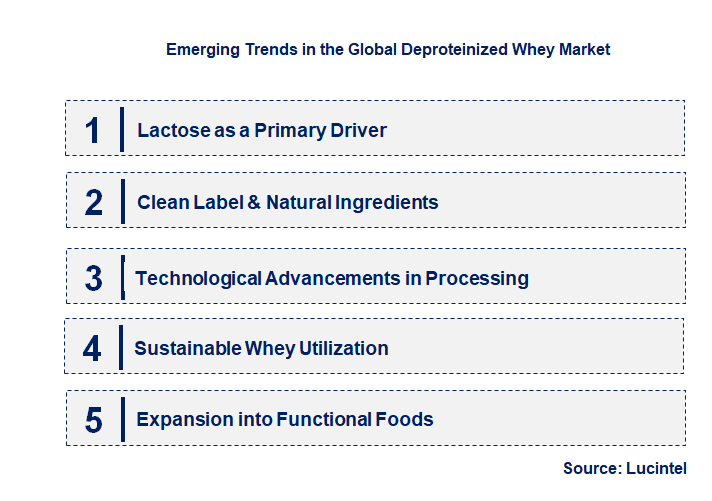
• Lactose as a Primary Driver: The increasing demand for lactose as a functional ingredient, particularly in infant formula and confectionery, is a major trend. Deproteinized whey serves as an excellent, cost-effective source of lactose, making it highly valuable for formulations requiring a high lactose content with minimal protein interference.
• Clean Label & Natural Ingredients: There is a strong market preference for clean-label products, driving the demand for deproteinized whey as a natural and transparent ingredient. Consumers are seeking food products with clear, recognizable ingredients, which positions deproteinized whey favorably due to its dairy origin and functional properties.
• Technological Advancements in Processing: Ongoing innovations in separation techniques, such as advanced membrane filtration and ion exchange, are significantly improving the efficiency and quality of deproteinized whey production. These technologies allow for better removal of proteins while preserving lactose, leading to higher purity and functionality.
• Sustainable Whey Utilization: The dairy industry is increasingly focused on sustainable practices, viewing deproteinized whey not as waste but as a valuable co-product. This trend involves converting whey into value-added commodities like biofuels or bioplastics, enhancing profitability and reducing environmental impact within the dairy processing chain.
• Expansion into Functional Foods: Deproteinized whey is gaining traction in the functional food and beverage sector beyond traditional applications. Its unique profile makes it suitable for enhancing texture, consistency, and nutritional value in products like low-protein bakery items and beverages, catering to specific dietary needs and health trends. These trends are profoundly reshaping the deproteinized whey market by fostering innovation in processing, expanding its application scope, and aligning production with sustainability goals. The market is increasingly driven by the versatile functionality of deproteinized whey as a cost-effective, natural, and highly adaptable ingredient for diverse food applications.
• Advanced Separation Technologies: Recent advancements in membrane filtration and ion exchange techniques have significantly improved the efficiency and purity of deproteinized whey production. These technologies allow for more precise protein removal while retaining desirable lactose content, leading to higher-quality and more versatile ingredients for food manufacturers.
• Increased Use in Infant Formulas: A key development is the growing incorporation of deproteinized whey in infant formula formulations. Its low protein yet high lactose content makes it an ideal ingredient for mimicking breast milk's carbohydrate profile and addressing specific dietary needs for infants with protein sensitivities, ensuring nutritional adequacy.
• Focus on Flavor and Texture Enhancement: Manufacturers are increasingly utilizing deproteinized whey to improve the sensory profiles of food products. Its neutral taste and functional properties contribute to enhancing the texture and consistency of bakery items, confections, and beverages, making products more appealing to consumers.
• Sustainable Valorization of Whey: The industry is witnessing a trend towards the sustainable valorization of whey, where deproteinized whey is seen as a valuable co-product rather than a waste. Developments include exploring its use in biotechnological applications beyond food, reducing environmental impact and maximizing resource utilization.
• Emergence of Novel Applications: Beyond traditional uses, deproteinized whey is finding new applications in areas like nutraceuticals and specialized dietary products. This expansion is driven by its functional attributes and cost-effectiveness, enabling the creation of new product lines that cater to evolving health and wellness trends. These developments are significantly impacting the deproteinized whey market by enhancing product quality, expanding its application versatility, and aligning production with sustainability principles. The market is evolving to meet the complex demands of the food and beverage industry, solidifying deproteinized whey's role as a crucial functional ingredient.
• Infant Formula Segment: This is a major growth driver, as deproteinized whey provides a crucial lactose source and can contribute to formulations that closely resemble human milk, while keeping protein levels suitable for infant digestion. Opportunities lie in developing high-purity deproteinized whey specifically for premium infant nutrition products.
• Confectionery & Bakery Industries: Deproteinized whey's high lactose content makes it an excellent ingredient for confectionery (e.g., chocolates, caramels) and bakery products. It enhances browning, texture, and flavor, and acts as a cost-effective bulking agent. Strategic growth involves promoting its functional benefits for improved product quality.
• Dairy Products: Opportunities exist in fortifying various dairy products, such as yogurt, ice cream, and specialty cheeses, with deproteinized whey to boost lactose content or improve texture. This caters to consumers seeking dairy products with specific nutritional profiles or enhanced sensory attributes.
• Beverage Industry: Deproteinized whey can be used in beverages as a natural sweetener or a functional ingredient in sports drinks and nutritional beverages. Its mild taste and solubility offer advantages for formulations where low protein and high carbohydrate content are desired, expanding its use beyond traditional dairy drinks.
• Animal Feed & Pet Food: As a cost-effective source of dairy solids and lactose, deproteinized whey finds significant application in animal feed, particularly for young animals. Strategic growth involves highlighting its nutritional benefits for livestock and pet health, promoting efficient growth and development. These opportunities are significantly impacting the deproteinized whey market by driving specialized product development and fostering its adoption across high-growth food and beverage sectors. The focus on leveraging its unique functional properties for various applications is ensuring sustained demand and market expansion.
• Agropur
• Arla Foods Ingredients
• Proliant Dairy Ingredients
• Lactalis Ingredients
• Agri-Dairy Products
• Arion Dairy Products
• Fayrefield Foods
• Physical Separation (Membrane Filtration)
• Chemical Separation (Ion Exchange)
• Dairy Products
• Bakery Products
• Candy
• Beverages
• Others
• North America
• Europe
• Asia Pacific
• The Rest of the World
• United States: The U.S. market shows increased adoption of deproteinized whey in functional foods and dietary supplements, driven by a strong consumer focus on clean label and high-protein products. Technological advancements in membrane filtration are improving production efficiency and quality, positioning deproteinized whey as a sought-after ingredient in a health-conscious market.
• China: China deproteinized whey market is expanding due to increasing demand for functional and low-protein food ingredients, especially in infant formulas. Deproteinized whey offers a suitable alternative for infants with protein restrictions, providing necessary lactose. Its use also enhances shelf life and taste in snacks and ready-to-eat meals.
• Germany: Germany is witnessing growing demand for whey protein overall, with a focus on product innovation using micro articulation technology to enhance delivery and stability. While deproteinized whey is less protein-rich, the broader whey market trends indicate a push for high-quality dairy ingredients, influencing processing advancements that can also benefit deproteinized whey production.
• India: India deproteinized whey market is experiencing growth alongside its burgeoning whey protein market, driven by heightened health awareness and rising demand for protein supplements. Deproteinized whey's value as a cost-effective and versatile ingredient, particularly for infant formulas and functional foods, is gaining traction amidst increasing R&D spending and domestic manufacturing.
• Japan: The Japanese market for whey protein, including its derivatives like deproteinized whey, is influenced by growing consumer attention towards functional benefits and convenience foods. Manufacturers are incorporating whey protein ingredients into ready-to-eat products and beverages, reflecting the demand for nutritious and convenient options, despite a fragmented market with several players.


• Agropur
• Arla Foods Ingredients
• Proliant Dairy Ingredients
• Lactalis Ingredients
• Agri-Dairy Products
• Arion Dairy Products
• Fayrefield Foods Q5. Which deproteinized whey market segment will be the largest in future? Answer: Lucintel forecasts that, within the type category, physical separation (membrane filtration) is expected to witness higher growth over the forecast period. Q6. In deproteinized whey market, which region is expected to be the largest in next 5 years? Answer: In terms of region, APAC is expected to witness the highest growth over the forecast period. Q7. Do we receive customization in this report? Answer: Yes, Lucintel provides 10% customization without any additional cost.


Choose a license that fits your team. Instant PDF delivery.
Prices exclude taxes. Instant delivery. Custom licensing available on request.
Market Report · July 22, 2026
Market Report · July 22, 2026
Market Report · July 22, 2026
Trusted partner for strategic intelligence and business growth


Receive a complimentary market analysis tailored to your industry. Our analysts will identify key growth opportunities and competitive dynamics specific to your business.

Market size, growth rate, and key trend analysis for your specific sector.

Top competitor positioning and market share analysis.

Strategic recommendations backed by data-driven insights.
Get curated market intelligence and competitive moves straight to your inbox.
By subscribing, you agree to receive our monthly insights. Unsubscribe anytime.
Receive a complimentary market analysis tailored to your industry. Our analysts will identify key growth opportunities and competitive dynamics specific to your business.
Market size, growth rate, and key trend analysis for your specific sector.
Top competitor positioning and market share analysis.
Strategic recommendations backed by data-driven insights.
Get curated market intelligence, emerging trends, and competitive moves straight to your inbox each month.
By subscribing, you agree to receive our monthly insights. Unsubscribe anytime.
We'll send your sample report shortly.